A mighty transatlantic battle is in prospect over how to regulate artificial intelligence (AI). Donald Trump’s second administration seems sure to opt for the lightest of light touches, influenced by tech tycoon Elon Musk. (If Musk can tear himself away from his bizarre obsession with Britain.) The European Union has already legislated for a far more restrictive approach, with Britain likely to follow a middle way. The sensible aim must be to unleash the creative, social and economic benefits of AI while minimising the harm it may cause if abused or badly handled.
As debate raged about AI regulation, it struck me that many of the arguments deployed for and against AI and tech regulation also played a huge role in shaping the response to the railway revolution in the 19th century.
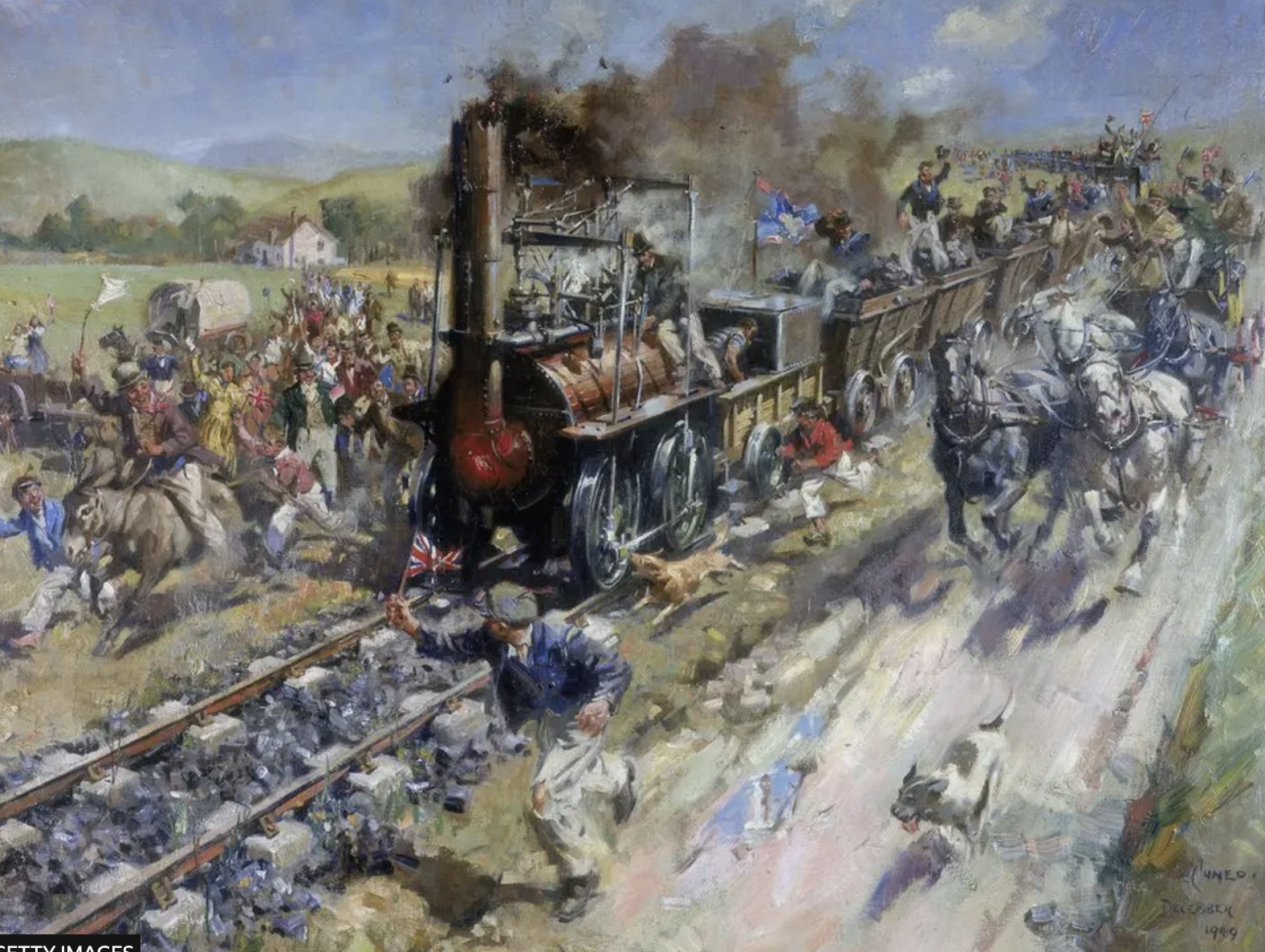
The opening of the Stockton & Darlington in 1825. Painting by Terence Cuneo; NRM/Science & Society Picture Library
The railway age properly began in September 1825 with the opening of the world’s first public railway to use steam locomotives, the Stockton & Darlington Railway in County Durham in the north of England. After the success of the first intercity railway between Liverpool and Manchester, opened in 1830, Britain enjoyed a railway boom, as pioneers planned lines linking major cities – and serving industry, the original purpose of the iron road. By the early 1840s, railway mania had taken over, in a prelude to the dot.com boom at the turn of the 21st century. In 1844, 240 private bills were presented to the British parliament to authorise 2,820 miles of railway. Had all these been built, the £100 million of capital needed represented over one and a half times Britain’s gross domestic product (GDP) for that year. Parliament still approved half these railways.
Anything goes? The heyday of the laissez-fair state
Britain in the 1840s was a firmly non-interventionist state. The dominant philosophy was laissez-faire: small government, low taxes and the free market. Most acts of parliament were private acts to authorise new railways rather than government initiatives. Anyone able to raise money could form a railway company and apply to parliament for permission to build their pet route. The sheer volume of railway business threatened to overwhelm the Westminster legislature. But an attempt to create order by setting up a railway advisory board to vet proposed plans before they reached parliament was short lived, killed by the powerful railway lobby. (And conflicts of interest: 157 out of 658 MPs had financial interests in the railways.) This was Britain’s last chance to create a strategic rail network, deploying investors’ money more efficiently. The failure led to many investors losing most if not all their money on rail schemes that had no hope of success, again pre-empting the dot.com bubble of 1999-2000.
If you’ve arrived at London’s Kings Cross station in the rush hour only to endure a packed tube train to reach the heart of London, you may wonder why the station wasn’t built nearer your destination. Kings Cross isn’t alone; Marylebone, Euston and St Pancras are similarly stranded north of the Marylebone and Euston roads, which were created as the New Road in the 18th century.
Jonn Elledge entertainingly explains on his Substack (The Newsletter of (Not Quite) Everything) how the New Road was built as a by-pass for cows. Jonn adds his explanation for the inconvenient siting of these great termini:
[Railway] Companies serving destinations to the east and south of London drove their new lines right into the urban area, with scant regard for the poor residents they dispossessed; those coming from the west and north, by contrast, tended to respect the capital’s existing geography. That is why, to this day, Kings Cross (1852), St Pancras (1868) and Euston (1837) stations line up along the road, with Marylebone (1907) [actually 1899] a mile or two distant: they were effectively plugging into the existing transport network, made up of a massive road with canal access.
This is only part of the story. Today’s travellers are inconvenienced as a result of a Royal Commission set up by prime minister Sir Robert Peel in 1846:
Amazingly, the Royal Commission on metropolitan railway termini reported just three months later. It recommended that railway lines entering London should not be allowed to enter the West End. The commissioners accepted that more central stations would lead to the destruction of countless homes and other buildings. In 1846, the New Road was on the very edge of London, which is why the Royal Commission took it as the furthest a railway line from the west or north should pass into London.
New year is the time I look back on the cycling year just passed, and anticipate adventures to come. This time last year, I shared my plans for 2024 with a hint of hesitation. Telling the world that I planned to cycle from London to Wales and back in a day seemed tempting fate. But that London Wales London challenge proved a happy one as I blogged in May. It remains to be seen how I cope with the far bigger ambition to complete London Edinburgh London this August.
2024: the year I became an endurance cyclist
Crossing the Severn Bridge, London Wales London 2024
At the start of 2024, I’d never cycled more than 103 miles in a day. Could I make the jump to riding over 250 miles in one go? I knew that this would be as much a mental challenge as a physical one. So I tested myself on a 157 mile shortened version of the London Wales London route, which I tackled three weeks before the real thing. My heart sank as I suffered a puncture after 49 miles, but the tubeless sealant plugged the hole, and I made it to the end. I was also tested by a pitiless headwind for much of the first 60 miles, which meant I had to pedal downhill as well as up. These hurdles tested my resilience but I came through with the confidence to tackle London Wales London.
The opening page of my Arrivée article on LWL
I’ve already written a comprehensive account of my debut London Wales London in Audax UK’s Arrivée magazine and on this blog, so I won’t repeat myself here. I’ll just say that I found it an almost spiritual experience, especially seeing a new day dawning as I pedalled across the unspoilt Berkshire countryside. I was also delighted to reach the final feedstop at Lambourn after 196 miles in buoyant shape and spirits. My LWL success isn’t proof that I will be able to complete London Edinburgh London (or indeed the 600km Bryan Chapman Memorial ride in June) but it suggests that I am not crazy to attempt them.
Cycling across Ireland
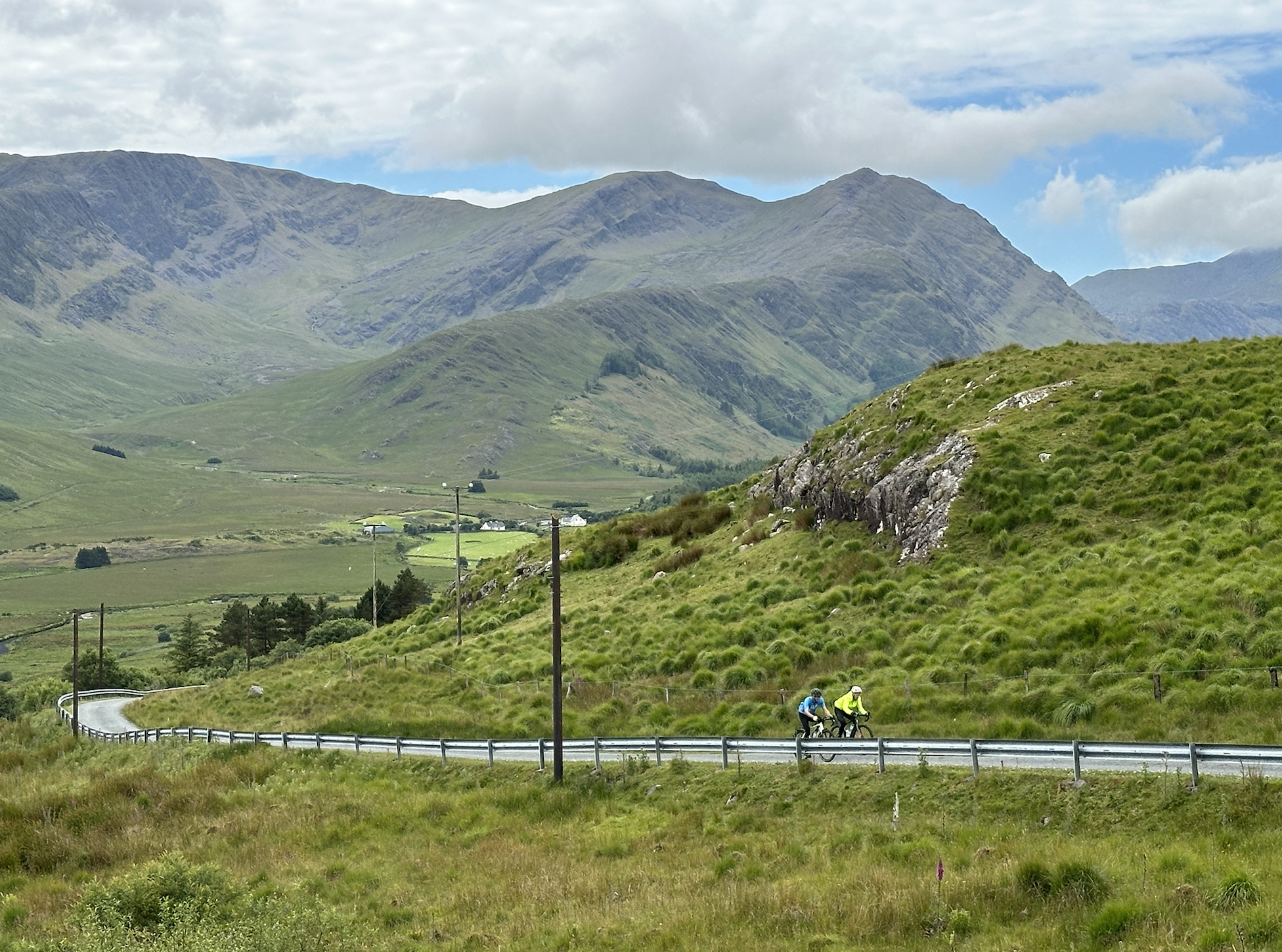
Climbing the Sheeffry pass, Co Mayo, Ireland
It was a joy to return to Ireland in June, for my third ‘end to end’ ride, from Mizen Head in Co Cork to Malin Head in Co Donegal with the excellent Peak Tours. It was no surprise that the weather wasn’t as benign as in Portugal in 2023, but we did have a surprising number of bright days. I’ve written a detailed day-by-day account starting here.
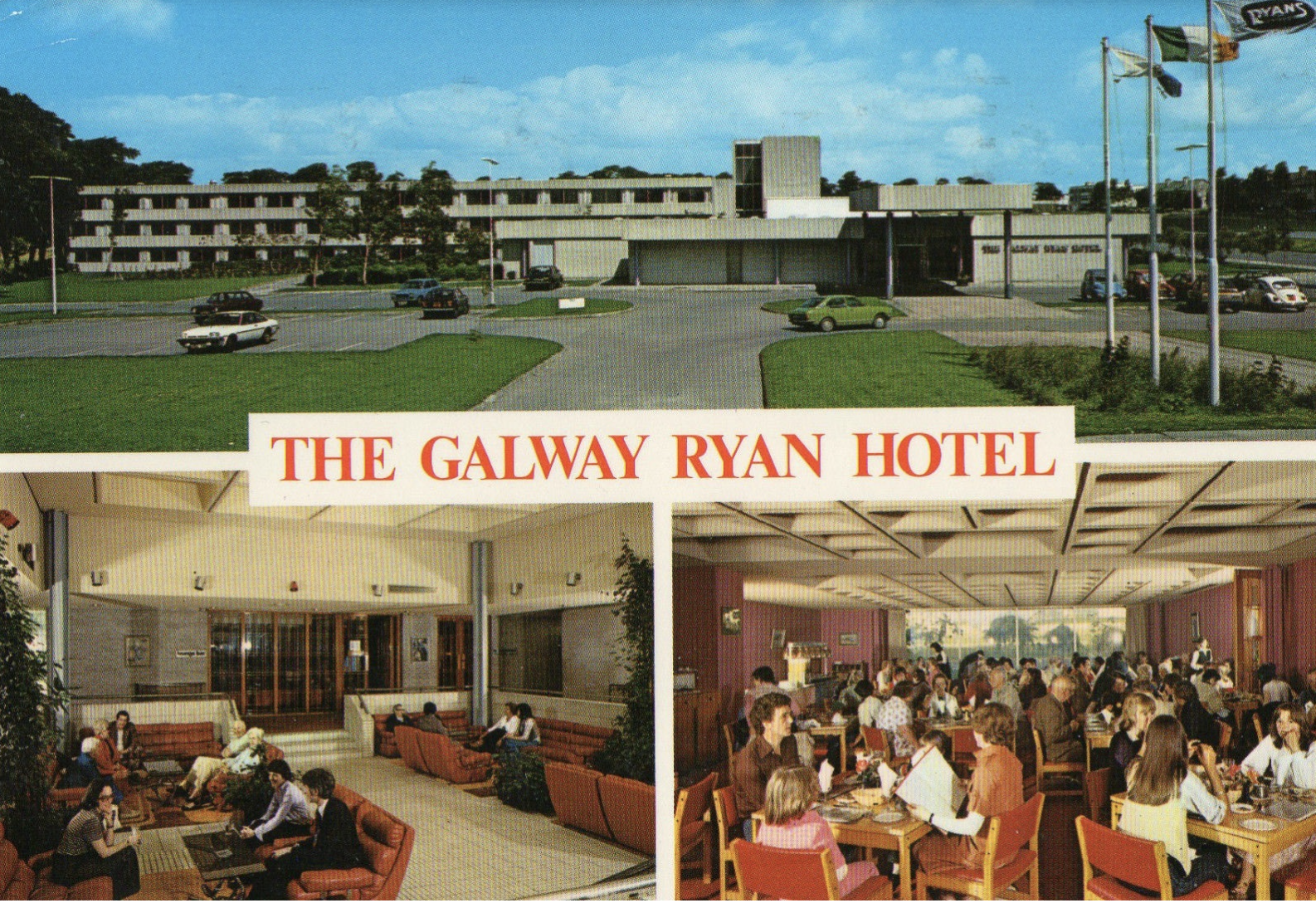
In my 2024 new year post previewing the trip, I looked forward to returning to the seaside town of Lahinch 50 years after my visit aged 10 with Mum and Dad. We didn’t stay there in 2024 as it turned out, but I stopped briefly and found it rather a sad place and not at all how I remembered it. But in an amazing coincidence we did stay in the same Galway hotel that Mum, Dad and I visited in 1974. The old Ryan Hotel was renamed the Connacht in 2013.
Conquering the Rapha Festive 500
My 2024 cycling year ended on a high as I completed the Rapha Festive 500 for the first – and most likely only – time. As one of my readers, Tempocyclist said, it’s a lot nicer cycling 500 festive kilometres in the southern hemisphere than in a British winter.
You can read my tips on tackling the Festive 500 here. I was delighted and relieved to finish the last ride. I have to be honest that it wasn’t my favourite cycling experience of the year, but it did mean I finished 2024 more healthily than if I’d stayed on the sofa, which gives me a head start in my training for 2025’s cycling challenges.
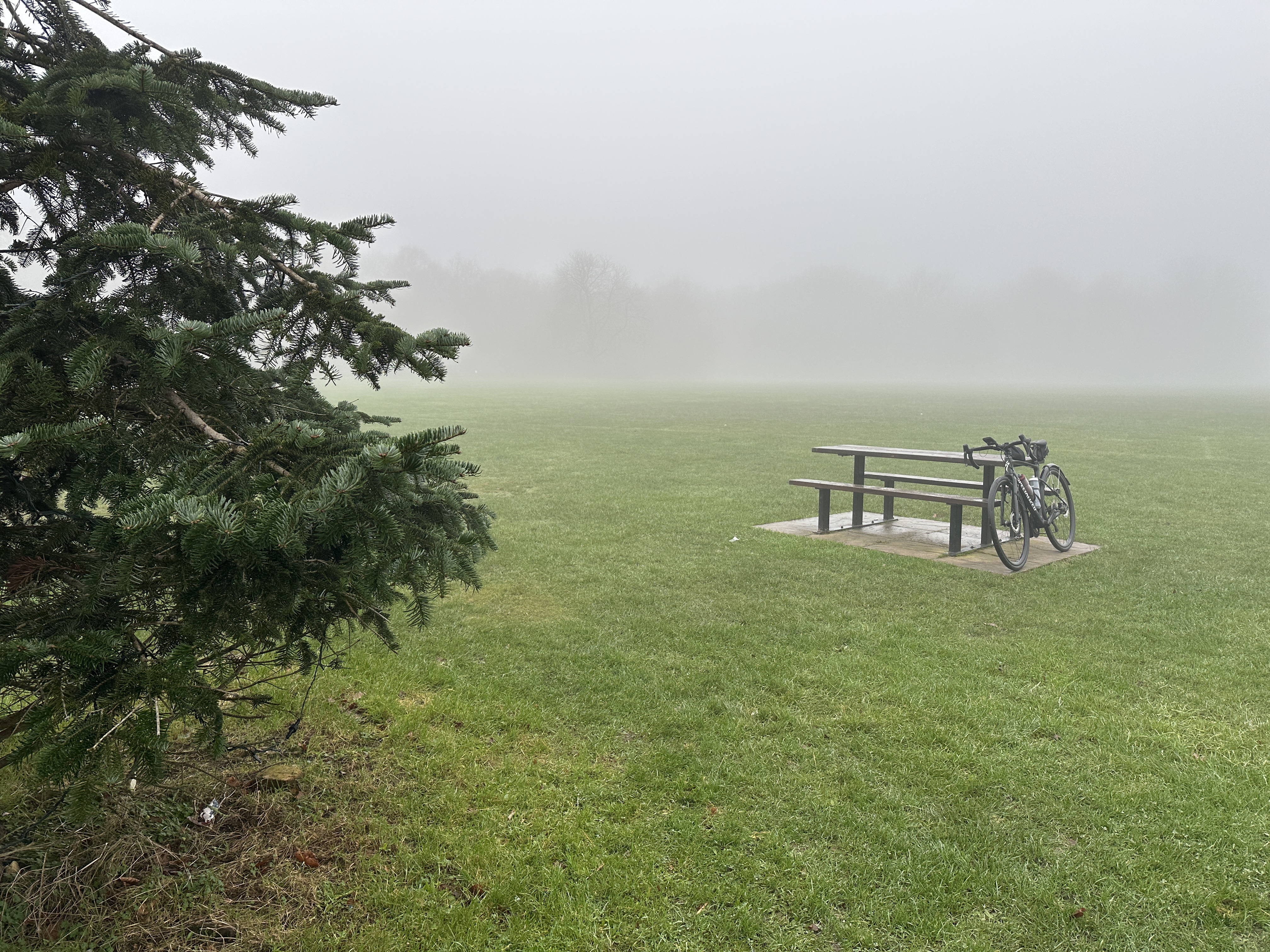
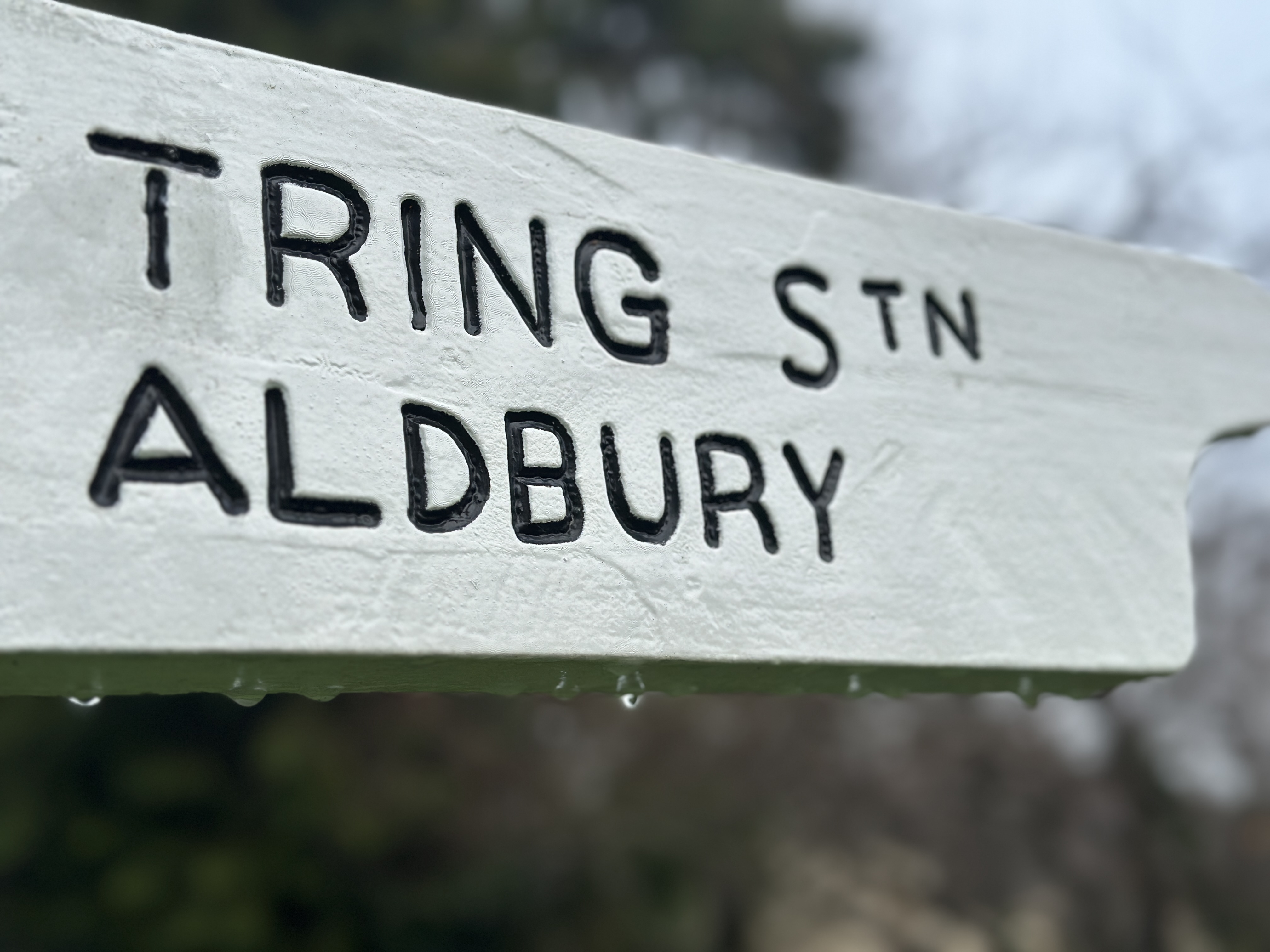
This was the moment when I cursed my decision to enter the Rapha Festive 500 challenge. I’d been cycling for over an hour, and the mist was seeping through every pore. I saw a sign for my village and mourned the fact I had another thirty miles to cycle, rather than a sofa in a warm house, to look forward to. The week’s rain-free weather forecast had led me astray – I was getting wetter and colder than I had ever imagined. I finished the Boxing Day ride – the third day of the Festive 500 – wondering if I’d finish the challenge. Yet four days later I passed the 500 kilometre finish line with a day to spare.
In this blogpost, I’ll share the lessons I learned – what went right, and more importantly how to avoid the mistakes I made. For anyone who isn’t aware, British cycle clothing company Rapha launched the Festive 500 in 2010. Participants have to cycle 500 kilometres (310 miles) in the eight days from Christmas Eve to New Year’s Eve. You can ride on roads, trails, on indoor turbo trainers and even an e-bike.
Here are my tips based on my experience in 2024.
Ask yourself: is it for me?
Cycling 500 kilometres in eight days is an achievement for most people. Yet it’s even harder over the festive period. Most people taking on the challenge will have other commitments – hosting family or friends, travelling for some of the holidays, social events and work. Can you fit in cycling 500km with these commitments? If you’re likely to have several days when you can’t cycle, will you be able to make up the miles in the remaining time? Will your family understand and support you, or will they resent not having you around ? No sensible person will judge you if you don’t make it, but it’s best to set off aware of the complications that might be the difference between success and not making it.
Weather or not…
Day 6: first sight of the sun…
It’s ironic that the Festive 500 was created by a company in Britain – a country not renowned for its fine weather, especially over the Christmas and New Year period, (The Scottish capital Edinburgh has just cancelled its Hogmanay new year celebrations because of forecast winter storms.) I decided to take part in the Festive 500 this year after seeing the benign weather forecast, but as the opening of this post suggests, it wasn’t as benign as I expected… After days of mist, it was a joy to see the sun breaking through on day 6, half way through my longest (50 mile/80km) ride of the challenge.
If your forecast suggests days of gales and rain, you can always ride indoors, or decide to wait until next year… I’d find riding 500km indoors soul-destroying, but I did ride indoors to top up shorter than expected outdoor rides.
Get organised
Set up your routes before the big day
I was full of good intentions on the first day. I’d planned to set off during the morning of Christmas Eve, but wasted over an hour trying to get my route onto my Garmin. As a result, I had less daylight time to complete the ride I planned, and as a result was behind schedule on the very first day. Lesson learned: get everything ready the day before, so you’re on the road on time.
Keep warm: layering matters
Warm and visible: Christmas Day Festive 500 ride
I’ve already mentioned that a weather forecast lured me into a false sense of security. This was an unseasonably warm Christmas in southern England, so a base layer and jacket, and summer cycling shoes would be fine, surely? For the first two days that was true, but on Boxing Day my mood took a tumble as I explained at the start of this post. Who knew that mist was so wet and cold? Yet it took another day’s ride before I learned my lesson, adding a Rapha wind-proof jersey, Sealskinz socks and Shimano winter cycling boots to my outfit. It transformed my mood, and I had my favourite ride of them all, to the lovely Velolife cafe at Warren Row for a delicious toastie. Layer up – you can always remove a layer if you get too warm.
I found my Le Col and Rapha bib tights essential wear for keeping me cosy, along with my neck warmer and full (but lightweight) gloves.
Lights – and action
If you’re doing the Festive 500 in Britain or another northern hemisphere country, you’ll not have endless daylight to complete your outdoor rides. On day one, my rear light failed as it was getting dark, which meant I finished about 10km earlier than expected. (Safety is more important.) After that, I charged my taillight every night, and also took a spare. I also wore a neon jacket to make sure I was seen by any distracted Christmas drivers.
Podcasts: my motivation for winter miles
I found podcasts a wonderful way to keep engaged and motivated on my Festive 500 rides. (A contrast with my London Wales London 400km audax ride, when I preferred silence, as I explained here.) Just before the Festive 500 began, I downloaded a stack of The Rest is History podcast episodes, and listened enraptured as the miles passed. I never expected the causes of the Great War to be laugh-out-loud amusing. It made me rethink all my assumptions about the road to catastrophe in 1914. (On a trivial note, I was intrigued to learn that the Kaiser signed the order mobilising Germany’s armed forces at a desk made from wood from Nelson’s flagship HMS Victory, and that British foreign secretary Sir Edward Grey visited London Zoo the day Britain declared war on Germany.)
Adapt your plans as needed
Plotting my rides
As mentioned earlier, in the early days of the Festive 500 I was falling short, because of disorganisation and the mist that hit my morale. By day four, I realised that adding indoor miles was the perfect solution. I confess that I don’t enjoy indoor cycling – gamification can only go so far in relieving the tedium – but I wouldn’t have completed the 500km with a day to spare without my Wattbike Atom smart trainer, Rouvy and Zwift.
In much the same way, keep a close eye on your local weather forecast. One of the reasons I delayed my initial daily starts was the hope that it would be warmer at 1pm than 11am, but in truth it made little difference. By contrast, if you’re expecting strong winds later in the challenge, get your big rides in early – or go indoors.
Don’t let setbacks get you down
The moment I saw my bike crashing to the ground, I knew it wasn’t good news. I set off anyway, on what should have been my longest cycling day yet, but as soon as I started climbing I knew that I’d be returning home. The derailleur hanger was bent, preventing me using most of my gears. This is where N+1 comes in: the idea that the ideal number of bikes to own is one more than you currently have. As I’ve been following that philosophy for years, I put my damaged bike in the garage and set off on a shortened route on my Specialized Roubaix.
If you’ve only got one bike, this might not be an option, but you might be able to see if your local bike shop – or mechanically-minded friend – can repair your mount.
Above all, accept that setbacks will happen. And if you prop your bike against the garage door, or farm gate, make sure the drive side is facing in, so the derailleur doesn’t take the impact if the bike falls over…
It’s all in the mind…
The secret to success in most cycling – and life? – challenges is in the mind. If you’re setting off on a cycling journey, those first pedal-strokes are the hardest. I explained in my London Wales London post that I soon realised that noting that 2.4km represented one percent of the total was a one way path to madness. On a more modest scale, I do recommend ditching the idea of clocking how many kilometres you still have to cycle. Just keep those pedals turning.
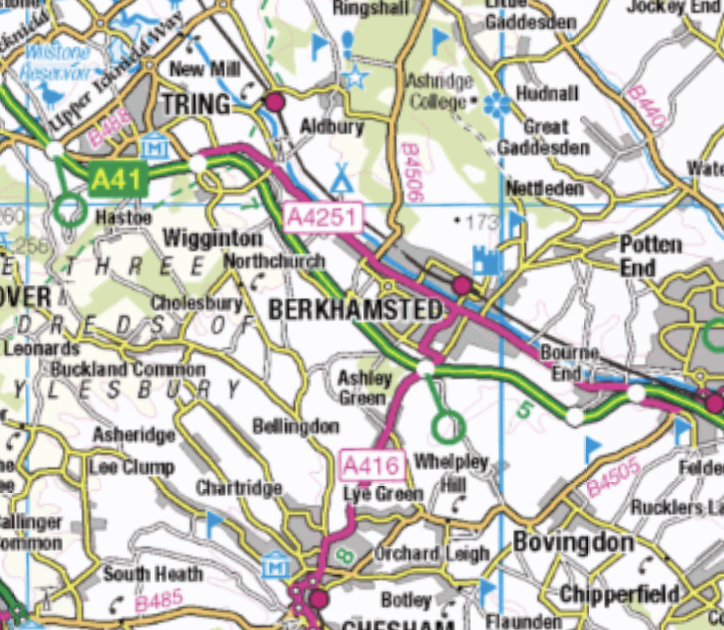
t’s a wonderful moment: completing a serious cycling challenge. Cycling 500km (310 miles) over the Christmas holidays is no mean feat, especially with family commitments. And let’s be honest, setting off into the cold and mist when the alternative is eating and drinking in a warm house takes commitment. On my longest (80km) Festive 500 ride, I kept alive the option of cutting my route short. Yet as I cycled north, the mist was replaced with a weak sunshine, and the easy riding north of Tring, Hertfordshire. (And all the while, Dominic Sandbrook and Tom Holland were telling their enthralling story about the outbreak of the Great War on The Rest is History…)
Enjoy your food and drink
Chiltern Velo cafe, Hawridge, near Chesham
It’s easy to forget that winter cycling needs fuel. For a few of my rides, I forgot to take an energy bar but happily always found a cafe or shop when I needed to refuel. My favourite Festive 500 memories are of my lunches at Chiltern Velo and Velolife cafes – and the cafe at Burnham Beeches. (Kudos to Velolife for posting its Christmas opening hours online – very helpful for route planning.)
Head for the hills – or the flat?
The joy of easy climbing: Christmas Day
Put bluntly, the challenge is 500km: you get no extra kudos for climbing. I was amused to see that Rapha shared a participant’s 154 mile ride in Asia, but noticed that this rise involved 1,000 feet less climbing than my 50 mile ride on day 6…
In short, add ascents if you wish, but don’t feel it’s compulsory. One of the reasons that my Boxing Day ride was a struggle was that it was a switchback. I always prefer routes that ascend, stay at the summit level, and then descend, rather than follow a rollercoaster profile.
Don’t neglect family and friends
You may love the idea of bagging the Festive 500 trophy. But remember: there are more important things in life than cycling. Really…
I was very mindful that while I was completing the challenge I wasn’t taking the dog for daytime walks, let alone ironing or cooking. So make sure you talk to your family about what is negotiable and what isn’t. So if you have loved ones staying, don’t assume your partner will happily entertain them for five hours while you’re cycling unless they’ve told you this is true…
Ride somewhere different
I don’t know about you, but I ride the same routes all the time. Yet on the Festive 500 I looked for new places to go. We live just a handful miles of the border between Buckinghamshire and Greater London, but I’d never cycled from home to London until day 3 of the Festive 500. Similarly, I’d only ever ridden north to Mentmore (the location of the famous country house sale of the century in the 1970s) in the spring and summer on century rides. There’s a joy in seeking new routes to send the heart singing.
Look after your bike
I’ve already said you need to adapt should you hit a mechanical. It’s better, naturally, to try to avoid any mechanical problems. Keep on top of maintenance, checking tyre pressure, washing your mount and ensuring you have spare inner tubes, pump and all the other essential kit to keep you on the road.
You’ve done it!
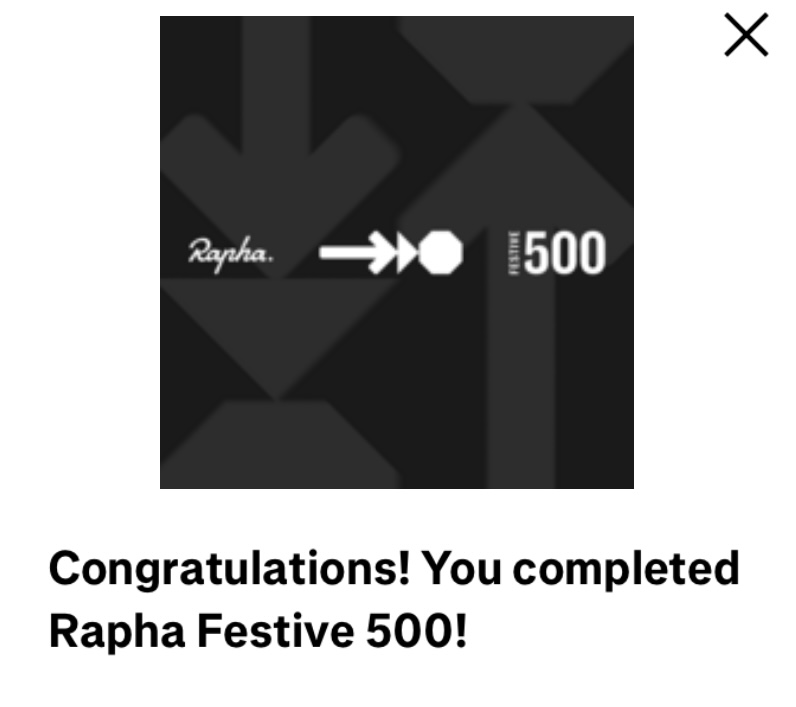
Screenshot
I was thrilled to complete the Rapha Festive 500 a day early. But what next? Are you inspired to go further – perhaps Land’s End to John O’Groats? Just do it!
You can read my day by day account of my successful Festive 500 challenge here.
Fifty years ago today, I broke the light in the loft of our Cardiff home. I only know the date this happened because a far more historic event happened the same day. Britain held a second general election in eight months – only the second time two general elections had taken place in a calendar year. (The other time was 1910, when the Liberal government was locked in a titanic battle with the unelected House of Lords to pass the People’s Budget, which introduced Britain’s first state pension.)
Harold Wilson had very narrowly won the first 1974 election in February, picking up fewer votes but a handful more seats than the Conservative government, led by Ted Heath. The Tory PM had gone to the country in the midst of a bitter battle with the striking coal miners. He framed the vote as ‘Who governs Britain?’ The electorate (at least by the rules of the UK’s first past the post voting system) answered: ‘Not you!’
It was clear that, hampered by the first hung parliament since the war, Wilson would soon call another election to try to win a working majority. In the event, he gained a margin of a pitifully thin three seats. There followed a chaotic, exhausting yet enthralling period in British politics. Wilson himself surprised almost everyone by stepping down aged 60 in 1976, leaving Jim Callaghan to cope with the loss of that wafer-thin majority in 1977. He negotiated the Lib-Lab pact with the Liberal party and the government survived until losing a confidence vote in March 1979. The election that followed brought Margaret Thatcher to power as Britain’s first woman prime minister.
I met Callaghan six years later, when Dad and I visited him in his House of Commons office on a mission to secure a work permit for a musician from Hong Kong who was appearing in a concert in Cardiff. I’d just graduated from university, and Sunny Jim asked me what I wanted to do for a living. When I replied that I’d like to work in PR or journalism, Callaghan turned to my father and commented, ‘They all want to do that know, don’t they!” I tell the story of that meeting in more detail here.
For the first time in 28 years, I’ve travelled to Ireland by train and ferry.
It was inspired by a post by rail travel expert The Man in Seat 61. As a result, I took the route of the Irish Mail, which operated for over 150 years between London and Dublin.
But first, a rant…
Over 25 years ago, I endured another passenger’s mobile phone conversation on a late night train journey from London to Wiltshire. I remember that he was discussing the merits of various films. I hoped it would be a short conversation but it lasted for the hour it took for the train to reach Swindon.
Things are so much worse today. People think it’s fine to have conversations with the whole chat broadcast on their phone’s speaker – and to watch a film in the same intrusive way. When did people become so utterly selfish?
Soon after I took my train seat at London’s Euston station, I was on edge when someone opposite held a mobile chat on speaker. I was relieved when he moved away without any intervention by me. But a couple of hours later a guy behind me started watching a film with his smartphone blasting out the soundtrack on full volume. Three women tried to reason with him, but he seemed to think they were taking away his human right to inflict noise on everyone around him. I supported them, and I was relieved when he moved out of our carriage. I was glad he gave way. But why should we have our peaceful journeys ruined because of another passenger’s selfishness?
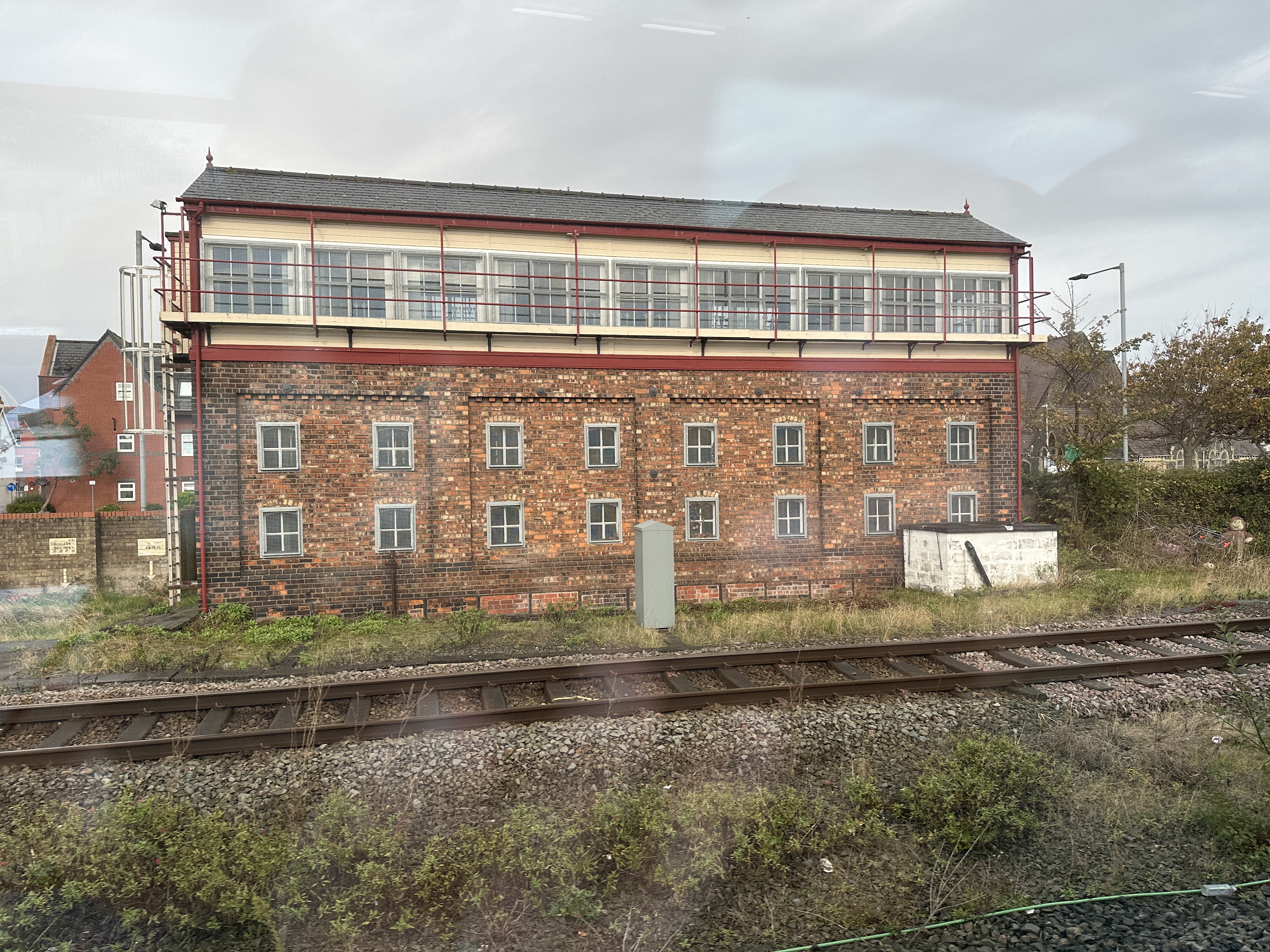
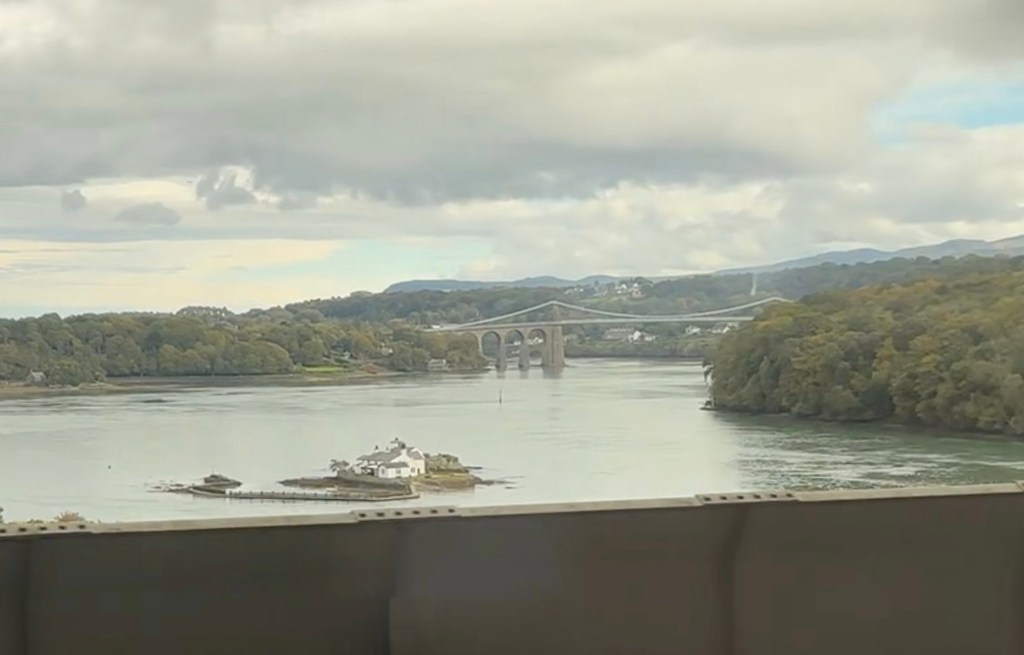
On a happier note, the North Wales coast line is a delight. Many of the original 19th century station buildings and signal boxes survive along with a few semaphore signals in Anglesey. The route hugs the Irish Sea shore and crosses the historic Britannia Bridge to Ynys Môn, Anglesey. This was one of Robert Stephenson’s monumental accomplishments but sadly the old tubes that carried the rails above the Menai Straits were fatally damaged by a fire started accidentally by two children in 1970. The bridge was rebuilt in more modern form two years later and in 1980 an additional deck was added to provide a second road bridge to Anglesey. The old bridge was flanked by two statues of lions, and I glimpsed one of these as my train headed across the bridge. The BFI has a wonderful film of an LNWR train crossing the original bridge in Victorian times here.
Happily Stephenson’s 1848 tubular bridge at Conwy survives – perhaps the only one left anywhere in the world.
Telford’s 1826 Menai Bridge from the Britannia rail crossing
I was amused that the on-train safety announcement was in Welsh – before we’d even left the London suburbs! But I discovered that the irritating ‘See it, Say it, Sorted’ slogan is just as annoying in Welsh, as ‘Wedi sylwi, Wedi sôn, Wedi setlo”…
I sailed to Ireland on Ulysses, an Irish Ferries super ferry. It’s the size of a small cruise liner, and although it tales longer than a fast ferry, it is almost never cancelled because of the weather. It was an easy and enjoyable way to travel, although for the first time on a ferry I had to put my bags through a security scanner. There were no restrictions on liquids, though.
I assumed that the ferry would be birthed next to the railway station but the ferry terminal has moved a mile or so, presumably to accommodate modern, bigger ships.
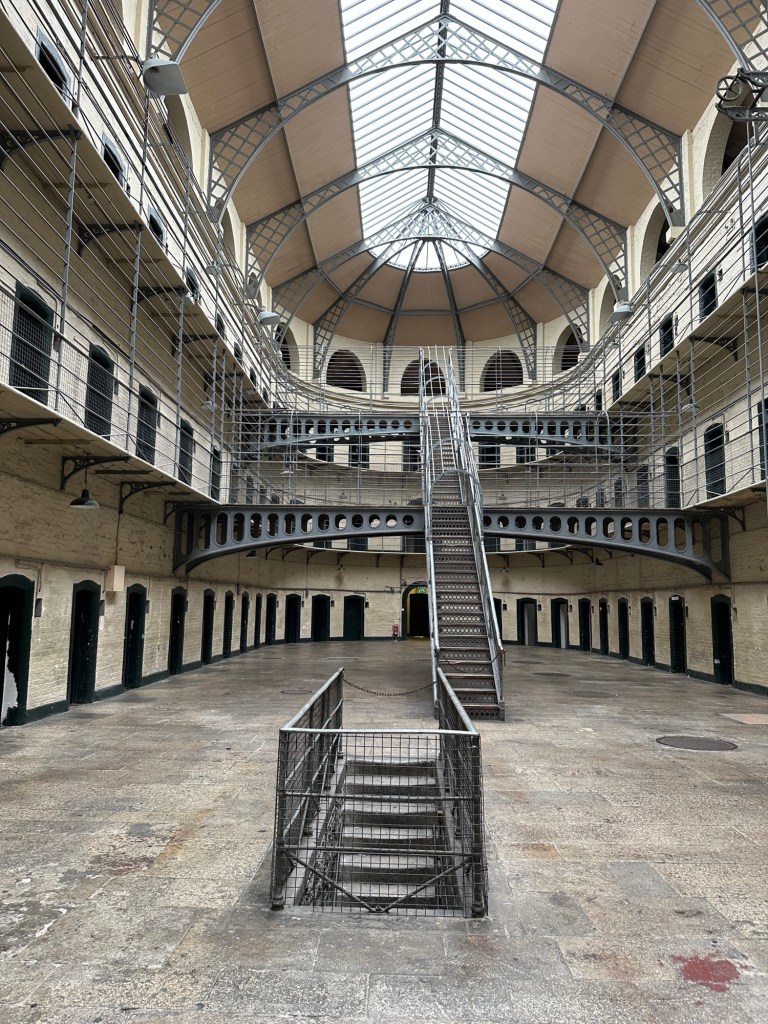
Kilmainham Gaol
I love my visits to Dublin, and this was no exception. My friend Louise kindly collected me from Dublin ferry port and took me to my hotel, the Maldron in Smithfield. The following evening, Louise, Aidan and I had dinner after convivial drinks with Allan Chapman and Barry Chapman from PR agency Comit. These get togethers always prompt serendipitous conversation: this time, we talked about family connections to the Australian goldfields and Ned Kelly.
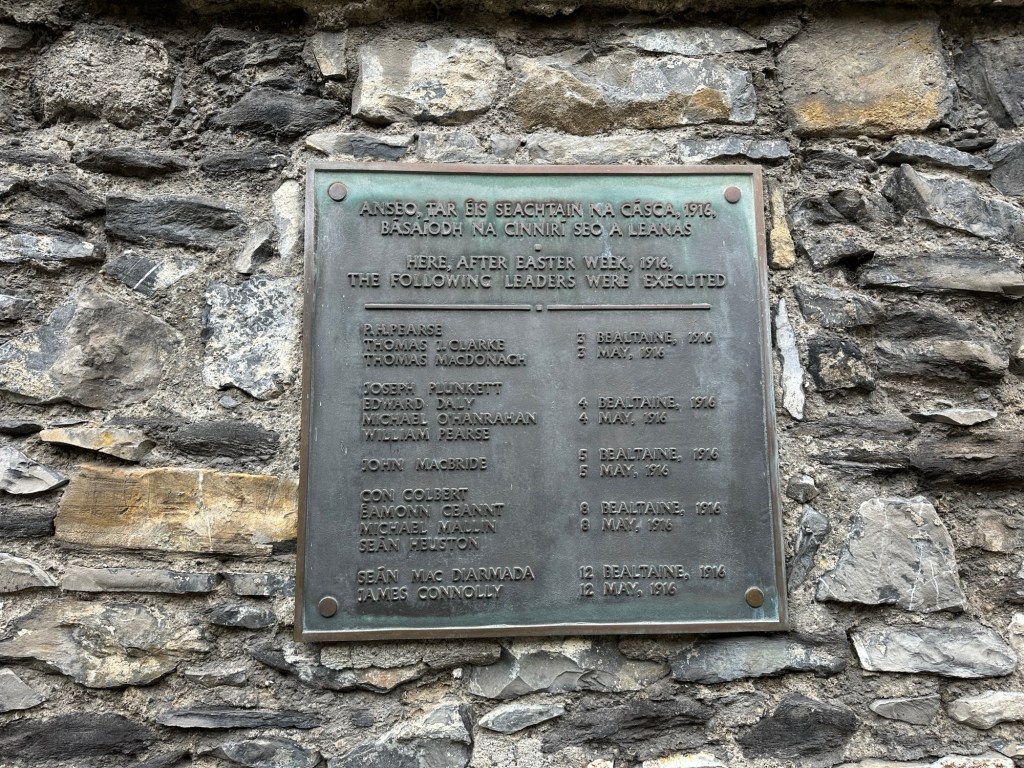
Earlier, I toured Kilmainham Gaol. This prison is over 225 years old, and replaced dungeons as a home for Dublin’s prisoners. It is best known as the place where the men and women who fought for Irish independence were held and in all too many cases executed. It was sobering to see the spot where those who took part in 1916’s Easter Rising were shot, marked by a simple wooden cross. A few metres away another cross symbolised where James Connolly was executed by firing squad sitting in a chair as he was unable to stand because of injuries he sustained during the rising. I blogged about the Easter rising and the British reaction to it on the centenary in 2016.
There’s also a plaque commemorating those executed at Kilmainham by the Irish Free State army during the Irish civil war in 1922.
On a more lighthearted note, I learned on the tour that the prison scenes in the Paddington 2 film were filmed at Kilmainham.
Finally, the old spelling gaol reminded me that I was completely stumped when asked to read it aloud at school in Wales 50 years ago. I think I said ‘gale’. The Guardian was still using the old spelling well into the 1980s before conceding and adopting the modern spelling.
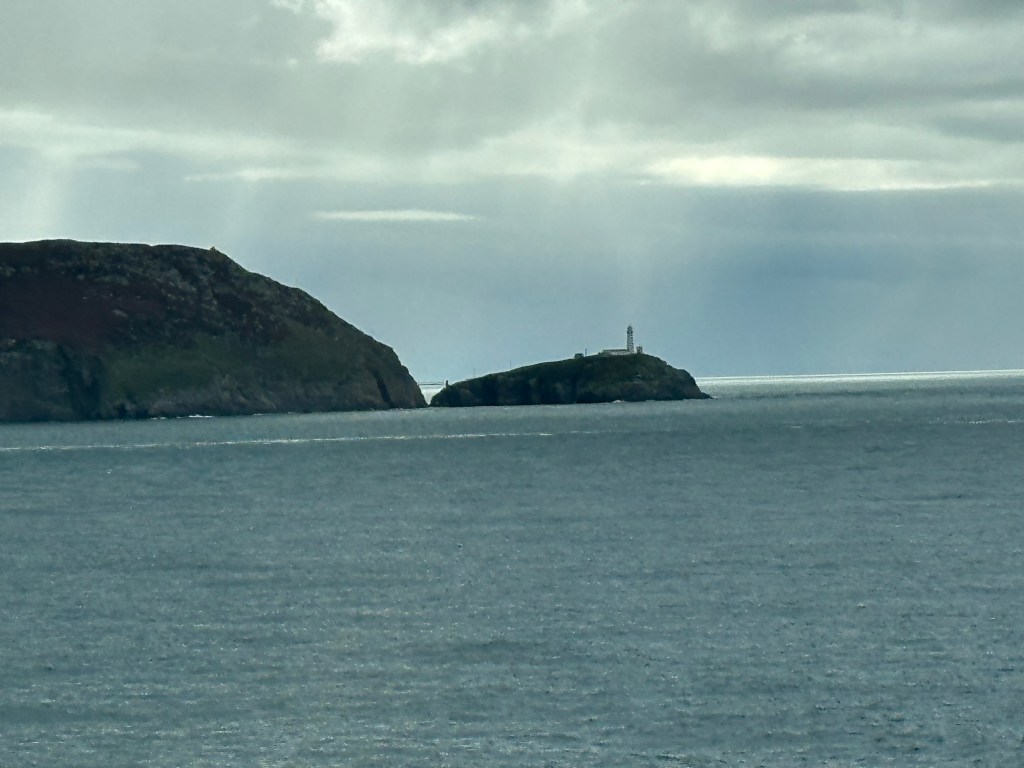
South Stack lighthouse, Wales
I enjoyed my land and sea journey to Ireland. I’d happily do it again, perhaps taking the car from Fishguard to Rosslare, as I did on my first visit to Ireland with Mum and Dad in 1974. Or by bike, as I did in 1996? Time will tell.
I was sad to hear that Herman Ouseley had died. The news took me back to a year working alongside Herman in Brixton in 1992.
Herman was chief executive of Lambeth borough council at the time. The Conservative government’s environment secretary, Michael Heseltine, had the wheeze of inviting deprived areas to compete for funding for projects to transform their areas. Lambeth Council still had a terrible reputation as one of the so-called ‘loony left’ councils in the 1980s, and Heseltine told Lambeth it had no chance of winning.
That’s where I come in. I was working for Eagle Star insurance at the time, which was owned by British American Tobacco. BAT had an extensive community impact programme focused on Brixton, and in early 1992 its chairman, Sir Patrick Sheehy, agreed to second a manager to Lambeth to help it put a bid together for funding to transform Brixton. I’ve always relished a challenge – and agreed to take on ‘mission impossible’.
Three days a week, I swapped the dull corporate landscape of my City of London workplace for vibrant yet cruelly deprived Brixton. I was based in the old Bon Marche department store, which had been converted into the Brixton small business centre. It was a maze of corridors and hidden rooms, and shook when trains passed just feet away on the railway line into central London. It was just a decade after the infamous Brixton riots of 1981, and a local bar offered a cocktail called Brixton Riot in a Glass…The deprivation that helped cause the riots had certainly not gone away.
I got to know and admire Herman Ouseley during that year-long secondment. I was impressed by his immense dignity and calmness, which must have helped him cope with the stress of running such a deprived borough. I was delighted when he went on to chair the Commission for Racial Equality. He was the perfect candidate given his own background as someone who came to Britain from Guyana aged 11, and endured the endemic racism that blighted Britain for so long. He went on to found Kick it Out, a campaign to end discrimination and racism in football.
We took a community first approach to our bid, holding a presentation to government officials at a local secondary school, and arranging for young people from the school’s video unity to film the event. I wrote a briefing for ministers that referred to Brixton as an area that had produced a prime minister – John Major, who won a general election just weeks later, featuring his old Brixton home in a party political broadcast. We also held a presentation to business leaders at Lambeth Palace. This showed how much Lambeth was changing – in the days of council leader ‘Red Ted’ Knight just a few years before it would have been unthinkable for the council to partner with big business.
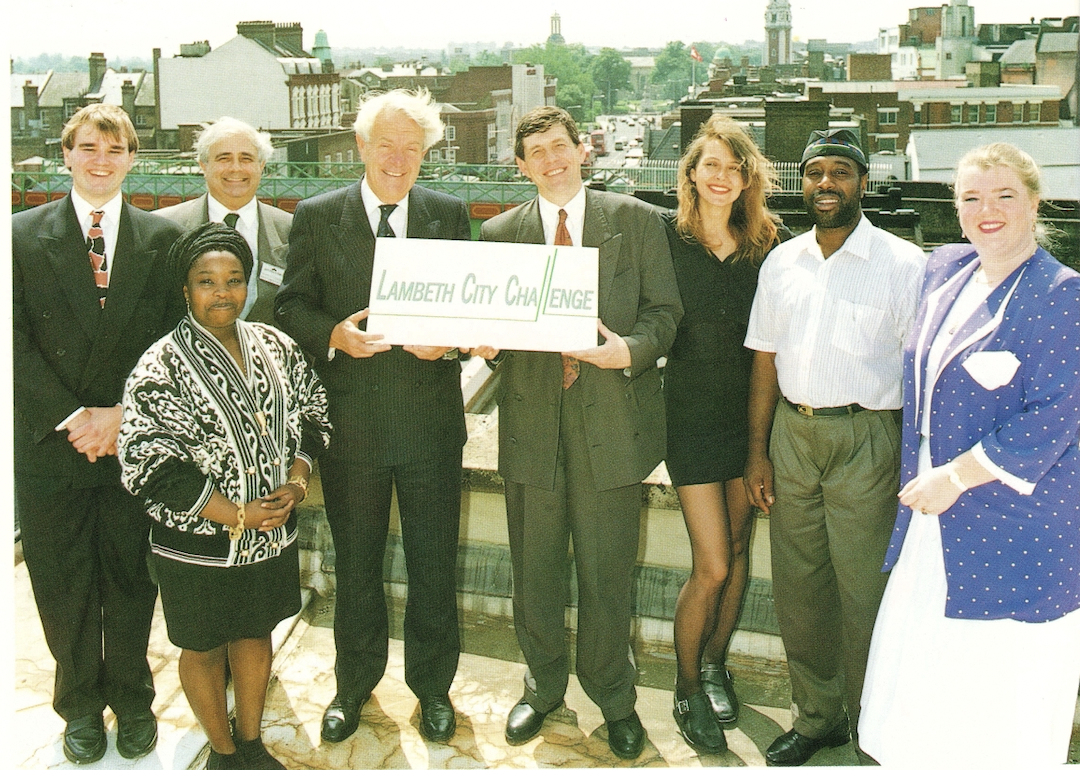
Winners! Government minister Nicholas Scott announces Lambeth had won. Rob on left
I’ll never forget the day Lambeth won. Nicholas Scott, a government minister, came to Brixton for a photocall, which we held on the roof of the small business centre. An ITV news film crew seemed less than keen to stand so close to a 200 foot drop to Brixton high street! It was a joyous day.
Three years later, I chatted to Michael Heseltine at a BAT event in London, and commented that I’d played a part in proving him wrong in dismissing Lambeth’s chances of winning. He was very gracious, but his mind may have been on other matters. All the talk at Westminster was about whether he would challenge John Major for the leadership of the Conservative party. He didn’t, but Major appointed him deputy prime minister days later after seeing off a challenge from John Redwood.
Reflections on Brixton Challenge
Even at the time I was troubled by the notion that deprived areas should compete for money. Why should the life prospects of someone living in poverty in Brixton, Toxteth, Moss Side or Handsworth depend on how good their council was at bidding? I agreed it made sense to get the private sector to invest in our inner cities, but BAT had already been doing that for some years. Indeed my boss during my secondment, BAT’s Brian Hutchinson, already worked tirelessly for Brixton.
A separate company, Brixton Challenge, was set up to oversee the implementation of the City Challenge projects. By all accounts it was not a smooth ride, and the project was criticised for not achieving what had been promised. But I look back with pride on one of the most satisfying years of my career, working with a truly diverse group of talented and enthusiastic people. Above all, I’m glad to have known Herman Ouseley.
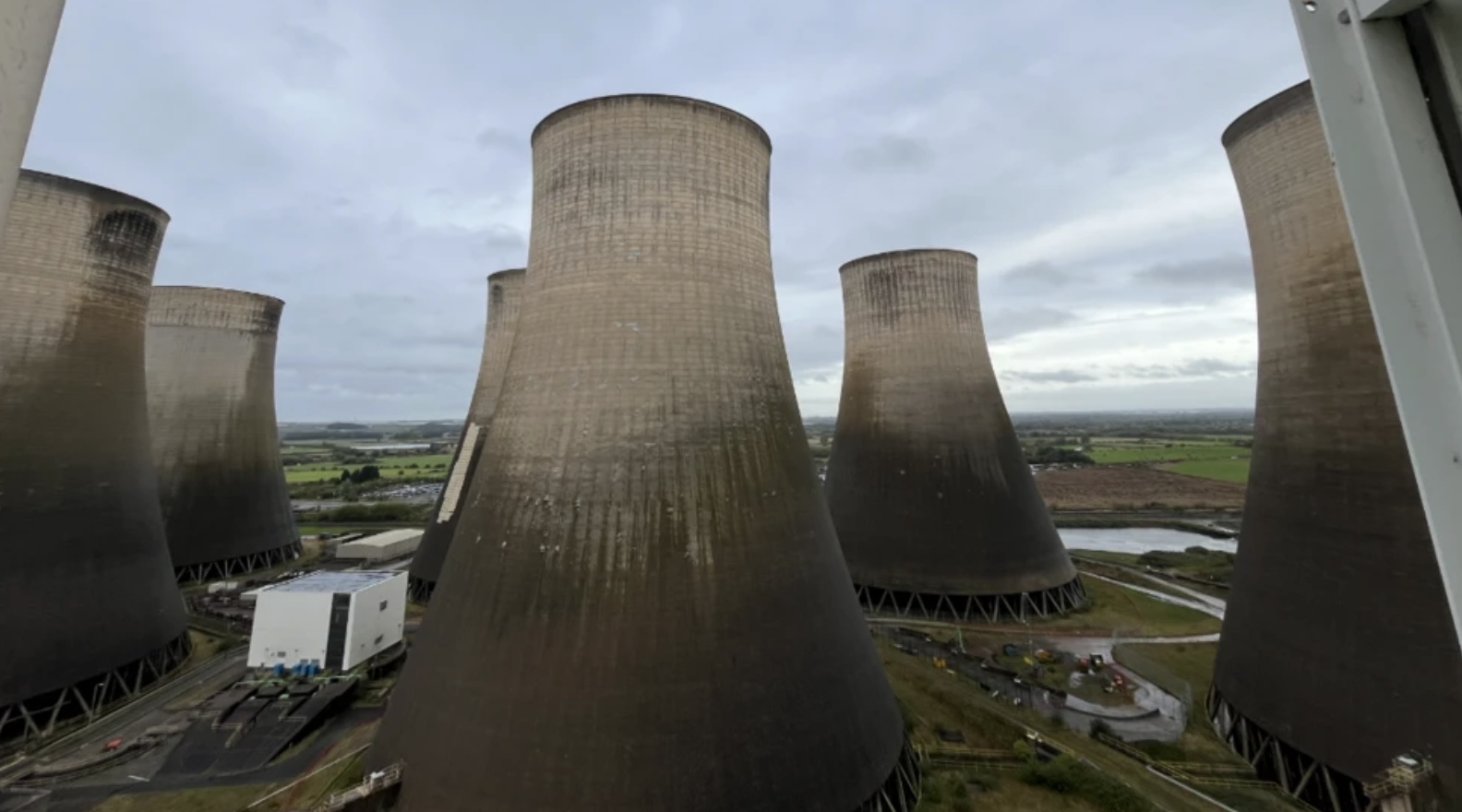
The cooling towers at Ratcliffe on Soar power station. Photo: BBC
The coal age in Britain is over. The country’s last coal-powered power station closed yesterday, marking the end of 140 years of generating power from coal.
I have fond memories of that power station, Ratcliffe on Soar. On a canal holiday in 1988, we moored in the shadow of its eight cooling towers, toasting its mighty presence with a bottle of gin. It dominated the East Midlands landscape.
‘Salt and pepper’: Roath Power station, Cardiff
Over 50 years ago, my late father Bob Skinner played his part in the destruction of the cooling towers at the old Roath Power station in Cardiff. Dad told me that he pressed the button that blew up one of the two towers, nicknamed ‘salt and pepper’. Full of pride, I told my school friends about Dad’s starring role in the event that featured on the Welsh news the night before. “No he didn’t – the [lord] mayor did!’ my friend replied. Over half a century on, I will never know the truth.
Didcot Power station – the cathedral of the Vale
DPSDPS from a Cardiff train, 2013
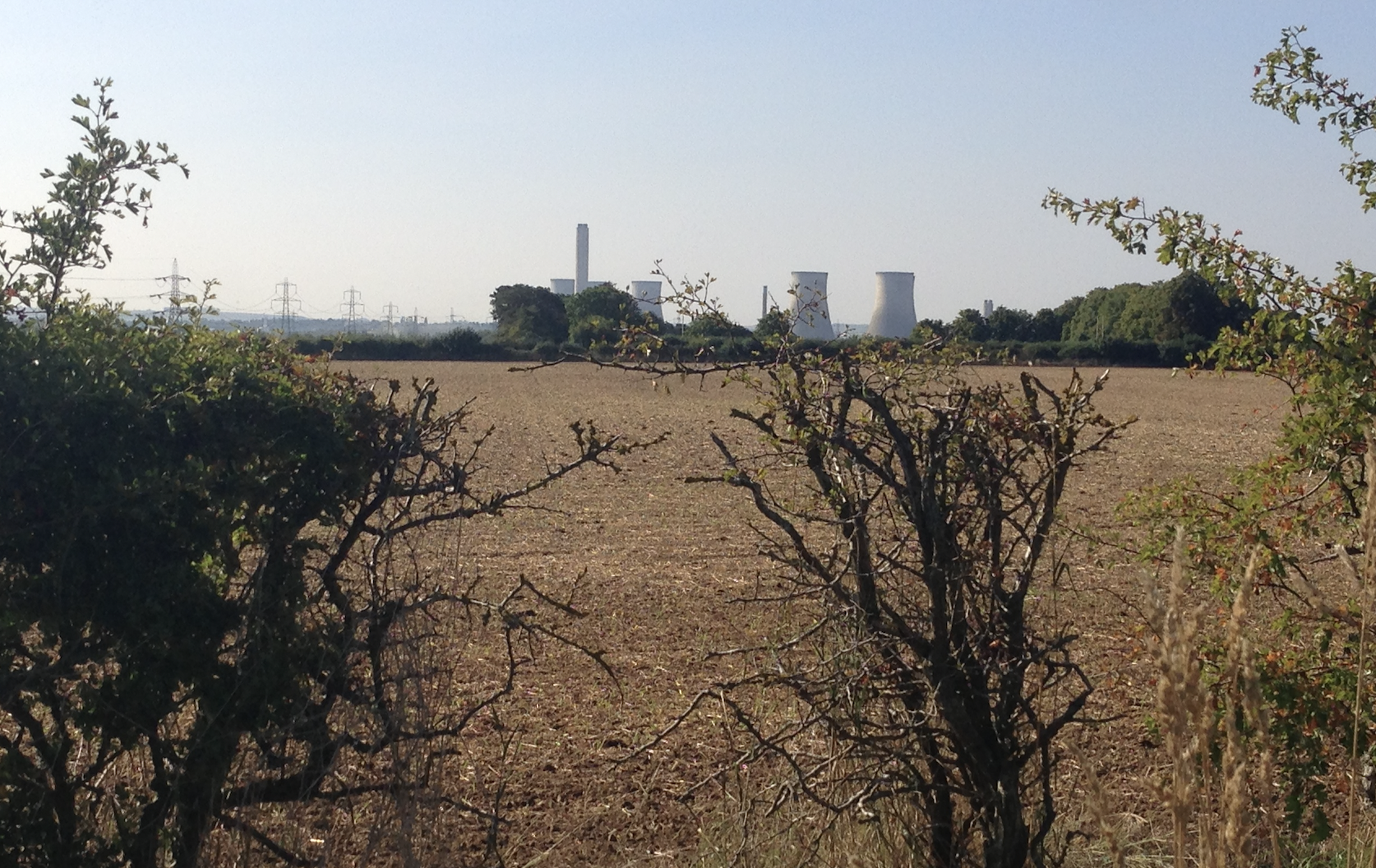
I was most familiar with Didcot power station in Oxfordshire. It was known as the cathedral of the Vale of the White Horse (though we called it DPS), as it could be seen for miles around, and was a milestone on rail journeys between London and Wales. The most striking views were from 18 miles away on the M40 motorway as it climbed the escarpment at Stokenchurch.
We mourned the loss of that iconic view after Didcot’s last three cooling towers were demolished in 2019. I hope calls to save at least one of the Ratcliffe on Soar towers are successful, so we can save part of this monument to the part coal played in powering Britain.
I’ve been dreaming of cycling across mysterious Romney Marsh to historic Rye for years. The inspiration was Jack Thurston’s first Lost Lanes book of bike tours, along with childhood memories of Malcolm Saville’s adventure stories for children based there. (More on that later.)
I finally followed Jack’s tour in September, and have made a documentary video about it. Unusually for my videos, this focuses less on cycling and more on the fascinating history of this corner of England. This blogpost tells the story of my ride, along with a longer version of the stories from the past featured in the video.
Here’s the video on YouTube. (Do please like and subscribe!)
Britain’s most spectacular railway station
My journey began at St Pancras station in London, Britain’s most spectacular railway station. When the Midland Railway decided it needed its own London terminus, it chose the most opulent neo-Gothic style for the station building, along with a stunning roof that spanned all the platforms. It overshadowed its neighbour, Kings Cross station, although the simpler lines of the older station have arguably stood the test of time better.
It’s unbelievable. Britain’s wartime cabinet was meeting in 1915 to plan the Dardanelles campaign that was destined to cost the lives of 41,000 Allied troops. Yet the prime minister, Herbert Asquith, wasn’t interested. Instead, he was reading a letter from his lover, Venetia Stanley, delivered to the Cabinet Room in 10 Downing Street during the meeting. As Winston Churchill, David Lloyd George and Lord Kitchener debated the details, Asquith was penning a reply to Venetia, after checking his diary to see when he could slip away to meet her.
Here is a classic example later that year:
My own darling – I am writing in the stress & tumult of a windy & wordy controversy about munitions … between Ll. G [Lloyd George], Winston [Churchill] and A.J.B [Tory leader Arthur Balfour] – and I daren’t abstract myself more. Asquith to Venetia, during a War Council meeting 1915
Robert Harris has turned the Asquith-Stanley scandal into a brilliant novel. The prime minister’s letters to Venetia have survived but he destroyed all her letters after she ended the relationship, and he had been ousted as PM by Lloyd George in 1916. Some have doubted whether the relationship was sexual, but Harris is sure that it was, and the surviving letters tend to support this – though we will never know for sure.
Asquith was obsessed with Venetia, who was 35 years younger than the 61 year old premier. He ran appalling risks by sending her top secret government documents through the post, including messages about a planned troop evacuation from Antwerp and much more. When the two were enjoying secret rides in his prime ministerial Napier limousine, Asquith would reveal the latest intelligence decrypts to her, before throwing them out of the car window. One of the few fictional characters in Robert Harris’s novel is police detective Paul Deemer, who surreptitiously intercepts the lovers’ letters, to copy them before returning them to the postal sorting office. He also wangles a job as a gardener at the Stanleys’ north Wales mansion, Penrhos, and creeps into her bedroom to open the case in which she kept Asquith’s letters. She saved them for posterity and Robert Harris.
Harris brilliantly chronicles how Venetia turns from an equal partner in the affair to being uncomfortable and indeed oppressed by her lover’s spiral into near madness. She finally agrees to marry Asquith’s close friend and cabinet minister Edwin Montagu, despite not finding him attractive. It was a marriage of convenience that ended when he died just nine years later, during which she had a string of affairs.
You’ve got mail
Precipice sheds light on the remarkable postal service London enjoyed even at the height of the Great War. The General Post Office (GPO) collected and delivered mail 12 times a day in the city, and three times in the country. Venetia noticed with some suspicion that her post seems to be delayed – probably by just a few hours – after detective Deemer starts intercepting it. Today, no one would even notice.
There are a few false notes. When Harris recounts Asquith’s response to her suggestion that the disastrous Dardanelles campaign should be abandoned before any more lives are lost, he has him responding, ‘No, I fear there’s no alternative except to double down’, using an expression first noted in 1949 – and by very few in Britain until the 21st century. At least Harris didn’t have Asquith pleading with her to ‘reach out’…
It was a pleasure to listen to Robert Harris talking about the novel at a Chiltern Bookshops event in the highly appropriate setting of Chorleywood’s Memorial Hall, opened in 1922 to honour those who gave their lives in the Great War. He amusingly explained how Asquith’s great-grandson told guests at the novel’s launch party that it was totally ridiculous, especially the idea that his great-grandfather had anything other than a platonic friendship with Venetia. ‘How on earth would he know, 110 years later?’ Harris asked. He added, ‘Asquith was notorious for his wandering hands and it is well known that Venetia had married lovers after her marriage. That’s the nature of the two people.’
Robert Harris’s achievement is to make us care about the two main characters, even though their behaviour is hardly commendable, especially during a war in which thousands are dying every week. Asquith and Venetia were very much characters of their time, although Harris got a laugh at Chorleywood by making a reference to Boris Johnson’s scandalous actions as PM a century later. Stanley herself was part of a fabulously rich family with mansions in Wales and Cheshire, along with a grand house in London. Yet Harris gives a fair impression how unfulfilling her life was, despite the decadence and splendour. Harris noted at Chorleywood how the family’s Welsh and Cheshire palaces lay in ruins just a few short decades later, while Venetia herself died aged just 60.
Asquith’s legacy
We shouldn’t judge Asquith just on his sordid pursuit of Venetia Stanley. He was the leader of Britain’s last Liberal government, before being forced to turn his wartime ministry into a coalition. Above all, he presided over an extraordinary peacetime revolution, which included the first state pension and the titanic battle to curb the powers of the unelected House of Lords, which included two elections in a single year, 1910, and the threat to demand that the king created enough new peers (lords) to force the upper house to back down. Until war came and he became obsessed with Venetia Stanley, he cleverly harnessed the supremely talented Lloyd George and Churchill. It helped shape modern Britain.
When the Great War was news, not history
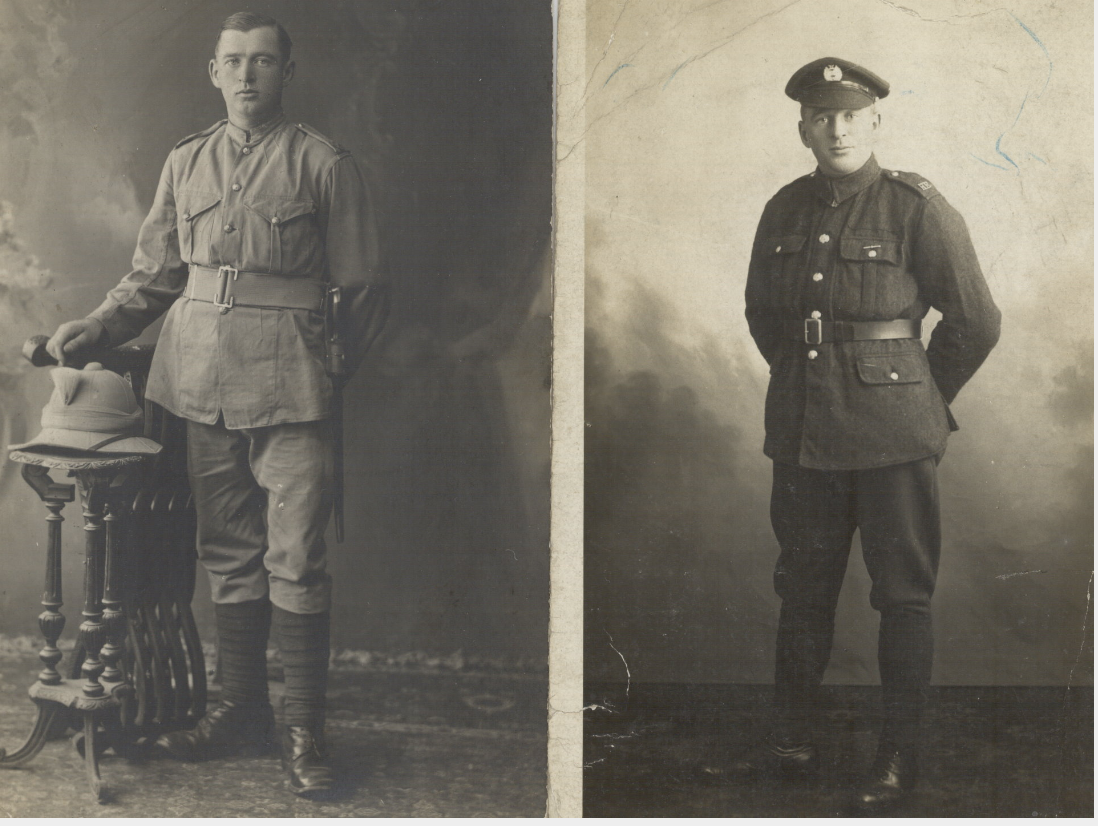
Photos like these feature in countless family photo albums across these islands. They feature my grandfather Frank and his twin brother. Frank was one of the men sent to fight in the Dardanelles campaign that Asquith should have been discussing when he was distracted by his passion for Venetia Stanley. His terrible ordeal led him to forbid my late father from joining his school’s cadet force on the eve of the second world war in 1939. Tragically, his brother – my great-uncle – died in the Spanish flu pandemic after surviving the trenches. Frank died too young at 52 of a heart attack in 1942, as my own 94 year old father remembered so poignantly on his own blog on the 78th anniversary of that sad day in 2020.
The commendable Venetia
Venetia should not be defined by her relationship with Asquith or Montagu. She was determined to play her part in the war effort, and enlisted as a nurse, in conditions so different from her affluent and cosseted family lifestyle. She sailed to France the day Asquith was forced to form a wartime coalition.
One last thought. Almost 80 years after she died, Venetia is the silent witness in this extraordinary story. She’s not here to give her side of the story, a silence that applies to countless women down the centuries who have been unfairly defined and characterised by their relationships with powerful men. We should remember this before casting any judgement about what she did over a century ago as Europe went to war.

















 Ertblog