Remembering Cardiff City’s Jimmy Andrews

Jimmy Andrews, who has died aged 85, was Cardiff City’s manager when the Bluebirds slipped into the third division in 1975 for the first time since the 1940s. Yet he led the club straight back up, and also presided over an enthralling FA Cup run with stunning victories over Spurs and Wrexham. (I blogged about City’s 1977 FA Cup run during our even more remarkable 2008 campaign.)

I started going to Ninian Park regularly during that promotion season of 1975/76. Cardiff struggled in early games against the likes of Halifax and Bury, but I was hooked with a series of thrillers – especially a 4-3 Friday night win against Chesterfield on my 12th birthday and a 2-0 victory against league leaders Hereford. (I was one of 35,000 who watched that one!)

Jimmy Andrews – a regular in the South Wales Echo 1977

Jimmy Andrews deserves credit for the success he enjoyed during his time as manager. (The 25 years that followed proved bleaker, with long years in the old third and fourth divisions.) He showed he was ready to take a gamble, signing Robin Friday, one of the most exotic players to wear City’s (old) colours. I saw Friday on his debut on 1 January 1977 against Fulham. I went mainly to see George Best, who was then playing for Fulham. (I should have known that Best would never have turned up on New Year’s day…) But I saw Friday score two against Bobby Moore’s team. Friday soon proved too wild for Andrews to tame – as he may have suspected when his new player was arrested on his way to sign for Cardiff for travelling using a platform ticket.

I didn’t realise back then that Jimmy Andrews was a former West Ham player. Until his death this month he was the oldest surviving former Hammer.

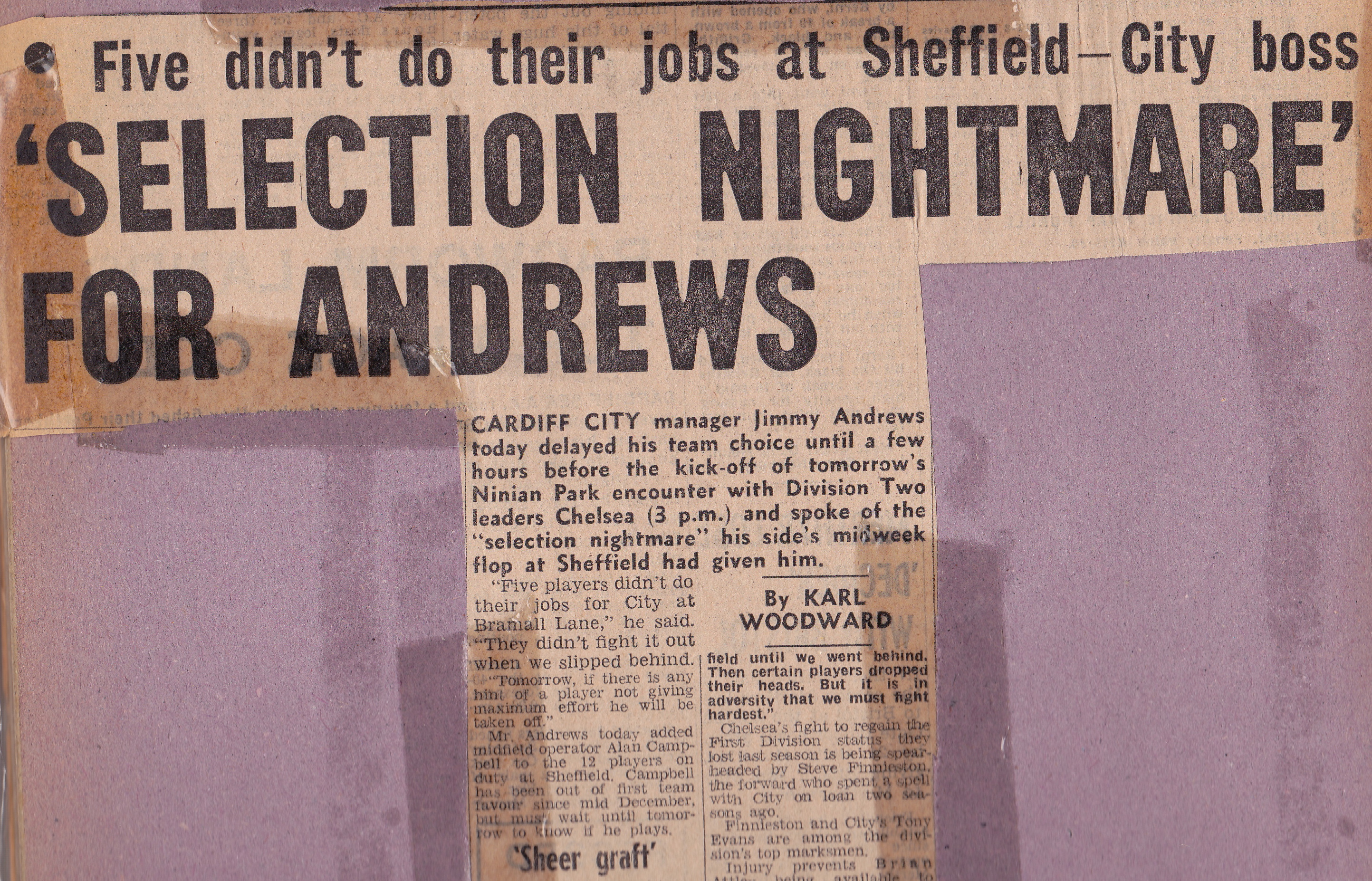
PS: the cutting below refers to a league game with Chelsea, then in the old second division. Not easy times for the future European champions!
Managing challenging times

Snap! Leicester, The Jam and the sound of the 80s

Eighties beat

Music takes you right back. Back to a time, a place, a feeling.

Last night, on the way home, I heard The Jam’s Down in the tube station at midnight on the radio. It prompted me to grab my CD of the group’s Snap greatest hits album to play on the drive to work today. I was transported to a freezing cold night in Leicester in the winter of 1984. I was on the last leg of my journey back to my student house after a weekend home in Cardiff. I was listened to the cassette version of Snap as I made my way along The Newarke past the medieval Magazine Gateway.

It’s amazing to think that it’s 30 years next week that I arrived in Leicester as a very green fresher. The difference between studying at school, with its very structured, almost spoon-fed approach, to university lectures and seminars was a shock to the system. No one took any notice if you didn’t turn up to a lecture. To a much greater extent, you were on your own. Land law in particular was a challenge, although I coped. I much preferred civil liberties and law and medicine, although criminal law and tort were fascinating in their way. It seemed extraordinary that the law of negligence was then only 50 years old. (Until the famous ‘snail in the ginger beer bottle’ case of Donoghue v Stevenson in 1932, you couldn’t claim damages from a manufacturer of faulty goods that had done you harm unless you had a contract with them.)

We were also intrigued by the extraordinary final chapter in Canada’s independence from Britain. That month, the British parliament passed the act patriating Canada’s constitution to Ottawa. Until then, Canada was governed by the British North America Act 1867. It was a formality – Canada was independent decades before – but it meant that Canada would no longer have to ask Britain to amend its constitution. Native Canadians lobbied Westminster against the change as they trusted London above Ottawa. (It is, apparently, the only British act of parliament passed in French since the middle ages.)

The soundtrack of my first term at university was a varied one. Culture Club and the exotic Boy George burst into the charts with Do you really want to hurt me? I loved Tears for Fears’ first hit, Mad World (in the charts when I made my first weekend trip home to Wales at the end of October 1982), and Fat Larry’s Band’s Zoom, not to mention Dexy’s Midnight Runners’ Jackie Wilson said. But I also played a lot of the Beatles on my cassette player, plus tapes I bought at Woolco in Oadby. (Anyone remember Woolco? They were Woolworths’ superstores. Now consigned to history along with the music cassette.)

Leicester was a good place to be a student 30 years ago. Terry Wogan may have mocked it as ‘middle of the country, middle of the road,’, but it was an inexpensive place to live and the university of Leicester had a good reputation, especially as a law school. ‘Town and gown’ got on well, and the Asian community meant we had any number of great curry houses to savour. Washed down by cheap beer!

In praise of Mike Baker

Anyone wondering why a civilised society needs journalists need only look at the career of  Mike Baker, who died last week. Baker knew more about education than most, if not all, of the education secretaries and ministers he interviewed.

Baker became a familiar figure in the late 1980s and early 1990s as the Thatcher and Major governments introduced the national curriculum, intensive testing of pupils and school league tables. Baker’s BBC reports chronicled the battle between the government, which claimed to be increasing standards, and the teaching profession, which protested against the resulting enormous bureaucracy and the pressure on young people and teachers.

After retiring from the BBC, Baker enjoyed a new career as a freelancer, in which he was able to assert his own views. One of his last blogposts, from June, condemned the foolishness of Michael Gove’s plans to revise O levels, reflecting Mike’s deep knowledge of the origins of that exam.

Estelle Morris, one of the few education secretaries who knew as much about education as Mike, paid tribute to him. “He was a specialist journalist and knew the area better than most politicians. I have more than once turned to his words in an effort to better understand what was happening.”

The tragedy is that the habit of reshuffling government ministers means that few ministers build up the expertise of specialist reporters and commentators like Mike Baker. We’d have a far better education system – not to mention health service and transport system – if ministers were allowed to stay in post for more than a year or two. And made policy based on evidence and common sense, not dogma. That would be the best tribute to a great journalist, Mike Baker.

In praise of Timehop and Day One

We record our everyday lives in a way that would have seemed unimaginable even 20 years ago. We take photos and videos on our phone. We share those images, and our thoughts, on Facebook and Twitter.

What a contrast with my childhood. I have just a handful of photos of my first 10 years, plus some prized cine film.

Yet in many ways it’s the trivia that proves of enduring interest years later. That’s where Day One is brilliant. It’s an incredibly simple app for iPhone, iPad and the Mac that creates a journal of your life. At first, it was just text, but it now lets you add photos, locations and even temperatures.

I discovered Day One a year ago , some 12 months after starting weekly entries about our weekends with Owen, then two, in my normal calendar. Day One was far better as it meant reminiscences weren’t mixed up with mundane things such as dentist appointments. Day One is now integrated with Apple’s iCloud service so you can add entries on iPhone, iPad and Mac and they’ll be automatically synced.You can add a snapshot of your day – in words or photos – in seconds.

I love looking back on old entries, such as this gem from Owen when he woke one morning last March:

“There’s a wolf at the door and he’s got a glass of wine for you. And I’ve got blueberry juice.”

In similar vein, I love Timehop. (Credit to former colleague Jon Bishop for telling me about it.)  It sends you a daily email replaying your Twitter, Facebook, Foursquare and Instagram entries from a year before. I smiled at one quoting Owen the week he started his nursery school in September 2011:

“I cried a lot. And there are too many children.”

I should add that he soon settled in to love it!

Tale of a tank engine (and it’s not Thomas)

Borrowed time: BR 80072 in Barry, 1986

Owen and I went on a steam train today. We took the short ride on the Chinnor & Princes Risborough Railway.

The train was pulled by an impressive tank engine, BR 2-6-4T 80072, built the month my sister was born, November 1953. Like most engines on preserved lines, it was rescued from Barry scrapyard in South Wales – steam’s graveyard. I’ve blogged before about this remarkable place, and today wondered if by chance I’d taken a photo of 80072 on my visits to Barry in the 1970s and 1980s. It seemed unlikely – I always made a beeline for express engines such as GWR King Edward II, rather than the less glamorous British Railways standard tank engines. But going through my old photos I found out that I had snapped 80072 on my last visit to Barry, in October 1986. By then, the remaining engines were in a very bad way.

It’s little short of a miracle that this wreck is today pulling trains again. All credit to everyone who made it possible.

80072 had an interesting history even before the great escape from Barry. It hauled commuter trains from Southend and Tilbury to London’s Fenchurch Street. It then had a complete change of scene, moving to Swansea to work the beautiful central Wales line. The month before I was born it moved back to England, to Leamington, working parcels and car transporter trains.

PS: curiously, I didn’t take a photo today. That’s almost as remarkable as the fact I photographed our engine 26 years ago…

iPhone 5: another winner?

Apple’s new iPhone 5, announced yesterday, doesn’t look like a breakthrough. That should help rivals Samsung and Nokia. Yet the changes Apple made to the phone that changed everything in 2007 may still prove significant.

Giving the iPhone a bigger screen is a smart move: after using a tablet – or a Samsung Galaxy S2 or S3 – the iPhone 4 seems too small for photos and video especially. Improving the camera is important, given that the current phone lags behind its main Android rivals.

Some were surprised that iPhone 5 didn’t include NFC (near field communication) functionality. Many in the payment and tech industries mistakenly assume that mobile payments equal NFC, and were hoping Apple would add NFC to the new iPhone. But Apple remains a sceptic about NFC. There’s no consumer cry for it. True, Apple has a record of giving consumers what they didn’t know they needed – the iPad especially. (Innovators don’t wait for demand – they create it.) But NFC remains a solution in search of a problem. As I blogged in May:

… this belief in the potential of NFC is almost certainly misplaced. It’s a classic case in focusing on the technology, rather than what it does, and what consumers and businesses want. Or, putting it another way, the classic mistake of assuming that if you ‘build it, they will use it’.

That said, it’s hard to escape the feeling that the iPhone is losing its position as the poster-child of the mobile phone market. Fans will buy it – I expect to upgrade later this year. But my decision will mainly reflect the fact the iPhone complements my other Apple products: Mac and iPad. In the jargon, I’ve too much invested in the Apple ‘ecosystem’. In plain English, I love the way Photostream shares my photos on all my devices. And in my view, Apple’s iOS operating system is more elegant and easy to use than Android, although I was otherwise impressed by the Samsung S2 that I tried earlier this year. Apple shouldn’t assume that this will be enough to stay ahead of the game.

Thank you, London 2012

An amazing summer: London 2012

The closing ceremony of the Paralympic Games is under way. In a short while, London 2012 will be over. Six amazing weeks, and countless breathtaking memories.

I’ve blogged before that I’ve turned from a sceptic about the cost and benefit of hosting the games to a belief that they’ve been a landmark for Britain. And I posted last week about our inspirational day at the Olympic Stadium watching the Paralympics.

Track magic

Thank you to everyone involved in making London 2012 such an amazing experience and such a huge success, from the athletes to the Games Makers, from the organisers to the countless workers who made it happen. (And the broadcasters who brought these wonders into our homes.) We’ll never forget these six weeks – our sensational summer.

Starting school – the generation game

Starting School: a timeless tale

Owen started school this week, aged four years and two months. It’s a landmark in everyone’s life. We knew it was going to go well when he announced early that morning, “I don’t want Cbeebies, I want to go to school”!

I’m sure this reflects the fact he’s been going to the nursery attached to his new school for the last year.

First day at school: the Ahlbergs’ story begins

Before he started at his nursery last year, we read him Janet and Allan Ahlberg’s wonderful story, Starting School, published by Puffin. It’s a beautifully observed account of a group of children’s first term at school, from the first day to breaking up for Christmas. It helped Owen understand what school is like, including the initial unfamiliarity.

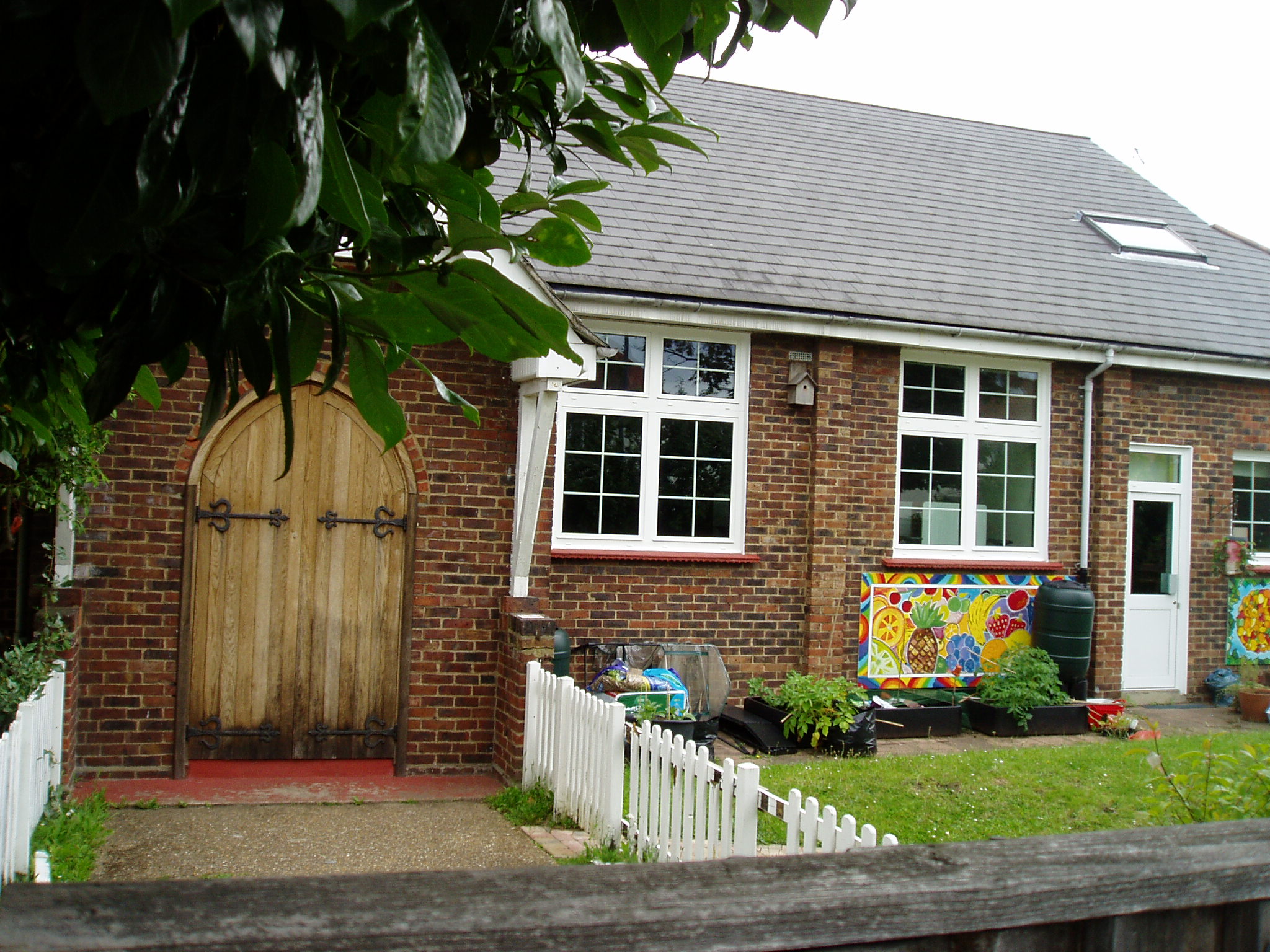
Seeing Owen starting school brought back all my memories of my own big day in September 1968. (It was a long time ago – some three weeks after the end of steam locomotives on British Railways.) A year ago, I took Owen to see my old school, Bishop Perrin in Whitton, Middlesex, with my mum and dad. Bishop Perrin hasn’t changed much in the past 44 years (at least from the outside), so it was easy to imagine myself, aged four, playing with the sand and water on the front lawn in that lovely September sunshine in 1968.

Bishop Perrin was a wonderful school for me. The classes were small. In my first year, you could choose a friend to join you in a classroom wendy house to eat Smarties on your birthday. Headmaster Mr Davies insisted on keeping the traditional ways of teaching reading until the education authorities could show the new ways were more effective.

Last Wednesday, after we dropped off Owen for his first day in school, I drove past Bishop Perrin on the way to work. Happy memories.

My first school: at Bishop Perrin with Owen, 2011

Bishop Perrin, 2011. That lawn seemed bigger in 1968…

Goodbye Ken Clarke

Veteran Tory politician Ken Clarke was sidelined in this week’s cabinet reshuffle, leaving his post as justice secretary.

The move marks a sad day for the criminal justice system in England and Wales. Clarke proved one of the most intelligent justice or crime ministers in a generation. He challenged the Daily Mail view that throwing people into prison was the best way to protect society. He was prepared to take a fresh look at criminal justice and the role of restorative justice. Clarke wasn’t always right – his comments about rape were ill-judged – but his heart was in the right place.

We need to get away from the idea that prison is the answer to everything. Why does the UK – or at least England and Wales – lock up more people than almost every other democratic country? How can we rehabilitate criminals while protecting the public? The Daily Mail doesn’t care – but politicians should. Ken should be a role model for future justice chiefs, not a false dawn.

Our brilliant Paralympics day at Olympic Stadium

Arriving at Olympic Stadium

We had an unforgettable day at the London 2012 Paralympic Games today. We were lucky enough to get seats in the packed Olympic Stadium in Stratford, experiencing three new world records.

We had a great journey to east London from Buckinghamshire (birthplace of the Paralympics in 1948). We caught one of the new Met line trains from Amersham to St Pancras before catching a Javelin high speed train for the six minute trip to Stratford. (What a brilliant idea to give free London travelcards with London 2012 tickets – it made the Paralympic tickets the biggest bargain of the decade!)

It was lovely to see our niece Siân at work as a Games Maker at Stratford Gate as we went through. Volunteers like her, and everyone involved in organising and running the games, have done the country proud with their incredible efforts.

Running shared

Inspiring a generation

It was so good to see the Olympic Stadium packed for the Paralympics. Great Britain was the birthplace of the Paralympics just after the second world war, as a new start for soldiers who had suffered spinal injuries during the war. (Karen took part in the opening ceremony of the 1984 Paralympics at Stoke Mandeville.) We were keen to support the games and to celebrate amazing athletic achievement.

Anyone watching the Paralympics would have been inspired even more than by the achievements of Olympic athletes. I couldn’t help thinking of that old expression to describe the disabled: differently abled. That epithet was mocked by some as politically correct, but you can see this week why people wanted to redefine disabled people by what they could do rather than what they couldn’t. (As I write this, David Weir has just claimed another gold medal on the track, proving my point.)

We have lift off…

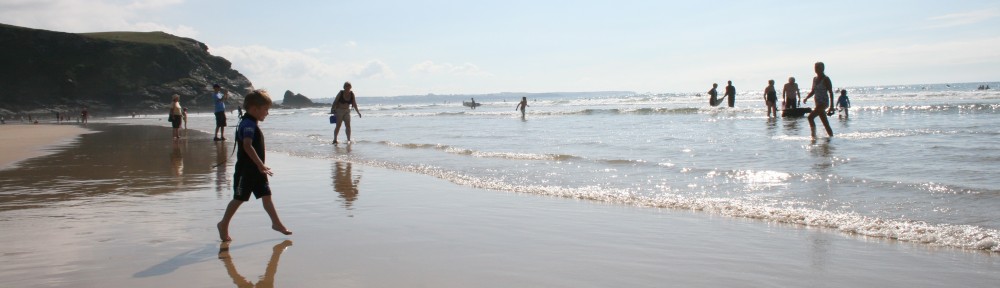
We saw so many families with children at the Paralympics, as we had at the Olympics football opener in Cardiff. London 2012’s aim of inspiring a generation seems to be doing just that. I heard children on a Cornish beach talking in awe about the speeds recorded by amputee cyclists at the Paralympics. And it may be a coincidence but Owen has become a swimmer during the London 2012 summer! Above all, we wanted Owen to understand that personal endeavour and determination can overcome life’s setbacks to achieve amazing dreams.

Bladerunner bruised: Pistorius’s protest

The sour note of the Paralympics came on Sunday night when South Africa’s Oscar Pistorius protested about his defeat in the T44 200 metre final. Some commentators said this showed that the Paralympics had arrived as elite sport. Perhaps, but it would be sad for the Paralympics to witness the kind of lack of sportsmanship that now plagues football. Happily the Olympics and Paralympics have been graced by tremendous sportsmanship.

The Paralympics summer

Stratford: the ugly lovely town

The Olympics have transformed Stratford. The stadium, velodrome and aquatic centre are stunning additions to the east end of London. As we discovered, Stratford has brilliant transport links across London and beyond. But it’s a shame that many of the other developments do little to lift the spirits. Leaving the Olympic Park towards the Westfield centre, every building ahead of us was an ugly box. This is a big opportunity missed. We just hope that London 2012 provides a longer benefit here.

One amazing day

Homeward bound

We’ll remember our day at the Paralympics for the rest of our lives. Thank you to everyone who made it happen. Especially those amazing, inspiring athletes.