Swindon’s Mechanics’ Institute: my letter in The Times

The Mechanics’ Institute in Swindon, Wiltshire, is symbolic of the Victorian belief in self improvement. It was founded in 1854 by Great Western Railway workers to provide themselves with a library, lectures, classes and, in time, a library and health services. Yet sadly this historic building has fallen into a ruinous state since closing in 1986.

My letter in The Times, Friday 28 March 2025

I paid tribute to the Mechanics’ Institute in a letter to The Times on Friday, prompted by a piece by columnist James Marriott praising Newcastle Upon Tyne’s Literary and Philosophical Society, where the father of the railways George Stephenson demonstrated his miners’ safety lamp in 1815.

Swindon was just a small village when the great engineer Isambard Kingdom Brunel chose it as the location for the Great Western Railway’s locomotive works, which opened in 1843. Within a decade, over 2,000 people worked there, many living in a railway village close by the main line. The workers paid for the Mechanics’ Institute, an initiative that was replicated in countless towns and cities across Britain.

Continue reading

Celebrating World (Audio) Book Day

My latest audiobook playlist

World Book Day. A inspired way of getting children to read books, or an annual chore for parents whose children need a Gruffalo outfit for school?

I’ll leave you to decide. But I’ve been thinking about reading, and my own changing ways of enjoying books. From an early age, I’ve loved reading, although mostly non-fiction. I enjoy a good novel, but as a history fan I’m usually drawn to volumes on the past, especially military history and politics.

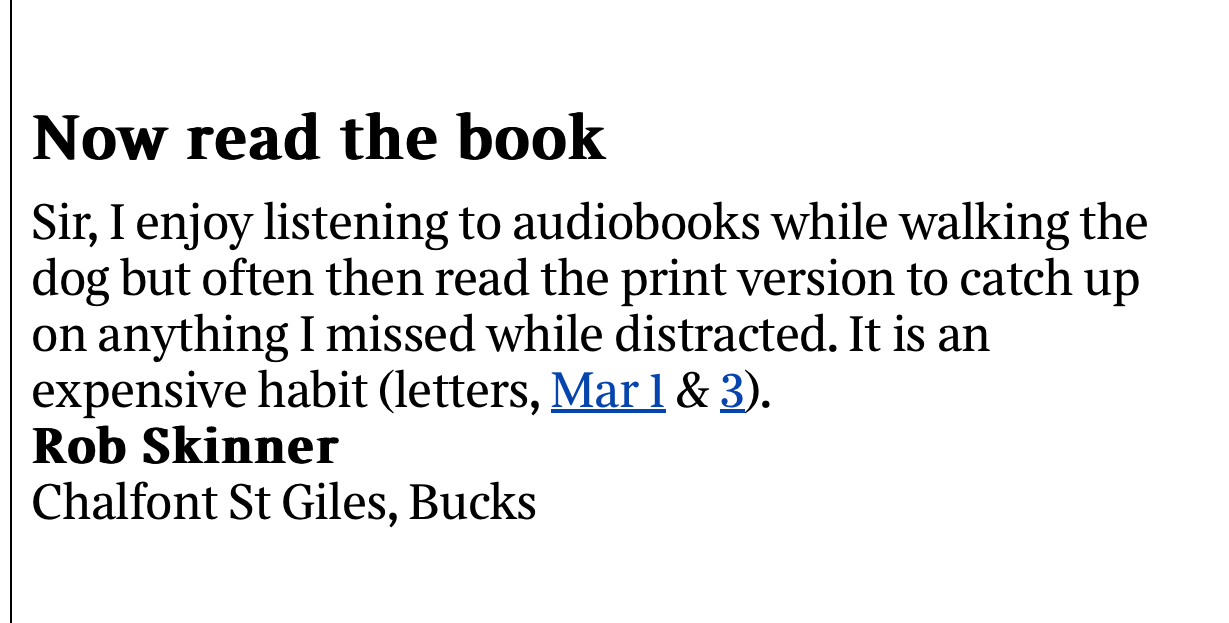
As my latest letter in The Times this week showed, I’m increasingly listening to books. Back in the analogue era, I had a few books on audio cassette, including Tony Benn’s diaries and Douglas Hurd’s memoirs. (I’m eclectic in my political interests!) In 2012 I discovered Audible’s range of audio books, and have been hooked ever since. They’re perfect for car journeys, bike rides and dog walks.

But, as my Times letter admitted, I often read the print or Kindle version of the audio book to catch up on what I missed – it’s important to pay more attention to the road than to the latest twist in Starmer’s battle against the Corbynite left in Get In, Maguire and Pogrund’s exhaustive book about the Labour leader’s road to 10 Downing Street.

An adult World Book Day?

The Times today asked whether adults needed their own World Book Day – presumably without the need to dress up. The paper noted that 40 per cent of British adults haven’t read or listened to a book in the past year, according to YouGov research. But, looking on the bright side, half of Britons say they read or listen to a book at least once a week. That’s more encouraging, especially given the distractions of social media, and the flood of podcasts and video available online.

Hardback reader

Over the past few years, I’ve started buying hardback non-fiction books. They’re often easier to read, with larger type than paperbacks, while also looking rather nice on the bookshelf. As the photo above shows, I’m working my way through James Holland’s magisterial account of the battle for Italy during the second world war. This is one of the less well known aspects of the war, which deserves a wider audience.

Distractions abound

Despite being addicted to books, I can’t deny that I find it far harder to concentrate on reading these days. I have an urge to Google people and events featured in the book. Worse still, I find my attention wandering to tasks to be completed, or the route of that afternoon’s bike ride. I try to focus on the book, but too often put it down to tackle that other activity. Distractions: the curse of our online age…

Pointless jargon: my latest letter in The Times

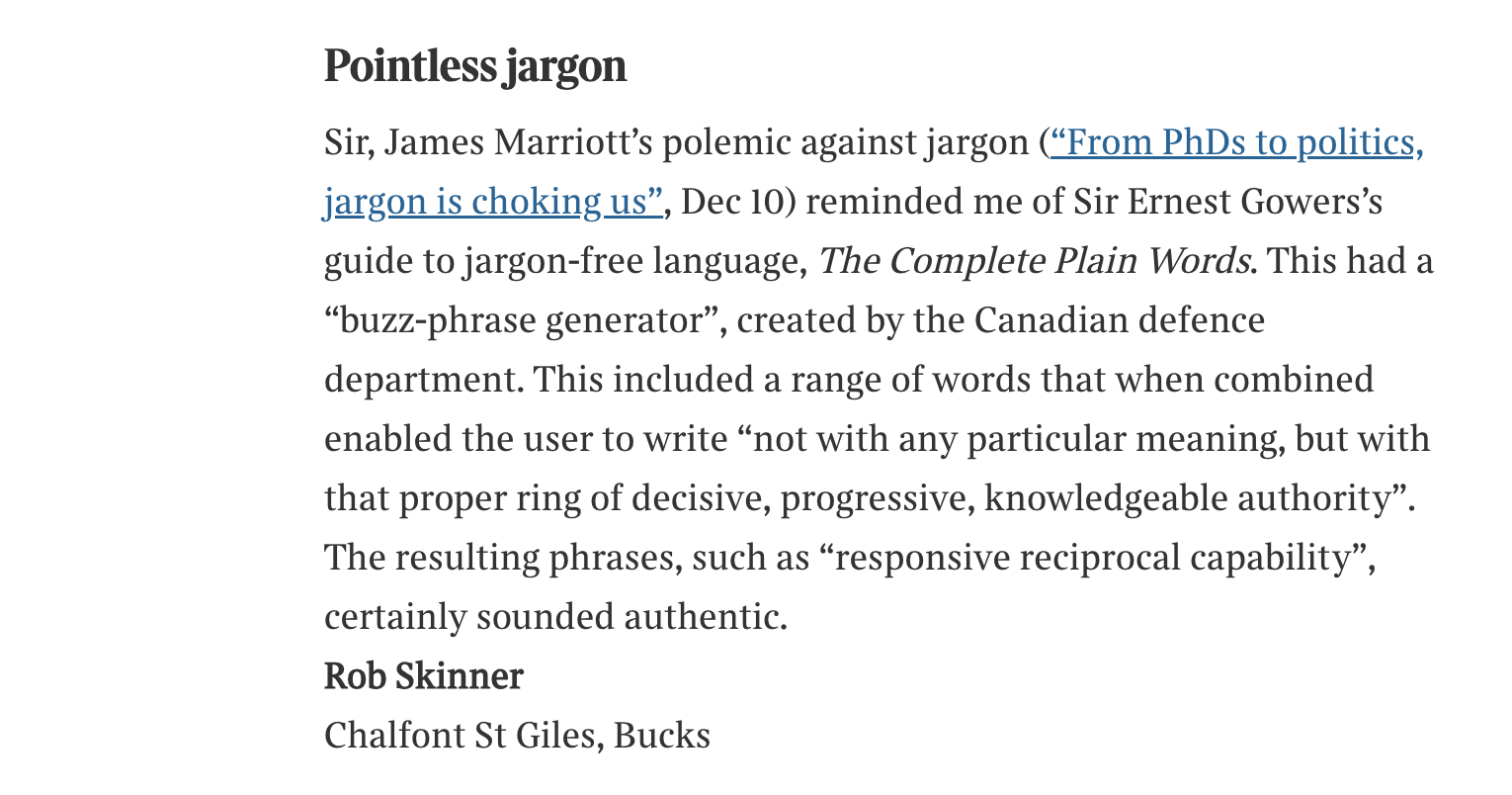
Over 40 years ago, I bought a wonderful book called The Complete Plain Words by Sir Ernest Gowers. It has guided me throughout my 37 year career in communication. Today, it featured in my latest letter in The Times – my sixth this year.

Ernest Gowers had an illustrious career in the civil service. He was Lloyd George’s principal private secretary as chancellor of the exchequer, and wrote the original Plain Words as a guide for civil servants in 1948. The edition I bought in 1984 was revised by another distinguished public servant, Sir Hugh Fraser. Both knights recognised that communication with the public should be clear and free from jargon that may baffle and annoy them. As the book says, the idea is to get an idea as exactly as possible out of one person’s mind into another’s.

James Marriott, whose article about jargon inspired my letter, was railing especially against the way jargon creates an exclusive club. Those who do not understand it are excluded. It also places a more subtle barrier, as recipients struggle to decode the meaning. As a result, jargon users are likely to spend more time dealing with an enquiry than if they’d explained themselves clearly in the first place.

I have spent almost 40 years in the financial services industry, and the past 16 years in the world of fintech – a buzz word that simply means companies that apply technology to provide financial services in a different way. (Think app-based banks rather than high street lenders.) Fintech also means combining the jargon from two industries (technology and finance) that thrive on gobbledegook.

I wrote in more detail about the fight against jargon and cliche in this 2012 blogpost.

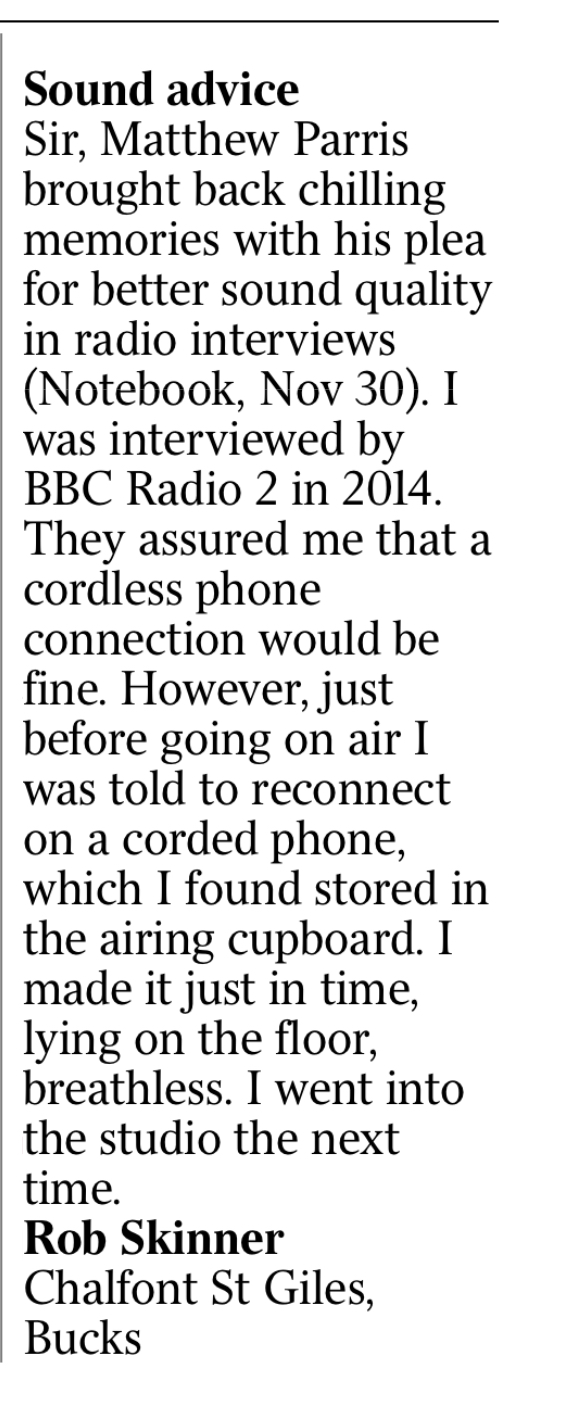
Radio panic: my letter in The Times

Bottom-right fame…

“There are, as we all know, some things in life that money simply cannot buy. The bottom-right corner of the letters page of The Times is one of them.”

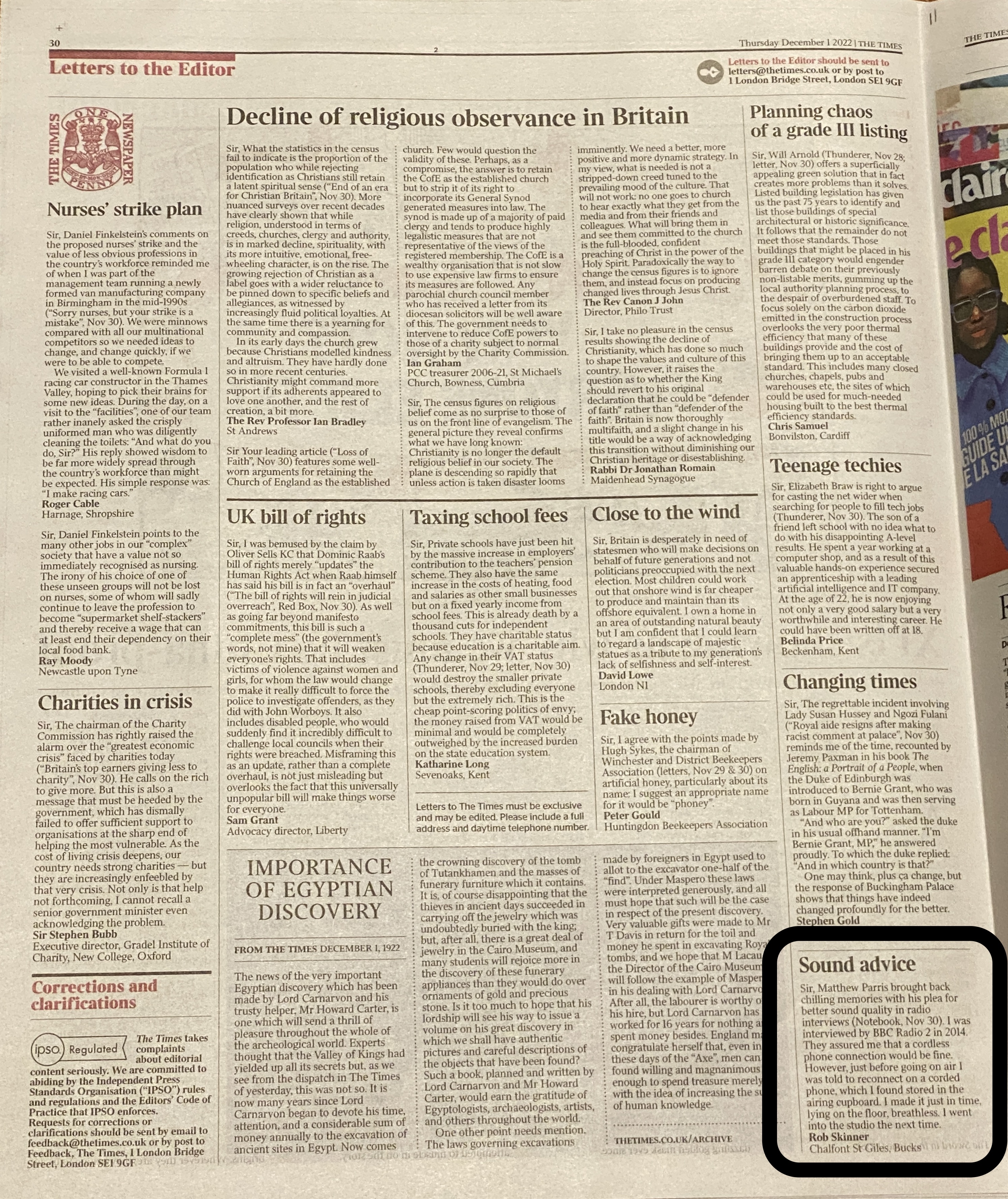
So declared Andrew Riley, The Times letters editor, in 2018. Today, my latest letter to the paper appeared in that prized slot. It was inspired by Matthew Parris’s always-enjoyable Notebook column yesterday, in which he lamented the decline in audio quality on British radio during and after the pandemic. It reminded me of my alarming scare when interviewed live on Simon Mayo’s Radio 2 show in 2014.

I’m in good company: Queen Victoria once had a letter published in The Times. The late Queen’s epistle was in response to speculation about her resumption of public appearances following the death of the Prince Consort three years earlier. Mine may be seen as trivial in comparison. But I made the coveted bottom-right corner..

In his column explaining what makes a good letter for The Times, Andrew Riley urges brevity. He quotes the late Times literary editor Philip Howard’s warning that “the most common reason for the rejection of a letter for publication is overwriting”. Riley adds that it is hard to consider a letter if it’s substantially more than 200 words. Mine was just 78 words. I wrote it on the train to London after enjoying Parris’s column over a coffee. (Travelling by train remains an enjoyable experience despite the vagaries of incompetent management and strikes for better pay.) My last published letter, about the accents of Cardiff’s old Tiger Bay docklands, was even shorter at 51 words.

Brevity is a noble aim, whether writing to The Times or giving a presentation. It’s a human instinct to keep going. But knowing when to stop is a gift that others will value.

Climate crisis: the train must take the strain

What an irony. Thousands travelling to the COP26 climate conference in Glasgow were stranded in London after the two rail lines to Scotland were closed by severe weather. Many took flights instead.

Trains have a vital role to play if we are to tackle the climate crisis. As Clare Foges explained in an excellent column in The Times (Trains are key to getting net zero on track) rail travel creates 14 grams of CO2 emissions per passenger mile compared with 158 grams by car and 285 by plane. Yet Britain’s railways and governments seem to do everything in their power to encourage us to take more polluting forms of transport.

Family travel – at a cost

Cost

Travelling by train in Britain is eye-wateringly expensive. A Which? survey, quoted by Foges, found that domestic flights are typically half the price of the competing rail ticket, yet six times worse for carbon emissions. I’d love to travel by train more often, but even for one person the cost is punitive. If you’re travelling as a family, you may need to take out a second mortgage. Saving the planet? All the odds are stacked against us. Esoecially as the UK government has just announced a cut in the tax payable on domestic flights, just days before COP26 began. Madness.

Continue reading

The Times and Sunday Times Newsstand app – crash!

I wrote last November that Apple’s Newsstand app was seriously flawed. It promises to deliver your daily (digital) newspaper to your iPad overnight ready for your commute. It’s never worked well – now it never works.

Britain’s News International has just launched a combined Times and Sunday Times app within Newsstand. Judging from today’s performance, this is the worst Newsstand experience so far. I saw glimpses of the Sunday Times front page – but never got any further as the app crashed every time.

Must do better…

Guardian’s iPad app: good news

IMG_0053

The Guardian's iPad app

The Guardian finally released an iPad app this week. It was worth the wait.

The paper has been a digital pioneer, but (apart from the brilliant Eyewitness photojournalism app) has been left behind as the Daily Telegraph, The Times and Sunday Times have launched apps for Apple's hugely successful iPad. 

But the Guardian's effort is the most stylish of them all. The design is gorgeous, with big photos, and clear text on white background. Navigation is straightforward.

The app also takes advantage of Apple's Newsstand app, which automatically deivers new editions as they become available. That's good news: no need to wait for an edition to download before racing out of the door to catch your morning train.

Editor in chief Alan Rusbridger acknowledged in a blog post that not everyone will be happy. As he says, it's a 'reflexive, once a day Guardian', rather than the website. Many commenters complained that the app won't include comments on articles. But that reflects the fact it's a digital newspaper, not a live website. The printed paper doesn't include comments, apart from the daily letters to the editor, which also appear in the app. The criticisms show we now have different views on what a newspaper is. Traditionalist see it as a printed product, and like the apps that provide a digital version. Others think the old idea of a paper as a once a day snapshot of news is hopelessly out of date. (They'd point out that the app makes no mention of Liam Fox's resignation, which happened five hours ago.) 

The app doesn't include everything – the excellent Weekend magazne isn't included, for example. I'm sure this will follow. (The Times app's Saturday edition originally missed most of the Saturday print content, which appeared a few months later.)

But I still like the idea of the reflexive Guardian, as Rusbridger describes it. I know all about Fox's departure – I read about it on Twitter, confirmed it on the BBC news site and heard more on Radio 4's PM. I'm a Gaurdian print subscriber, and welcome the chance to download a version to read on the train on my days in London. In time, I'm sure newspaper apps will be updated more often – The Times brought out an app update to mark Steve Jobs' death last week. 

I also like Rusbridger's view of the changing Guardian: "The Guardian is many other things. You can now watch, listen to and join in with the Guardian. You can literally follow it minute by minute around the clock as it reports, mirrors, analyses and gives context to the shifting patterns and rhythms of the world's news. It's Android when it wants to be, Kindle when it chooses." He's right. The same principle applies to many aspects of modern life: we want to connext to Facebook on different devices; we want to check our diary in the same way; we're increasingly looking to shop online and on the high street, on a mobile and a PC. Companies need to change the way they offer services to customers in this ever-flexible world.

The bigger question is whether the Guardian's iPad app move will revive the Guardian's finances. The group has faced a couple of torrid years, as print sales and ad revenues fall, and the GMG invests heavily in digital. The iPad app will cost £9.99 a month, while web access will remain free, unlike at News International's titles. Will the Grauniad follow NI's example? If it doesn't, it's hard to see how the losses will be reduced significantly. A growing number of readers don't buy the print edition, and won't pay for an app while they can get all the web content for free. Yet I share the view of a few commenters on Rusbridger's blogpost: I want to contribute to the Guardian's quality journalism, and like the idea of the app. Time will tell if enough of us cough up. 

Below: photos come to life on the Guardian app

IMG_0054


Media that I pay for – print and online

I've neglected this blog for a month or so after a prolific spring. So thanks to Ged Carroll,  Stuart Bruce and Stephen Waddington for prompting my first post this month. 

All three were writing about the media they value enough to pay for. I was intrigued to read their thoughts, as media owners around the world are desperately looking for ways to secure revenue from readers, viewers and listeners, especially online. (The subject came up in a meeting I had with one of the Guardian's top journalists today.)

I was really surprised that not one of the media Ged, Stuart and Stephen cited as worth paying for were online. (Or, more accurately, they all cited print versions of media that offer online content.) Now I recognise that most media owners still offer most if not all their content for free online. But there's still a huge amount of paid for content, including now The Times and Sunday Times, plus the Financial Times and Wall Street Journal, which have had used successful paid-for business models for years. 

So here's my contribution to the debate – online and print. 

The Guardian

I've been a Guardian reader since the 1970s. I share most of the paper's values, and like its mix of excellent news coverage, often-provocative op-ed articles and lively features. Although the Guardian's content is free online, I value the print edition enough to pay for it – though I enjoy a big discount through its subscriber scheme. 

The Guardian's website is one of the very best in the industry, and I'd happily pay to access it if it ever went down that route. In the meantime, the Guardian iPhone app is well worth the £2.39 price tag. (And its amazing Eyewitness app is free.) 

The Times

I read The Times from time to time (no pun intended) though I find its tabloid format less attractive than the Guardian's larger Berliner size. I also feel the paper's comment section has got thinner in recent years, especially after it moved the leaders to page 2. 

The huge question, of course, is whether Rupert Murdoch's bold move to charge for online access to The Times and Sunday Times content will pay off. I signed up for the £1 special offer for the first month and wondered whether I'd value the content enough to pay for it, given that I'm not a natural Times reader. 

After a month, I'm rather surprised to find that I may well take the plunge. The reason? The excellent morning business news email, with links to the day's Times business stories – and top stories from the Independent and Daily Telegraph (but curiously not The Guardian). I regularly click on David Wighton's business comment pieces. The Times and its Sunday stablemate think culture is the way to lure people into paying for its online content – it features very heavily in their 'paywall' marketing. It won't get me to sign up – but great content might. 

Zinio

If you've bought an iPad, you may have seen Zinio. It's an application that enables you to buy iPad versions of a stack of magazines, including NME, Men's Health, Cycling Plus, Macworld and PC Advisor. I still like browsing a printed magazine, but when I'm heading for the airport I like the idea of taking an electronic magazine. 

Cycling Plus

I've been buying my favourite cycling mag for almost 15 years. It inspired my Land's End to John O'Groats adventure in 2002 (though it took me six years to act on that inspirational C+ feature). I still get C+ every month, but still mourn the demise of Cycling Today, which I started buying in its earlier guise as new Cyclist after I bought my first proper bike in 1989. 

Talk of Cycling Today prompts me to record my sadness at the loss of a couple of other publications I bought regularly. Bike was a short-lived cycling magazine, which wowed me with great design, photos and inspiring articles. Sadly, I was obviously a lone fan. Similarly, I loved Digital Video Technigues, which I found hugely inspiring when I first got into video editing some six years ago. It decided to focus on articles about high-end video editing programs in 2007 and disappeared soon after. 

Buckinghamshire Advertiser

Stuart Bruce mentioned the Yorkshire Post – God's own county's national newspaper. We don't have such a revered title in Bucks, but we do have (amongst others) the Bucks Advertiser. My wife Karen buys it every week. I read it regularly, but usually with a feeling of dismay at this failure of local journalism, as I blogged in March. Judging from the Advertiser, the village of Chalfont St Peter is a hotbed of anti-social behaviour to rival inner city London or New York. A classic example of crime reporting stifling any other image of a neighbourhood. It could do so much better. Still, Karen's the one who coughs up the 65p cover price…

eBooks

I'd love to report that I'm buying loads of eBooks. The iPad is the perfect platform for them, as the reader can change font size and backlighting, and click on links to find out more about the subject. I enjoyed reading a sample of Peter Mandelson's The Third Man autobiography on the iPad on my flight to San Francisco last week. But I wasn't prepared to pay £15.99 to get the iPad version when I could get the hardback for less through Amazon or Waterstone's. In time, that will surely change as publishers and Apple realise that keener pricing will prompt far greater sales.