The BBC today reported that the last surviving Battle of Britain pilot has died. Group Captain John ‘Paddy’ Hemingway was aged 105. He travelled from Ireland to join the RAF on the eve of war and also fought in the Battle of France, in which the RAF desperately tried to hold off the German Blitzkrieg invasion of Britain’s ally.
Winston Churchill famously called the brave RAF pilots the Few:
‘Never in the field of human conflict was so much owed by so many to so few…’
Paddy Hemingway and his fellow fliers saved Britain during the glorious, sunny summer of 1940. The Germans hoped to wipe out the RAF, and so open the way for a seaborne invasion of Great Britain. The RAF’s young pilots won the battle, making the defeat of Nazi Germany possible five long years later.
James Holland brilliantly recreated the immense stress of those Battle of Britain pilots in his 2004 novel, The Burning Blue. He also reminds us how the life of the Battle of Britain crews was so different from that of men serving in the Royal Navy or the armies in North Africa or Italy. The Few lived and died in everyday British communities, fighting in blue skies over the patchwork fields of Kent and Sussex by day, and drinking in traditional English country pubs by night.
The stress must have been overwhelming as the battle progressed, as the RAF noted for Paddy Hemingway:
‘Towards the end of the October 1940, the strain of fighting and loss of comrades was beginning to take its toll on Paddy. He was particularly troubled by the loss of his dear friend ‘Dickie’ Lee DSO, DFC in August 1940, saying in later years that his biggest regret was the loss of friends.
World Book Day. A inspired way of getting children to read books, or an annual chore for parents whose children need a Gruffalo outfit for school?
I’ll leave you to decide. But I’ve been thinking about reading, and my own changing ways of enjoying books. From an early age, I’ve loved reading, although mostly non-fiction. I enjoy a good novel, but as a history fan I’m usually drawn to volumes on the past, especially military history and politics.
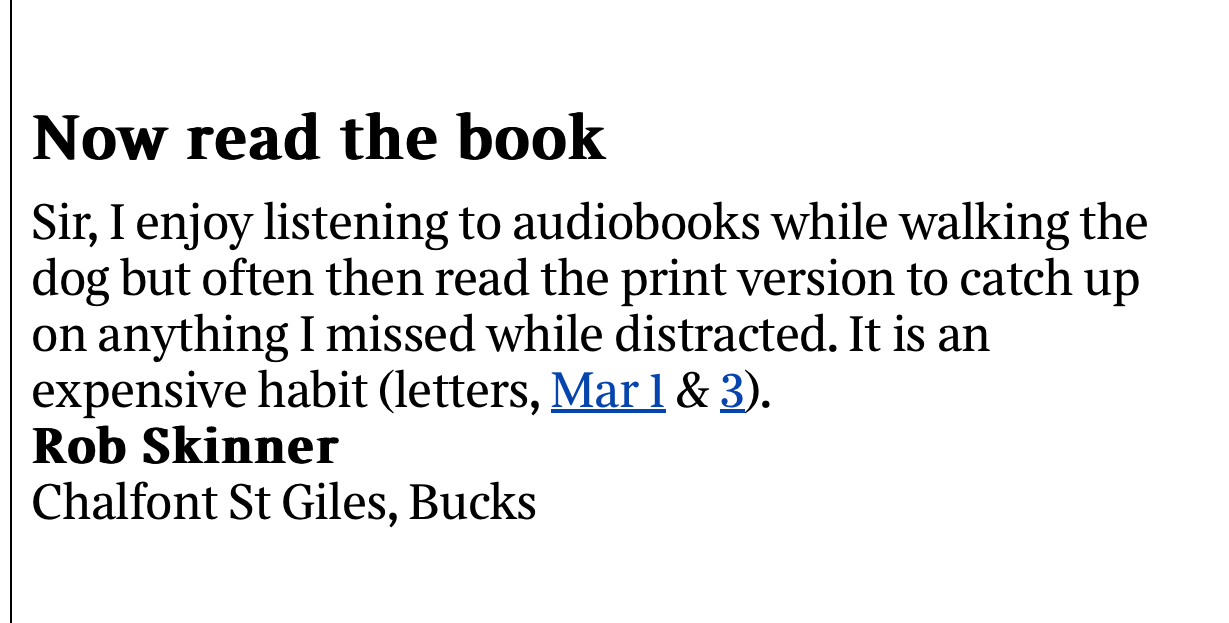
As my latest letter in The Timesthis week showed, I’m increasingly listening to books. Back in the analogue era, I had a few books on audio cassette, including Tony Benn’s diaries and Douglas Hurd’s memoirs. (I’m eclectic in my political interests!) In 2012 I discovered Audible’s range of audio books, and have been hooked ever since. They’re perfect for car journeys, bike rides and dog walks.
But, as my Times letter admitted, I often read the print or Kindle version of the audio book to catch up on what I missed – it’s important to pay more attention to the road than to the latest twist in Starmer’s battle against the Corbynite left in Get In, Maguire and Pogrund’s exhaustive book about the Labour leader’s road to 10 Downing Street.
An adult World Book Day?
The Times today asked whether adults needed their own World Book Day – presumably without the need to dress up. The paper noted that 40 per cent of British adults haven’t read or listened to a book in the past year, according to YouGov research. But, looking on the bright side, half of Britons say they read or listen to a book at least once a week. That’s more encouraging, especially given the distractions of social media, and the flood of podcasts and video available online.
Hardback reader
Over the past few years, I’ve started buying hardback non-fiction books. They’re often easier to read, with larger type than paperbacks, while also looking rather nice on the bookshelf. As the photo above shows, I’m working my way through James Holland’s magisterial account of the battle for Italy during the second world war. This is one of the less well known aspects of the war, which deserves a wider audience.
Distractions abound
Despite being addicted to books, I can’t deny that I find it far harder to concentrate on reading these days. I have an urge to Google people and events featured in the book. Worse still, I find my attention wandering to tasks to be completed, or the route of that afternoon’s bike ride. I try to focus on the book, but too often put it down to tackle that other activity. Distractions: the curse of our online age…
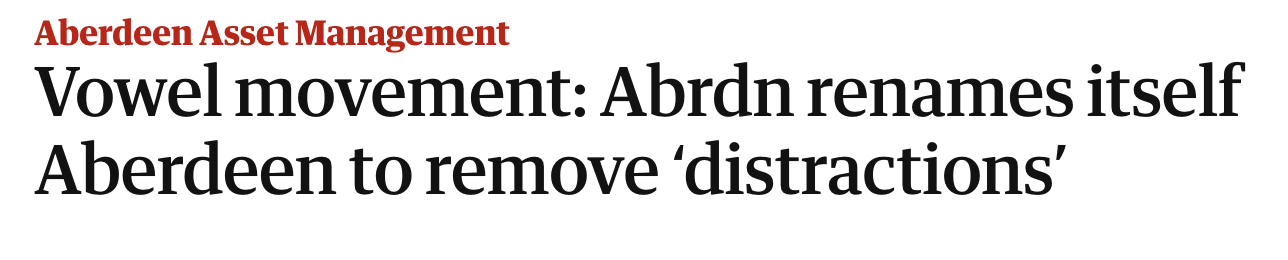
It was the most mocked rebrand in years. In 2021, when most companies were worrying about the pandemic, the Aberdeen investment company decided vowels were so yesterday, and renamed itself Abrdn. It claimed the change reflected a ‘modern, agile, digitally-enabled brand’. The move was almost universally mocked, with the group accused of suffering from irritable vowel syndrome. It didn’t help that the new Abrdn had to explain that the name was still pronounced … Aberdeen.
Last year, in a cringeworthy cry of pain, Abrdn’s chief investment officer Peter Branner complained that the mockery amounted to corporate bullying, saying such abuse wouldn’t be allowed if Abrdn was an individual. He told Financial News:
‘I understand that corporate bullying to some extent is part of the game with the press, even though it’s a little childish to keep hammering the missing vowels in our name.’
Branner’s pitiful outcry was equally mocked. City AM had fun with a headline reading ‘Abrdn: an apology – sry we kp tkng th pss ot of yr mssng vwls”.
This week, Abrdn threw in the towel, and conceded that vowels weren’t so bad after all. It will now be branded aberdeen group. Yes, without a capital A. Think of it as a matter of pride – a go-ahead brand can’t be expected to go all conventional overnight.
‘We will deliver by looking forward with confidence and removing distractions. To that end, we are changing our name to aberdeen group plc. This is a pragmatic decision marking a new phase for the organisation, as we focus on delivering for our customers, people and shareholders.’
This kind of corporate gobbledegook is sadly common. It means nothing. Is Windsor really admitted that Abrdn – sorry, aberdeen group – hasn’t been focusing on its customers, people and shareholder during its four year campaign against innocent vowels? And talk of removing ‘distractions’ ignores the fact that it was Aberdeen that caused the distraction in the first place.
I love America. I was lucky enough to work for a wonderful American company for 16 years, and cherished the friendships of many fine American colleagues. But the transformation of the leader of the free world into a cheerleader for brutal dictatorship and the far right cannot be ignored.
In 1776, 13 American colonies declared independence from Great Britain. Just short of the 250th anniversary of that historic event, the perfidious actions of the 47th president of the resulting United States of America make it essential for Britain itself to break free.
Trump bullies the man who defied his friend Putin’s invasion
Like millions of Europeans, I was appalled to see President Trump bully and humiliate Ukraine’s President Zelenskyy in what looked like a hostage video staged in the White House. Trump and Vance constantly interrupted the beleaguered Ukrainian leader, who valiantly tried to cope with the flood of invective. At the very same time Trump was abusing his counterpart, the American president’s friend Vladimir Putin’s forces were killing Zelenskyy’s fellow citizens, as they have been since 24 February 2022.
“You are gambling with the lives of millions of people. You’re gambling with world war three,” Trump told a man whose country had been invaded by a brutal dictator intent on wiping Ukraine off the map. Fortunately, America’s greatest president, Franklin Roosevelt, took a different line in 1941 with Winston Churchill. Rather than bullying Britain’s wartime prime minister into accepting an armistice with Hitler, Roosevelt gave extraordinary support for his fight for national survival. Alongside the heroic efforts of the Soviet Union, that ensured that Europe was liberated from the tyranny of Nazi rule less than four years after America entered the war.
I am usually very reluctant to mention the Nazis (people do this all too often), but the shocking encounter at the White House reminded me of the humiliation in 1938 of Austria’s chancellor Kurt Schuschnigg, subjected to a terrifying two hour tirade by Adolf Hitler in the dictator’s mountain retreat at Berchtesgaden, Bavaria. ‘You have done everything to avoid a friendly policy!’ Hitler screamed. ‘And I can tell you right now, Herr Schuschnigg, that I am absolutely determined to make an end of this.’ The Anschluss – the Nazis’ forced union of Germany and Austria – came the following month, with appalling consequences for Austria’s Jews and countless others. Austria only became an independent country again in 1955, 10 years after the second world war.
No, you’re not cheating if you ride an electric bike. The e-bike revolution is one of the best things to happen to cycling in the past decade. I have two e-bikes and love them.
It’s your choice what you ride
No one has the right to tell you what type of bike to ride. If you like the idea of a little help going up a hill, just go for it. And you won’t be alone: Mintel forecast that e-bikes would be the best selling type of cycle in 2024, and a quarter of British adults have considered buying one according to a Paul’s Bikes survey last year. It’s likely that many people buying an e-bike wouldn’t have bought an unpowered one.
You still get a workout on an e-bike
When I got my first road e-bike, a Trek Domane +, in 2022 I was surprised by how many calories i burned on my rides. The reason? Because in Britain an electric bike (technically called an ‘electrically assisted pedal cycle’) motor has to cut out above 15.5mph, after which your pedal power alone will move you forward. You’re likely to burn more calories doing this than on a non-e-bike as your mount will be a lot heavier with the motor and battery. (As an example, the latest electric Trek Domane + SLR 7 AXS weighs 12.64kg in size 56, compared with 8.29kg for the non-electric version. Data from Trek website.) You can always slow down below 15.5mph to get the motor to kick back in…
No one is losing out because you ride an e-bike
A lot of people were angry when Bob Dylan went electric in 1965. No one should care if you do the same, on a bike, unless you’re in a race. Or grabbing a king (KOM) or queen (QOM) of the mountains on a Strava segment.
E-bikes are brilliant for car-free commuting
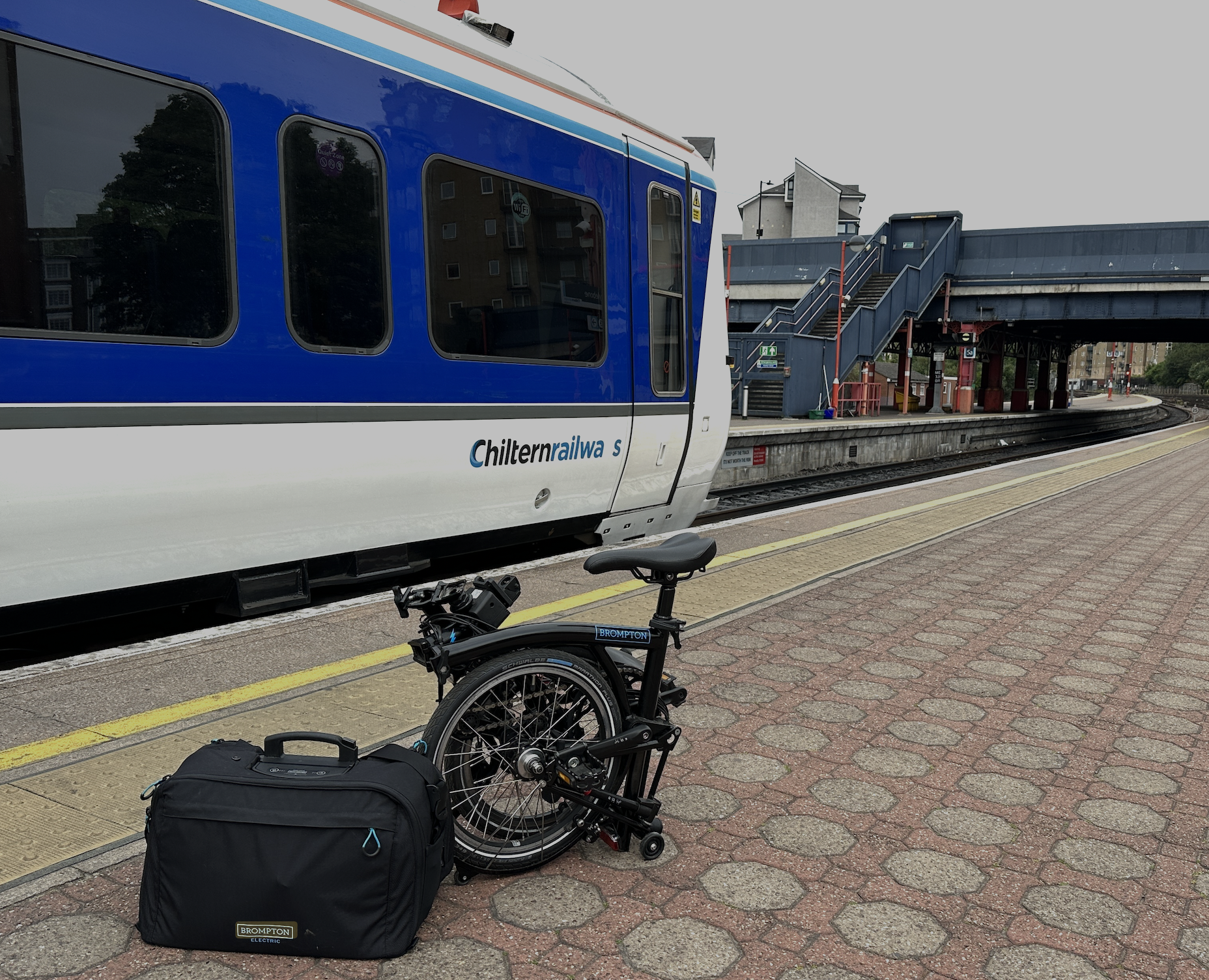
My first e-bike was a Brompton Electric. I found it brilliant for commuting to London: I’d cycle to the local railway station, pop the folded bike on the train, and spin across town from Marylebone to various places in the West End and City. I saved over £16 a day in car parking and the cost of the onward London tube journey from Marylebone. And it meant one fewer car on my local roads. I wrote more about my Brompton Electric experience here.
Electric bikes might make you cycle more
Hills? No fear
There are days when just don’t feel like cycling. But then I remember my electric Trek Domane. I took the photo above on my first ride on it, three years ago this month, when I relished the feeling of traversing the hilly Chilterns without quite as much effort. I still burned a lot of calories, because of the 15.5mph cut off for assistance, and even below that you still need to pedal. The Domane has differing levels of assistance so you can decide how much you want to exert yourself. I confess I usually choose the maximum help – I’ll choose my unpowered bike if I want a proper workout.
An e-bike makes family rides easier
An e-bike would be helpful… Masca, Tenerife
The beauty of an e-bike is that it helps less powerful riders keep up with their more athletic cycling friends and family. I first noticed this in 2019 riding up a very long, steep hill near Masca in Tenerife. I was very surprised to be overtaken by two small children. When their parents followed them past me I realised the whole family were on e-bikes. I was envious…
The Guardian newspaper has been running an amusing correspondence about school reports in its letters column. My contribution appeared in today’s paper – quoting two of my Cardiff High School reports from the 1970s, the first from my third form (the modern year 9) maths teacher.
I have an almost complete set of my school reports from 1972 to 1982, just before I sat my A levels. Looking back, it is striking how brief primary school reports were in the early 1970s. Take this example from Lakeside Primary School, Cardiff:
(There was a brief summary by the class teacher as well.)
In those primary years, there was a section about handwriting, and few reports went by without a comment about my poor handwriting. ‘If only he could be neater!… Untidy! … Still lacking in shape… poor…’ My mother even bought me a copy of Teach Yourself Handwriting but my attempts to practise neater writing didn’t last long. To be fair, my handwriting had improved by the time I sat my A levels – I can still easily read my mock exam essays.
Rereading the old reports, I was surprised to see a glowing report from the primary teacher I liked least, when I was nine. Miss Lloyd was terrifying, and almost the first thing she said to me was, ‘What language is this – Chinese?’ on seeing my handwriting. One day she told me off for losing so many pens, and threatening dire consequences if I lost another. Needless to say I did, and I vividly remember lying in the bath that evening, stressed about going into school the next day. Nothing happened, but 52 years later I was amused to see her comments in the report: ‘At times he is possibly over-anxious and perhaps takes life rather too seriously’…
Curiously, my Welsh teacher Mrs Davies always praised me for working well or very good work even when giving me a C rating.
My worst ever school report, just before my O levels
I was well into my fifties when Dad gave me a stack of my school reports that he and Mum had kept. It was unusual for him to keep old school materials and books – as I blogged recently he tended to throw these away without telling me. I read the report above, issued just after my O level mocks, with some pain. I had done very badly in some of my subjects, especially chemistry and French, and my teachers stated bluntly that I needed to work much harder to do well in my O levels. (My mother had made a similar point when she found me day dreaming rather than revising over the Christmas holidays.) The warnings worked: I did reasonably well, especially in my favourite subjects, history, commerce and English language and literature, and didn’t disgrace myself in the others.
One postscript to that report. My O level chemistry teacher says that I would be better suited to CSE rather than O level. The Certificate of Secondary Education ran in parallel to O levels, and was designed for less academically able pupils. I was mortified at first to be told I couldn’t sit chemistry O level (although with 22 percent in the mock, it was clear I would fail) but loved my five months in the CSE chemistry class. It was clearly at my ability level, and I got the top CSE grade, 1, in the exam. Years later a school friend, Alison, recalled being surprised when I joined the CSE class: ‘We thought you were brainy!’ My experience showed the importance of adapting education to the needs of the child rather than a one size fits all approach. CSEs and O levels were replaced by GCSE eight years later.
Looking back, I can see that I didn’t work nearly as hard as I should have done especially at high school. My 16 year old son Owen is working far harder and achieving much more consistently high grades. In short, he’s much more conscientious than his father was…
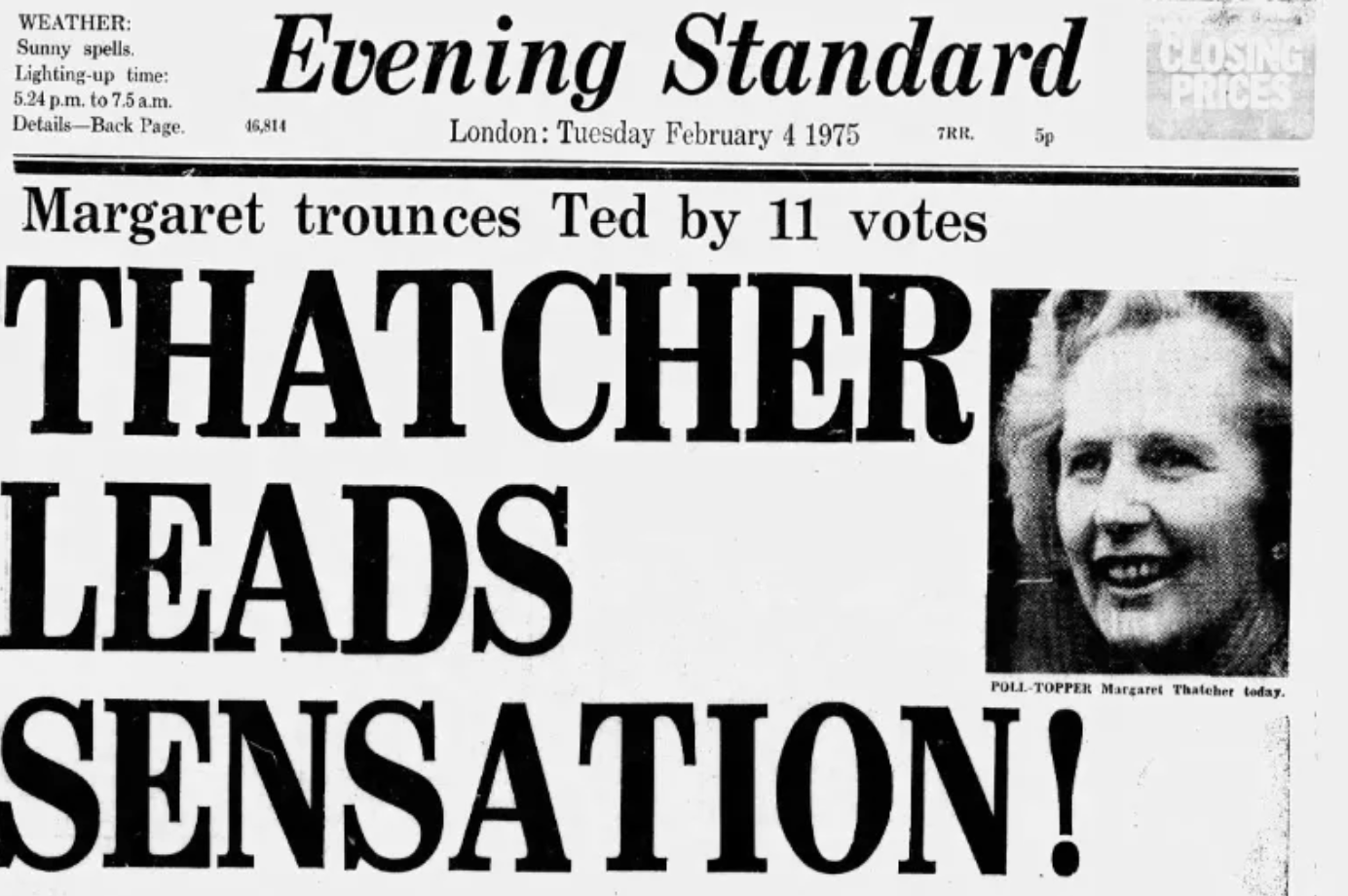
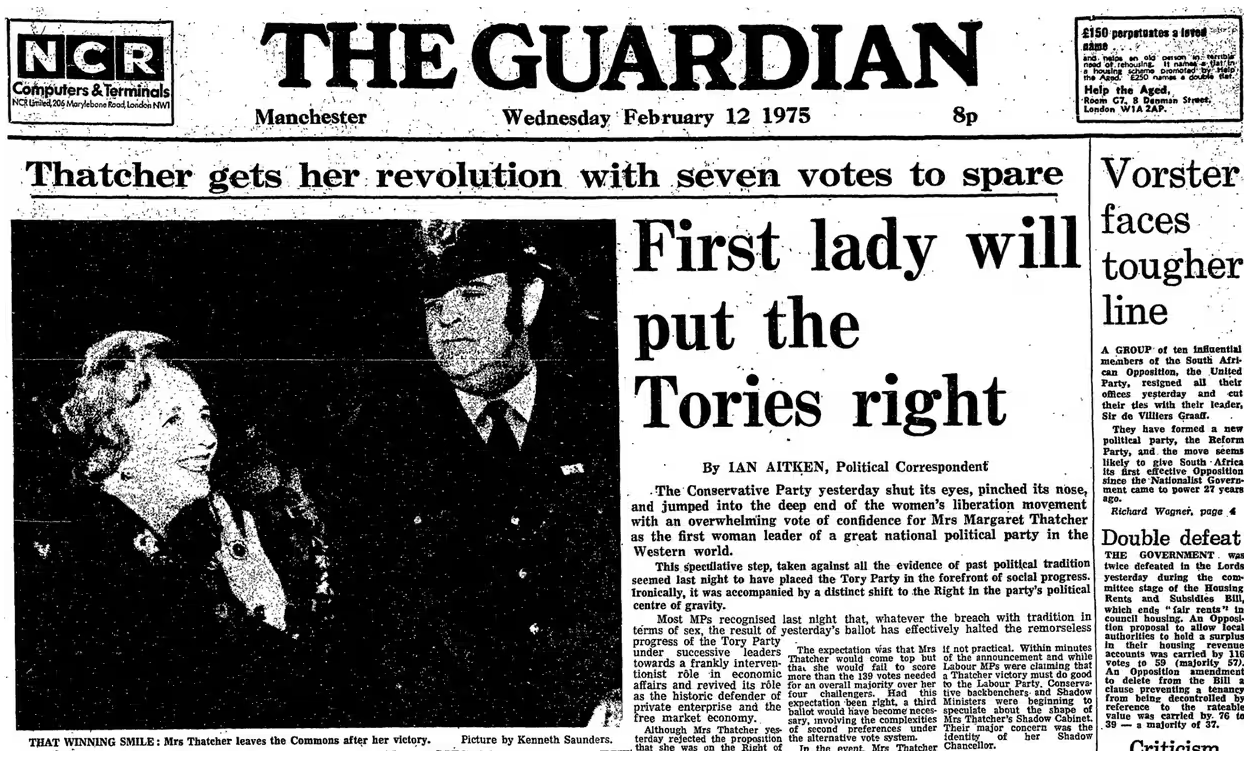
Reflections on Margaret Thatcher’s shock victory 50 years ago this week in the leadership election that eventually led her to become Britain’s first woman prime minister
I was just 11 when Margaret Thatcher amazed the political world by ousting former prime minister Edward Heath to become Conservative party leader 50 years ago this week. But as a precocious schoolboy I was fascinated.
Even in 1975, it was hard to see how Heath could cling on to the leadership. He had lost two general elections in eight months the previous year. His four years as premier had been a series of crises, and when he called the first 1974 election with the question ‘Who governs Britain?’ the voters refused to give Ted Heath’s Tories as the answer. (A hung parliament was the messy outcome.) And he was extraordinarily rude to his colleagues – people he needed to vote for him.
Thatcher had been a largely invisible middle ranking cabinet minister – apart from earning infamy as the ‘milk snatcher‘ after abolishing free milk for primary school children. But after the successive 1974 Tory election defeats she became far more prominent. Thatcher made the headlines in the second 1974 election with a plan to abolish the rates, the tax that funded local councils, and to cut the cost of home loans. As the 1975 leadership campaign unfolded, she brilliantly led the Conservative response to Labour’s finance bill, showing a mastery of detail. Thatcher also dissed the performance of the Heath government, telling the Daily Telegraph, ‘People believe too many Conservatives have become socialists already’. (An uncanny preview of right wing criticisms of the Johnson and Sunak governments almost 50 years later.) Yet few saw her as a likely party leader.
Her campaign manager, Colditz escaper Airey Neave, leaked news that Thatcher was ahead of Heath in polling for the first leadership ballot. (They were the only two candidates at that stage.) He cleverly encouraged those who wanted to oust Heath to back her in the initial vote, as that was the only way they could get their preferred candidate into the race. Heath was humiliated by coming second to Thatcher and pulled out, beginning a 30 year ‘incredible sulk’ against Thatcher that lasted until he died in 2005.
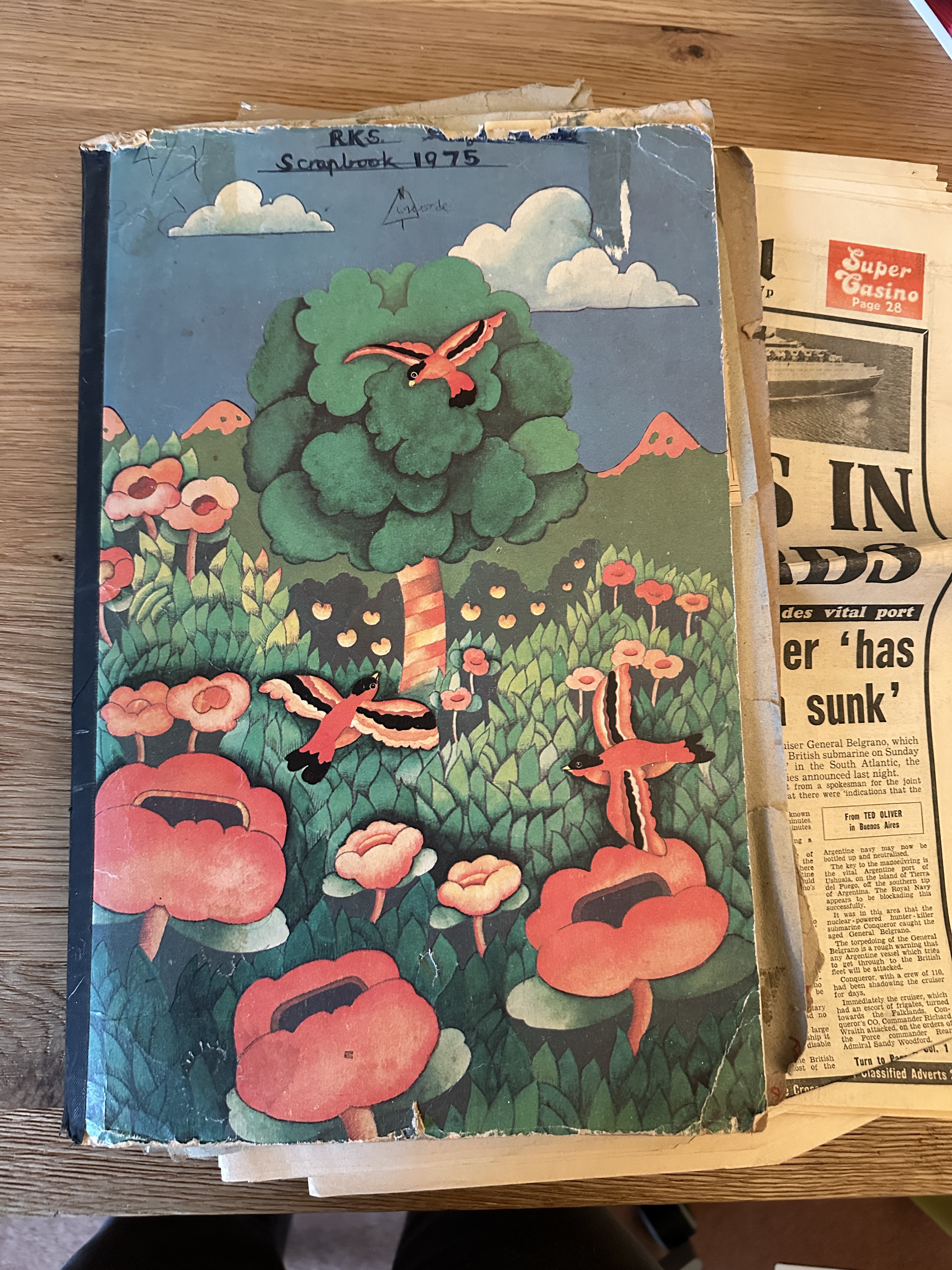
Do any children today keep a scrapbook? It seems very unlikely given almost every aspect of our lives has gone digital. So I was thrilled to rediscover my 50 year old childhood scrapbook, overflowing with yellowing newspaper cuttings. I wrote Scrapbook 1975 on the cover – I wonder whether it was a 1974 Christmas present? I seem to have written my Lakeside, Cardiff class, 4/1, there too.
I must have noticed that my scrapbook had 84 pages – one for every year of my beloved grandmother’s life at that point. (Nanny lived to within months of her 103rd birthday in 1994, as I blogged last year on the 130th anniversary of her birth.)
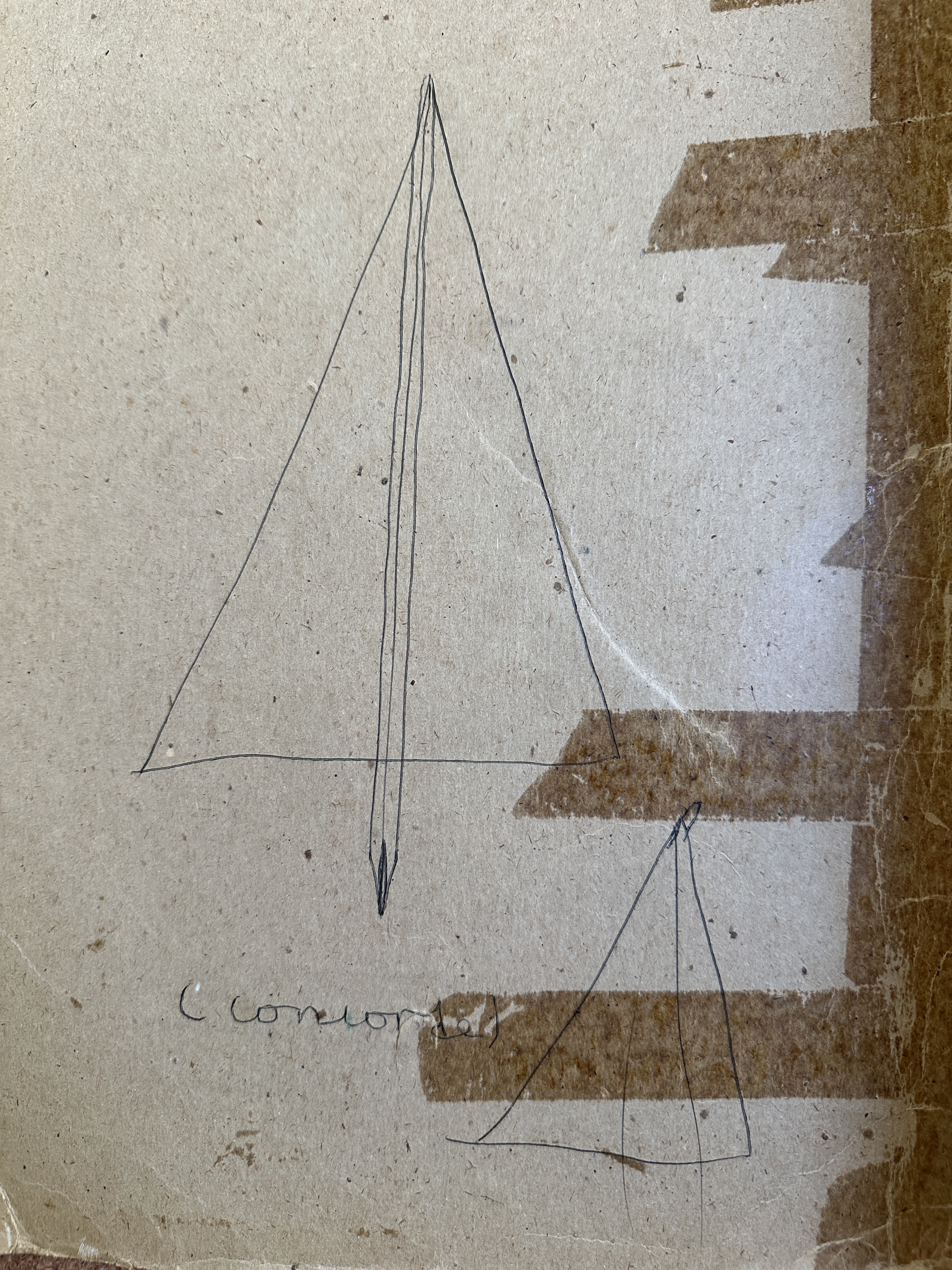
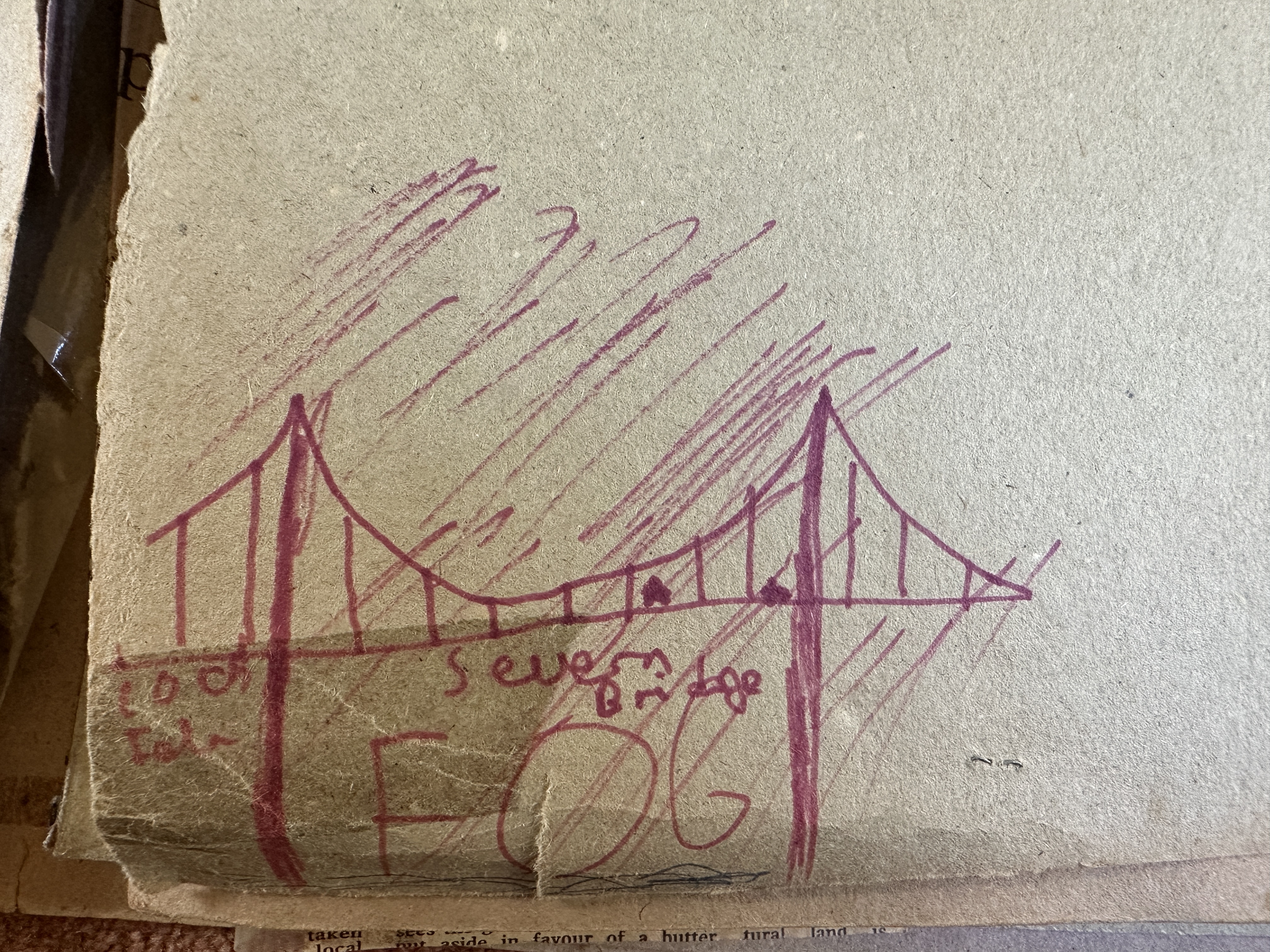
On the inside cover, I drew (badly) an impression of Concorde, the supersonic passenger plane that was to enter service the following year. These were the supersonic seventies, in the words of a 1970 Cadbury’s television advert… I never flew in Concorde, although I did walk through one in a Somerset museum in 1978. It wasn’t the same…
During the three day school half term, on Monday 10 February, Mum and Dad took me to Bristol for the day. If my scrapbook sketch is anything to go by, it was a foggy day. As a book lover, it was no surprise that my favourite part of the day was going to George’s bookshop, on Park Street. According to blogger Sue Purkiss, George’s dated back to 1847, so I was entering hallowed territory that foggy February day. At the time I was a big fan of Jackdaw children’s folders, a fascinating series of folders that illustrated historical topics with facsimiles of related documents. I received the Battle of Britain one Christmas, which included a wartime identity card and a 1940 Daily Mirror. I added my late grandfather’s real second world war identity card. I wouldn’t be surprised if I bought another Jackdaw at George’s. All I know for sure is that I took one of the bookshop’s bookmarks, as it’s in my scrapbook with the date on it. Sadly George’s is no more, like my old Cardiff spiritual home, Lear’s bookshop in Royal Arcade.
Everyone’s heard of the loss of Titanic in April 1912, the world’s most famous peacetime shipping disaster. It lives on thanks to the scale of the human tragedy and a sense of hubris: the supposedly unsinkable ship that ended up at the bottom of the Atlantic.
One man’s reputation was ruined on that deadly night. J Bruce Ismay was on board as the chief executive of Titanic’s owner, the White Star Line. As the great ship set out on its maiden voyage he seemed to have it all: wealth, power and prestige. He had succeeded his late father in 1899 as head of White Star but within three years sold the company to JP Morgan’s new shipping conglomerate, International Merchant Marine (IMM). Ismay became president of IMM and masterminded the building of Titanic and its sister leviathans Olympic and Britannic, believing that these giant luxury ships would give White Star a competitive advantage over rival lines such as Cunard. (Their size also made them ideal for the thousands of people emigrating from Europe to the United States; those travelling steerage did so in greater comfort than on most rival liners.)
There are countless books and online stories about the Titanic’s fatal encounter with the iceberg, so here I’ll focus on Bruce Ismay’s dramatic fall from grace.
Titanic’s collapsible D lifeboat, similar to Ismay’s collapsible C
In the early hours of Monday 15 April 1912, Ismay stepped into starboard collapsible lifeboat C, and into infamy. He made it clear to the American Senate inquiry into the disaster that no one ordered him into the lifeboat, giving the following reason for his entering the boat:
‘Because there was room in the boat. She was being lowered away. I felt the ship was going down, and I got into the boat.’
According to most of the accounts of that tragic night, Ismay helped load the lifeboats, calling out for any remaining women to get in. He himself recalled complete calmness: no panic and no crowds of desperate passengers fearing for their lives as the last lifeboats were lowered. In reality, Titanic’s final hour was chaotic. The crew were nervous about filling the boats to capacity. So, although Titanic’s boats could carry 1,100 or the 2,340 people on board, only 705 were actually saved. Ismay’s own lifeboat had room for a few more to board, so he wasn’t condemning anyone to a freezing cold death by getting in. The White Star line boss couldn’t look as his great ship sank below the waves, accompanied by the shocking screams of those condemned to freeze to death in the ice-cold waters of the April ocean.
Cycling in Britain is a safe way of getting around and exercising. According to road safety charity Brake, one cyclist dies for every 33 million miles cycled. They sound like good odds, and they’re getting better. The casualty rate has been falling over the past decade, reports Cycling UK (even after discounting the impact of the pandemic, when there were blissfully few cars on the road).
Despite all this, many people say they’re too frightened to cycle on Britain’s roads. If you’re inexperienced, a busy urban road understandably feels like a scary place. And most accidents happen at junctions, rather than on the open road. Ironically, I have found central London one of the most enjoyable places to ride a bike, even in the rush hour, as the city now has many miles of segregated cycle routes, where bikes and cars are kept apart. There’s little chance of that luxury where I live in the Chilterns.
There are things cyclists can do to improve the odds, regardless of where we cycle. Cycling UK has plenty of tips. Meanwhile, I have had two positive results over the past month in the small steps I have taken to make my local roads safer for cyclists.
Report those potholes
Potholes are a serious danger for cyclists, while causing expensive damage to bikes and cars. They are a particular danger in bad weather – when you can mistake them for mere surface water – and at night. I recently rediscovered Cycling UK’s brilliant tool for reporting potholes: Fill that Hole. (Anyone can use it – car drivers as well as those on bikes.) I got an informative response confirming that the huge hole on the A355 where it crosses M40 junction 2 would be repaired in the coming month or so after others reported the hazard. In my experience, potholes do get repaired when you report them. It takes just a couple of minutes to file a report, which can include photos.
Report dangerous drivers
My biggest concern when cycling is drivers who pass far too closely. The Highway Code requires drivers to allow a passing distance of at least 1.5 metres (5 feet) when overtaking cyclists, but few drivers follow the rules. Out on the roads of Buckinghamshire and neighbouring counties, I’ll usually experience at least one car or van passing closer than I’d like on most rides. It’s rarer for me to experience a sense of danger – but two years ago I decided to report the serious cases to the Thames Valley Police. It’s very easy to do this online: the form requests the necessary information, and you can upload video.
I’m very selective about those I report. I only act against those close passes where I felt in danger. To capture the evidence, I use a Cycliq Fly12 Sport front camera, which contains a front light as well. In my first 18 months, I have reported two drivers, and on both occasions Thames Valley Police has taken action against the driver. You can see the latest overtaking case above.
I decided at the beginning not to report every incident. As an experienced cyclist, I am not fazed by traffic, and my view is that if I’m not unduly bothered at the time there’s no reason to file a report, even if the driver hasn’t left the required passing distance. Others, notably CyclingMikey, who has reported over 1,000 errant drivers, including Chris Eubank and Guy Ritchie, are more interventionist. I am more likely to report commercial drivers as they are likely to drive further than private motorists, putting more cyclists in danger, although the first person I reported was in a private car who ran me off the road on a single track road.
I have found the Cycliq a brilliant bit of kit, especially as it is largely ‘fit and forget’. It records over earlier footage when the memory card is full, so you don’t have to worry about replacing the card, and it records for up to seven hours between charges. You can flag incidents you want to save by pressing the Q button to keep the relevant video segments.
Cycliq is the subject of negative comments online about its customer service, but I have found the camera very reliable.
The cycling revival
As I mentioned at the start of this post, cycling is far safer than many think. Modern bike brakes and lights are vastly better than when I started cycling as an adult over 35 years ago. Better still, there are far more people on bikes today, compared with when I was growing up in the 1970s – possibly the low point for cycling in Britain, when car ownership was booming and cycling was seen as a poor person’s way of getting around. Long may the cycling revival continue.









 Ertblog