You see them everywhere, dangling from people’s ears as they grab a coffee or run for a train. Apple’s AirPods have become the equivalent of the Sony Walkman in the 1980s: the way we listen to music on the go. (Other brands are available.)
Yet they have proved our family’s most unreliable Apple product by far. We’ve had four sets failing, and friends report a similar experience. The issue is the same: barely any sound coming from one AirPod while the other is playing normally. Today, I made the familiar trek to the Apple Store to get my son Owen’s faulty AirPod replaced. This is his third AirPod failure in 14 months.
Needless to say, Apple makes this very easy, and I was on my way in 25 minutes with the replacement. Perhaps more importantly, I was given an explanation for the failures that, with luck, will help us avoid another failure. I hope so…
Apple AirPod and bud
It’s all down to dirt collecting on the mesh of the AirPod buds, which then works its way through to the actual AirPod. Regular cleaning is the answer – the guy at the Apple Store Genius Bar recommended lightly dabbing the AirPod mesh with some Blu Tack, to remove the dirt. (I have not tried this yet, so take care if you follow this advice.) He also recommended replacing the buds every now and again. I was given a replacement as the faulty AirPod could not be repaired. Apple’s website gives further cleaning advice here.
It seems that AirPods are very sensitive and vulnerable to dirt, so it makes sense to keep them clean. And if you’re experiencing any issues, do take them along to your nearest Apple Store, especially if you are close to the end of any warranty period. (Although Apple did replace my three year old AirPods last year free of charge.)
Apple Store cupboards around the world must be overflowing with replacement AirPods!
Strava has emailed me to say that I joined the exercise tracking service 10 years ago.
My modest early Strava months in 2014
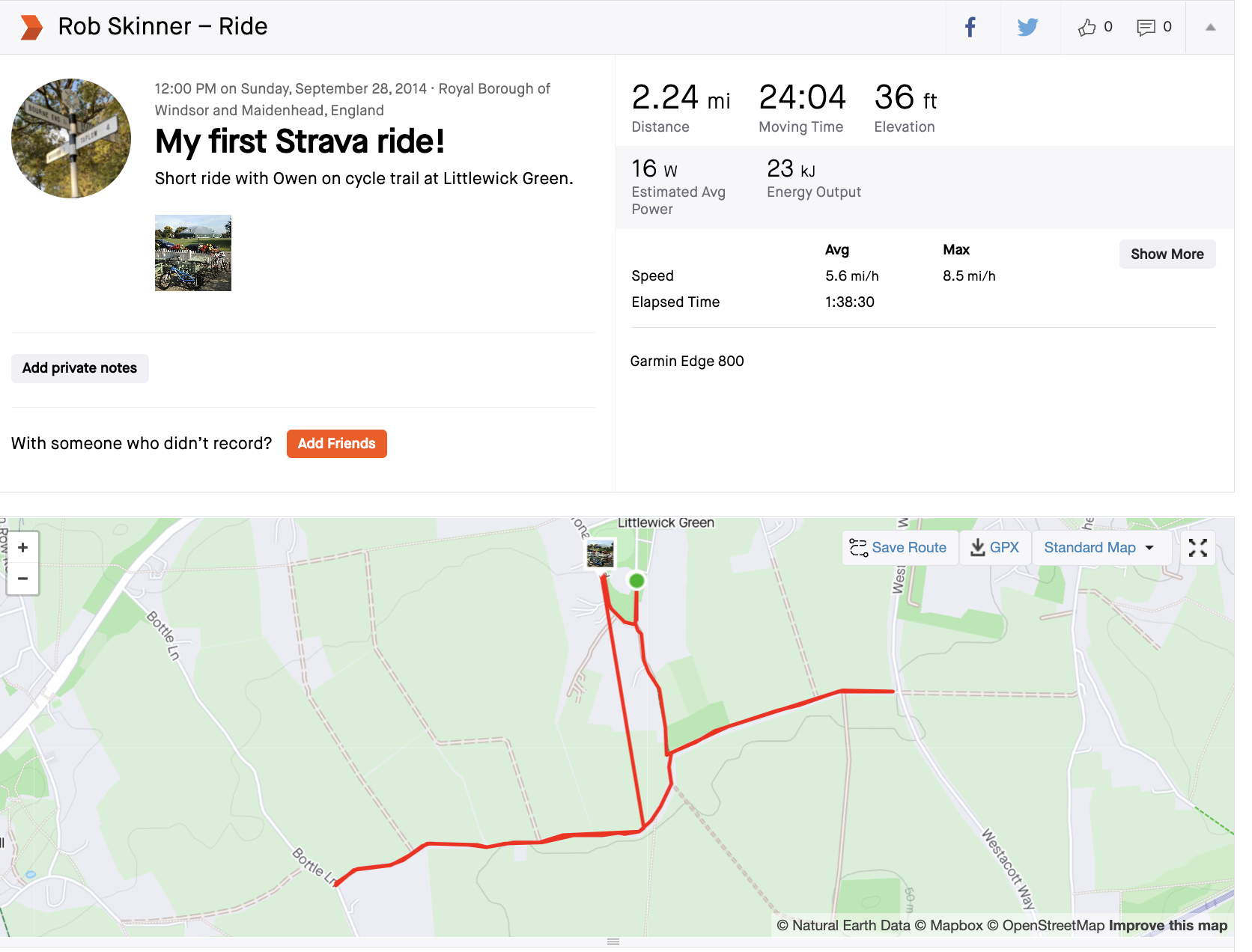
In those early days in 2014 and 2015, I rarely recorded a bike ride longer than 10 miles. My first Strava ride was less than three miles: a ride with Owen, then aged 6, on his own bike, along a Sustrans trail in Berkshire. The following year I cycled 800 miles, and only passed that milestone because I saw on Strava that I was 37 miles away from it.
That first Strava ride
By contrast, I notched up more than 6,250 miles in 2021, including over 500 miles every single month. Strava has definitely motivated me, and I was thrilled earlier this year to record my best ever time up a local hill, Bottom Lane in Seer Green – beating my 400 or so previous ascents on this segment.
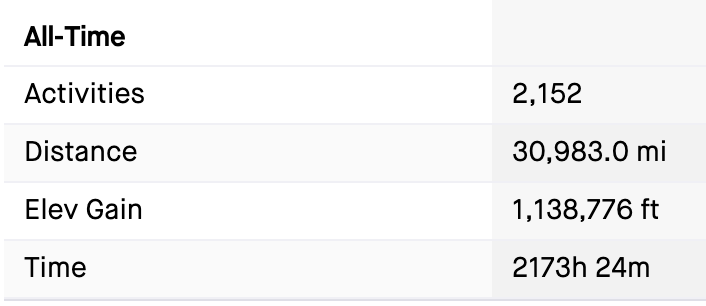
This is my Strava career to date: almost 31,000 miles of cycling, including over a million feet of climbing. My longest ride was the 407km (254 miles) of London Wales London this May, while the biggest climb was the 4,829 feet ascent of Mount Teide in Tenerife from the west in 2019. (Unbelievably tough, especially as my hire bike didn’t have a low enough gears.) London Wales London was also the ride with the biggest climbing tally, at over 13,000 feet.
I love having such stats at my fingertips. I will never be a racing cyclist, but I do enjoy looking back at how far, high and fast I’ve gone. It’s also nice to have mileage stats for my bikes. I’ve done over 7,000 miles on two bikes, with the prize currently held by my Cannondale Synapse, which I sold to a friend a couple of years ago. I should overtake that 7,250 mile record on my Diverge gravel bike in the next couple of months.
Fifty years ago today, I broke the light in the loft of our Cardiff home. I only know the date this happened because a far more historic event happened the same day. Britain held a second general election in eight months – only the second time two general elections had taken place in a calendar year. (The other time was 1910, when the Liberal government was locked in a titanic battle with the unelected House of Lords to pass the People’s Budget, which introduced Britain’s first state pension.)
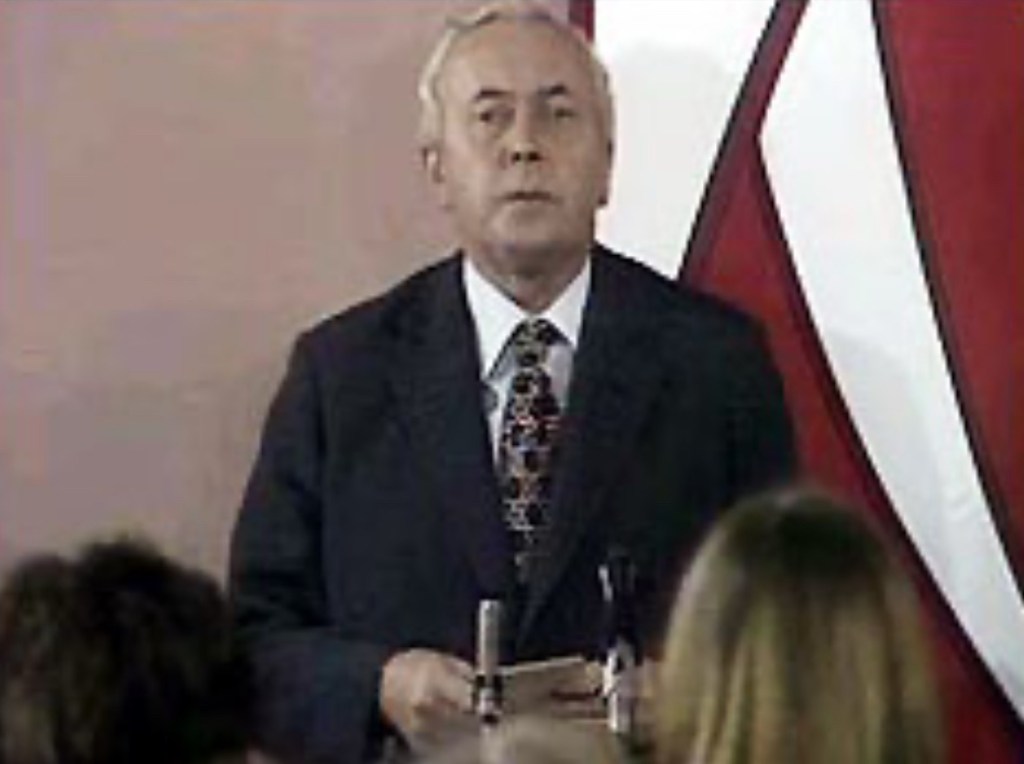
Harold Wilson had very narrowly won the first 1974 election in February, picking up fewer votes but a handful more seats than the Conservative government, led by Ted Heath. The Tory PM had gone to the country in the midst of a bitter battle with the striking coal miners. He framed the vote as ‘Who governs Britain?’ The electorate (at least by the rules of the UK’s first past the post voting system) answered: ‘Not you!’
It was clear that, hampered by the first hung parliament since the war, Wilson would soon call another election to try to win a working majority. In the event, he gained a margin of a pitifully thin three seats. There followed a chaotic, exhausting yet enthralling period in British politics. Wilson himself surprised almost everyone by stepping down aged 60 in 1976, leaving Jim Callaghan to cope with the loss of that wafer-thin majority in 1977. He negotiated the Lib-Lab pact with the Liberal party and the government survived until losing a confidence vote in March 1979. The election that followed brought Margaret Thatcher to power as Britain’s first woman prime minister.
I met Callaghan six years later, when Dad and I visited him in his House of Commons office on a mission to secure a work permit for a musician from Hong Kong who was appearing in a concert in Cardiff. I’d just graduated from university, and Sunny Jim asked me what I wanted to do for a living. When I replied that I’d like to work in PR or journalism, Callaghan turned to my father and commented, ‘They all want to do that know, don’t they!” I tell the story of that meeting in more detail here.
For the first time in 28 years, I’ve travelled to Ireland by train and ferry.
It was inspired by a post by rail travel expert The Man in Seat 61. As a result, I took the route of the Irish Mail, which operated for over 150 years between London and Dublin.
But first, a rant…
Over 25 years ago, I endured another passenger’s mobile phone conversation on a late night train journey from London to Wiltshire. I remember that he was discussing the merits of various films. I hoped it would be a short conversation but it lasted for the hour it took for the train to reach Swindon.
Things are so much worse today. People think it’s fine to have conversations with the whole chat broadcast on their phone’s speaker – and to watch a film in the same intrusive way. When did people become so utterly selfish?
Soon after I took my train seat at London’s Euston station, I was on edge when someone opposite held a mobile chat on speaker. I was relieved when he moved away without any intervention by me. But a couple of hours later a guy behind me started watching a film with his smartphone blasting out the soundtrack on full volume. Three women tried to reason with him, but he seemed to think they were taking away his human right to inflict noise on everyone around him. I supported them, and I was relieved when he moved out of our carriage. I was glad he gave way. But why should we have our peaceful journeys ruined because of another passenger’s selfishness?
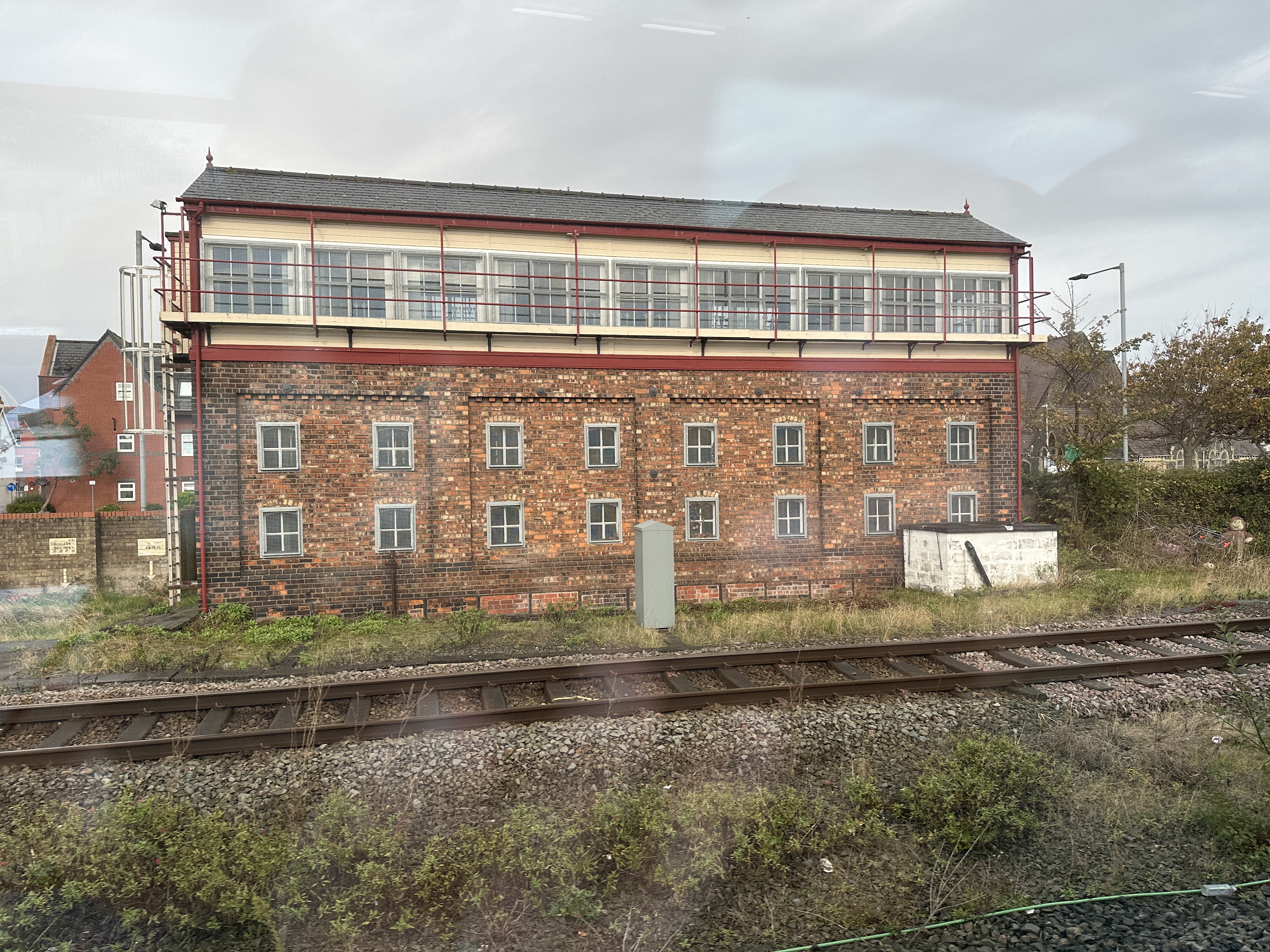
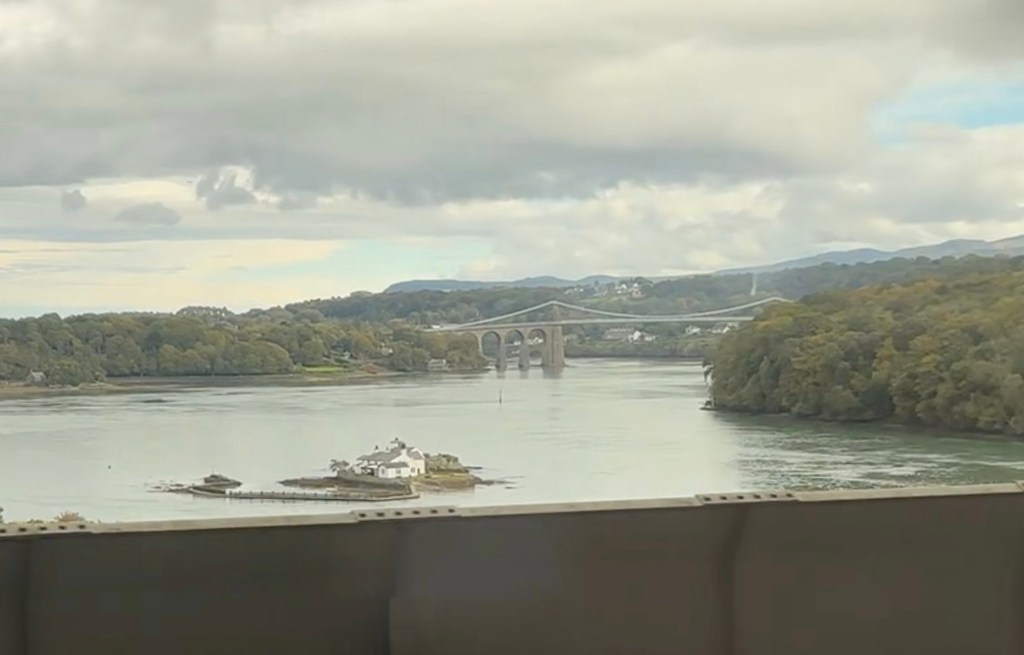
On a happier note, the North Wales coast line is a delight. Many of the original 19th century station buildings and signal boxes survive along with a few semaphore signals in Anglesey. The route hugs the Irish Sea shore and crosses the historic Britannia Bridge to Ynys Môn, Anglesey. This was one of Robert Stephenson’s monumental accomplishments but sadly the old tubes that carried the rails above the Menai Straits were fatally damaged by a fire started accidentally by two children in 1970. The bridge was rebuilt in more modern form two years later and in 1980 an additional deck was added to provide a second road bridge to Anglesey. The old bridge was flanked by two statues of lions, and I glimpsed one of these as my train headed across the bridge. The BFI has a wonderful film of an LNWR train crossing the original bridge in Victorian times here.
Happily Stephenson’s 1848 tubular bridge at Conwy survives – perhaps the only one left anywhere in the world.
Telford’s 1826 Menai Bridge from the Britannia rail crossing
I was amused that the on-train safety announcement was in Welsh – before we’d even left the London suburbs! But I discovered that the irritating ‘See it, Say it, Sorted’ slogan is just as annoying in Welsh, as ‘Wedi sylwi, Wedi sôn, Wedi setlo”…
I sailed to Ireland on Ulysses, an Irish Ferries super ferry. It’s the size of a small cruise liner, and although it tales longer than a fast ferry, it is almost never cancelled because of the weather. It was an easy and enjoyable way to travel, although for the first time on a ferry I had to put my bags through a security scanner. There were no restrictions on liquids, though.
I assumed that the ferry would be birthed next to the railway station but the ferry terminal has moved a mile or so, presumably to accommodate modern, bigger ships.
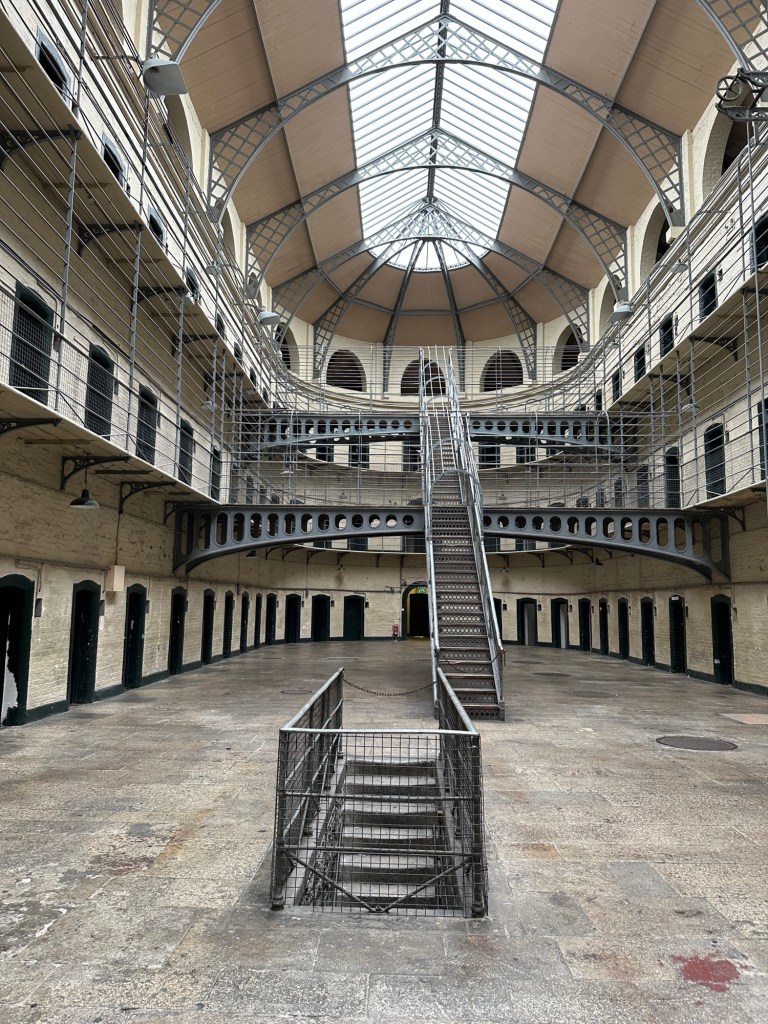
Kilmainham Gaol
I love my visits to Dublin, and this was no exception. My friend Louise kindly collected me from Dublin ferry port and took me to my hotel, the Maldron in Smithfield. The following evening, Louise, Aidan and I had dinner after convivial drinks with Allan Chapman and Barry Chapman from PR agency Comit. These get togethers always prompt serendipitous conversation: this time, we talked about family connections to the Australian goldfields and Ned Kelly.
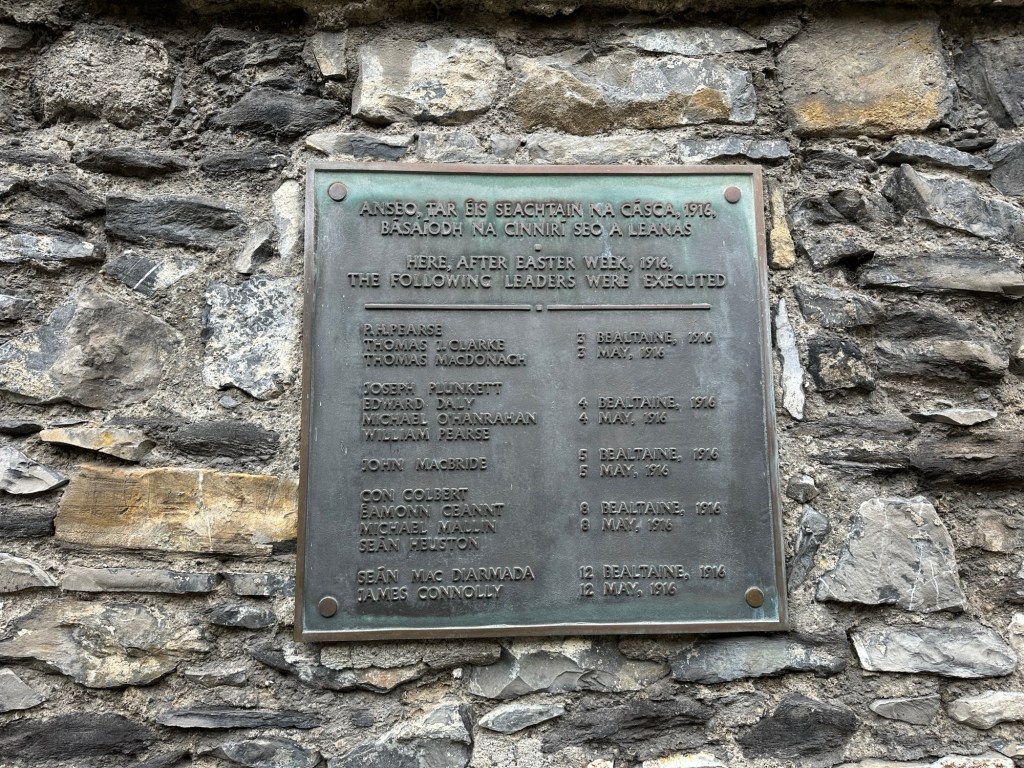
Earlier, I toured Kilmainham Gaol. This prison is over 225 years old, and replaced dungeons as a home for Dublin’s prisoners. It is best known as the place where the men and women who fought for Irish independence were held and in all too many cases executed. It was sobering to see the spot where those who took part in 1916’s Easter Rising were shot, marked by a simple wooden cross. A few metres away another cross symbolised where James Connolly was executed by firing squad sitting in a chair as he was unable to stand because of injuries he sustained during the rising. I blogged about the Easter rising and the British reaction to it on the centenary in 2016.
There’s also a plaque commemorating those executed at Kilmainham by the Irish Free State army during the Irish civil war in 1922.
On a more lighthearted note, I learned on the tour that the prison scenes in the Paddington 2 film were filmed at Kilmainham.
Finally, the old spelling gaol reminded me that I was completely stumped when asked to read it aloud at school in Wales 50 years ago. I think I said ‘gale’. The Guardian was still using the old spelling well into the 1980s before conceding and adopting the modern spelling.
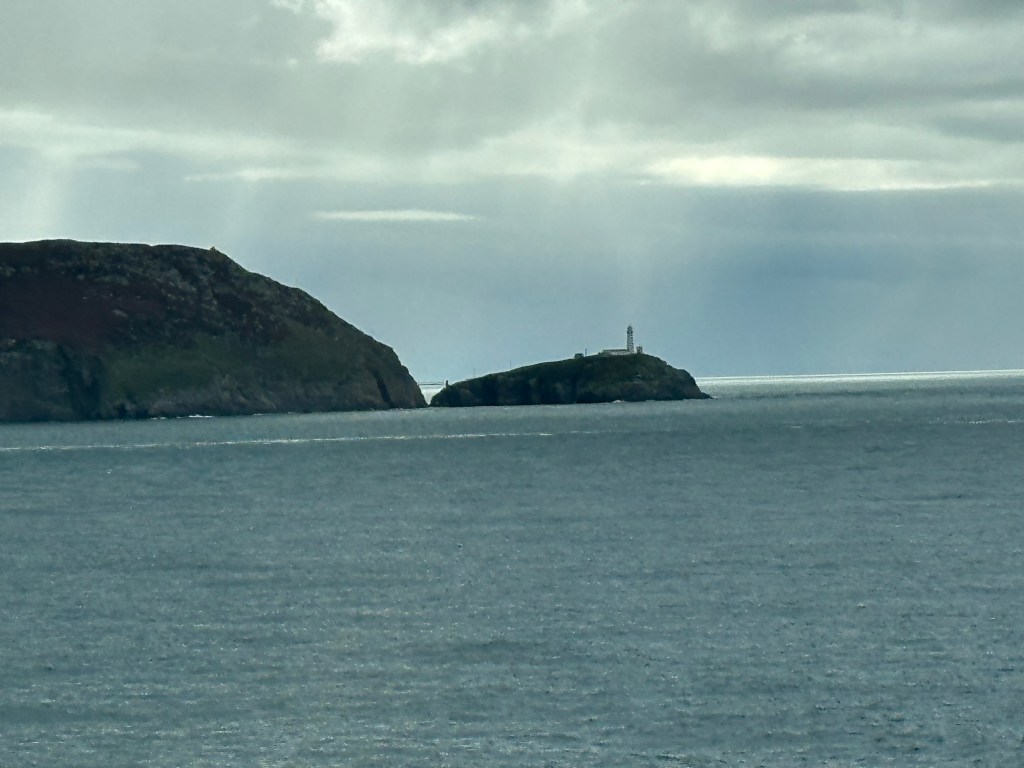
South Stack lighthouse, Wales
I enjoyed my land and sea journey to Ireland. I’d happily do it again, perhaps taking the car from Fishguard to Rosslare, as I did on my first visit to Ireland with Mum and Dad in 1974. Or by bike, as I did in 1996? Time will tell.
I was sad to hear that Herman Ouseley had died. The news took me back to a year working alongside Herman in Brixton in 1992.
Herman was chief executive of Lambeth borough council at the time. The Conservative government’s environment secretary, Michael Heseltine, had the wheeze of inviting deprived areas to compete for funding for projects to transform their areas. Lambeth Council still had a terrible reputation as one of the so-called ‘loony left’ councils in the 1980s, and Heseltine told Lambeth it had no chance of winning.
That’s where I come in. I was working for Eagle Star insurance at the time, which was owned by British American Tobacco. BAT had an extensive community impact programme focused on Brixton, and in early 1992 its chairman, Sir Patrick Sheehy, agreed to second a manager to Lambeth to help it put a bid together for funding to transform Brixton. I’ve always relished a challenge – and agreed to take on ‘mission impossible’.
Three days a week, I swapped the dull corporate landscape of my City of London workplace for vibrant yet cruelly deprived Brixton. I was based in the old Bon Marche department store, which had been converted into the Brixton small business centre. It was a maze of corridors and hidden rooms, and shook when trains passed just feet away on the railway line into central London. It was just a decade after the infamous Brixton riots of 1981, and a local bar offered a cocktail called Brixton Riot in a Glass…The deprivation that helped cause the riots had certainly not gone away.
I got to know and admire Herman Ouseley during that year-long secondment. I was impressed by his immense dignity and calmness, which must have helped him cope with the stress of running such a deprived borough. I was delighted when he went on to chair the Commission for Racial Equality. He was the perfect candidate given his own background as someone who came to Britain from Guyana aged 11, and endured the endemic racism that blighted Britain for so long. He went on to found Kick it Out, a campaign to end discrimination and racism in football.
We took a community first approach to our bid, holding a presentation to government officials at a local secondary school, and arranging for young people from the school’s video unity to film the event. I wrote a briefing for ministers that referred to Brixton as an area that had produced a prime minister – John Major, who won a general election just weeks later, featuring his old Brixton home in a party political broadcast. We also held a presentation to business leaders at Lambeth Palace. This showed how much Lambeth was changing – in the days of council leader ‘Red Ted’ Knight just a few years before it would have been unthinkable for the council to partner with big business.
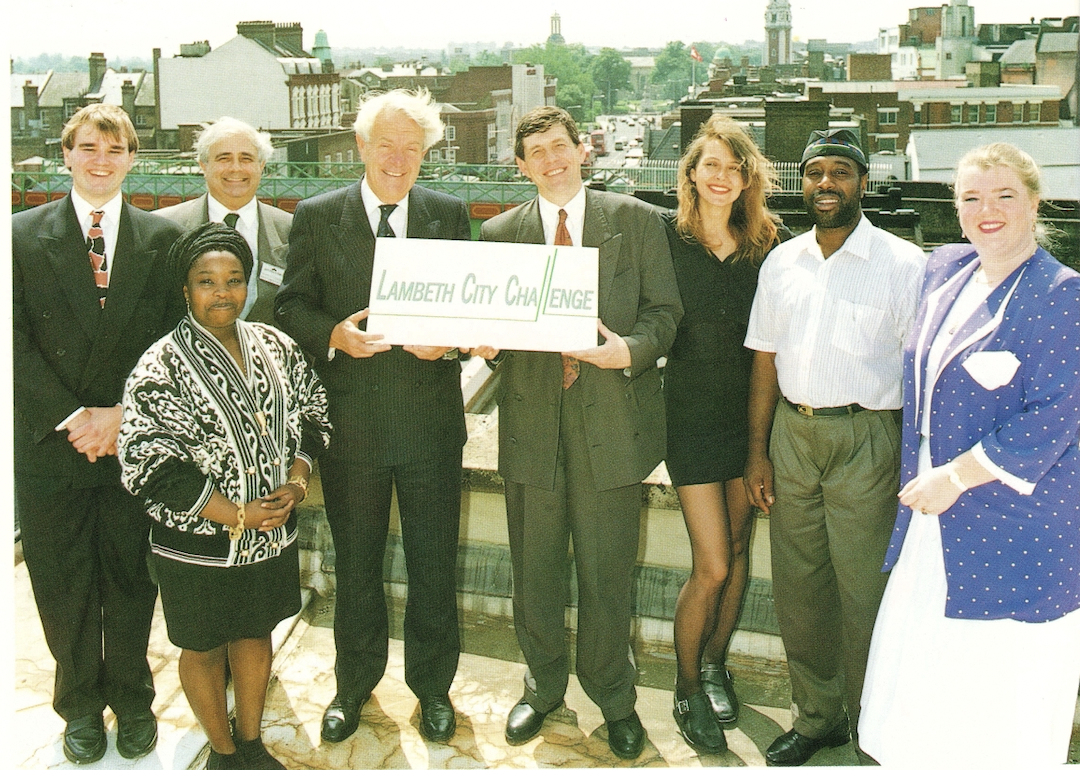
Winners! Government minister Nicholas Scott announces Lambeth had won. Rob on left
I’ll never forget the day Lambeth won. Nicholas Scott, a government minister, came to Brixton for a photocall, which we held on the roof of the small business centre. An ITV news film crew seemed less than keen to stand so close to a 200 foot drop to Brixton high street! It was a joyous day.
Three years later, I chatted to Michael Heseltine at a BAT event in London, and commented that I’d played a part in proving him wrong in dismissing Lambeth’s chances of winning. He was very gracious, but his mind may have been on other matters. All the talk at Westminster was about whether he would challenge John Major for the leadership of the Conservative party. He didn’t, but Major appointed him deputy prime minister days later after seeing off a challenge from John Redwood.
Reflections on Brixton Challenge
Even at the time I was troubled by the notion that deprived areas should compete for money. Why should the life prospects of someone living in poverty in Brixton, Toxteth, Moss Side or Handsworth depend on how good their council was at bidding? I agreed it made sense to get the private sector to invest in our inner cities, but BAT had already been doing that for some years. Indeed my boss during my secondment, BAT’s Brian Hutchinson, already worked tirelessly for Brixton.
A separate company, Brixton Challenge, was set up to oversee the implementation of the City Challenge projects. By all accounts it was not a smooth ride, and the project was criticised for not achieving what had been promised. But I look back with pride on one of the most satisfying years of my career, working with a truly diverse group of talented and enthusiastic people. Above all, I’m glad to have known Herman Ouseley.
One of my weekly pleasures is reading Jonn Elledge’s latest Newsletter of (Not Quite) Everything. It’s a mix of political commentary, transport and geographical trivia. In short, it could have been made for me.
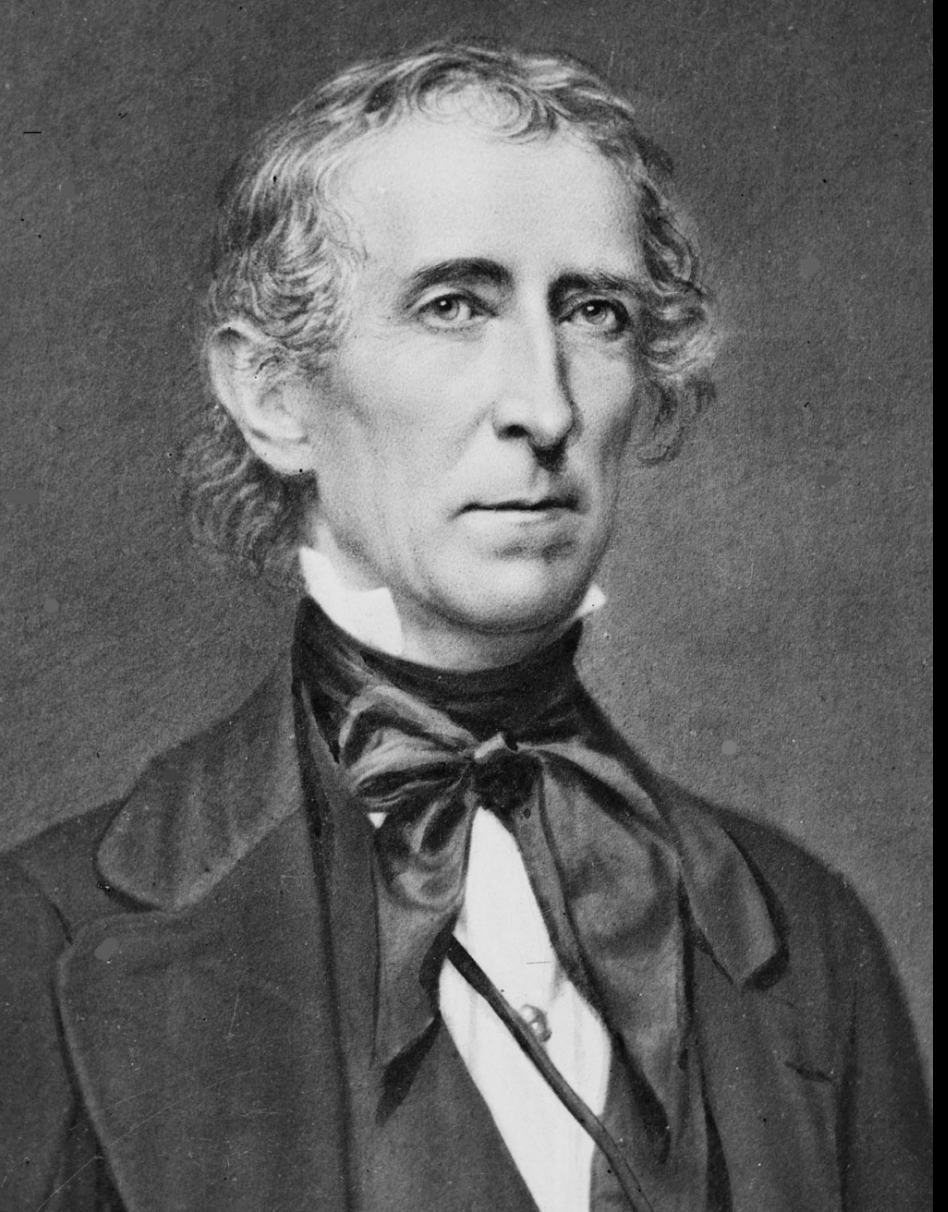
A recent edition contained just the kind of revelation that I love, and on the off chance that any of my readers don’t follow Jonn’s Substack I thought I’d reshare it. John Tyler, president of the United States from 1841 to 1845, has a grandchild still alive in 2024. (As of this January.)
This is Jonn’s version of the story:
In 1844, following the death of first wife, Tyler secretly married a woman 30 years his junior, the 24 year old Julia Gardiner. They had seven children, one of whom, Lyon Gardiner Tyler, would follow in his dad’s footsteps by marrying a second wife, Sue Ruffin, nearly 35 years his junior. One of their sons, Lyon Gardiner Tyler Jr, survived until 2020, when he died aged 95. Another, Harrison Ruffin Tyler, born in 1928, was reported to be still going as recently as January. So yes, it is entirely possible to be alive in the 21st century, and have a grandfather born in the 18th. Cool.
I found this amazing.
I’ve always cherished memories of my Victorian grandmother, born on Lenin’s 21st birthday in 1891, but this is in a different league. Not long ago, I tried to establish whether there had been anyone born before Nan was born in April 1891 who was still alive when my son Owen was born in 2008. Such a person would have been over 117 in 2008 for this to have happened. People have lived longer than that, but my Googling academic research suggests that their lifespan didn’t match the 1891-2008 period. The closest match was Emiliano Mercado del Toro, who lived from August 1891 to January 2007. (No man has lived beyond 116 years; the oldest woman, Jeane Calment, reached 122.)
I’m looking forward to Jonn’s latest gems in this week’s newsletter! It’s well worth subscribing.
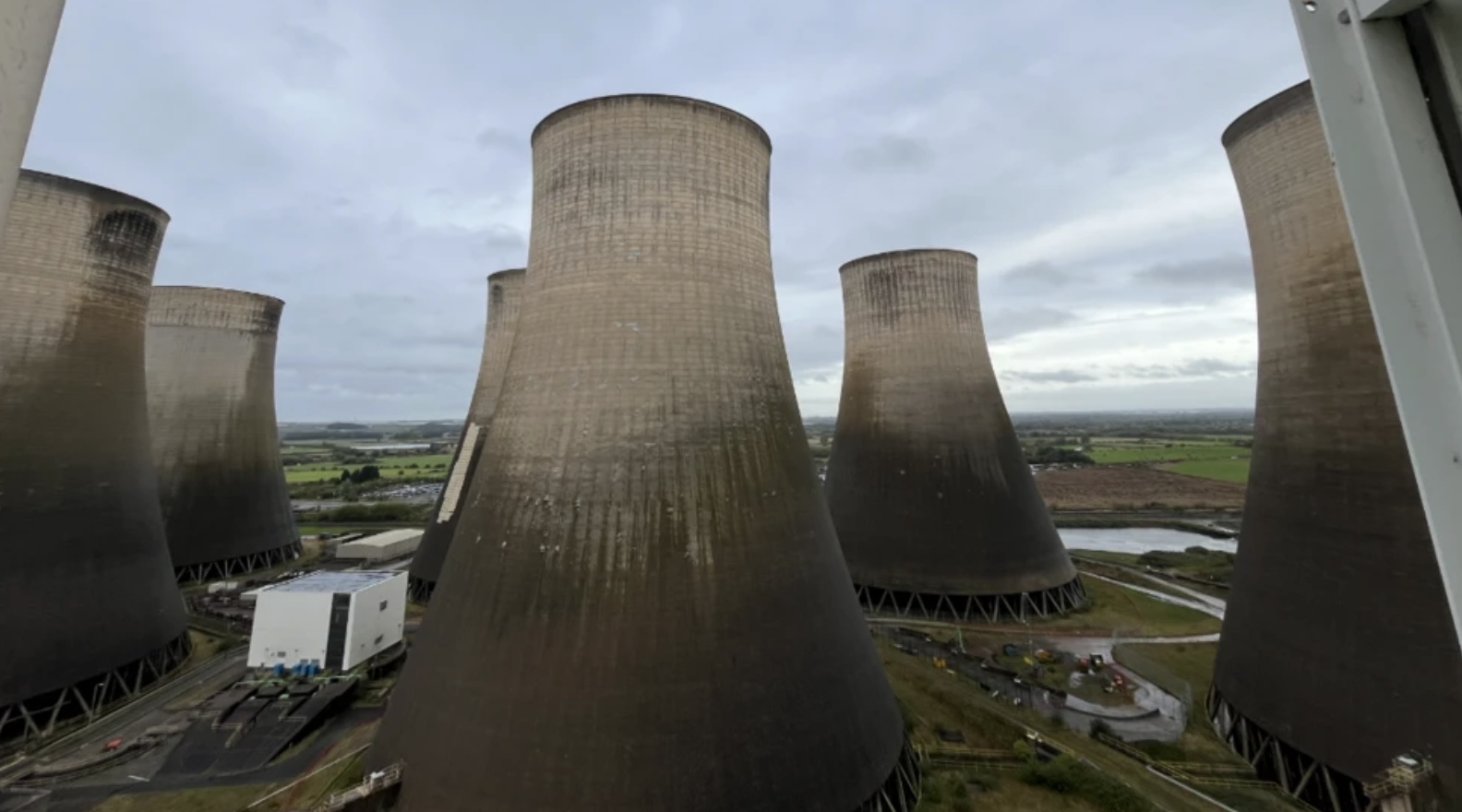
The cooling towers at Ratcliffe on Soar power station. Photo: BBC
The coal age in Britain is over. The country’s last coal-powered power station closed yesterday, marking the end of 140 years of generating power from coal.
I have fond memories of that power station, Ratcliffe on Soar. On a canal holiday in 1988, we moored in the shadow of its eight cooling towers, toasting its mighty presence with a bottle of gin. It dominated the East Midlands landscape.
‘Salt and pepper’: Roath Power station, Cardiff
Over 50 years ago, my late father Bob Skinner played his part in the destruction of the cooling towers at the old Roath Power station in Cardiff. Dad told me that he pressed the button that blew up one of the two towers, nicknamed ‘salt and pepper’. Full of pride, I told my school friends about Dad’s starring role in the event that featured on the Welsh news the night before. “No he didn’t – the [lord] mayor did!’ my friend replied. Over half a century on, I will never know the truth.
Didcot Power station – the cathedral of the Vale
DPSDPS from a Cardiff train, 2013
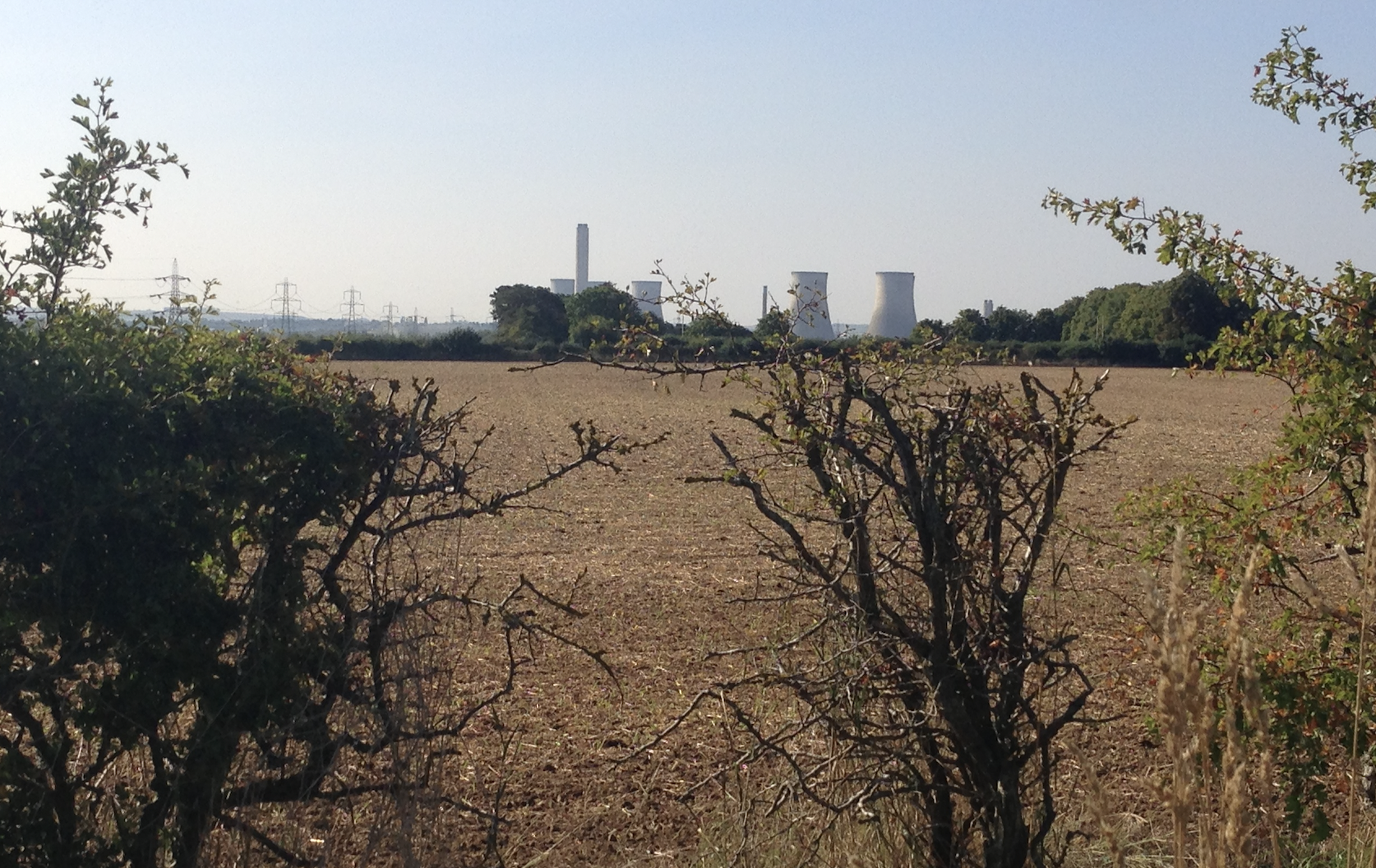
I was most familiar with Didcot power station in Oxfordshire. It was known as the cathedral of the Vale of the White Horse (though we called it DPS), as it could be seen for miles around, and was a milestone on rail journeys between London and Wales. The most striking views were from 18 miles away on the M40 motorway as it climbed the escarpment at Stokenchurch.
We mourned the loss of that iconic view after Didcot’s last three cooling towers were demolished in 2019. I hope calls to save at least one of the Ratcliffe on Soar towers are successful, so we can save part of this monument to the part coal played in powering Britain.
I’ve been dreaming of cycling across mysterious Romney Marsh to historic Rye for years. The inspiration was Jack Thurston’s first Lost Lanes book of bike tours, along with childhood memories of Malcolm Saville’s adventure stories for children based there. (More on that later.)
I finally followed Jack’s tour in September, and have made a documentary video about it. Unusually for my videos, this focuses less on cycling and more on the fascinating history of this corner of England. This blogpost tells the story of my ride, along with a longer version of the stories from the past featured in the video.
Here’s the video on YouTube. (Do please like and subscribe!)
Britain’s most spectacular railway station
My journey began at St Pancras station in London, Britain’s most spectacular railway station. When the Midland Railway decided it needed its own London terminus, it chose the most opulent neo-Gothic style for the station building, along with a stunning roof that spanned all the platforms. It overshadowed its neighbour, Kings Cross station, although the simpler lines of the older station have arguably stood the test of time better.










 Ertblog