This is the second in a series of posts about my training and preparation for the 1530km London Edinburgh London audax event in August 2025. The series was inspired by LEL supremo Danial Webb asking if anyone was planning to post about their training and preparation for the event. Read part one here.
(London Edinburgh London is a cycle ride across Great Britain between the English and Scottish capitals. Held every four years, it is the premier British audax – a long-distance, non-competitive cycle ride. You have a maximum of 128 hours to ride to Edinburgh and back to London.)
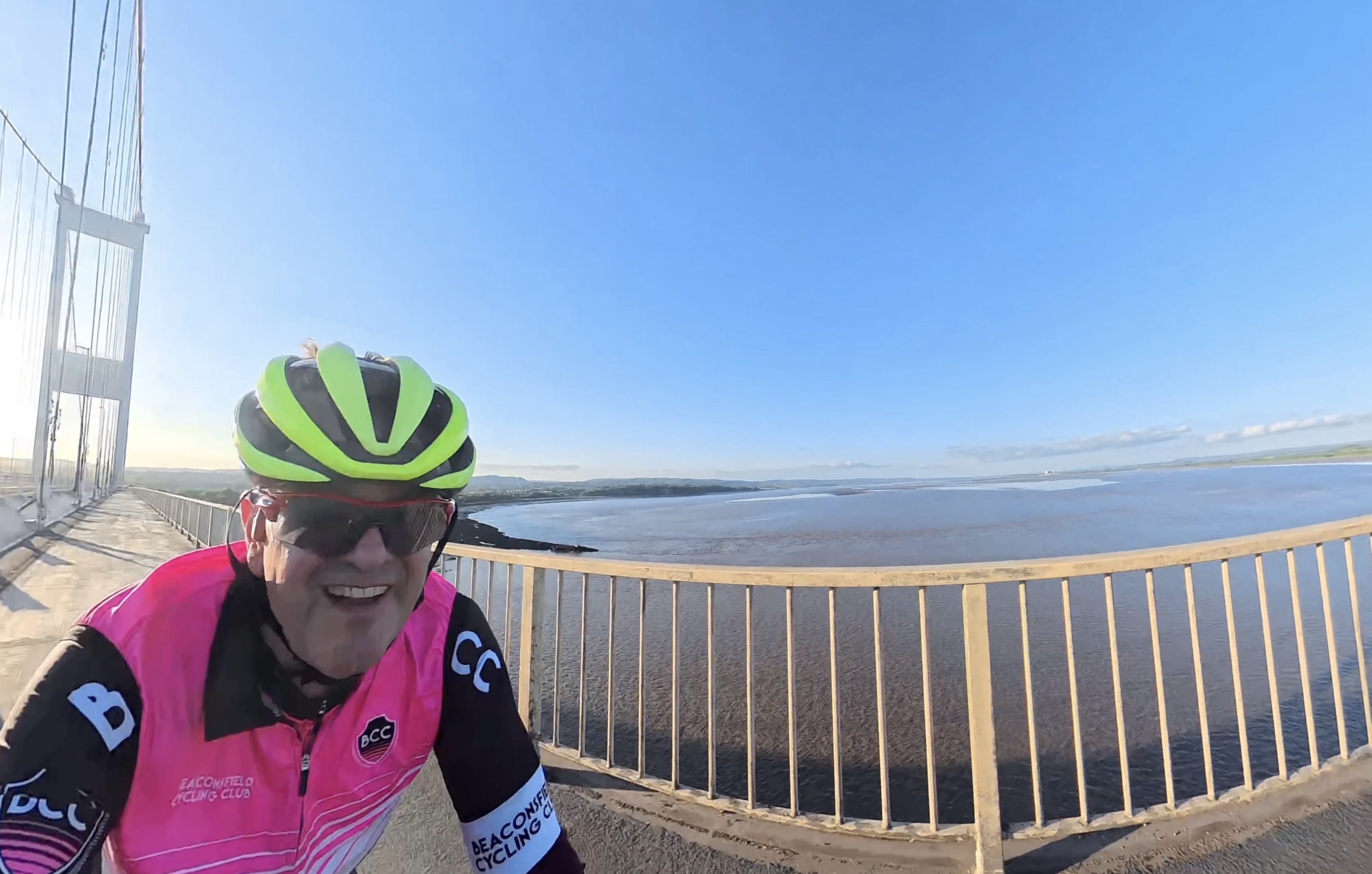
Heading back into England over the Severn Bridge, LWL 2025
London Wales London 2025
I wrote a lengthy post a year ago about completing the annual London Wales London audax from Chalfont St Peter near London to Chepstow in Wales and back via the original Severn Bridge. If you’re interested in a detailed account of riding LWL, head there as this will be a much shorter account. Instead I’ll focus on how I plan to learn from this year’s LWL experience to help my preparations for London Edinburgh London in August. (Both what worked well and what didn’t.) I’ll look at organisational lessons – yes, including charging devices – and personal ones, such as keeping healthy and maintaining morale through the inevitable lows.
LWL riders close to Islip, the first control at 38km
I never thought we’d have a second year of fine weather for LWL, but conditions were similar to last year, with the exception of a light but noticeable headwind on the outward leg across the Cotswolds. We were lucky to miss the 28C temperatures two days before – as well as the far colder weather that arrived within 12 hours of the finish. Organiser Liam FitzPatrick is obviously on very good terms with the weather gods…
This is the first in a series of posts about my training and preparation for the 1530km London Edinburgh London audax event in August 2025. The series was inspired by LEL supremo Danial Webb asking if anyone was planning to post about their training and preparation for the event. For part 2, lessons from London Wales London, click here.
London Edinburgh London is a cycle ride across Great Britain between the English and Scottish capitals. Held every four years, it is the premier British audax – a long-distance, non-competitive cycle ride. You have a maximum of 128 hours to ride to Edinburgh and back to London.
I’ve been dreaming about taking part in LEL since the pandemic, and will be on the start line in August. I’ve followed LEL Facebook and Yet Another Cycling Forum (YACF) posts, and read several books by previous participants such as Andy Allsopp and Malcolm Dancy for inspiration and information. I also bought the film about the 2013 edition of LEL. (All of which, truth be told, sent shivers of fear down my spine about what I’ve signed up for!) I’ve also enjoyed the LEL podcasts, which you can find on all the usual podcast platforms, including Spotify.
In this post, I’ll explain my road to LEL 2025, talk about my training, and also share a few tips for fellow LEL riders – which may be useful for anyone taking part in other multi-day audax rides. These tips are based on my own cycling experiences and advice shared by previous LEL riders. In future editions, I’ll share any new lessons from my training and preparations.
So – what makes me think I can complete LEL?
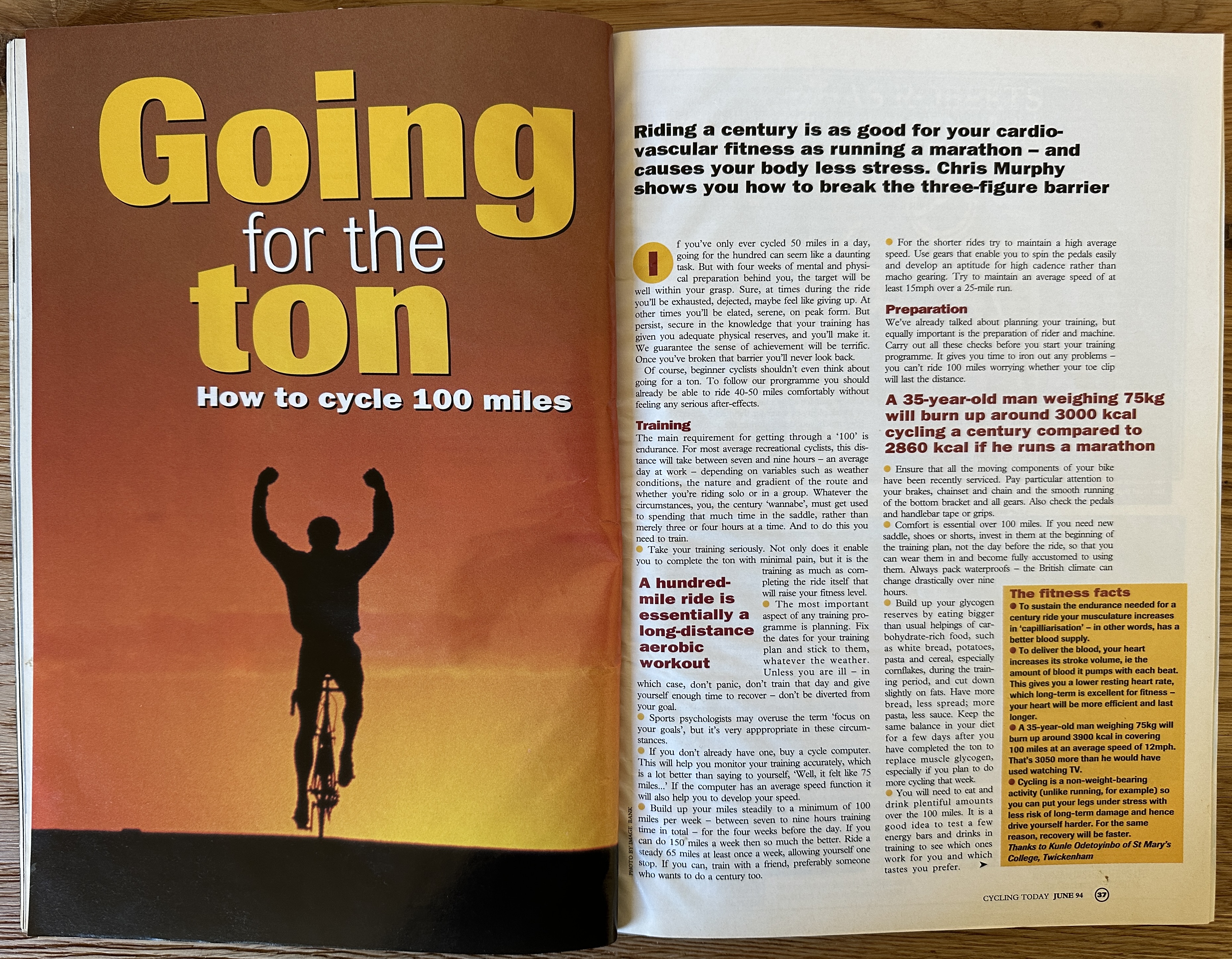
My original inspiration for long distance cycling, 1994
I’ve been cycling for over 35 years, since buying my first proper bike in 1989, as I blogged last year. Back in 1994, I was inspired by this feature in the old Cycling Today magazine about cycling 100 miles, and successfully completed my first century the following year.
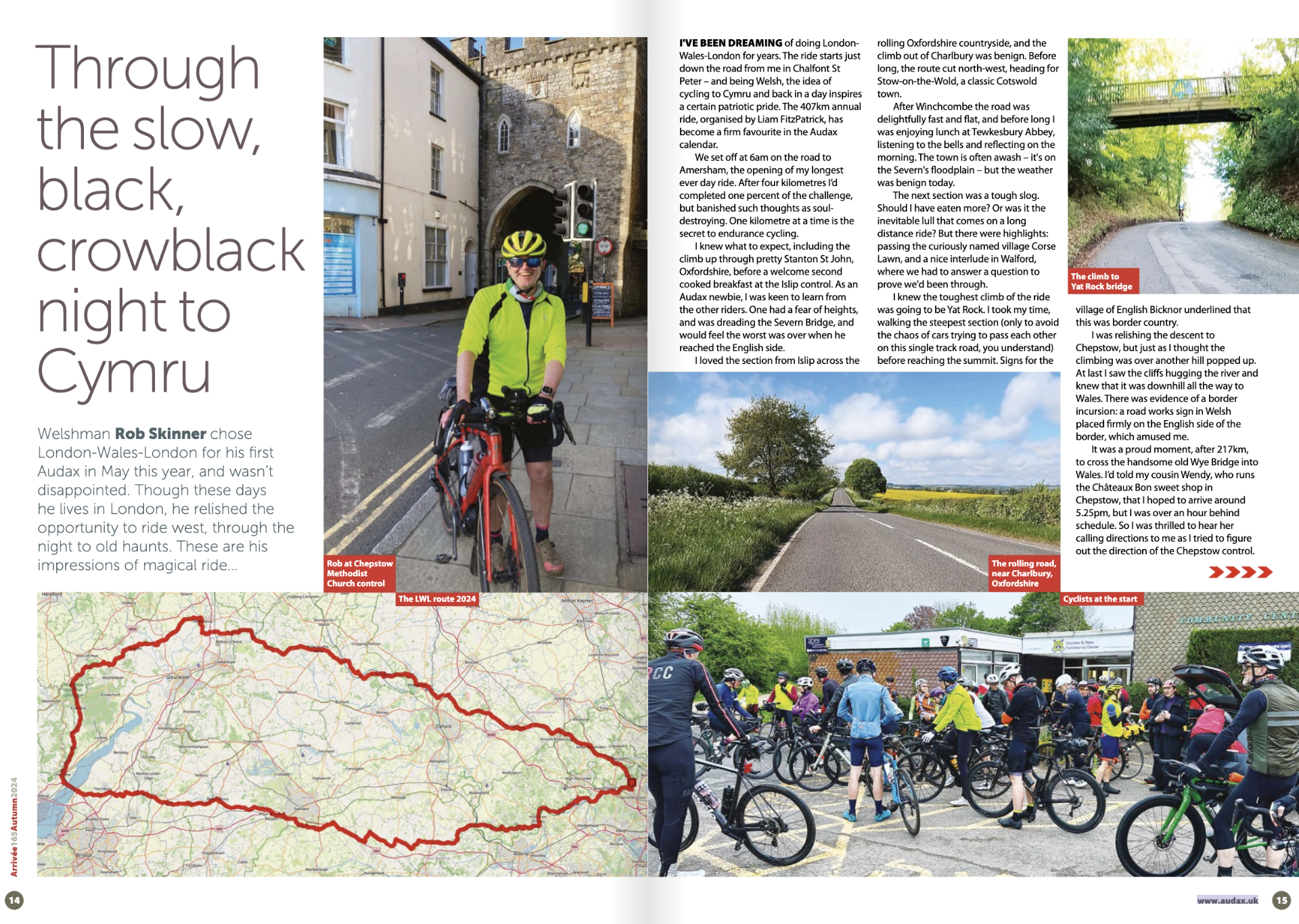
Last year, I completed my first audax ride, the 400km London Wales London, and my beginner’s story appeared in Audax UK’s Arrivée magazine. (The article was a shorter version of my LWL blogpost.) I knew that LWL was a good test of my ability to complete the far bigger LEL challenge, and early on my ride to Wales I had a brief crisis of confidence:
‘I was still in the Cotswolds when I decided such a challenge [LEL] was beyond me. The toll on body and spirit would be huge. Yet now, after the satisfaction of completing LWL successfully with something to spare, I’m not so sure. I have a guaranteed place for 2025, and that would have to be the year – it really would be too much by 2029, when I’d be approaching 66.’
I am feeling more confident now about LEL, and am fitter than I was on the eve of LWL 2024.
No, you’re not cheating if you ride an electric bike. The e-bike revolution is one of the best things to happen to cycling in the past decade. I have two e-bikes and love them.
It’s your choice what you ride
No one has the right to tell you what type of bike to ride. If you like the idea of a little help going up a hill, just go for it. And you won’t be alone: Mintel forecast that e-bikes would be the best selling type of cycle in 2024, and a quarter of British adults have considered buying one according to a Paul’s Bikes survey last year. It’s likely that many people buying an e-bike wouldn’t have bought an unpowered one.
You still get a workout on an e-bike
When I got my first road e-bike, a Trek Domane +, in 2022 I was surprised by how many calories i burned on my rides. The reason? Because in Britain an electric bike (technically called an ‘electrically assisted pedal cycle’) motor has to cut out above 15.5mph, after which your pedal power alone will move you forward. You’re likely to burn more calories doing this than on a non-e-bike as your mount will be a lot heavier with the motor and battery. (As an example, the latest electric Trek Domane + SLR 7 AXS weighs 12.64kg in size 56, compared with 8.29kg for the non-electric version. Data from Trek website.) You can always slow down below 15.5mph to get the motor to kick back in…
No one is losing out because you ride an e-bike
A lot of people were angry when Bob Dylan went electric in 1965. No one should care if you do the same, on a bike, unless you’re in a race. Or grabbing a king (KOM) or queen (QOM) of the mountains on a Strava segment.
E-bikes are brilliant for car-free commuting
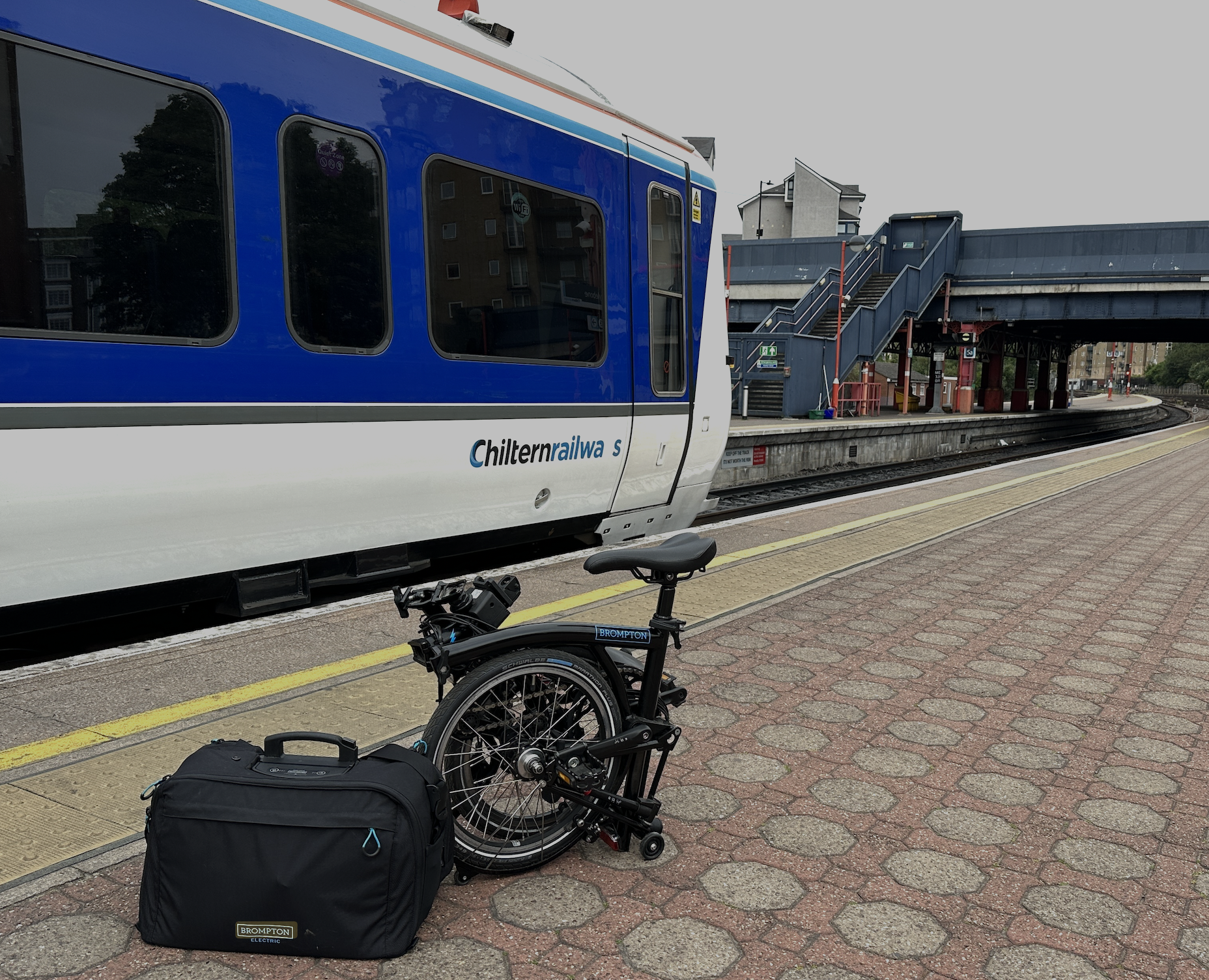
My first e-bike was a Brompton Electric. I found it brilliant for commuting to London: I’d cycle to the local railway station, pop the folded bike on the train, and spin across town from Marylebone to various places in the West End and City. I saved over £16 a day in car parking and the cost of the onward London tube journey from Marylebone. And it meant one fewer car on my local roads. I wrote more about my Brompton Electric experience here.
Electric bikes might make you cycle more
Hills? No fear
There are days when just don’t feel like cycling. But then I remember my electric Trek Domane. I took the photo above on my first ride on it, three years ago this month, when I relished the feeling of traversing the hilly Chilterns without quite as much effort. I still burned a lot of calories, because of the 15.5mph cut off for assistance, and even below that you still need to pedal. The Domane has differing levels of assistance so you can decide how much you want to exert yourself. I confess I usually choose the maximum help – I’ll choose my unpowered bike if I want a proper workout.
An e-bike makes family rides easier
An e-bike would be helpful… Masca, Tenerife
The beauty of an e-bike is that it helps less powerful riders keep up with their more athletic cycling friends and family. I first noticed this in 2019 riding up a very long, steep hill near Masca in Tenerife. I was very surprised to be overtaken by two small children. When their parents followed them past me I realised the whole family were on e-bikes. I was envious…
Everyone’s heard of the loss of Titanic in April 1912, the world’s most famous peacetime shipping disaster. It lives on thanks to the scale of the human tragedy and a sense of hubris: the supposedly unsinkable ship that ended up at the bottom of the Atlantic.
One man’s reputation was ruined on that deadly night. J Bruce Ismay was on board as the chief executive of Titanic’s owner, the White Star Line. As the great ship set out on its maiden voyage he seemed to have it all: wealth, power and prestige. He had succeeded his late father in 1899 as head of White Star but within three years sold the company to JP Morgan’s new shipping conglomerate, International Merchant Marine (IMM). Ismay became president of IMM and masterminded the building of Titanic and its sister leviathans Olympic and Britannic, believing that these giant luxury ships would give White Star a competitive advantage over rival lines such as Cunard. (Their size also made them ideal for the thousands of people emigrating from Europe to the United States; those travelling steerage did so in greater comfort than on most rival liners.)
There are countless books and online stories about the Titanic’s fatal encounter with the iceberg, so here I’ll focus on Bruce Ismay’s dramatic fall from grace.
Titanic’s collapsible D lifeboat, similar to Ismay’s collapsible C
In the early hours of Monday 15 April 1912, Ismay stepped into starboard collapsible lifeboat C, and into infamy. He made it clear to the American Senate inquiry into the disaster that no one ordered him into the lifeboat, giving the following reason for his entering the boat:
‘Because there was room in the boat. She was being lowered away. I felt the ship was going down, and I got into the boat.’
According to most of the accounts of that tragic night, Ismay helped load the lifeboats, calling out for any remaining women to get in. He himself recalled complete calmness: no panic and no crowds of desperate passengers fearing for their lives as the last lifeboats were lowered. In reality, Titanic’s final hour was chaotic. The crew were nervous about filling the boats to capacity. So, although Titanic’s boats could carry 1,100 or the 2,340 people on board, only 705 were actually saved. Ismay’s own lifeboat had room for a few more to board, so he wasn’t condemning anyone to a freezing cold death by getting in. The White Star line boss couldn’t look as his great ship sank below the waves, accompanied by the shocking screams of those condemned to freeze to death in the ice-cold waters of the April ocean.
A mighty transatlantic battle is in prospect over how to regulate artificial intelligence (AI). Donald Trump’s second administration seems sure to opt for the lightest of light touches, influenced by tech tycoon Elon Musk. (If Musk can tear himself away from his bizarre obsession with Britain.) The European Union has already legislated for a far more restrictive approach, with Britain likely to follow a middle way. The sensible aim must be to unleash the creative, social and economic benefits of AI while minimising the harm it may cause if abused or badly handled.
As debate raged about AI regulation, it struck me that many of the arguments deployed for and against AI and tech regulation also played a huge role in shaping the response to the railway revolution in the 19th century.
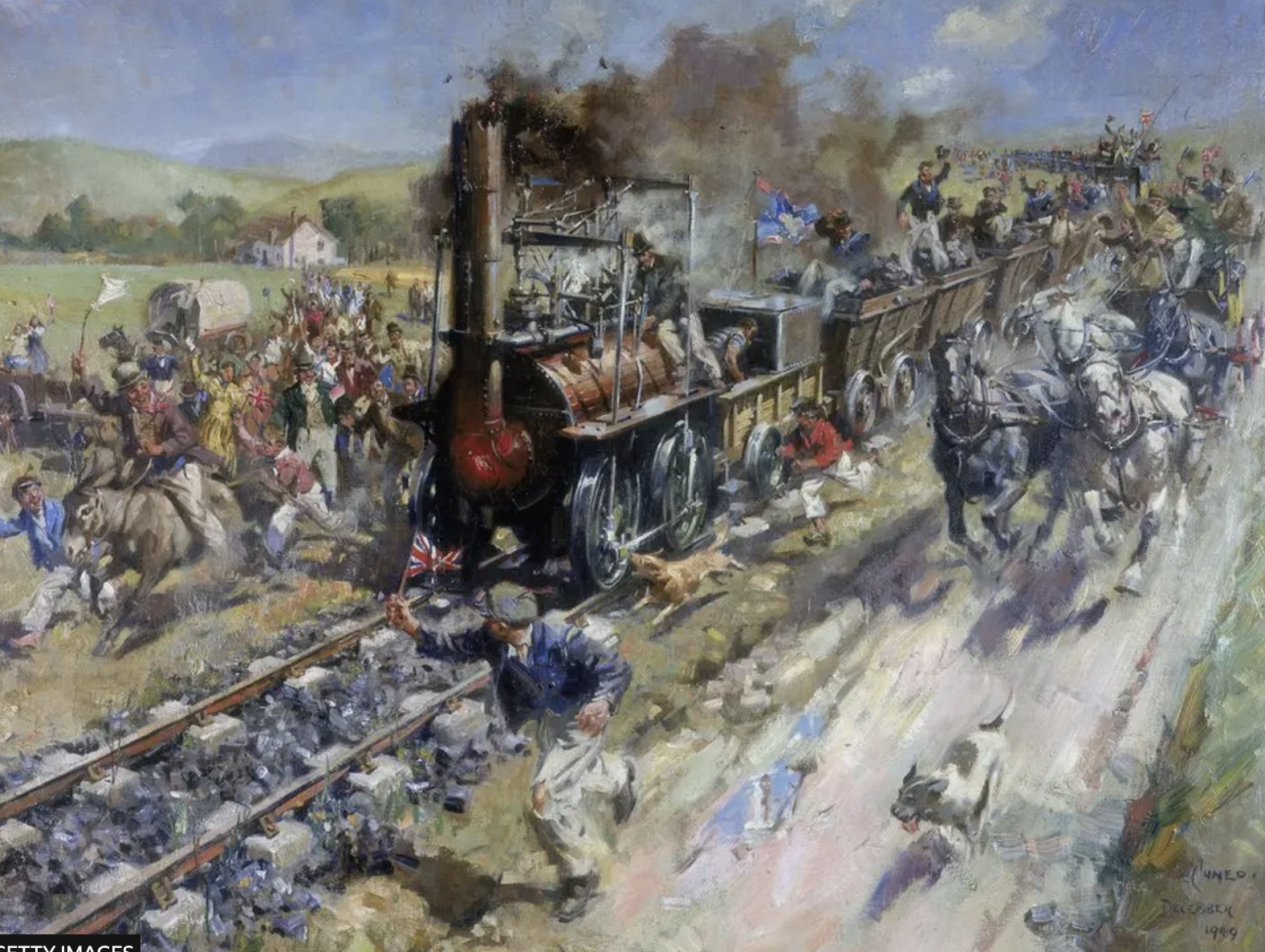
The opening of the Stockton & Darlington in 1825. Painting by Terence Cuneo; NRM/Science & Society Picture Library
The railway age properly began in September 1825 with the opening of the world’s first public railway to use steam locomotives, the Stockton & Darlington Railway in County Durham in the north of England. After the success of the first intercity railway between Liverpool and Manchester, opened in 1830, Britain enjoyed a railway boom, as pioneers planned lines linking major cities – and serving industry, the original purpose of the iron road. By the early 1840s, railway mania had taken over, in a prelude to the dot.com boom at the turn of the 21st century. In 1844, 240 private bills were presented to the British parliament to authorise 2,820 miles of railway. Had all these been built, the £100 million of capital needed represented over one and a half times Britain’s gross domestic product (GDP) for that year. Parliament still approved half these railways.
Anything goes? The heyday of the laissez-fair state
Britain in the 1840s was a firmly non-interventionist state. The dominant philosophy was laissez-faire: small government, low taxes and the free market. Most acts of parliament were private acts to authorise new railways rather than government initiatives. Anyone able to raise money could form a railway company and apply to parliament for permission to build their pet route. The sheer volume of railway business threatened to overwhelm the Westminster legislature. But an attempt to create order by setting up a railway advisory board to vet proposed plans before they reached parliament was short lived, killed by the powerful railway lobby. (And conflicts of interest: 157 out of 658 MPs had financial interests in the railways.) This was Britain’s last chance to create a strategic rail network, deploying investors’ money more efficiently. The failure led to many investors losing most if not all their money on rail schemes that had no hope of success, again pre-empting the dot.com bubble of 1999-2000.
If you’ve arrived at London’s Kings Cross station in the rush hour only to endure a packed tube train to reach the heart of London, you may wonder why the station wasn’t built nearer your destination. Kings Cross isn’t alone; Marylebone, Euston and St Pancras are similarly stranded north of the Marylebone and Euston roads, which were created as the New Road in the 18th century.
Jonn Elledge entertainingly explains on his Substack (The Newsletter of (Not Quite) Everything) how the New Road was built as a by-pass for cows. Jonn adds his explanation for the inconvenient siting of these great termini:
[Railway] Companies serving destinations to the east and south of London drove their new lines right into the urban area, with scant regard for the poor residents they dispossessed; those coming from the west and north, by contrast, tended to respect the capital’s existing geography. That is why, to this day, Kings Cross (1852), St Pancras (1868) and Euston (1837) stations line up along the road, with Marylebone (1907) [actually 1899] a mile or two distant: they were effectively plugging into the existing transport network, made up of a massive road with canal access.
This is only part of the story. Today’s travellers are inconvenienced as a result of a Royal Commission set up by prime minister Sir Robert Peel in 1846:
Amazingly, the Royal Commission on metropolitan railway termini reported just three months later. It recommended that railway lines entering London should not be allowed to enter the West End. The commissioners accepted that more central stations would lead to the destruction of countless homes and other buildings. In 1846, the New Road was on the very edge of London, which is why the Royal Commission took it as the furthest a railway line from the west or north should pass into London.
The wonderful finale of the BBC’s hit comedy Gavin & Stacey on Christmas Day brought further fame to Barry in South Wales. It’s a place that has a place in my heart thanks to family seaside memories and visits to its long-gone scrapyard for old steam locomotives.
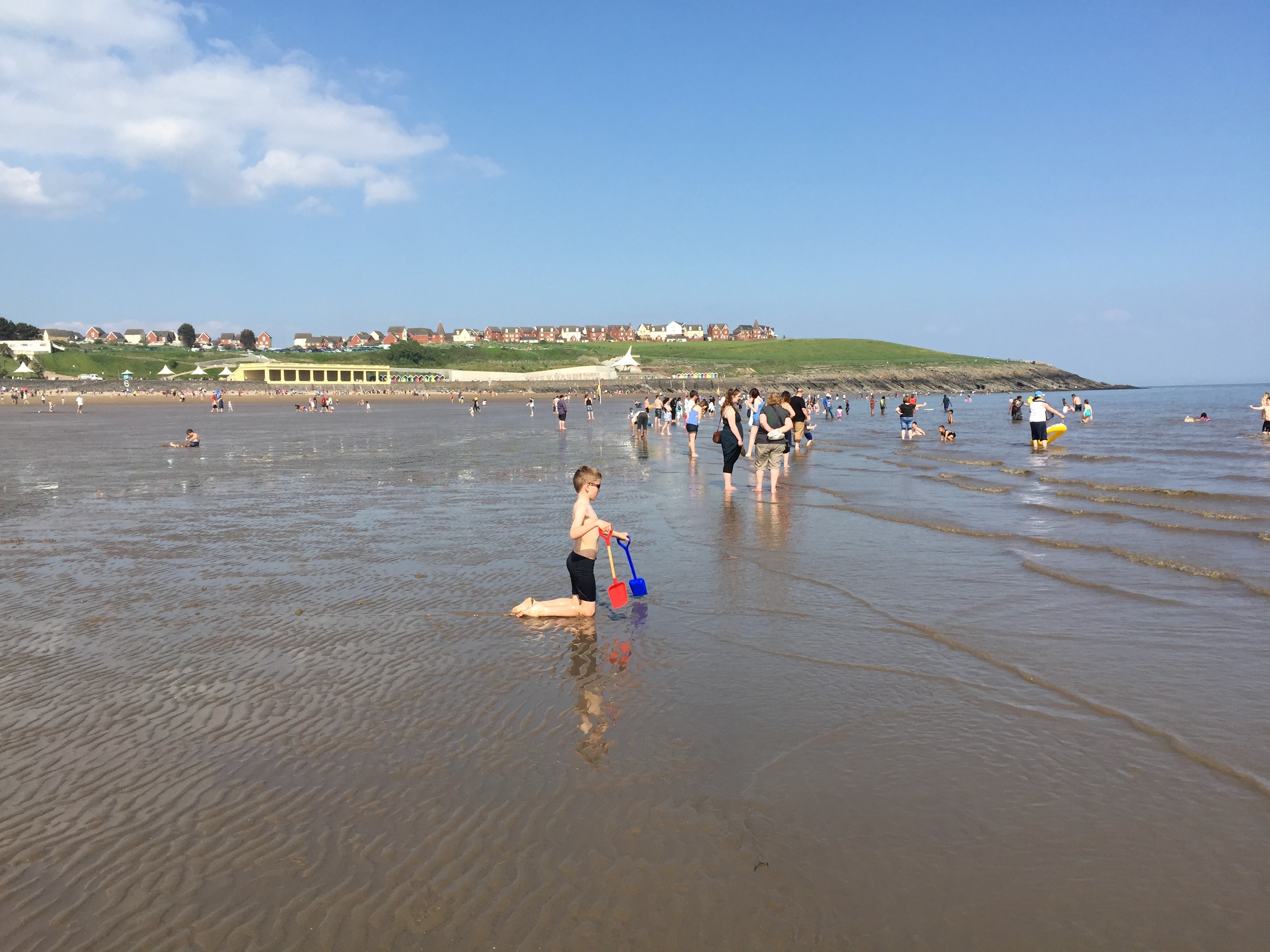
Barry Island, Sunday 5 January 2025
Last weekend, I took my son Owen for a short break in my hometown, Cardiff. As the rest of the country shivered under blizzards or sheltered from the icy rain, we made the short trip to Barry Island, and were rewarding with a few minutes of glorious winter sunshine. When I was at school, I regularly took the train from Heath High Level in Cardiff to Barry Island, and our Sunday visit brought so many memories flooding back.
Barry is a town that saw explosive growth during the later stages of the industrial revolution. Barely a hundred people lived there in the middle of the 19th century, but the entrepreneur David Davies of Llandinam saw its potential as a port. Davies was known as Davies the Ocean after the coal mining company that made his fortune. Like many Welsh coal tycoons, he was frustrated by the delays and cost involved in exporting their black gold from Cardiff, and vowed to create a rival port less than nine miles away at Barry. As he exclaimed, “We have five million tons of coal and can fill a thundering good dock the first day we open it!”
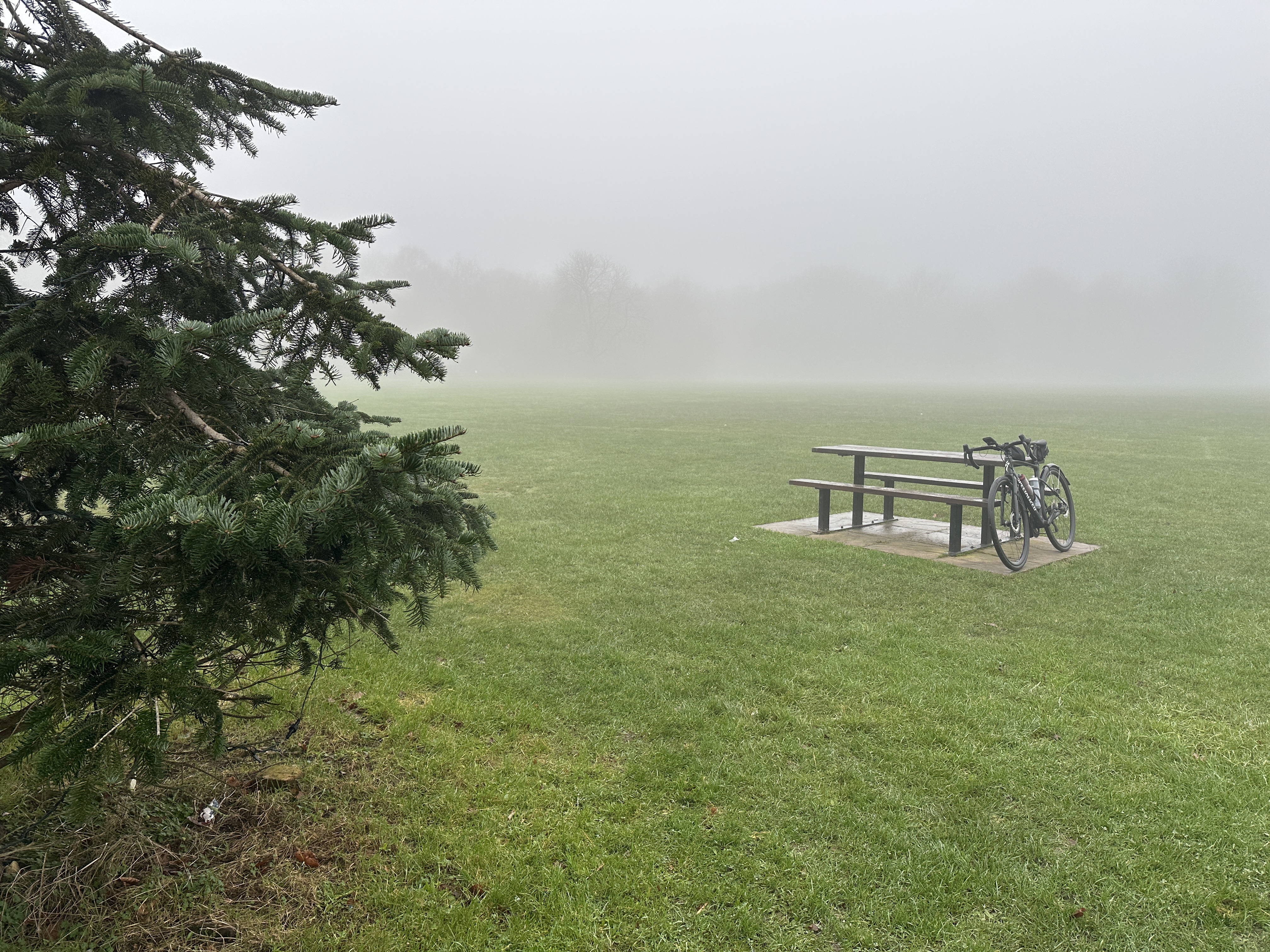
This was the moment when I cursed my decision to enter the Rapha Festive 500 challenge. I’d been cycling for over an hour, and the mist was seeping through every pore. I saw a sign for my village and mourned the fact I had another thirty miles to cycle, rather than a sofa in a warm house, to look forward to. The week’s rain-free weather forecast had led me astray – I was getting wetter and colder than I had ever imagined. I finished the Boxing Day ride – the third day of the Festive 500 – wondering if I’d finish the challenge. Yet four days later I passed the 500 kilometre finish line with a day to spare.
In this blogpost, I’ll share the lessons I learned – what went right, and more importantly how to avoid the mistakes I made. For anyone who isn’t aware, British cycle clothing company Rapha launched the Festive 500 in 2010. Participants have to cycle 500 kilometres (310 miles) in the eight days from Christmas Eve to New Year’s Eve. You can ride on roads, trails, on indoor turbo trainers and even an e-bike.
Here are my tips based on my experience in 2024.
Ask yourself: is it for me?
Cycling 500 kilometres in eight days is an achievement for most people. Yet it’s even harder over the festive period. Most people taking on the challenge will have other commitments – hosting family or friends, travelling for some of the holidays, social events and work. Can you fit in cycling 500km with these commitments? If you’re likely to have several days when you can’t cycle, will you be able to make up the miles in the remaining time? Will your family understand and support you, or will they resent not having you around ? No sensible person will judge you if you don’t make it, but it’s best to set off aware of the complications that might be the difference between success and not making it.
Weather or not…
Day 6: first sight of the sun…
It’s ironic that the Festive 500 was created by a company in Britain – a country not renowned for its fine weather, especially over the Christmas and New Year period, (The Scottish capital Edinburgh has just cancelled its Hogmanay new year celebrations because of forecast winter storms.) I decided to take part in the Festive 500 this year after seeing the benign weather forecast, but as the opening of this post suggests, it wasn’t as benign as I expected… After days of mist, it was a joy to see the sun breaking through on day 6, half way through my longest (50 mile/80km) ride of the challenge.
If your forecast suggests days of gales and rain, you can always ride indoors, or decide to wait until next year… I’d find riding 500km indoors soul-destroying, but I did ride indoors to top up shorter than expected outdoor rides.
Get organised
Set up your routes before the big day
I was full of good intentions on the first day. I’d planned to set off during the morning of Christmas Eve, but wasted over an hour trying to get my route onto my Garmin. As a result, I had less daylight time to complete the ride I planned, and as a result was behind schedule on the very first day. Lesson learned: get everything ready the day before, so you’re on the road on time.
Keep warm: layering matters
Warm and visible: Christmas Day Festive 500 ride
I’ve already mentioned that a weather forecast lured me into a false sense of security. This was an unseasonably warm Christmas in southern England, so a base layer and jacket, and summer cycling shoes would be fine, surely? For the first two days that was true, but on Boxing Day my mood took a tumble as I explained at the start of this post. Who knew that mist was so wet and cold? Yet it took another day’s ride before I learned my lesson, adding a Rapha wind-proof jersey, Sealskinz socks and Shimano winter cycling boots to my outfit. It transformed my mood, and I had my favourite ride of them all, to the lovely Velolife cafe at Warren Row for a delicious toastie. Layer up – you can always remove a layer if you get too warm.
I found my Le Col and Rapha bib tights essential wear for keeping me cosy, along with my neck warmer and full (but lightweight) gloves.
Lights – and action
If you’re doing the Festive 500 in Britain or another northern hemisphere country, you’ll not have endless daylight to complete your outdoor rides. On day one, my rear light failed as it was getting dark, which meant I finished about 10km earlier than expected. (Safety is more important.) After that, I charged my taillight every night, and also took a spare. I also wore a neon jacket to make sure I was seen by any distracted Christmas drivers.
Podcasts: my motivation for winter miles
I found podcasts a wonderful way to keep engaged and motivated on my Festive 500 rides. (A contrast with my London Wales London 400km audax ride, when I preferred silence, as I explained here.) Just before the Festive 500 began, I downloaded a stack of The Rest is History podcast episodes, and listened enraptured as the miles passed. I never expected the causes of the Great War to be laugh-out-loud amusing. It made me rethink all my assumptions about the road to catastrophe in 1914. (On a trivial note, I was intrigued to learn that the Kaiser signed the order mobilising Germany’s armed forces at a desk made from wood from Nelson’s flagship HMS Victory, and that British foreign secretary Sir Edward Grey visited London Zoo the day Britain declared war on Germany.)
Adapt your plans as needed
Plotting my rides
As mentioned earlier, in the early days of the Festive 500 I was falling short, because of disorganisation and the mist that hit my morale. By day four, I realised that adding indoor miles was the perfect solution. I confess that I don’t enjoy indoor cycling – gamification can only go so far in relieving the tedium – but I wouldn’t have completed the 500km with a day to spare without my Wattbike Atom smart trainer, Rouvy and Zwift.
In much the same way, keep a close eye on your local weather forecast. One of the reasons I delayed my initial daily starts was the hope that it would be warmer at 1pm than 11am, but in truth it made little difference. By contrast, if you’re expecting strong winds later in the challenge, get your big rides in early – or go indoors.
Don’t let setbacks get you down
The moment I saw my bike crashing to the ground, I knew it wasn’t good news. I set off anyway, on what should have been my longest cycling day yet, but as soon as I started climbing I knew that I’d be returning home. The derailleur hanger was bent, preventing me using most of my gears. This is where N+1 comes in: the idea that the ideal number of bikes to own is one more than you currently have. As I’ve been following that philosophy for years, I put my damaged bike in the garage and set off on a shortened route on my Specialized Roubaix.
If you’ve only got one bike, this might not be an option, but you might be able to see if your local bike shop – or mechanically-minded friend – can repair your mount.
Above all, accept that setbacks will happen. And if you prop your bike against the garage door, or farm gate, make sure the drive side is facing in, so the derailleur doesn’t take the impact if the bike falls over…
It’s all in the mind…
The secret to success in most cycling – and life? – challenges is in the mind. If you’re setting off on a cycling journey, those first pedal-strokes are the hardest. I explained in my London Wales London post that I soon realised that noting that 2.4km represented one percent of the total was a one way path to madness. On a more modest scale, I do recommend ditching the idea of clocking how many kilometres you still have to cycle. Just keep those pedals turning.
t’s a wonderful moment: completing a serious cycling challenge. Cycling 500km (310 miles) over the Christmas holidays is no mean feat, especially with family commitments. And let’s be honest, setting off into the cold and mist when the alternative is eating and drinking in a warm house takes commitment. On my longest (80km) Festive 500 ride, I kept alive the option of cutting my route short. Yet as I cycled north, the mist was replaced with a weak sunshine, and the easy riding north of Tring, Hertfordshire. (And all the while, Dominic Sandbrook and Tom Holland were telling their enthralling story about the outbreak of the Great War on The Rest is History…)
Enjoy your food and drink
Chiltern Velo cafe, Hawridge, near Chesham
It’s easy to forget that winter cycling needs fuel. For a few of my rides, I forgot to take an energy bar but happily always found a cafe or shop when I needed to refuel. My favourite Festive 500 memories are of my lunches at Chiltern Velo and Velolife cafes – and the cafe at Burnham Beeches. (Kudos to Velolife for posting its Christmas opening hours online – very helpful for route planning.)
Head for the hills – or the flat?
The joy of easy climbing: Christmas Day
Put bluntly, the challenge is 500km: you get no extra kudos for climbing. I was amused to see that Rapha shared a participant’s 154 mile ride in Asia, but noticed that this rise involved 1,000 feet less climbing than my 50 mile ride on day 6…
In short, add ascents if you wish, but don’t feel it’s compulsory. One of the reasons that my Boxing Day ride was a struggle was that it was a switchback. I always prefer routes that ascend, stay at the summit level, and then descend, rather than follow a rollercoaster profile.
Don’t neglect family and friends
You may love the idea of bagging the Festive 500 trophy. But remember: there are more important things in life than cycling. Really…
I was very mindful that while I was completing the challenge I wasn’t taking the dog for daytime walks, let alone ironing or cooking. So make sure you talk to your family about what is negotiable and what isn’t. So if you have loved ones staying, don’t assume your partner will happily entertain them for five hours while you’re cycling unless they’ve told you this is true…
Ride somewhere different
I don’t know about you, but I ride the same routes all the time. Yet on the Festive 500 I looked for new places to go. We live just a handful miles of the border between Buckinghamshire and Greater London, but I’d never cycled from home to London until day 3 of the Festive 500. Similarly, I’d only ever ridden north to Mentmore (the location of the famous country house sale of the century in the 1970s) in the spring and summer on century rides. There’s a joy in seeking new routes to send the heart singing.
Look after your bike
I’ve already said you need to adapt should you hit a mechanical. It’s better, naturally, to try to avoid any mechanical problems. Keep on top of maintenance, checking tyre pressure, washing your mount and ensuring you have spare inner tubes, pump and all the other essential kit to keep you on the road.
You’ve done it!
Screenshot
I was thrilled to complete the Rapha Festive 500 a day early. But what next? Are you inspired to go further – perhaps Land’s End to John O’Groats? Just do it!
You can read my day by day account of my successful Festive 500 challenge here.
Note: I published this blogpost a year ago, but accidentally unpublished it a couple of months later.
‘Don’t tell him, Pike!’ It’s the most famous line associated with Private Pike in Dad’s Army. Yet it was the officious Captain Mainwaring, played by Arthur Lowe, who uttered it. Mainwaring also regularly called Pike a ‘stupid boy’. Such is the enduring fame and appeal of the classic comedy series that many people born long after the last episode was shown in 1977 are familiar with these timeless catch phrases.
Ian Lavender, who has died aged 77, was the last survivor of the golden cast of Dad’s Army. He was 22 when he joined Dad’s Army – almost 50 years younger than Arnold Ridley (Private Godfrey) and John Laurie (Private Frazer). He played the immature Pike to perfection. It is poignant to reflect that Ian Lavender died over half a century after the passing of James Beck in 1973, who played the black market ‘spiv’ Private Walker. (Spivs were people who traded in black market goods, bypassing the strict wartime rationing system for food and other goods.)
The 1971 film version of Dad’s Army was largely filmed in our village, Chalfont St Giles, Buckinghamshire. Walmington on Sea has rarely been so far inland! The old Crown pub took on the guise of Martin’s Bank (manager, Captain Mainwaring), as seen below. In real life, the building is now empty after brief stints as Crown Coffee, and before that Costa Coffee as I blogged in 2014. It is due to reopen as Durans Bistro later this year.
My father Bob Skinner with Wynford Vaughan-Thomas, 1977
I was delighted to discover this photo of my late father with Wynford Vaughan-Thomas, one of the most illustrious Welshmen of the twentieth century.
Wynford was a wonderful broadcaster and writer. His first prominent role was as the BBC’s Welsh language commentator at the coronation of King George VI and Queen Elizabeth (later the Queen Mother) in 1937.
His most famous broadcast was from a Lancaster bomber on a raid on Berlin in 1943, an experience he told Michael Parkinson in 1981 was “the most terrifying eight hours I’ve spent in my life”. Like his BBC contemporary John Arlott, Vaughan-Thomas had an almost poetic way with words, which isn’t surprising given he was taught by Dylan Thomas’s father. He recalled that burning Berlin was “the most beautifully horrible sight I’ve ever seen, like watching someone throwing jewellery on black velvet, winking rubies, sparkling diamonds, all coming up at you.” He went on to compare the Berlin searchlights with the tentacles of an octopus.
The BBC radio programme Archive on 4 devoted an intriguing episode in 2013 to the raid with audio from the original 1943 broadcast, Vaughan-Thomas’s recollections and most movingly the memories of a survivor of the raid who was a Berlin schoolgirl in 1943. She tells how her mother risked death by going back into their collapsing home to rescue her teddy bear. Her interview brought to mind the terrible human cost of the Allied – and German – bombing raids of the second world war.
When I rediscovered the photo that opens this blogpost amongst Dad’s photo collection. I assumed that it was taken at an Institute of Public Relations dinner during the time Bob was chairman pf the IPR (now CIPR) Wales group in the 1970s. Sure enough, I found confirmation in a box file of Dad’s speeches and articles: the notes of the speech he gave that night:
“The champagne voice of Wales” – how apt!
Bob wrote a short history of the IPR in Wales in 1995, which was launched at an event in (I think) Newport. It includes this photo, which shows that my mother Rosemary also attended, and that the dinner with Wynford Vaughan-Thomas took place in November 1977, a day before Dad’s 51st birthday. Arwyn Owen, seen in the photo above, who ran PR for Welsh Brewers, kindly supported my application to join the IPR in 1990.
Wynford Vaughan-Thomas was a leading figure in Welsh broadcasting, and was one of the founders of Harlech Television (HTV, now ITV Wales). Not long before he died in 1987 he co-presented a wonderful television history of Wales, The Dragon Has Two Tongues. His sparring partner was the equally loquacious Gwyn A Williams, and over 13 episodes the two Welshmen argued passionately about the interpretation of the past. By common consent Williams won the debate, and Vaughan-Thomas was reduced at one point to dismiss his fellow presenter as “a Marxist magpie”.
Sadly this entertaining series has never been repeated in Wales for copyright reasons, although it has been broadcast in Ireland. It was accompanied by two contrasting histories, Wales: a History by Wynford, and When Was Wales? by Alf.














 Ertblog