The Daily Telegraph turns Torygraph

I cancelled my digital subscription to the Daily Telegraph today. A shame, because it’s one of my favourite news apps. But I’m not willing to pay £10 a month for what has become a general election propaganda sheet for the Conservative party. I’ll get enough of that for free through the letterbox. It’s living up to the Torygraph tag.

Hold the front page: business leaders support the Tories. In other news, the Pope's a catholic

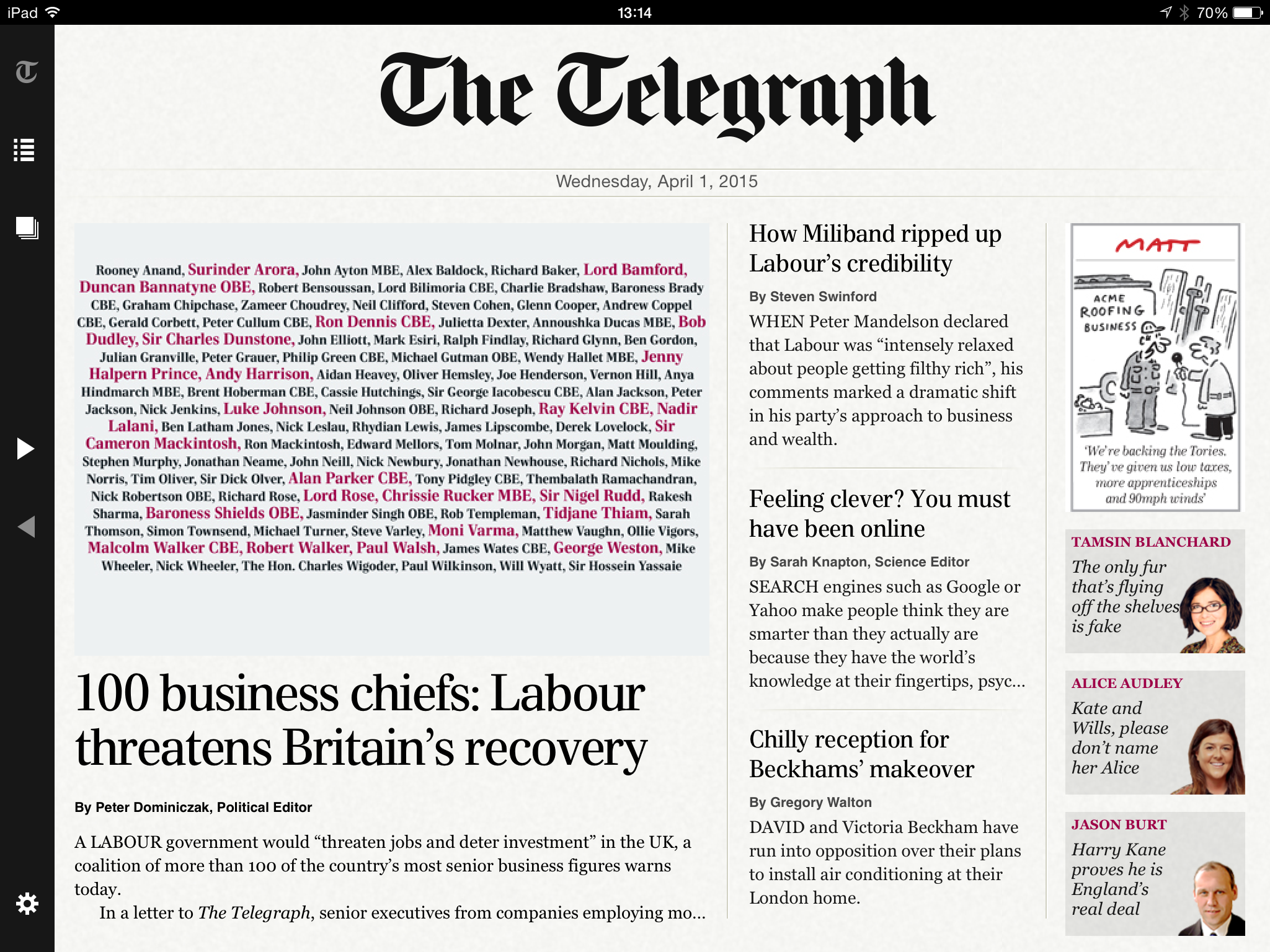
Hold the front page: business leaders support the Tories. 

Every front page lead story for the past six days has attacked Labour or carried a pro-Tory message. Today’s reported that 100 business leaders think that Labour threatens the economy.

Continue reading

Solving Daily Telegraph iPad app problems

Daily Telegraph iPad app

Daily Telegraph iPad app

I love reading newspapers on my iPad. I get them delivered to my tablet without having to go to the letterbox, never mind the newsagent. I can catch up on the news wherever I am in the world, as long as I’m online. The Daily Telegraph iPad app is one of my favourites, as it’s one of the most elegant apps.

But it’s not the most reliable. It rarely if ever downloads automatically, unlike the Guardian and Sunday Times. And recently it has stopped downloading at all: it sticks at 8% downloaded.

Time to use the app equivalent of turning a pesky computer on and off again: I deleted the app completely and downloaded it afresh. This is where I ran into difficulties. It asked me to enter my details as a subscriber. I chose ‘digital subscriber’. But it didn’t recognise me. I tried again. And again. Still no joy. It kept asking me to buy a subscription, which I already had.

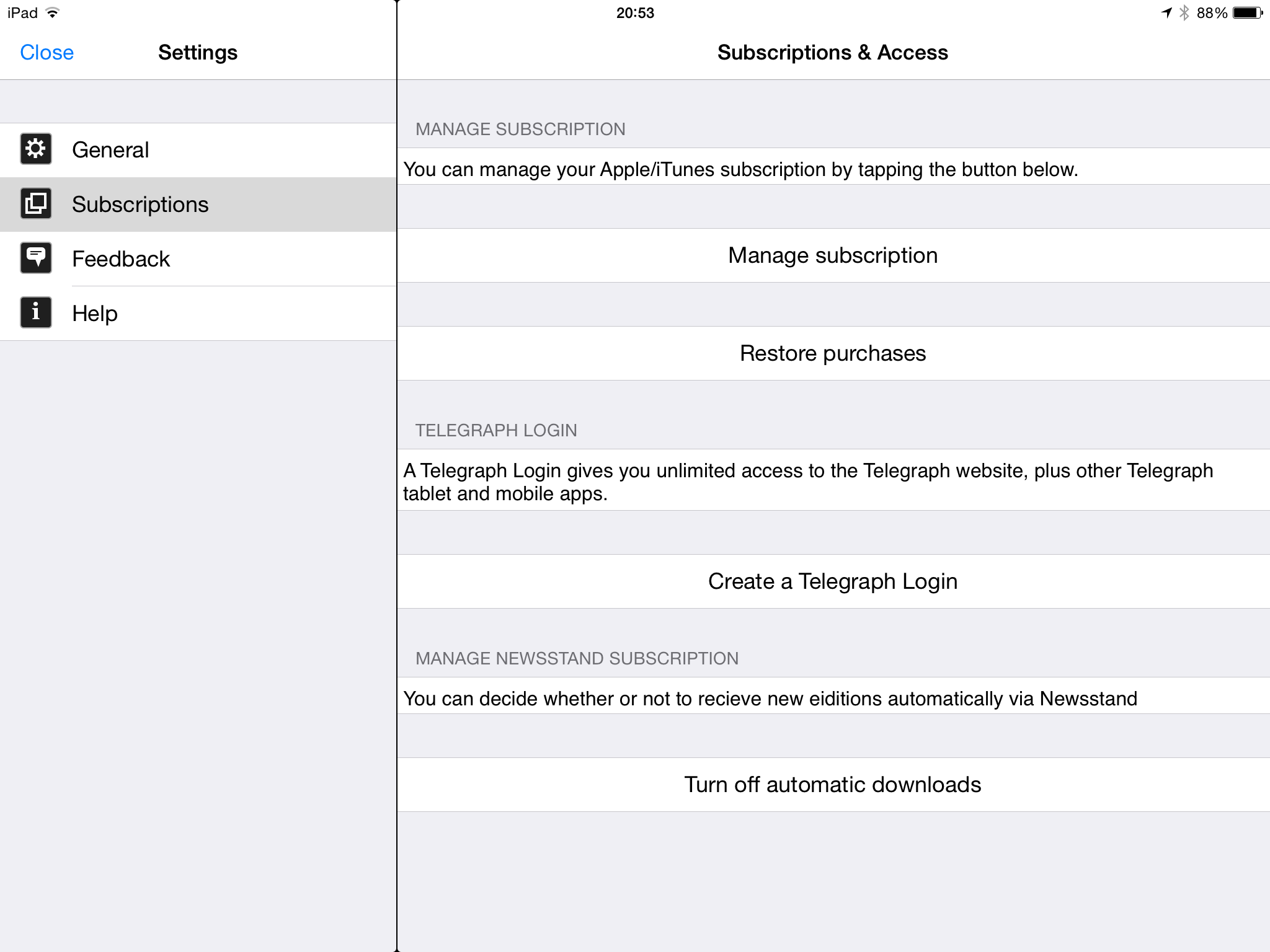
At this point I called the 0800 number. A helpful man told me I needed to take a different route: click on the cogwheel on the bottom left of the app screen. Click subscriptions, then choose restore purchases. Enter Apple ID password – and you’ll not be asked to buy a new subscription.

Restore purchases

Choose restore purchases

This solved the 8% hitch. It still doesn’t download automatically though…

I love my first generation iPad – but its days are numbered

iPad 1

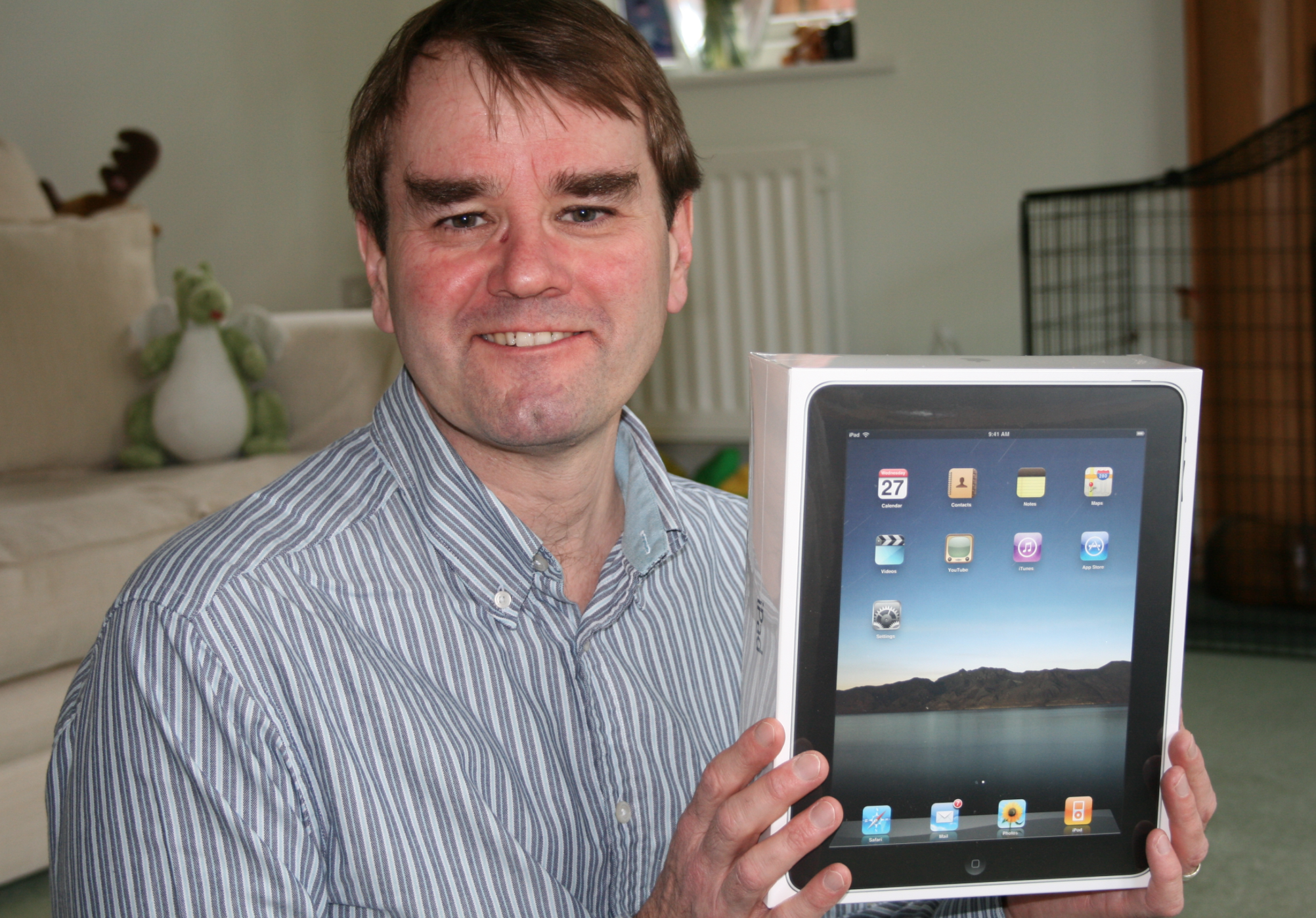
Taking the tablet: iPad arrives, 27 May 2010

I got my iPad on 27 May 2010 – the day before it went on sale in the shops. (I had ordered it in advance.) It was love at first sight, as I explained in a blog post that evening. I went on to rave about how quickly it got me to my chosen websites. For the first time in my life, I was an early adopter.

It’s been a constant companion ever since. I’ve used it to watch movies on flights to California, to blog about major events and to read books. I’ve enjoyed listening to music on Spotify’s iPad app. I’ve read the Guardian and Times iPad editions while on holiday and business abroad.

But it’s showing its age. Apps crash far too often. The Daily Telegraph’s iPad app won’t open if I’ve got any other apps open. The Guardian’s iPad edition’s letters links don’t appear most of the time. In short, it’s time to upgrade.

Some will argue that it’s shocking that a device less than three years old costing over £500 (I bought the 64GB model) no longer works properly. I’m more understanding. The iPad changed everything. It wasn’t the first tablet computer (far from it) but it was the first to make the tablet popular. Later models were more powerful, and apps developed to match their higher specs.

I’ll keep my original iPad – but it’s time to accept that it’s no longer good enough.

Denis MacShane: yet another disgraced MP

Three years ago, Britain was scandalised by the Daily Telegraph’s exposure of MPs’ appalling – and in many cases criminal – expense claims. Duck houses, moats and phantom mortgages featured heavily.

We thought it was all in the past until Labour’s Denis MacShane was forced to resign today after a parliamentary committee found he had submitted 19 false invoices which were “plainly intended to deceive” Parliament’s expenses authority.

Judging from the Parliamentary Committee on Standards and Privileges’ report, MacShane shamelessly used taxpayers’ money to fund his personal and political interests. Bizarrely the police dropped an investigation into MacShane’s deceit for lack of evidence – let’s hope they read the parliamentary report, which will provide the evidence they were incapable of finding.

By coincidence, this week I’ve been reading Robert Winnett and Gordon Rayner’s book about the Telegraph’s 2009 expenses scoop, No Expenses Spared. The story of how MPs tried to keep the scandal secret is as shocking now as it was in 2009. The Telegraph deserves huge credit for the way it investigated more than a million expenses documents in a matter of weeks. My main reservation was that it focused only on Labour ministers for the first few days, giving the impression that this was a Labour scandal.

Meanwhile, here’s my blogpost from May 2009, written the evening MPs were being ripped to shreds by the BBC Question Time audience in one of the most compelling editions of that show. I pointed out that the MPs’ excuses were groundless. And here is my manifesto for a new politics in the wake of the expenses scandal.

The Guardian: too much Apple coverage?

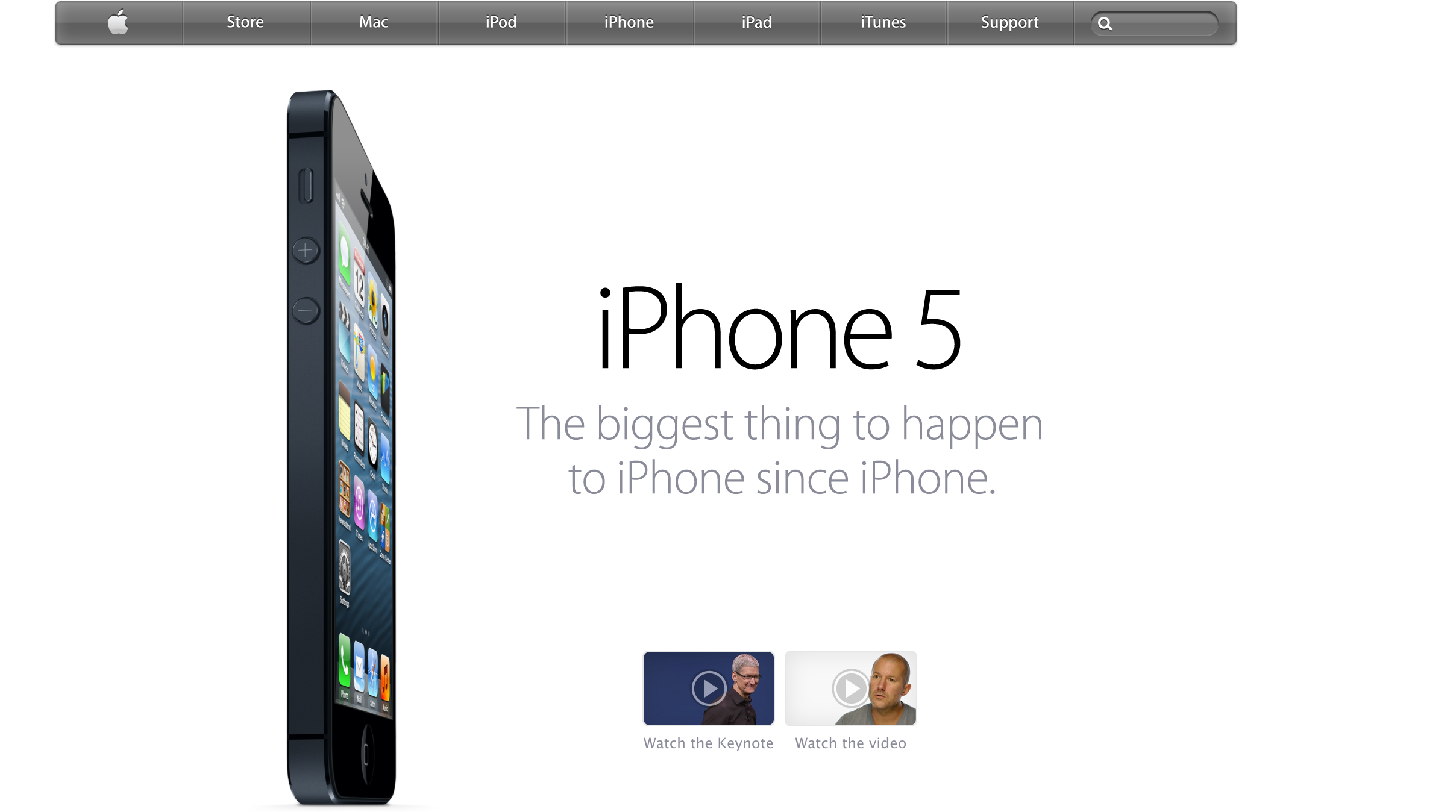
iPhone 5: does it get free and easy publicity from the media?

The Guardian’s readers’ editor Chris Elliott today devoted his Open door column to respond to reader criticism that the paper has, in Elliott’s words, been,'”brainwashed” by Apple to give the company and its products excessive amounts of favourable publicity.’

Elliott makes a comparison of the paper’s coverage of Apple phones compared with the rival Android mobile phone operating system over the past 12 months:

“There were 900 references to Apple in the paper and on the website in total; 470 of those were in print. There were 340 references to Android phones, of which 30 were in print.”

Elliott’s article was balanced without reaching a verdict on the claims of Apple bias. He quotes the paper’s technology editor Charles Arthur:

“The statistics show that people read about Apple stuff. If a story involves the company, it gets huge readership. We aim to write about it fairly. If it gets a lot of coverage, that’s because what it does can move entire markets – stock markets, other companies’ shares (eg suppliers who win/lose contracts), how we use devices (so it might not have been the first company with a touchscreen phone, but it set the standard all the others followed).”

Arthur was criticised heavily by readers last month for posting a 5 star review of the iPhone 5 that didn’t mention the flaws in the new Apple Maps app that replaced Google Maps in the iOS 6 operating system that powers the new phone. Arthur reassured readers who may be concerned about switching to the Apple app: “Don’t worry – it’s very good.” Within 24 hours, his colleague Juliette Garside reported ‘significant glitches’ in Apple Maps, including the disappearance of Stratford upon Avon, new airports and relocated towns.

Charles wasn’t the only reporter to publish a glowing review that didn’t mention the maps fiasco. The Telegraph’s Shane Richmond wrote a similarly euphoric write up the same day. The challenge tech writers like Shane and Charles face is that readers and publishers demand an instant appraisal of new tech products. They don’t always get enough time to get under the skin of the latest phones and other devices. It was much the same with the last truly new iPhone model – the rumpus about the reception problems of the iPhone 4 (the predictably named ‘antennagate’) broke a couple of weeks after the launch, long after the glowing reviews had appeared.

UPDATE: Shane has pointed out in response that he wrote a parallel story the same day as his iPhone 5 review highlighting that iOS 6 isn’t as good as it could be: “Unfortunately, in the version I tested, Apple’s Maps are missing places such as railway stations and frequently misplace cafes and restaurants, often putting them streets away from their actual locations.” Charles has highlighted his piece last week asking ‘Why do some people really hate Apple?”

The cult of Apple … and Android

It can’t be easy to be a tech writer. Anything you write about Apple or Android leads to an torrent of vitriol from fans of the rival systems that is literally beyond reason. Take one comment on Chris Elliott’s article:

“For most purposes Apple products suck. If you want to do any serious professional work using a computer you do not use Apple, but instead PCs running Microsoft Windows or a version of Linux…The only people who use Apple products are those who buy the product as a fashion accessory, or because they think it is cool and rebellious not use Windows.”

It’s hard to think of any other type of consumer product that provokes this kind of religious/cult style over-reaction. Do Ford car owners condemn Vauxhall or Mercedes owners as stupid for their choice of car? Or Canon devotees about Nikon users? It seems unlikely.

My view is that Android and Apple phones are amazing devices. They offer features that we could only dream about five years ago – and are so much more user friendly than earlier smartphones. (Just try using a BlackBerry if you want to see how awful smartphones were before the iPhone.) iPhones are brilliant for people who want a simple yet powerful user experience but aren’t bothered about customising how everything works. Android is terrific for anyone who wants more flexibility – in handsets, software and customisation. You choose.

The Times they are a-charging: thoughts on those paywall figures

Photo

Above: The future of paid for online news? The Times iPad app

Britain's media industry has been desperate to find out how many people have paid for online access to The Times and Sunday Times since News International installed its paywall in July. Ni finally issued figures this week, declaring that it had sold 105,000 'digital products' since July.

Media commentators have had a field day with the data. The Financial Times reported that experts doubted the figures, claiming they were vague or even an example of 'chicanery'. Robert Andrews at www.paidcontent.co.uk suggests that just 0.25% of Times Online readers have converted to paid subscribers (rather than pay-per-day customers). 

My view? I don't think we can read anything into these figures. We simply don't know enough to decide how well News International is doing. That 105,000 includes people on the introductory £1 for a month offer. It presumably includes people who have cancelled their subscription. Above all, it's just four months since NI launched the first paywall at a major British mainstream, mass market news website. NI will experiment with new offers, new products and new payment methods. It has enormous marketing clout. It will make this work. 

The critics suggest a host of reasons why the NI experiment won't succeed. They argue that NI is bound to fail while rival news sites such as the BBC, the Guardian and Daily Telegraph remain free. They suggest that NI is breaking a fundamental rule of the web: that charging for content is wrong. And they point out that the Times and Sunday Times have cut themselves off from online and social media communities – who's going to tweet links to stories that are locked behind a paywall? Oh, and many see Rupert Murdoch as the devil, and while they may have been happy to accept his content for free, they won't pay for it.

I don't accept the philosophical argument that all online content should be free. Why? If you value something, why wouldn't you want to pay for it? I am happy to pay for the BBC through the licence fee because I value its content and don't want that content to be scarred by advertising. I take the same view of online news. Good journalism costs money. True, I'm very happy if news organisations are happy to give it away for free. But I doubt this is sustainable as print sales fall and a generation grows up with the idea that online is the place to go for news. 

I started this post with a screenshot of the Times iPad edition. This might just show show the way to make paid for content work. (I recognise I was sceptical about this when the iPad was announced in January, but I might be wrong.) I'm not a natural Times reader, but I've thoroughly enjoyed the iPad edition this week after discovering that my online subscription includes the iPad app content. (I was sure it was separate.) The best thing is that I can download the day"s paper and then read it all offline, such as at my parents', or on a flight to San Francisco. The app isn't perfect – navigation is confusing and inconsistent – but overall I love the Times on the iPad. I'd happily pay extra on top of my Guardian print subscription to get an iPad issue. (And for the Media Talk and Tech Weekly podcasts if the Guardian decided to charge for them.) 

For me, that's the secret to paid content success. Experiment to find out what hits the spot for various customer segments. For some regular print readers, it may be adding an iPad edition for an extra £5 a month. For some online customers, it might be occasional print editions for an extra sum. News International seems to think culture is the only way to lure subscribers. I'm not a complete philistine, but it does nothing for me! Content, not culture, is king.

Disclosure: I am head of PR for PayPal UK. PayPal has pioneered payment services for digital goods, including online news. The Financial Times announced on 27 October that it was working with PayPal to further drive online subscription growth. 
General election 2010: The Guardian asks readers which party it should support

The Guardian has asked readers and staff for their views on which party (if any) the paper should support in the 2010 general election. Editor Alan Rusbridger (@arusbridger on Twitter) posed the question of Friday in the wake of the second leaders' debate.

I was impressed by the paper's attempt to engage with readers. But the initiative underlines the bizarre and frankly disreputable tradition in British newspapers of telling readers who to vote for. Why should a paper tell readers who to vote for – even if they've asked their views first? 

The Guardian is far from the worst offender. The Daily Mail, Daily Express and Daily Telegraph are the media wings of the Conservative Party, and lose no opportunity to distort the news to encourage readers to vote Tory. But, as I posted in May 2008, the Guardian published a clumsy piece of propaganda urging readers to support Ken Livingstone in the London mayoral election. (Not that it helped Ken: he lost to Boris Johnson.) The Guardian even tried to influence the 2004 US presidential election with a similarly ill-judged operation to persuade voters in Ohio's Clark county to reject George W Bush.) 

It is simply grotesque that the media and politicians take any notice of The Sun's decision who to back in an election. Yet last week's decision of James Murdoch to invade The Independent's offices to protest at that paper's innocuous headline, 'Rupert Murdoch won't decide this election. You will.', shows how high the stakes are. The Murdoch clan really do think they have the right to influence an election. Their attempt to bully a newspaper that barely sells 100,000 copies a day shows concern that that this election could, just, be the one that breaks the political power of the media.

The response of the Mail and Telegraph to the rise of Cleggmania following the first leaders' debate was instructive. They both resorted to smears about the Liberal Democrat leader. As I posted last week, social media helped blunt the impact of the smear campaign with the clever #nickcleggsfault campaign. If the papers had been interested in genuine examination, why didn't they pursue the question why the Lib Dems hadn't returned donations from crooked donor Michael Brown? That would have been genuine journalism rather than political propaganda.  

Let's hope the people vote without being bamboozled by the media on 6 May.