Today had been billed as a recovery day: just 50 miles. That sounded good after two challenging but enjoyable stages. But it led us into underestimating today’s cycling. Those 50 miles included 4,500 feet of climbing, with the steepest sections appearing in the heat of the afternoon.
Breakfast at the monastery wasn’t as good as dinner last night, with long queues for the coffee machine. (It’s curious how the French have embraced these automatic machines, which dispense various types of coffee. Once they’d have been appalled by the idea.)
But it was a leisurely start to the day: we didn’t set off until 9.30am. I wasted some of that bonus time as it took ages to transfer the day’s route (the GPX file) onto my Garmin. In the past, I’d have loaded every day’s route onto my device before the start of the tour. I must remember to do that in future.
The ride began with a freewheeling descent to Saint-Flour’s lower town. We cycled alongside the A75 motorway before peeling off for the first, easy climb of the day. The highlight of the day was cycling past the Viaduc de Garabit, Gustave Eiffel’s magnificent railway bridge over the Truyère river valley. Its parabolic arch, 165 metres wide, was the longest in the world when it opened in 1885, until Porto’s famous Dom Luis I bridge over the Douro surpassed it the following year. Eiffel also designed a railway bridge in Porto that’s very similar to Garabit, but his greatest monument is, naturally, the tower named after him in Paris.
This post recounts the seventh day of my English Channel to the Mediterranean cycle tour in France with Peak Tours in June 2025. Read Day 6: Aubusson to Le Mont-Dore.
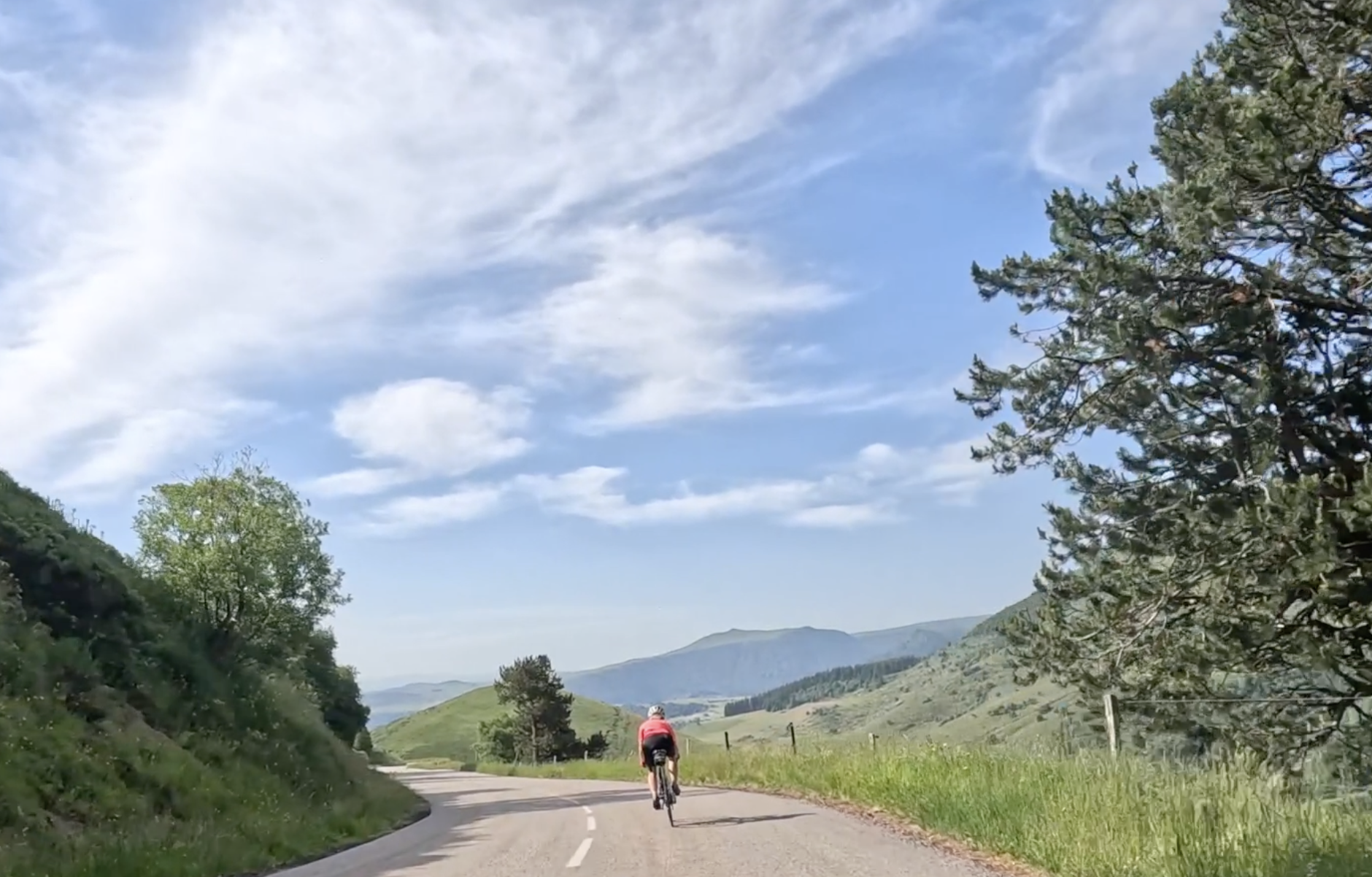
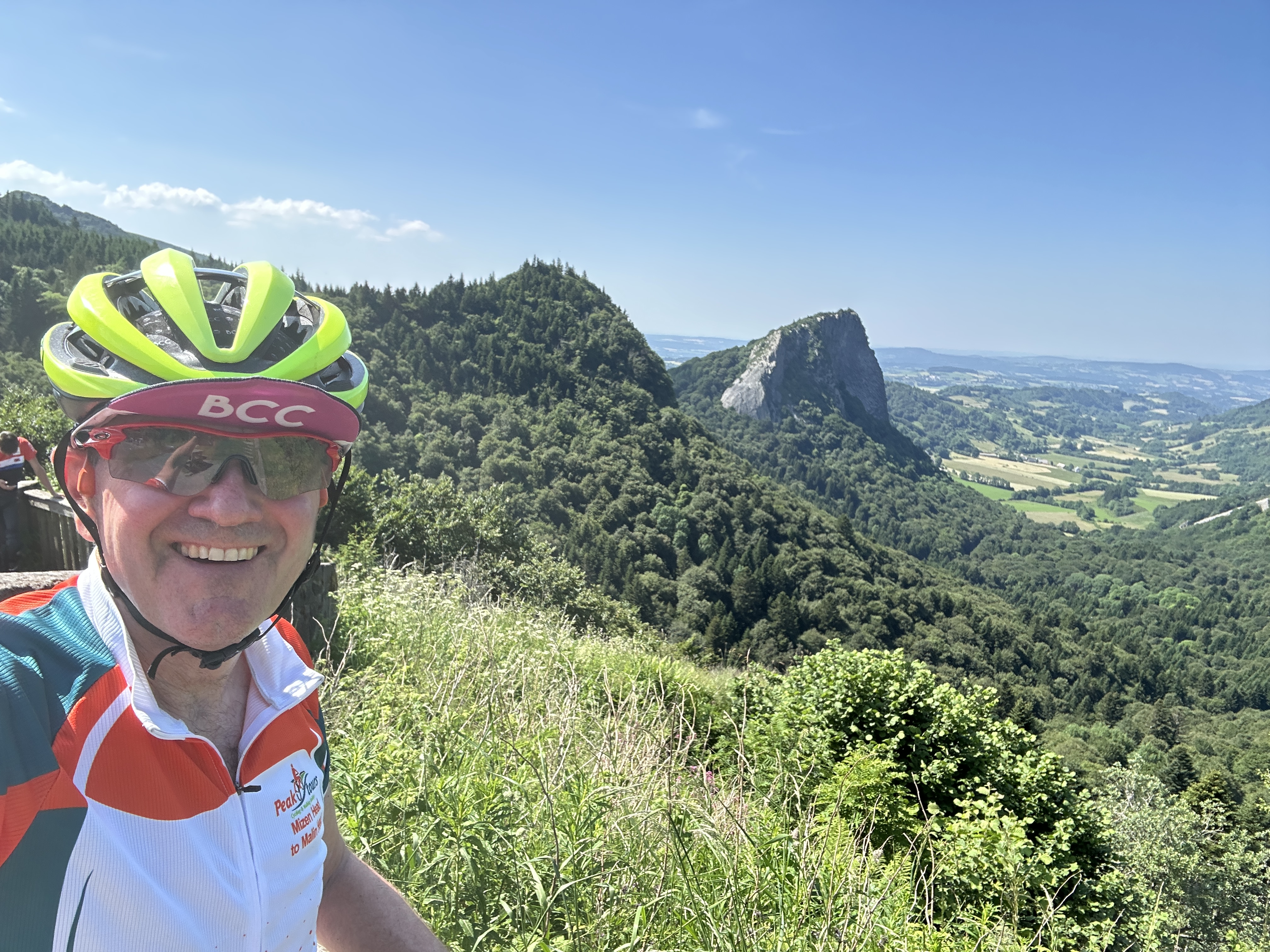
This was one of the toughest days of the tour, although worth it for the stunning scenery. We had a mix of several long climbs plus a rollercoaster, undulating ride during the morning. We tackled all this under an unforgiving sun. But, as I’ve said before, better that than torrential rain and no views!
The usual route out of Le Mont-Dore was closed, so we came back the way we entered. (Poor Donal and Monica followed the closed route, so had tackled a big climb before descending to do it all over again in another direction.)
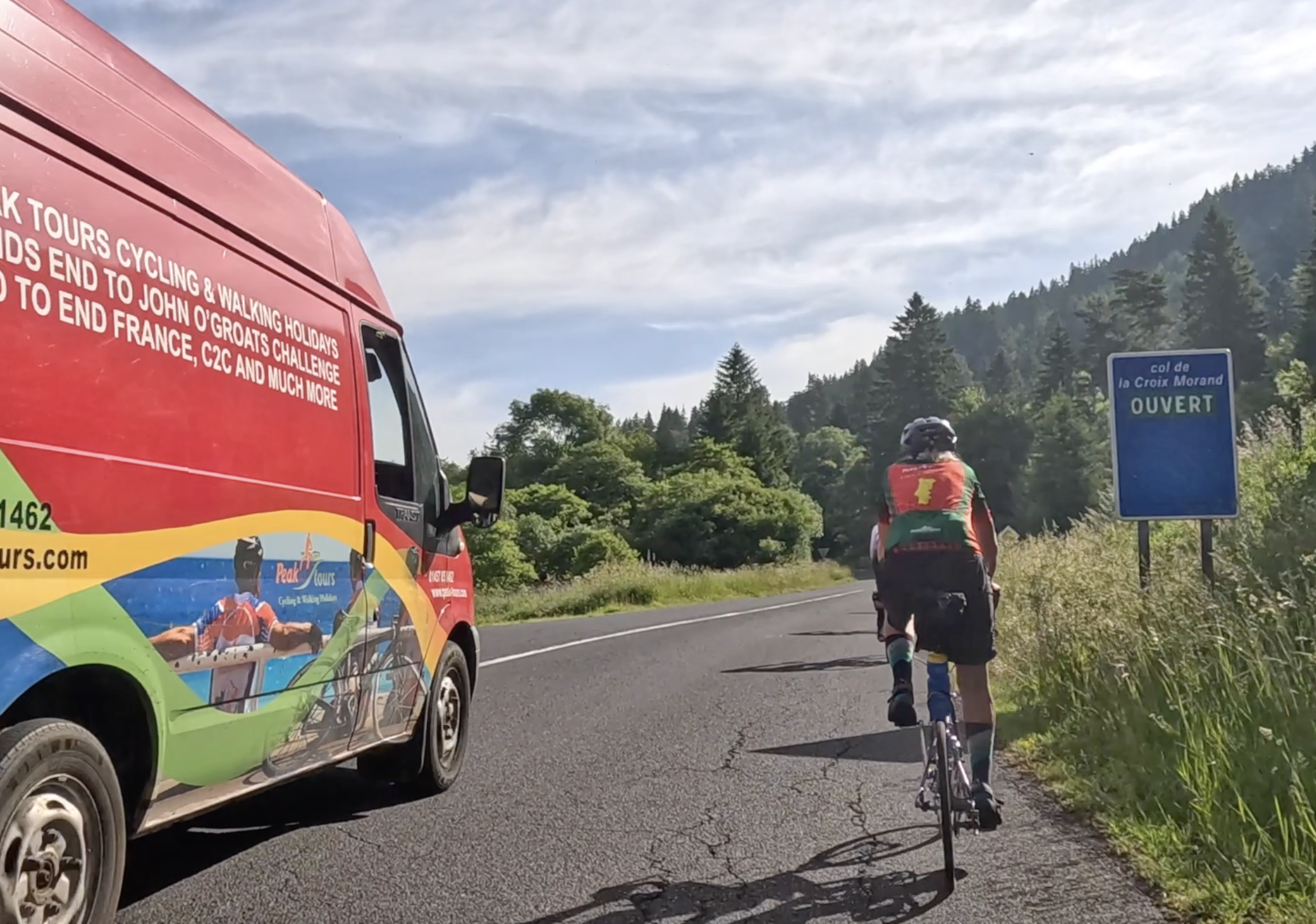
The first few miles were one long, steep climb up the Col de la Croix Morand. This was fine, especially as we were fuelled and fresh.
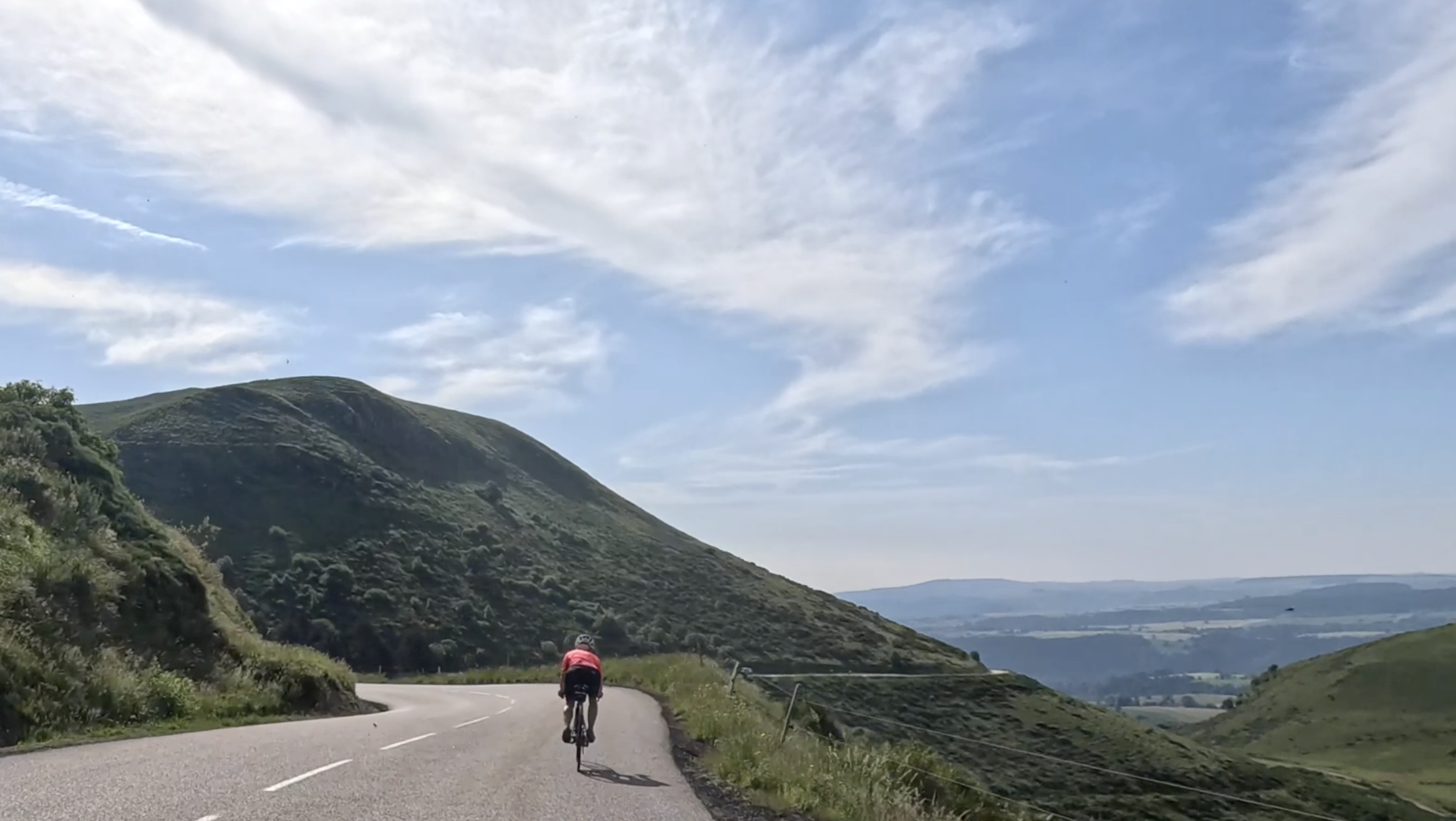
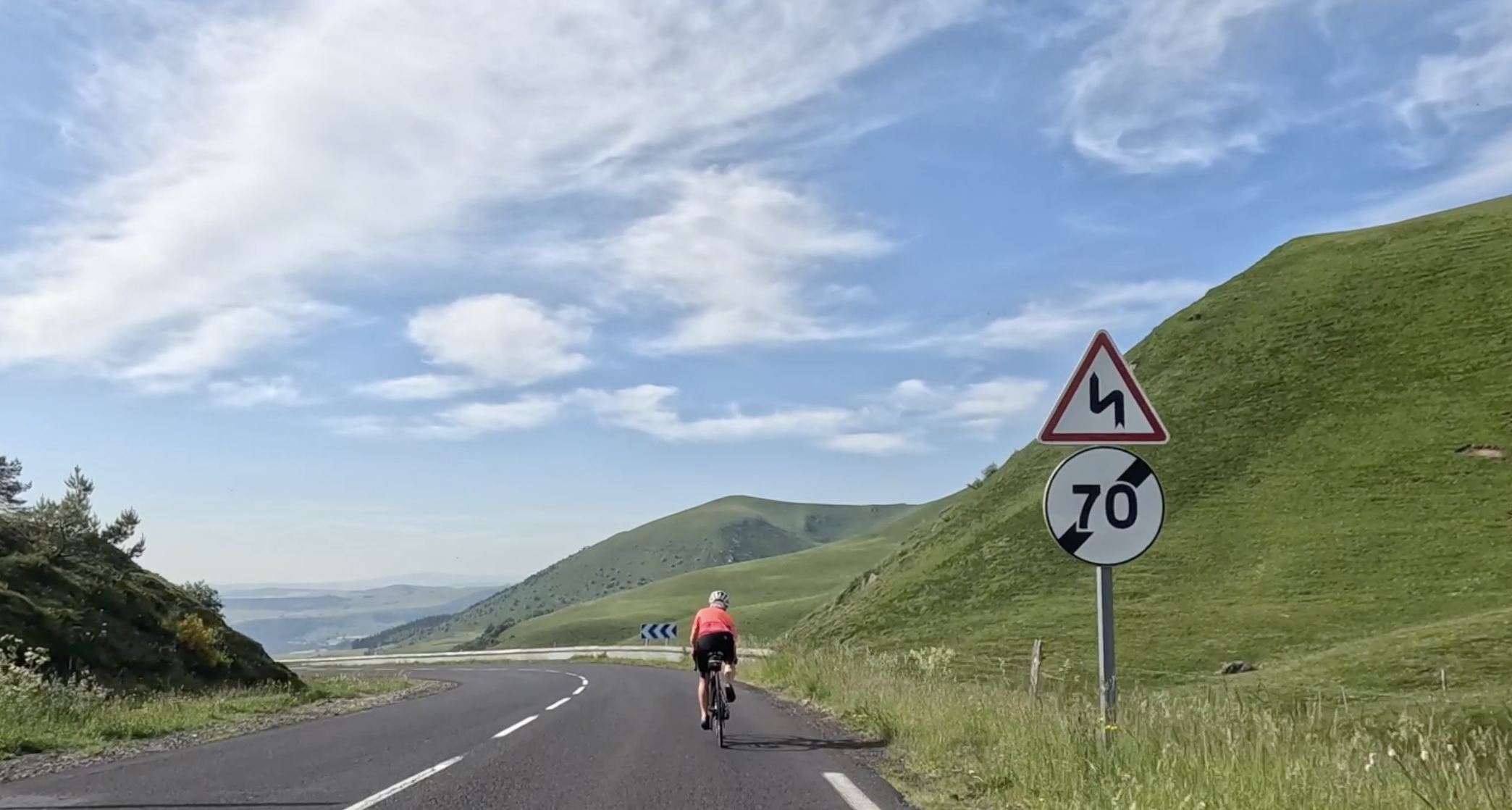
It was a joy descending the other side, the road twisting and turning, with views of the stark volcanic peaks around us as we rode.
We had a surprise at the morning brew stop at 17 miles in. The last to arrive was Willie, usually one of the fastest riders. He’d missed a critical turn, and had to backtrack.
I’d been looking forward to today since studying the Channel to the Med route long before the holiday. I first visited the Auvergne in 1976 on a school skiing trip to La Bourboule, just four miles from today’s destination, Le Mont-Dore. I liked the idea of saying I’d cycled to the region from the English Channel.
The day started with breakfast at the hotel in Aubusson. I’d had sinking feeling about this last night, after we’d been asked to choose items on a breakfast menu. I ticked two baguettes as I suspected they’d not be large. I was right. There was no muesli or granola option, which concerned me as these really fuel me on long rides. But the food I had seemed filling, so I hoped it would be enough.
On the first, gradual hill I felt lethargic. It was easy to blame the breakfast, but looking back another poor night’s sleep was more likely to be the culprit, given this was the start of the day, and the gradient was hardly punishing, as the gradient profile above shows. Whatever the reason, I didn’t enjoy this early session, despite the pretty, forested route, so typical of the first half of the tour. But I felt better after the morning brew stop at Monteillaud, where another dog showed a keen interest in us.
Steve, Maureen, Willie and Alison at breakfast, Argenton (clockwise from top left)
It was a pleasure taking breakfast on the terrace at the Hôtel Manoir de Boisvillers. After the meal, I opened the shutters in my room and spotted the Aberdeen contingent, Steve, Maureen, Alison and Willie enjoying their petit déjeuner, and took the photo above.
If yesterday was an easy day, today proved the opposite. It was partly the combination of distance (76 miles) and an impressive 6,000 feet of climbing, but mainly because of the heat, which reached the mid 30s. This would be a theme for much of the rest of the tour, but I preferred that to the rain that other editions of this tour have endured. The route profile above tells a vivid story: the whole day we’d be gaining height as we cycled south towards the Massif Central, which we’d reach during tomorrow’s ride. The few descents were followed inevitably by steep, longer climbs.
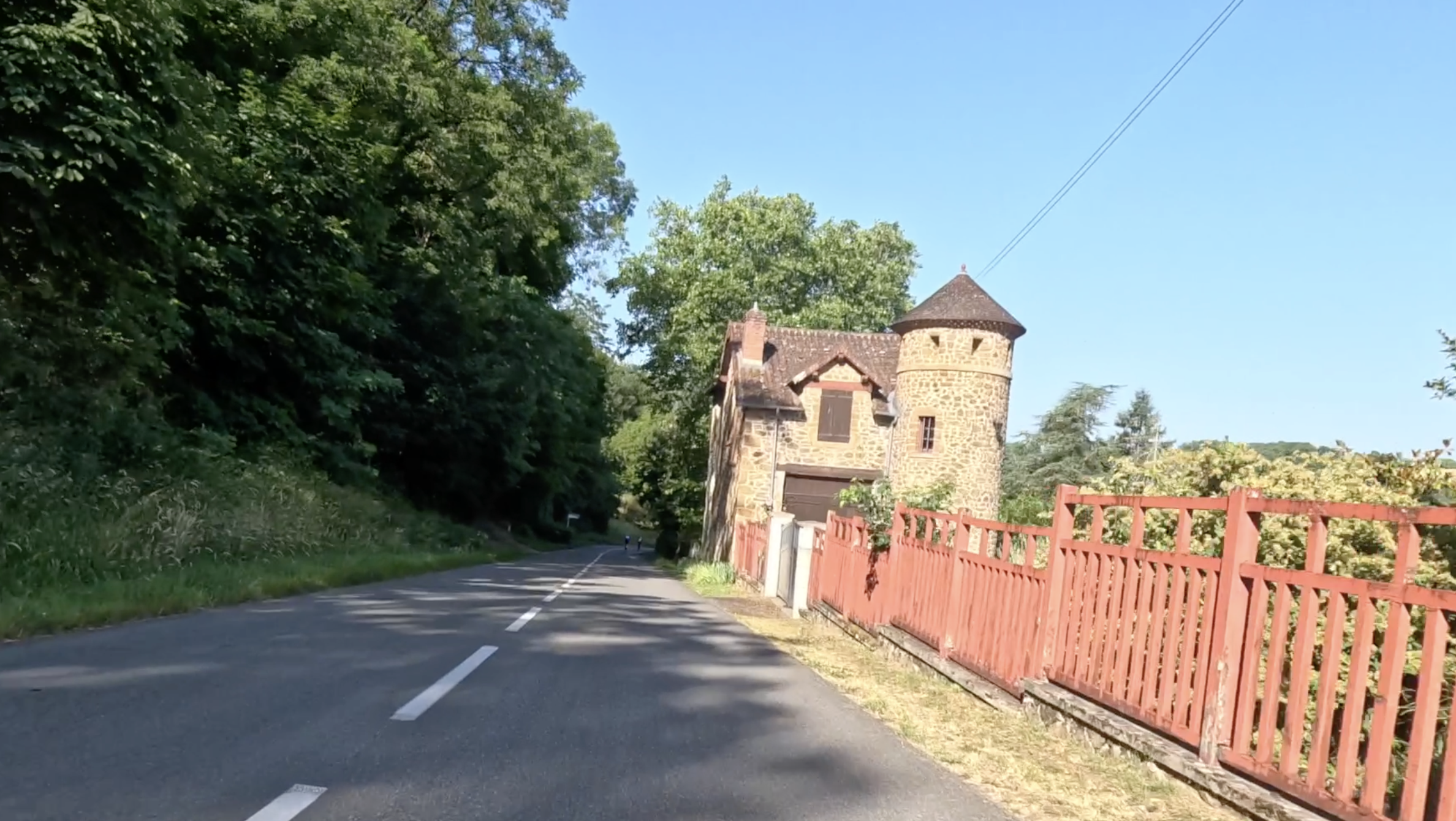
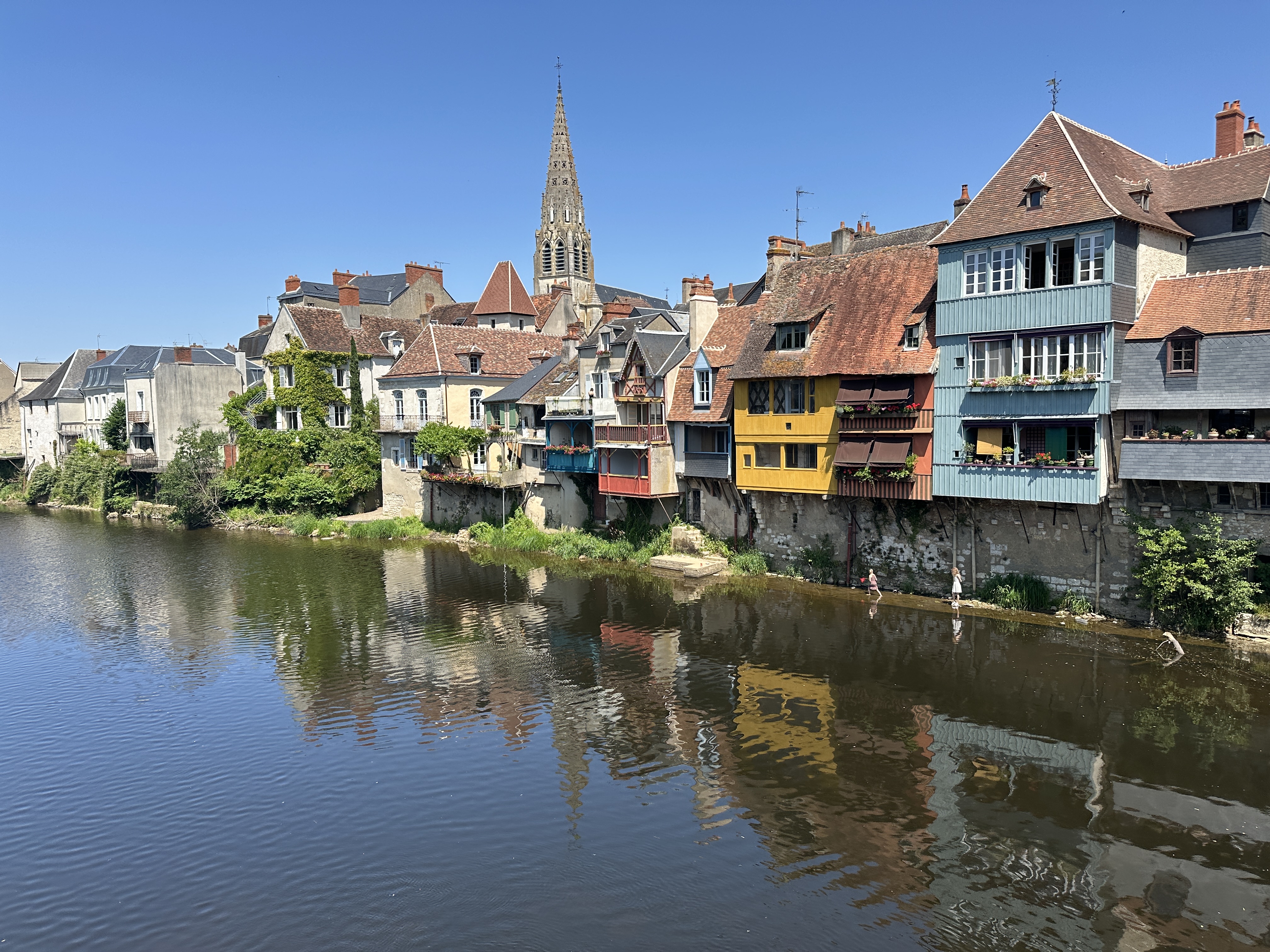
We followed the scenic Creuse valley for much of the day. We started by recrossing the old bridge in Argenton, quickly followed by a very steep but short ascent to a road junction. Within a few miles we were back on the river’s east bank and climbing – the theme for the day. We saw a few castellated houses along the valley road, overlooking the Creuse. John remarked on them at the morning brew stop, leading me to say I’d caught them on video, as seen above. Much of this stage of the ride was in woodland, which helped keep us cool on the climbs.
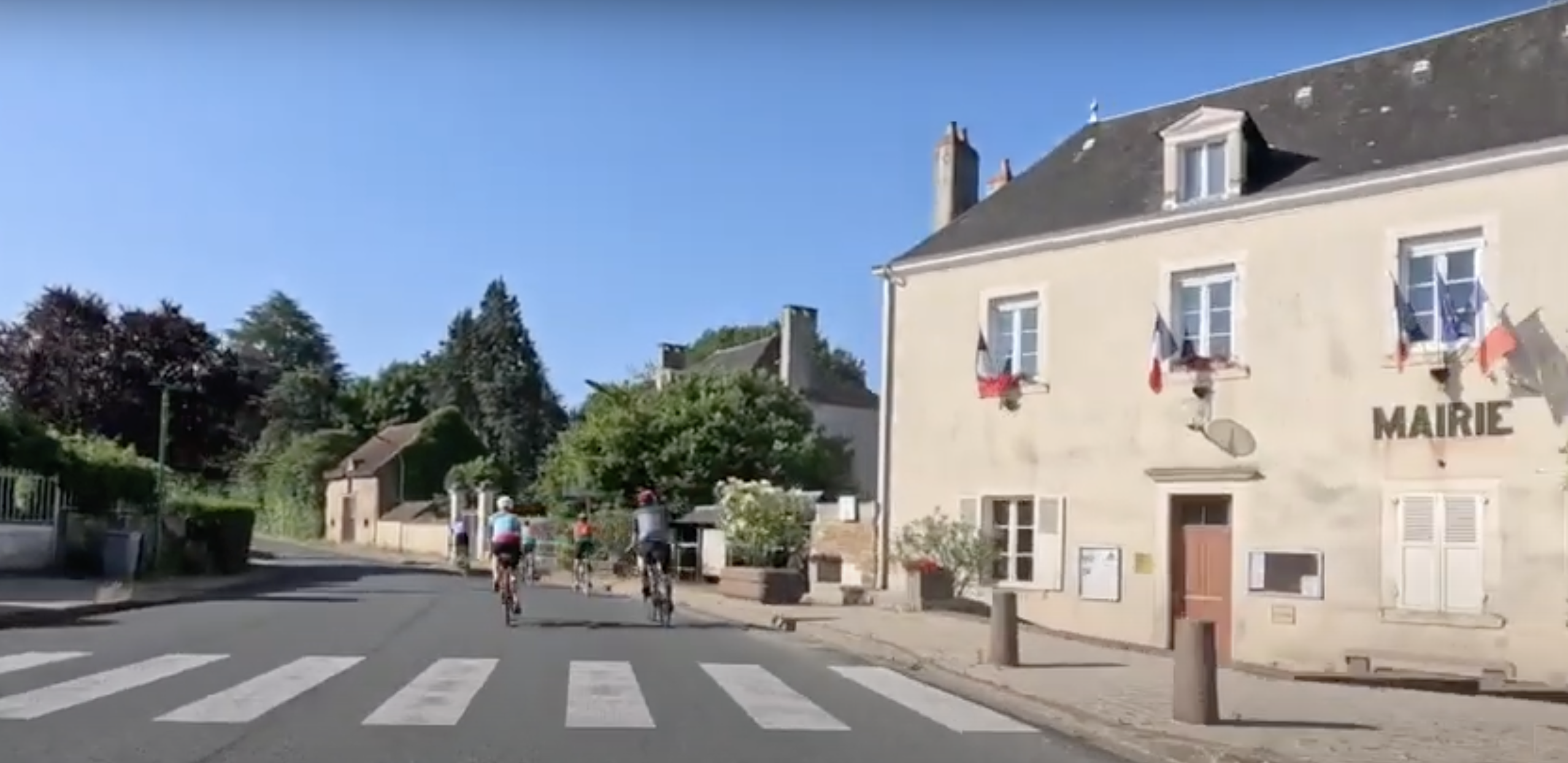
A feature of French towns and villages is the mairie, which is the rough equivalent of a town hall in Britain. The difference is that all but the tiniest hamlet has a mairie, reflecting the importance of local government and identity in France following the French revolution in 1789. This is where the maire (mayor) oversees his or her patch. You inevitably see the French tricolor flying proudly from the building, but they seem to be as deserted as the communes they oversee.
This post recounts the fourth day of my English Channel to the Mediterranean cycle tour in France with Peak Tours in June 2025. Read Day 3: La Flèche to Loches.
After our ride briefing in front of the impressive Best Western hotel in Loches, we were soon negotiating the handsome streets of this historic town. I wish I’d had the time to explore last night – that’s one of the downsides of such an intense tour.
Enjoying this easier day
This was the easiest day of the tour: 51 miles, and more significantly just 1,762 feet of climbing, most of which would feature before lunch.
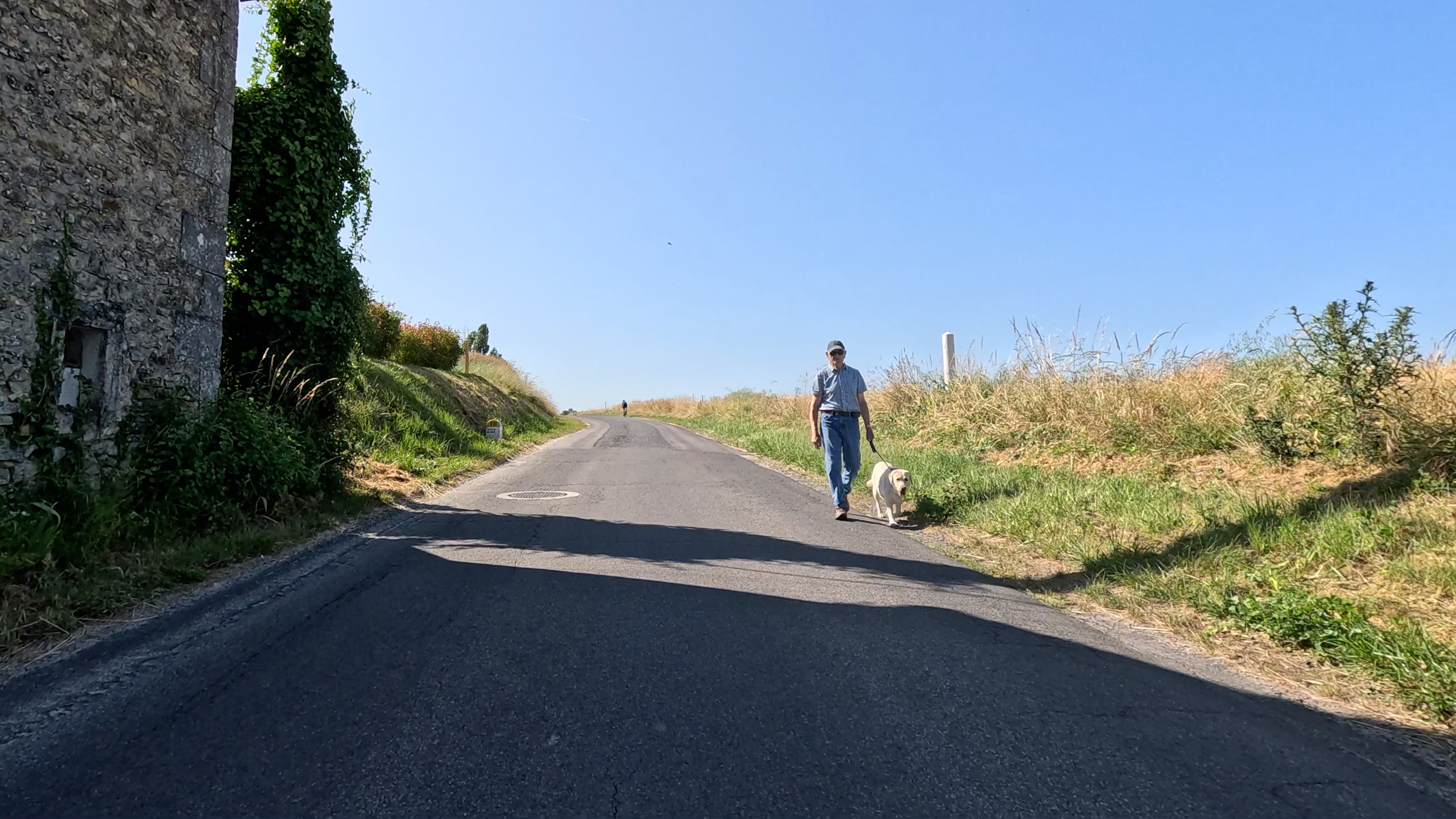
It was a pleasure to call out, ‘Bonjour!’ to dog walkers and others we passed, in my ‘finest’ French accent. We also saw many tractors, a reminder that France is still a hugely agricultural country, unlike Britain. (No wonder those farmers still hold the power to break presidents and prime ministers.)
Our morning stop was at a pretty location next to an old bridge, which we’d cross immediately after the break. Our route instructions asked us not to lean our bikes on the flowers – mine was resting on a sign, not the blooms surrounding it! We went without a hot drink as the hotel in Loches had filled the flasks with cold, not hot, water… But soft drinks proved just what we needed on another hot day.
At first glance, this should have been a fairly easy day, given we’re all more than capable of cycling 80 miles. The route had a lot less climbing than yesterday, and the weather was set fair. As it turned out, the session after lunch was a struggle thanks to that cyclist’s curse, a pesky headwind. But I’m getting ahead of myself…
It was tricky getting out of La Flèche, and we had to squeeze past the cars clogging the narrow streets of the town centre. But we were soon crossing the bridge over the Loir, which was lined with handsome buildings. We passed few typical French villages once again, although these seemed less prosperous than those in Normandy. The countryside was also flatter, as the route profile suggested.
We were in for a treat at the first brew stop at Noyant. Guide Fernando had donned a ‘Coffee and Croissant Club’ apron, and was rolling banana slices in coconut. He’d also sliced kiwi fruit and oranges, which went very well with my morning coffee. This stop was next to a church with a war memorial commemorating those from Noyant who died in the world wars and also in Vietnam and Algeria, the two great colonial wars of independence that led to the collapse of the French fourth republic in 1958.
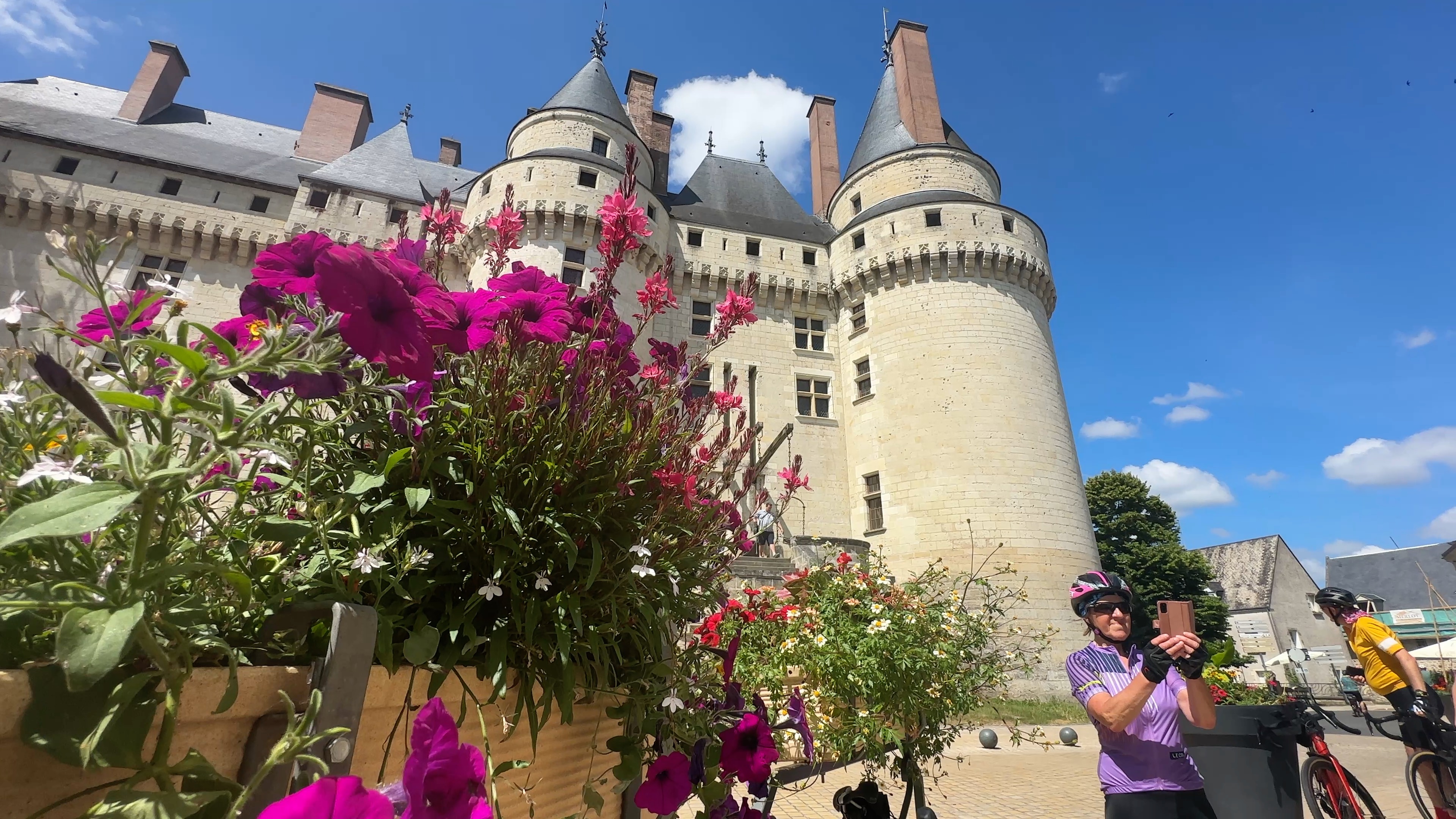
The next section was a delight, and I made good time along wooded roads towards the town of Langeais, with a dramatic chateau at its heart. We stopped to take photos here before winding our way down to the mighty Loire – the real one, and not the Loir from La Flèche. (I got the two confused on the highlights video at the end of this blogpost.)
Today was our first long day in the saddle: nearly 80 miles. Unlike yesterday, most of the climbing was in the morning. Fortunately, I was still fresh, and climbing reasonably well. I still had a slight twinge in my leg from the Bryan Chapman audax last weekend, but that disappeared without me noticing over the next day or so.
Sunday cycling
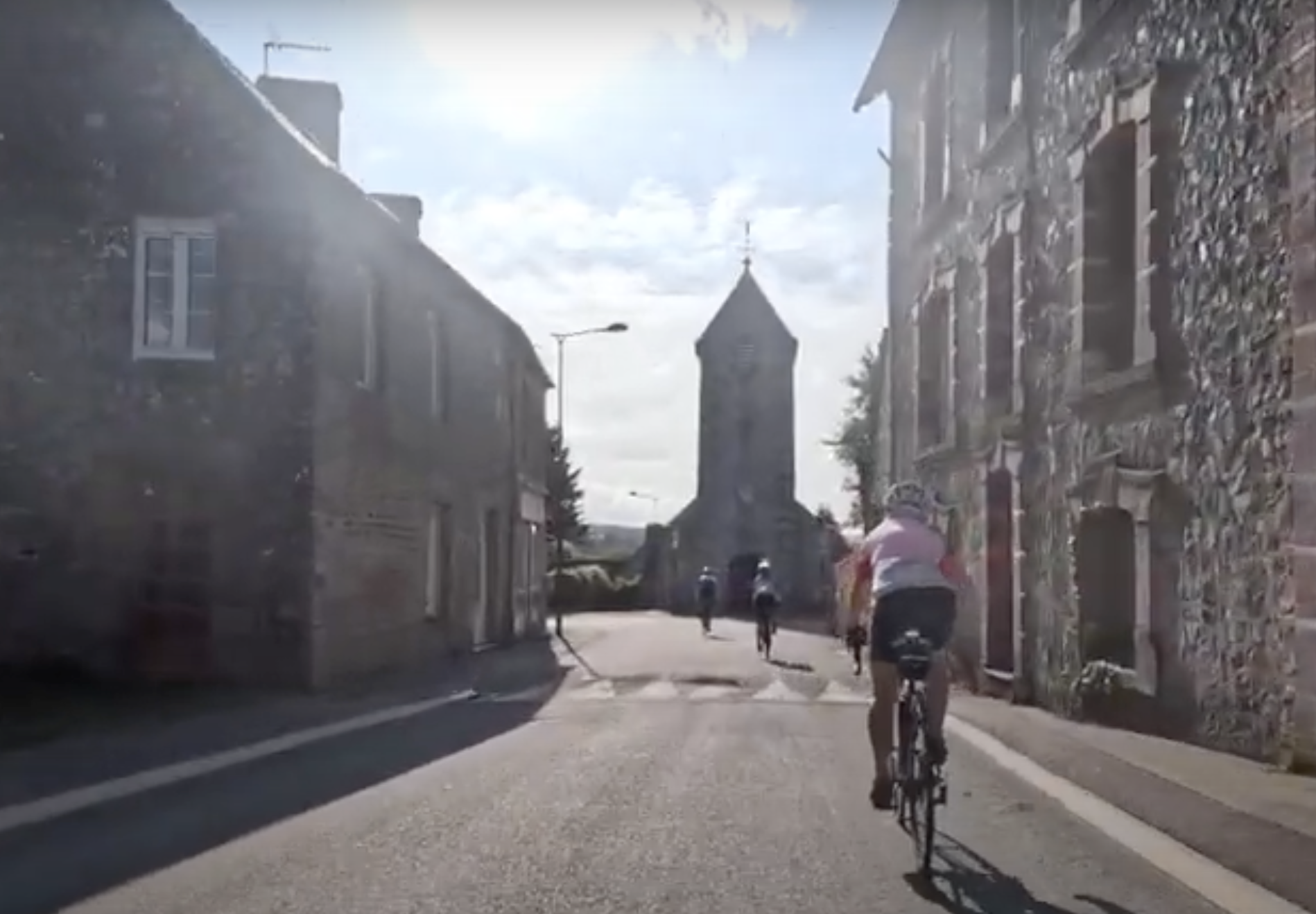
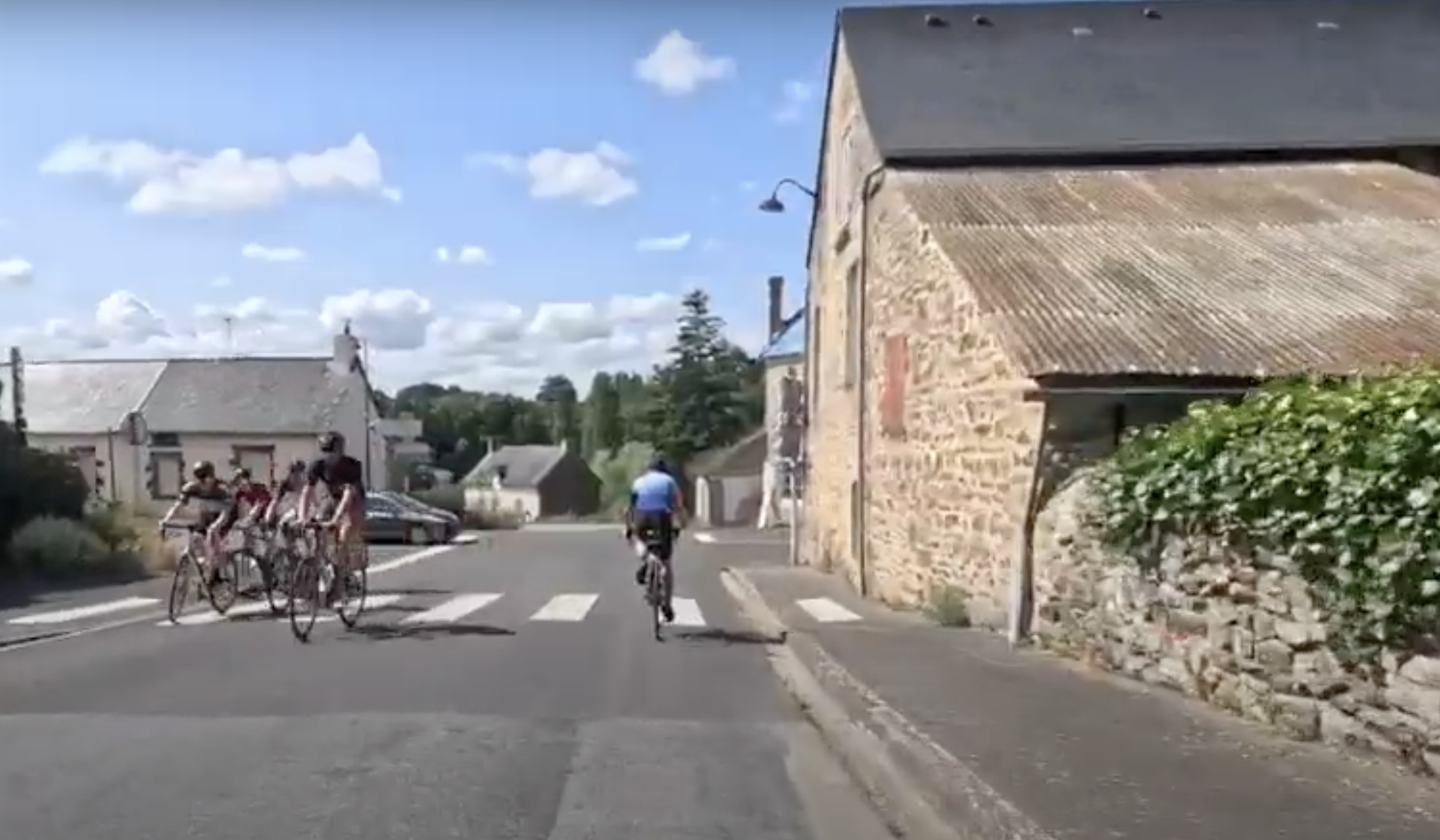
It was a pleasure weaving through French villages that were as quiet as you’d expect on a Sunday morning. (I’ve always been puzzled by the absence of people in these small communities.) They were characterised by distinctive churches – typically very different from those in Britain – and often handsome stone buildings. Our first brew stop was opposite a large church in the village of Saint-Cyr-sur-Pail.
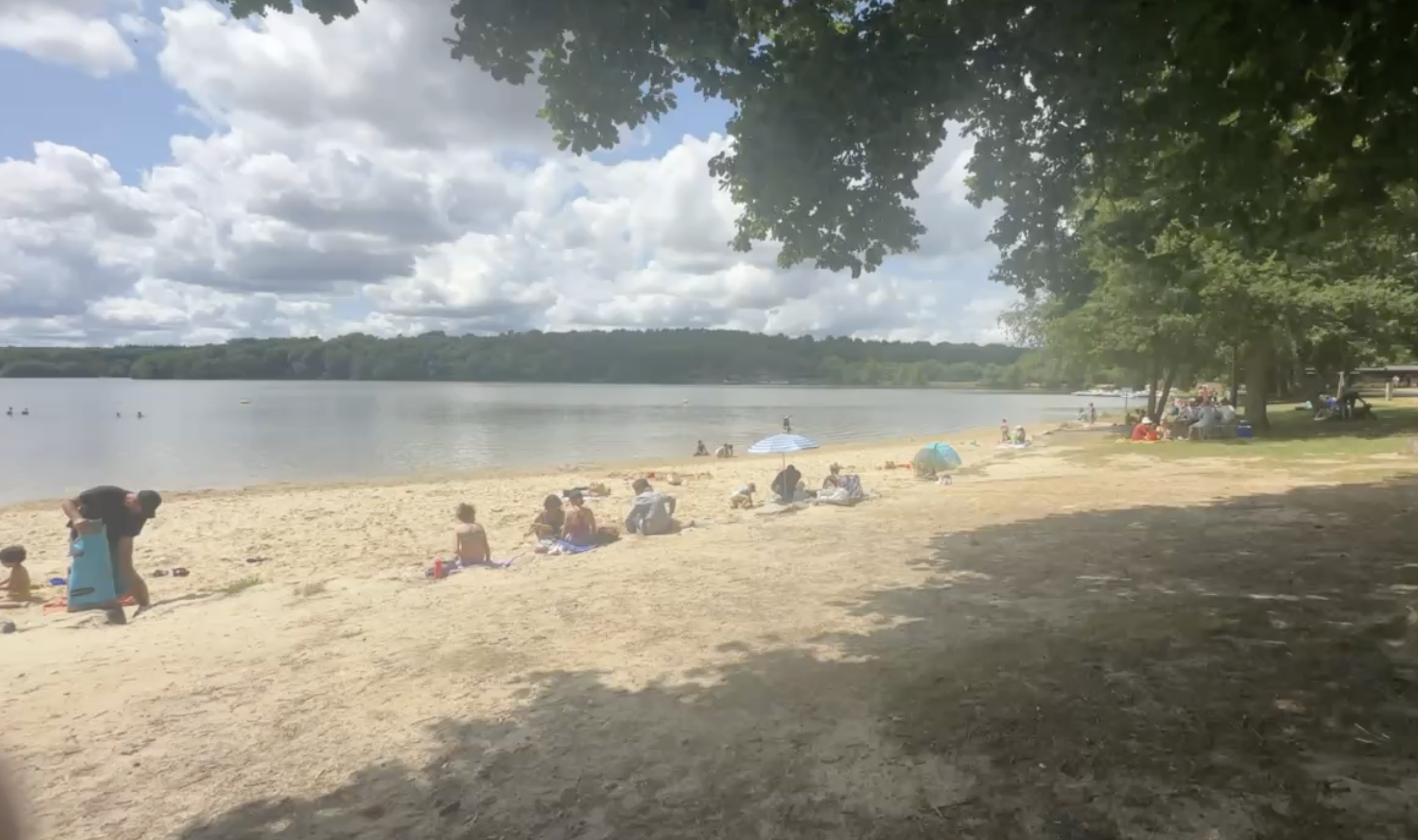
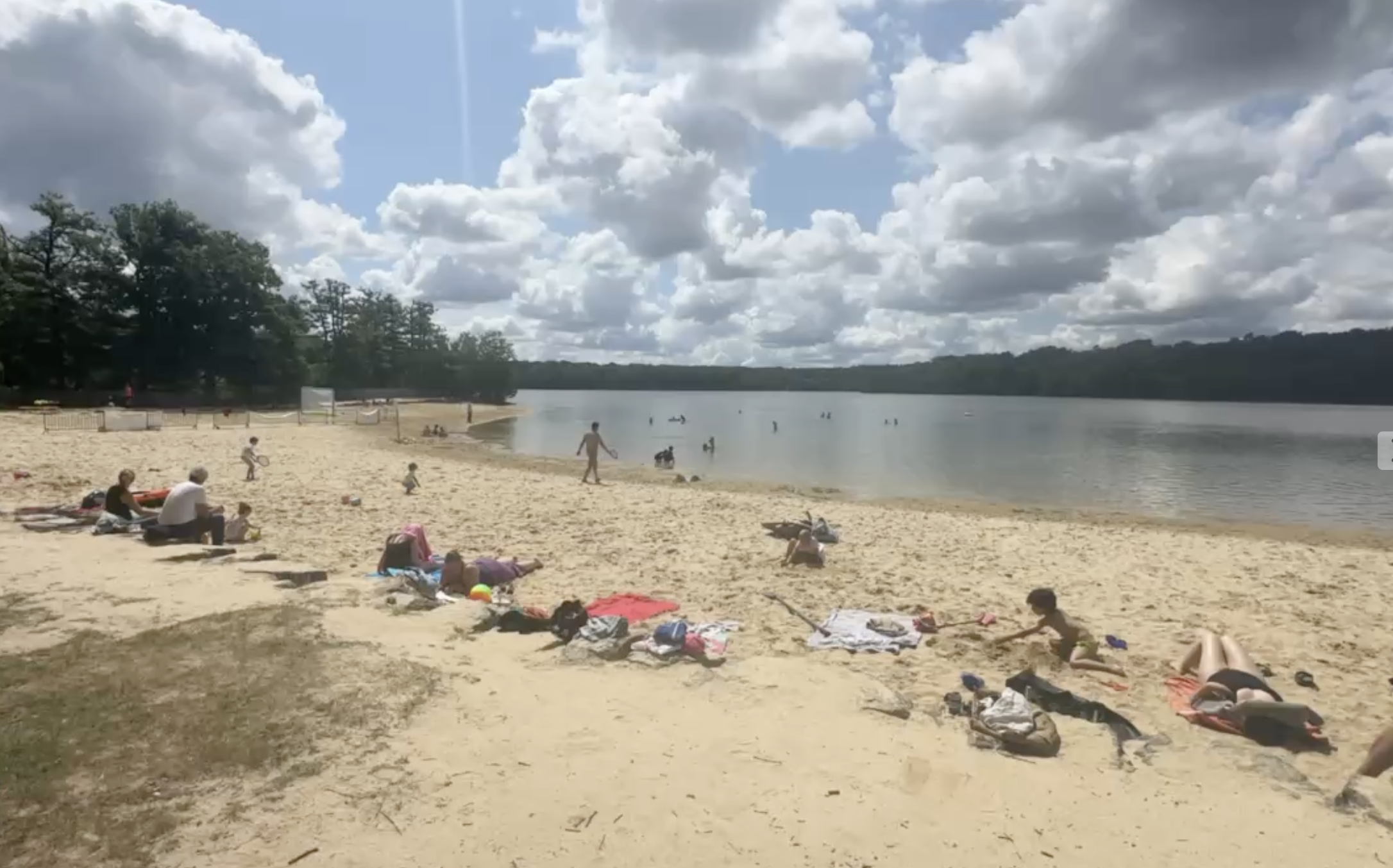
The landscape was one of soft, rolling hills – we’d see a great change as the tour unfolded, and we reached the volcanic, mountainous land of the Auvergne. The climbing meant a slow average speed, but the compensation was a gorgeous lakeside location for lunch at La Plage (the beach) at Sille-en-Gillaume. I grabbed a coffee from the bar, and took my lunch to eat on a picnic table overlooking families enjoying their Sunday swim in this lovely lake, and chatted with the others.
This post recounts the first day of my English Channel to the Mediterranean cycle tour in France with Peak Tours in June 2025.
Prologue: Sword beach, Ouistreham
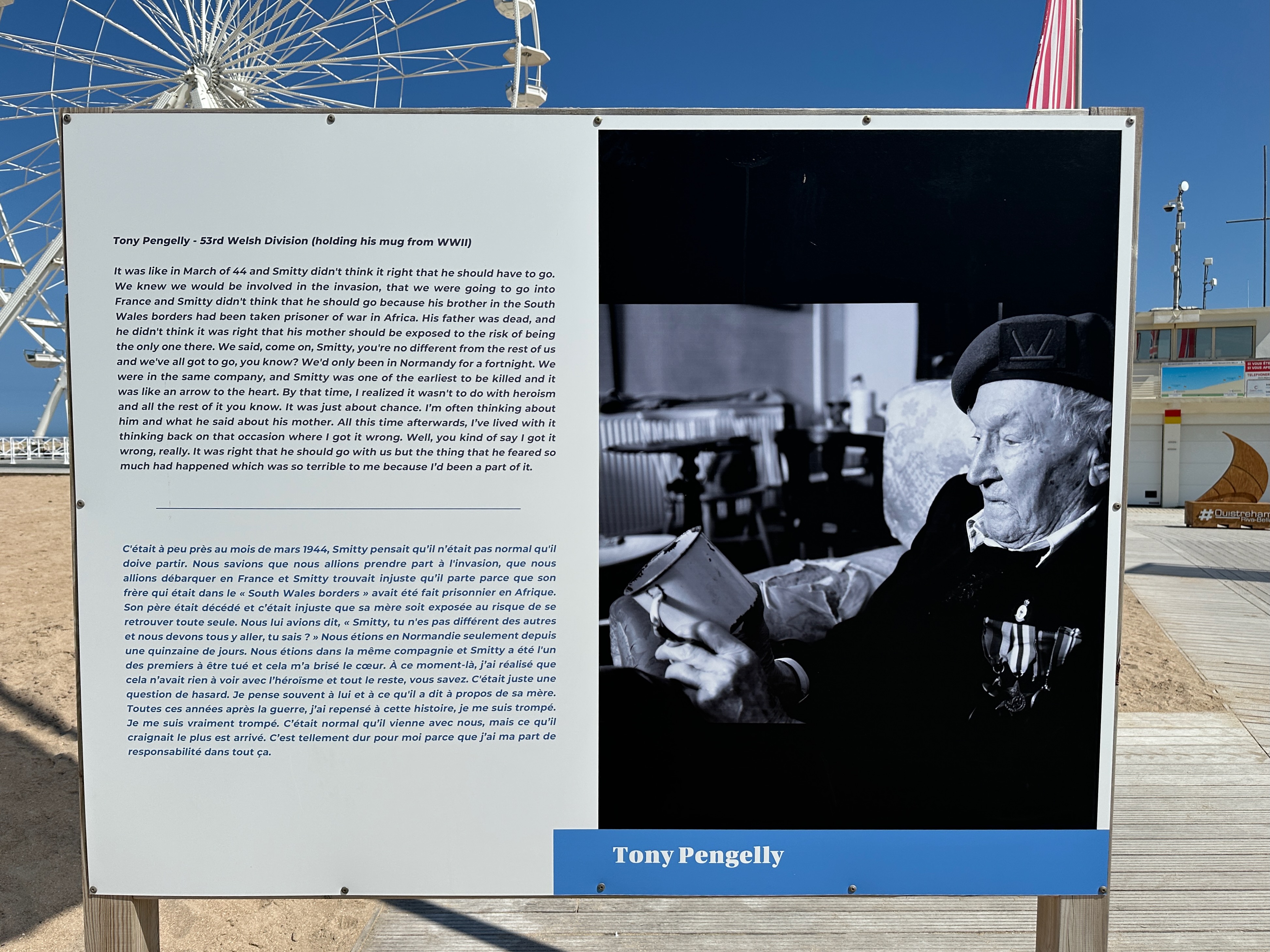
Today. Ouistreham is a peaceful place to land in France. But as I walked along the sand with the English Channel by my side, I marvelled at the stark contrast with the experience of the men who fought their way up this beach – immortalised as Sword beach – on 6 June 1944. I reflected on the individual stories told on a series of plaques along the beach walkway, such as fellow Welshman Tony Pengelly, featured in a photo above. These men were just a year or so older than my late father Bob, who joined the British Army himself some six months after D-Day on turning 18. However tough I found cycling from here to the Mediterranean, it would be nothing compared with the hell endured by that extraordinary generation of men and women of many nations as they liberated Europe over 80 years ago.
An easy start
Our long journey to the Mediterranean began at the fish market at Ouistreham, following the west bank of Caen canal to that city. As we set off I realised my Garmin was still set to kilometres following last weekend’s Bryan Chapman Memorial 600km audax ride in Wales. I switched back to miles, just to make it easier to cross reference the Peak Tours route directions in case of Garmin issues. This proved a smart move…
Screenshot
Just three miles into the ride, we came to Pegasus Bridge at Bénouville. British troops captured this critical crossing just 26 minutes into D-Day, a mere 90 minutes after taking off from Dorset in Horsa gliders, and hours before the landings on the Normandy beaches. The bridge that we saw was a 1990s replacement of similar design to the 1934 original, which is now in a nearby museum.
We didn’t have time for a coffee at Café Gondrée, whose wartime owners were active in the French resistance. I was once served by their daughter Arlette, who took over this historic institution after her parents died. She is now in her eighties. One of our party recalled meeting the legendary older Gondrée owners in the 1970s.
Our first navigational doubts came in Caen, but we reached a consensus and continued on the right route. Today’s city lacks the character of many historic cities across Normandy because of its near total destruction in the weeks after D-Day. The Allies hoped to capture Caen on that critical day, but its liberation came six brutal weeks later, at a bitter price: the loss of 30,000 Allied troops, 3,000 civilians as well as the loss of most of the historic city.
First brew stop, near Amayé-sur-Orne
After we left the canal, we followed an old railway line south of Caen. This is now part of the Vélo Francette, a marked cycle route that wends its way to La Rochelle on the Atlantic. It reminded me of the Tâmega trail on my Portugal end to end tour in 2023. Some 18 miles after setting off, we had our first ‘brew stop’ near Amayé-sur-Orne. These morning and afternoon stops are a brilliant idea by Peak Tours, as I found on my first tour with them in 2019, Land’s End to John O’Groats. They guarantee you will be well fuelled for the remaining miles to lunch or your afternoon destination. (The Yorkshire Tea was popular – even in the heat of later days!)
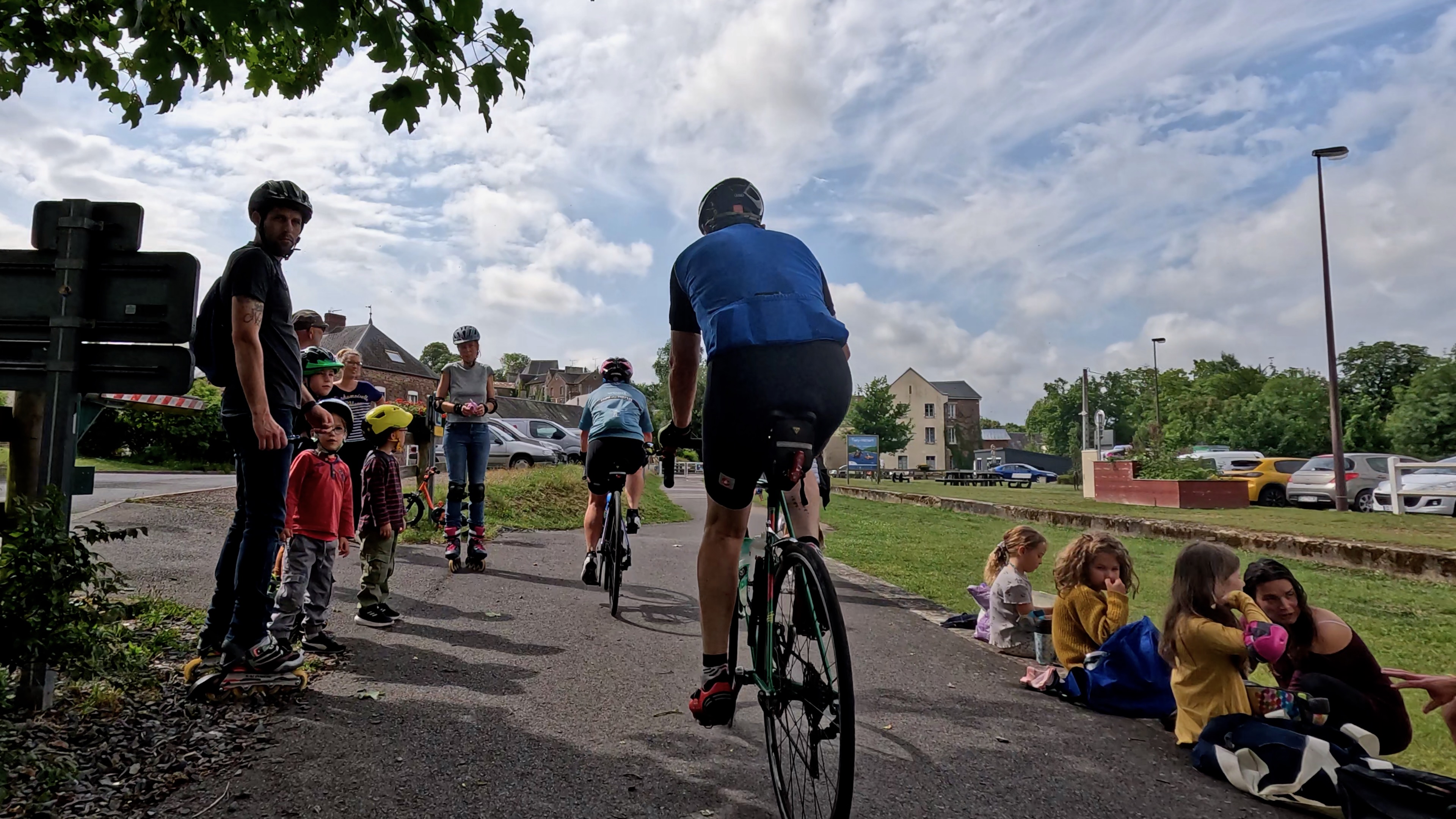
It was fun weaving our way through the families enjoying their Saturday morning activities at Thury-Harcourt. It was here that I nearly came a cropper after misjudging my path between barriers across the trail. But all was well.
We were now following signs for Suisse Normande (Swiss Normandy). While Normandy is hardly mountainous, the name does confirm that it has its fair share of hills, which we’d be climbing after lunch at Clécy. We were briefly delayed by two moments of navigational uncertainty on either side of the bridge over the Orne. Once again, the route notes solved the riddle: ‘cross over the [river] bridge’ and turn left after ‘some recycling bins’ proved conclusive. It is curious how cycling satnav devices occasionally prompt such doubts compared with car navigational systems. You’d think our slower speeds would prove ample time to display the exact turns – or is it the fault of the GPX route files that we use?
Clécy
I’d been looking forward to seeing Clécy after staying here on two cycle tours in 1998. I stayed in the loft of an outhouse in the garden of a hotel on both occasions – which featured in a photo in a Normandy guide! We had a steep climb up to town from there. Only after we passed through this time after an enjoyable lunch at the Aux Rochers restaurant did I realise that my 1998 stop was on the other side of town, away from the river.
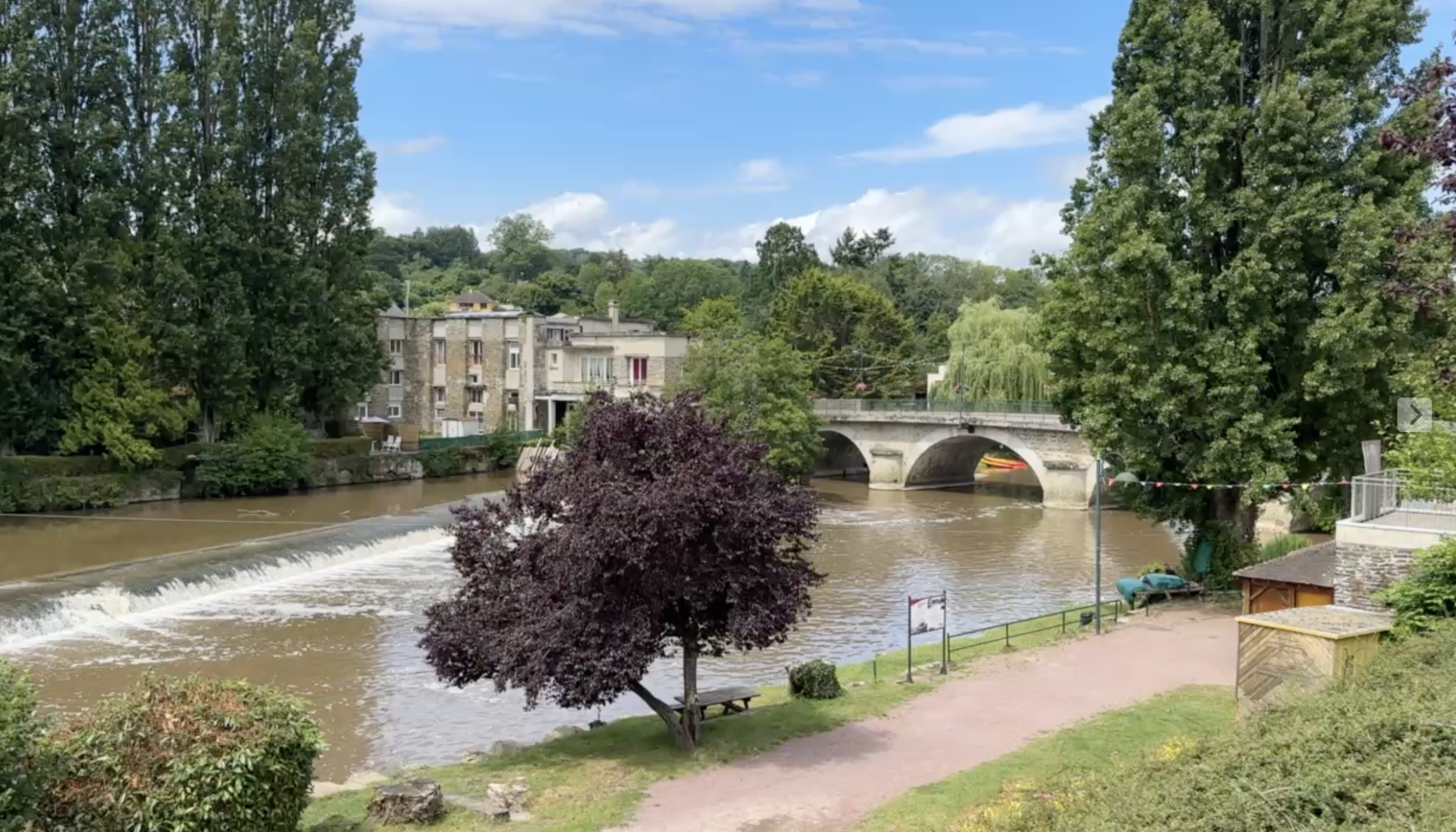
Now the climbing began. Unlike later in the tour, these were short if sharp ascents, but they came in quick succession. It was a pleasure to pause to take photos in Pont d’Ouilly, with its eponymous, handsome bridge over the Orne. Soon after, I overtook a few touring cyclists, and smiled when I saw a baguette poking out of one of their panniers. Over the coming weeks, we’d see many laden touring cyclists. I was once one of their number – see my account of a tour of Brittany in 1996 – but am glad to leave others to carry my luggage today.
As the miles passed after lunch, with one climb after another, I was dismayed to see my Garmin telling me that I’d only completed 700 of the 3,000 feet of climbing for the day. But then I looked closer, and realised that it was showing 700 metres of ascent. Changing the device’s measurement from kilometres to miles this morning obviously hadn’t switched ascent to feet. That meant far fewer hills remained to be conquered.
This called for a celebration. We stopped for a pastry at this wonderful pâtisserie in the village of Les Monts d’Andaine. It was an indulgence as we barely had five miles still to ride, but it was worth it. It was wonderful to find such a classy pâtisserie in a small French town.
Our destination, Bagnoles de l’Orne, was just as I remembered it from staying here in 1998: a rather elegant, small spa town with a small lake at its heart. The tranquility was slightly disturbed by some kind of festival taking place on the other side of the lake from our modern hotel.
This evening, we had our welcome dinner. Peak Tours usually holds these on the eve of the first day’s cycling, but as some prefer to join the Channel to the Med trip by overnight ferry the morning of departure they wait until the first evening on the road on this tour. So we’d already started to get to know each other by the time we sat down for drinks and dinner at Bagnoles. There was, however, a shadow over proceedings: we learned that one of our riders had been taken to hospital after an accident just after lunch. As a result, the guides were very busy supporting him. Sadly, he never rejoined the tour, but happily recovered from the crash.
This is the third in a series of posts about my training and preparation for the 1530km London Edinburgh London audax event in August 2025. The series was inspired by LEL supremo Danial Webb asking if anyone was planning to post about their training and preparation for the event. Read part one here and part 2 here.
Crossing the Gospel Pass on Bryan Chapman Memorial audax
They say we learn far more from our failures than our successes. If so, my experience on last weekend’s Bryan Chapman Memorial 600km audax ride should really help me on London Edinburgh London in August.
I’ve written a blow-by-blow account of the ride here, so head over there for the gory details. Or you can watch my five minute highlights video:
Here, I’ll share what I learned on the Bryan Chapman. Let’s start on a positive note: what went well.
The right bike
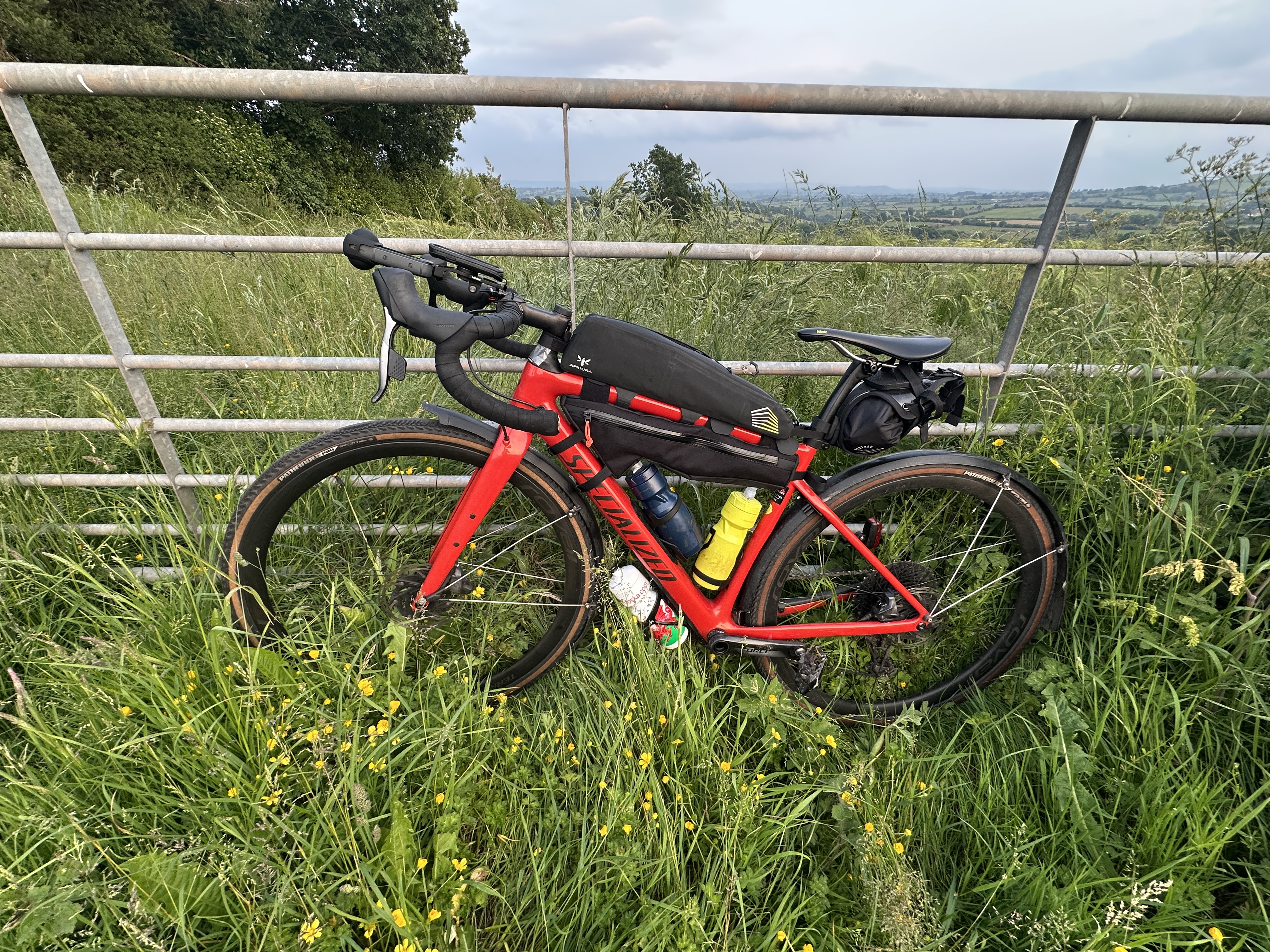
Should you ride your fastest or your most robust bike on a big audax event? I chose my Specialized Diverge gravel bike. It’s seen me through countless adventures including two editions of London Wales London. It’s not my lightest bike, but its 38mm tyres give me such reassurance, especially when hitting a pothole at speed in the middle of the night.
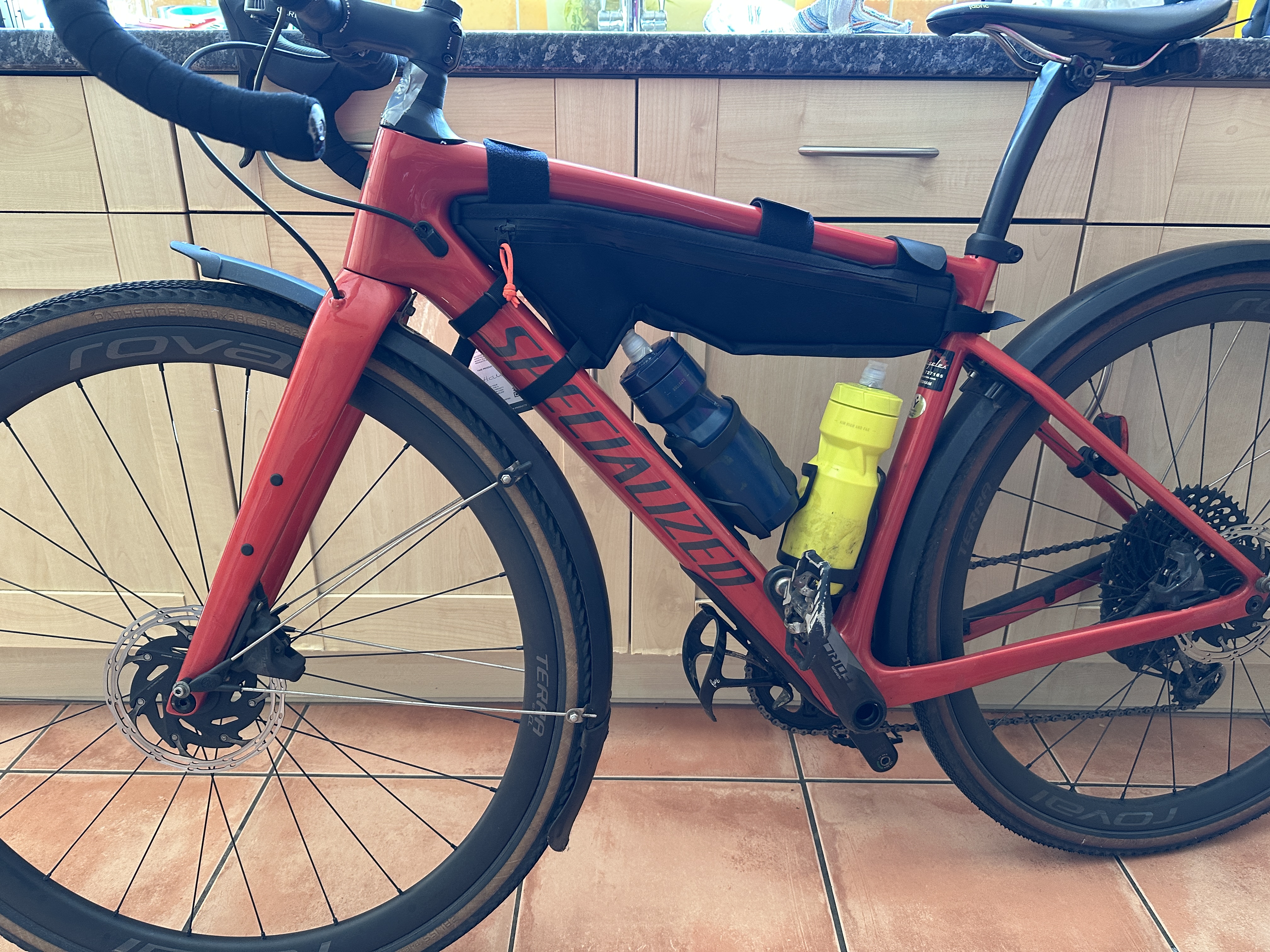
My Restrap custom frame bag was so useful
One of the disadvantages of riding a small frame bike – in my case 54mm – is that only the smallest frame bags fit. On a 600km or longer audax event that is a pain. But I noticed that Restrap offer a custom frame bag for a very reasonable £119.99. I sent off for the design pack, which helps you work out the dimensions, and where the various straps should go.
My wife Karen and I carefully followed the instructions to design my custom bag, and I placed my order. At first I was afraid the bag wouldn’t arrive in time given the stated lead times, but the Restrap team was brilliant, and I received the bag a week before the Bryan Chapman. It fitted perfectly, and was a huge help on the ride.
Cutting the ride short: the right decision
A few weeks ago, endurance cyclist Emily Chappell invited advice on her Substack post about long-distance cycling. I gave a few tips, including not giving up cheaply when you’re at your lowest ebb. Eat, sleep, and reflect.
So it was ironic that I decided to cut short my Bryan Chapman route, going straight from the Dolgellau control at Kings Youth Hostel to the sleep stop at Aberdyfi. I made the decision after going miles off route because my Garmin led me onto the southbound track when I was still heading north. As a result, I had a massive, additional pass to climb, and lost a huge chunk of time.
I had already made the decision before Kings, and it was undoubtedly the right one. I could enjoy a reviving stay at the control, relish the coastal ride to Aberdyfi, and be in far better condition for the remaining 210km in the morning. Best of all, I was at peace with the failure to get to Menai Bridge. I could do my Welsh end to end another time.
My near midnight finish on the second day shows how right I was.
Taking spare SRAM batteries was vital
If you ride electronic gears, you have to be ready to replace or charge batteries on the road. SRAM eTap batteries theoretically last up to 1,000km, at least when new. I had to pop in a spare one after around 375km. Those constant gear changes on the very hilly Bryan Chapman drained the battery far sooner than I expected. But I was prepared.
The volunteers were amazing
As I spent time recovering at Aberdyfi, I was struck once again by the critical role volunteers play in audax events. One female helper seemed to be ever present – there when I went to sleep past midnight, and again when I went for breakfast just after 6am. She was constantly replenishing supplies and helping weary riders. To her and every other volunteer, and organiser Will Pomeroy: thank you!
So… the lessons I need to learn from
Make your own decisions
I was seriously underfuelled at times on the Bryan Chapman. Twice I allowed myself to be led by other people’s examples. After 74km at the first control, I ordered a small breakfast, as others had done, but it wasn’t enough. Later, after seeing Bryan Chapman riders eating at a bakery I did the same, even after finding the choice very limited.
On an audax like Bryan Chapman, you have to find your own food except at a small number of controls. You really have to make smart choices. I didn’t.
London Edinburgh London is very different, with food on offer at controls throughout the route. (Although judging from accounts of previous editions supplies may be limited if you arrive at a very busy time.) If you feel lethargic, don’t miss the chance to eat proper food – bars and gels can get you only so far.
Don’t trust your Garmin
My great mistake on the Bryan Chapman was to trust my Garmin’s directions. When it told me to turn off the main road between Machynlleth and Dolgellau I obeyed, and went miles off route, requiring an extra, very big climb. I didn’t realise it was sending me on the following day’s ride. Organiser Will Pomeroy had provided control-to-control GPS files. Had I used those, rather than the complete route version, I’d have been OK. Something to ponder with London Edinburgh London, whose northbound and southbound routes also cross.
Leaving Aberdyfi
You may be slower than you think
I deliberately didn’t try to estimate when I’d reach the various controls on Bryan Chapman. I knew how hilly the route was. Yet on the second day, I still under estimated how slow I’d be. The lack of sleep, and eating too little, had a big impact. I should have left Aberdyfi 90 minutes earlier at least.
Prepare to sleep
I’d brought a sleeping bag liner as I’d heard that the blankets provided at the Bryan Chapman sleep stop could be scratchy. I could have done with ear plugs to block out the constant noise of people coming and going, accompanied by their phone wake up alarms. One for the kit list for London Edinburgh London.
At a low point on a quiet mountain road, I enjoyed a power nap on a grassy verge beside the road. It revived my spirits. On London Edinburgh London, I’ll take the opportunity for a half hour nap at controls during the day if I need to.
Final thoughts
I booked to enter the Bryan Chapman as a test of my readiness for London Edinburgh. I’m glad I did. While I failed to complete the full 600km, I did ride further than I’d ever done before in two days. But I need to learn from my mistakes, and continue to build my endurance fitness. I’m starting a bike ride through France from the English Channel to the Mediterranean tomorrow, which should help!
It was a sickening moment. I had already ridden over 110 hilly miles on one of Britain’s toughest long-distance bike rides, with 260 still to go. But I realised that I was miles off route.
I was taking part in the Bryan Chapman Memorial 600km audax (long-distance cycling) event. It commemorates Bryan Chapman, a cyclist who’d supposedly cycle the length of Wales to get his favourite mechanic to fettle his bike – then ride home.
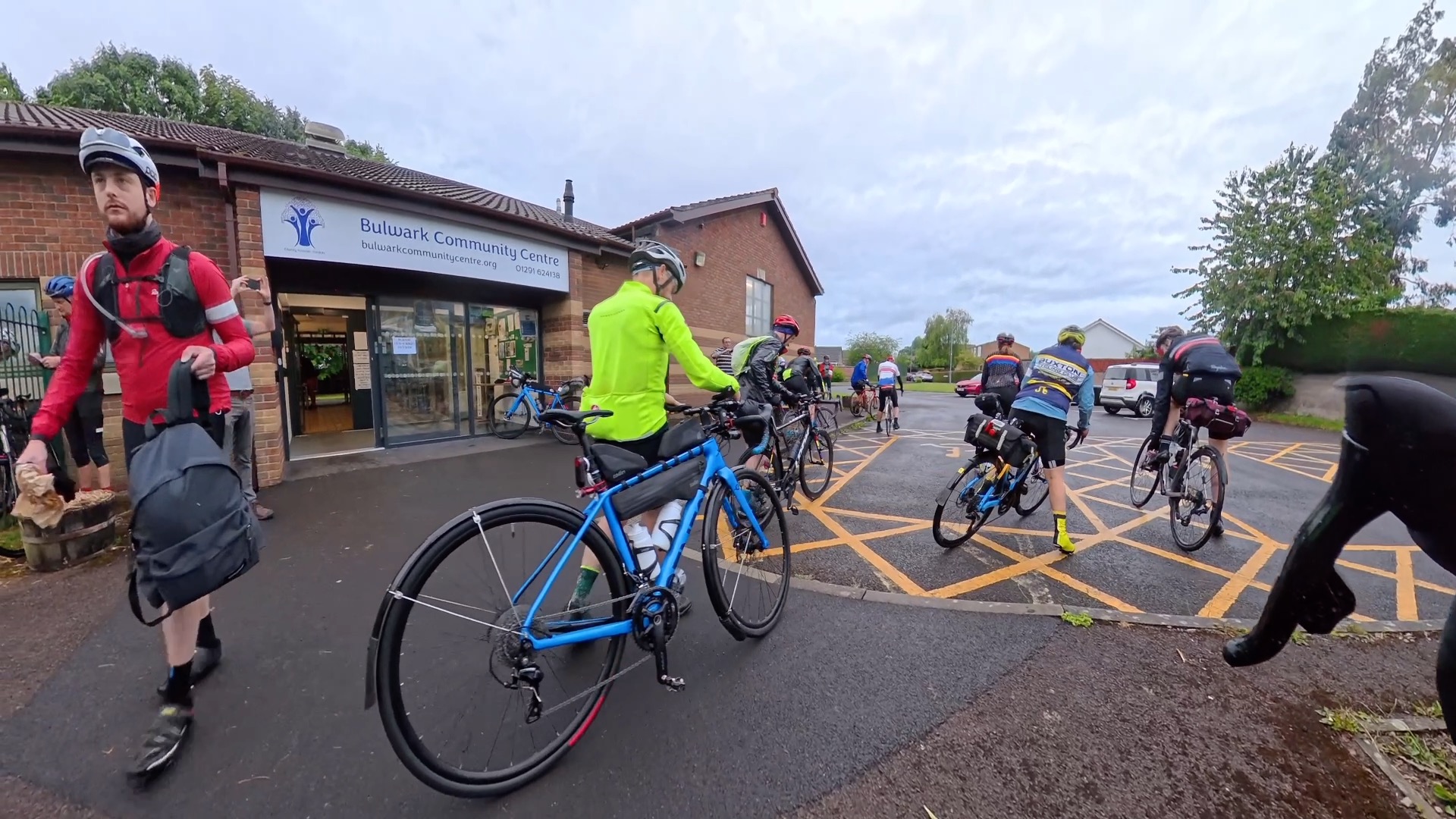
We set off at 6am on Saturday morning from Bulwark Community Centre, a building in Chepstow that’s amazingly hard to find even when using Google or Apple Maps. My usual eve of ride butterflies were fully justified for once – I knew this would be my toughest ride, with the extra menace of the weather and fear of a mechanical on a lonely Welsh mountain.
I enjoyed riding in a group for the 74km to the first control at Bronllys in the Bannau Brycheiniog (Brecon Beacons) national park. It felt like slow progress for the first half of this stage, but I knew the secret was not to burn too many matches too early.
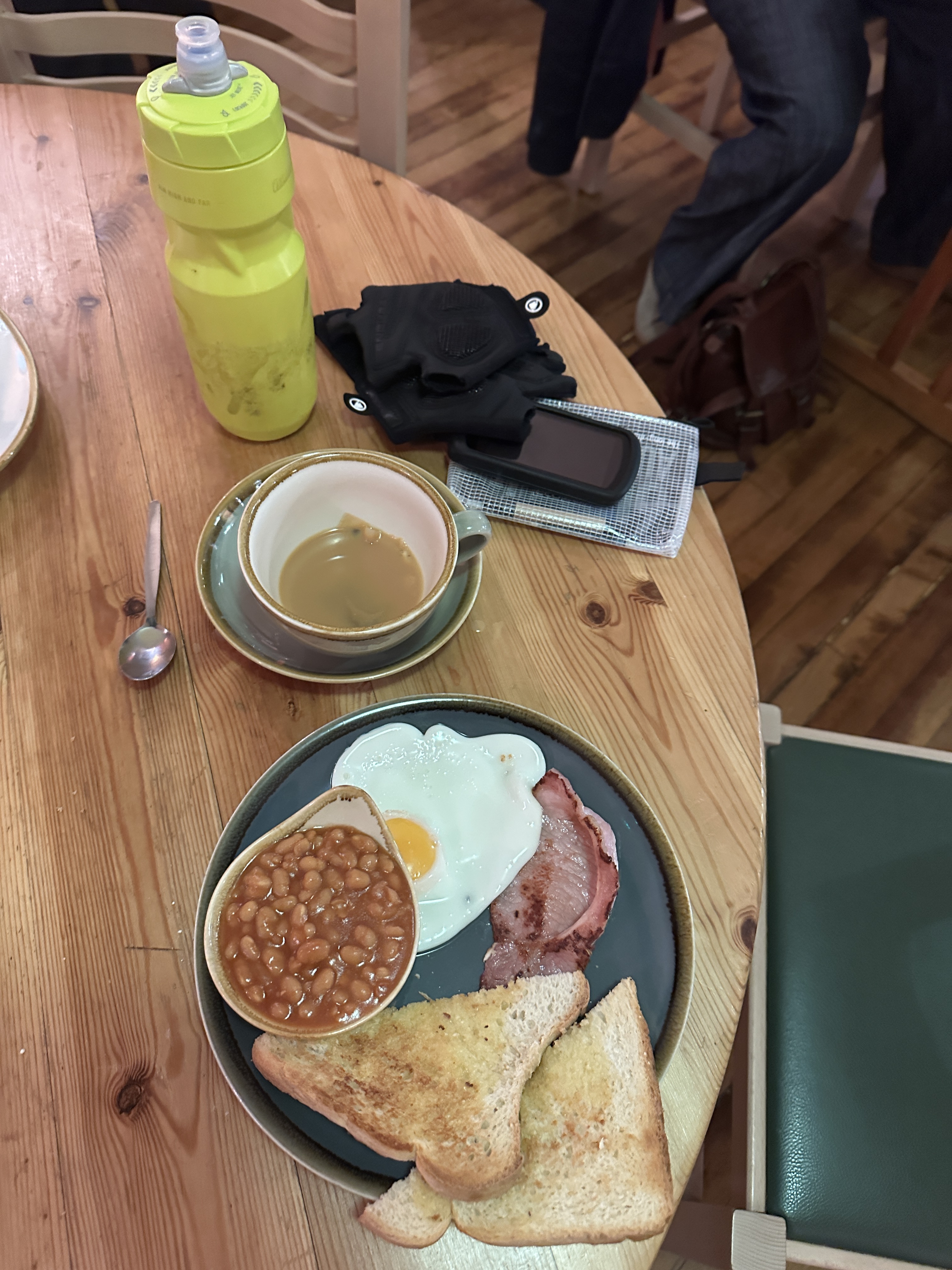
The Bronllys control was at the lovely Honey cafe, and I knew from Dave Atkinson’s account of his 2024 Bryan Chapman that a fried breakfast was the order of the day. Here I made my first mistake. Hearing several people ahead of me asking for a ‘small breakfast’ I did the same. I could have done with something more substantial.

















 Ertblog