Wattbike: a lesson in how not to use AI

Artificial Intelligence – AI – is all the rage. Companies the world over see it as a way to provide fast customer service, as well as to crunch data and solve problems. But my experience this week with Wattbike, a company that sells smart indoor bike trainers, shows that used badly AI can damage a company’s reputation.

I had a simple query. I wanted to order a new power supply lead for my first generation Wattbike Atom. I’ve no idea what happened to the original, but it’s disappeared since I last did an indoor turbo session in the spring.

Wattbike customer service was excellent the last time I got in touch. This time, I left a message via the website, and was really impressed to get a reply within a minute:

Hello Rob,

Thank you for your message and for checking the compatibility before placing an order. I’m sorry for any confusion this may cause. The UK Power Supply (AtomX) you’ve linked is designed for the next generation AtomX model and delivers a higher power output (12v 7A), which is not suitable for your 2018 first generation Wattbike Atom (which requires 12v 2A). 

For your 2018 Wattbike Atom, you’ll need the UK Power Supply specifically made for the Atom G1 model (Nucleus & Atom G1) with the correct 12v 2A rating. 

If you have any other questions about compatible parts or need further support, I’m here to help!

Customer Support | Wattbike
Powered by AI

The reply was obviously generated by AI, as indicated, but that would have been fine if it had solved my query. But I was surprised that it didn’t include a link to the product I needed in the online shop. When I replied asking for the link I was sent this within seconds:

Hello Rob,

Thank you for your patience. You can purchase the correct UK Power Supply for your Nucleus and Atom G1 (including the 2018 First Generation Atom) directly from our website at the following link:

UK Power Supply (Nucleus & Atom G1)

This power supply is suitable for the 12v 2A requirement of your Wattbike Atom. Please note that this is the appropriate choice for your model, and the UK Power Supply (AtomX) is only compatible with the Next Generation AtomX, not the first generation Atom.

If you need any further assistance or have any more questions, just let me know. I’m here to help!

Customer Support | Wattbike
Powered by AI

But clicking on the supplied link gave me this resounding error message:

If AI can identify a link to a product listing, surely it should be capable of making sure the link works?

When I pointed out the link was not working, I got the following admission of defeat by Wattbike’s bot:

Hello Rob,

Thank you for letting us know about the trouble accessing the UK Power Supply (Nucleus & Atom G1) link, and I’m very sorry for the inconvenience this is causing. The correct power supply for your 2018 Wattbike Atom is indeed available as a product in our range, but the direct purchase link on the website currently appears to be broken, which is why you’re seeing the “Page Not Found” message.

I will be transferring your case to a specialist team who manages our website, so they can look into fixing this issue or provide clear guidance on how you can order the appropriate power supply for your Wattbike Atom G1 or Nucleus. We will aim to respond within four working days—please avoid sending multiple emails or reaching out on different platforms about this enquiry, as it can slow down our response time. Our business hours are Monday to Friday, 9am–5pm (GMT).

Thank you again for your patience, and we’ll be in touch as soon as possible with a solution.

Customer Support | Wattbike
Powered by AI

Four passed without any contact from Wattbike. I then received the following pathetic email message:

Hi Rob, 

We wanted to let you know that we’re currently experiencing unforeseen staffing issues alongside an unprecedented level of demand on our customer service team. We’re working hard to get through the backlog and will respond to your ticket as soon as possible

To help us resolve your query more quickly, please avoid sending additional messages or opening new tickets on any channel, as this can create further delays.

Thank you for your patience and understanding – we really appreciate it.

Why did it take Wattbike four days to send this ‘don’t contact us, we’re busy’ message? Presumably the company was just as busy four days ago. Or is it a coincidence that the four working days mentioned in the bot’s surrender message have now elapsed?

It looks as if I’ll have to find the correct Atom G1 power supply from a company that cares more about customer service than Wattbike. It’s such a shame after my wonderful experience with Wattbike last year. I’m always suspicious when companies remove a customer service phone number from their website – a quick call might have established that Wattbike was out of stock of the item I needed. But four days on, I’m none the wiser. And unable to use my Wattbike Atom.

If you’re thinking of using AI to provide customer service, don’t follow Wattbike’s example. Test it thoroughly, and only set it loose on customers if you are sure it works. And whatever you do, don’t use it just to save money. The damage to your reputation could cost you far more than you save.

Marks & Spencer cyber attack: my frustrating customer story

M&S chief executive Stuart Machin

British retailer Marks & Spencer has been in the headlines for all the wrong reasons after its operations were crippled by a cyber attack. Online sales have been suspended for over a month. The company says the incident will cost it around £300 million – a third of its annual profits.

I have an M&S Rewards credit card, which gives vouchers to spend online or in-store. I intended to buy a pair of joggers with the latest coupon, but had to go into a store to buy them given the website is now just a shop window. I did this at M&S’s flagship Oxford Street store in London yesterday. The sales assistant took one look at the paper voucher, and told me that she couldn’t accept it because of the systems failure.

I was astounded. I had presented a paper voucher clearly stating it was for £25, the price of the item. How could M&S be so reliant on an electronic point of sales system that it couldn’t accept a paper voucher? Way back in the 1980s, I worked in a Nationwide Building Society branch. If the system went down, we still served customers: we noted the transaction on paper ledgers, and reconciled them later. How could M&S not have a similar back up plan? How can it be forced to suspend online sales for over a month in an online era? Stressed out teenagers sitting their GCSEs are more resilient than this British retailing giant.

We shouldn’t be surprised. M&S was slow to embrace the online revolution 25 years ago, after waiting over 30 years before accepting credit cards (other than its own charge card) in its shops in April 2000.

The voucher I tried to use expires in just over a month. The manager at M&S Oxford Circus wrote a note on it saying it should be accepted for a further month. That was good customer service, but the highly paid executives at M&S HQ in Paddington, London, should be taking the heat, not the poor bloody infantry on the front line.

Are electric bikes cheating? No!

No, you’re not cheating if you ride an electric bike. The e-bike revolution is one of the best things to happen to cycling in the past decade. I have two e-bikes and love them.

It’s your choice what you ride

No one has the right to tell you what type of bike to ride. If you like the idea of a little help going up a hill, just go for it. And you won’t be alone: Mintel forecast that e-bikes would be the best selling type of cycle in 2024, and a quarter of British adults have considered buying one according to a Paul’s Bikes survey last year. It’s likely that many people buying an e-bike wouldn’t have bought an unpowered one.

You still get a workout on an e-bike

When I got my first road e-bike, a Trek Domane +, in 2022 I was surprised by how many calories i burned on my rides. The reason? Because in Britain an electric bike (technically called an ‘electrically assisted pedal cycle’) motor has to cut out above 15.5mph, after which your pedal power alone will move you forward. You’re likely to burn more calories doing this than on a non-e-bike as your mount will be a lot heavier with the motor and battery. (As an example, the latest electric Trek Domane + SLR 7 AXS weighs 12.64kg in size 56, compared with 8.29kg for the non-electric version. Data from Trek website.) You can always slow down below 15.5mph to get the motor to kick back in…

No one is losing out because you ride an e-bike

A lot of people were angry when Bob Dylan went electric in 1965. No one should care if you do the same, on a bike, unless you’re in a race. Or grabbing a king (KOM) or queen (QOM) of the mountains on a Strava segment.

E-bikes are brilliant for car-free commuting

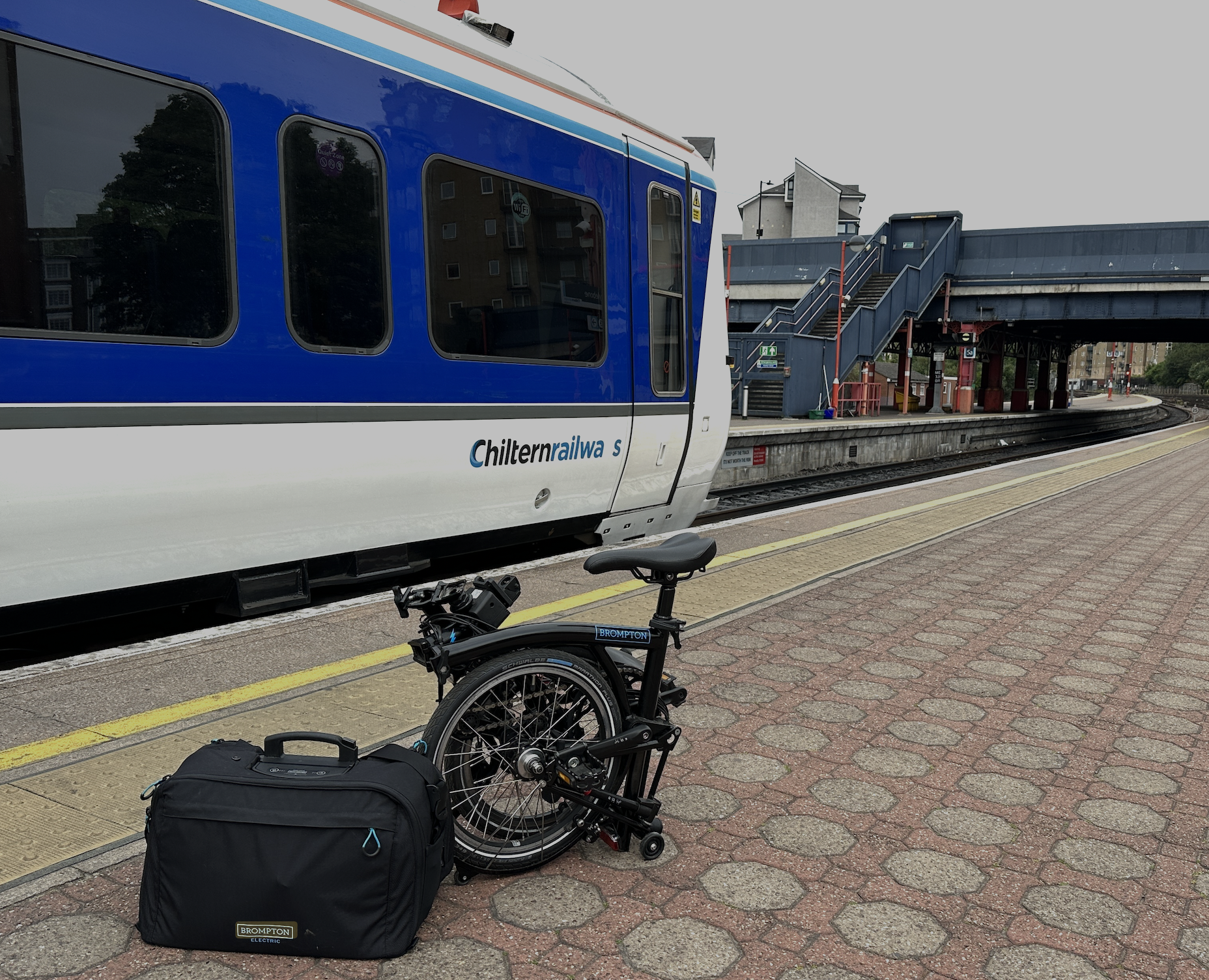
My first e-bike was a Brompton Electric. I found it brilliant for commuting to London: I’d cycle to the local railway station, pop the folded bike on the train, and spin across town from Marylebone to various places in the West End and City. I saved over £16 a day in car parking and the cost of the onward London tube journey from Marylebone. And it meant one fewer car on my local roads. I wrote more about my Brompton Electric experience here.

Electric bikes might make you cycle more

Hills? No fear

There are days when just don’t feel like cycling. But then I remember my electric Trek Domane. I took the photo above on my first ride on it, three years ago this month, when I relished the feeling of traversing the hilly Chilterns without quite as much effort. I still burned a lot of calories, because of the 15.5mph cut off for assistance, and even below that you still need to pedal. The Domane has differing levels of assistance so you can decide how much you want to exert yourself. I confess I usually choose the maximum help – I’ll choose my unpowered bike if I want a proper workout.

An e-bike makes family rides easier

An e-bike would be helpful… Masca, Tenerife

The beauty of an e-bike is that it helps less powerful riders keep up with their more athletic cycling friends and family. I first noticed this in 2019 riding up a very long, steep hill near Masca in Tenerife. I was very surprised to be overtaken by two small children. When their parents followed them past me I realised the whole family were on e-bikes. I was envious…

The TL;DR summary: e-bikes are brilliant!

A rare pandemic outing: Cardiff Castle by Brompton

Two simple ways you can make cycling safer

Cycling in Britain is a safe way of getting around and exercising. According to road safety charity Brake, one cyclist dies for every 33 million miles cycled. They sound like good odds, and they’re getting better. The casualty rate has been falling over the past decade, reports Cycling UK (even after discounting the impact of the pandemic, when there were blissfully few cars on the road).

Despite all this, many people say they’re too frightened to cycle on Britain’s roads. If you’re inexperienced, a busy urban road understandably feels like a scary place. And most accidents happen at junctions, rather than on the open road. Ironically, I have found central London one of the most enjoyable places to ride a bike, even in the rush hour, as the city now has many miles of segregated cycle routes, where bikes and cars are kept apart. There’s little chance of that luxury where I live in the Chilterns.

There are things cyclists can do to improve the odds, regardless of where we cycle. Cycling UK has plenty of tips. Meanwhile, I have had two positive results over the past month in the small steps I have taken to make my local roads safer for cyclists.

Report those potholes

Potholes are a serious danger for cyclists, while causing expensive damage to bikes and cars. They are a particular danger in bad weather – when you can mistake them for mere surface water – and at night. I recently rediscovered Cycling UK’s brilliant tool for reporting potholes: Fill that Hole. (Anyone can use it – car drivers as well as those on bikes.) I got an informative response confirming that the huge hole on the A355 where it crosses M40 junction 2 would be repaired in the coming month or so after others reported the hazard. In my experience, potholes do get repaired when you report them. It takes just a couple of minutes to file a report, which can include photos.

Report dangerous drivers

My biggest concern when cycling is drivers who pass far too closely. The Highway Code requires drivers to allow a passing distance of at least 1.5 metres (5 feet) when overtaking cyclists, but few drivers follow the rules. Out on the roads of Buckinghamshire and neighbouring counties, I’ll usually experience at least one car or van passing closer than I’d like on most rides. It’s rarer for me to experience a sense of danger – but two years ago I decided to report the serious cases to the Thames Valley Police. It’s very easy to do this online: the form requests the necessary information, and you can upload video.

I’m very selective about those I report. I only act against those close passes where I felt in danger. To capture the evidence, I use a Cycliq Fly12 Sport front camera, which contains a front light as well. In my first 18 months, I have reported two drivers, and on both occasions Thames Valley Police has taken action against the driver. You can see the latest overtaking case above.

I decided at the beginning not to report every incident. As an experienced cyclist, I am not fazed by traffic, and my view is that if I’m not unduly bothered at the time there’s no reason to file a report, even if the driver hasn’t left the required passing distance. Others, notably CyclingMikey, who has reported over 1,000 errant drivers, including Chris Eubank and Guy Ritchie, are more interventionist. I am more likely to report commercial drivers as they are likely to drive further than private motorists, putting more cyclists in danger, although the first person I reported was in a private car who ran me off the road on a single track road.

I have found the Cycliq a brilliant bit of kit, especially as it is largely ‘fit and forget’. It records over earlier footage when the memory card is full, so you don’t have to worry about replacing the card, and it records for up to seven hours between charges. You can flag incidents you want to save by pressing the Q button to keep the relevant video segments.

Cycliq is the subject of negative comments online about its customer service, but I have found the camera very reliable.

The cycling revival

As I mentioned at the start of this post, cycling is far safer than many think. Modern bike brakes and lights are vastly better than when I started cycling as an adult over 35 years ago. Better still, there are far more people on bikes today, compared with when I was growing up in the 1970s – possibly the low point for cycling in Britain, when car ownership was booming and cycling was seen as a poor person’s way of getting around. Long may the cycling revival continue.

AI regulation: a lesson from 200 years of railway history

A mighty transatlantic battle is in prospect over how to regulate artificial intelligence (AI). Donald Trump’s second administration seems sure to opt for the lightest of light touches, influenced by tech tycoon Elon Musk. (If Musk can tear himself away from his bizarre obsession with Britain.) The European Union has already legislated for a far more restrictive approach, with Britain likely to follow a middle way. The sensible aim must be to unleash the creative, social and economic benefits of AI while minimising the harm it may cause if abused or badly handled.

As debate raged about AI regulation, it struck me that many of the arguments deployed for and against AI and tech regulation also played a huge role in shaping the response to the railway revolution in the 19th century.

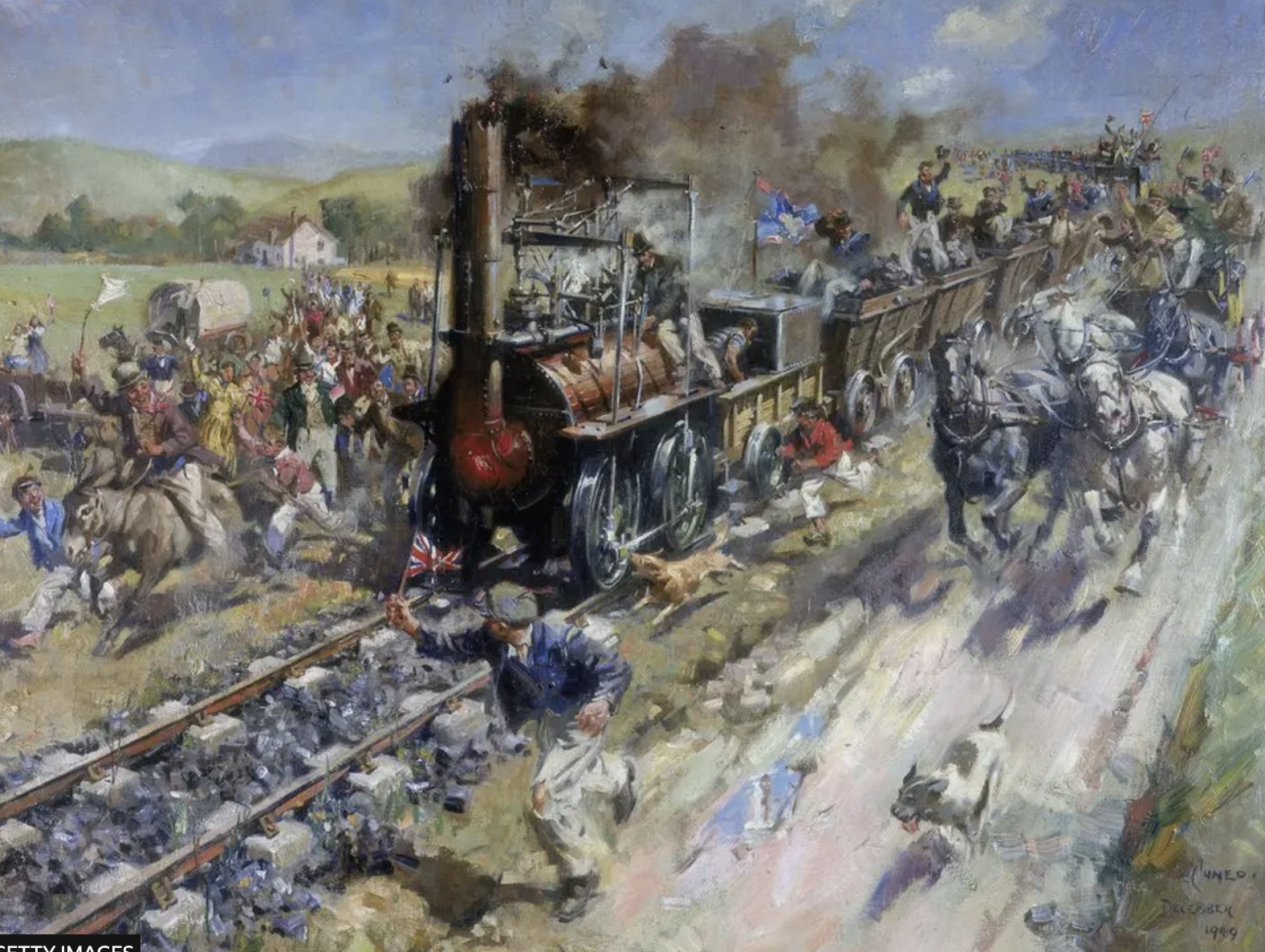
The opening of the Stockton & Darlington in 1825. Painting by Terence Cuneo; NRM/Science & Society Picture Library

The railway age properly began in September 1825 with the opening of the world’s first public railway to use steam locomotives, the Stockton & Darlington Railway in County Durham in the north of England. After the success of the first intercity railway between Liverpool and Manchester, opened in 1830, Britain enjoyed a railway boom, as pioneers planned lines linking major cities – and serving industry, the original purpose of the iron road. By the early 1840s, railway mania had taken over, in a prelude to the dot.com boom at the turn of the 21st century. In 1844, 240 private bills were presented to the British parliament to authorise 2,820 miles of railway. Had all these been built, the £100 million of capital needed represented over one and a half times Britain’s gross domestic product (GDP) for that year. Parliament still approved half these railways.

Anything goes? The heyday of the laissez-fair state

Britain in the 1840s was a firmly non-interventionist state. The dominant philosophy was laissez-faire: small government, low taxes and the free market. Most acts of parliament were private acts to authorise new railways rather than government initiatives. Anyone able to raise money could form a railway company and apply to parliament for permission to build their pet route. The sheer volume of railway business threatened to overwhelm the Westminster legislature. But an attempt to create order by setting up a railway advisory board to vet proposed plans before they reached parliament was short lived, killed by the powerful railway lobby. (And conflicts of interest: 157 out of 658 MPs had financial interests in the railways.) This was Britain’s last chance to create a strategic rail network, deploying investors’ money more efficiently. The failure led to many investors losing most if not all their money on rail schemes that had no hope of success, again pre-empting the dot.com bubble of 1999-2000.

Continue reading

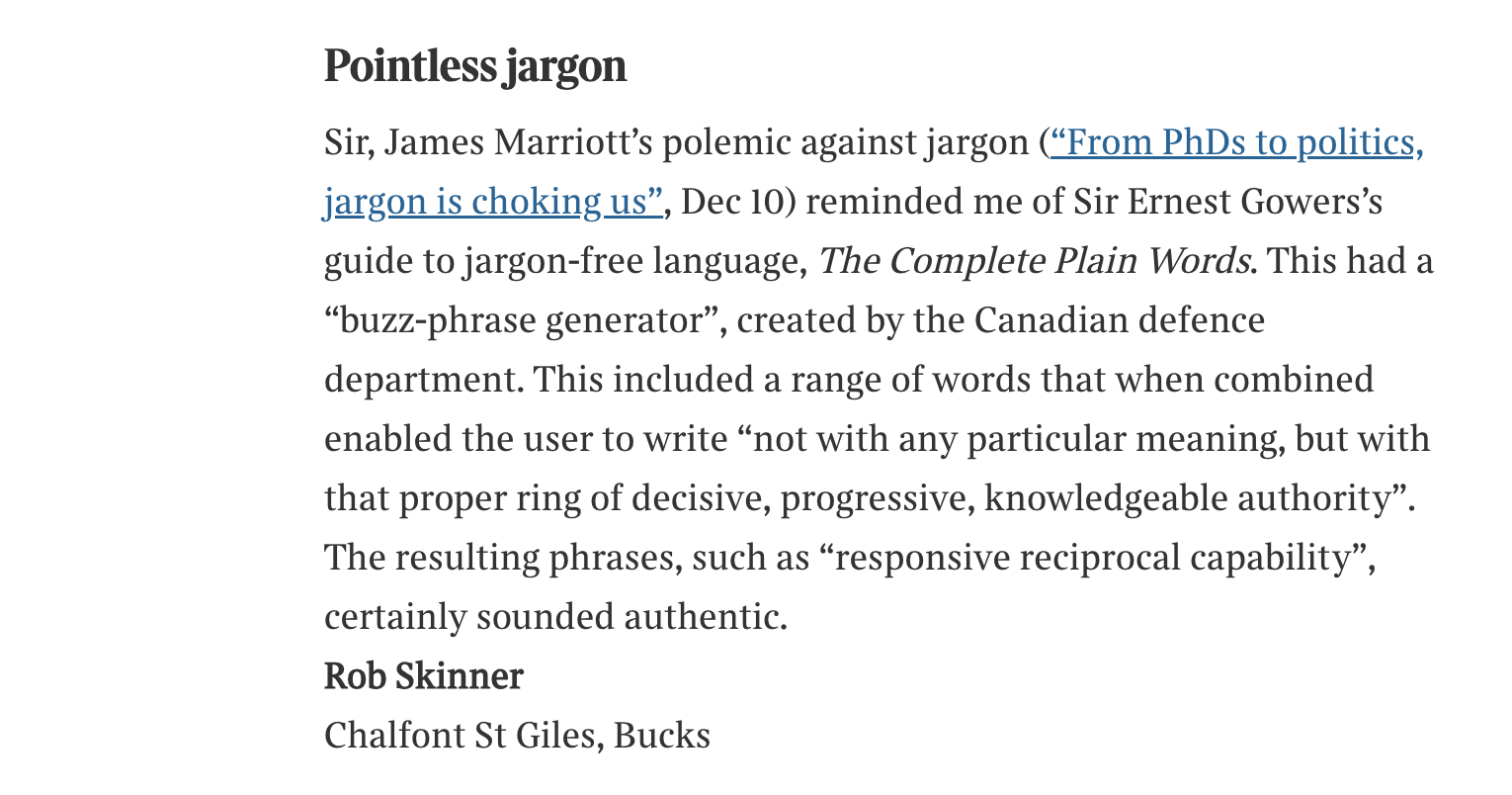
Pointless jargon: my latest letter in The Times

Over 40 years ago, I bought a wonderful book called The Complete Plain Words by Sir Ernest Gowers. It has guided me throughout my 37 year career in communication. Today, it featured in my latest letter in The Times – my sixth this year.

Ernest Gowers had an illustrious career in the civil service. He was Lloyd George’s principal private secretary as chancellor of the exchequer, and wrote the original Plain Words as a guide for civil servants in 1948. The edition I bought in 1984 was revised by another distinguished public servant, Sir Hugh Fraser. Both knights recognised that communication with the public should be clear and free from jargon that may baffle and annoy them. As the book says, the idea is to get an idea as exactly as possible out of one person’s mind into another’s.

James Marriott, whose article about jargon inspired my letter, was railing especially against the way jargon creates an exclusive club. Those who do not understand it are excluded. It also places a more subtle barrier, as recipients struggle to decode the meaning. As a result, jargon users are likely to spend more time dealing with an enquiry than if they’d explained themselves clearly in the first place.

I have spent almost 40 years in the financial services industry, and the past 16 years in the world of fintech – a buzz word that simply means companies that apply technology to provide financial services in a different way. (Think app-based banks rather than high street lenders.) Fintech also means combining the jargon from two industries (technology and finance) that thrive on gobbledegook.

I wrote in more detail about the fight against jargon and cliche in this 2012 blogpost.

Solved: repeated Apple AirPods failures

Case solved?

You see them everywhere, dangling from people’s ears as they grab a coffee or run for a train. Apple’s AirPods have become the equivalent of the Sony Walkman in the 1980s: the way we listen to music on the go. (Other brands are available.)

Yet they have proved our family’s most unreliable Apple product by far. We’ve had four sets failing, and friends report a similar experience. The issue is the same: barely any sound coming from one AirPod while the other is playing normally. Today, I made the familiar trek to the Apple Store to get my son Owen’s faulty AirPod replaced. This is his third AirPod failure in 14 months.

Needless to say, Apple makes this very easy, and I was on my way in 25 minutes with the replacement. Perhaps more importantly, I was given an explanation for the failures that, with luck, will help us avoid another failure. I hope so…

Apple AirPod and bud

It’s all down to dirt collecting on the mesh of the AirPod buds, which then works its way through to the actual AirPod. Regular cleaning is the answer – the guy at the Apple Store Genius Bar recommended lightly dabbing the AirPod mesh with some Blu Tack, to remove the dirt. (I have not tried this yet, so take care if you follow this advice.) He also recommended replacing the buds every now and again. I was given a replacement as the faulty AirPod could not be repaired. Apple’s website gives further cleaning advice here.

It seems that AirPods are very sensitive and vulnerable to dirt, so it makes sense to keep them clean. And if you’re experiencing any issues, do take them along to your nearest Apple Store, especially if you are close to the end of any warranty period. (Although Apple did replace my three year old AirPods last year free of charge.)

Apple Store cupboards around the world must be overflowing with replacement AirPods!

(Not) Hanging on the Telephone

‘We’ll never forget the magic of a landline’, Viv Groskop wrote in The Guardian on Friday in a nostalgic article mourning the passing of the traditional telephone. It got me thinking about my relationship with the old fashioned landline. (Not that we ever called it that in the days before the mobile phone took over.)

During my 1970s childhood, our household phone sat on a table in the hall of our Cardiff house. That, and the cost, tended to keep calls short. As a 10 year old I’d developed a curious habit of answering calls with an awkward announcement: “Cardiff 755183, who’s speaking please?” On reflection, this was curious – why repeat a number that the person on the other end had just dialled? And they were about to tell me their identity.

As Groskop points out, we memorised numbers in those days. I still remember my aunt’s number: Cardiff 756796, even though I haven’t dialled that number for over 35 years. You can see my own first home phone in the 1989 photo of my Teddington flat at the top of this post. My number? 01 977 9115. (London’s old 01 code was so iconic that ITV named its London events show 01 for London.)

My London number (by then including the new 081 outer London code) even appeared on Nationwide Building Society news releases as an evening contact number in that pre-mobile era. Yet I cannot tell you my son’s mobile number, no doubt because there’s no need to memorise numbers now we just click on a contact name.

Yet I did have one curious teenage experience when my memory for a phone number went awry. During my O levels in 1980, I called my sister in Wiltshire. I couldn’t understand why I’d got that painful number unobtainable ring tone for a number I called every week. I tried again – only to realise I’d used my four digit WJEC candidate number instead of the Swindon code. One memory had temporarily overwritten another.

Back in the 1990s I’d have long conversations with friends on the phone, before one of us would call a halt by warning of the cost of the call. In time, we’d all sign up to BT’s Family and Friends scheme which offered discounted calls to a handful of numbers. It paid to work out whose number to honour in this way – your most frequently dialled number may not have been the most expensive to call.

Searching for a phone box

When I went to university in 1982, I suddenly became dependent on the street phone box. The traditional Giles Gilbert Scott kiosk was a design classic, but standing searching for one with a working phone was a dispiriting experience on a bitterly cold East Midlands winter night. When I found one, I’d usually discover someone already inside, in mid call. After 10 minutes, it was tempting to sigh loudly, or even tap on the door to ask how much longer they’d be. Yet when I finally got in and put in my 2p coins I had no idea if my the person I was calling was actually at home. If I was calling home, I’d give my Mum the phone number of the box, and wait for her to call me back. I remember a curious tone like birdsong for a few seconds when we were reconnected.

Student accommodation rarely had a phone, so we had to communicate in other ways. One exam season I sent a letter to my friends Kate and Helen to try to arrange to meet up (their student hovel was a few miles away from mine) and thinking even then there must be better ways to communicate! These days, we arrange our reunions by Facebook Messenger and WhatsApp.

When I graduated, I took photos of the phone boxes I’d spent so much time in over the past few years. Another world…

999!

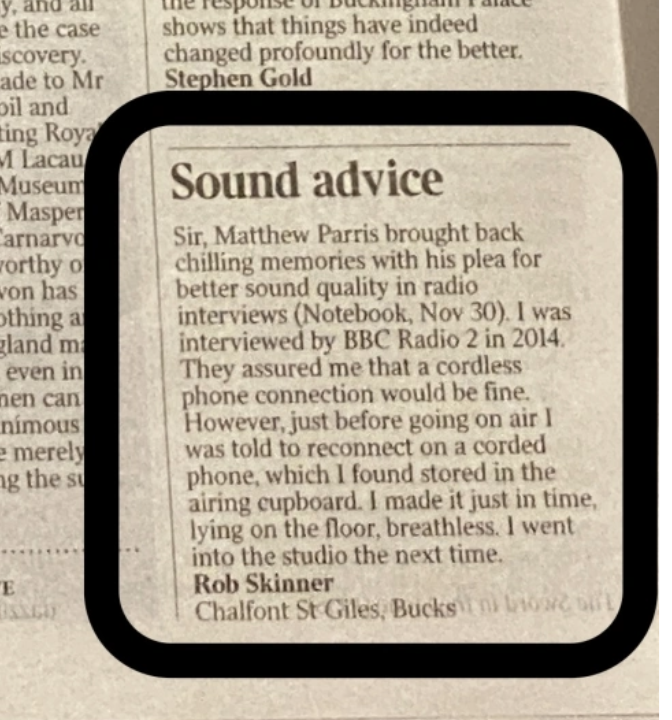
My letter in The Times about a broadcasting landline panic

When our son Owen was very little, we got a call one Sunday morning asking if all was well. It was the 999 operator, who explained that someone had dialled the emergency number from our phone. It was obviously Owen, playing with the keypad. We hid the landline in the airing cupboard to prevent it happening again. A few years later this caused a panic when I was about to appear live on Simon Mayo’s Radio 2 show. I’d been reassured that a cordless phone was fine, but just before going on air I was told it had to be a fixed line. I just had time to retrieve the old handset from its hiding place before the interview began. I recalled this panic in a letter to The Times in 2022.

Rob and father Bob, pictured, edit Bob’s Kindle book via Zoom, February 2021

By 2020 the only person I’d speak to on the home phone was my father, for a Sunday evening catch up. Dad would also sometimes call for advice on tech matters, announcing himself when I answered, ‘It’s Dad’. Yet after the pandemic struck we switched to Zoom calls, as he found it easier to hear me there than on the phone. We Zoomed as he lay in a Cardiff hospital bed with Covid in October 2020, and four months later we worked together via Zoom turning his Bob the Blogger web diary into a Kindle book, Pandemic! My care home diary. I was thrilled by the way my then 94 year old father was adapting to new technology – not for the first time!

Back in 1978, Blondie’s song Hanging on the Telephone reached number 5 in the British charts. The lyrics evoke that long-gone era in which making phone calls was an often frustrating experience, as I found in my student years. The irony is that today, when we carry a phone with us everywhere, the last thing we’re likely to do is to call someone on it!

Kenneth Grange: the designer who made the InterCity 125 HST an icon

Photo: National Railway Museum, York

British Rail’s High Speed Train caused a sensation when it burst onto the scene in October 1976. Just eight years after the end of steam, Britain’s travellers loved the new train, which as the branding InterCity 125 hinted raced between cities at up to 125 miles an hour. And you didn’t have to pay a penny extra for the privilege.

Speed was the big attraction: in the early years, the fastest service from Cardiff to London took just 1 hour 41 minutes, a speed unmatched by today’s timetable. But the bold design, with its striking blue and yellow wedge-shaped power cars, played a big part in making the High Speed Train an icon, thanks to designer Sir Kenneth Grange, who died this week aged 95. According to his obituary in The Times (paywall), British Rail asked him to enliven the train’s livery, but he persuaded BR he could also make power cars more streamlined, with shades of the 1930s steam loco record breaker Mallard.

Continue reading

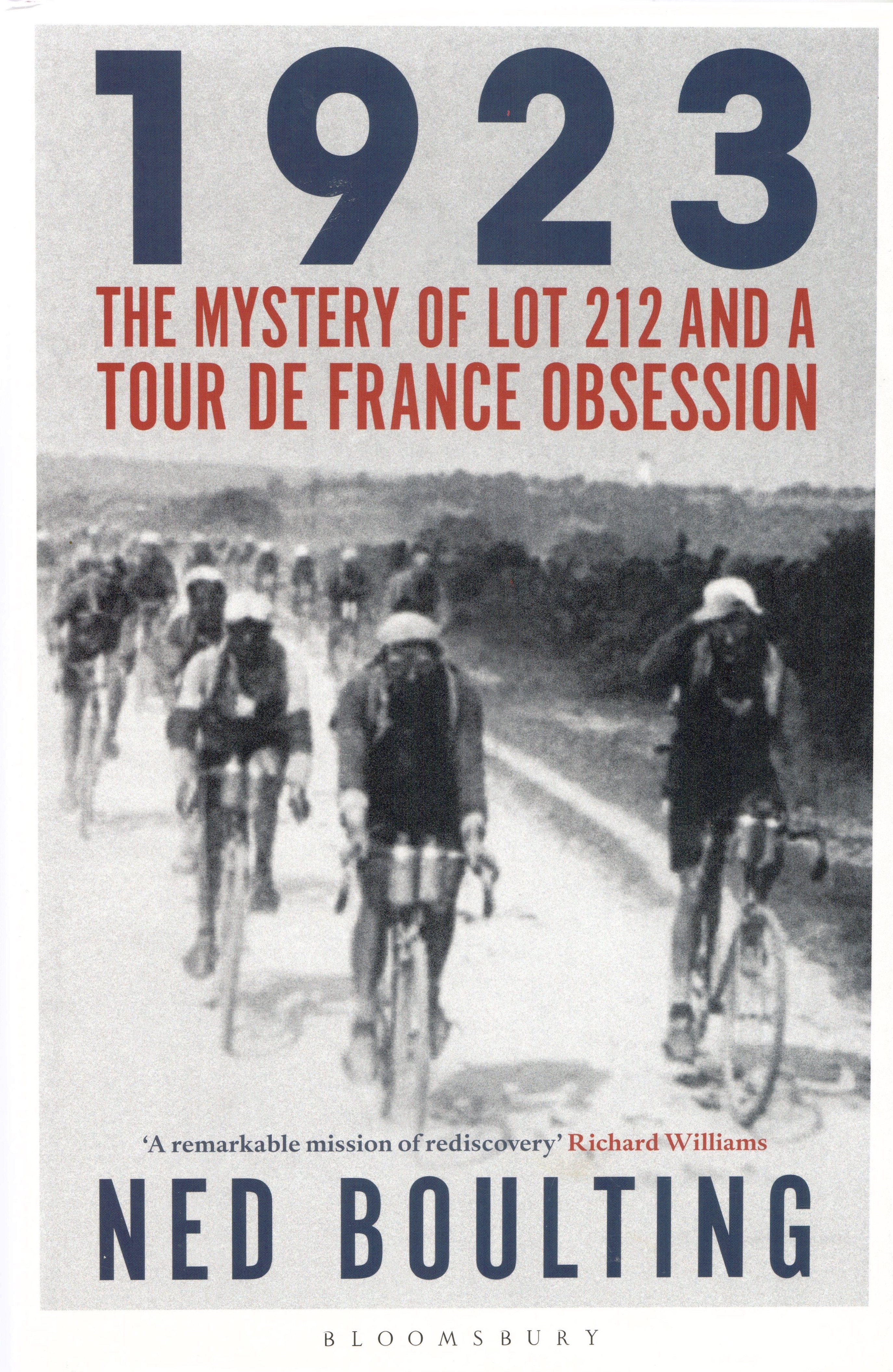
1923: Ned Boulting’s Tour de France obsession

Cycling journalist Ned Boulting’s latest book, 1923, is the story of how the purchase of the fragment of a newsreel report about a century-ago edition of the Tour de France led to an obsession with the forgotten rider seen on the film crossing a spectacular bridge. But this is far more than just another cycling book. It tells the story of a Europe still riven by tension and hatred five years after the Armistice.

The story begins when a friend pointed him to an item for sale in an online auction:

Lot 212. A Rare Film Reel from the Tour de France in the 1930s? Condition unknown.”

Ned bought the film for £120, and began a fascinating journey (literally and metaphorically) of discovery. The question mark over the date in the auction house listing was appropriate. The film, just over two minutes long, actually featured the 1923 Tour de France. Boulting found that the early Tours after the Great War followed exactly the same route, so he resorted to reading old newspaper articles, and even searching for weather reports, to establish that the stage from Brest to Les Sables d’Olonne featured in the film took place on 30 June 1923.

That £120 purchase could have had disastrous consequences. The company that made Boulting a digital video out of the ancient reel told him that the original was a nitrate film, and so highly flammable. Ned didn’t admit to the film restorers that the item had sat next to the radiator of his house after popping through his letterbox after he won the auction. If you happen to have a very old film reel at home, do check that it isn’t nitrate…

Théophile Beeckman leads the peloton over the bridge at La Roche-Bernard. Photo: Ned Boulting, 1923

This is one of the defining images from the 1923 story. It shows the hero of the book, Théophile Beeckman, racing ahead on the bridge across the river Vilaine at La Roche-Bernard. As the subtitle of the book, The Mystery of Lot 212 and a Tour de France Obsession, suggests, Boulting became obsessed with uncovering the story of Beeckman, a man so obscure that he has all but vanished from the records. (As Ned discovered, there was virtually nothing about the rider online until he published 1923.)

Continue reading