You see them everywhere, dangling from people’s ears as they grab a coffee or run for a train. Apple’s AirPods have become the equivalent of the Sony Walkman in the 1980s: the way we listen to music on the go. (Other brands are available.)
Yet they have proved our family’s most unreliable Apple product by far. We’ve had four sets failing, and friends report a similar experience. The issue is the same: barely any sound coming from one AirPod while the other is playing normally. Today, I made the familiar trek to the Apple Store to get my son Owen’s faulty AirPod replaced. This is his third AirPod failure in 14 months.
Needless to say, Apple makes this very easy, and I was on my way in 25 minutes with the replacement. Perhaps more importantly, I was given an explanation for the failures that, with luck, will help us avoid another failure. I hope so…
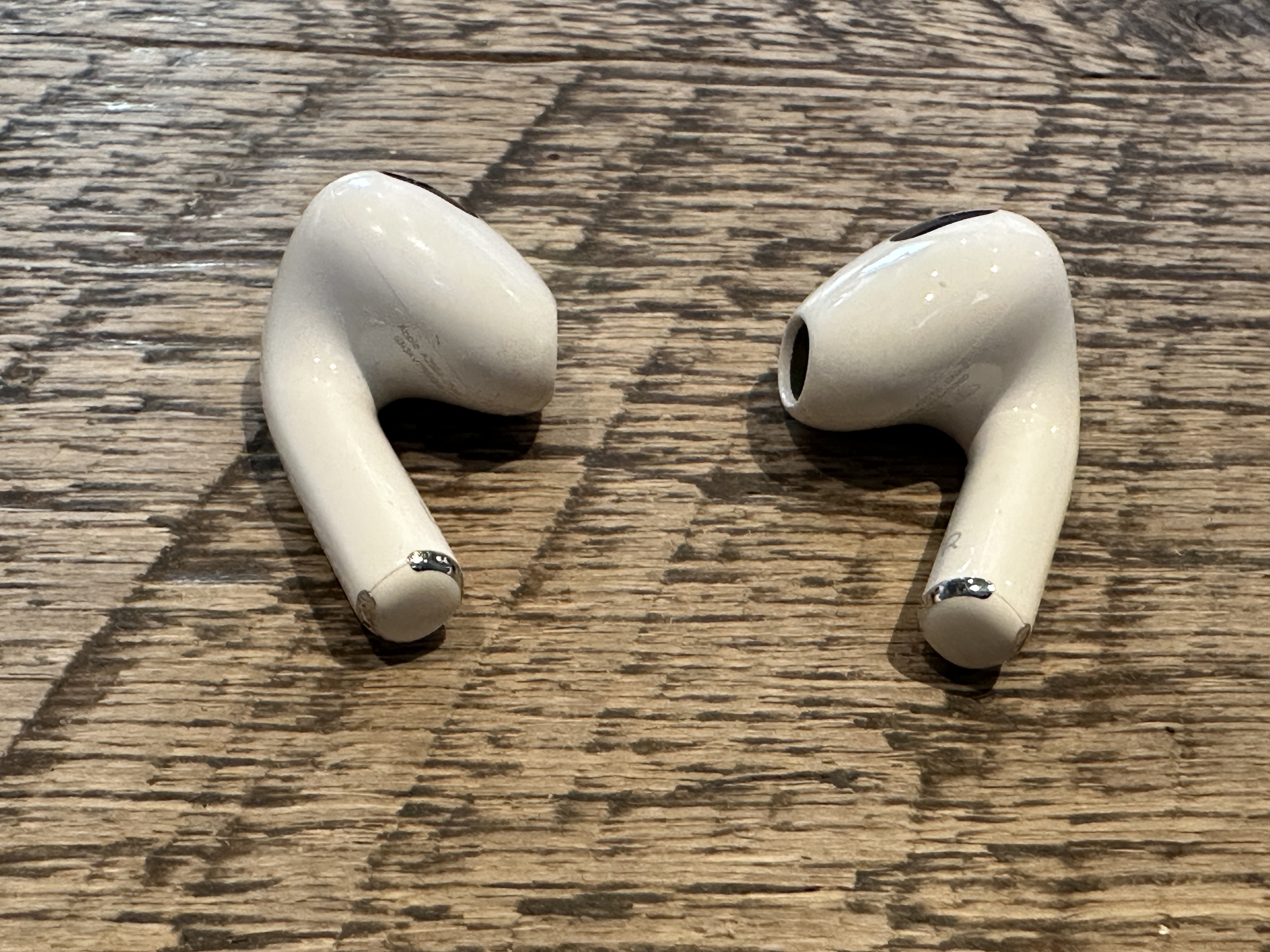
Apple AirPod and bud
It’s all down to dirt collecting on the mesh of the AirPod buds, which then works its way through to the actual AirPod. Regular cleaning is the answer – the guy at the Apple Store Genius Bar recommended lightly dabbing the AirPod mesh with some Blu Tack, to remove the dirt. (I have not tried this yet, so take care if you follow this advice.) He also recommended replacing the buds every now and again. I was given a replacement as the faulty AirPod could not be repaired. Apple’s website gives further cleaning advice here.
It seems that AirPods are very sensitive and vulnerable to dirt, so it makes sense to keep them clean. And if you’re experiencing any issues, do take them along to your nearest Apple Store, especially if you are close to the end of any warranty period. (Although Apple did replace my three year old AirPods last year free of charge.)
Apple Store cupboards around the world must be overflowing with replacement AirPods!
I was sad to hear that Herman Ouseley had died. The news took me back to a year working alongside Herman in Brixton in 1992.
Herman was chief executive of Lambeth borough council at the time. The Conservative government’s environment secretary, Michael Heseltine, had the wheeze of inviting deprived areas to compete for funding for projects to transform their areas. Lambeth Council still had a terrible reputation as one of the so-called ‘loony left’ councils in the 1980s, and Heseltine told Lambeth it had no chance of winning.
That’s where I come in. I was working for Eagle Star insurance at the time, which was owned by British American Tobacco. BAT had an extensive community impact programme focused on Brixton, and in early 1992 its chairman, Sir Patrick Sheehy, agreed to second a manager to Lambeth to help it put a bid together for funding to transform Brixton. I’ve always relished a challenge – and agreed to take on ‘mission impossible’.
Three days a week, I swapped the dull corporate landscape of my City of London workplace for vibrant yet cruelly deprived Brixton. I was based in the old Bon Marche department store, which had been converted into the Brixton small business centre. It was a maze of corridors and hidden rooms, and shook when trains passed just feet away on the railway line into central London. It was just a decade after the infamous Brixton riots of 1981, and a local bar offered a cocktail called Brixton Riot in a Glass…The deprivation that helped cause the riots had certainly not gone away.
I got to know and admire Herman Ouseley during that year-long secondment. I was impressed by his immense dignity and calmness, which must have helped him cope with the stress of running such a deprived borough. I was delighted when he went on to chair the Commission for Racial Equality. He was the perfect candidate given his own background as someone who came to Britain from Guyana aged 11, and endured the endemic racism that blighted Britain for so long. He went on to found Kick it Out, a campaign to end discrimination and racism in football.
We took a community first approach to our bid, holding a presentation to government officials at a local secondary school, and arranging for young people from the school’s video unity to film the event. I wrote a briefing for ministers that referred to Brixton as an area that had produced a prime minister – John Major, who won a general election just weeks later, featuring his old Brixton home in a party political broadcast. We also held a presentation to business leaders at Lambeth Palace. This showed how much Lambeth was changing – in the days of council leader ‘Red Ted’ Knight just a few years before it would have been unthinkable for the council to partner with big business.
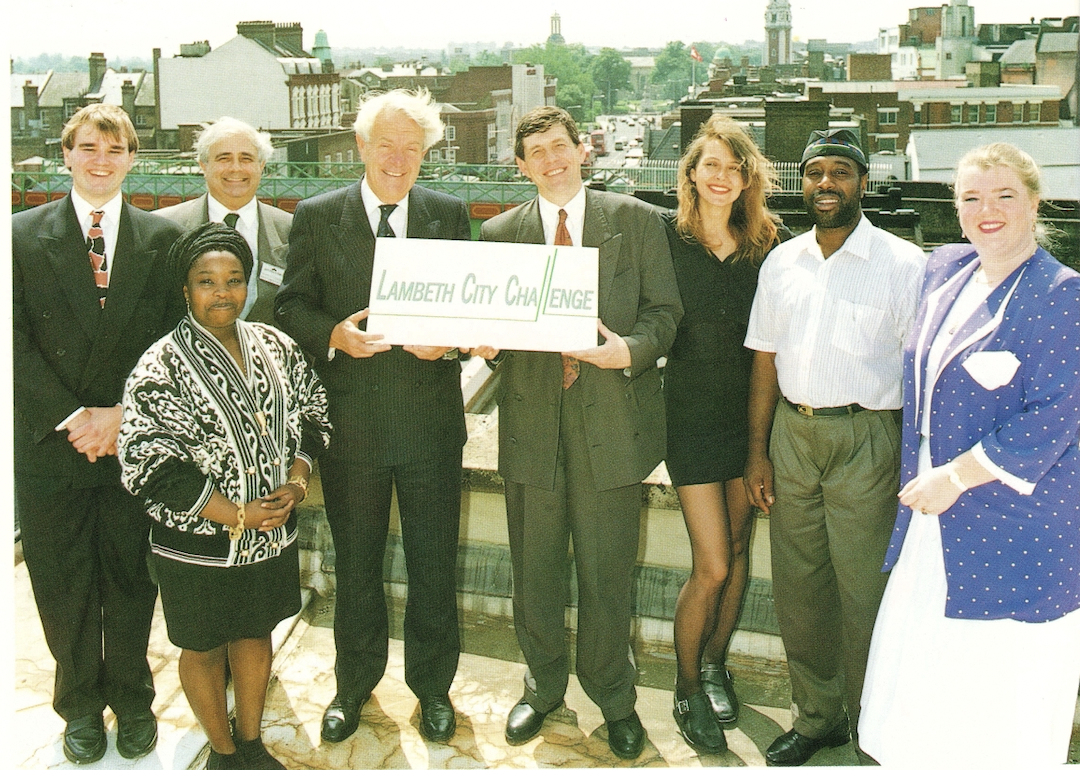
Winners! Government minister Nicholas Scott announces Lambeth had won. Rob on left
I’ll never forget the day Lambeth won. Nicholas Scott, a government minister, came to Brixton for a photocall, which we held on the roof of the small business centre. An ITV news film crew seemed less than keen to stand so close to a 200 foot drop to Brixton high street! It was a joyous day.
Three years later, I chatted to Michael Heseltine at a BAT event in London, and commented that I’d played a part in proving him wrong in dismissing Lambeth’s chances of winning. He was very gracious, but his mind may have been on other matters. All the talk at Westminster was about whether he would challenge John Major for the leadership of the Conservative party. He didn’t, but Major appointed him deputy prime minister days later after seeing off a challenge from John Redwood.
Reflections on Brixton Challenge
Even at the time I was troubled by the notion that deprived areas should compete for money. Why should the life prospects of someone living in poverty in Brixton, Toxteth, Moss Side or Handsworth depend on how good their council was at bidding? I agreed it made sense to get the private sector to invest in our inner cities, but BAT had already been doing that for some years. Indeed my boss during my secondment, BAT’s Brian Hutchinson, already worked tirelessly for Brixton.
A separate company, Brixton Challenge, was set up to oversee the implementation of the City Challenge projects. By all accounts it was not a smooth ride, and the project was criticised for not achieving what had been promised. But I look back with pride on one of the most satisfying years of my career, working with a truly diverse group of talented and enthusiastic people. Above all, I’m glad to have known Herman Ouseley.
For years, the media have bemoaned Britain’s productivity crisis. The country hasn’t become significantly more efficient at producing goods and services in the 16 years since the financial crisis. It seems a complex riddle. Why is the UK falling behind our international rivals? is it our newfound love of working from home? Or is a chronic lack of investment to blame?
Three poor customer experiences in the past week make me think we’re overthinking the problem. Too often companies screw up the simplest things – such as an online booking service. As a result, customer and company spend unnecessary time fixing the problem.
Case study 1: Everyman
I’m a big fan of Everyman. I love stretching out on a comfy cinema sofa while watching a great film, nursing a coffee. As a member, I can book a second, free ticket on Mondays. Today’s the first Monday I’ve had the chance to enjoy this 2 for 1 offer. But the website made it impossible to book.
I selected my member’s ticket – one of the six tickets a year under the cheapest membership package. I then chose the 2 for 1 ticket for my wife, and selected our chosen sofa. So far, so good. But the system wouldn’t allow me to check out without choosing a third seat. I tried every variation, but nothing worked. In the end, I phoned Everyman and a helpful person booked the tickets for me.
Solution: Everyman, fix the website bug, so your customer service people don’t have to spend time booking tickets that should be available online. You will also avoid people giving up, and not buying food and drink from your cinemas.
Case study 2: GoPro
I bought a new GoPro 13 action camera earlier this month. (Highly recommended, by the way.) It came with a year’s free GoPro Premium subscription, which includes cloud storage of GoPro footage. But when I tried to set up automatic upload of my videos, it told me to buy a subscription. I called GoPro, and was assured that everything was set up correctly. But 10 days later, I’m still being prompted to buy a subscription. I’m going to have to call again – a complete waste of my time and that of the GoPro customer service team.
Solution: GoPro, fix the glitch that stops my subscription showing up on your system. And make sure your agents look into things more carefully, rather than simply saying everything is set up when it clearly isn’t.
Case study 3: Wales & West Housing
We’ve been trying to sell my late father’s flat in Wales for over a year. It’s part of a block for older people managed by Wales & West Housing. I’ve told the company repeatedly that no one is living in the house, and to send all letters directly to me for a quicker response, given I live 150 miles away in England. Needless to say, this never happens. In July, I received a redirected letter telling me that an engineer would be visiting to carry out the annual gas safety check. I called to tell Wales & West that the engineer should gain access via the estate agent handling the sale. A couple of weeks later, I got another redirected letter – above – saying the engineer called at the flat but couldn’t gain access – having ignored my instruction.
I called Wales & West again, repeating what I’d told them already. Yet again, I got a letter saying an engineer had called and found no one at home, and threatening legal action. This time, I emailed Wales & West chief executive Anne Hinchey, who took the necessary action. (Thanks, Anne.)
As a result of this saga, an engineer wasted time on two fruitless visits – and the chief executive and I also wasted time that could have been used more productively.
Solution: Wales & West, make sure your people act on instructions, sending correspondence to the right address and not sending an engineer to an unoccupied flat.
Get it right, first time
We can all think of similar examples of time wasted because of a faulty website, customer service teams not taking responsibility for an issue – and a host of other reasons why life’s tasks don’t run smoothly. That’s why it’s so important for companies to fix issues when they arise. In my PR career, I often got emails from unhappy customers, and always passed these on promptly to someone who could help. Getting things right first time is essential to being efficient – and makes for happy customers. It’s also a quick win in solving Britain’s productivity crisis.
British Rail’s High Speed Train caused a sensation when it burst onto the scene in October 1976. Just eight years after the end of steam, Britain’s travellers loved the new train, which as the branding InterCity 125 hinted raced between cities at up to 125 miles an hour. And you didn’t have to pay a penny extra for the privilege.
Speed was the big attraction: in the early years, the fastest service from Cardiff to London took just 1 hour 41 minutes, a speed unmatched by today’s timetable. But the bold design, with its striking blue and yellow wedge-shaped power cars, played a big part in making the High Speed Train an icon, thanks to designer Sir Kenneth Grange, who died this week aged 95. According to his obituary in The Times (paywall), British Rail asked him to enliven the train’s livery, but he persuaded BR he could also make power cars more streamlined, with shades of the 1930s steam loco record breaker Mallard.
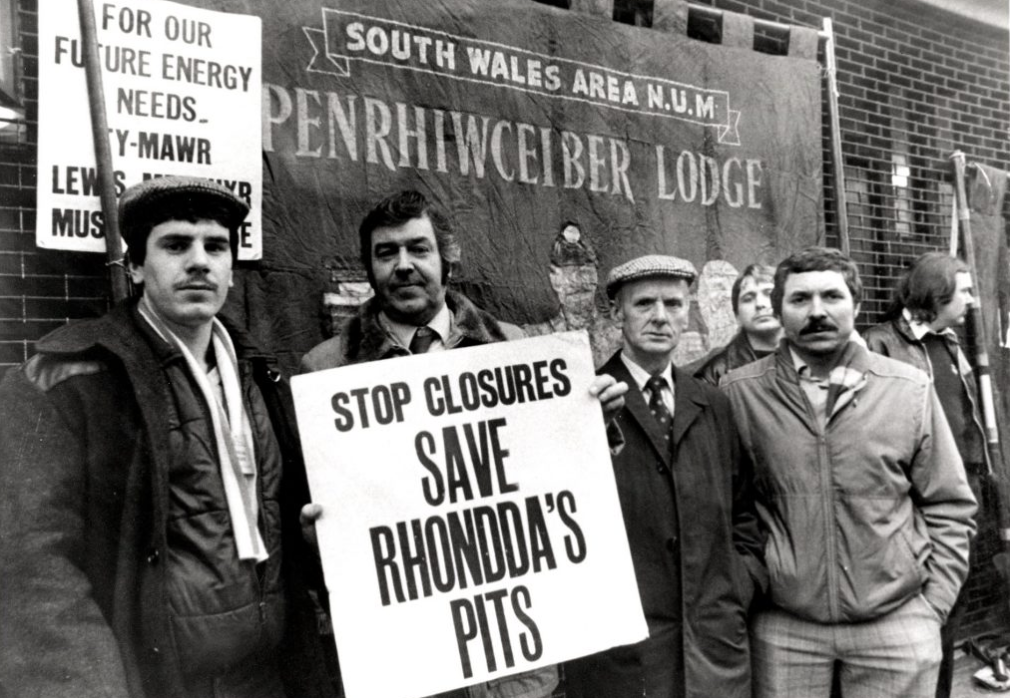
It was one of my strangest dreams. I was in a chip shop in the Rhondda Fach in South Wales in 1985, watching miners’ leader Arthur Scargill sadly announce it was all over. The year-long battle to stop the mass closure of Britain’s coal mines had ended in defeat.
The dream was just that. But it reflected the painful reality of that March day in 1985. The miners of Maerdy in the Rhondda Fach marched proudly back to work, but we all knew that the Thatcher government had won a bitter struggle.
The strike began forty years ago on 6 March 1984, after the National Coal Board announced that 20 mines would close, with the loss of 20,000 jobs. Scargill said that the government would close far more mines (ultimately he was proved right in the years after the strike ended).
The battle that followed was Britain’s last great industrial confrontation, which left many of us with deeply conflicting emotions. The British people had long admired the miners, enduring one of the hardest and most dangerous ways to earn a living. (I blogged about some of the tragedies that struck South Wales in this blogpost.) They also sympathised with colliery communities such as Penrhiwceiber and Maerdy. These isolated villages existed to serve the coal trade, and faced a bleak future if Thatcher axed the coal industry. The women of those communities were magnificent in the grim months of 1984 and beyond, fighting for justice and speaking with eloquence.
You wear a bike helmet to keep safe. So it is a shock to find a faulty helmet design that could actually make things worse in a crash.
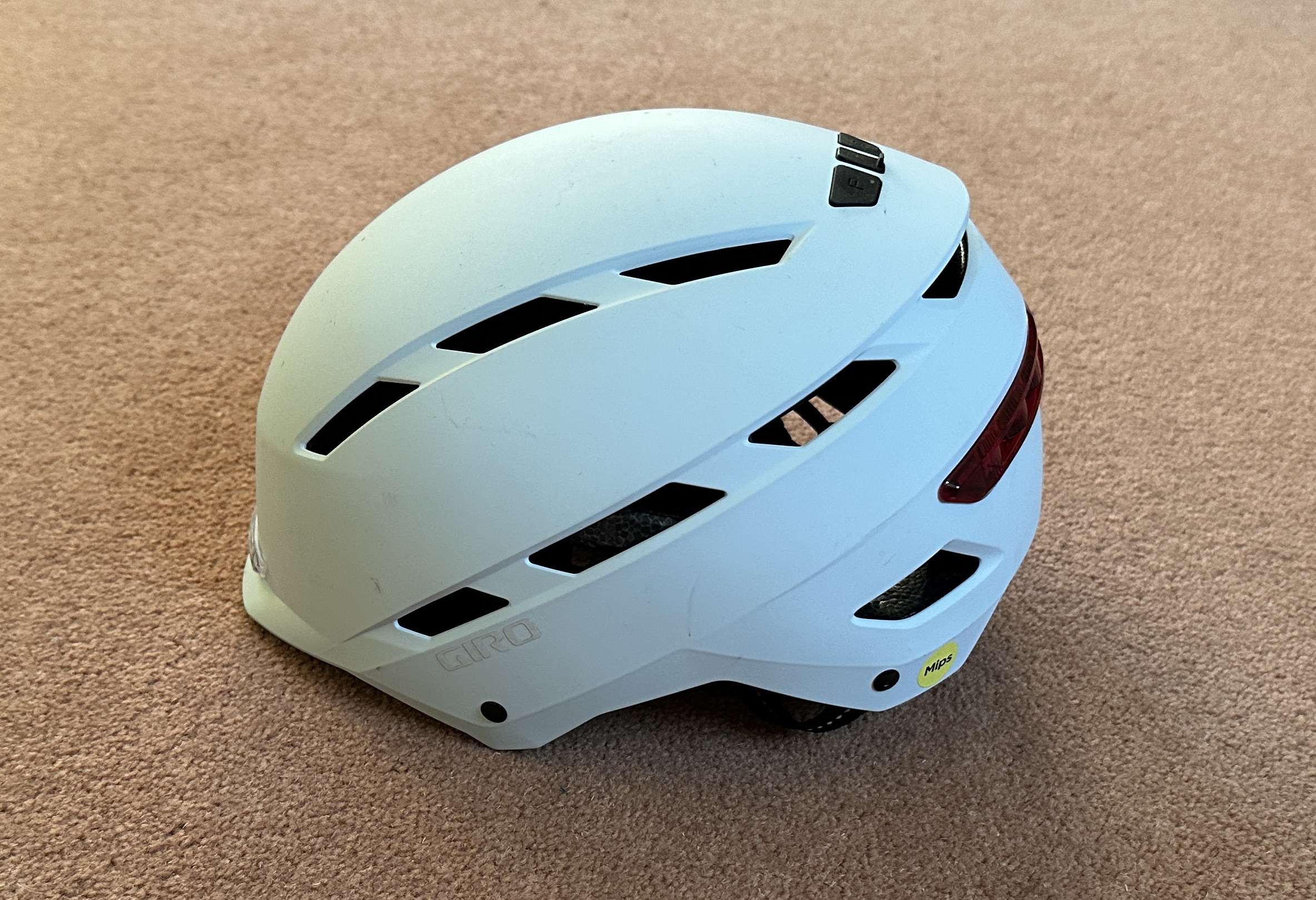
I bought a Giro Escape urban helmet in 2022. I wanted a lid with integrated lights for my weekly commute across London. After a few months, the strap came loose, and the helmet fell to the ground as I got to the office in the City of London.
Giro were very good, refunding me without quibble, and I bought a second Giro Escape, assuming the first helmet had a manufacturing fault. I loved the fit and the bright LED lights – just what I needed cycling home along dark country lanes after getting off the London train.
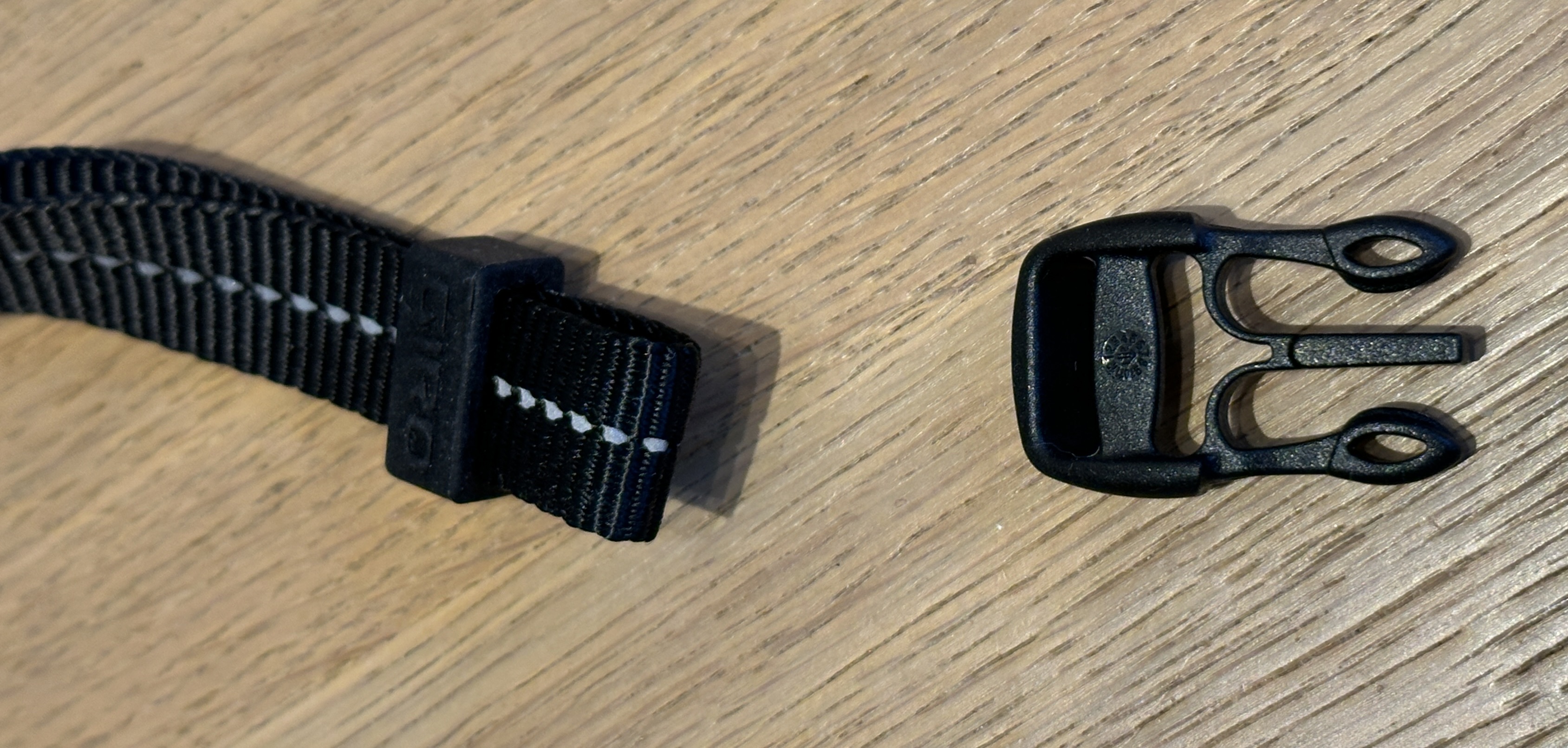
Yet after six months the same thing happened to the replacement. As I set off on my commute the helmet felt very loose, and I wondered how I could have forgotten to do it up. Then I found the two sides of the buckle were firmly attached: it was the strap that had come loose.
I contacted Giro, and was surprised by its response:
This is not something we have had reported to us often, especially 2 in a row for the same customer.
We would recommend that you reattach the clip and set the strap to the correct length. A small stitch through the loose part of the strap may stop this from happening.
Giro customer support by email, 16 january 2024
In other words, we expect you to redesign our helmet to make it safe to use.
To be fair, when I pointed out how unreasonable this response was Giro quickly agreed to refund me. But my second incident showed the dangerous design fault in the Giro Escape helmet. If I bought a third helmet, the same thing would happen again.
The fatal flaw
Let me explain the fault. The right side Escape strap is attached to the buckle by a very loose rectangle of soft plastic. It simply isn’t secure or tight enough to stop the strap working its way out of this loop and detaching from the buckle. I have made a video showing how easily this happens:
Within a day, another Escape user commented that they had exactly the same problem.
I then discovered that the design flaw isn’t restricted to Giro’s Escape helmets. It had recalled Merit helmets in North America, Australia and New Zealand because, in Giro’s words, quoted by BikeRadar, “the helmet strap may detach from the helmet when “pulled with relatively little force, posing a risk of injury to the user in a crash”. That’s exactly what happened to my two Escape helmets, happily without a crash.
So, Giro, how long are you going to continue selling the unsafe Escape helmet?
When my Apple AirPods Pro started playing up, I blamed Microsoft Teams. (An online search suggested compatibility problems.) Then I was told I sounded like a different person on a call. And I got a painful feedback noise when I used them.
Undaunted, I bought a pair of AirPods for my son for his birthday. But he soon reported that he couldn’t hear anything in one of the pods when listening to music or videos.
We took his pods into an Apple store in Orlando, Florida, when on holiday last August, and were delighted when Apple replaced them – although, as they were barely a month old, I expected no less. Yet within two months the new ones were playing up in the same way. I got them replaced at another Apple store – this time in Newcastle Upon Tyne – but the same fault emerged, again in under two months. This time I demanded a refund rather than a third replacement. Giving Apple one last chance, I bought a set of new AirPods Pro for Owen, telling him if it happened again we’d go for a more reliable rival product. Apple also replaced my faulty three year old AirPods Pro at the same time.
Were we unlucky? It seems not. Friends in Switzerland tell me they’ve had three sets of AirPods replaced and have now switched to Shokz headphones, which I also recommend. (They’re brilliant for cycling, as you can hear approaching traffic as well as your music.)
AirPods are ubiquitous, but you’d think it in Apple’s interest to solve the inherent problem that we have experienced rather than keep replacing faulty ones.
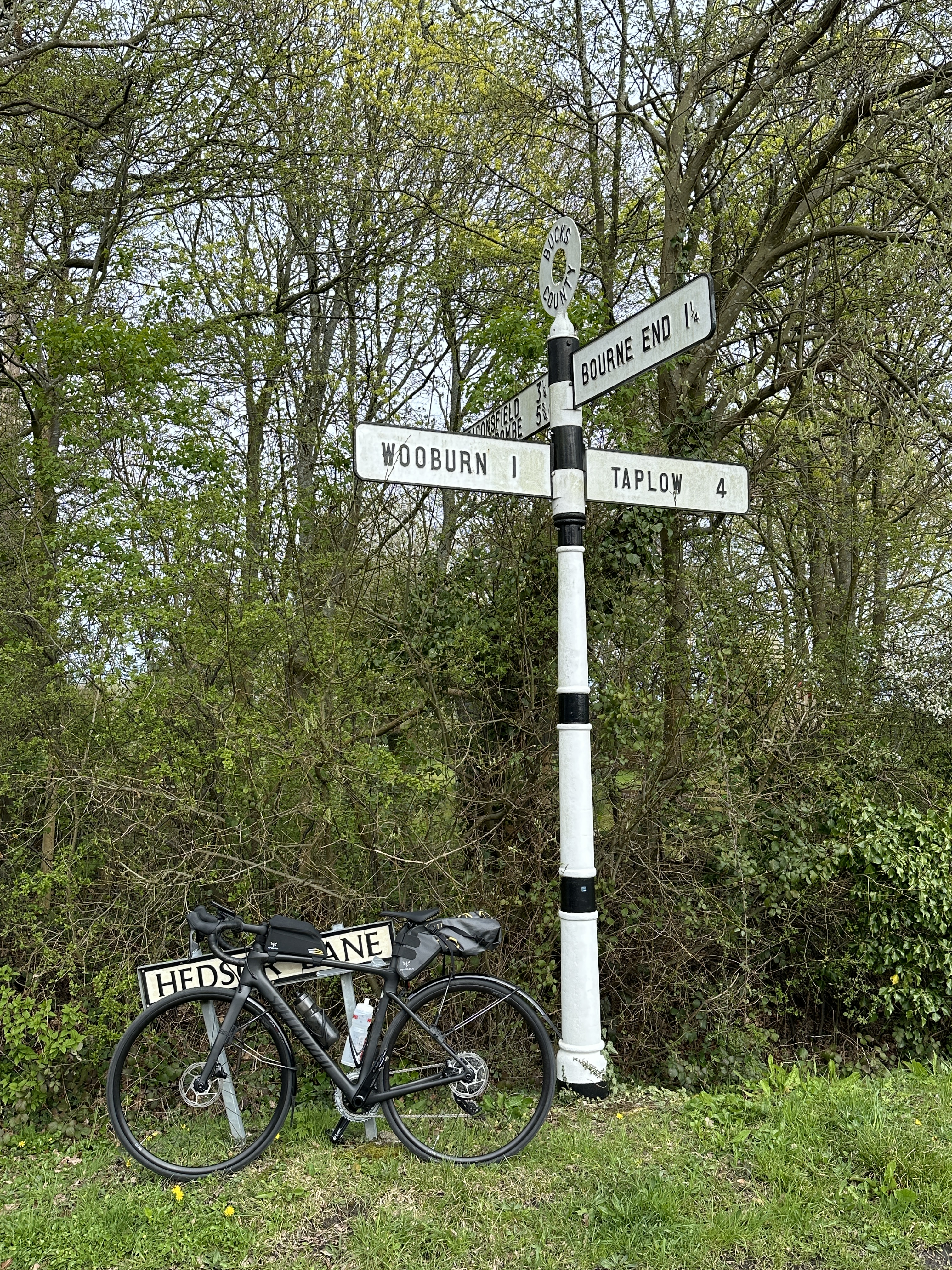
My Specialized Roubaix, about to tackle Palace to Palace
Back in April, I picked up my latest bike, a Specialized Roubaix Expert. I loved my original, more basic Roubaix (as I noted in my account of my century ride in 2015) and had high hopes for its successor, with its SRAM Rival electronic gear change. Sadly, it has proved my most troublesome, unreliable bike ever. I’ve decided to blog about it in case anyone else is having similar problems with their SRAM-equipped bike.
I had a hint of the bike’s unreliability on my very first ride, just hours after collecting it from Dees Cycles in Amersham on Good Friday 2023. The brand new Roubaix was making a distinctive squeaking sound, rather than the smooth as silk ride you expect from a maiden journey. I had to take it back to Dees several times before that irritant was banished.
Far more seriously, the bike had a habit of shedding the chain when I changed up onto the bike chainwheel. As I pushed the dual gear change paddles, I would hear an ominous clanking noise as the chain went beyond the large chainwheel cogs, and flopped onto the outside of the chainwheel. I soon found that shifting straight back down would retrieve the chain and place it back onto the small chainwheel. Bizarrely, if I then tried another shift up the chain would move obediently onto the large chainwheel without incident.
I admire the company’s enterprising PR spirit. But there’s more to this 100th birthday than you’d think reading an @LNER tweet. The current LNER is just five years old, taking over rail services on the east coast main line in 2018. The new operator revived the name of the historic LNER, which was created on 1 January 1923 when some 120 British railway companies were grouped into the ‘Big Four’: GWR, LNER, LMS and Southern Railway. Those iconic brands disappeared exactly 25 years later when the railways were nationalised. Yet their enduring appeal led to three of the famous names being revived by privatised-era rail operators: GWR, Southern and LNER. (The reborn LNER scrapped the conjunction in the old name, London and North Eastern Railway.)
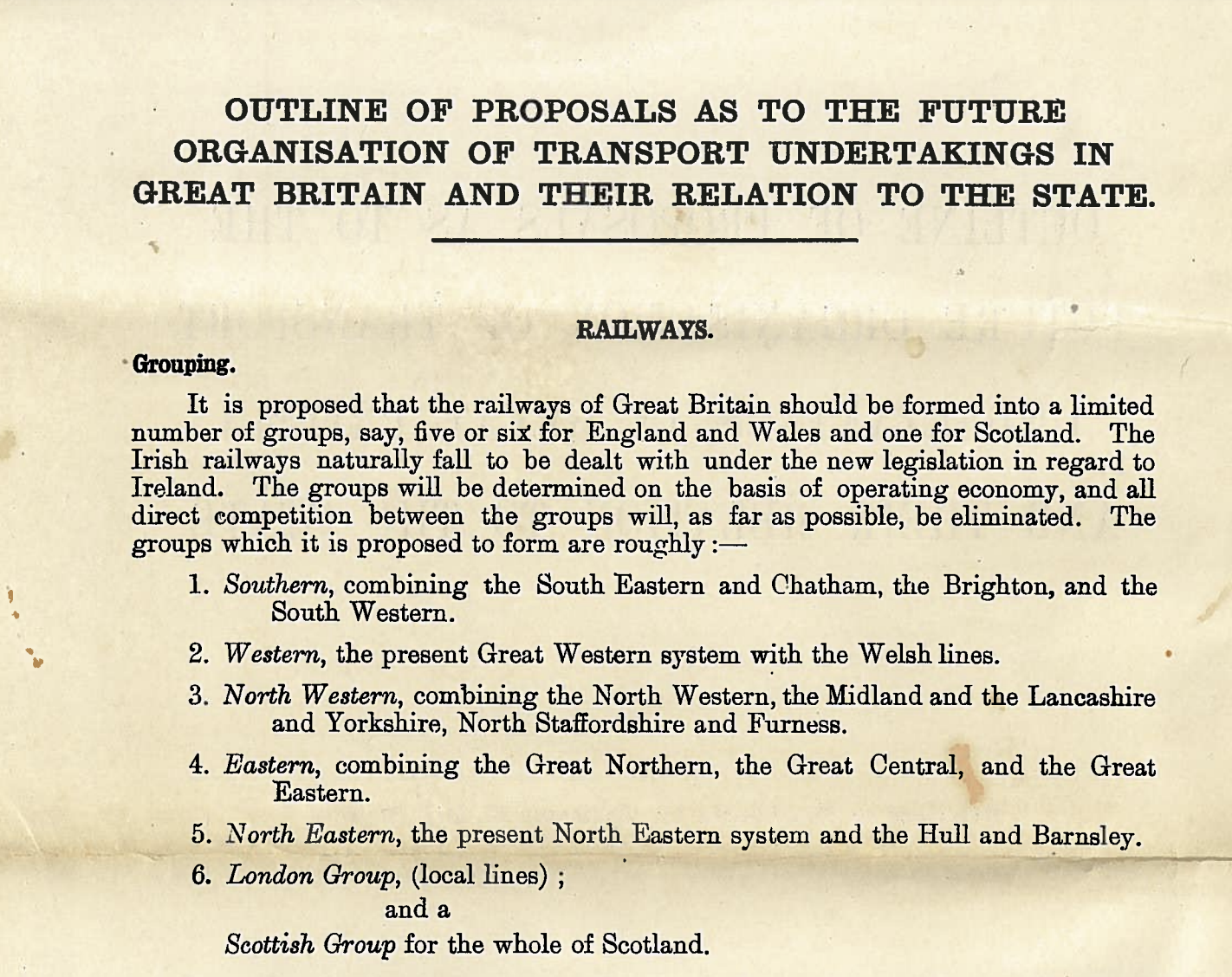
The British government’s 1920 white paper that led to the 1923 grouping
It is striking that the aim of the grouping was to make the railways more efficient, and to eliminate direct competition ‘as far as possible’. Indeed, Winston Churchill spoke in favour of nationalising the railways in 1918, but changed his mind by the time the 1945 Labour government nationalised the Big Four as British Railways. The eventual amalgamation created just four groups rather than the seven suggested in 1920.
What a surprise. Royal Mail is handing £400 million to shareholders after a rise in postal deliveries during the pandemic. It’s bitter news for its hapless customers.
I finally received a birthday card two weeks after blowing out my candles. I’m still waiting for last week’s New Statesman – and the previous edition, published 11 days ago.
This isn’t a new failing. Twice I have had to chase The Times because I haven’t received my subscriber’s tokens for the print edition of the Sunday Times. Businesses like The Times and New Statesman are suffering customer complaints through no fault of their own.
When will Royal Mail reward its customers rather than its shareholders, and provide the service we have paid for?












 Ertblog