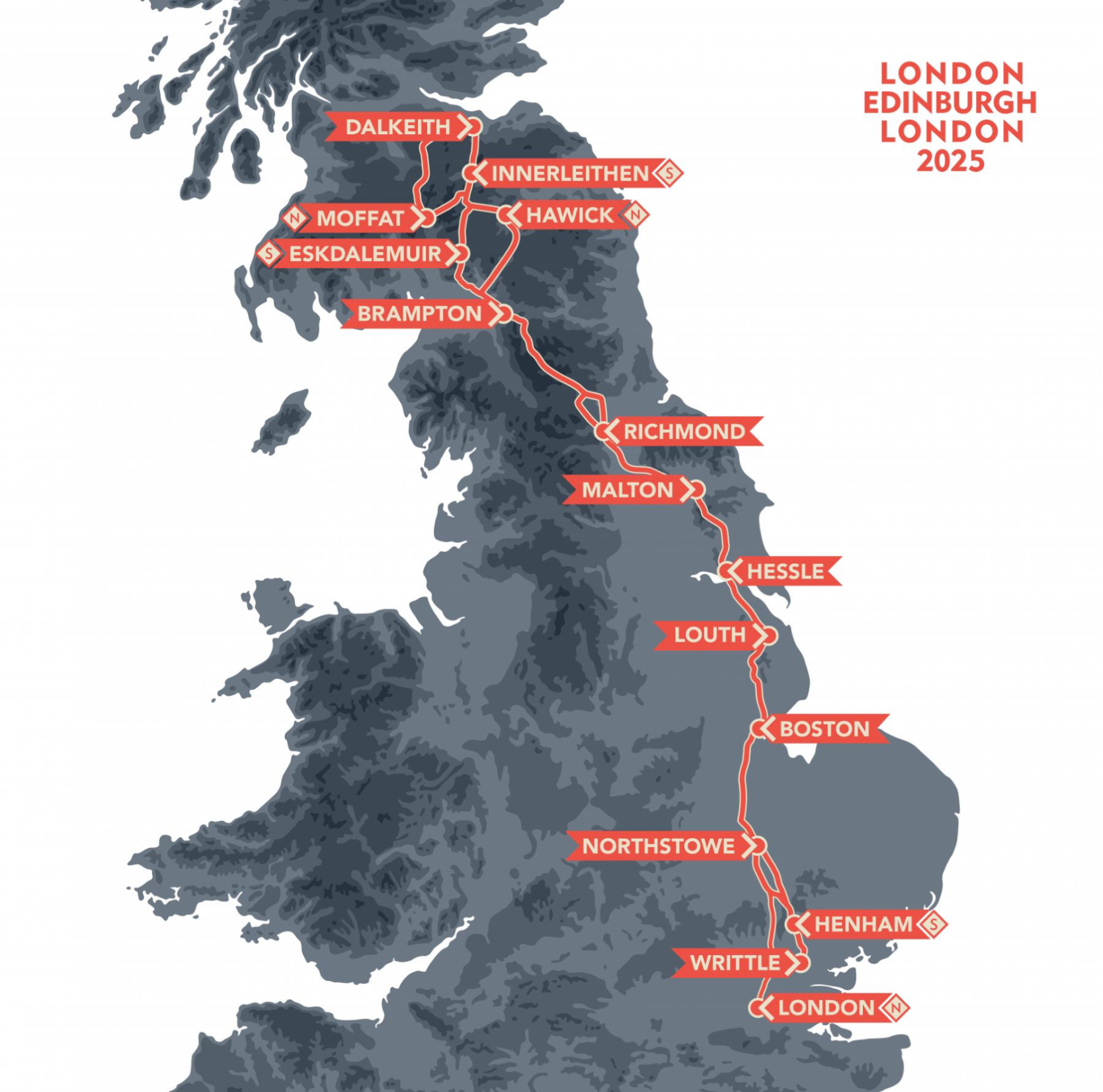
This is the fifth in my series of posts about my preparation for the 1530km London Edinburgh London audax event in August 2025. Read part one here (my road to LEL), part 2 here (lessons from the 400k London Wales London audax), part 3 here (even harder lessons from the Bryan Chapman Memorial 600k audax), and part 4 here (volunteers put together the LEL rider starter packs).
It’s starting to feel very real. On Sunday morning, 3 August 2025, I will join over 2,000 cyclists in the quest to ride London Edinburgh London, one of the world’s greatest amateur cycling events. My training is complete, and my bike serviced. Now, I’m going through my final preparations and kit choices. There’s been some chatter on the LEL Facebook page about kit lists, so I thought I’d share some of my kit choices and packing tips. The chances are that you are taking much less than I am, but as a first time LEL rider I’m playing it safe.
I’ll start by confessing that I’m torn between carrying things like a down jacket that will help me cope if we get wild weather in Scotland (as in 2009 and 2017) and keeping my on-bike weight down. I may compromise by having it in a drop bag, ready to carry if it looks necessary.
My other aim is to try to organise my kit in a way that saves time at controls while minimising the chance of losing things. On my recent tour of France (which involved a different destination every night) I used packing cubes, which made it very easy to find things in a suitcase. I’ll obviously not be carrying suitcases on LEL, but will use small bags within my saddle bag. This is how it will work:
Sleepover kit
This is taking into a control where I plan to sleep for a couple of hours. It will sit at the bottom of my saddle bag. It includes a sleeping bag liner, inflatable pillow, eye mask, ear plugs (mine plus the ones included in each rider’s registration pack), plus loose shorts to sleep in to give my body a rest from cycling shorts.
If you’ve arrived at London’s Kings Cross station in the rush hour only to endure a packed tube train to reach the heart of London, you may wonder why the station wasn’t built nearer your destination. Kings Cross isn’t alone; Marylebone, Euston and St Pancras are similarly stranded north of the Marylebone and Euston roads, which were created as the New Road in the 18th century.
Jonn Elledge entertainingly explains on his Substack (The Newsletter of (Not Quite) Everything) how the New Road was built as a by-pass for cows. Jonn adds his explanation for the inconvenient siting of these great termini:
[Railway] Companies serving destinations to the east and south of London drove their new lines right into the urban area, with scant regard for the poor residents they dispossessed; those coming from the west and north, by contrast, tended to respect the capital’s existing geography. That is why, to this day, Kings Cross (1852), St Pancras (1868) and Euston (1837) stations line up along the road, with Marylebone (1907) [actually 1899] a mile or two distant: they were effectively plugging into the existing transport network, made up of a massive road with canal access.
This is only part of the story. Today’s travellers are inconvenienced as a result of a Royal Commission set up by prime minister Sir Robert Peel in 1846:
Amazingly, the Royal Commission on metropolitan railway termini reported just three months later. It recommended that railway lines entering London should not be allowed to enter the West End. The commissioners accepted that more central stations would lead to the destruction of countless homes and other buildings. In 1846, the New Road was on the very edge of London, which is why the Royal Commission took it as the furthest a railway line from the west or north should pass into London.
I was sad to hear that Herman Ouseley had died. The news took me back to a year working alongside Herman in Brixton in 1992.
Herman was chief executive of Lambeth borough council at the time. The Conservative government’s environment secretary, Michael Heseltine, had the wheeze of inviting deprived areas to compete for funding for projects to transform their areas. Lambeth Council still had a terrible reputation as one of the so-called ‘loony left’ councils in the 1980s, and Heseltine told Lambeth it had no chance of winning.
That’s where I come in. I was working for Eagle Star insurance at the time, which was owned by British American Tobacco. BAT had an extensive community impact programme focused on Brixton, and in early 1992 its chairman, Sir Patrick Sheehy, agreed to second a manager to Lambeth to help it put a bid together for funding to transform Brixton. I’ve always relished a challenge – and agreed to take on ‘mission impossible’.
Three days a week, I swapped the dull corporate landscape of my City of London workplace for vibrant yet cruelly deprived Brixton. I was based in the old Bon Marche department store, which had been converted into the Brixton small business centre. It was a maze of corridors and hidden rooms, and shook when trains passed just feet away on the railway line into central London. It was just a decade after the infamous Brixton riots of 1981, and a local bar offered a cocktail called Brixton Riot in a Glass…The deprivation that helped cause the riots had certainly not gone away.
I got to know and admire Herman Ouseley during that year-long secondment. I was impressed by his immense dignity and calmness, which must have helped him cope with the stress of running such a deprived borough. I was delighted when he went on to chair the Commission for Racial Equality. He was the perfect candidate given his own background as someone who came to Britain from Guyana aged 11, and endured the endemic racism that blighted Britain for so long. He went on to found Kick it Out, a campaign to end discrimination and racism in football.
We took a community first approach to our bid, holding a presentation to government officials at a local secondary school, and arranging for young people from the school’s video unity to film the event. I wrote a briefing for ministers that referred to Brixton as an area that had produced a prime minister – John Major, who won a general election just weeks later, featuring his old Brixton home in a party political broadcast. We also held a presentation to business leaders at Lambeth Palace. This showed how much Lambeth was changing – in the days of council leader ‘Red Ted’ Knight just a few years before it would have been unthinkable for the council to partner with big business.
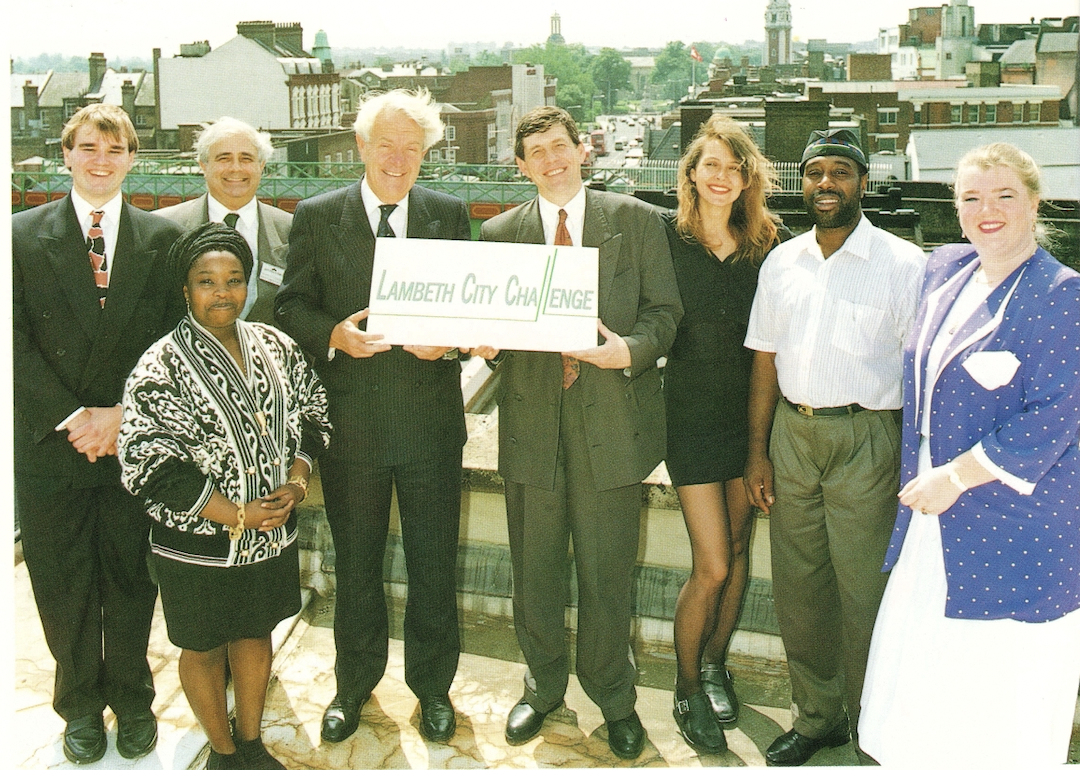
Winners! Government minister Nicholas Scott announces Lambeth had won. Rob on left
I’ll never forget the day Lambeth won. Nicholas Scott, a government minister, came to Brixton for a photocall, which we held on the roof of the small business centre. An ITV news film crew seemed less than keen to stand so close to a 200 foot drop to Brixton high street! It was a joyous day.
Three years later, I chatted to Michael Heseltine at a BAT event in London, and commented that I’d played a part in proving him wrong in dismissing Lambeth’s chances of winning. He was very gracious, but his mind may have been on other matters. All the talk at Westminster was about whether he would challenge John Major for the leadership of the Conservative party. He didn’t, but Major appointed him deputy prime minister days later after seeing off a challenge from John Redwood.
Reflections on Brixton Challenge
Even at the time I was troubled by the notion that deprived areas should compete for money. Why should the life prospects of someone living in poverty in Brixton, Toxteth, Moss Side or Handsworth depend on how good their council was at bidding? I agreed it made sense to get the private sector to invest in our inner cities, but BAT had already been doing that for some years. Indeed my boss during my secondment, BAT’s Brian Hutchinson, already worked tirelessly for Brixton.
A separate company, Brixton Challenge, was set up to oversee the implementation of the City Challenge projects. By all accounts it was not a smooth ride, and the project was criticised for not achieving what had been promised. But I look back with pride on one of the most satisfying years of my career, working with a truly diverse group of talented and enthusiastic people. Above all, I’m glad to have known Herman Ouseley.
Note: I published this blogpost a year ago, but accidentally unpublished it a couple of months later.
‘Don’t tell him, Pike!’ It’s the most famous line associated with Private Pike in Dad’s Army. Yet it was the officious Captain Mainwaring, played by Arthur Lowe, who uttered it. Mainwaring also regularly called Pike a ‘stupid boy’. Such is the enduring fame and appeal of the classic comedy series that many people born long after the last episode was shown in 1977 are familiar with these timeless catch phrases.
Ian Lavender, who has died aged 77, was the last survivor of the golden cast of Dad’s Army. He was 22 when he joined Dad’s Army – almost 50 years younger than Arnold Ridley (Private Godfrey) and John Laurie (Private Frazer). He played the immature Pike to perfection. It is poignant to reflect that Ian Lavender died over half a century after the passing of James Beck in 1973, who played the black market ‘spiv’ Private Walker. (Spivs were people who traded in black market goods, bypassing the strict wartime rationing system for food and other goods.)
The 1971 film version of Dad’s Army was largely filmed in our village, Chalfont St Giles, Buckinghamshire. Walmington on Sea has rarely been so far inland! The old Crown pub took on the guise of Martin’s Bank (manager, Captain Mainwaring), as seen below. In real life, the building is now empty after brief stints as Crown Coffee, and before that Costa Coffee as I blogged in 2014. It is due to reopen as Durans Bistro later this year.
You wear a bike helmet to keep safe. So it is a shock to find a faulty helmet design that could actually make things worse in a crash.
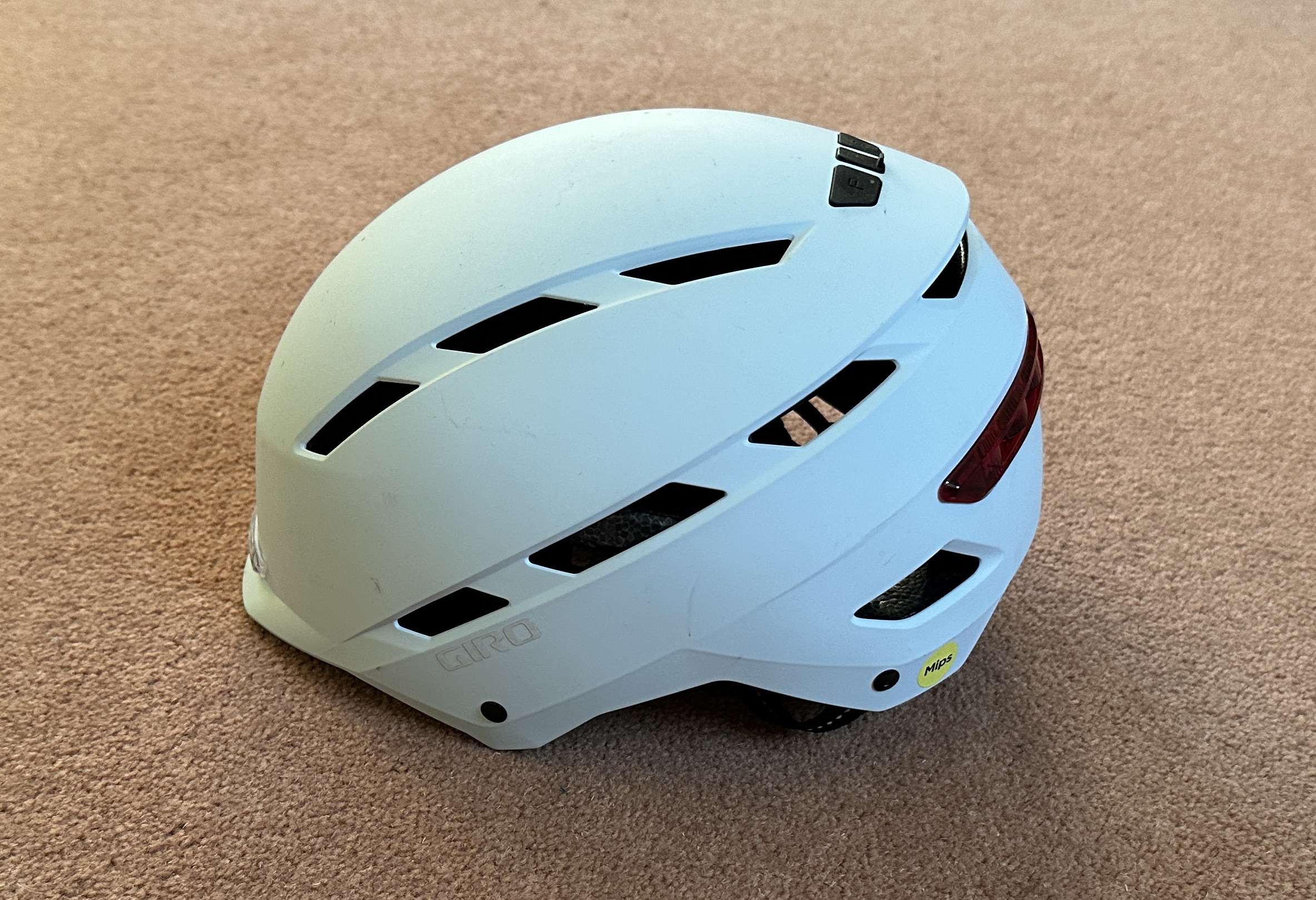
I bought a Giro Escape urban helmet in 2022. I wanted a lid with integrated lights for my weekly commute across London. After a few months, the strap came loose, and the helmet fell to the ground as I got to the office in the City of London.
Giro were very good, refunding me without quibble, and I bought a second Giro Escape, assuming the first helmet had a manufacturing fault. I loved the fit and the bright LED lights – just what I needed cycling home along dark country lanes after getting off the London train.
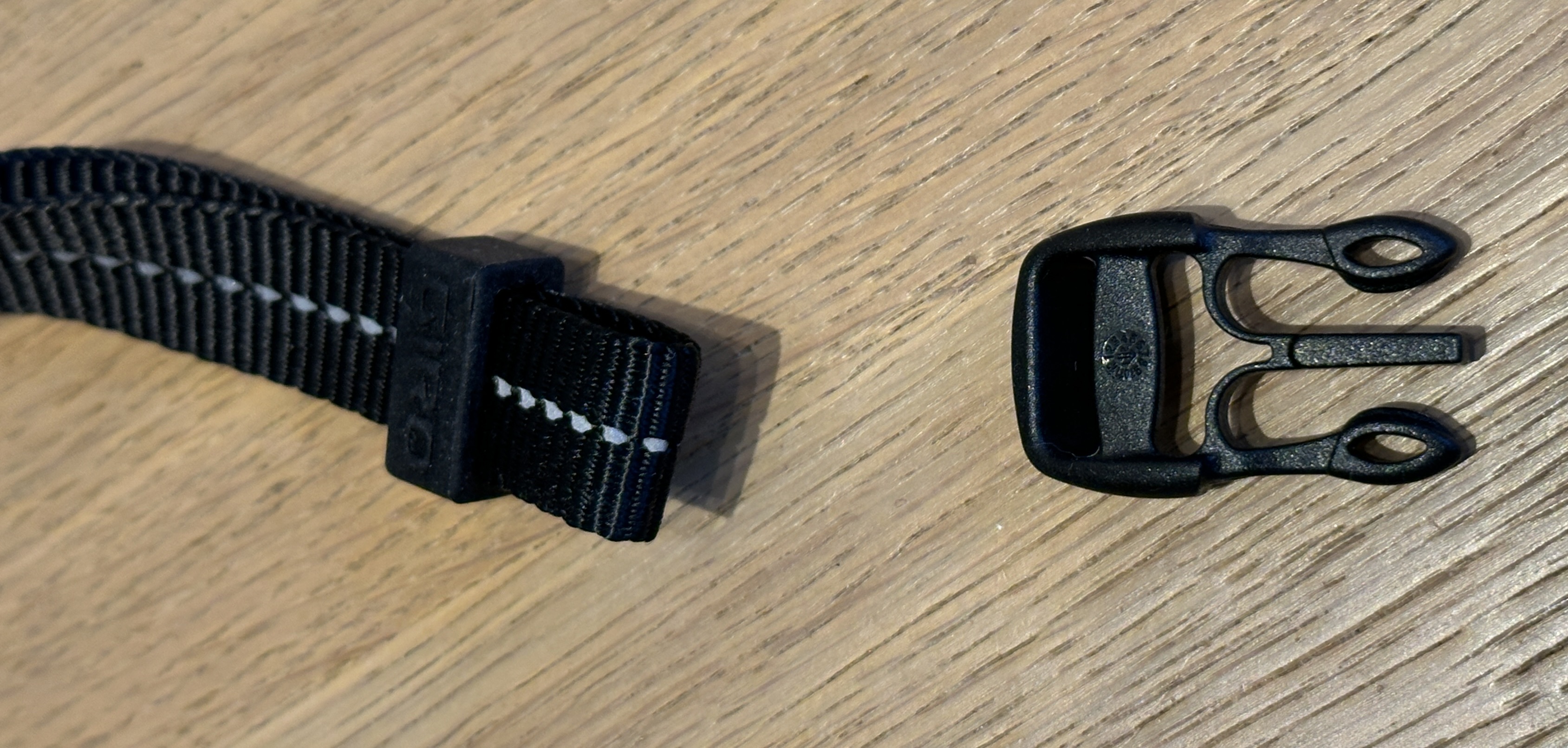
Yet after six months the same thing happened to the replacement. As I set off on my commute the helmet felt very loose, and I wondered how I could have forgotten to do it up. Then I found the two sides of the buckle were firmly attached: it was the strap that had come loose.
I contacted Giro, and was surprised by its response:
This is not something we have had reported to us often, especially 2 in a row for the same customer.
We would recommend that you reattach the clip and set the strap to the correct length. A small stitch through the loose part of the strap may stop this from happening.
Giro customer support by email, 16 january 2024
In other words, we expect you to redesign our helmet to make it safe to use.
To be fair, when I pointed out how unreasonable this response was Giro quickly agreed to refund me. But my second incident showed the dangerous design fault in the Giro Escape helmet. If I bought a third helmet, the same thing would happen again.
The fatal flaw
Let me explain the fault. The right side Escape strap is attached to the buckle by a very loose rectangle of soft plastic. It simply isn’t secure or tight enough to stop the strap working its way out of this loop and detaching from the buckle. I have made a video showing how easily this happens:
Within a day, another Escape user commented that they had exactly the same problem.
I then discovered that the design flaw isn’t restricted to Giro’s Escape helmets. It had recalled Merit helmets in North America, Australia and New Zealand because, in Giro’s words, quoted by BikeRadar, “the helmet strap may detach from the helmet when “pulled with relatively little force, posing a risk of injury to the user in a crash”. That’s exactly what happened to my two Escape helmets, happily without a crash.
So, Giro, how long are you going to continue selling the unsafe Escape helmet?
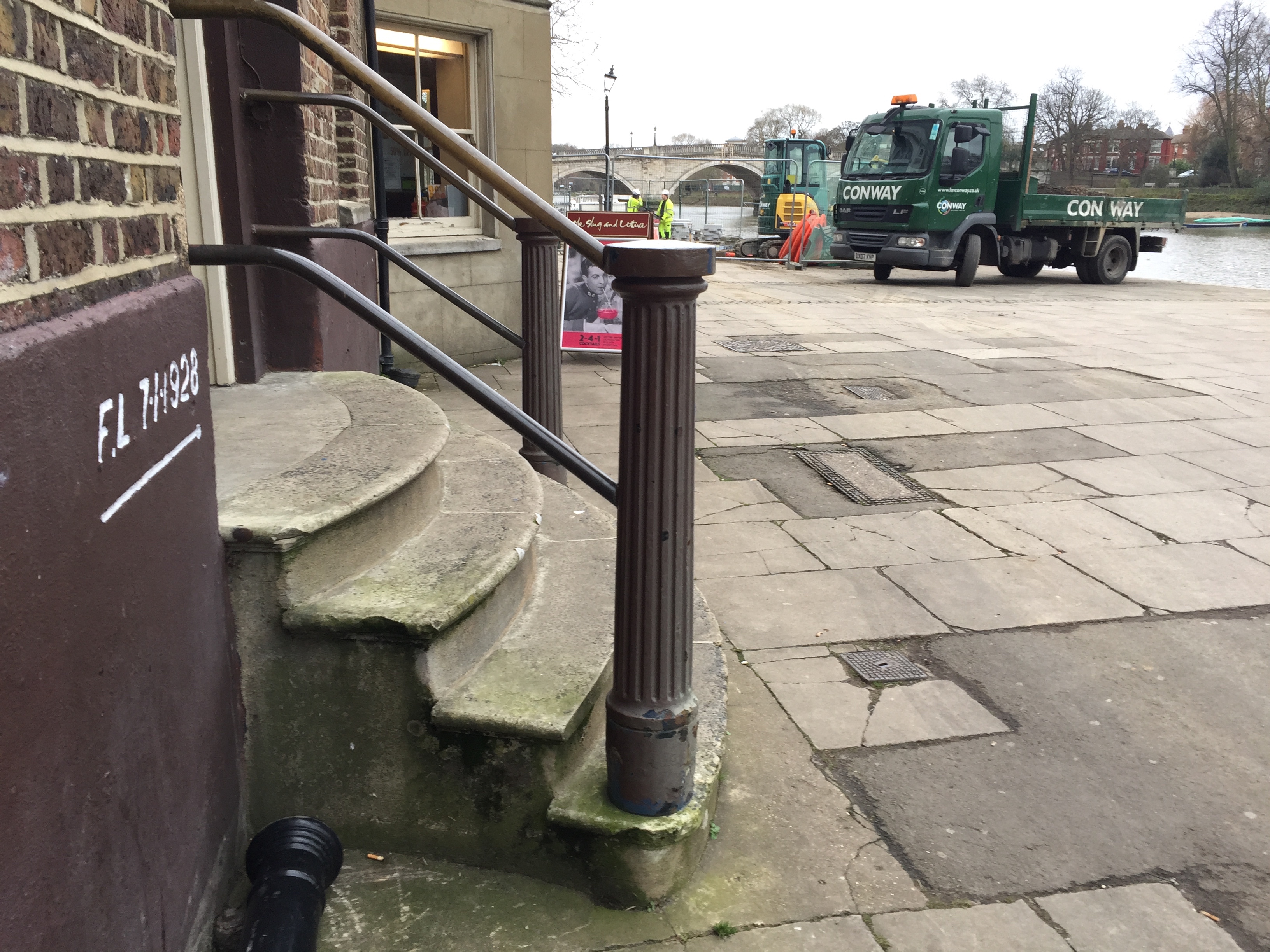
Anyone working or living in Richmond, Surrey, is used to the river Thames lapping over the riverside roads and paths. The White Cross pub even has a sign showing the high tide entrance. Yet few high tides have ever come close to January 1928.
Owen and the immortal Spitfire and Hurricane, November 2011
We went back to the RAF Museum, London in Hendon, London, today. It was Owen’s choice – he loved our two visits last winter and couldn’t wait to return.
As I blogged last November about the RAF Museum, Owen enjoyed the hands-on gallery that explains how aircraft fly. This time, we watched the moving and impressive film about Our Finest Hour – the RAF’s role saving Britain in 1940. flight works.
After three visits, we’ve still not seen the whole of the museum. We’ll be back!
Finally, here’s the video I made of our first visit in November 2011.
But there's a serious point here. My father, born in 1926, thought the Battle of Britain was fought in 1941. I was adamant – knowing the overwhelming documentary evidence in my favour – that 1940 was the year. And I was surprised that he was so wrong, given his strong memories of the Blitz.
But then it struck me. His memories are of the bombing. And to a 13 year old, there's no difference between being bombed in the Battle of Britain and the Blitz that followed through the winter and spring of 1941. Oh, and unlike us, Dad didn't learn about the second world war in history. It wasn't history to anyone born in the 1920s. It was news.
The lesson, though, is clear. Don't take memories as gospel truth. Don't assume people who lived through the events in question can give you the facts. But don't trust your own assumptions about history. Dad's point was that Cardiff was bombed before London, and that his parents and aunt sent him to the Welsh capital for safety just as the Luftwaffe decided Cardiff was a perfect target. (The debate about the Battle of Britain is a sideshow.) Looking at the records, he's right. I didn't realise Cardiff was bombed before London.
But my point remains. Don't assume that eyewitnesses are flawless witnesses to history. In fact, don't assume anything…





 Ertblog