This is the first in a series of posts about my training and preparation for the 1530km London Edinburgh London audax event in August 2025. The series was inspired by LEL supremo Danial Webb asking if anyone was planning to post about their training and preparation for the event. For part 2, lessons from London Wales London, click here.
London Edinburgh London is a cycle ride across Great Britain between the English and Scottish capitals. Held every four years, it is the premier British audax – a long-distance, non-competitive cycle ride. You have a maximum of 128 hours to ride to Edinburgh and back to London.
I’ve been dreaming about taking part in LEL since the pandemic, and will be on the start line in August. I’ve followed LEL Facebook and Yet Another Cycling Forum (YACF) posts, and read several books by previous participants such as Andy Allsopp and Malcolm Dancy for inspiration and information. I also bought the film about the 2013 edition of LEL. (All of which, truth be told, sent shivers of fear down my spine about what I’ve signed up for!) I’ve also enjoyed the LEL podcasts, which you can find on all the usual podcast platforms, including Spotify.
In this post, I’ll explain my road to LEL 2025, talk about my training, and also share a few tips for fellow LEL riders – which may be useful for anyone taking part in other multi-day audax rides. These tips are based on my own cycling experiences and advice shared by previous LEL riders. In future editions, I’ll share any new lessons from my training and preparations.
So – what makes me think I can complete LEL?
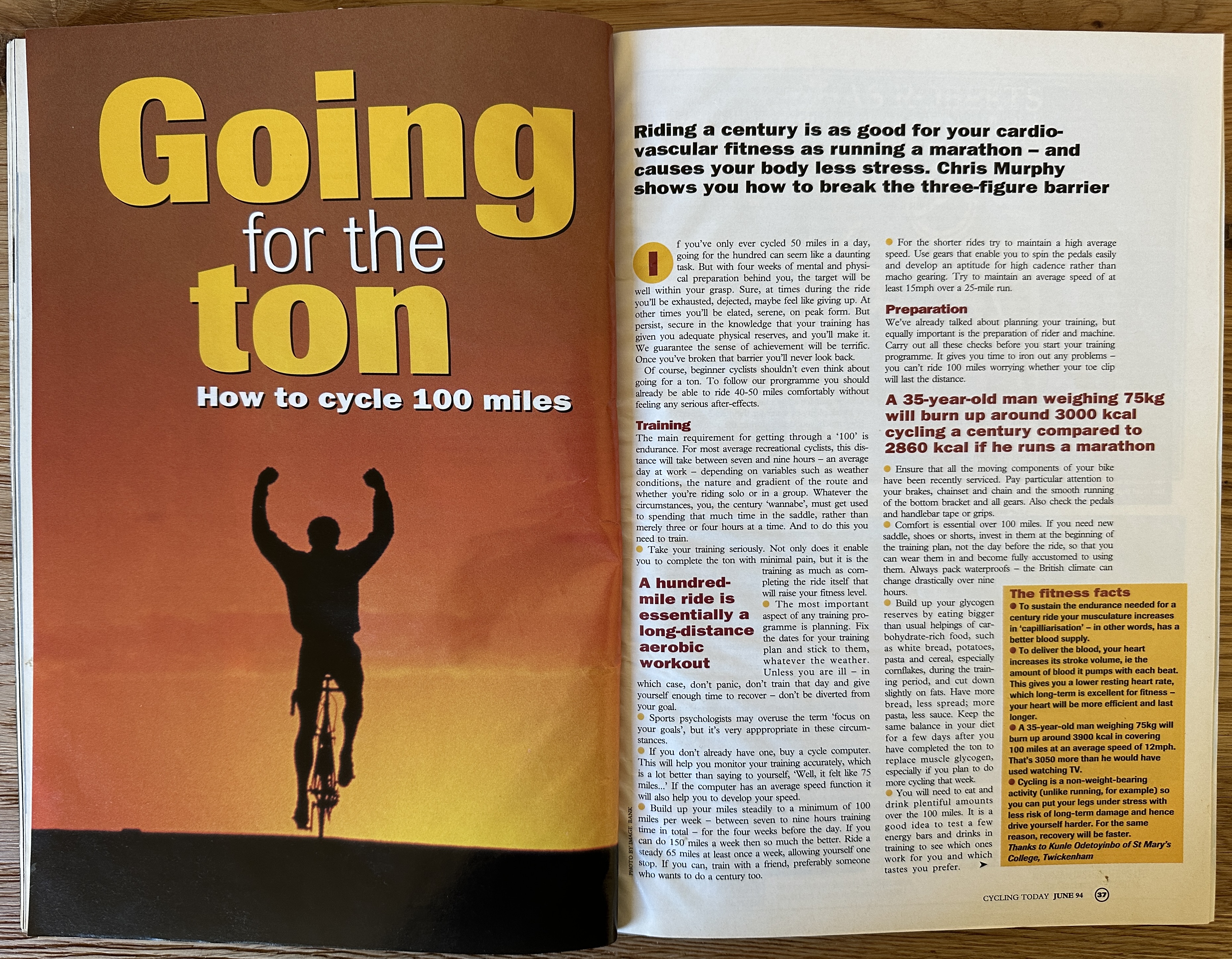
My original inspiration for long distance cycling, 1994
I’ve been cycling for over 35 years, since buying my first proper bike in 1989, as I blogged last year. Back in 1994, I was inspired by this feature in the old Cycling Today magazine about cycling 100 miles, and successfully completed my first century the following year.
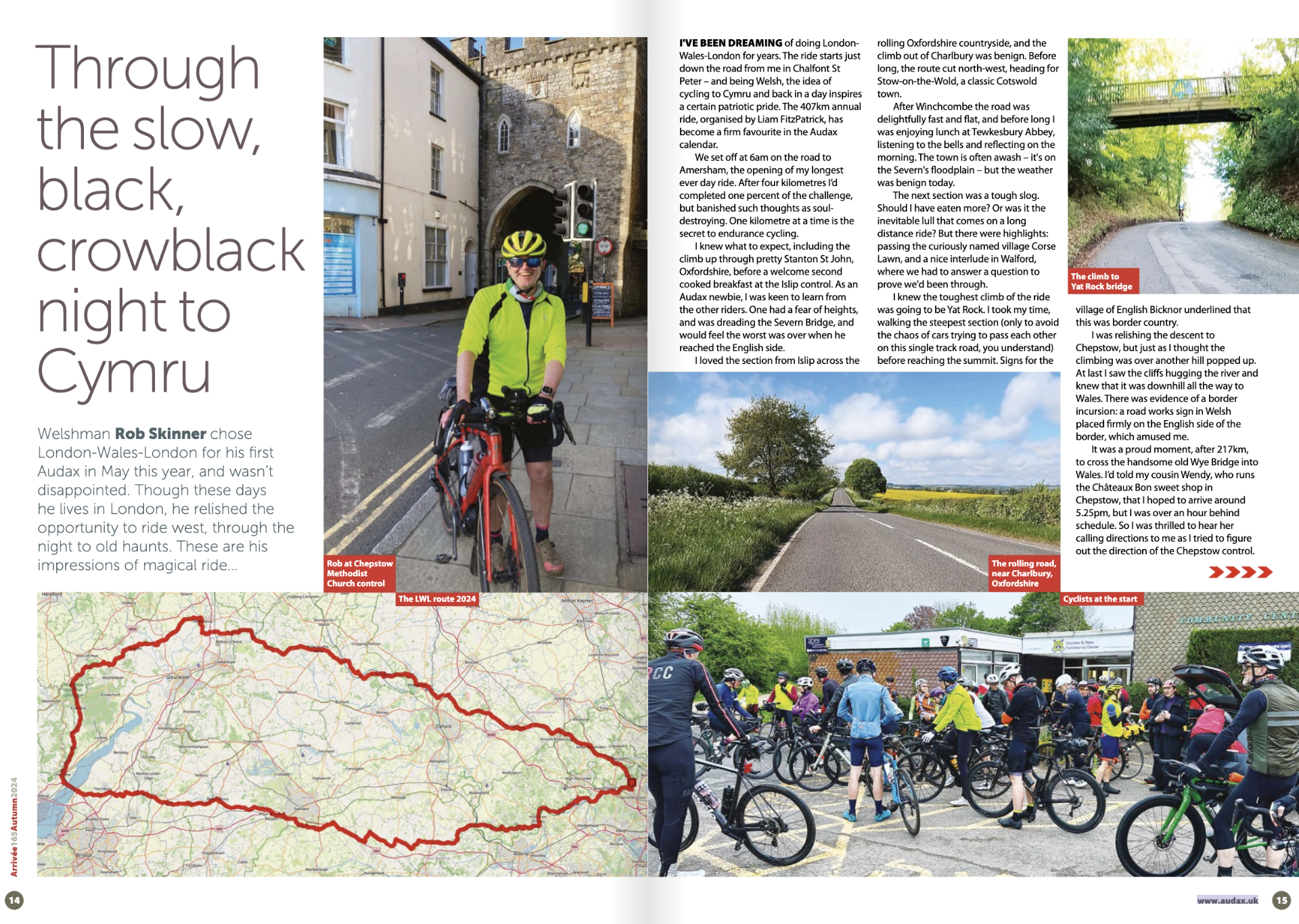
Last year, I completed my first audax ride, the 400km London Wales London, and my beginner’s story appeared in Audax UK’s Arrivée magazine. (The article was a shorter version of my LWL blogpost.) I knew that LWL was a good test of my ability to complete the far bigger LEL challenge, and early on my ride to Wales I had a brief crisis of confidence:
‘I was still in the Cotswolds when I decided such a challenge [LEL] was beyond me. The toll on body and spirit would be huge. Yet now, after the satisfaction of completing LWL successfully with something to spare, I’m not so sure. I have a guaranteed place for 2025, and that would have to be the year – it really would be too much by 2029, when I’d be approaching 66.’
I am feeling more confident now about LEL, and am fitter than I was on the eve of LWL 2024.
It’s official. I’m taking part in Britain’s greatest cycling challenge, the 1530km London Edinburgh London ride in August 2025.
I’ve been thinking about it for a while, and my successful completion of London Wales London in 2024 makes me think I’m not completely crazy contemplating cycling from London to Edinburgh and back in 128 hours. That wonderful 26 hour experience showed that I was capable of the mental attitude needed for endurance cycling. As I wrote in my LWL blogpost, the mental challenge is arguably greater than the physical one, at least while the body is still capable of turning the pedals. LEL will require far greater mental strength than the far shorter distance of LWL, which spans just one night – although the fastest LWL riders make it home before midnight.
I’ve really enjoyed the London Edinburgh London podcast series – I was impressed how it shows how you don’t have to be a super athlete to do LEL, while not hiding the fact this is a feat of endurance. I listened to this episode while driving to Wales with my son just hours after entering. I felt exciting and scared in equal measure!
Over the coming months, I’ll be getting match fit while learning from accounts by LEL veterans what I need to do to maximise my chances of success. This will vary from the physical – how to improve core strength for days on the bike, while avoiding saddle sores and Shermer’s neck – and choosing the right equipment for the ride. As my friends know, I love recording my cycling adventures in word and video, but LEL is so all-embracing that I’ll have virtually no time or energy to give a detailed account along the way as I’ll be living in the moment. (My clear lesson from LWL was to avoid faffing and minimise the elapsed time off the bike – it’s easier to reduce time at stops than make up time on the road.)
Last year, I was pleased with my training for LWL. I blended time on the road with hill climbing, which helped me on the big one. I need to take this to a new level for LEL, and also get into the habit of stretching – for days after LWL, I was incredibly stiff, which will be debilitating on LEL when setting off after my first sleep after a few hundred kilometres. In 2002, on my first Land’s End to John O’Groats ride, I was impressed by a couple of riders who stretched whenever they stopped. I must follow their example in 2025.
I’ll post updates on my preparations in the coming months. Do please share any advice! UPDATE: you can read the series on training and preparing for London Edinburgh London starting here. (There’s a link to the next episode at the end of each post.)
PS: I am lucky enough to have a guaranteed entry to London Edinburgh London as a member of Audax UK, Britain’s long distance cycling association. But I hit a glitch using the guaranteed entry to apply. It emerged that as I applied for the early entry ballot in 2023 the guaranteed entry link didn’t work. Happily, the LEL team sorted this for me, hence the entry confirmation at the start of this post. If you are in a similar position, just contact them for help.
New year is the time I look back on the cycling year just passed, and anticipate adventures to come. This time last year, I shared my plans for 2024 with a hint of hesitation. Telling the world that I planned to cycle from London to Wales and back in a day seemed tempting fate. But that London Wales London challenge proved a happy one as I blogged in May. It remains to be seen how I cope with the far bigger ambition to complete London Edinburgh London this August.
2024: the year I became an endurance cyclist
Crossing the Severn Bridge, London Wales London 2024
At the start of 2024, I’d never cycled more than 103 miles in a day. Could I make the jump to riding over 250 miles in one go? I knew that this would be as much a mental challenge as a physical one. So I tested myself on a 157 mile shortened version of the London Wales London route, which I tackled three weeks before the real thing. My heart sank as I suffered a puncture after 49 miles, but the tubeless sealant plugged the hole, and I made it to the end. I was also tested by a pitiless headwind for much of the first 60 miles, which meant I had to pedal downhill as well as up. These hurdles tested my resilience but I came through with the confidence to tackle London Wales London.
The opening page of my Arrivée article on LWL
I’ve already written a comprehensive account of my debut London Wales London in Audax UK’s Arrivée magazine and on this blog, so I won’t repeat myself here. I’ll just say that I found it an almost spiritual experience, especially seeing a new day dawning as I pedalled across the unspoilt Berkshire countryside. I was also delighted to reach the final feedstop at Lambourn after 196 miles in buoyant shape and spirits. My LWL success isn’t proof that I will be able to complete London Edinburgh London (or indeed the 600km Bryan Chapman Memorial ride in June) but it suggests that I am not crazy to attempt them.
Cycling across Ireland
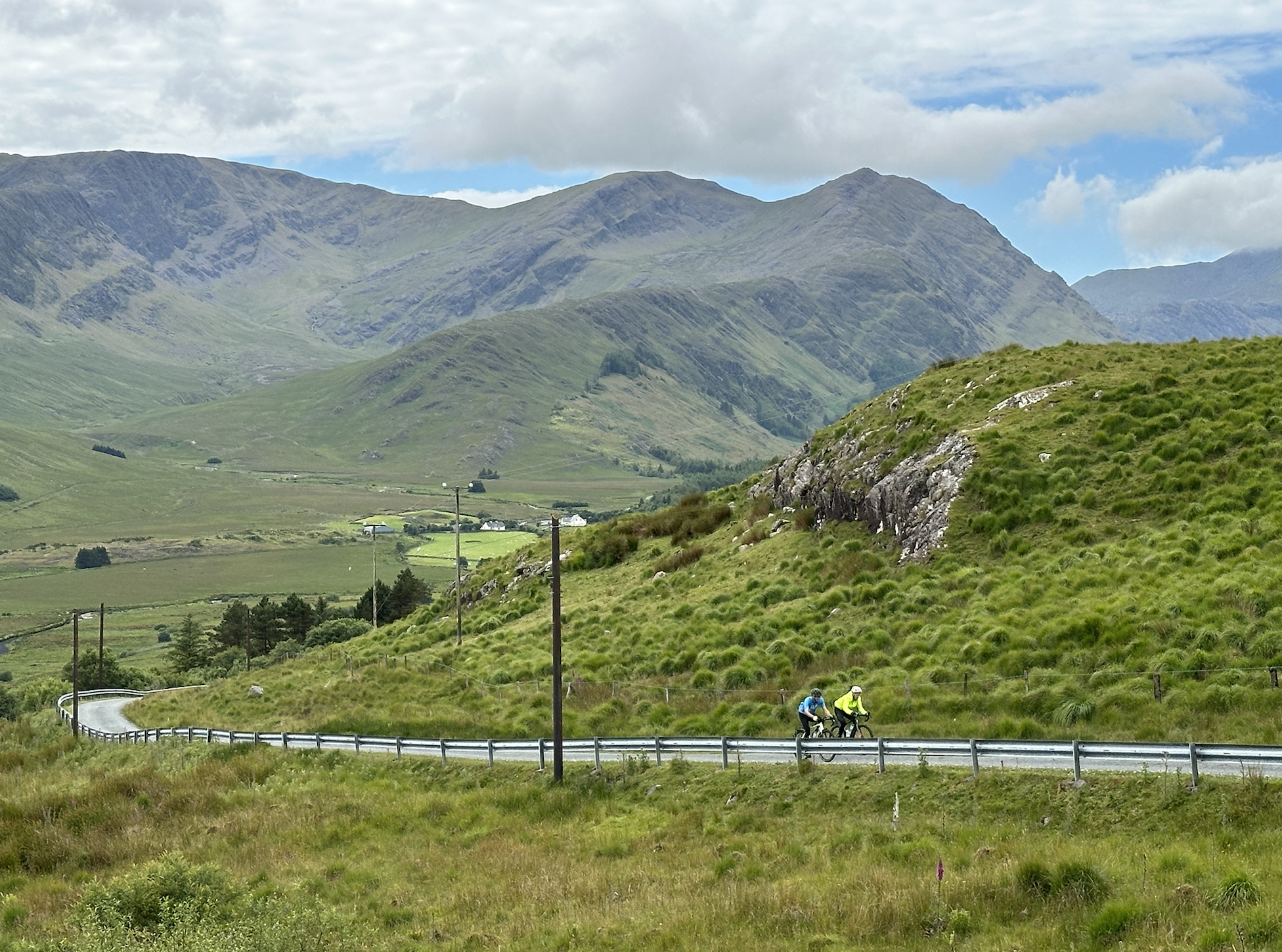
Climbing the Sheeffry pass, Co Mayo, Ireland
It was a joy to return to Ireland in June, for my third ‘end to end’ ride, from Mizen Head in Co Cork to Malin Head in Co Donegal with the excellent Peak Tours. It was no surprise that the weather wasn’t as benign as in Portugal in 2023, but we did have a surprising number of bright days. I’ve written a detailed day-by-day account starting here.
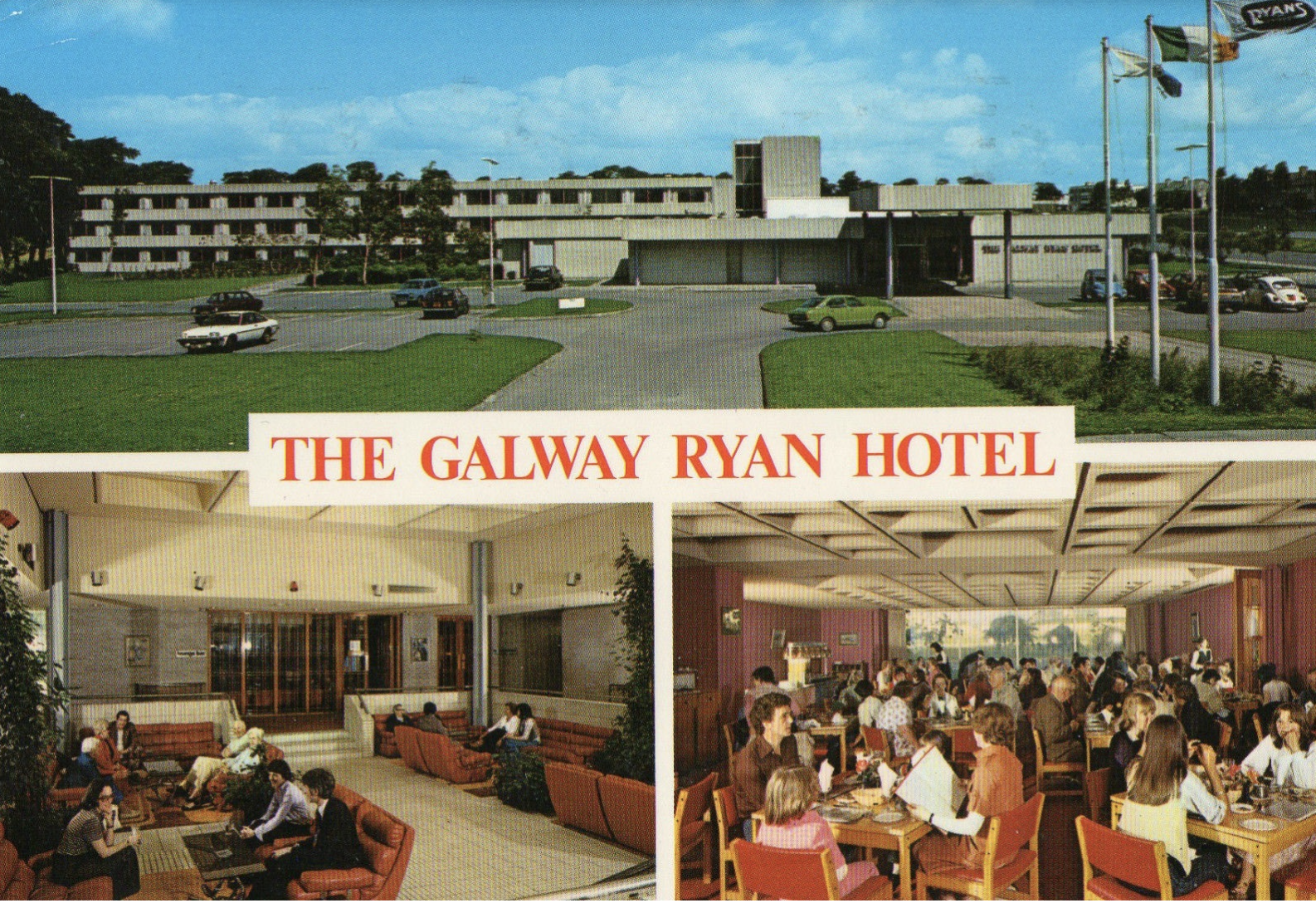
In my 2024 new year post previewing the trip, I looked forward to returning to the seaside town of Lahinch 50 years after my visit aged 10 with Mum and Dad. We didn’t stay there in 2024 as it turned out, but I stopped briefly and found it rather a sad place and not at all how I remembered it. But in an amazing coincidence we did stay in the same Galway hotel that Mum, Dad and I visited in 1974. The old Ryan Hotel was renamed the Connacht in 2013.
Conquering the Rapha Festive 500
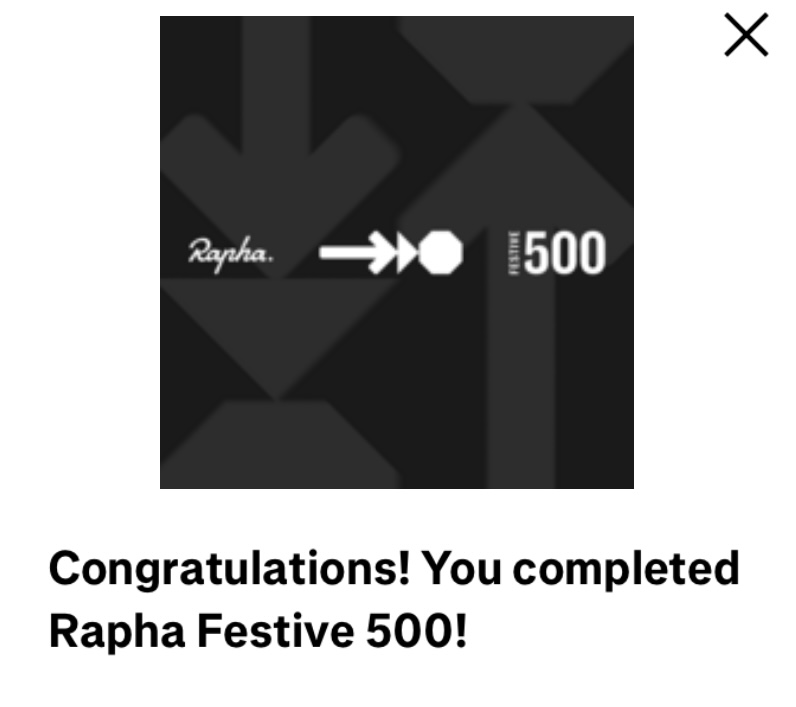
My 2024 cycling year ended on a high as I completed the Rapha Festive 500 for the first – and most likely only – time. As one of my readers, Tempocyclist said, it’s a lot nicer cycling 500 festive kilometres in the southern hemisphere than in a British winter.
You can read my tips on tackling the Festive 500 here. I was delighted and relieved to finish the last ride. I have to be honest that it wasn’t my favourite cycling experience of the year, but it did mean I finished 2024 more healthily than if I’d stayed on the sofa, which gives me a head start in my training for 2025’s cycling challenges.
For the first time in 28 years, I’ve travelled to Ireland by train and ferry.
It was inspired by a post by rail travel expert The Man in Seat 61. As a result, I took the route of the Irish Mail, which operated for over 150 years between London and Dublin.
But first, a rant…
Over 25 years ago, I endured another passenger’s mobile phone conversation on a late night train journey from London to Wiltshire. I remember that he was discussing the merits of various films. I hoped it would be a short conversation but it lasted for the hour it took for the train to reach Swindon.
Things are so much worse today. People think it’s fine to have conversations with the whole chat broadcast on their phone’s speaker – and to watch a film in the same intrusive way. When did people become so utterly selfish?
Soon after I took my train seat at London’s Euston station, I was on edge when someone opposite held a mobile chat on speaker. I was relieved when he moved away without any intervention by me. But a couple of hours later a guy behind me started watching a film with his smartphone blasting out the soundtrack on full volume. Three women tried to reason with him, but he seemed to think they were taking away his human right to inflict noise on everyone around him. I supported them, and I was relieved when he moved out of our carriage. I was glad he gave way. But why should we have our peaceful journeys ruined because of another passenger’s selfishness?
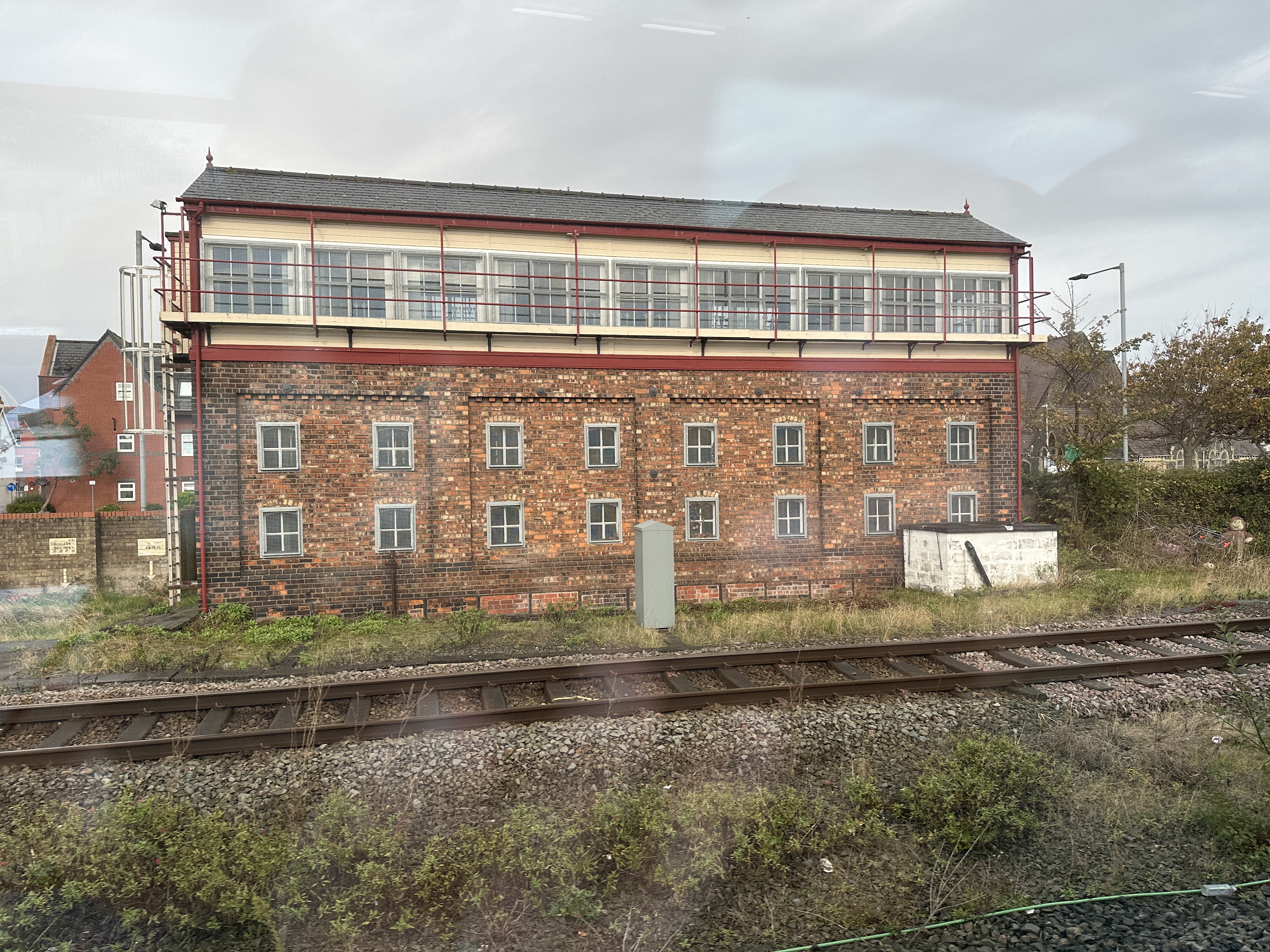
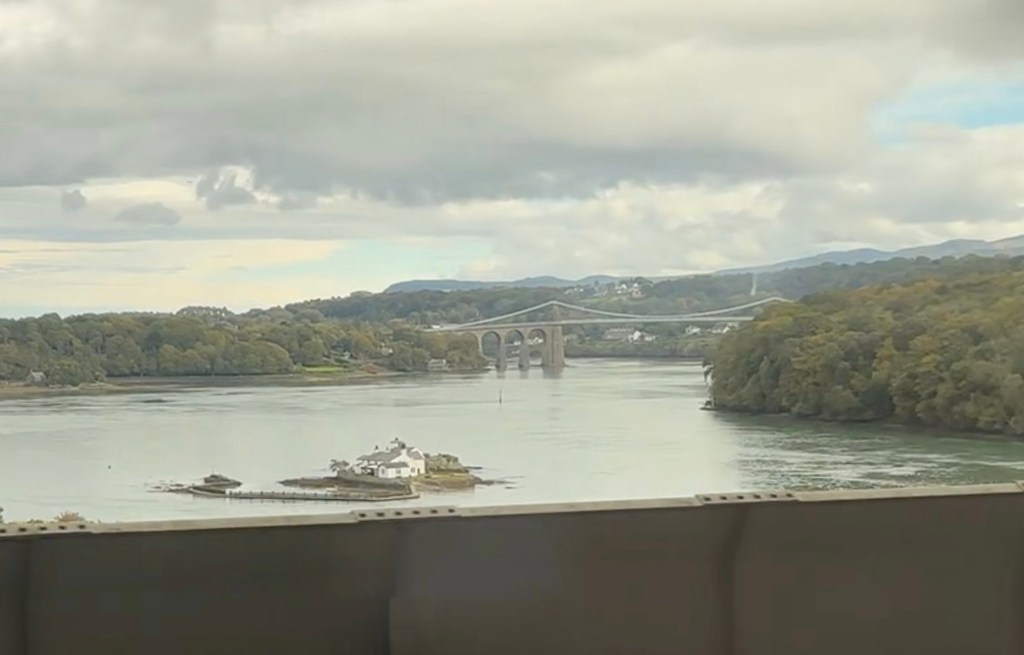
On a happier note, the North Wales coast line is a delight. Many of the original 19th century station buildings and signal boxes survive along with a few semaphore signals in Anglesey. The route hugs the Irish Sea shore and crosses the historic Britannia Bridge to Ynys Môn, Anglesey. This was one of Robert Stephenson’s monumental accomplishments but sadly the old tubes that carried the rails above the Menai Straits were fatally damaged by a fire started accidentally by two children in 1970. The bridge was rebuilt in more modern form two years later and in 1980 an additional deck was added to provide a second road bridge to Anglesey. The old bridge was flanked by two statues of lions, and I glimpsed one of these as my train headed across the bridge. The BFI has a wonderful film of an LNWR train crossing the original bridge in Victorian times here.
Happily Stephenson’s 1848 tubular bridge at Conwy survives – perhaps the only one left anywhere in the world.
Telford’s 1826 Menai Bridge from the Britannia rail crossing
I was amused that the on-train safety announcement was in Welsh – before we’d even left the London suburbs! But I discovered that the irritating ‘See it, Say it, Sorted’ slogan is just as annoying in Welsh, as ‘Wedi sylwi, Wedi sôn, Wedi setlo”…
I sailed to Ireland on Ulysses, an Irish Ferries super ferry. It’s the size of a small cruise liner, and although it tales longer than a fast ferry, it is almost never cancelled because of the weather. It was an easy and enjoyable way to travel, although for the first time on a ferry I had to put my bags through a security scanner. There were no restrictions on liquids, though.
I assumed that the ferry would be birthed next to the railway station but the ferry terminal has moved a mile or so, presumably to accommodate modern, bigger ships.
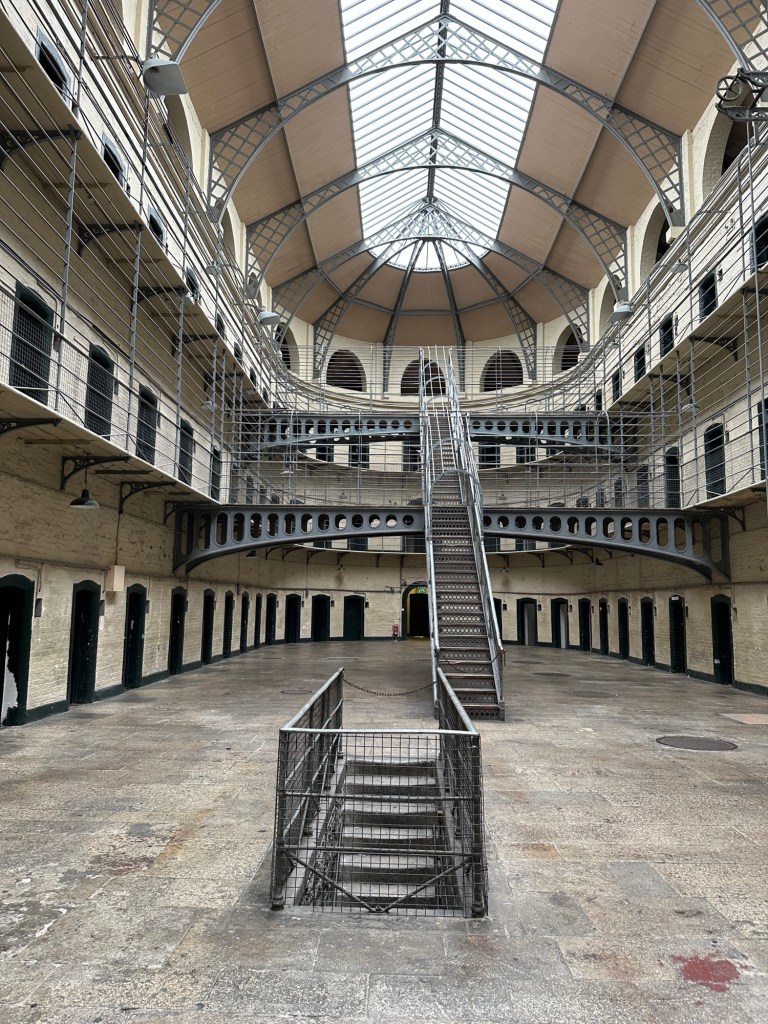
Kilmainham Gaol
I love my visits to Dublin, and this was no exception. My friend Louise kindly collected me from Dublin ferry port and took me to my hotel, the Maldron in Smithfield. The following evening, Louise, Aidan and I had dinner after convivial drinks with Allan Chapman and Barry Chapman from PR agency Comit. These get togethers always prompt serendipitous conversation: this time, we talked about family connections to the Australian goldfields and Ned Kelly.
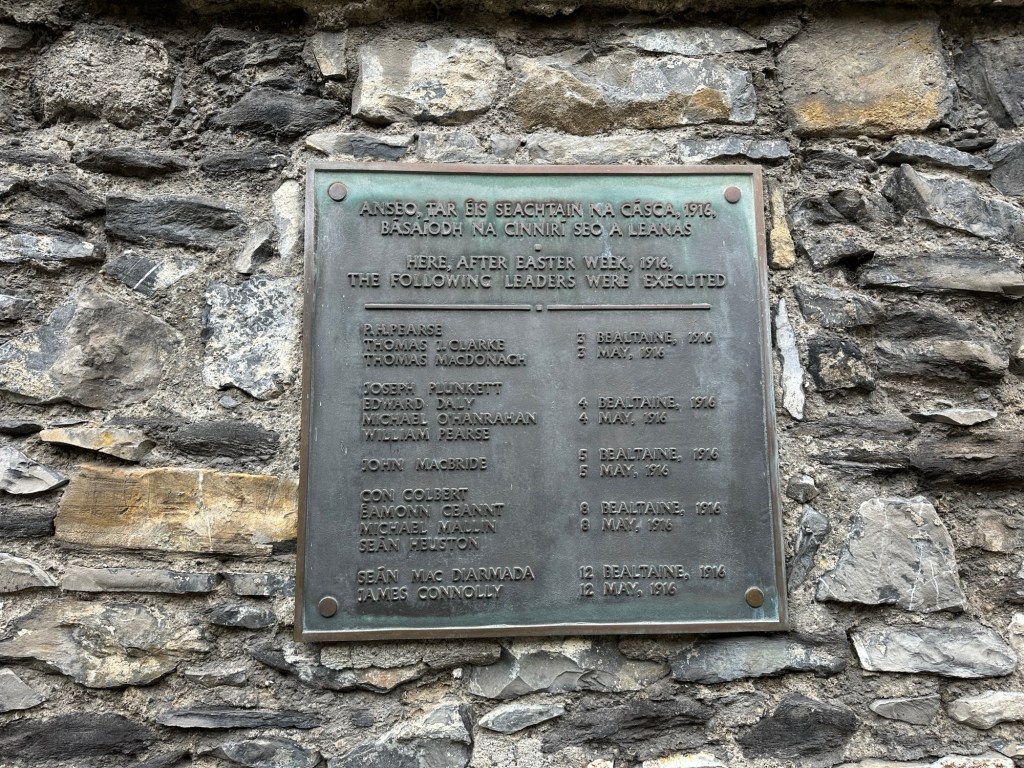
Earlier, I toured Kilmainham Gaol. This prison is over 225 years old, and replaced dungeons as a home for Dublin’s prisoners. It is best known as the place where the men and women who fought for Irish independence were held and in all too many cases executed. It was sobering to see the spot where those who took part in 1916’s Easter Rising were shot, marked by a simple wooden cross. A few metres away another cross symbolised where James Connolly was executed by firing squad sitting in a chair as he was unable to stand because of injuries he sustained during the rising. I blogged about the Easter rising and the British reaction to it on the centenary in 2016.
There’s also a plaque commemorating those executed at Kilmainham by the Irish Free State army during the Irish civil war in 1922.
On a more lighthearted note, I learned on the tour that the prison scenes in the Paddington 2 film were filmed at Kilmainham.
Finally, the old spelling gaol reminded me that I was completely stumped when asked to read it aloud at school in Wales 50 years ago. I think I said ‘gale’. The Guardian was still using the old spelling well into the 1980s before conceding and adopting the modern spelling.
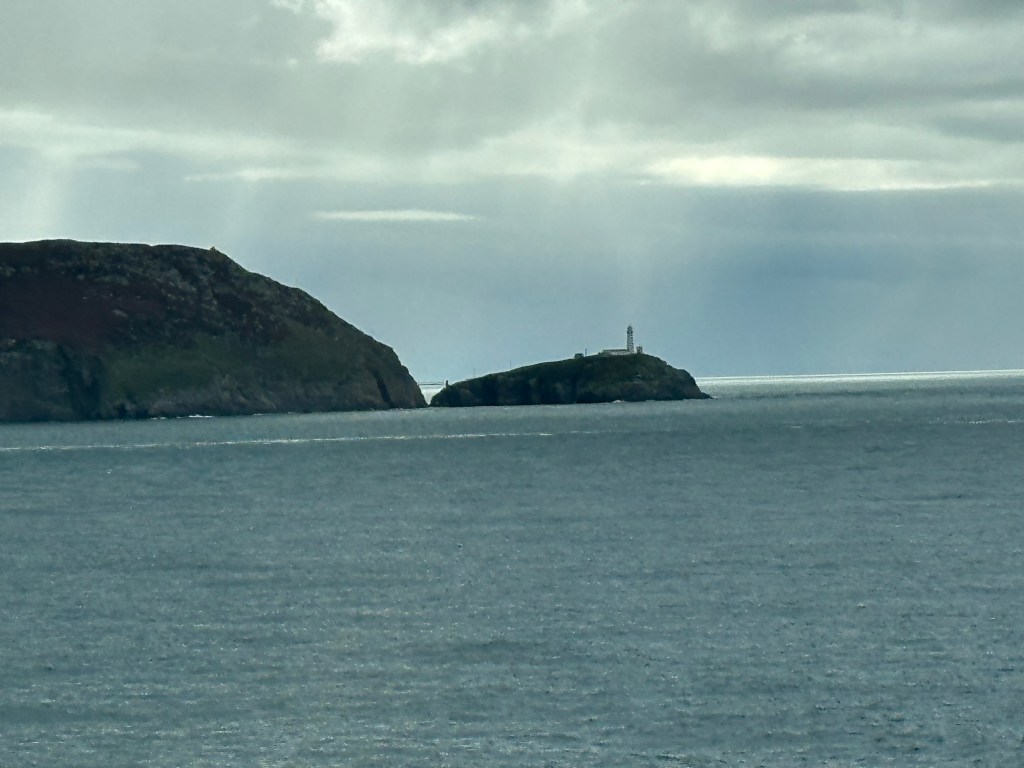
South Stack lighthouse, Wales
I enjoyed my land and sea journey to Ireland. I’d happily do it again, perhaps taking the car from Fishguard to Rosslare, as I did on my first visit to Ireland with Mum and Dad in 1974. Or by bike, as I did in 1996? Time will tell.
I’ve been dreaming of cycling across mysterious Romney Marsh to historic Rye for years. The inspiration was Jack Thurston’s first Lost Lanes book of bike tours, along with childhood memories of Malcolm Saville’s adventure stories for children based there. (More on that later.)
I finally followed Jack’s tour in September, and have made a documentary video about it. Unusually for my videos, this focuses less on cycling and more on the fascinating history of this corner of England. This blogpost tells the story of my ride, along with a longer version of the stories from the past featured in the video.
Here’s the video on YouTube. (Do please like and subscribe!)
Britain’s most spectacular railway station
My journey began at St Pancras station in London, Britain’s most spectacular railway station. When the Midland Railway decided it needed its own London terminus, it chose the most opulent neo-Gothic style for the station building, along with a stunning roof that spanned all the platforms. It overshadowed its neighbour, Kings Cross station, although the simpler lines of the older station have arguably stood the test of time better.
“This will go down as the year of the roof box,” declared Tom Peck in The Times today (paywall). He added that travelling to the in-laws with small children makes a top box essential.
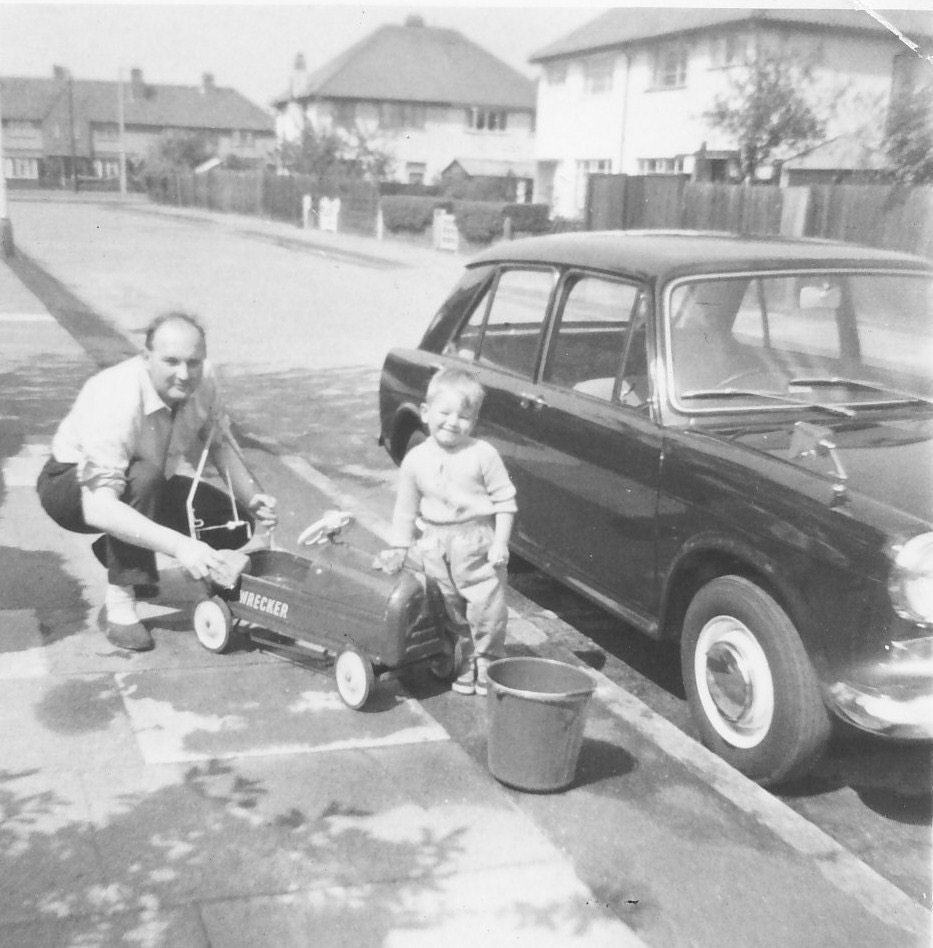
I recognised the sentiment. When Owen was born, one of our first purchases was a roof box for journeys to my parents in Wales and holidays in Dorset and Cornwall. At the time I thought it odd that my Mum and Dad could go on holiday with two children in far smaller cars, such as Dad’s 1960s Austin 1100 seen above, without the need for a roof rack. But life was simpler in those days. Cars didn’t have seat belts, never mind Isofix child seats. And people had far less stuff.
Off to Devon, 2010
As the photo above shows, even an estate car wasn’t big enough for a holiday with a two year old. What on earth did we take with us?
The top box has languished in the garden for most of the last five years; you can travel lighter with a teenager than a toddler. But on our first pandemic holiday, in Tenby in August 2020, we planned to use it so we could take all our beach stuff, windbreaks and so on. But disaster struck: we’d forgotten where we’d stored the Thule kit that attached the box to the car. As a result, we went away without it. It was only on our return that we remembered it was inside the box!
No wonder I have a reputation for taking everything except the kitchen sink when I go on holiday…
I had a few butterflies at the start of the final stage of our tour. Yesterday’s weather cast a shadow but happily the rain had moved on by the time we got going. Perhaps our obsessive attention to our weather apps paid off!
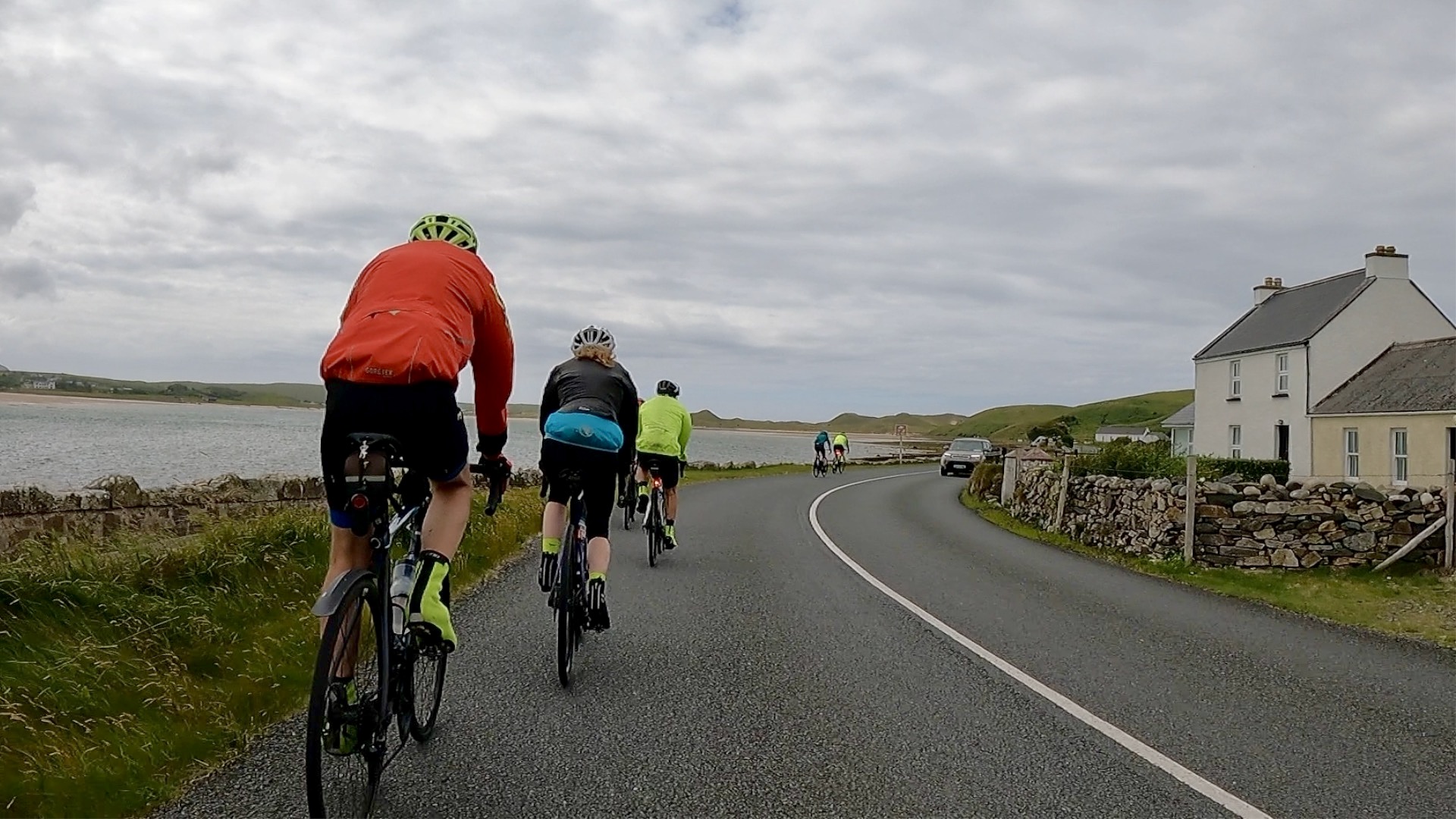
I was one of the last to set off, but was cycling at pace as we headed along the coast and the stunning Gweebarra estuary. I couldn’t resist taking photos – I doubt I’ll come this way again – so I was the lanterne rouge again. I didn’t want to hold that lonely place for long, and by setting a cracking pace caught up with a few others – though it took a mile or two.
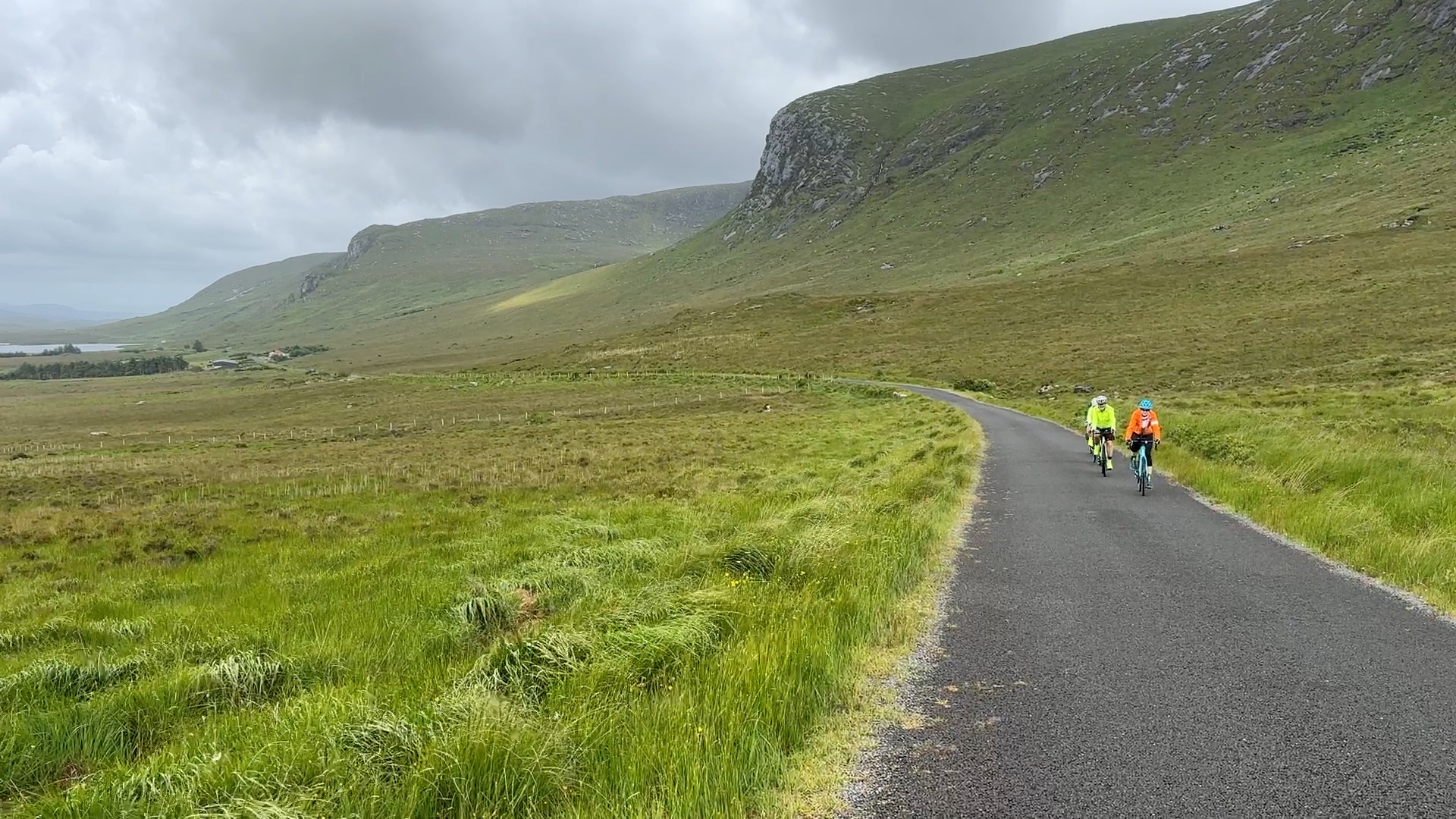
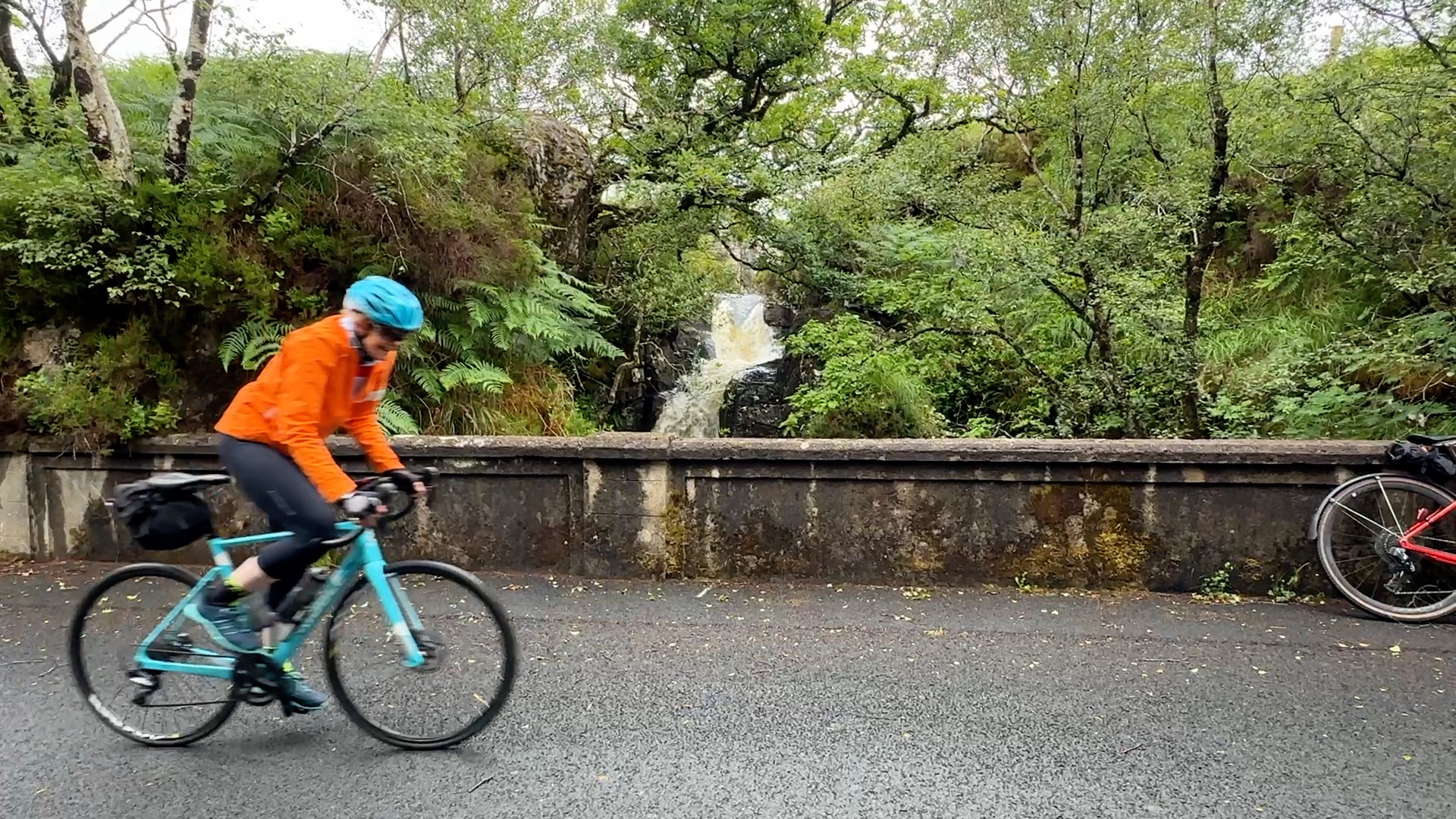
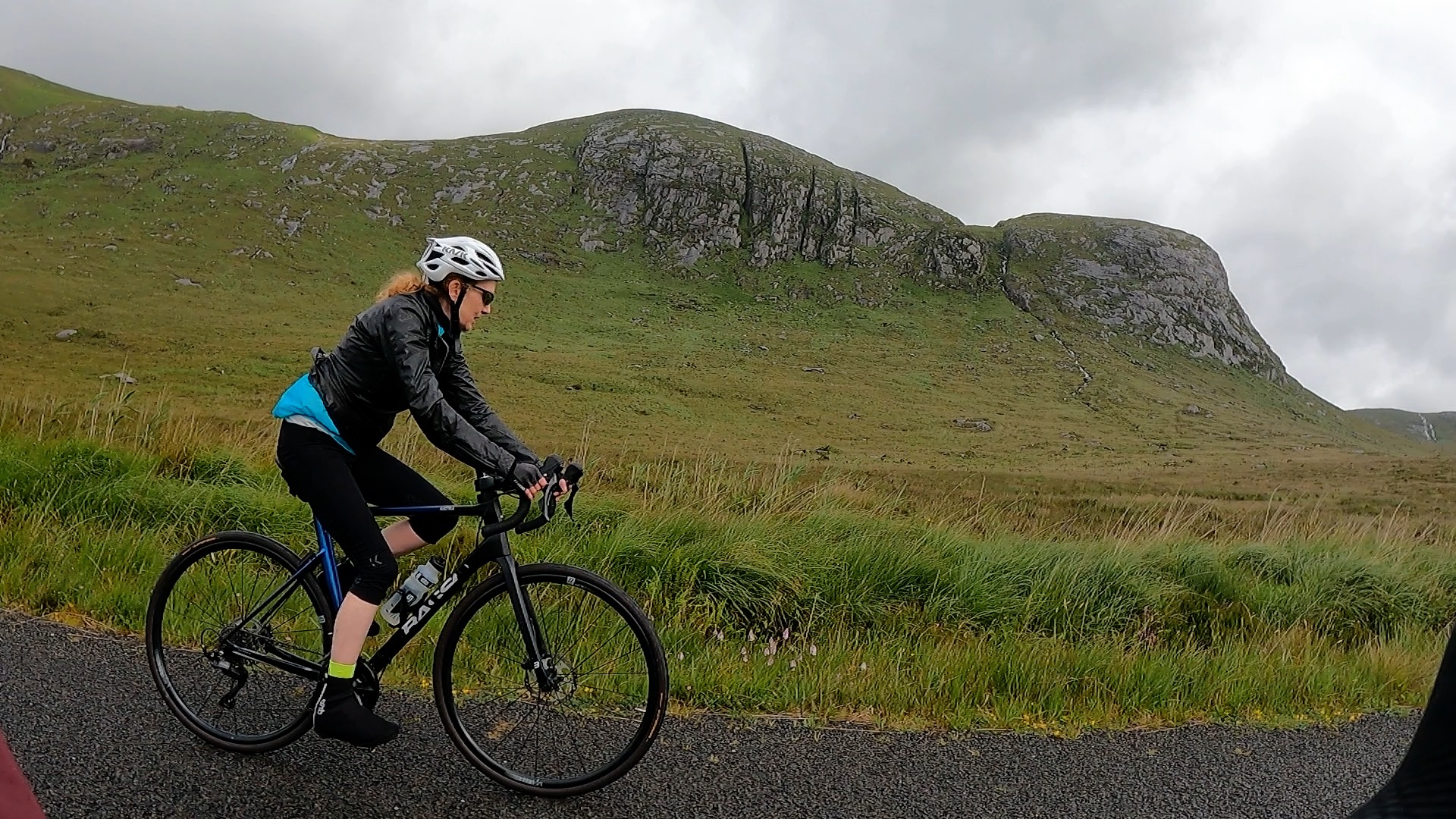
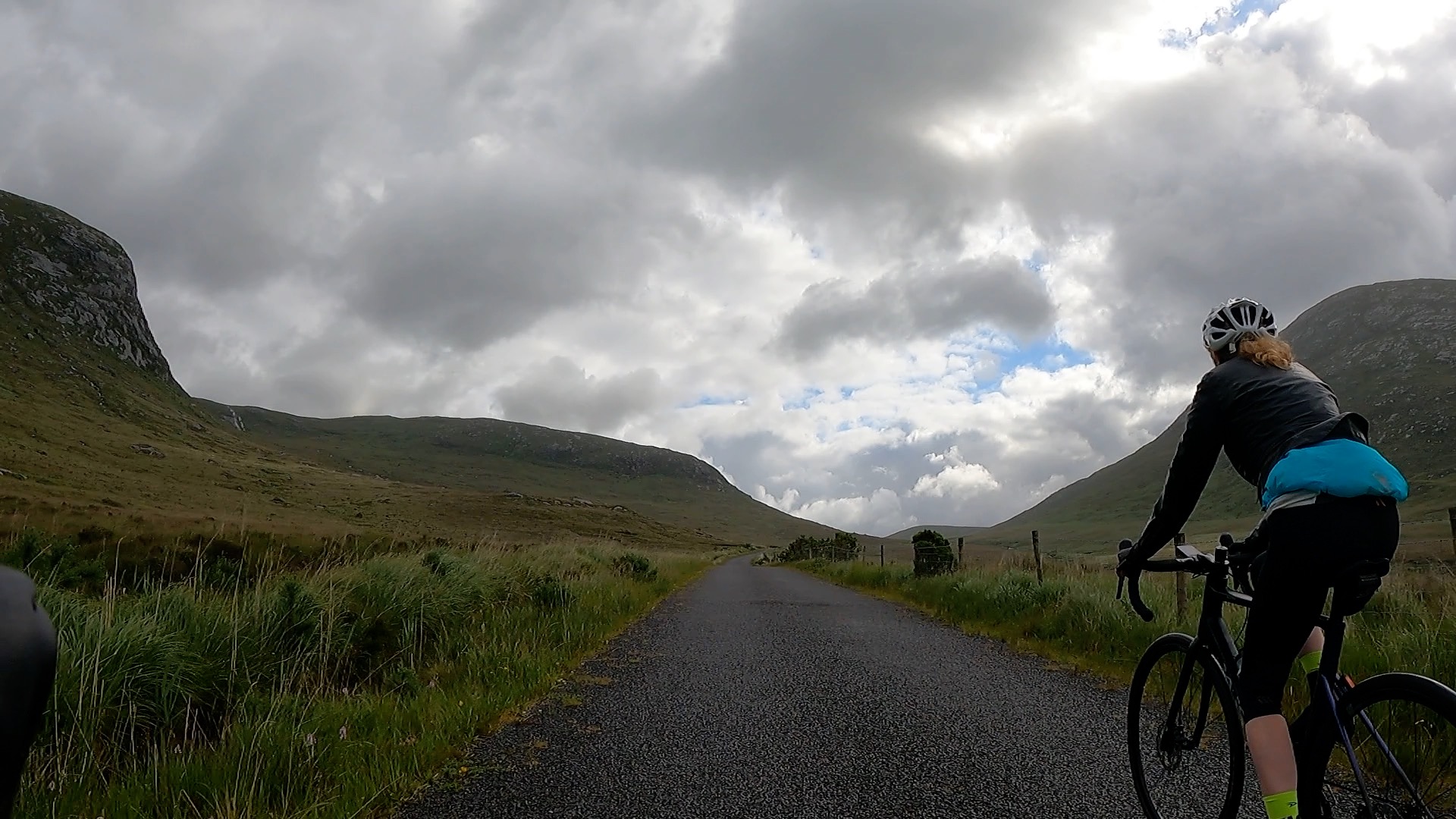
There’s nothing quite like realising you are experiencing one of your best ever cycling routes. This was the joy that awaited me as we traversed the stunning Glenveagh National Park. The route was lined by the Derryveagh mountains and several waterfalls. The day’s highlights video at the end of this post gives a great impression of the joy of this section, which again reminded me of the Scottish Highlands and Eryri.
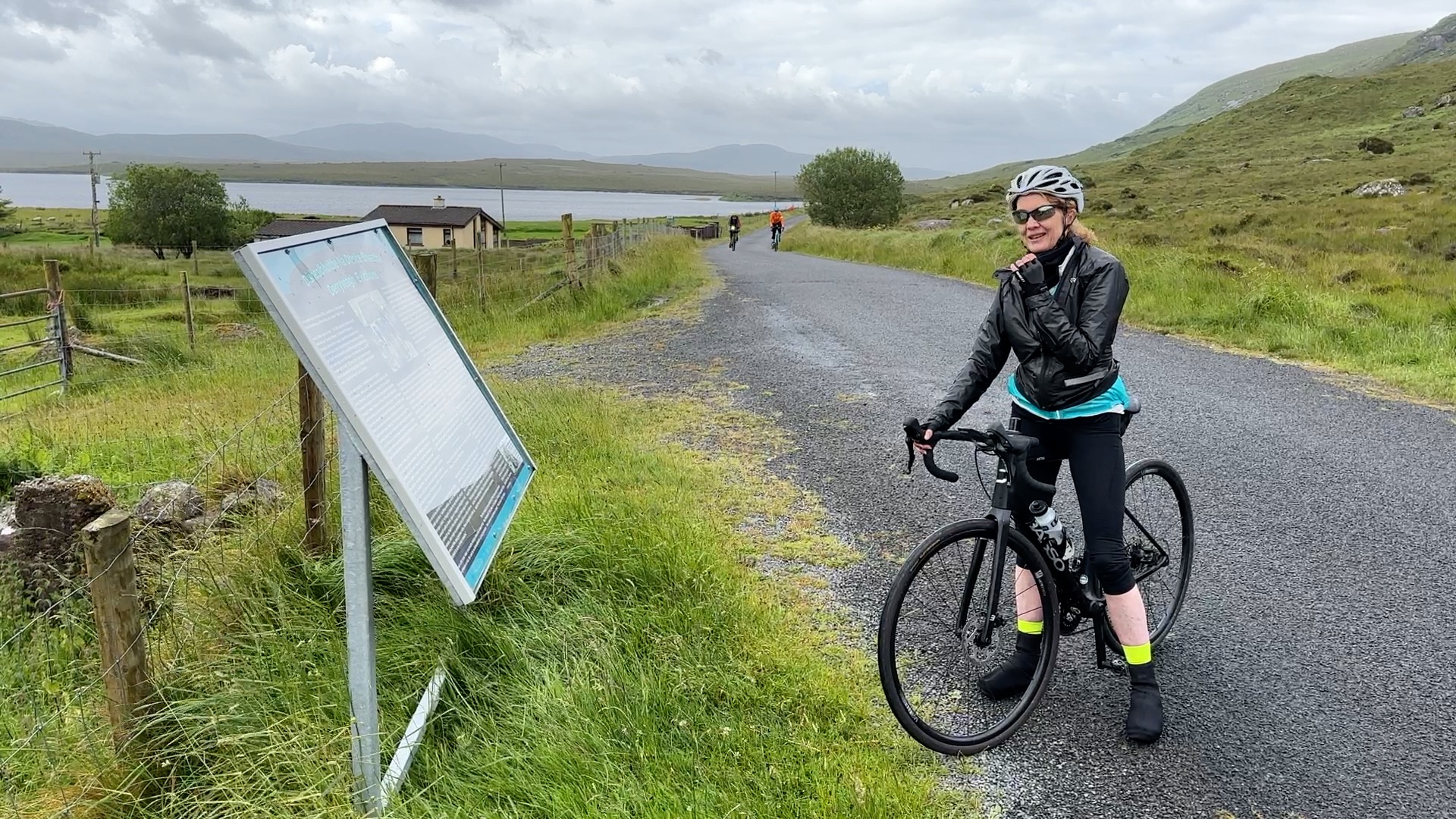
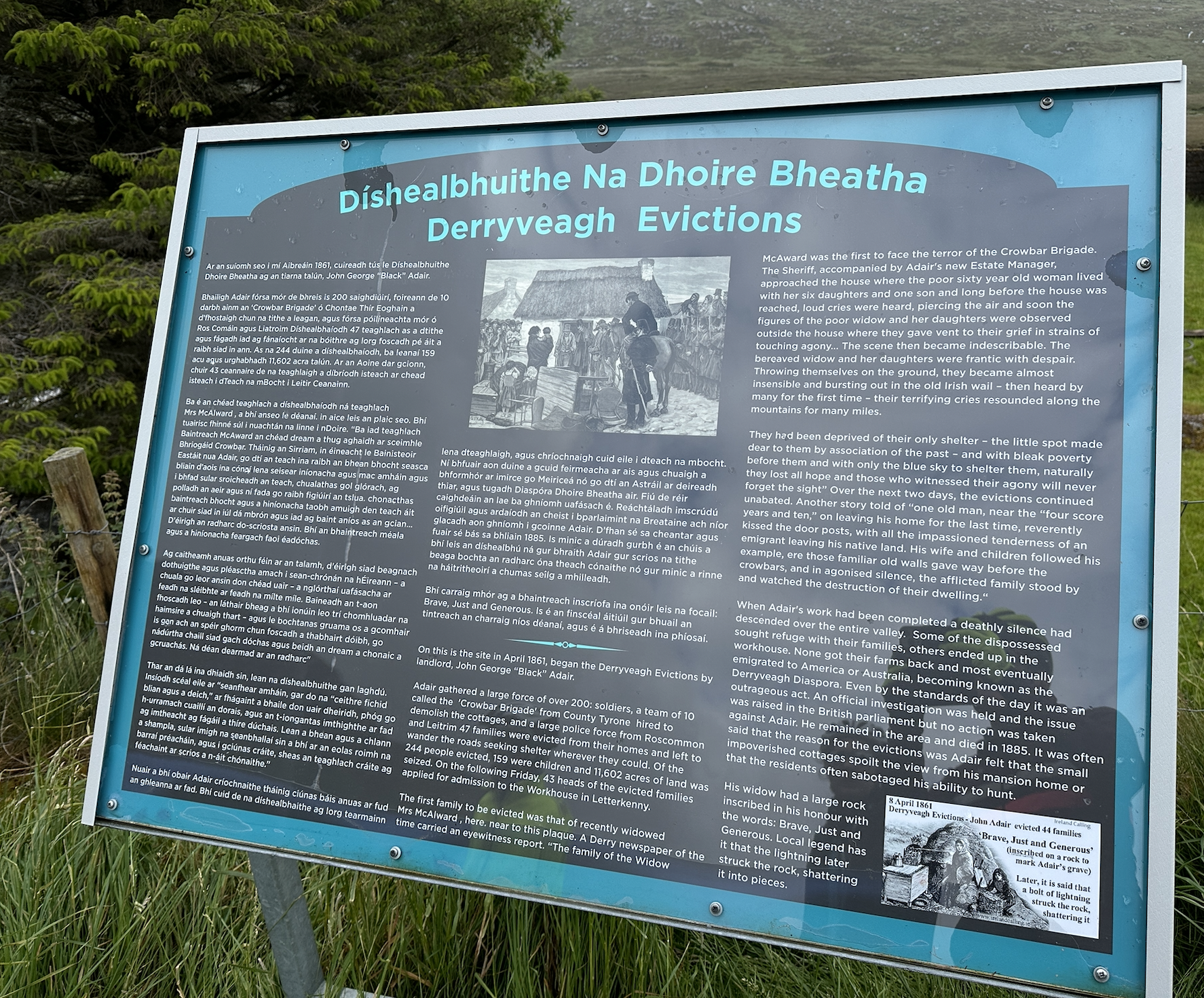
As so often in Ireland, the beautiful landscape contained a dark history, revealed by a plague by the side of Lough Barra.
It was sobering to read how landlord George Adair evicted almost 250 tenants from their homes here in 1861, leaving them helplessly roaming the hills in search of shelter. The plaque tells the story of one victim, recently widowed Mrs McAlward. I confess we smiled at the melodramatic account of how she let out an ‘Irish wail … that resounded along the mountains for many miles’.
The scandal was debated in the Westminster parliament (Ireland was then still part of the United Kingdom) but to no avail. The story reminds us of the terrible power of the landlord in Ireland in the 19th century, which has echoes of the Scottish Highland clearances.
Lucy climbs the pass
On a happier note, I loved the climb to the pass. It was at a gradient that suited my 2024 fitness, and I accelerated onwards and upwards as we left Lough Barra behind.
We had been told that the morning brew stop would be at the top of the pass unless the weather made this too exposed. That would have been the case yesterday, but the weather gods were on our side today, and I enjoyed a coffee relishing the decent to follow.
Julia descends from the pass
That descent was as good as I expected, lasting a few miles before we were climbing again towards Gartan Lough – below is a rare shot of me climbing beside the lough.
Lunch was a leisurely affair at the Travellers Rest at Milford. It was a pleasure to find a coffee stand and barista in the courtyard, and I savoured a latte while sitting under a patio heater. (Not great for the environment but welcome while eating outside when it was just 13C.)
Approaching Lough SwillyTo the ferry
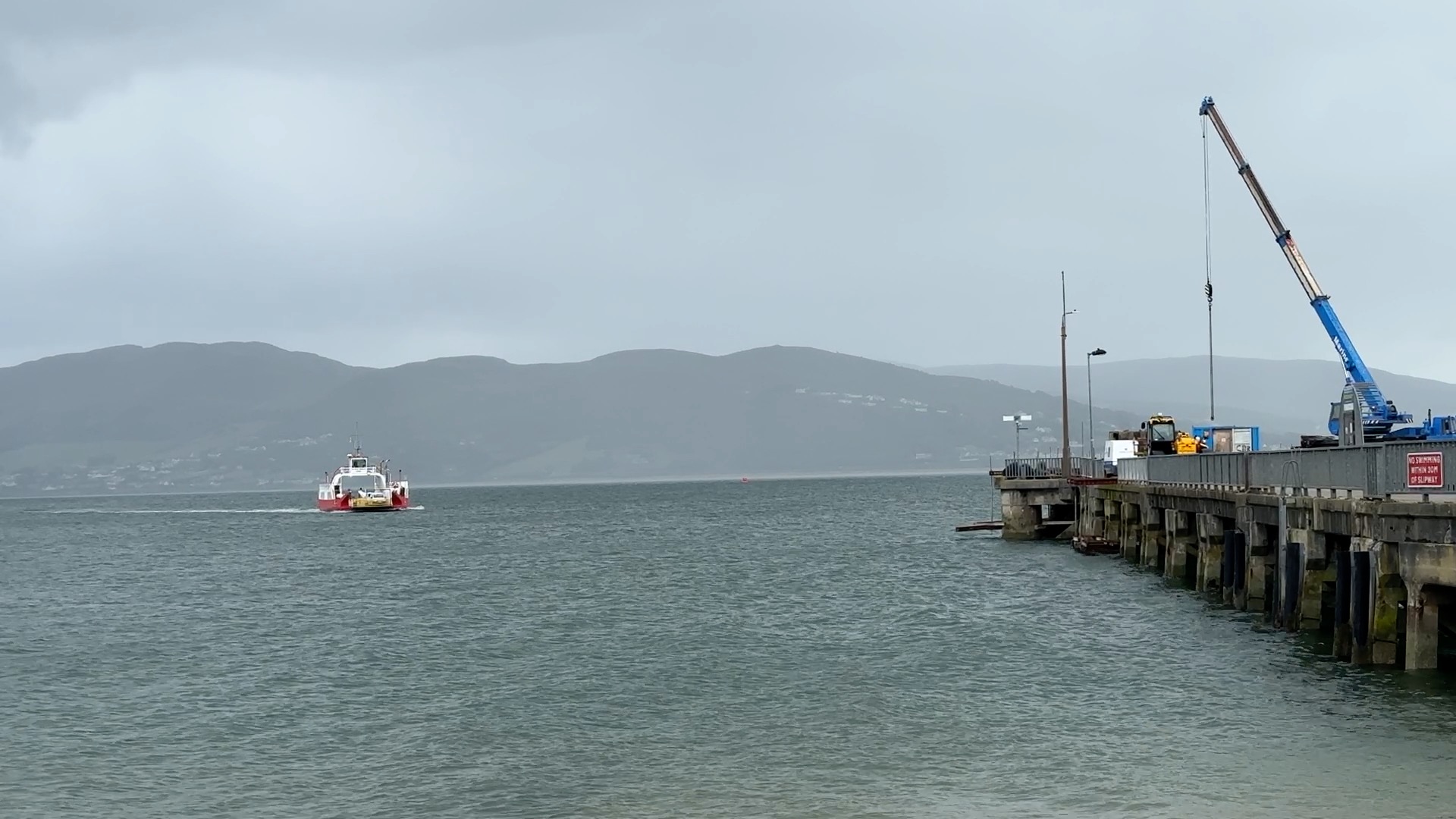
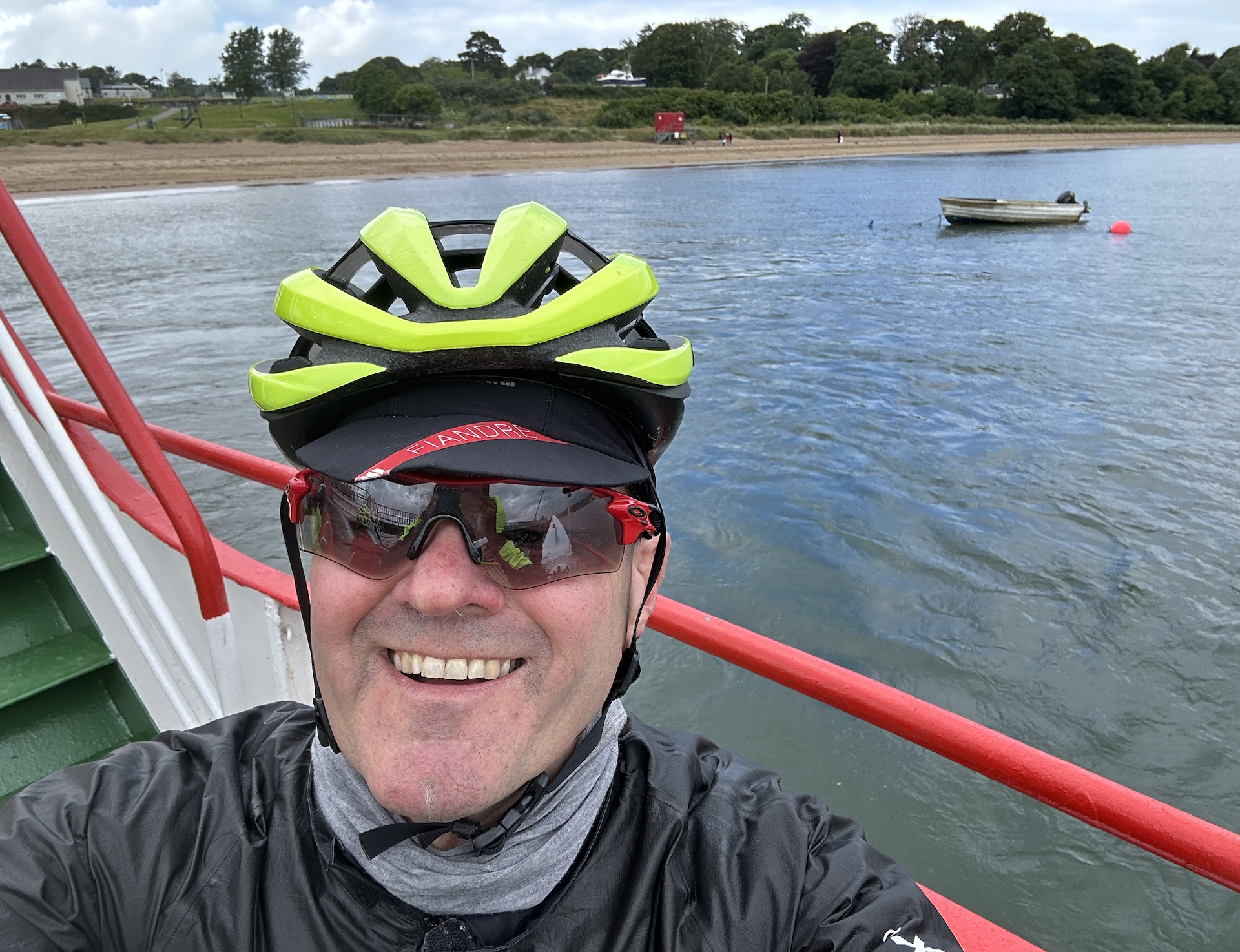
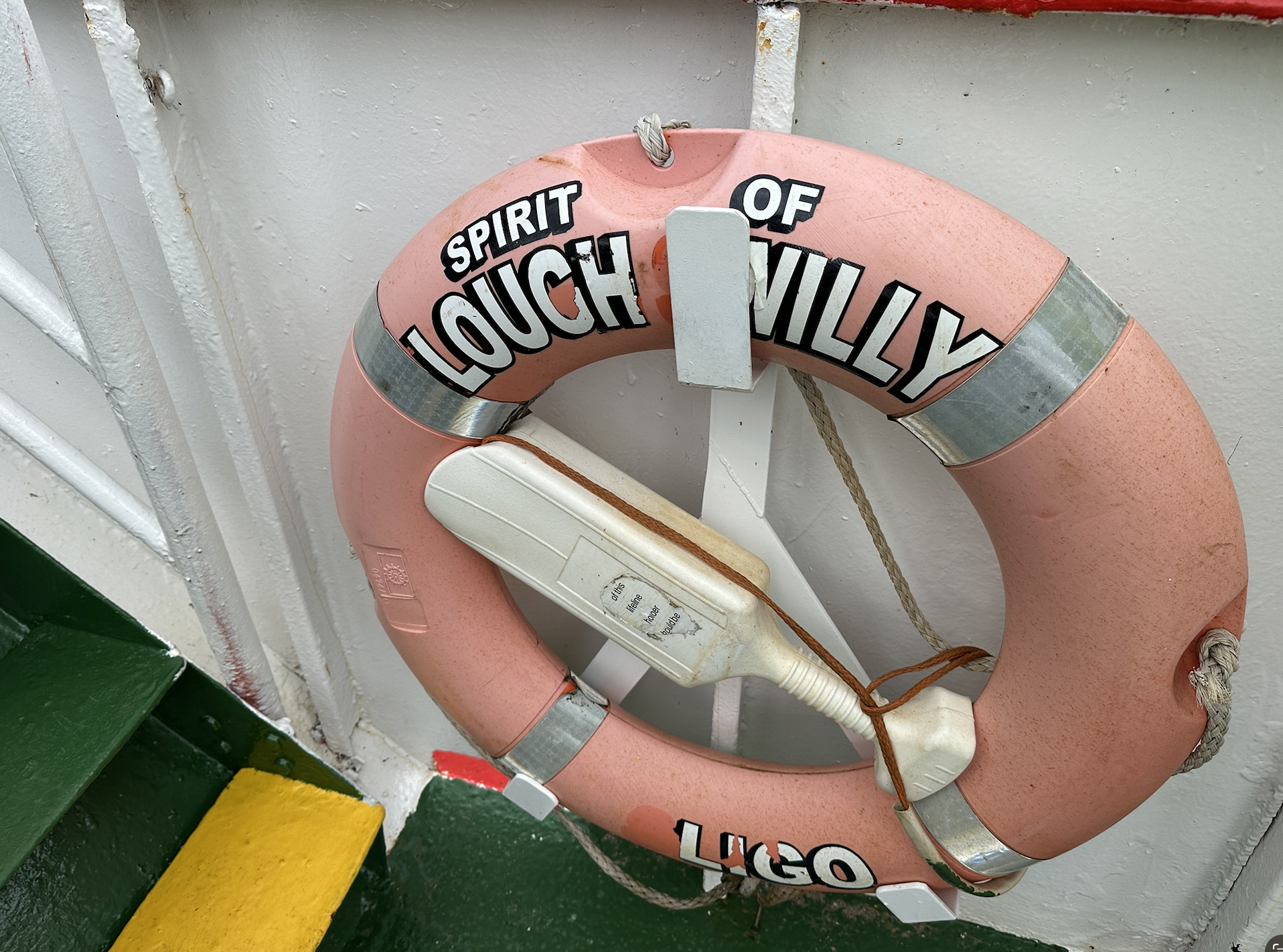
We had one short, steep climb after lunch as we made our way to the Rathmullan to Buncrana ferry across Lough Swilly. I was surprised to see someone on an old bike pulling a trolley at speed – no mean feat. It was a pleasure to cycle along the lough to the ferry terminal, where we waited for a short time as it crossed towards us.
After the idyllically quiet roads this morning it was a shock to be cycling in traffic as we threaded through Buncrana’s one way system, wondering why such a small place needed one!
The road from Buncrana climbed steadily for around seven miles, the last long ascent of the tour. After this we had a blissfully long section of fast road towards Carndonagh. I savoured the wide open landscape (seen above) as I raced along at up to 36 mph.
Carndonagh was a busy little place, and I passed a stretch wedding limo as I turned out of town towards Malin.
Malin bridge
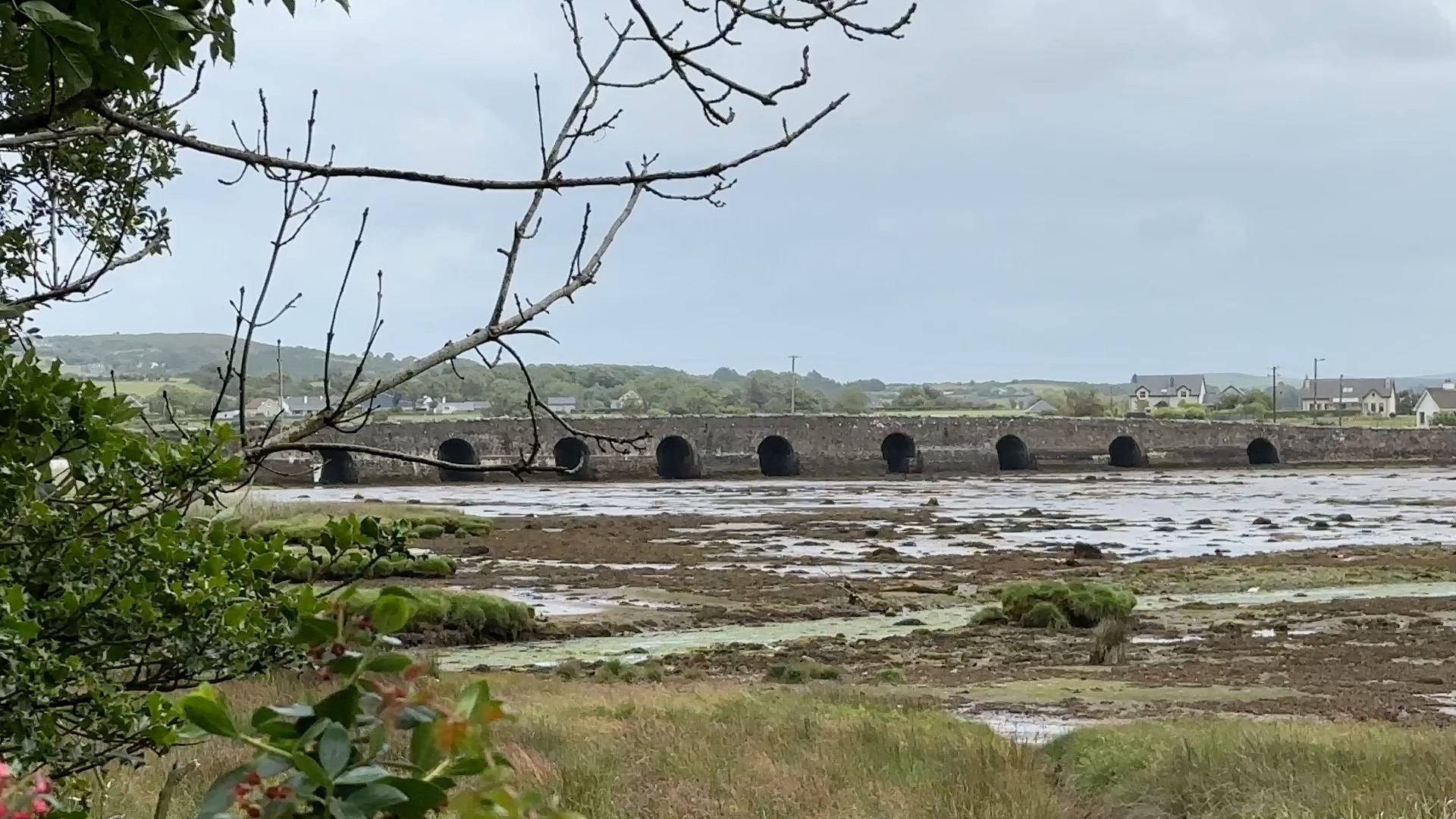
We had a very pesky crosswind as we approached Malin, and I was seriously concerned about being blown into overtaking cars on this busier stretch of road. It didn’t stop me admiring Malin’s historic bridge, built in 1758. We had our final brew stop just beyond Malin. Wendy started putting everything away as a heavy hint that we should be on our way!
Trawbreaga Bay
As we headed off on the very last leg of our journey across Ireland, the crosswind had become a headwind. It was nowhere near as tough as yesterday, but it slowed our progress. The compensation was the gorgeous sight of Trawbreaga Bay, seen above and below.
The end in sight…
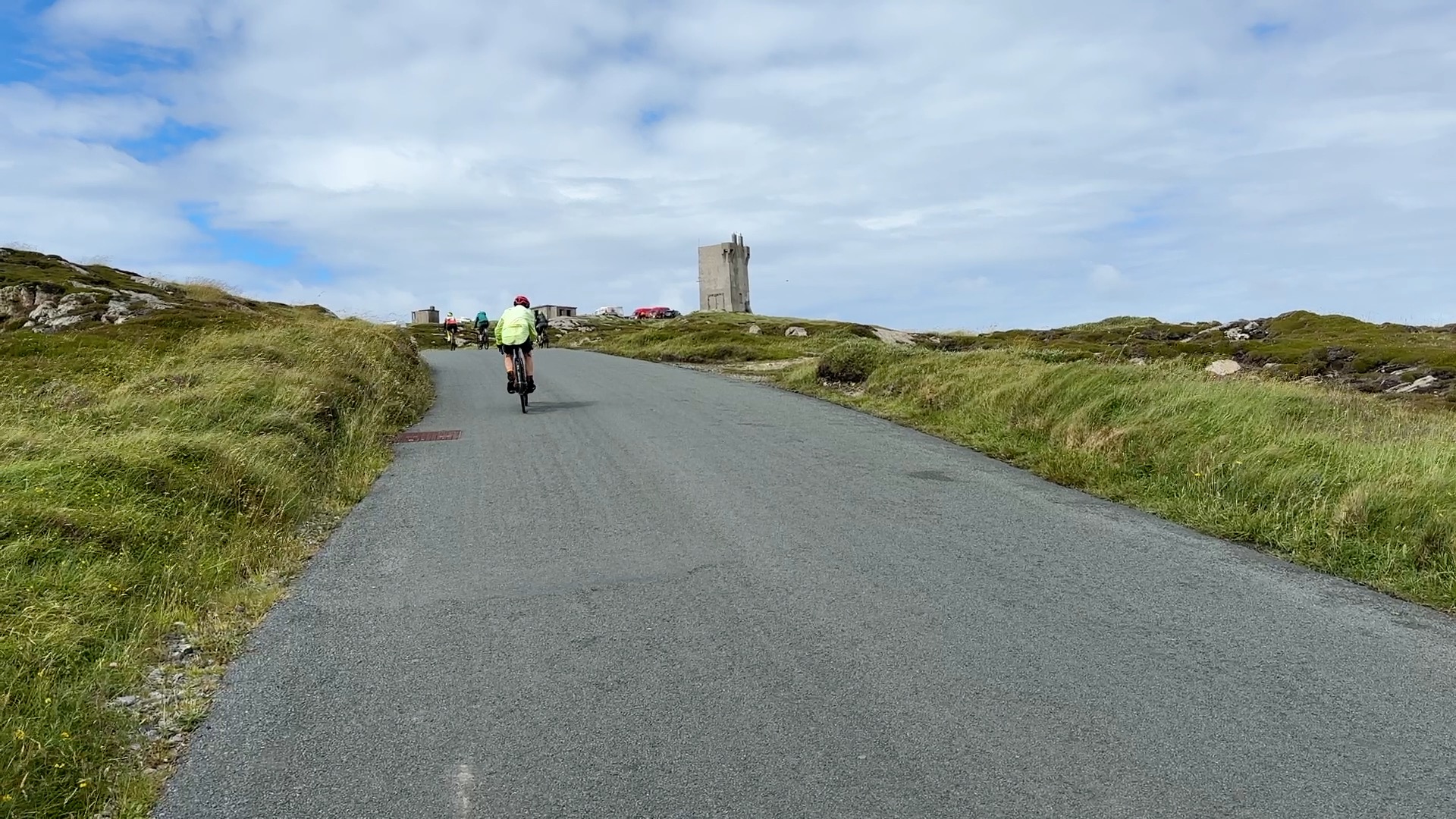
It was quite a moment when we sighted the tower at Malin Head, showing how close we were to our destination. But we still had some climbing to do, especially the incredibly steep final rise to the head itself. It would have been no shame to walk that bit, but I made it thanks to low gears and having climbed over 150,000 feet already this year!
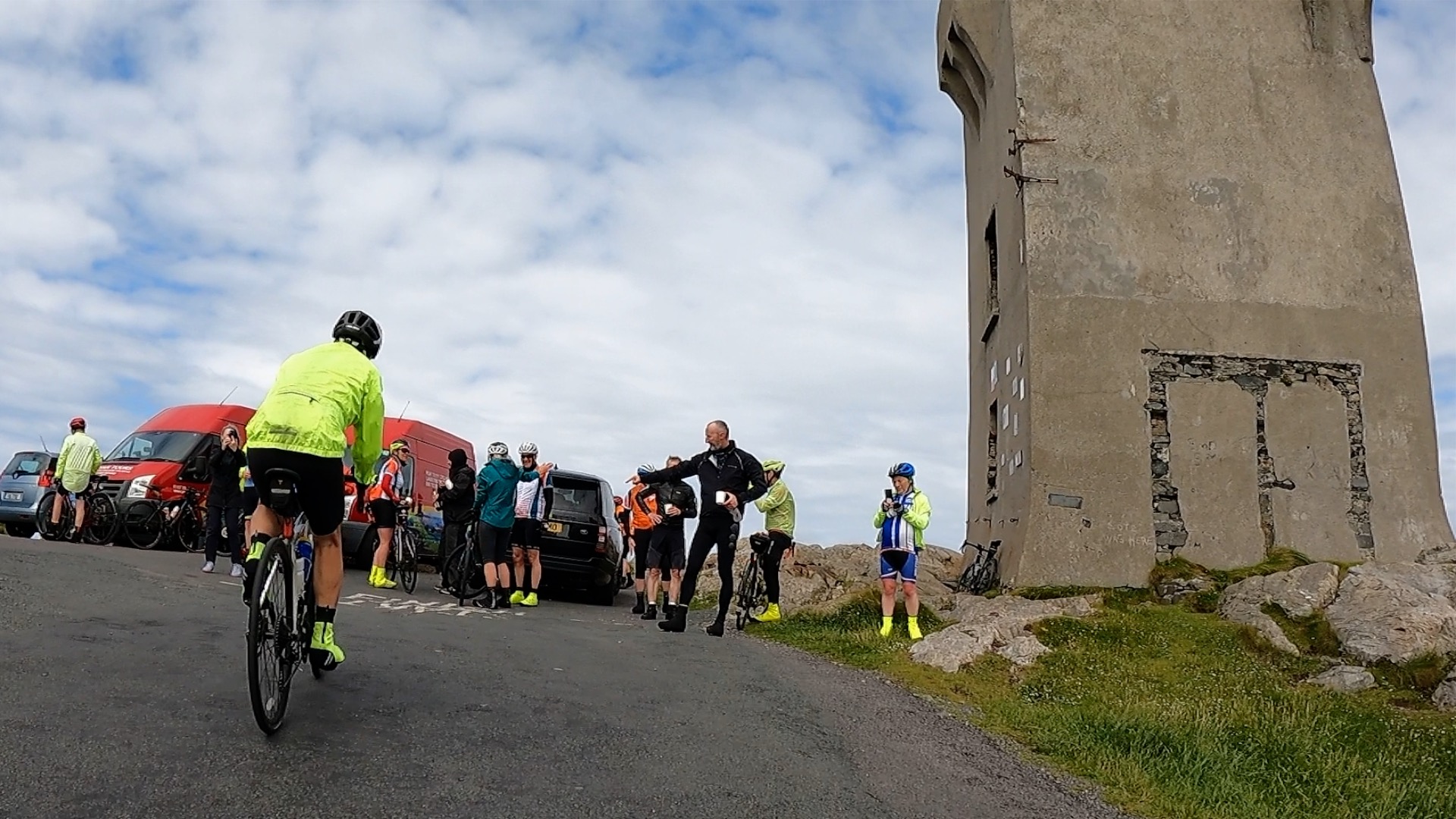
I realised after I got off the bike that I hadn’t actually crossed the finish line… Others were more diligent, including Lucy and Julia seen below.
Malin Head is a beginning and an end of a journey, which gives it a special significance, like John O’Groats in Scotland. The tower that we saw from afar was built in 1805 as a lookout point during the Napoleonic wars. It was taken over by Lloyd’s of London in 1870 as a signal station, while the Marconi company sent the first commercial wireless message from Malin Head to the SS Lake Ontario in 1902. Despite this fascinating history no one would describe the structure as attractive, which is a shame for such a scenic landmark.
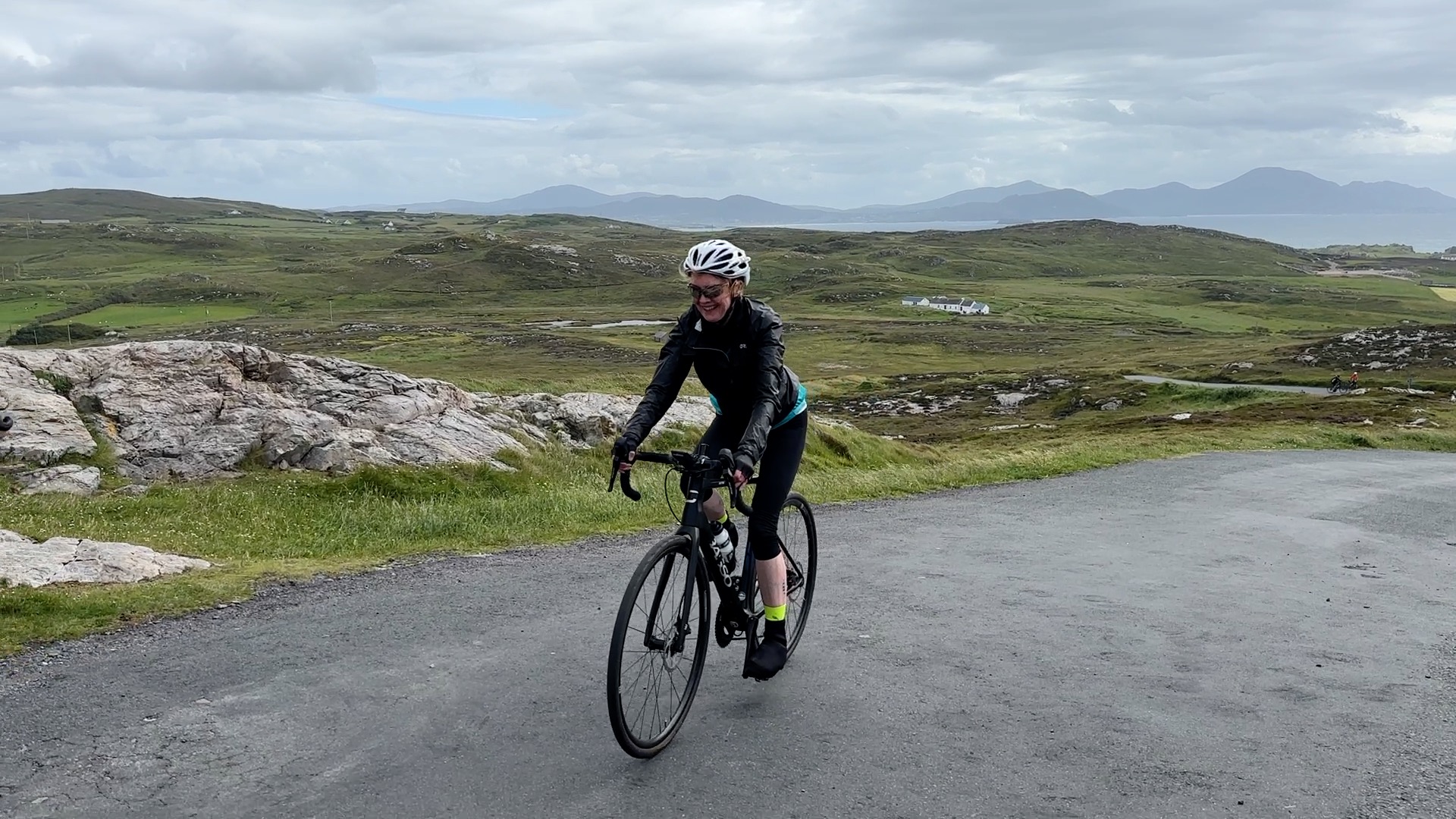
The view from Malin Head
We didn’t have long to savour the views. The Peak Tours guides had to put our bikes into the vans for the journey back across the Irish Sea, so we had a race against the clock to remove bags, computers and any other touring accessories. That done, we had an enjoyable hour’s drive to Derry, where we were staying the night. Just before the Irish border we passed through the village of Muff, and the more juvenile of us on the coach sniggered at the sight of Muff Barbers. Our phones pinged as they reconnected with UK mobile network – a very 20th century sign that you have crossed a border, although a singular one in the case of Ireland.
Unfortunately we didn’t have time to go into Derry City, but as we passed through on the coach I spotted several Sinn Féin election posters just six days before the UK general election. (As a republican party, Sinn Fén contests UK general elections but does not take its seats at Westminster if elected. This tradition is over a century old: the first woman elected to Westminster was Sinn Féin’s Constance Markievicz in 1918 but she never attended.)
Reflections on cycling across Ireland
Cycle touring is a wonderful way to get to know a country. I fell in love with Ireland on my first Irish cycling tour in 1996 as I made my way from Dublin over the Wicklow Mountains to Rosslare. I was so taken with the carnival atmosphere in Wexford as its hurling team won its first all-Ireland hurling championship since 1968 that I carried a Wexford club flag on my bike all the way back to my hometown in Wales, Cardiff!
Ireland: enjoining the craic in GalwayIreland: a scenic delight
This trip has been equally unforgettable. I love mountains – well, I do come from Wales – and I delighted in discovering Ireland’s magnificent high peaks, and the thrill of those mountain passes. Yet it was not difficult climbing as the gradients rarely went into double figures. And on our route we avoided the rollercoaster succession of climbs and descents that sap the energy.
You expect a warm welcome – míle fáilte, or a thousand welcomes – in Ireland, and that’s exactly what we found. Everyone we met was friendly except for a surly hotel receptionist in Glengariff – who came from southern England… Mary from the Beal na Barna B&B in Narin stands out for kindness, inviting us in for tea and scones after we’d survived the biblical storm yesterday. We’d heard her life story by the time we’d finished the last, succulent bite!
A thousand stories
Above: learning about Irish history in Wales, 1980
Ireland is a country of a thousand stories, as well as welcomes. Its turbulent history gives the curious traveller plenty of opportunities to learn what shaped modern Ireland. When I was studying history in school in Wales 45 years ago I learned of the appalling conditions in rural Ireland in the 19th century, and was horrified to find (as I wrote in that fragment of an exam essay above) that ‘Irish families were thrown off their farms without warning’. In the starkly beautiful Derryveagh mountains I came face to face with just one example of such cruelty, the Derryveagh evictions. Similarly, on a peaceful night in Clifden, I was moved by learning of the death and destruction that came to that lovely town during Ireland’s war of independence. If these grim stories tell us anything, it must surely be that we can never rest in the quest for peace and reconciliation.
Weather or not…
Wet wet wet – leaving Glengariff, day 2
Ireland is where North Atlantic storms reach Europe, so you can’t be surprised to get wet when cycling there. On the whole we were fortunate, and I thanked our lucky stars that we had dry days to appreciate the Galway coast, the Sky Road and Killary Fjord, and the Derryveagh mountains. It’s a shame that we didn’t complete the penultimate day in County Donegal, but keeping safe is always the right decision. I was grateful we avoided the washout that my 2019 LEJOG friends Fiona nd Simon suffered a couple of years ago on this tour.
Thank you, Peak Tours
Guides Wendy and Hamish on the Shannon ferry
I’ll end with a thank you. I discovered Peak Tours in 2019 when I cycled Land’s End to John O’Groats. That happy experience made it my favourite cycle tour company. This tour of Ireland proved the point, especially when the guides went out of their way to rescue the situation when the appalling weather forced us to abandon the day’s ride at lunch yesterday. We really appreciated it.
Here’s to the next adventure!
The final day’s stats
74.41 miles, 4.790 feet climbing, 5 hours 15 mins cycling, average speed 14.2 mph.
This post recounts the eighth day of my Mizen Head to Malin Head cycle tour in Ireland with Peak Tours in June 2024. Read Day 7: Westport to Sligo
Rob, battling against the elements
What a day. The forecast for today was always grim, but I clung to the hope that it may not turn out so bad. For a time this morning, that hope seemed justified. But then the expected storm hit…
Misty morning. It got worse…
It was dry, if windy, for the first hour or so out of Sligo – and hilly, with one of the steepest climbs of the whole tour, at 17% early on. The mist was hanging over the hills and people’s rain jackets were flapping in the wind.
We didn’t linger long at the morning brew stop give the conditions. For many miles I was cycling with Julia, Lucy, Tizzie and Ken, and I confess I found this stage strangely satisfying, defying the elements. I’d have preferred sunshine but there are times when you just cope with what nature throws at you. We passed close to Mullaghmore, where Lord Louis Mounbatten was assassinated by the IRA along with three others in August 1979.
We cycled through Bundoran, a sad-looking seaside town, seen above. I shouldn’t be too harsh – I first visited Bondi Beach in Australia on a similar wet day in 2000 and thought it looked like Barry Island in Wales in winter. I stopped briefly to take some video so today’s highlights video would give a fair representation of our experience.
Leaving Ballyshannon
Nearby Ballyshannon was a much nicer place, and as we swept away from the coast, seen above, I was feeling reasonably positive still.
We had a stiff climb after Ballyshannon, and I waited for the others to catch me up. At this point the wind was getting stronger, which was very obvious on that exposed hill climb. Soon after, we had to wheel our bikes past road works on a narrow lane. (We had optimistically ignored the ‘road blocked’ signs just before.) This reminded me of the very wet morning of day three – it seems like Ireland’s county councils save their road repairs for terrible weather!
As Ken and I came to a t-junction, we found Mark in the Peak Tours van. At this point the tour usually has a lovely section along Rossnowlagh beach, but given the conditions we were diverted to an inland route to the Sandhouse Hotel next to the beach. ‘Is it too dangerous to continue?’ Mark asked us. I replied that it was OK for now – but I dramatically changed my mind in the next 15 minutes!
Abandoned… fighting to keep upright at Rossnowlagh beach
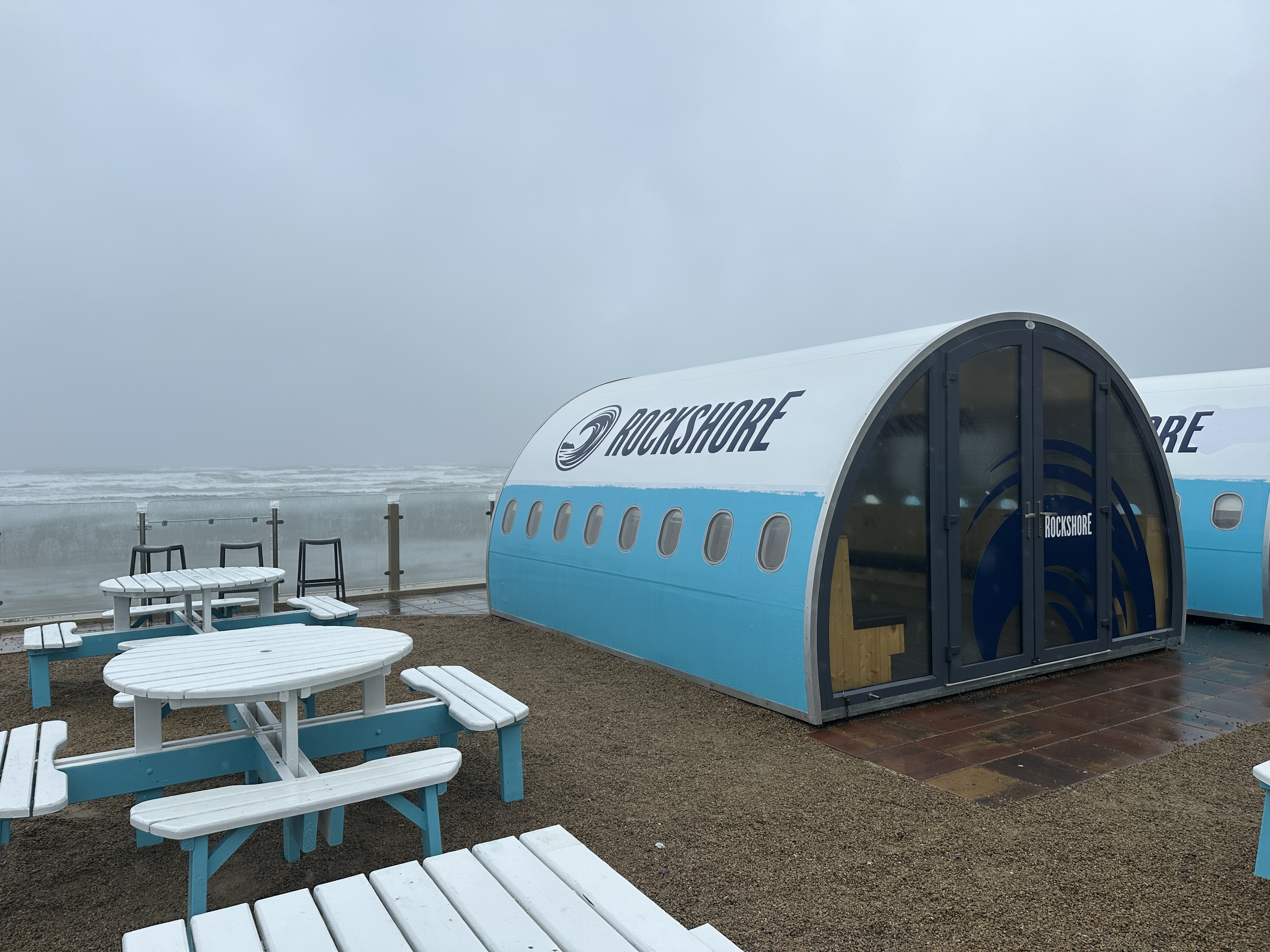
As we finally turned towards our lunch stop, the full force of the gale hit us. It was impossible to move forward on the bike as 51mph gusts met us head on. It was clear that we’d be cycling no further today.
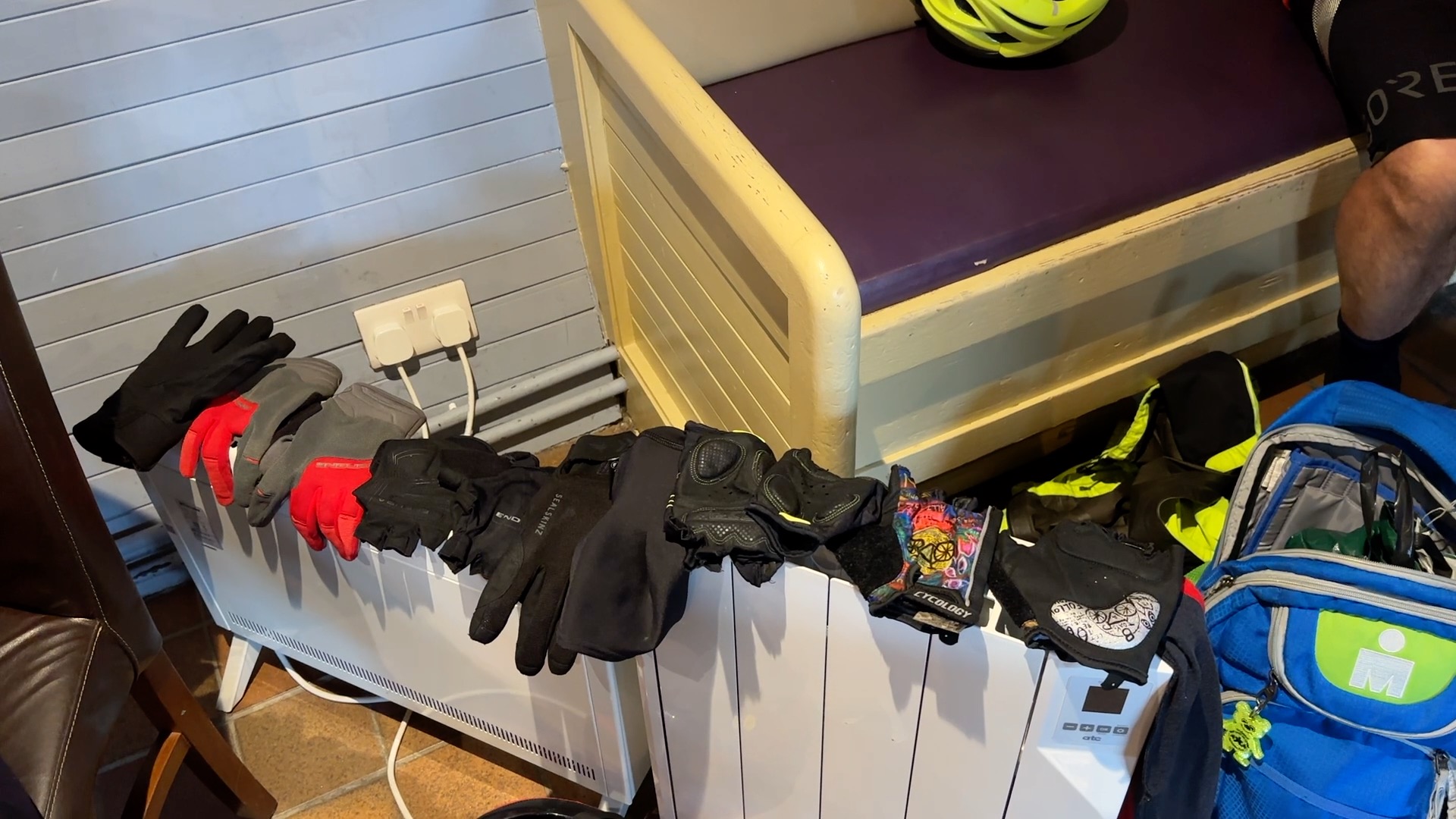
It was impossible to imagine cycling along the beach and even the surfers were nowhere to be seen – not even in the Surfers’ Bar at the hotel, where I enjoyed coffee and sandwiches as we sheltered. I had learned my lesson from being so cold at lunch on day three, carrying my down cycling jacket in my saddle bag. I popped it on after removing me soaking wet cycling jersey. Ironically I bought the jacket to keep me warm at 2am on London Wales London, but never needed it then, unlike at 12pm in Ireland in late June!
Mark, the lead guide on the tour, worked a miracle getting a coach within an hour to take us to today’s destination, Portnoo and Narin. It is typical of the dedication and care that Peak Tours has shown during my five tours with the company so far. As we enjoyed the lift to Narin, Mark and Hamish were squeezing all our bikes into the two vans – another triumph!
The coach dropped us off with our luggage in Narin, and I struggled down a very wet lane to our B&B, Beal na Barna. (This is when I cursed my customary decision to bring so much stuff…) When we got to the bungalow, we found that this wasn’t our place, which was actually very near where we were dropped off. I was ready to cry, but the husband of the owner, Mary, kindly gave us a lift. (It turned out that Mary’s family owned both properties.)
Beal na Barna turned out to be a lovely place to stay – it was actually a self catering property, with kitchen and sitting room. Mary invited us to her home, where several of our tour party were staying, for afternoon tea and home made scones. Suddenly life seemed better.
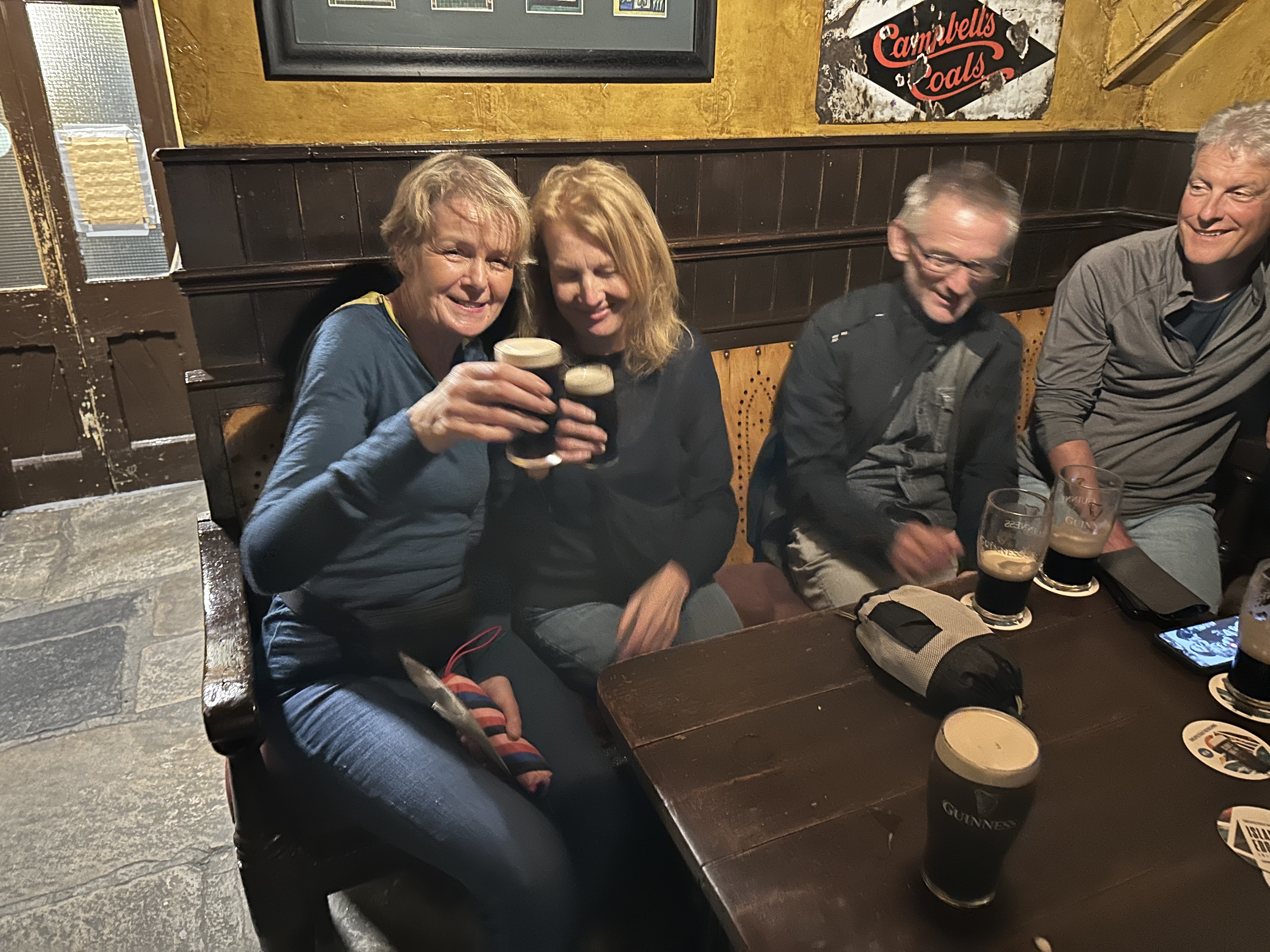
Wendy gave Julia, Lucy and me a lift in the van to dinner at Narin’s smart golf clubhouse, and we had a wonderful meal – with a Guinness as a starter! We walked back to our B&B, and chatted in the kitchen before the end of an extraordinary day.
This post recounts the seventh day of my Mizen Head to Malin Head cycle tour in Ireland with Peak Tours in June 2024. Read Day 6: Clifden to Westport
Lough Cullin
After the scenic fireworks yesterday, today was a more prosaic day. We had a late start as we had just 28 miles to ride to lunch at Foxford. This was unusual on this tour, as lunch stops have typically been well beyond the half way point.
Once again, I took the opportunity to stop to take photos, especially after spotting this lovely calf! I was overtaken as I paused.
After getting going again I got into a speedy rhythm and for once was one of the first to reach the brew stop – but one of the last to leave!
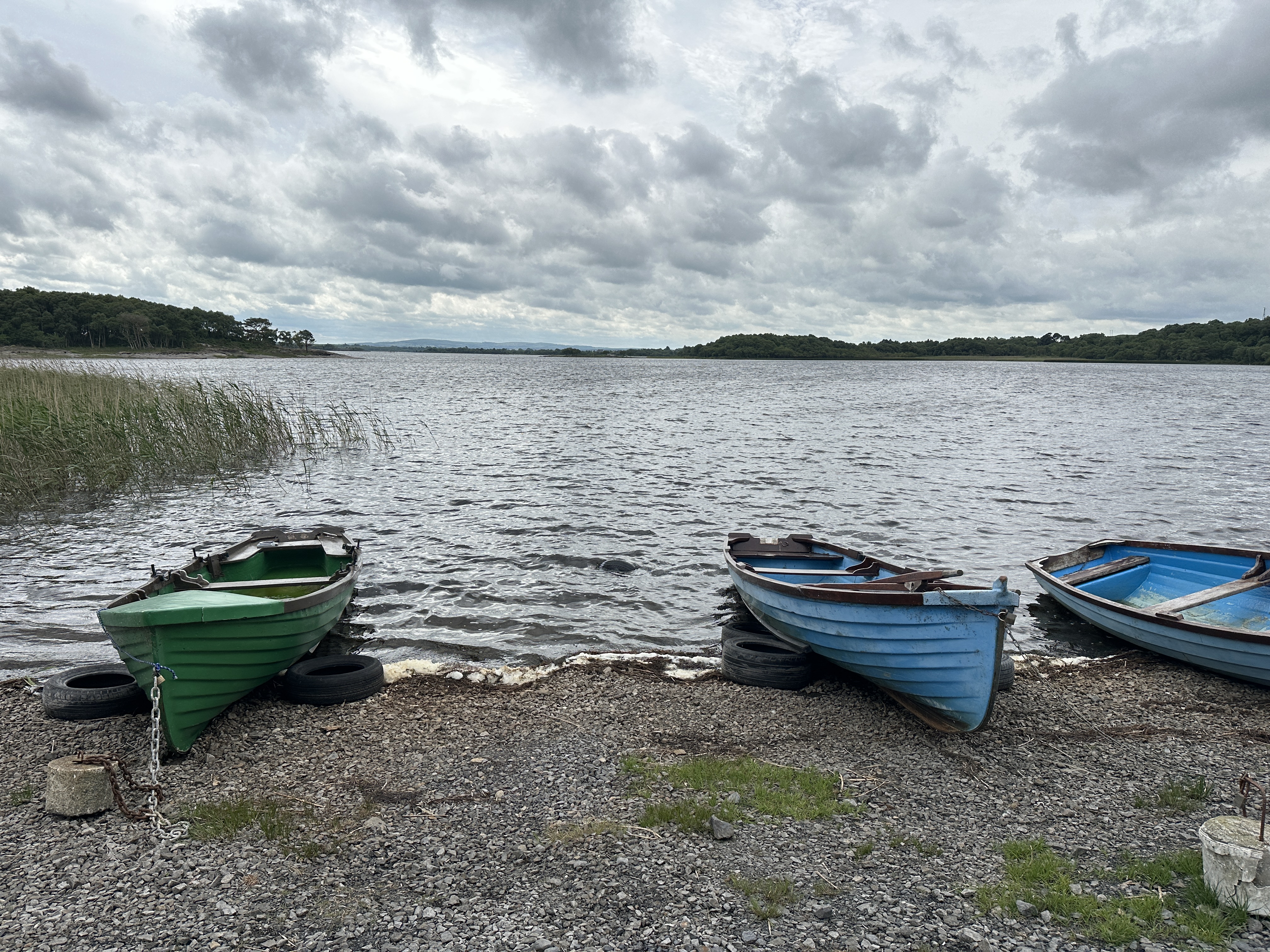
I had an enjoyable interlude on the shore of Lough Cullin, having spotted the rowing boats from the main road. After I set off again I had an even better view of the lough, with a sandy beach, but chose not to stop again.
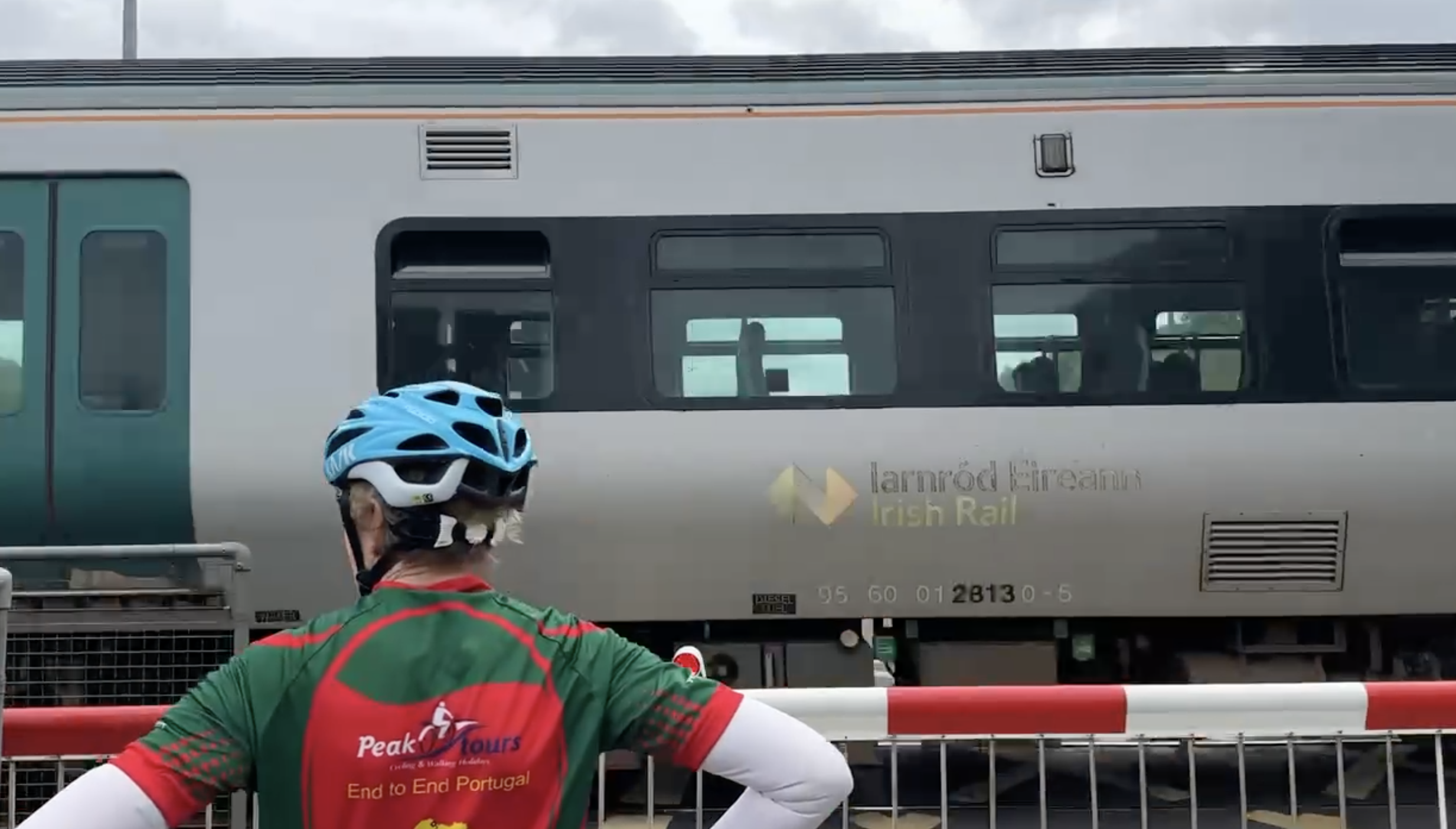
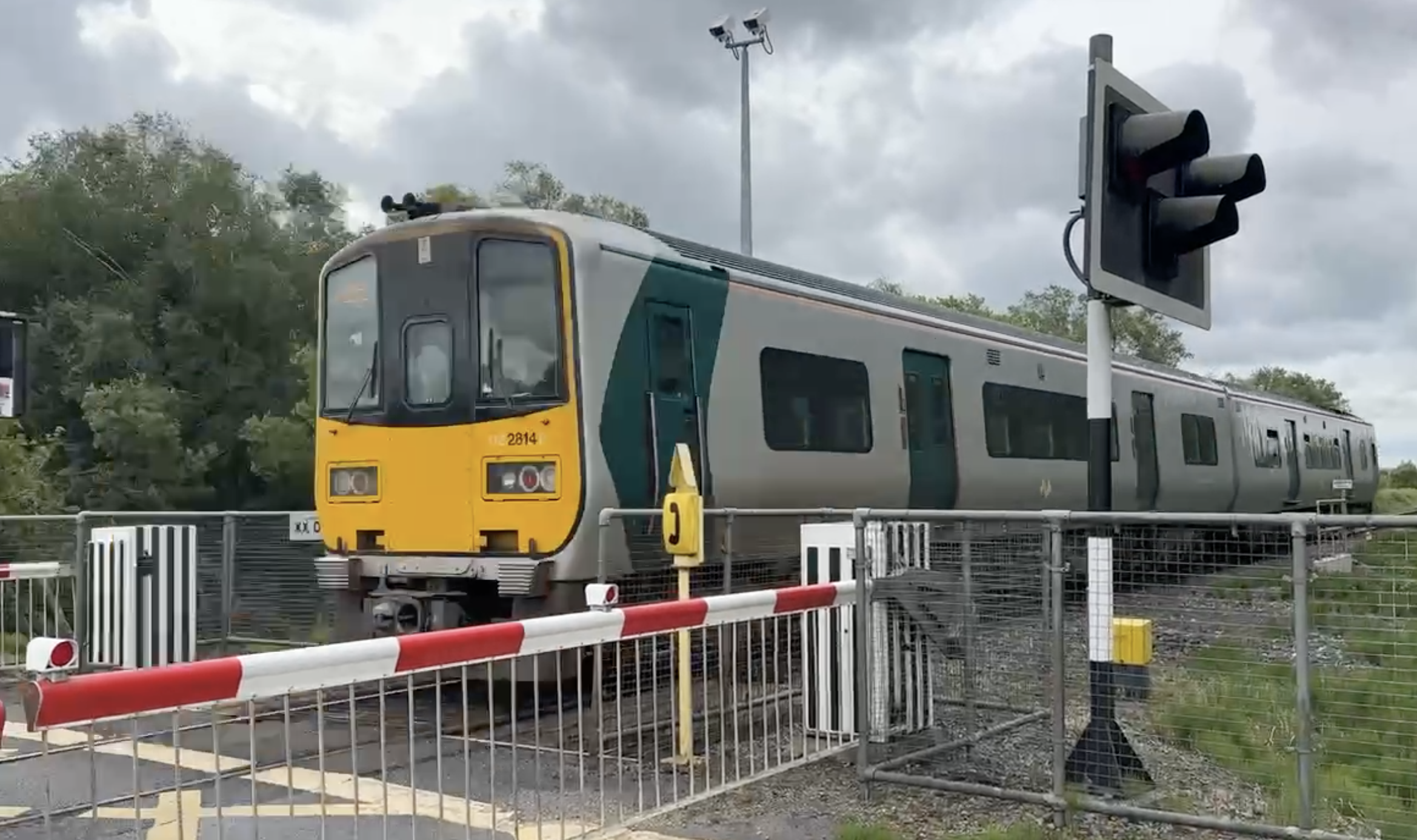
As we approached Foxford, we found the railway level crossing barriers closed. It took a few minutes for the train to arrive – I’m glad we persuaded Ian to wait rather than try to get past!
We were soon crossing the bridge into Foxford, and the best lunch of the tour. The venue was Foxford Cafe in the town’s historic woollen mill, which produces rugs and throws. I chose a mix of salads, which was delicious and made me feel really virtuous after not eating much salad or vegetables over the past week!
Let the climb commence…
The downside of an early lunch was a long afternoon, which also included one of the longest climbs of the tour – some five miles. The sky was darkening as we finished the ascent, but I was determined not to put my rain jacket on until I really had to, about a mile before the afternoon brew stop. (I’d rather get sightly wet than overheat when cycling.)
The Mill Cafe sign next to the brew stop table suggested that guide Wendy had gone into the hospitality business. She hadn’t – the building behind us was the Cloonacool community cafe, presumably open at weekends. The Peak Tours awning was helpful in keeping off the rain, which stopped soon after.
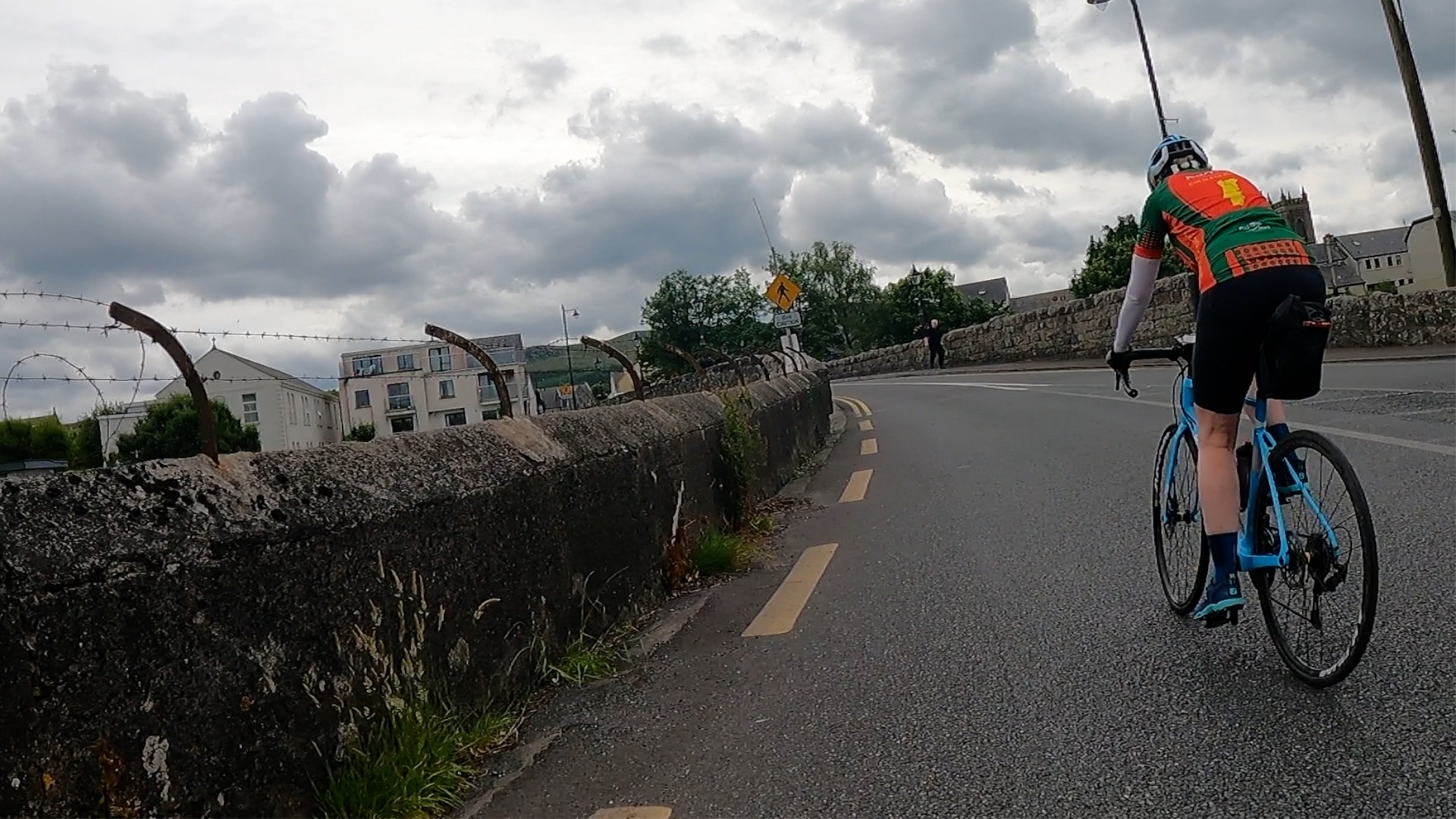
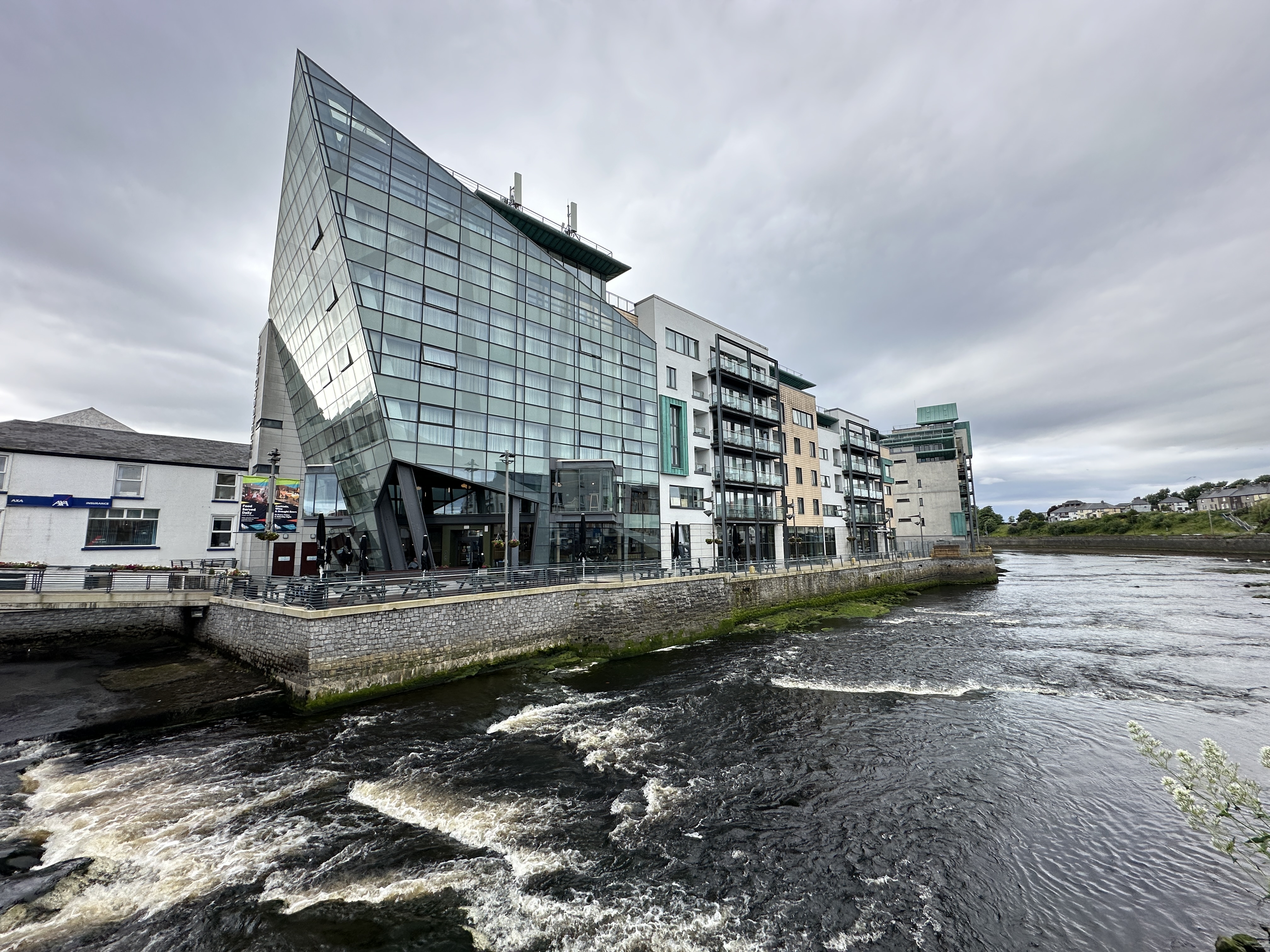
The rest of the ride to Sligo was rather nondescript especially as it was an overcast day. We were staying at the Glasshouse on the river Garavogue – a very impressive modern hotel. I enjoyed parking my bike in the underground car park!
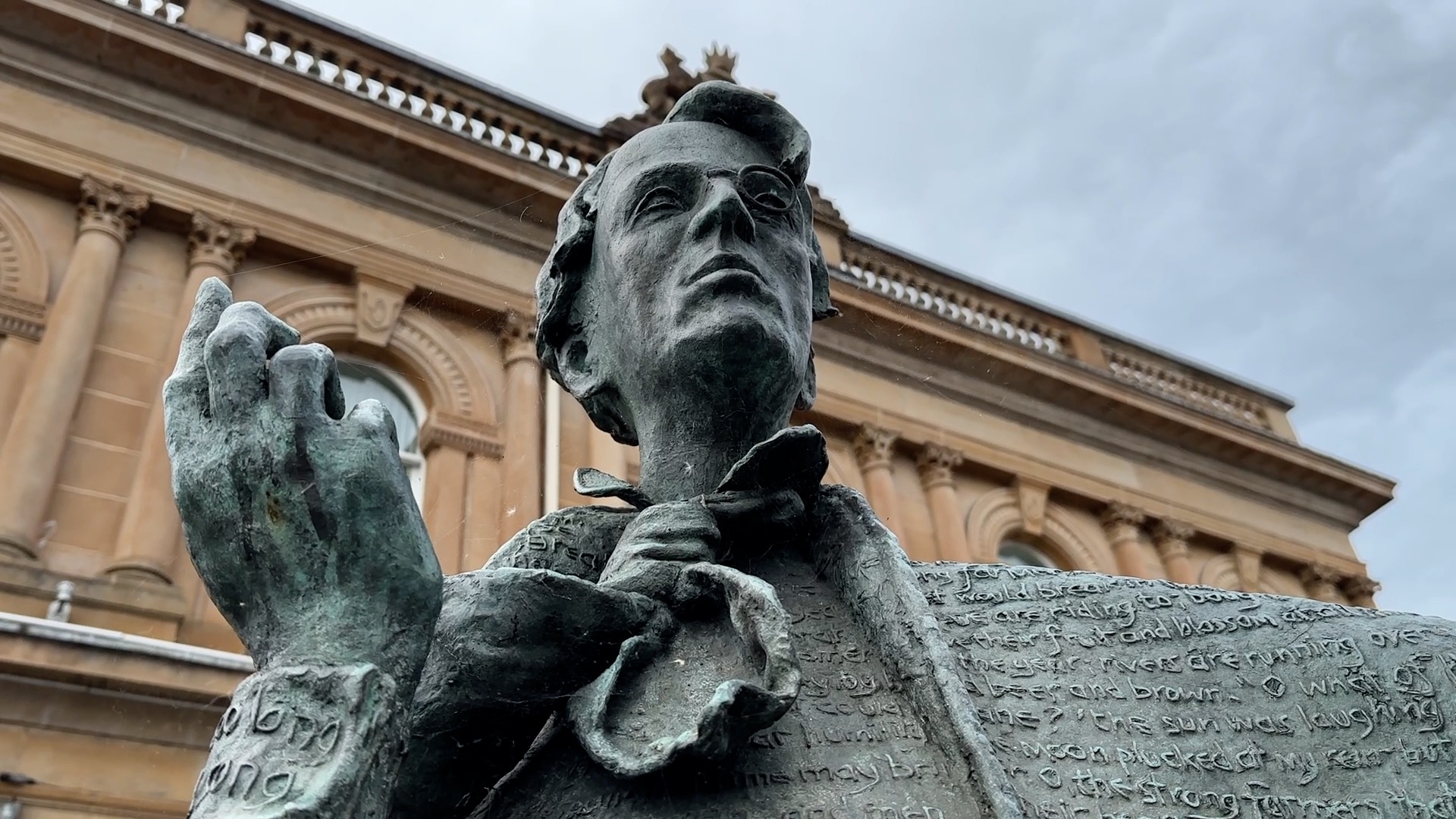
Sligo makes the most of its connections with the famous Irish poet WB Yeats, and the great man is commemorated with a splendid statue on the other side of the river from our hotel. It features words from his works.
We had another enjoyable evening, first with an Italian dinner at Rugantino to celebrate Lucy’s birthday, followed by the inevitable Guinness at Shoot the Crows bar. We tried not to think about the weather forecast for tomorrow, the longest day of the tour, which is awful.
This post recounts the sixth day of my Mizen Head to Malin Head cycle tour in Ireland with Peak Tours in June 2024. Read Day 5: Galway to Clifden
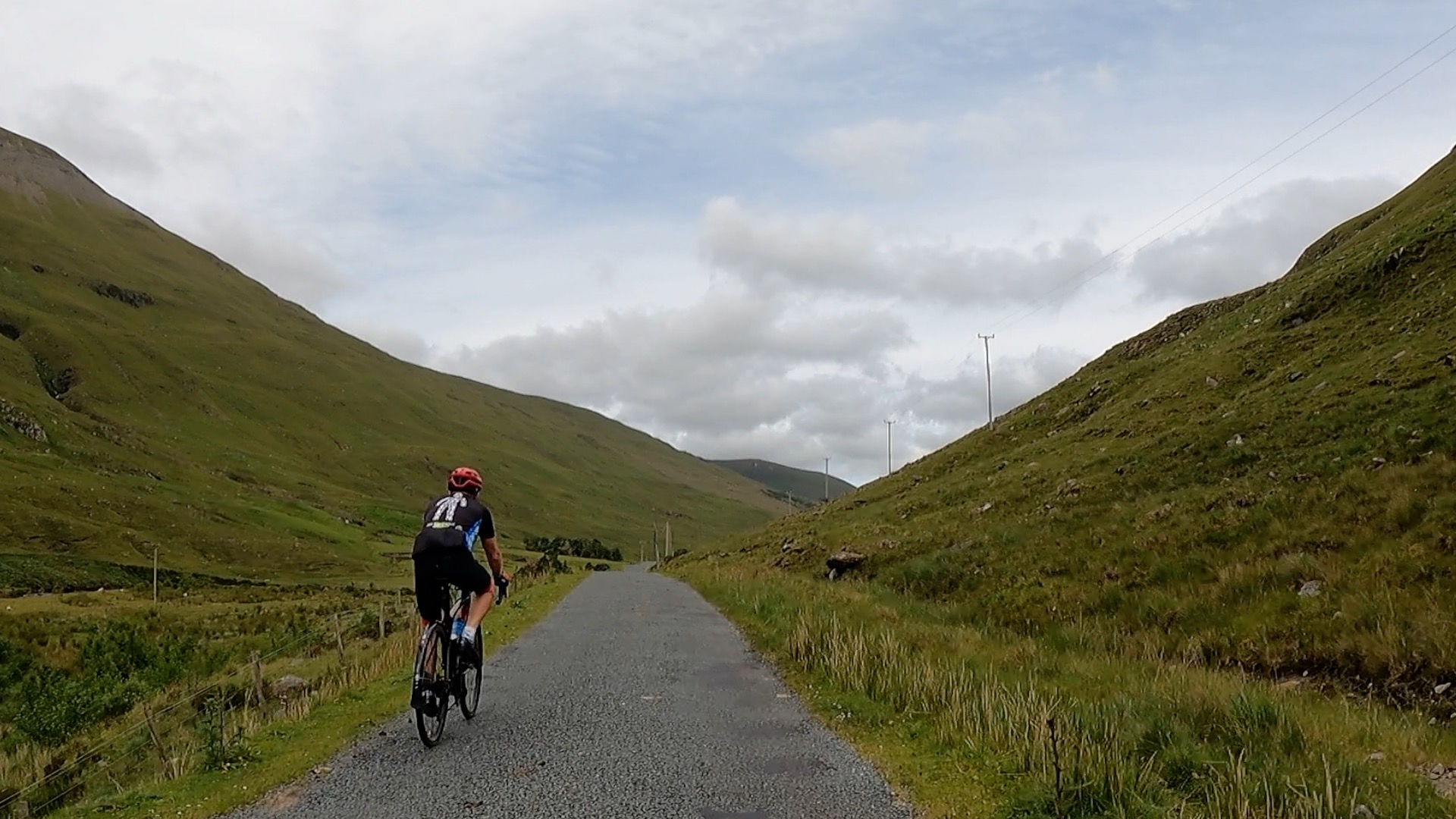
Climbing the Sheefry Pass
This was one of my best ever cycling days. The scenery was stunning, including the coast, a fjord and stunning mountain pass. Despite having cycling over the Wicklow Mountains in 1996 I had no idea Ireland had so many mountains, let alone fjords. At times I thought I was in the Scottish Highlands or Eryri (Snowdonia) in Wales.
Coastal view from Sky Road
We had a rude awakening – a very steep climb out of Clifden before following the Sky Road in a dramatic loop. This set the scene for today’s visual delights – the Sky Road was far from a direct route to our destination, but no one with soul would have regretted the detour.
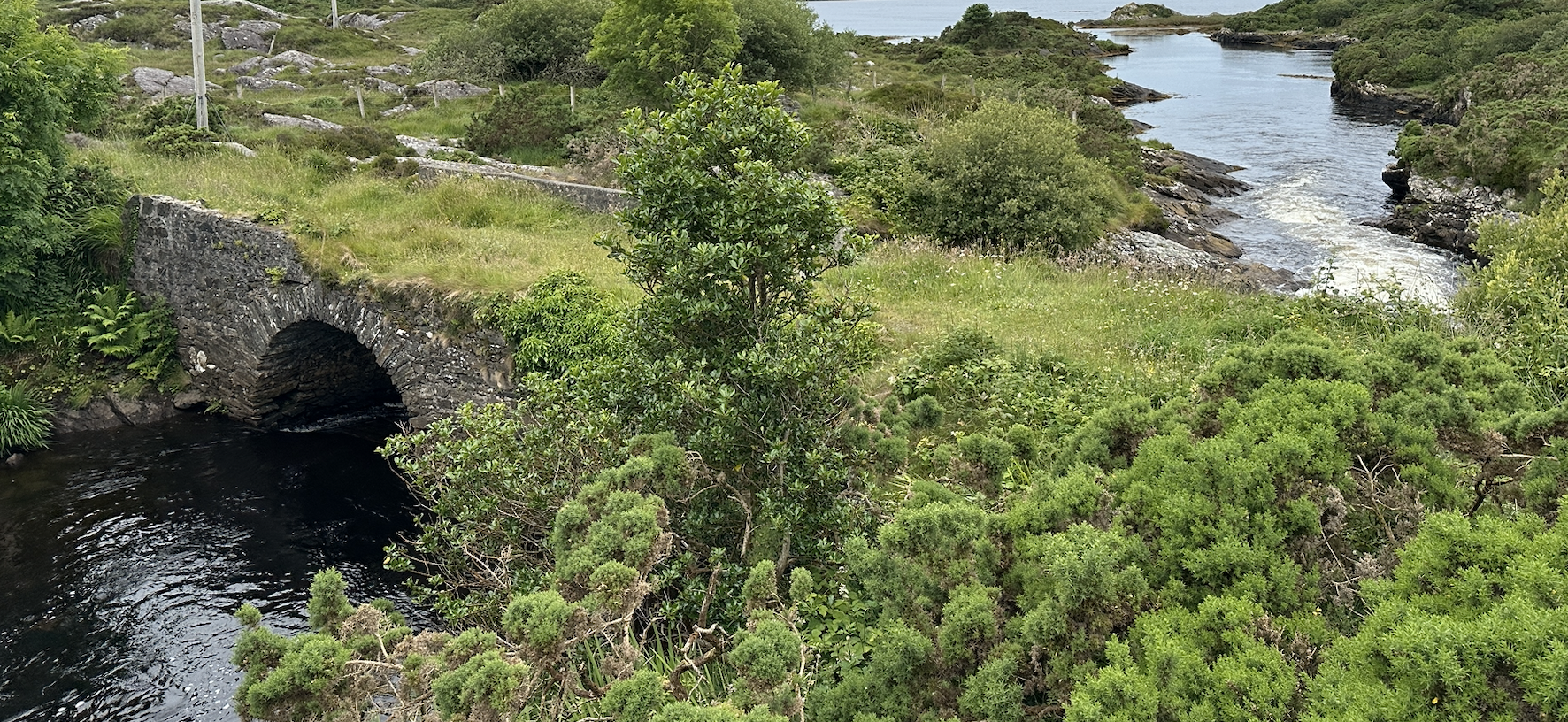
This was the view from the morning’s brew stop, next to an old bridge.
The view towards Tonakeera Point
I had one unfortunate moment. As I took the photo above, a sudden gust of wind rocked the gate and tipped the bike over – inevitably on the drive side. As a result, the previously flawless shifting wasn’t the same for the rest of the tour. The view was lovely though!
This was start of a magical part of the route, as we cut inland to pass Lough Fee. I loved the blend of mountains, lough and the small islands.
Julia cycles away from Lough Fee
We were now on the final stretch to lunch at Leenane Hotel on Killary Fjord. Yes, Ireland has fjords – as indeed do Scotland (three: Lochs Long, Fyne and Etive) and Wales (the Afon Mawddach estuary inland towards Dolgellau). The meal was a real treat, and we felt conspicuous in our sweaty cycling lycra amongst the smart tourists.
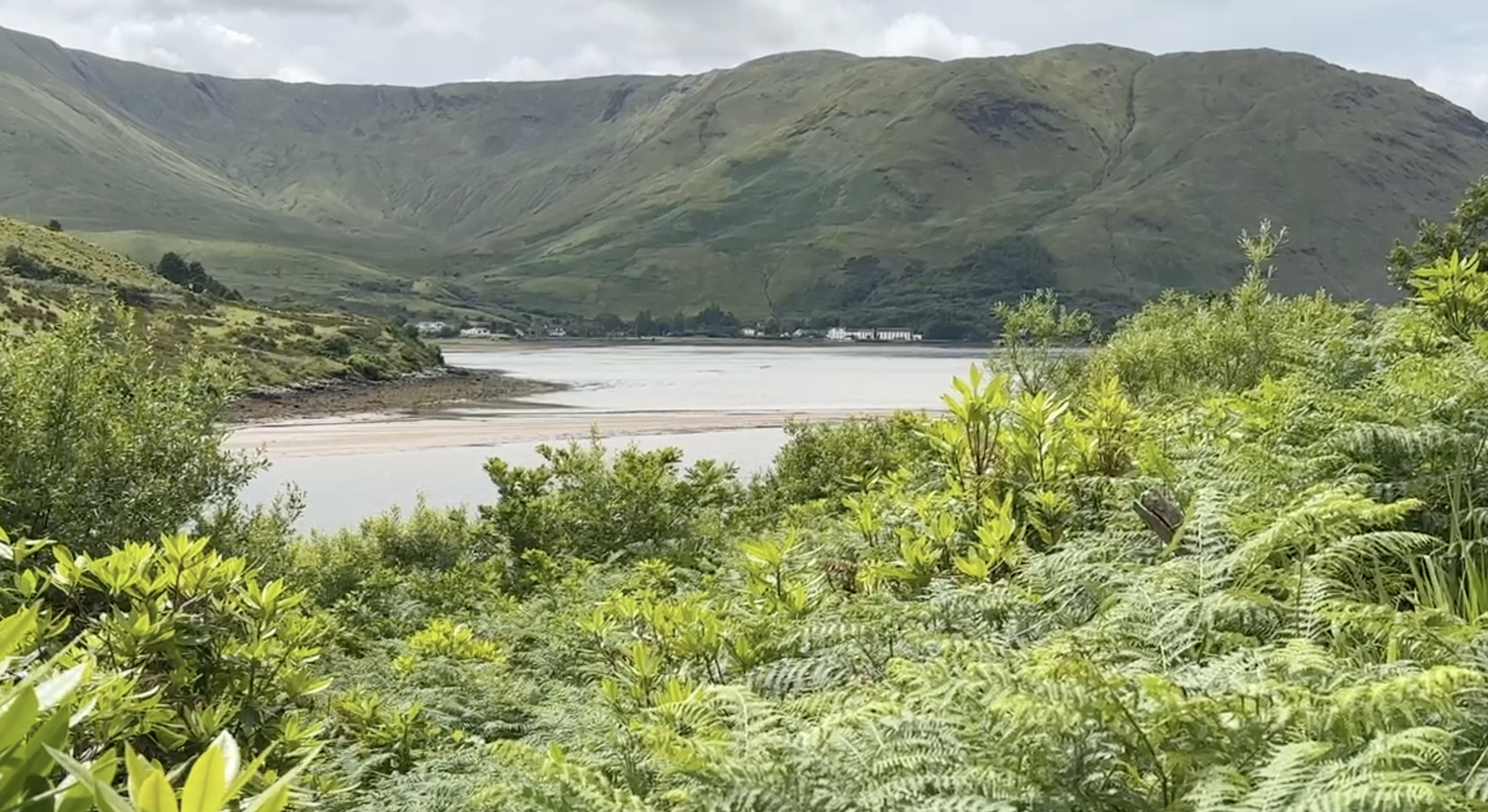
Our lunch venue from the other side of Killary Fjord – the long white building on the shoreline
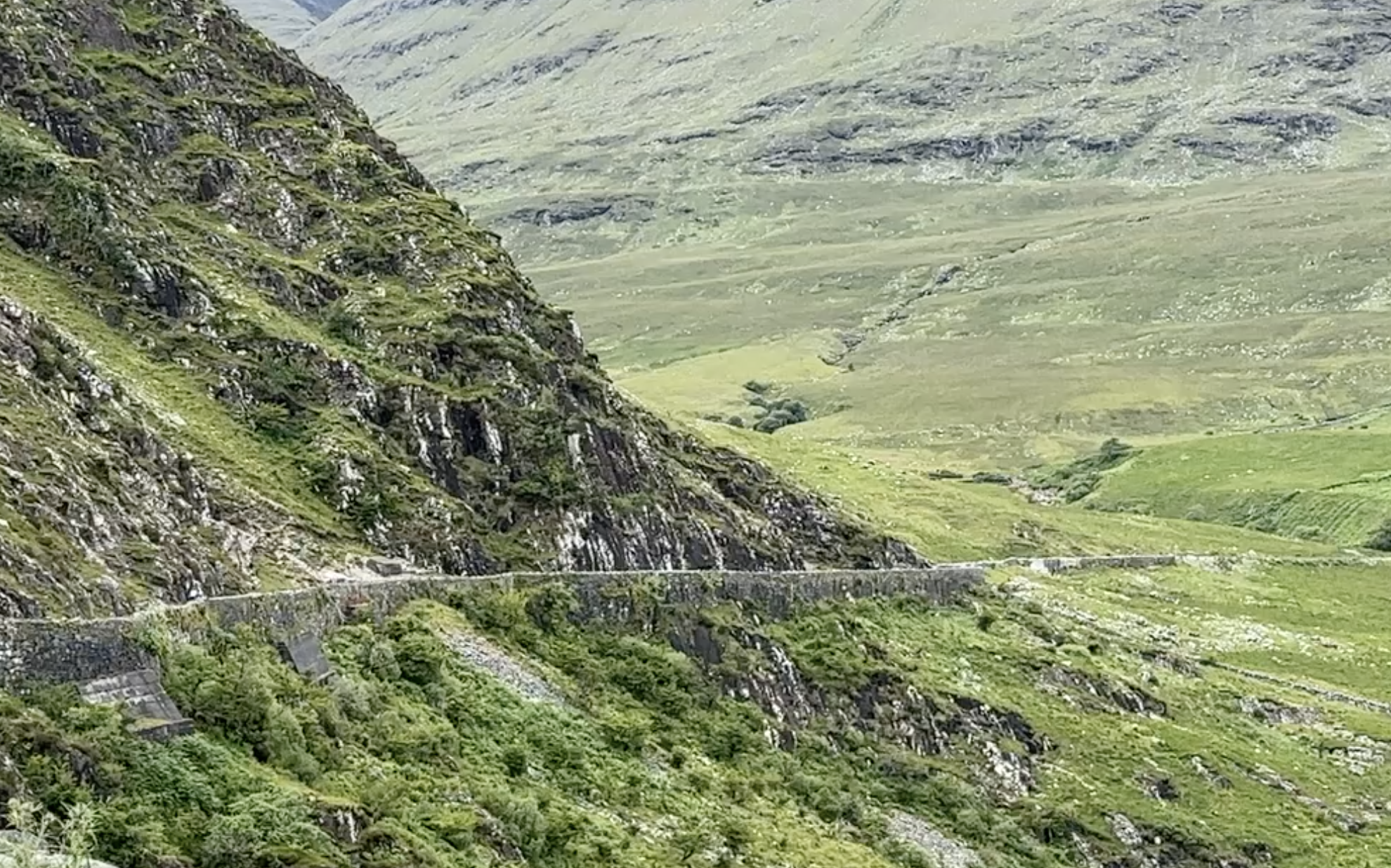
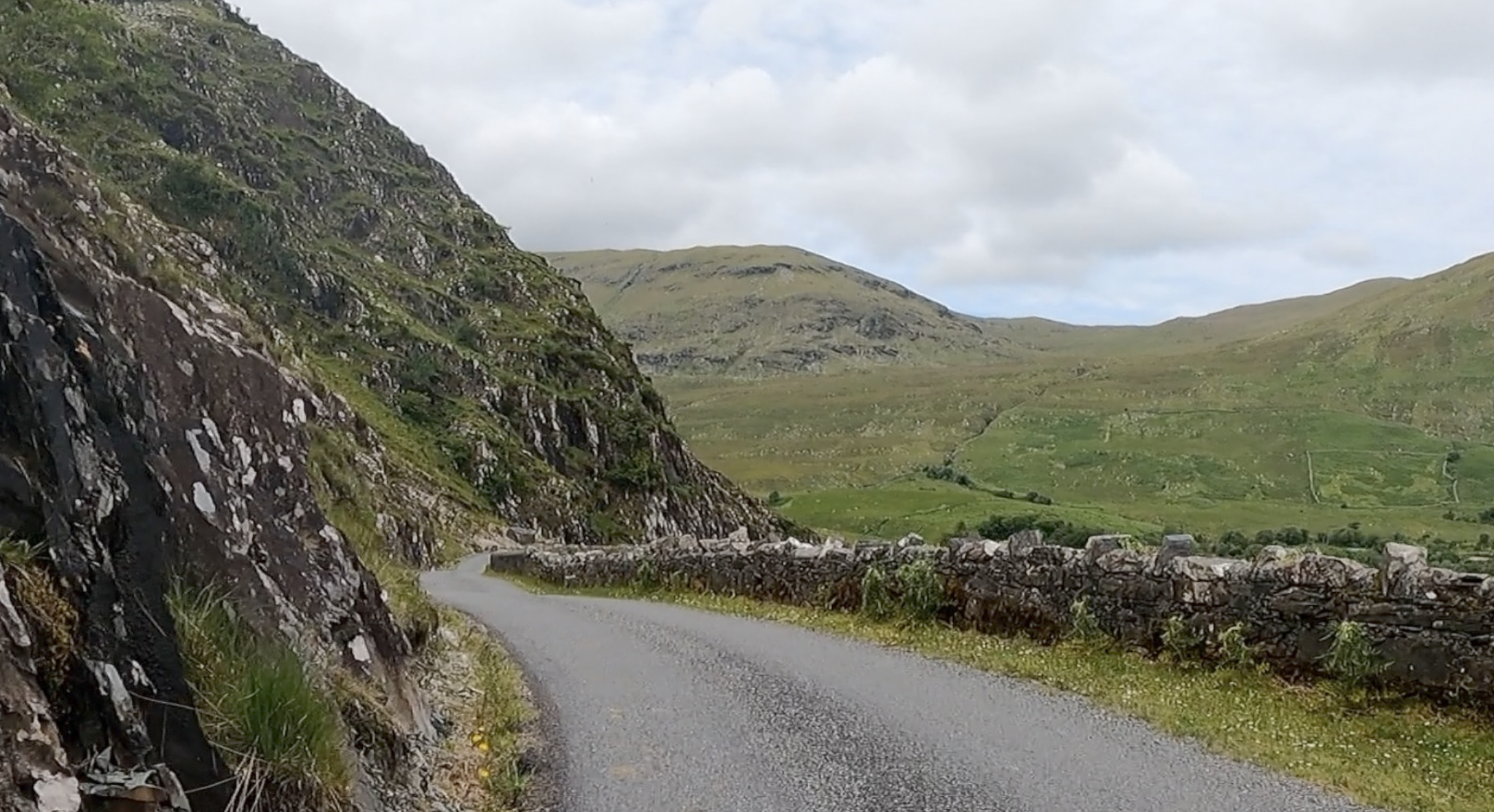
As the fjord finally narrowed, we crossed the water and worked our way along the other side, with lovely views of the route we’d taken earlier. We then turned inland towards Lough Doo, before turning again onto the L1824 towards the Sheefry Pass.
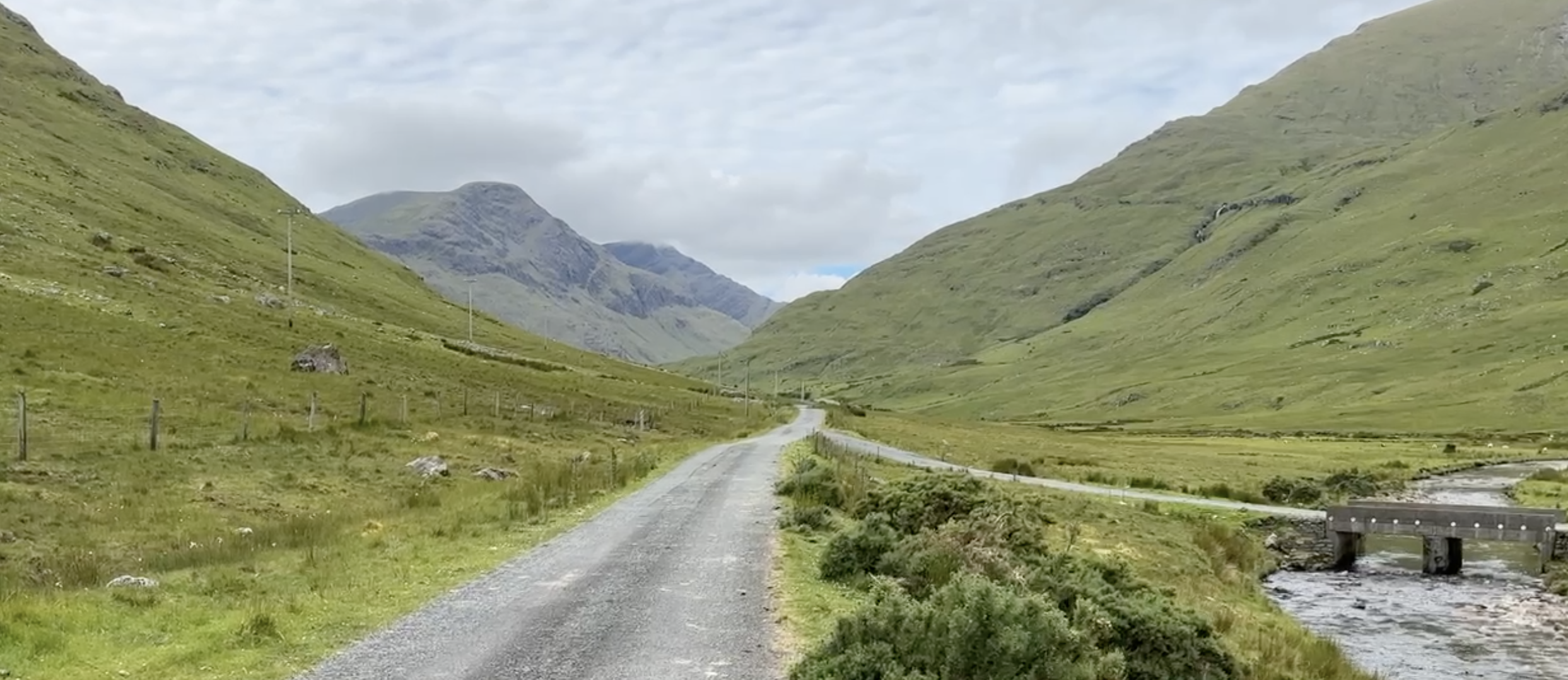
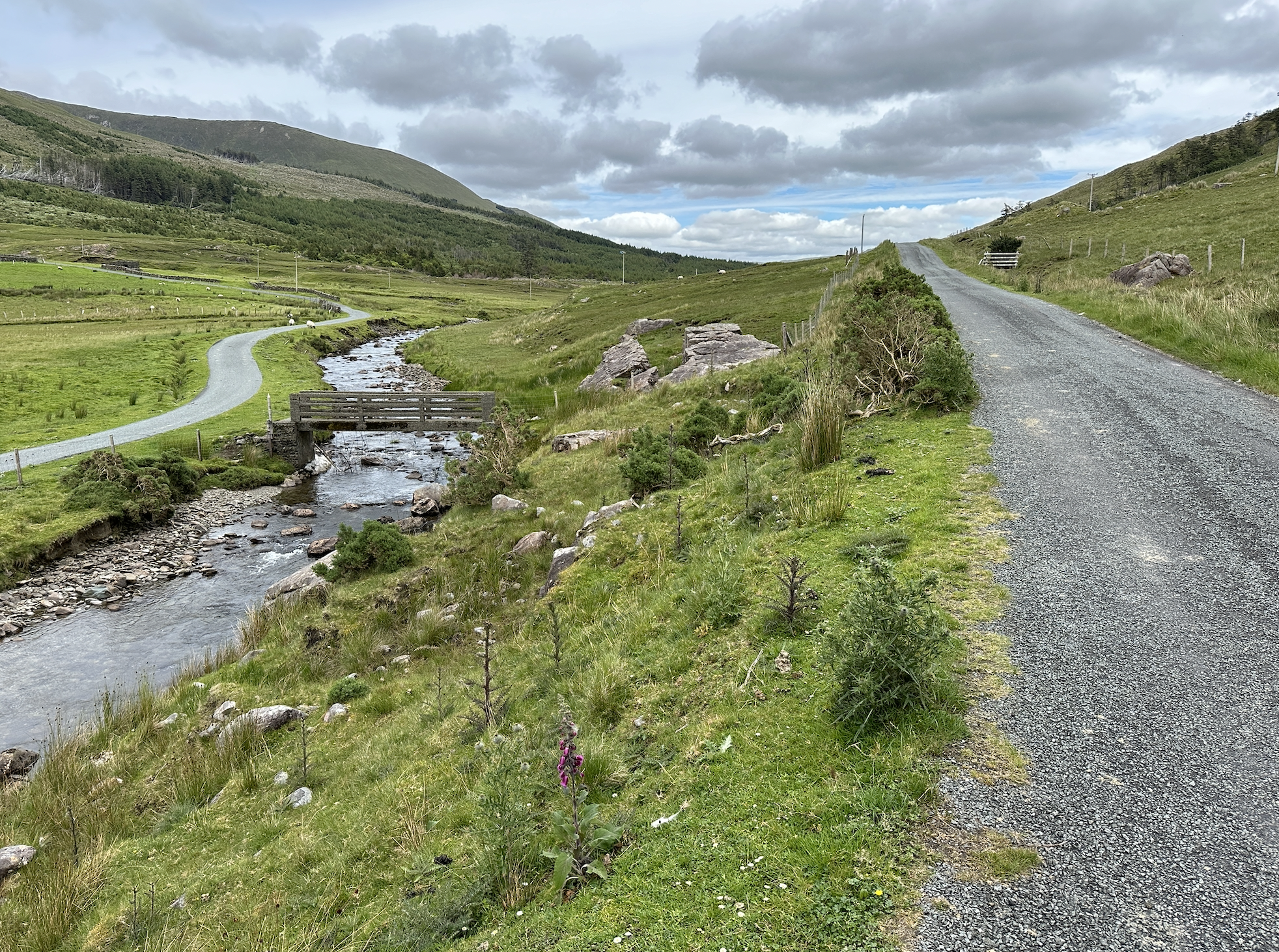
This was another stunning road – the photos above show the early part of the route before the serious climbing began.
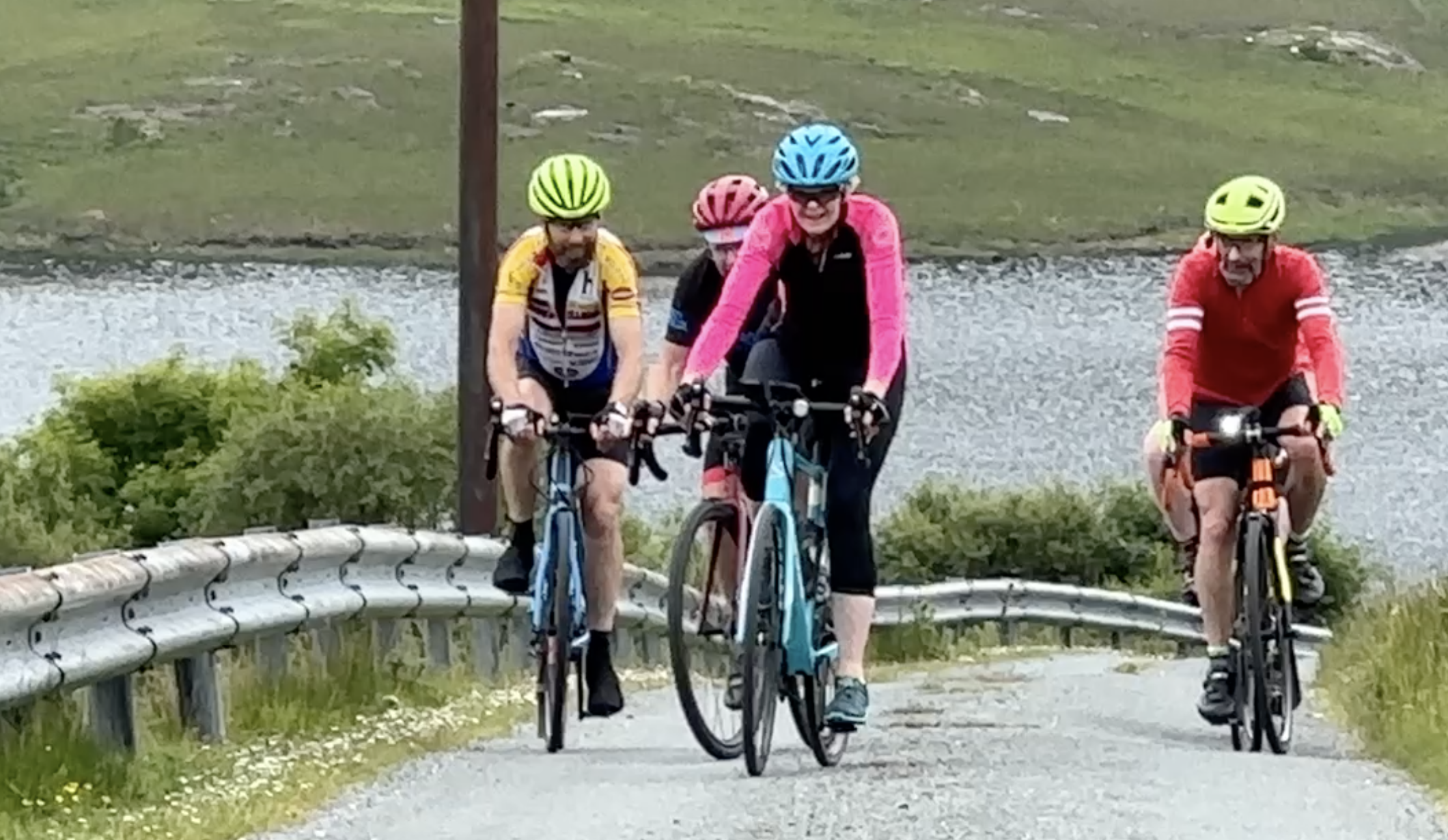
This photo gives a good feel for the terrain before the landscape opened out with Tawnyard Lough providing a nice view to savour below as we undertook the final push to the summit. The gradient was around 13 percent – we’d face much steeper, if shorter, climbs in the final stages of the tour.
The afternoon brew stop was at the summit, and I enjoyed a mug of tea watching Julia and others reaching the top with Tawnyard Lough in the background. It may not have been Bealach na Bà, the iconic climb in Scotland which we conquered two years ago but it was still an achievement. I certainly benefitted from my 3,000 miles of cycling so far in 2024 including London Wales London – all that riding and climbing helped!
The joy of tacking a mountain pass is the descent that follows. I loved racing down the twisting mountain road from Sheefry Pass as we made our way towards Westport. I was amused to see a sign for Owenwee, and with juvenile glee shared a photo of it with my son Owen…
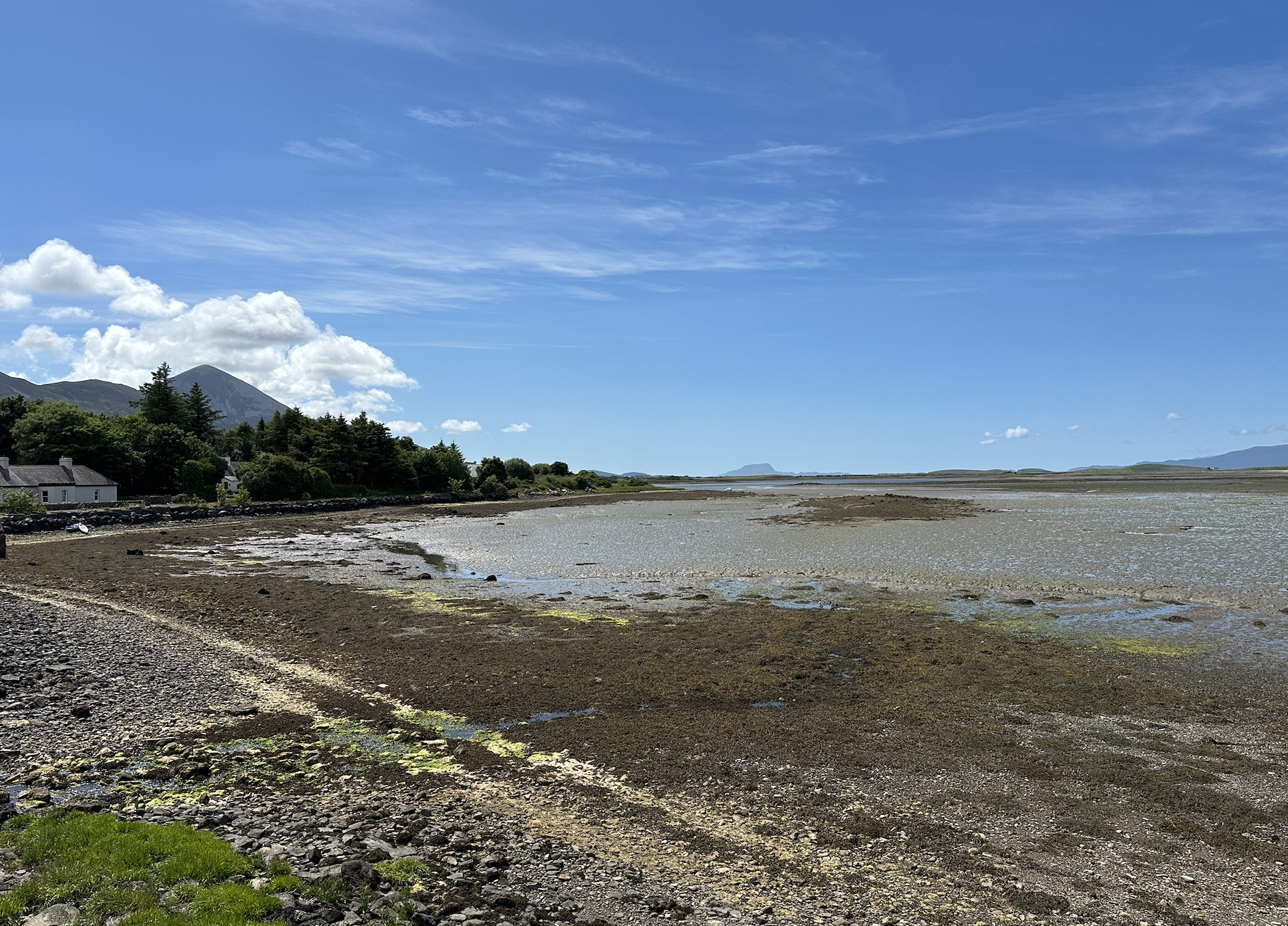
It was a joy to reach the coast again at Westport, with the view of Croagh Patrick, the pyramid shaped mountain associated with Saint Patrick, seen in the distance above.
Lovely Westport
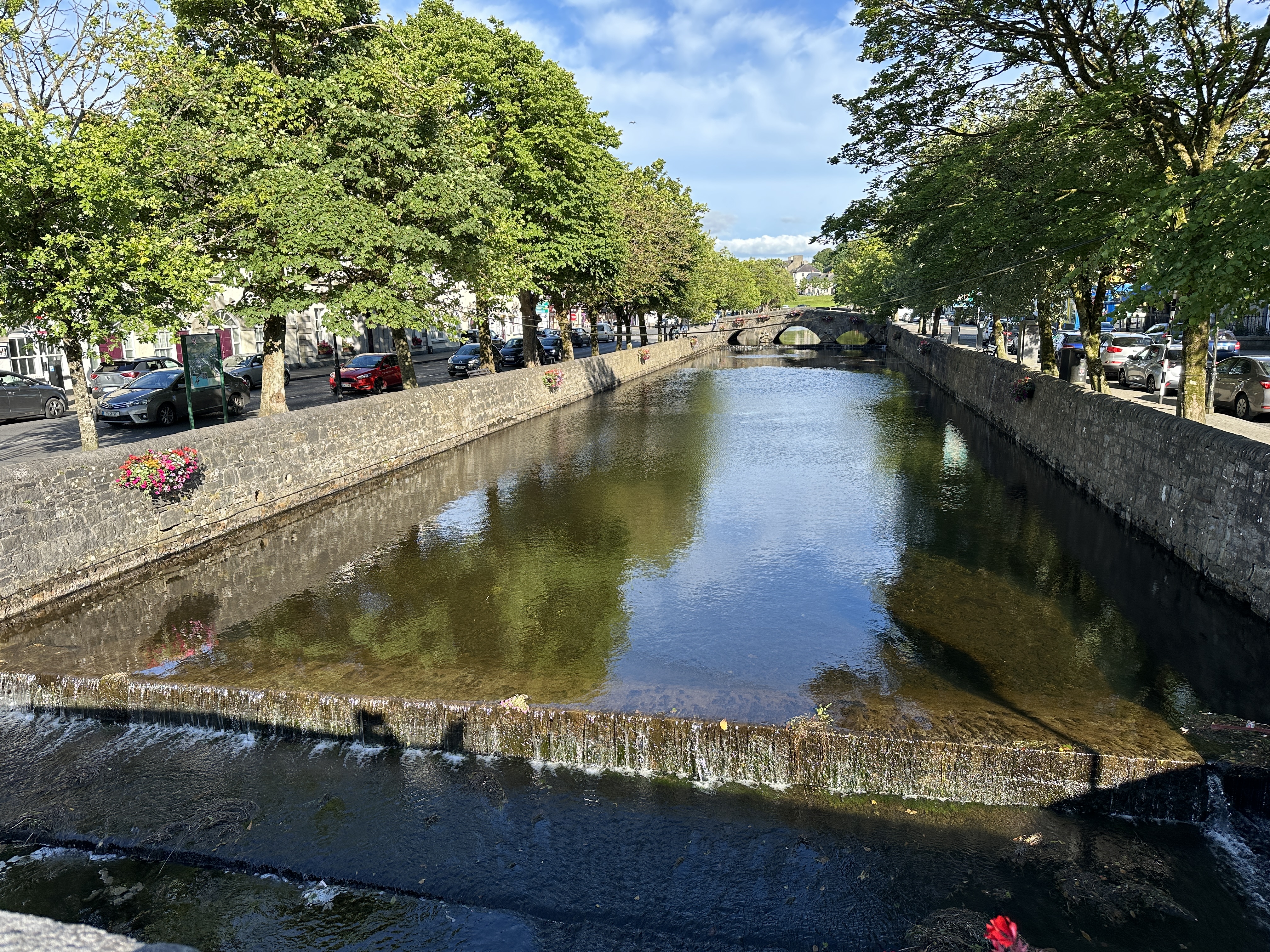
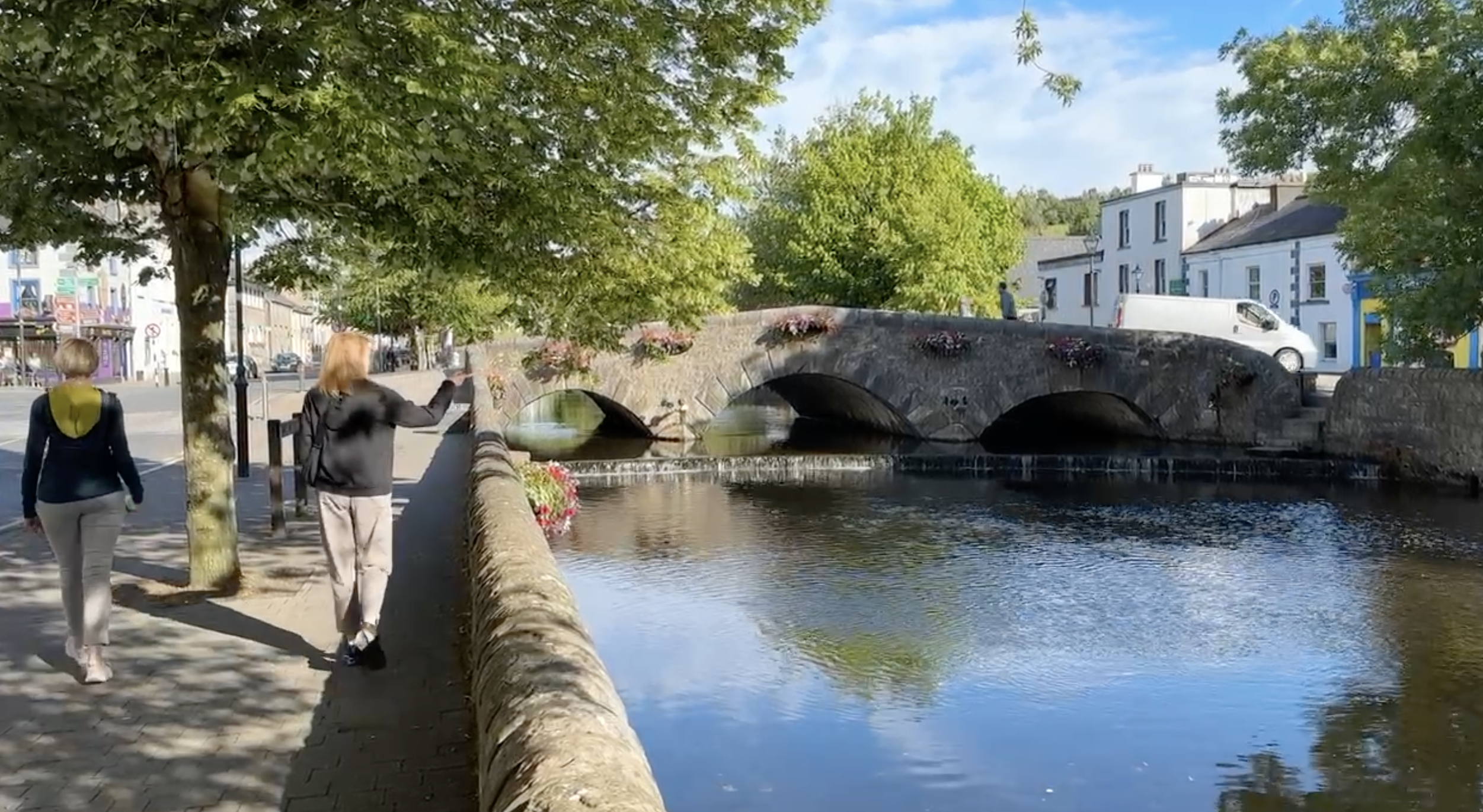
We approached the town via Westport Quay, and given the name Westport suggests a maritime, coastal settlement I assumed this was where we were staying. But we still had another three miles and a stiff climb to go. I was pleased to reach my guesthouse, Plougastel House after admiring the lovely Carrowbeg river in the middle of town. Plougastel sounded Breton, so I wasn’t surprised to learn that Plougastel was Westport’s twin town in Brittany.
It was a gorgeous, sunny evening and Julia, Lucy and I were determined to eat al fresco. We weren’t the only ones to have this intention, and every bar and restaurant with an outside table was buzzing. So we walked at least twice around the town centre, and back over the river, before grabbing a table at Hoban’s Bar that our fellow Peak Tours cyclists were vacating. We enjoyed a convivial meal in the sunshine – the last warm evening of the tour.
































 Ertblog