James Burke: Connections revisited

I caught a glimpse of James Burke on Mark Lawson’s BBC 2 show about Seventies TV tonight. It was pure nostalgia.

Burke was a fixture on the BBC during that dramatic decade and the late 1960s. He came to fame as a Tomorrow’s World presenter and commentator on the moon landings.

But for me his greatest hour was as the creator and presenter of Connections, a 10 part BBC series showing how technological developments are interlinked. I found it enthralling. It was a highlight of my Sundays along with the less intellectually stimulating The Big Match. (Although the contemporary success of Nottingham Forest was a surprise.)

I remember my mother’s cousin being as enthralled by the Connections book as I was when he stayed with us for my grandmother’s funeral in 1981. Another era. It’s hard to imagine a major TV channel devoting a 10-episode series to technology and science in 2012.

Not so smart TV: no BBC iPlayer on Samsung 5400 LED TV

Visit the new Ertblog on WordPress at robskinner.net!

I bought a new TV today for our kitchen. The old one stopped working after digital switchover this week, so I replaced it with an internet-connected one that enables us to watch BBC iPlayer on TV. John Lewis in High Wycombe said the Samsung UE22ES5400 LED 22 inch TV would do just this.

IMG_2672

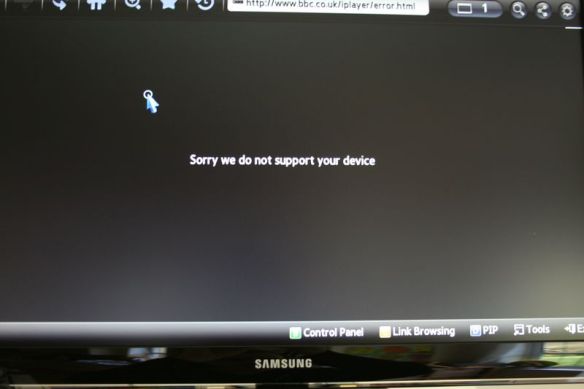
I was impressed by how easy it was to set up. But I couldn't find the iPlayer. The web based iPlayer said the BBC didn't support my device (above).

I didn't think that mattered. After all, Samsung's BBC iPlayer app features prominently on the company's website – but that was also missing:

IMG_2672

At this point, I called John Lewis. Its friendly technical help person couldn't help. He said I could return the TV – or call Samsung. I didn't think there was much chance Samsung would answer the phone late on a Saturday afternoon. But to its credit, I did get through to someone who explained after some research that the iPlayer app wasn't yet available for the 5400 TV as it was a new model but would be in early May.

So I won't be taking the TV back to John Lewis just yet.

PS: why are TV names so obscure and impossible to remember? Samsung could learn a lot from Apple. iPhone is so much more compelling and easier to remember than UE22ES5400.

Ertblog has a new home at robskinner.net. Do visit!

Goodbye, Ceefax

The BBC's Ceefax service teletext service has disappeared from out TVs after our area completed digital switchover. I can't say I'll miss it.

I've not looked at Ceefax since I went online over 15 years ago. I recognise that it was once a worthwhile innovation, giving information about news, sport and travel developments on screen at a time when we had just a handful of TV channels. But it was a frustrating system to use. The difference categories had a series of scrolling pages, and I always seem to miss the page with Cardiff City's result – meaning I had to wait for half a dozen pages to appear before 'my' result reappeared.

The BBC also split Ceefax pages between BBC1 and BBC2 – I could never remember which appeared where. And in an era before hyperlinks, you had to note the page number of the story you wanted. ITV and Channel 4 had their own teletext services.

It all makes the world wide web seem even more miraculous!


Not such a smart TV: no BBC iPlayer on Samsung

I bought a new TV today for our kitchen. The old one stopped working after digital switchover this week, so I replaced it with an internet-connected one that enables us to watch BBC iPlayer on TV. John Lewis in High Wycombe said the Samsung UE22ES5400 LED 22 inch TV would do just this.

Image

I was impressed by how easy it was to set up. But I couldn’t find the iPlayer. The web based iPlayer said the BBC didn’t support my device (above).

I didn’t think that mattered. After all, Samsung’s BBC iPlayer app features prominently on the company’s website – but that was also missing:

Image

At this point, I called John Lewis. Its friendly technical help person couldn’t help. He said I could return the TV – or call Samsung. I didn’t think there was much chance Samsung would answer the phone late on a Saturday afternoon. But to its credit, I did get through to someone who explained after some research that the iPlayer app wasn’t yet available for the 5400 TV as it was a new model but would be in early May.

So I won’t be taking the TV back to John Lewis just yet.

PS: why are TV names so obscure and impossible to remember? Samsung could learn a lot from Apple. iPhone is so much more compelling and easier to remember than UE22ES5400.

Why I won’t miss BBC’s Ceefax

The BBC’s Ceefax service teletext service has disappeared from our TVs after our area completed digital switchover. I can’t say I’ll miss it.

I’ve not looked at Ceefax since I went online over 15 years ago. I recognise that it was once a worthwhile innovation, giving information about news, sport and travel developments on screen at a time when we had just a handful of TV channels. But it was a frustrating system to use. The difference categories had a series of scrolling pages, and I always seem to miss the page with Cardiff City’s result – meaning I had to wait for half a dozen pages to appear before ‘my’ result reappeared.

The BBC also split Ceefax pages between BBC1 and BBC2 – I could never remember which appeared where. And in an era before hyperlinks, you had to note the page number of the story you wanted. ITV and Channel 4 had their own teletext services.

It all makes the world wide web seem even more miraculous!

Remembering the Seventies

The 1970s have had a bad press. Those 10 years have been written off as a grim decade of terrorist carnage, strikes and inflation. That's before the critics move on to popular culture: the years that taste forgot, with flares, garish colours, Gary Glitter and the Austin Allegro.

Tonight's BBC series The 70s is sure to prompt a debate about whether the decade has been wrongly maligned. As presenter and historian Dominic Sandbrook explains on BBC News' online magazine, the decade has been overshadowed by the Sixties, a period whose vibrant reputation doesn't match the reality of that iconic era for most people in Britain.

Back in 1970, the mood was optimistic. Cadbury's ran a television advert about the 'supersonic seventies' – sadly missing from YouTube - which reflected an era of technological advancement. Concorde was a symbol of that excitement, along with the moon landings that continued until 1972. (People of a certain age will remember space dust sweets, which made your tongue tingle.) Family holidays featured Benidorm rather than Bognor or Barry Island.

Yet the mood changed quickly. The evening news chronicled a descent into chaos and violence, from picket line battles at Grunwick and Saltley to bomb and bullet-scarred Northern Ireland. (Forty years on, I can still picture the BBC's Northern Ireland reporter WD Flackes, who was on our screen every night to record the latest horrors.) British political leaders of all parties seemed to have no idea how to tackle the country's troubles. I vividly remember my father Bob Skinner proclaiming the country was going to the dogs on eating of the latest destructive strike. (Aptly, we were on holiday in Benidorm at the time, on our first ever package holiday.)

Overseas, the Seventies saw Watergate, the Munich Olympics massacre, the end of the Vietnam war and carnage in the Middle East. Not to mention the continuing cold war.

Yet it's too easy to write off the Seventies as a time of hopelessness. Growing up in Cardiff, I enjoyed a happy, secure childhood. My parents, like so many, had more spare cash than in the Sixties, and we got our first colour television and automatic washing machine. (A contrast to the primitive machines we had before – I even remember one with a mangle on top!) And the glorious summer of 1976 and the Queen's silver jubilee in 1977 lightened the mood during the growing economic crisis.

The decade saw positive developments in society. The Labour government outlawed race and sex discrimination, and passed an equal pay act. The moves were symbolic – it would take years for attitudes to change – but important. Britain was changing for the better in many ways.

The BBC has already examined the Seventies. Its millennium year series We Love the Seventies was a nostalgic look back at life in that maligned decade. Author Andy Beckett brilliantly told the story of those years in When the lights went out.

Finally, a decade in which Wales dominated European rugby in scintillating style has to be honoured!
 

Remembering the Seventies

The 1970s have had a bad press. Those 10 years have been written off as a grim decade of terrorist carnage, strikes and inflation. That’s before the critics move on to popular culture: the years that taste forgot, with flares, garish colours, Gary Glitter and the Austin Allegro.

Tonight’s BBC series The 70s is sure to prompt a debate about whether the decade has been wrongly maligned. As presenter and historian Dominic Sandbrook explains on BBC News‘ online magazine, the decade has been overshadowed by the Sixties, a period whose vibrant reputation doesn’t match the reality of that iconic era for most people in Britain.

Back in 1970, the mood was optimistic. Cadbury’s ran a television advert about the ‘supersonic seventies’ – sadly missing from YouTube – which reflected an era of technological advancement. Concorde was a symbol of that excitement, along with the moon landings that continued until 1972. (People of a certain age will remember space dust sweets, which made your tongue tingle.) Family holidays featured Benidorm rather than Bognor or Barry Island.

Yet the mood changed quickly. The evening news chronicled a descent into chaos and violence, from picket line battles at Grunwick and Saltley to bomb and bullet-scarred Northern Ireland. (Forty years on, I can still picture the BBC’s Northern Ireland reporter WD Flackes, who was on our screen every night to record the latest horrors.) British political leaders of all parties seemed to have no idea how to tackle the country’s troubles. I vividly remember my father Bob Skinner proclaiming the country was going to the dogs on reading of the latest destructive strike. (Aptly, we were on holiday in Benidorm at the time, on our first ever package holiday.)

Overseas, the Seventies saw Watergate, the Munich Olympics massacre, the end of the Vietnam war and carnage in the Middle East. Not to mention the continuing cold war.

Yet it’s too easy to write off the Seventies as a time of hopelessness. Growing up in Cardiff, I enjoyed a happy, secure childhood. My parents, like so many, had more spare cash than in the Sixties, and we got our first colour television and automatic washing machine. (A contrast to the primitive machines we had before – I even remember one with a mangle on top!) And the glorious summer of 1976 and the Queen’s silver jubilee in 1977 lightened the mood during the growing economic crisis.

The decade saw positive developments in society. The Labour government outlawed race and sex discrimination, and passed an equal pay act. The moves were symbolic – it would take years for attitudes to change – but important. Britain was changing for the better in many ways.

The BBC has already examined the Seventies. Its millennium year series We Love the Seventies was a nostalgic look back at life in that maligned decade. Author Andy Beckett brilliantly told the story of those years in When the lights went out.

Finally, a decade in which Wales dominated European rugby in scintillating style has to be honoured!

BBC: time to repeat Fair Game!

Back in 1994, the BBC screened a drama called Fair Game. It was the story of a young couple’s trip across northern England against the backdrop of 1970’s football world cup and British general election.

It was broadcast on the eve of 1994’s world cup. I recorded it on my video and enjoyed it several times before making the mistake of lending the tape to a colleague. She taped over it!

I’d love to see Fair Game again. It included a wonderful performance by Prunella Scales and an evocative soundtrack of 1970 music. Please, BBC, show it again!

The day my bank card appeared in ITV’s The Bill

PC Stamp The Bill Nationwide 1989

The news that ITV was scrapping The Bill, its long-running police drama, brought back happy memories of my encounters with one of British television's best loved shows. 

Back in April 1989, I arranged for Thames Television to film part of an episode at Nationwide Building Society's Shepherd's Bush branch in London. The scene featured PC Stamp, played by Graham Cole, who was trying to take money out of his account. The hapless Stamp had his cash card swallowed by the ATM as he'd forgotten his PIN. The card was mine – and I arranged for Nationwide's branch staff to fish it out of the back of the ATM at the end of each 'take'. 

Rob Skinner PS Stamp The Bill

I enjoyed working with the programme, and remember Thames changing the script after I explained the planned sequence wouldn't happen in real life. The following year, The Bill filmed at another Nationwide branch, but disguised it as the storyline wasn't one I wanted the society associated with. 

The Bill became famous for featuring the working lives of the characters rather than their lives outside the station, setting it apart from other British police dramas. It had a string of memorable characters, including PC Stamp, Sergeants June Ackland and Bob Cryer and DCI Burnside. In some cases life imitated art, and millions of viewers were shocked after the actor Kevin Lloyd, who played the troubled Tosh Lines, died tragically following a drinking binge just days after being fired from the series.

In time, The Bill became a more sensationalist drama, and lost something special as a result, as former Met Police commissioner Ian Blair described in a valedictory Guardian article last week. I wasn't surprised to hear about a Facebook campaign to save the show, but can't help thinking the very idea of a preservation society for a TV drama is ludicrous. TV should be constantly refreshed – and The Bill has had its day after over a quarter of a century. As Ian Blair put it, quoting the original British TV policeman Dixon of Dock Green, "Goodnight, All!"

Remembering my hero, Ludovic Kennedy

I was saddened today to hear that the broadcaster Ludovic Kennedy had died. 

Kennedy was one of my heroes: a legendary broadcaster who deserved enormous respect for his tireless battle against miscarriages of justice. 

His autobiography, On my way to the club, is an enthralling account of a fascinating life. It's full of marvellous stories, including the tale of how he met and married the famous dancer Moira Shearer. Shearer had recently shot to fame in the film The Red Shoes when he attended a fancy dress party which she happened to give out the prizes. He plucked up courage to ask her for a dance, amazing himself at the nerve of asking a famous dancer for a dance. She accepted, prompting even greater surprise by proving 'she couldn't dance for toffee', treading on his feet and almost tripping him up. 

More seriously, Kennedy described the unfair way his father was dismissed from the Royal Navy after being court-martialled for failing to crush a peacetime rebellion by Navy reservists in Newport, South Wales. Ludovic was just five at the time, but no doubt this early experience of injustice prompted his lifelong passion to right miscarriages of justice. His most famous book, 10 Rillington Place, helped secure a posthumous pardon for Timothy Evans, who had been hanged for the murder of his wife and baby daughter, despite his protests of innocence. Kennedy's campaign was a major influence in the fight to abolish the death penalty. 

Kennedy followed his father into the Royal Navy when war broke out. For the elder Kennedy, the coming of war represented a chance to put the Newport humiliation behind him. He returned to captain an old liner that had been turned into a makeshift warship to protect merchant ships. Captain Kennedy died a hero as his ship, HMS Rawalpindi was sunk in a brief battle with the German battleship Scharnhorst. In his autobiography, Kennedy describes hearing the news on the BBC news. The 20 year old Ludovic phoned the Admiralty for news of his father, only to be told, "The captain? No, I'm afraid he's gone". Ludovic went on to serve with distinction, taking part in the pursuit of the Bismarck and the Russian convoys. 

Our disgraced politicians could learn a lot from Ludovic Kennedy's distinguished life and passion for justice.