It’s always a thrill to get a letter published by The Times. I’ve had a few appear over the past 12 months, and my son Owen made his own epistolary debut in February.
My latest letter, above, was inspired by earlier letters about dreams. I particularly liked Dr Peter Cooper’s contribution. He recounted how he decided one night to note the key points of his latest dream so he could relive it in the morning. He said he didn’t bother trying again after reading back, “The banana is tougher than the skin”. It reminded me of a similar disappointment reading back a note I’d made during the television coverage of the 1997 general election. I hoped to find a thrilling, witty account of a dramatic, historic election. Instead I found a barely legible, barely interesting scribble.
The dream I mentioned in The Times was recounted to me in 1984 by my university friend, Richard Attewell. I couldn’t compete with that one – but I remember at the time dreaming of searching for a plastic tray on which to bury a dead fish I had found (in the dream) on a beach. I didn’t think Times readers would find that as amusing.
For years, the media have bemoaned Britain’s productivity crisis. The country hasn’t become significantly more efficient at producing goods and services in the 16 years since the financial crisis. It seems a complex riddle. Why is the UK falling behind our international rivals? is it our newfound love of working from home? Or is a chronic lack of investment to blame?
Three poor customer experiences in the past week make me think we’re overthinking the problem. Too often companies screw up the simplest things – such as an online booking service. As a result, customer and company spend unnecessary time fixing the problem.
Case study 1: Everyman
I’m a big fan of Everyman. I love stretching out on a comfy cinema sofa while watching a great film, nursing a coffee. As a member, I can book a second, free ticket on Mondays. Today’s the first Monday I’ve had the chance to enjoy this 2 for 1 offer. But the website made it impossible to book.
I selected my member’s ticket – one of the six tickets a year under the cheapest membership package. I then chose the 2 for 1 ticket for my wife, and selected our chosen sofa. So far, so good. But the system wouldn’t allow me to check out without choosing a third seat. I tried every variation, but nothing worked. In the end, I phoned Everyman and a helpful person booked the tickets for me.
Solution: Everyman, fix the website bug, so your customer service people don’t have to spend time booking tickets that should be available online. You will also avoid people giving up, and not buying food and drink from your cinemas.
Case study 2: GoPro
I bought a new GoPro 13 action camera earlier this month. (Highly recommended, by the way.) It came with a year’s free GoPro Premium subscription, which includes cloud storage of GoPro footage. But when I tried to set up automatic upload of my videos, it told me to buy a subscription. I called GoPro, and was assured that everything was set up correctly. But 10 days later, I’m still being prompted to buy a subscription. I’m going to have to call again – a complete waste of my time and that of the GoPro customer service team.
Solution: GoPro, fix the glitch that stops my subscription showing up on your system. And make sure your agents look into things more carefully, rather than simply saying everything is set up when it clearly isn’t.
Case study 3: Wales & West Housing
We’ve been trying to sell my late father’s flat in Wales for over a year. It’s part of a block for older people managed by Wales & West Housing. I’ve told the company repeatedly that no one is living in the house, and to send all letters directly to me for a quicker response, given I live 150 miles away in England. Needless to say, this never happens. In July, I received a redirected letter telling me that an engineer would be visiting to carry out the annual gas safety check. I called to tell Wales & West that the engineer should gain access via the estate agent handling the sale. A couple of weeks later, I got another redirected letter – above – saying the engineer called at the flat but couldn’t gain access – having ignored my instruction.
I called Wales & West again, repeating what I’d told them already. Yet again, I got a letter saying an engineer had called and found no one at home, and threatening legal action. This time, I emailed Wales & West chief executive Anne Hinchey, who took the necessary action. (Thanks, Anne.)
As a result of this saga, an engineer wasted time on two fruitless visits – and the chief executive and I also wasted time that could have been used more productively.
Solution: Wales & West, make sure your people act on instructions, sending correspondence to the right address and not sending an engineer to an unoccupied flat.
Get it right, first time
We can all think of similar examples of time wasted because of a faulty website, customer service teams not taking responsibility for an issue – and a host of other reasons why life’s tasks don’t run smoothly. That’s why it’s so important for companies to fix issues when they arise. In my PR career, I often got emails from unhappy customers, and always passed these on promptly to someone who could help. Getting things right first time is essential to being efficient – and makes for happy customers. It’s also a quick win in solving Britain’s productivity crisis.
It’s unbelievable. Britain’s wartime cabinet was meeting in 1915 to plan the Dardanelles campaign that was destined to cost the lives of 41,000 Allied troops. Yet the prime minister, Herbert Asquith, wasn’t interested. Instead, he was reading a letter from his lover, Venetia Stanley, delivered to the Cabinet Room in 10 Downing Street during the meeting. As Winston Churchill, David Lloyd George and Lord Kitchener debated the details, Asquith was penning a reply to Venetia, after checking his diary to see when he could slip away to meet her.
Here is a classic example later that year:
My own darling – I am writing in the stress & tumult of a windy & wordy controversy about munitions … between Ll. G [Lloyd George], Winston [Churchill] and A.J.B [Tory leader Arthur Balfour] – and I daren’t abstract myself more. Asquith to Venetia, during a War Council meeting 1915
Robert Harris has turned the Asquith-Stanley scandal into a brilliant novel. The prime minister’s letters to Venetia have survived but he destroyed all her letters after she ended the relationship, and he had been ousted as PM by Lloyd George in 1916. Some have doubted whether the relationship was sexual, but Harris is sure that it was, and the surviving letters tend to support this – though we will never know for sure.
Asquith was obsessed with Venetia, who was 35 years younger than the 61 year old premier. He ran appalling risks by sending her top secret government documents through the post, including messages about a planned troop evacuation from Antwerp and much more. When the two were enjoying secret rides in his prime ministerial Napier limousine, Asquith would reveal the latest intelligence decrypts to her, before throwing them out of the car window. One of the few fictional characters in Robert Harris’s novel is police detective Paul Deemer, who surreptitiously intercepts the lovers’ letters, to copy them before returning them to the postal sorting office. He also wangles a job as a gardener at the Stanleys’ north Wales mansion, Penrhos, and creeps into her bedroom to open the case in which she kept Asquith’s letters. She saved them for posterity and Robert Harris.
Harris brilliantly chronicles how Venetia turns from an equal partner in the affair to being uncomfortable and indeed oppressed by her lover’s spiral into near madness. She finally agrees to marry Asquith’s close friend and cabinet minister Edwin Montagu, despite not finding him attractive. It was a marriage of convenience that ended when he died just nine years later, during which she had a string of affairs.
You’ve got mail
Precipice sheds light on the remarkable postal service London enjoyed even at the height of the Great War. The General Post Office (GPO) collected and delivered mail 12 times a day in the city, and three times in the country. Venetia noticed with some suspicion that her post seems to be delayed – probably by just a few hours – after detective Deemer starts intercepting it. Today, no one would even notice.
There are a few false notes. When Harris recounts Asquith’s response to her suggestion that the disastrous Dardanelles campaign should be abandoned before any more lives are lost, he has him responding, ‘No, I fear there’s no alternative except to double down’, using an expression first noted in 1949 – and by very few in Britain until the 21st century. At least Harris didn’t have Asquith pleading with her to ‘reach out’…
It was a pleasure to listen to Robert Harris talking about the novel at a Chiltern Bookshops event in the highly appropriate setting of Chorleywood’s Memorial Hall, opened in 1922 to honour those who gave their lives in the Great War. He amusingly explained how Asquith’s great-grandson told guests at the novel’s launch party that it was totally ridiculous, especially the idea that his great-grandfather had anything other than a platonic friendship with Venetia. ‘How on earth would he know, 110 years later?’ Harris asked. He added, ‘Asquith was notorious for his wandering hands and it is well known that Venetia had married lovers after her marriage. That’s the nature of the two people.’
Robert Harris’s achievement is to make us care about the two main characters, even though their behaviour is hardly commendable, especially during a war in which thousands are dying every week. Asquith and Venetia were very much characters of their time, although Harris got a laugh at Chorleywood by making a reference to Boris Johnson’s scandalous actions as PM a century later. Stanley herself was part of a fabulously rich family with mansions in Wales and Cheshire, along with a grand house in London. Yet Harris gives a fair impression how unfulfilling her life was, despite the decadence and splendour. Harris noted at Chorleywood how the family’s Welsh and Cheshire palaces lay in ruins just a few short decades later, while Venetia herself died aged just 60.
Asquith’s legacy
We shouldn’t judge Asquith just on his sordid pursuit of Venetia Stanley. He was the leader of Britain’s last Liberal government, before being forced to turn his wartime ministry into a coalition. Above all, he presided over an extraordinary peacetime revolution, which included the first state pension and the titanic battle to curb the powers of the unelected House of Lords, which included two elections in a single year, 1910, and the threat to demand that the king created enough new peers (lords) to force the upper house to back down. Until war came and he became obsessed with Venetia Stanley, he cleverly harnessed the supremely talented Lloyd George and Churchill. It helped shape modern Britain.
When the Great War was news, not history
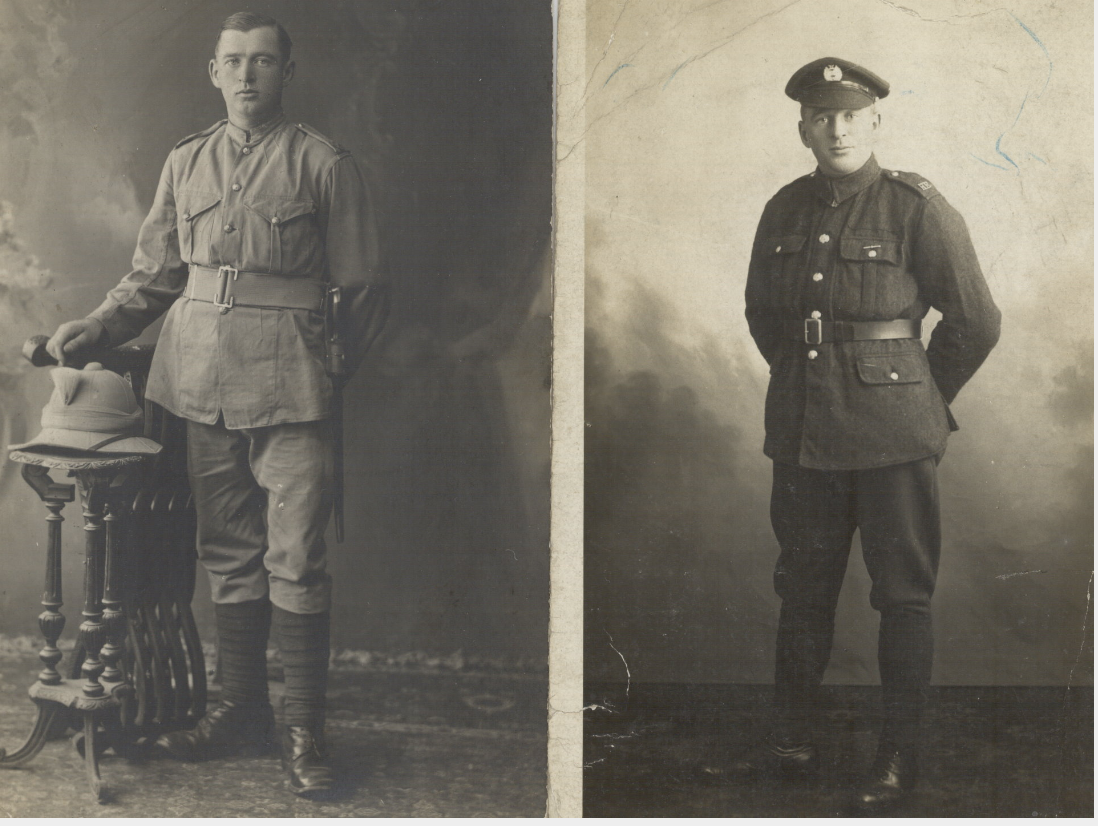
Photos like these feature in countless family photo albums across these islands. They feature my grandfather Frank and his twin brother. Frank was one of the men sent to fight in the Dardanelles campaign that Asquith should have been discussing when he was distracted by his passion for Venetia Stanley. His terrible ordeal led him to forbid my late father from joining his school’s cadet force on the eve of the second world war in 1939. Tragically, his brother – my great-uncle – died in the Spanish flu pandemic after surviving the trenches. Frank died too young at 52 of a heart attack in 1942, as my own 94 year old father remembered so poignantly on his own blog on the 78th anniversary of that sad day in 2020.
The commendable Venetia
Venetia should not be defined by her relationship with Asquith or Montagu. She was determined to play her part in the war effort, and enlisted as a nurse, in conditions so different from her affluent and cosseted family lifestyle. She sailed to France the day Asquith was forced to form a wartime coalition.
One last thought. Almost 80 years after she died, Venetia is the silent witness in this extraordinary story. She’s not here to give her side of the story, a silence that applies to countless women down the centuries who have been unfairly defined and characterised by their relationships with powerful men. We should remember this before casting any judgement about what she did over a century ago as Europe went to war.
Labour won a landslide victory in July’s general election, as the Conservative Party was swept from power after five years of law-breaking, financial incontinence and plain incompetence.
Keir Starmer’s narrative since taking office two months ago has been clear and consistent. Things are even worse than Labour feared, and the Tories are to blame.
This is a straight copy of David Cameron and George Osborne’s 2010 playbook, which pinned the blame for the 2008 financial crisis on Gordon Brown’s Labour Party. Labour was never able to shift the narrative to highlight the bold action Brown took to counter the crisis.
There are also echoes of Margaret Thatcher’s success in reminding voters of the chaos of the 1978/79 winter of discontent under Labour at every opportunity throughout the 1980s. For years, Tory party political broadcasts would show film of mountains of rubbish in the streets and picket line violence accompanied by a funereal voiceover intoning, “In 1979…” in case anyone had forgotten life under Labour.
But pinning the blame on the Tories won’t be enough for Starmer. The electorate gave a firm verdict on the Tories at the election: guilty. Labour must do more than simply emphasise what the voters have already decided. Starmer needs to become a political teacher, in commentator Steve Richards’ perceptive phrase.
Richards noted that the most successful modern British prime ministers – Thatcher, Blair and to some extent Wilson – did more than assert a political viewpoint. They realised they had to explain their vision and actions. Thatcher, for example, famously used the analogy of the household budget to explain that Britain could not spend beyond its means. (Critics disputed the parallel, but to little effect.) Blair was an even more effective communicator, combining clarity with the verve of a religious preacher. Under the New Labour, New Britain banner, he explained why the party and the country had to change. Although New Labour was accused of spin, Blair gave long media interviews and press conferences, engaging with the big issues of the day with seriousness and skill.
Starmer and team were understandably paranoid about losing the election. But they must now move beyond the doom-laden narrative of the government’s first two months to set a positive, optimistic vision for the next five years. This has to be done quickly. Starmer must avoid becoming another Theresa May: her utter inability to communicate let alone explain to the nation and her party what she was trying to achieve doomed her premiership especially after the catastrophic result (for her) of the 2017 general election. As Steve Richards put it, ‘She not only failed to tell her story, but did not even make an attempt. This was her fatal flaw – not only a failure to communicate, but an indifference to the art’. (The Prime Ministers: reflections on leadership from Wilson to Johnson, 2019)
Another judgement from Steve Richards about Theresa May strikes me as a stark warning to Keir Starmer: ‘She did at times have space on the political stage, but failed to see when she had the room to be bold and when she did not…. she acted weakly when she was politically strong…’ I fear Starmer may fall into the same fatal trap.
Even Blair’s own record in government provides a warning. On 2 May 1997, he was in complete control of the political landscape (even if he shared that control with Gordon Brown). Yet his first term was a story of paralysing caution aside from devolution to Wales and Scotland, the national minimum wage, and the historic Good Friday peace agreement in Northern Ireland. (His Tory predecessor, John Major, deserves credit for building the foundations for peace, but Blair’s masterful political artistry proved critical.) Soon after New Labour’s second landslide in 2001, the 11 September terrorist atrocities followed by the Iraq war stole what momentum Blair’s government might have achieved. I sense that if Starmer doesn’t seize the opportunity to become a political teacher now, voters will lose faith far more quickly than they did with Blair, especially as Tony enjoyed a golden economic inheritance from John Major.
Much will depend on chancellor Rachel Reeves’ budget on 30 October. Labour has already spun this as a budget of hard choices – forced on us thanks to the Tory financial black hole. And Reeves has already cancelled a host of rail and road projects, and the Edinburgh super computer intended to give Britain an advantage in the artificial intelligence race. It remains to be seen whether Labour will win the political intelligence race.
Cameron and Osborne won the argument in 2010 about Labour’s responsibility for the financial crash. But their remedy, years of austerity, has caused enormous damage to the fabric of the nation, especially public services. Funding for local government in England has been slashed by 55 percent in real terms since they took office in 2010. (Source: IFS.) All this was a factor in voter contempt for the Conservatives in July. After the Liz Truss catastrophe, Labour has to be prudent with public finances, but I fear that Labour is falling for the coalition’s slash and burn approach, much as it has stolen Cameron and Osborne’s blame playbook.
Lessons from history
Labour’s landslide win in July was bigger than the party’s famous win in 1945. (Although on a far smaller share of the vote.) Labour’s 1945 leader, Attlee, was even less charismatic than Starmer, but his government changed the country with the birth of the NHS and the welfare state, and independence for India. Yet it was out of power within six years. By 1951, voters were no longer prepared to put up with austerity and ‘jam tomorrow’ – food was still rationed years after the end of the war.
Starmer is a fan of Harold Wilson, who lost the 1970 election just four years after a landslide victory. Voters today are even less patient than 50 years ago, and Labour needs to heed these lessons from history. Lead the nation with a compelling story and show serious improvements to Britain’s shameful public services by 2028 and Labour has the chance to be the natural party of government for the 2030s.
Postscript: Jenni Russell makes almost exactly the same argument in her column in The Times three days after I published this blogpost. (Paywall.)










 Ertblog