
Let’s give the Camerons time to mourn their beautiful boy

Like so many others, I was shocked and saddened today to hear that Conservative leader David Cameron's son Ivan had died at the age of six.

As the father of a seven month old son, I found the news especially poignant, although you hardly needed to be a parent to identify with the Camerons' tragic loss.

By a strange coincidence, The Guardian chose today to profile David Cameron in its G2 supplement, which included the familiar photo of David and Samantha Cameron with their children. David and Ivan are seen looking lovingly at each other. The shot took on a painful poignancy today.

It's extraordinary that Britain's prime minister and opposition leader have both lost children. It shows that power and money count for little in life's lottery. If any good is to come out of such sadness, it is that Brown and Cameron are better able to bring their own terrible experiences to help others. It's no coincidence that both are strong supporters of the NHS.

The other lesson is that life is far more important than politics. We can only begin to imagine how Gordon Brown and David Cameron coped with the pressures of political life in the light of what they were facing in their family lives. Politicians are human beings. They share all our failings and weaknesses. But they don't enjoy our luxury of anonymity in troubled times. We should allow them their human frailties – along with the time and space to cope with tragedy.

Apple must offer cheaper laptops if it wants to be more than a niche player

Great article from Charles Arthur, the Guardian's Twechnology editor on the paper's website. Arthur convincingly shows why Apple should offer a netbook, a budget laptop designed for essential tasks such as browsing the internet and sending emails. He points out that the iPod only became the dominant MP3 player after Apple offered cheaper versions.

I'd love to have an Apple laptop as a desktop replacement. But right now, the only 17inch Mac laptop costs a staggering £1,949. I love Apple products, but I'd have to have more money than sense to pay that kind of money when a comparable Windows laptop is well over £1,000 cheaper.

As Arthur says, premium brands in many sectors, such as BMW, are hurting badly as the recession bites. The Guardian reports NPD's view that Apple's US sales are already falling.  I don't doubt that Apple can justify a certain premium, as its products are more stylish and easier to use than rival ones. But in tough times, we're all more likely to ask if we're getting value for money. If Arthur is right, the rise of the netbook offers Apple the chance to 'do an iPod' in capturing a far bigger chunk of the market by abandoning its premium pricing model. It will be interesting to see if Tim Cook, Apple's chief operating officer, who is standing in for Steve Jobs, goes for it.

Severn View motorway services: no view, no heating but usual rip off prices

We rarely stopped at motorway services before Owen was born last year. We'd drive non stop to Cardiff, avoiding the eye-watering prices. But these days our seven month old's feeds tend to come while we're on the road. So on Saturday we stopped off at the Severn View services on the M48, just before the original Severn bridge.

It brought back memories: I stopped at these services many times in the 1970s, enjoying the view over the river to the Welsh hills. But as we carried Owen into the building, I realised things had changed. This was not the original Severn View (or Aust) services, with its huge cafe overlooking the river, but a small replacement with just a Costa Coffee, Burger King and WH Smith, along with loos. The view was of the petrol station, not the Severn. And it was freezing cold (Owen's hands were very cold by the end of his feed). The chap at Costa told us the temperature was controlled remotely from head office in Bicester. "Please write to complain, they take no notice of us," he added. After spending £14 on sandwiches, crisps and drinks for the two of us, we were far from impressed. We won't return!

Chelsea’s firing of Scolari underlines the bankruptcy of football’s czars

Scolari has gone after just seven months. Chelsea's regime has shown its ruthlessness and its impotence.

Avram Grant got the Blues within an inch of the European Cup – something the fabled Jose Mourinho couldn't achieve. Yet that wafer-thin failure supposedly demanded Grant's removal. Chelsea are fast sliding into self appointed chaos. Mere money cannot buy success. Scolari may not have been the answer, but Abramovich's lethal mix of boredom and impatience will doom Chelsea to oblivion unless he finds a miracle worker.

This assumption of a divine right to success is disastrous. Newcastle fired Sir Bobby Robson four years ago yet have never come close to the success he achieved. Similarly, Tottenham sacked Martin Jol early in the 2007/08 season but have struggled to come anywhere near Jol's achievements. When will football owners demonstrate an understanding that things can get a lot worse, not better, if they replace their manager?

Bankers’ bonuses: end these rewards for disastrous failure

I'm usually suspicious of media headlines that begin 'fury at…'. The fury usually only exists in the mind of a Daily Mail headline writer.

But there's no doubting the fury against bonuses being paid to bankers whose failed companies have been rescued by the taxpayer. I was amazed to hear a lawyer called Ronnie Fox being interviewed by Peter Allen on Radio 5 Live's Drive show tonight. Fox was trying to justify bonuses being paid to his clients, typically managing directors and other senior managers in the big banks. Fox talked about people relying on bonuses. Yet no one should rely on a bonus, let alone extremely well paid people working for companies that would have collapsed without our money. A bonus should be a reward for good performance. It should not be assumed as automatic.

Many people have missed out on a bonus when their company didn't meet its target performance – even though the business made a good profit. Yet here are failed banks like RBS threatening to pay millions in bonuses.

I have a simple answer. If the Government decides it cannot prevent RBS and Lloyds Banking Group paying bonuses, it should declare that it will tax such payments at a special emergency tax rate of 100 per cent. It is time for the bankers to return to planet reality.

Our survey said: time for PR people to kick their addiction to research stories

If you hear or read the words 'according to a poll' in a broadcast or newspaper story, it's likely that the story is a result of a news release. All of us working in PR have resorted to research stories to get coverage for our organisations. I'm certainly no exception. When judgement day comes, I'll confess to the Valentine's day story I did for Eagle Star life assurance in 1997, claiming that women would love a pension plan for Valentine's day. The shame.

These non stories are a conspiracy between PR people and the media. They rarely have any substance to them, even though they abide by the rules governing market research. But I sense we are all getting bored by the tactic. My 1997 story was picked up by a stack of radio stations and the national press. Were I to repeat it now, I doubt any national would touch it. In the last week, journalists on Metro and The Observer I've spoken to have agreed with my view, even saying they delete emails from a certain insurance company because of the number of silly surveys.

The tactic can result in ridicule. Two weeks ago, the insurer LV issued a story claiming that inexperienced cyclists taking to the roads had resulted in a 29% increase in the number of road accidents involving cyclists. The Independent's report on the story carried the dramatic headline Credit crunch cyclists causing chaos on roads. The CTC, Britain's national cyclists' organisation, quickly condemned LV's story as Mickey Mouse research. Roger Geffen, CTC's respected campaigns manager, said LV's alarming figures appeared to no more than the difference between casualties in winter, when fewer people cycle, and the summer, when more of us take to our bikes. CTC's rebuttal was widely reported in the cycling press. In the words of Roger Geffen:

"Manipulating statistics for a PR stunt wastes the time of the people who took part in the survey. By demonising cyclists and scaring people into staying in their cars, it also undermines the efforts of charities like CTC to encourage more cycling and improve road safety for all”.

Things got worse for LV's PR team. In last Saturday's Guardian, Ben Goldacre devoted his Bad Science column to LV's story, under the headline Perils on the road to PR-reviewed data. Goldacre began:  "I've always fantasised that the insurance industry must possess a vast repository of useful data: the experience of centuries, carefully tabulated by actuaries into secret commercial databases containing a truth about human behaviour and risk that most epidemiologists and social scientists would kill for." LV's story destroyed that illusion, leading him to add, "I shall not be buying shares in this insurance company". (He couldn't anyway, as LV is actually a mutually owned friendly society, but he got his point across.)

LV achieved some media coverage. But it has alienated a sizeable group of people, and damaged its efforts to establish itself as expert on road safety. Not very smart. The release has now disappeared from LV's media centre but the damage has been done.

The British media’s Twitter obsession continues: Saturday’s crop of stories

I blogged on Wednesday about the British media's love affair with Twitter, the micro-blogging website. Today saw two contrasting features about Twitter in Britain's quality press. (Thanks to the Guardian's Jack Schofield for pointing out both these stories.)

The Daily Telegraph's Lucy Atkins provided a balanced, helpful guide to Twitter for beginners. In the words of the article's sub heading, "Twitter is taking the world by storm, leaving Facebook and email in its wake. We examine how the micro-blogging site is helping users in their personal and professional lives."

By contrast, the Independent columnist Terence Blacker wrote a lazy parody of Twitter. The headline – 'You don't have to be a twit … but it helps' – gave away the article's contents. Blacker went on: 'Twitter may have novelty value but it is more than mere surface silliness. It is anti-thought, the deadening white noise of modern life with all its pointless business.' There is, no question, pointlessness in Twitter. As there is in any national newspaper. (Give me Twitter any day over the Daily Mail's lethal campaign against the MMR vaccine.) But I wouldn't have come across either of these articles had I not seen Jack Schofield's Twitter posts ('tweets').

A final thought. It may be unfair to compare two great newspapers on the evidence of two articles. But I was surprised to see the supposedly reactionary Telegraph publish a helpful piece about Twitter, while the once fresh thinking Independent provides a platform for a rant against the new. What next, a Daily Mail leader praising the BBC?

Note: I'm now active on Twitter – find me here.

Note to BBC boss in Carol Thatcher row: ‘fulsome’ does not mean ‘full’!

Carol Thatcher, the daughter of the former British prime minister, has been fired by the BBC's One show for referring to a tennis player as a 'golliwog'.

The controller of BBC 1, Jay Hunt, took to the corporation's studios this morning to defend the decision. On Radio 4's Today programme, she said the BBC had given Thatcher ample opportunity to make a fulsome apology. Oops! Fulsome does not mean full. According to the Collins dictionary, it means 'excessive or insincere, especially in an offensive or distasteful way'. How ironic that a BBC boss stepping into a row about the use of language should commit a howler herself.

I shouldn't be surprised. It's that old menace, language inflation, that I blogged about a year ago. No one ever calls for an inquiry: it has to be a full inquiry. And too many people worry that short words lack gravitas, which surely explains why Jay Hunt said fulsome rather than full. They're wrong. Back in 1948, Sir Ernest Gowers wrote a wonderful book called Plain Words, which told civil servants to write in everyday language rather than jargon. Over six decades later, it's still available as The Complete Plain Words. Jay Hunt should buy a copy.

Facebook is five – but is Twitter the star of the party?

You could hardly have missed Facebook's fifth birthday. The BBC went to town on the story, technology correspondent Rory Cellan-Jones blogged about it from Bristol University and even Radio 5 Live Breakfast's Shelagh Fogarty got a Facebook page. (Though she, like many, couldn't grasp the ideas of total strangers being 'friends'.)

Yet I can't help feeling that the social media winner of the hour is Twitter, rather than Facebook. Rory Cellan-Jones has regularly blogged about the impact of Twitter – this post about hearing breaking news such as the New York river plane crash via the micro-blogging site is typical. He also appears to have sourced interviewees for his Facebook birthday story through Twitter. Obama's election, the Mumbai bombings and the air crash are just some of the big events that have got people sending 'tweets'.

Just one personal example. My niece Siân started following me on Twitter yesterday. "What's Twitter?" asked my wife when I told her. "I'll explain when I get home," I replied. By the time I got back, she knew all about the site from the BBC evening news.

Today, I used Twitter for real for the first time, reporting on the British parliament's Treasury select committee's grilling of high profile journalists such as the BBC's Robert Peston about the role of the media in the credit crunch. There were some great quotes, especially from former Times editor Simon Jenkins    Simon Jenkins: "We've wasted stupefying amounts of money on banks. Everyone's obsessed with banks. They're bankrupt!"

There is, naturally, room for both Facebook and Twitter. But for now, the upstart is getting the attention.

Simply snow: Britain stops in its icy tracks

IMG_5766

Yesterday, snow fell over London and South East England. Roads, railways and airports came to a standstill. A fifth of us failed to get to work.

The media didn't know how to handle this story. Should the transport system and the country's schools have coped better? Were we a country of skivers? How much money did a few inches of snow cost the economy? Did we keep going better when winter got icy 30, 40 or 60 years ago?
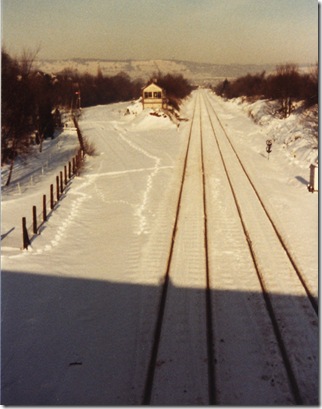
 Heath Junction snow 1982

Not in my experience. True, the winters of 1977/78, 1978/79 and 1981/82 were far worse than this one. (My 1982 diary shows that it started snowing at 9pm on 7 January and continued for 44 hours, until 5pm on 9 January.) But as my photo above from January 1982 shows, British Rail didn't run a service at all on the Coryton line in Cardiff, which is why you can't even see the tracks to the left of the signal box at Heath Junction. We were off school for a week as a result. (We had lessons in February half term to make up some of the lost time in our A level year.) So much for claims that schools never used to close because of wintry weather! And when we went on a school trip to London a week after the snow stopped, we had to go by coach as there were still no rail services between Cardiff and London. I cleared the drive at home the day before we set off (below).
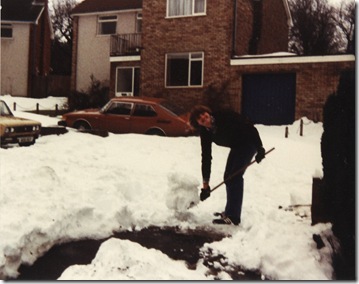
Rob clearing drive snow 1982

Back to 2009. The media and political know-alls were proclaiming mock outrage at the fact a snowstorm could bring London to a standstill. True, it was hardly a heroic performance. But as Boris Johnson said, it hardly makes sense spending millions on snowploughs that would only be used once every 10 or 20 years. My father Bob Skinner recalled London's Hounslow Council buying Swiss snowploughs for £500,000 after a bad winter in the 1960s – only to see them sitting idle until the winter of 1982!

It's also easy to sympathise with the Local Government Association's spokesman who was given a very rough time by Radio 5 Live Drive's Anita Anand. He was trying to justify why Birmingham and other authorities had announced on Monday afternoon that their schools would be closed on Tuesday, when the forecast heavy snow locally didn't materialise. He rightly said they'd have been damned whatever they had done. Working parents needed time to arrange childcare, rather than face a problem when they turned up at the school gates in the morning. Anand at least had the good grace to concede she had been unfair, after many listeners emailed and texted in support of the LGA's man. An example of how interactive broadcasting is a good thing rather than a fad.

Tonight's 5 Live Drive show also had an excellent contribution from Philip Eden from the Royal Meteorological Society. He paid tribute to the accuracy of the weather forecasts this week, which accurately predicted the snowfalls. He pointed out that the media's obsession with simplicity and brevity reduced the benefit of accurate forecasts. And, pointing out the London-centric view of the media, he showed how the weather men's accurate description of 'London's heaviest snowfall for 18 years' became, inaccurately, 'Britain's worst snowfall since 1991'.

Finally, over to Michael Fish, once Britain's best known weather forecaster. Writing in The Guardian today, he said yesterday hardly counted as a blizzard, which is drifts of eight to 10 feet. Those of us who enjoyed real winters in the 1970s and 1980s could have told you that! (The photo of our garden in Winnipeg Drive Cardiff in January 1982 shows what you get when a blizzard visits your home.)

Winnipeg Drive garden snow 1982