
A mighty transatlantic battle is in prospect over how to regulate artificial intelligence (AI). Donald Trump’s second administration seems sure to opt for the lightest of light touches, influenced by tech tycoon Elon Musk. (If Musk can tear himself away from his bizarre obsession with Britain.) The European Union has already legislated for a far more restrictive approach, with Britain likely to follow a middle way. The sensible aim must be to unleash the creative, social and economic benefits of AI while minimising the harm it may cause if abused or badly handled.
As debate raged about AI regulation, it struck me that many of the arguments deployed for and against AI and tech regulation also played a huge role in shaping the response to the railway revolution in the 19th century.
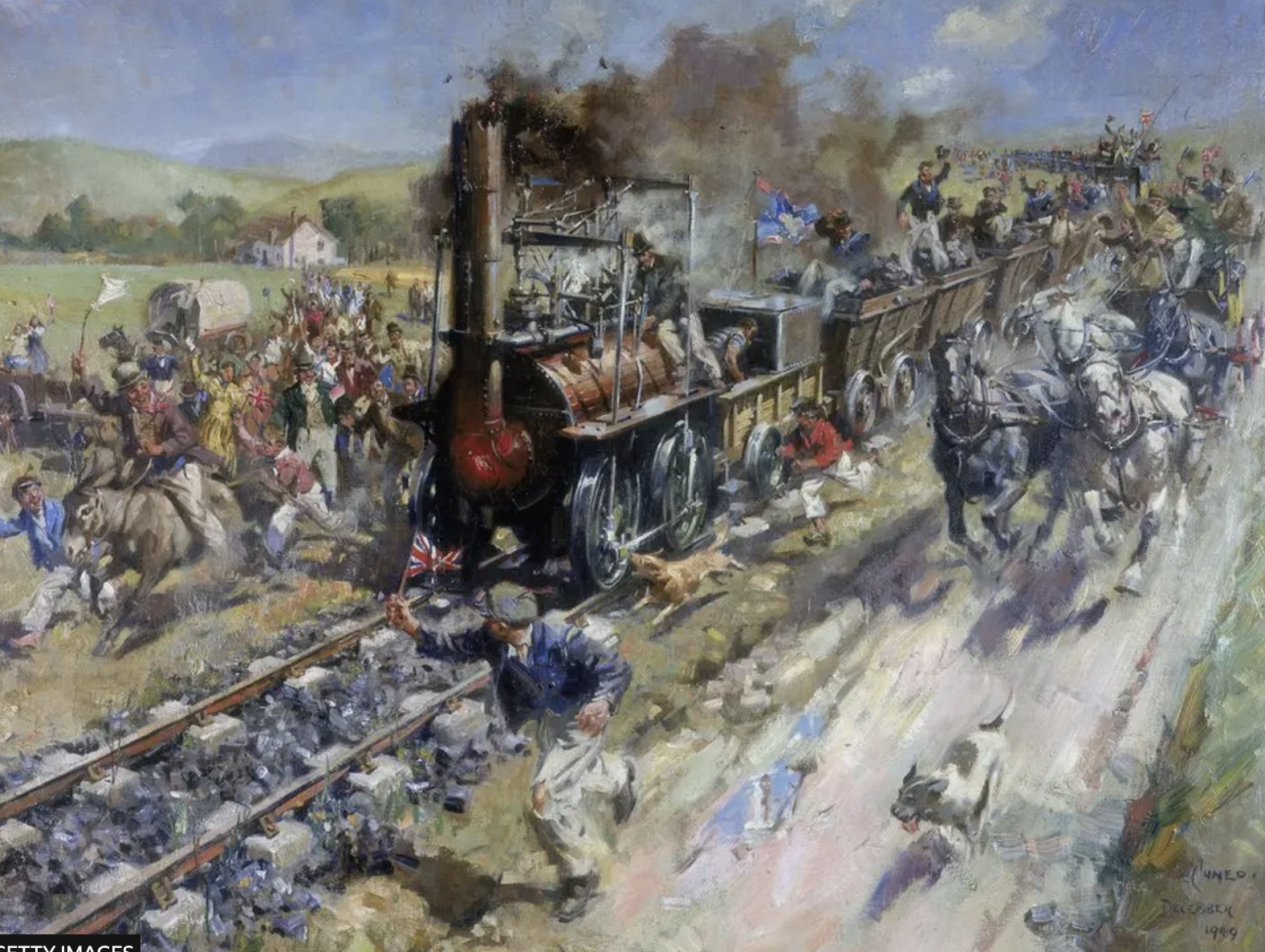
The railway age properly began in September 1825 with the opening of the world’s first public railway to use steam locomotives, the Stockton & Darlington Railway in County Durham in the north of England. After the success of the first intercity railway between Liverpool and Manchester, opened in 1830, Britain enjoyed a railway boom, as pioneers planned lines linking major cities – and serving industry, the original purpose of the iron road. By the early 1840s, railway mania had taken over, in a prelude to the dot.com boom at the turn of the 21st century. In 1844, 240 private bills were presented to the British parliament to authorise 2,820 miles of railway. Had all these been built, the £100 million of capital needed represented over one and a half times Britain’s gross domestic product (GDP) for that year. Parliament still approved half these railways.
Anything goes? The heyday of the laissez-fair state
Britain in the 1840s was a firmly non-interventionist state. The dominant philosophy was laissez-faire: small government, low taxes and the free market. Most acts of parliament were private acts to authorise new railways rather than government initiatives. Anyone able to raise money could form a railway company and apply to parliament for permission to build their pet route. The sheer volume of railway business threatened to overwhelm the Westminster legislature. But an attempt to create order by setting up a railway advisory board to vet proposed plans before they reached parliament was short lived, killed by the powerful railway lobby. (And conflicts of interest: 157 out of 658 MPs had financial interests in the railways.) This was Britain’s last chance to create a strategic rail network, deploying investors’ money more efficiently. The failure led to many investors losing most if not all their money on rail schemes that had no hope of success, again pre-empting the dot.com bubble of 1999-2000.
Continue reading

 Ertblog