Not so smart TV: no BBC iPlayer on Samsung 5400 LED TV

Visit the new Ertblog on WordPress at robskinner.net!

I bought a new TV today for our kitchen. The old one stopped working after digital switchover this week, so I replaced it with an internet-connected one that enables us to watch BBC iPlayer on TV. John Lewis in High Wycombe said the Samsung UE22ES5400 LED 22 inch TV would do just this.

IMG_2672

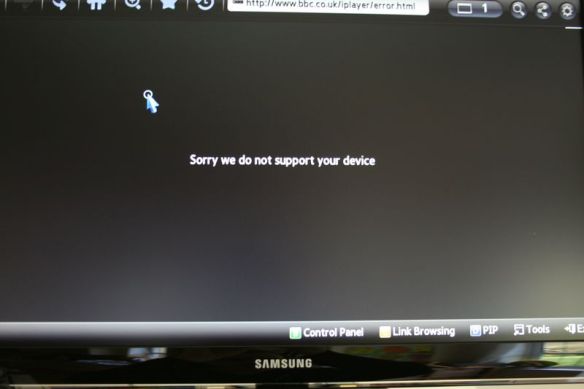
I was impressed by how easy it was to set up. But I couldn't find the iPlayer. The web based iPlayer said the BBC didn't support my device (above).

I didn't think that mattered. After all, Samsung's BBC iPlayer app features prominently on the company's website – but that was also missing:

IMG_2672

At this point, I called John Lewis. Its friendly technical help person couldn't help. He said I could return the TV – or call Samsung. I didn't think there was much chance Samsung would answer the phone late on a Saturday afternoon. But to its credit, I did get through to someone who explained after some research that the iPlayer app wasn't yet available for the 5400 TV as it was a new model but would be in early May.

So I won't be taking the TV back to John Lewis just yet.

PS: why are TV names so obscure and impossible to remember? Samsung could learn a lot from Apple. iPhone is so much more compelling and easier to remember than UE22ES5400.

Ertblog has a new home at robskinner.net. Do visit!

Goodbye, Ceefax

The BBC's Ceefax service teletext service has disappeared from out TVs after our area completed digital switchover. I can't say I'll miss it.

I've not looked at Ceefax since I went online over 15 years ago. I recognise that it was once a worthwhile innovation, giving information about news, sport and travel developments on screen at a time when we had just a handful of TV channels. But it was a frustrating system to use. The difference categories had a series of scrolling pages, and I always seem to miss the page with Cardiff City's result – meaning I had to wait for half a dozen pages to appear before 'my' result reappeared.

The BBC also split Ceefax pages between BBC1 and BBC2 – I could never remember which appeared where. And in an era before hyperlinks, you had to note the page number of the story you wanted. ITV and Channel 4 had their own teletext services.

It all makes the world wide web seem even more miraculous!


Ertblog joins WordPress

Ertblog has a new home. I've taken the plunge and created the second edition of my blog on WordPress.

I've been pondering the move for some time. Typepad has been good to me, making it easy for me to establish the original Ertblog at the end of 2005. And I've always found Typepad's customer service excellent – most recently last week when they responded to a whinge on Twitter. But I've long been curious about WordPress, and now seems the right time to start afresh.

I'm not planning to export the original blog here – it seems too much effort for limited reward. (I've read all the stories about how much effort is involved in moving from Typepad to WordPress, especially recreating images in posts.) I'll keep the original going as an archive – and will post some material on both editions, just to compare the traffic.

I've also finally got my own domain name – robskinner.net – for the WordPress version. It feels like my own home now, rather than something I've borrowed.

I'll spend some time over the coming weeks customising the new Ertblog. (Expect to see my old banner from the Typepad blog.) But it's nice to make the move.


Digital victim: Encyclopaedia Britannica ends print editions

The digital revolution has claimed another victim. Encyclopaedia Britannia will no longer be printed. The world's most famous (if you exclude Wikipedia) encyclopaedia will live on in digital form. 

The company behind Britannica pointed out in a news release that it had pioneered digital knowledge, creating its first digital version in 1981 and its first internet encyclopaedia in 1994. Encyclopedia (note US spelling) Britannica company president Jorge Cauze explained: “We’re digital, we’re mobile, and we’re social…We’re a very different company from 20 or 30 years ago." In other words, Britannica's print demise is not the final volume. 

Many will name Wikipedia as the cause of death of Britannica's print edition. Yet Wired's Tim Carmody names another suspect: Microsoft's Encarta encyclopaedia. He points out that millions bought the Microsoft reference work on CD and later DVD with their first computers. The tech giant delibarately priced the product cheaply to encourage families to buy home PCs in the 1990s. (I remember buying a couple of editions for £20 or less.) Expedia buyers were very unlikely to splash out £1,000 or more on Britannica.

This strikes me as a compelling argument. I'm not so convinced by Carmody's argument that Britannica was largely a vanity purchase. As a book-loving 18 year old, I was very envious when my older sister bought a Britannica set, along with a number of Britannica yearbooks. Britannica seemed like a wise and kind investment by parents keen to help their children learn about their world. 

Wrting this post has reminded me that I was once the proud owner of a set of Children's Britannica. I loved browsing those volumes – for study and for interest. Years later, I bought occasional editions of Pears' Cyclopaedia, but only really got back into the idea of an encyclopaedia when Encarta came along. 

Ironically, Encarta died three years before Britannica's print edition.  

Britannica's blog rightly said that change is OK. After all, organisations need to adapt if they're to survive. I'm not the right person to say if ditching print is the right move for Encyclopaedia Britannica. (But I'm not impressed by the blog's use of that awful cliched way of emphasising a point: "Every. Single. Day." That's not how you prove authority in a digital age.) 

I can't wait to hear whether Britannia has boosted interest in its iPad and iPhone editions since its announcement. This month's bold move must have been the biggest interest in Britannia for years. It's time to reap the rewards. 


I love my Garmin Edge 800

I had a wonderful Christmas surprise: a Garmin Edge 800 GPS device for my bike. Karen has always been very generous! It's been a revelation. 

Years ago, I couldn't see the point of satnav for cyclists. But I realised I was wrong late last year. The Garmin is so much more than a navigation device. It captures an enormous amount of information about your ride, from the usual bike info (speed, average speed, time spent), to heart rate info (heart rate, average heart rate, time in various heart zones) and plots all this and more online so you can share your ride – and download details of other people's routes. Even more fun, you can race against your earlier rides – and your target performance. 

Screen Shot 2012-01-21 at 21.00.55
This screenshot shows details of my ride today, uploaded to Garmin Connect. You'll gather that I set no speed records, although I knocked a modest four minutes of the time I took to ride the route on 28 December – my first Garmin ride. (Not as impressive as the four hours I cut from my Bucks century time in summer 2005!) I wish I'd had this remarkable gadget on my Land's End to John O'Groats ride in 2002…

The Garmin has given a real spur to my new year resolution to get back to cycling. And to lose a few pounds!

Life online: my 15 years on the internet

Fifteen years ago this weekend, I got onto the internet for the first time. Life has never been the same since.

Back in November 1996, life online was a revelation, despite the tardy 56k modem connection. My browser was Netscape, my search engine Altavista (I liked the name – it sounded like an appealing brand of coffee). I went online on my first PC, an Intel 486 based machine I bought in November 1994 from a long-forgotten company called Escom from its shop in Cheltenham.

I was used to company email: I was emailing within Nationwide Building Society in 1987, sending daily summaries of news coverage. But being online to the world was different. I loved, and love, the serendipity of the web: finding out about everything and anything almost instantly. Within months I'd found out from the BBC website who had become my MP in the 1997 general election. I followed progress of Ireland's historic Good Friday agreement online. And I dated the cricket bat my grandfather gave my dad in the 1930s from information we found on an Indian cricket website. Two years later, I got onto the web and external email at work at Eagle Star insurance. 

A decade and a half later, I have the internet in my pocket. I can shop, pay and enquire anytime and (almost) anywhere. I can find my way around London with an app on my phone. I follow with great interest the lives of my old school friends – even those I've not seen since 1982. I share my thoughts with the world on this blog – and Twitter. I share videos on YouTube. 

Life online is a joy – up to a point. My only concern is that our attention span is shortening. The constant stream of emails, Facebook and Twitter makes us twitchy. When we attend a lecture, many of us are more likely to be tweeting quotes than paying proper attention. (Something that I noted ironically at yesterday's excellent Institute for Government and Fishburn Hedges Media & Government debate about the respective influence of the media and social media.) We're rushing to judgement and comment, rather than reflecting on things.

But I strongly believe the online benefits outweigh the disadvantages. The internet has been a good thing. It has shared influence and power. It slightly redresses the balance of power in society – newspaper owners, politicians and big business have a little less influence over the rest of us. And we've barely begun – just wait another few years, and we'll see the huge benefits of the mobile revolution.

My first steps online were in a very different world. Back in 1996. John Major's dysfunctional government was tottering from one crisis to another. Tony Blair was a fresh faced leader who captured the imagination of the country. Major had started the disastrous denationalisation of Britain's railways. The Spice Girls dominated the charts, along with Oasis and the Fugees. The IRA ended a ceasefire, with bombings that devastated London docklands and Manchester. The country mourned the victims of the massacre at Dunblane school in Scotland. And the inventor of the jet engine Frank Whittle died aged 89. I imagine Frank Whiittle would be excited by the online revolution, which has had an even greater impact on the world than the jet age.  

PS: Apologies for using the terms internet and web interchangeably in this post. I do know the difference… 

iCloud and iOS5 calendars and notifications: what a mess

UPDATED: Monday 31 October 2011

At first, I loved Apple's iCloud, as I explained in my blogpost iCloud: getting rid of duplicate calendar entries

I thought I'd solved the one apparent problem: duplicate calendar entries. But then I discovered lots of other frustrating flaws. How could Apple launch a service riddled with so many faults? 

Here are the ones I've noticed:

  • My iPad and iPhone have access to my old Mac iCal calendars. Yet there's no sign of them on the iMac itself.
  • The iCloud calendar only includes entries since 25 September. If I want anything before this I have to tick on calendars 'from my Mac' in the calendars tab (see my blogpost above) to show them. Yet this duplicates all entries since 25 September – and recurring ones before as well.
  • The notifications service duplicates calendar notifications – even when the event appears only once on the device (through having just one calendar visible). 
  • iMessages written on my iPhone don't appear on the iPad.

As I said in the earlier blogpost, I gave up on MobileMe because of the frustration of duplicate entries. It's hugely disappointing that iCloud is even worse. Didn't Apple test the damn thing before launching it? They even had four months between announcement and launch to make sure!

I still like Photostream, though…

Is outrage driving out reasoned debate?

The Guardian's Julian Glover today raised an interesting question. Is outrage the common currency of political debate? He pointed out that commentators and columnist deal in absolute opinions. Yet real life is more uncertain. 

As Glover said, "Uncertainty comes over as weakness. Tribalism thrives. On these pages over the last few years I have sometimes expressed ideas in categorical terms about which I could never really be sure. The greater challenge for any writer is mounting a defence of compromise. It is, perversely, sometimes feeble to sound bold and bold to sound feeble."

He's right. It's ironic that the death of ideology in British politics has coincided with a far more aggressive approach to political debate. That's partly down to the 24 hours media – their short attention span and need for drama polarises modest differences. (In more ideological times, current affairs programmes like ITV's hour-long Weekend World tried to explain rather than create controversy.) The media demands instant answers, instant judgements. Reallife is not so simple. Yet a politician who says he or she doesn't have all the answers is seen as weak. (That said, wouldn't we respect an honest politician who admitted the truth more than a blustering one?)

Glover's article prompted a stream of critical comments, not least because he's leaving the Guardian to become a speechwriter for David Cameron. It's hard to think of anything more likely to inflame the passions of the Guardian readers. 

That, in one sense, proves Glover's point. I'm no fan of David Cameron, and am horrified by many of his government's policies (that broken promise not to lay waste to the NHS by yet more destructive reorganisations is high on the list). But like most voters I don't see him as the devil. I'm capable of making my own judgements about his actions and policies. 

It's not just political debate that suffers from this mock outrage. Just look at any story about Apple on the BBC or Guardian technology web pages. Critics of Apple insist that anyone who buys an iPhone or iPad has more money than sense. Apple fans claim that rival products don't work. Needless to say, neither claim is right. We all make choices. That doesn't make other people idiots because they've chosen another type of phone or computer. 

Live and let live…


iCloud: getting rid of duplicate calendar entries

UPDATED 25 October 2011

I love iCloud, Apple's new way of sharing information, documents and photos wirelessly across Macs, iPhones and iPads. But when I started using it, I was frustrated to find it copied one of the worst flaws of MobileMe – duplicated calendar entries. 

A quick Google search suggested various ways of solving the problem. But I found a very simple solution myself.

IMG_3457

On an iPhone or iPad, open Calendar, and open the Calendars tab on the top left. I had 'All from my Mac' ticked as well 'as All iCloud'. Unticking All from My Mac got rid of the duplicates.

I'm now on iCloud 9!

UPDATE, 25 October

Sadly, things didn't prove quite as simple. Everything's fine on the iPhone. But on my iPad I've now got the problem Frank describes in the first comment: clicking between calendars doesn't get rid of the duplicates. Bizarrely, I now have duplicate entries of recurring calendar items. But they're not identical: they're copies of the earliest entry, duplicated for every subsequent entry.I've got duplicates of a stack of old entries on iCal on my Mac – but I can't see any way of selecting any calendar other than iCloud in iCal. 

Apple, this is a total shambles. 

Ertblog has a new home at robskinner.net. Do visit! 

Guardian’s iPad app: good news

IMG_0053

The Guardian's iPad app

The Guardian finally released an iPad app this week. It was worth the wait.

The paper has been a digital pioneer, but (apart from the brilliant Eyewitness photojournalism app) has been left behind as the Daily Telegraph, The Times and Sunday Times have launched apps for Apple's hugely successful iPad. 

But the Guardian's effort is the most stylish of them all. The design is gorgeous, with big photos, and clear text on white background. Navigation is straightforward.

The app also takes advantage of Apple's Newsstand app, which automatically deivers new editions as they become available. That's good news: no need to wait for an edition to download before racing out of the door to catch your morning train.

Editor in chief Alan Rusbridger acknowledged in a blog post that not everyone will be happy. As he says, it's a 'reflexive, once a day Guardian', rather than the website. Many commenters complained that the app won't include comments on articles. But that reflects the fact it's a digital newspaper, not a live website. The printed paper doesn't include comments, apart from the daily letters to the editor, which also appear in the app. The criticisms show we now have different views on what a newspaper is. Traditionalist see it as a printed product, and like the apps that provide a digital version. Others think the old idea of a paper as a once a day snapshot of news is hopelessly out of date. (They'd point out that the app makes no mention of Liam Fox's resignation, which happened five hours ago.) 

The app doesn't include everything – the excellent Weekend magazne isn't included, for example. I'm sure this will follow. (The Times app's Saturday edition originally missed most of the Saturday print content, which appeared a few months later.)

But I still like the idea of the reflexive Guardian, as Rusbridger describes it. I know all about Fox's departure – I read about it on Twitter, confirmed it on the BBC news site and heard more on Radio 4's PM. I'm a Gaurdian print subscriber, and welcome the chance to download a version to read on the train on my days in London. In time, I'm sure newspaper apps will be updated more often – The Times brought out an app update to mark Steve Jobs' death last week. 

I also like Rusbridger's view of the changing Guardian: "The Guardian is many other things. You can now watch, listen to and join in with the Guardian. You can literally follow it minute by minute around the clock as it reports, mirrors, analyses and gives context to the shifting patterns and rhythms of the world's news. It's Android when it wants to be, Kindle when it chooses." He's right. The same principle applies to many aspects of modern life: we want to connext to Facebook on different devices; we want to check our diary in the same way; we're increasingly looking to shop online and on the high street, on a mobile and a PC. Companies need to change the way they offer services to customers in this ever-flexible world.

The bigger question is whether the Guardian's iPad app move will revive the Guardian's finances. The group has faced a couple of torrid years, as print sales and ad revenues fall, and the GMG invests heavily in digital. The iPad app will cost £9.99 a month, while web access will remain free, unlike at News International's titles. Will the Grauniad follow NI's example? If it doesn't, it's hard to see how the losses will be reduced significantly. A growing number of readers don't buy the print edition, and won't pay for an app while they can get all the web content for free. Yet I share the view of a few commenters on Rusbridger's blogpost: I want to contribute to the Guardian's quality journalism, and like the idea of the app. Time will tell if enough of us cough up. 

Below: photos come to life on the Guardian app

IMG_0054