Wattbike: a lesson in how not to use AI

Artificial Intelligence – AI – is all the rage. Companies the world over see it as a way to provide fast customer service, as well as to crunch data and solve problems. But my experience this week with Wattbike, a company that sells smart indoor bike trainers, shows that used badly AI can damage a company’s reputation.

I had a simple query. I wanted to order a new power supply lead for my first generation Wattbike Atom. I’ve no idea what happened to the original, but it’s disappeared since I last did an indoor turbo session in the spring.

Wattbike customer service was excellent the last time I got in touch. This time, I left a message via the website, and was really impressed to get a reply within a minute:

Hello Rob,

Thank you for your message and for checking the compatibility before placing an order. I’m sorry for any confusion this may cause. The UK Power Supply (AtomX) you’ve linked is designed for the next generation AtomX model and delivers a higher power output (12v 7A), which is not suitable for your 2018 first generation Wattbike Atom (which requires 12v 2A). 

For your 2018 Wattbike Atom, you’ll need the UK Power Supply specifically made for the Atom G1 model (Nucleus & Atom G1) with the correct 12v 2A rating. 

If you have any other questions about compatible parts or need further support, I’m here to help!

Customer Support | Wattbike
Powered by AI

The reply was obviously generated by AI, as indicated, but that would have been fine if it had solved my query. But I was surprised that it didn’t include a link to the product I needed in the online shop. When I replied asking for the link I was sent this within seconds:

Hello Rob,

Thank you for your patience. You can purchase the correct UK Power Supply for your Nucleus and Atom G1 (including the 2018 First Generation Atom) directly from our website at the following link:

UK Power Supply (Nucleus & Atom G1)

This power supply is suitable for the 12v 2A requirement of your Wattbike Atom. Please note that this is the appropriate choice for your model, and the UK Power Supply (AtomX) is only compatible with the Next Generation AtomX, not the first generation Atom.

If you need any further assistance or have any more questions, just let me know. I’m here to help!

Customer Support | Wattbike
Powered by AI

But clicking on the supplied link gave me this resounding error message:

If AI can identify a link to a product listing, surely it should be capable of making sure the link works?

When I pointed out the link was not working, I got the following admission of defeat by Wattbike’s bot:

Hello Rob,

Thank you for letting us know about the trouble accessing the UK Power Supply (Nucleus & Atom G1) link, and I’m very sorry for the inconvenience this is causing. The correct power supply for your 2018 Wattbike Atom is indeed available as a product in our range, but the direct purchase link on the website currently appears to be broken, which is why you’re seeing the “Page Not Found” message.

I will be transferring your case to a specialist team who manages our website, so they can look into fixing this issue or provide clear guidance on how you can order the appropriate power supply for your Wattbike Atom G1 or Nucleus. We will aim to respond within four working days—please avoid sending multiple emails or reaching out on different platforms about this enquiry, as it can slow down our response time. Our business hours are Monday to Friday, 9am–5pm (GMT).

Thank you again for your patience, and we’ll be in touch as soon as possible with a solution.

Customer Support | Wattbike
Powered by AI

Four passed without any contact from Wattbike. I then received the following pathetic email message:

Hi Rob, 

We wanted to let you know that we’re currently experiencing unforeseen staffing issues alongside an unprecedented level of demand on our customer service team. We’re working hard to get through the backlog and will respond to your ticket as soon as possible

To help us resolve your query more quickly, please avoid sending additional messages or opening new tickets on any channel, as this can create further delays.

Thank you for your patience and understanding – we really appreciate it.

Why did it take Wattbike four days to send this ‘don’t contact us, we’re busy’ message? Presumably the company was just as busy four days ago. Or is it a coincidence that the four working days mentioned in the bot’s surrender message have now elapsed?

It looks as if I’ll have to find the correct Atom G1 power supply from a company that cares more about customer service than Wattbike. It’s such a shame after my wonderful experience with Wattbike last year. I’m always suspicious when companies remove a customer service phone number from their website – a quick call might have established that Wattbike was out of stock of the item I needed. But four days on, I’m none the wiser. And unable to use my Wattbike Atom.

If you’re thinking of using AI to provide customer service, don’t follow Wattbike’s example. Test it thoroughly, and only set it loose on customers if you are sure it works. And whatever you do, don’t use it just to save money. The damage to your reputation could cost you far more than you save.

Marks & Spencer cyber attack: my frustrating customer story

M&S chief executive Stuart Machin

British retailer Marks & Spencer has been in the headlines for all the wrong reasons after its operations were crippled by a cyber attack. Online sales have been suspended for over a month. The company says the incident will cost it around £300 million – a third of its annual profits.

I have an M&S Rewards credit card, which gives vouchers to spend online or in-store. I intended to buy a pair of joggers with the latest coupon, but had to go into a store to buy them given the website is now just a shop window. I did this at M&S’s flagship Oxford Street store in London yesterday. The sales assistant took one look at the paper voucher, and told me that she couldn’t accept it because of the systems failure.

I was astounded. I had presented a paper voucher clearly stating it was for £25, the price of the item. How could M&S be so reliant on an electronic point of sales system that it couldn’t accept a paper voucher? Way back in the 1980s, I worked in a Nationwide Building Society branch. If the system went down, we still served customers: we noted the transaction on paper ledgers, and reconciled them later. How could M&S not have a similar back up plan? How can it be forced to suspend online sales for over a month in an online era? Stressed out teenagers sitting their GCSEs are more resilient than this British retailing giant.

We shouldn’t be surprised. M&S was slow to embrace the online revolution 25 years ago, after waiting over 30 years before accepting credit cards (other than its own charge card) in its shops in April 2000.

The voucher I tried to use expires in just over a month. The manager at M&S Oxford Circus wrote a note on it saying it should be accepted for a further month. That was good customer service, but the highly paid executives at M&S HQ in Paddington, London, should be taking the heat, not the poor bloody infantry on the front line.

Swindon’s Mechanics’ Institute: my letter in The Times

The Mechanics’ Institute in Swindon, Wiltshire, is symbolic of the Victorian belief in self improvement. It was founded in 1854 by Great Western Railway workers to provide themselves with a library, lectures, classes and, in time, a library and health services. Yet sadly this historic building has fallen into a ruinous state since closing in 1986.

My letter in The Times, Friday 28 March 2025

I paid tribute to the Mechanics’ Institute in a letter to The Times on Friday, prompted by a piece by columnist James Marriott praising Newcastle Upon Tyne’s Literary and Philosophical Society, where the father of the railways George Stephenson demonstrated his miners’ safety lamp in 1815.

Swindon was just a small village when the great engineer Isambard Kingdom Brunel chose it as the location for the Great Western Railway’s locomotive works, which opened in 1843. Within a decade, over 2,000 people worked there, many living in a railway village close by the main line. The workers paid for the Mechanics’ Institute, an initiative that was replicated in countless towns and cities across Britain.

Continue reading

Five years ago: Britain goes into Covid lockdown

Boris Johnson announced Britain’s first Covid lockdown, 23 March 2020

Five years ago today, our lives changed dramatically. Prime minister Boris Johnson announced on national TV that Britain was going into lockdown to try to stop the spread of the Covid-19 coronavirus pandemic. “You must stay at home,” he told the nation.

M&S High Wycombe, 10am, Thursday 19 March 2020

In reality, the people were ahead of the state. Shopping centres and other public spaces were already empty as we stayed away from other people. A couple of weeks earlier, I moved seats on a London Underground train to get away from a passenger who was sneezing.

I was very familiar with Covid by March 2020. As part of PayPal’s PR team, I helped with communications to the company’s teams in China and the rest of Asia from January, sharing advice on staying safe from the virus and information about office closures. We had at least daily calls with PR people in the United States, Europe and Asia. As March arrived, I was busier than ever, especially as employees in Europe were asking to be allowed to work from home. I myself decided to do just that, exactly a week before the UK lockdown announcement.

On the morning of Thursday 19 March, I took a much-needed break from work, and popped into High Wycombe for what turned out to be my last proper shopping trip for four months. I was struck by the complete absence of people, as seen in the photo inside Marks & Spencer above. I could choose any table at Bill’s restaurant for a late breakfast. The next day, I did what turned out to be the last school drop off the 2019/20 school year.

Continue reading

Reputation ruined: Bruce Ismay and the Titanic disaster

Everyone’s heard of the loss of Titanic in April 1912, the world’s most famous peacetime shipping disaster. It lives on thanks to the scale of the human tragedy and a sense of hubris: the supposedly unsinkable ship that ended up at the bottom of the Atlantic.

One man’s reputation was ruined on that deadly night. J Bruce Ismay was on board as the chief executive of Titanic’s owner, the White Star Line. As the great ship set out on its maiden voyage he seemed to have it all: wealth, power and prestige. He had succeeded his late father in 1899 as head of White Star but within three years sold the company to JP Morgan’s new shipping conglomerate, International Merchant Marine (IMM). Ismay became president of IMM and masterminded the building of Titanic and its sister leviathans Olympic and Britannic, believing that these giant luxury ships would give White Star a competitive advantage over rival lines such as Cunard. (Their size also made them ideal for the thousands of people emigrating from Europe to the United States; those travelling steerage did so in greater comfort than on most rival liners.)

There are countless books and online stories about the Titanic’s fatal encounter with the iceberg, so here I’ll focus on Bruce Ismay’s dramatic fall from grace.

Titanic’s collapsible D lifeboat, similar to Ismay’s collapsible C

In the early hours of Monday 15 April 1912, Ismay stepped into starboard collapsible lifeboat C, and into infamy. He made it clear to the American Senate inquiry into the disaster that no one ordered him into the lifeboat, giving the following reason for his entering the boat:

‘Because there was room in the boat. She was being lowered away. I felt the ship was going down, and I got into the boat.’

According to most of the accounts of that tragic night, Ismay helped load the lifeboats, calling out for any remaining women to get in. He himself recalled complete calmness: no panic and no crowds of desperate passengers fearing for their lives as the last lifeboats were lowered. In reality, Titanic’s final hour was chaotic. The crew were nervous about filling the boats to capacity. So, although Titanic’s boats could carry 1,100 or the 2,340 people on board, only 705 were actually saved. Ismay’s own lifeboat had room for a few more to board, so he wasn’t condemning anyone to a freezing cold death by getting in. The White Star line boss couldn’t look as his great ship sank below the waves, accompanied by the shocking screams of those condemned to freeze to death in the ice-cold waters of the April ocean.

Continue reading

AI regulation: a lesson from 200 years of railway history

A mighty transatlantic battle is in prospect over how to regulate artificial intelligence (AI). Donald Trump’s second administration seems sure to opt for the lightest of light touches, influenced by tech tycoon Elon Musk. (If Musk can tear himself away from his bizarre obsession with Britain.) The European Union has already legislated for a far more restrictive approach, with Britain likely to follow a middle way. The sensible aim must be to unleash the creative, social and economic benefits of AI while minimising the harm it may cause if abused or badly handled.

As debate raged about AI regulation, it struck me that many of the arguments deployed for and against AI and tech regulation also played a huge role in shaping the response to the railway revolution in the 19th century.

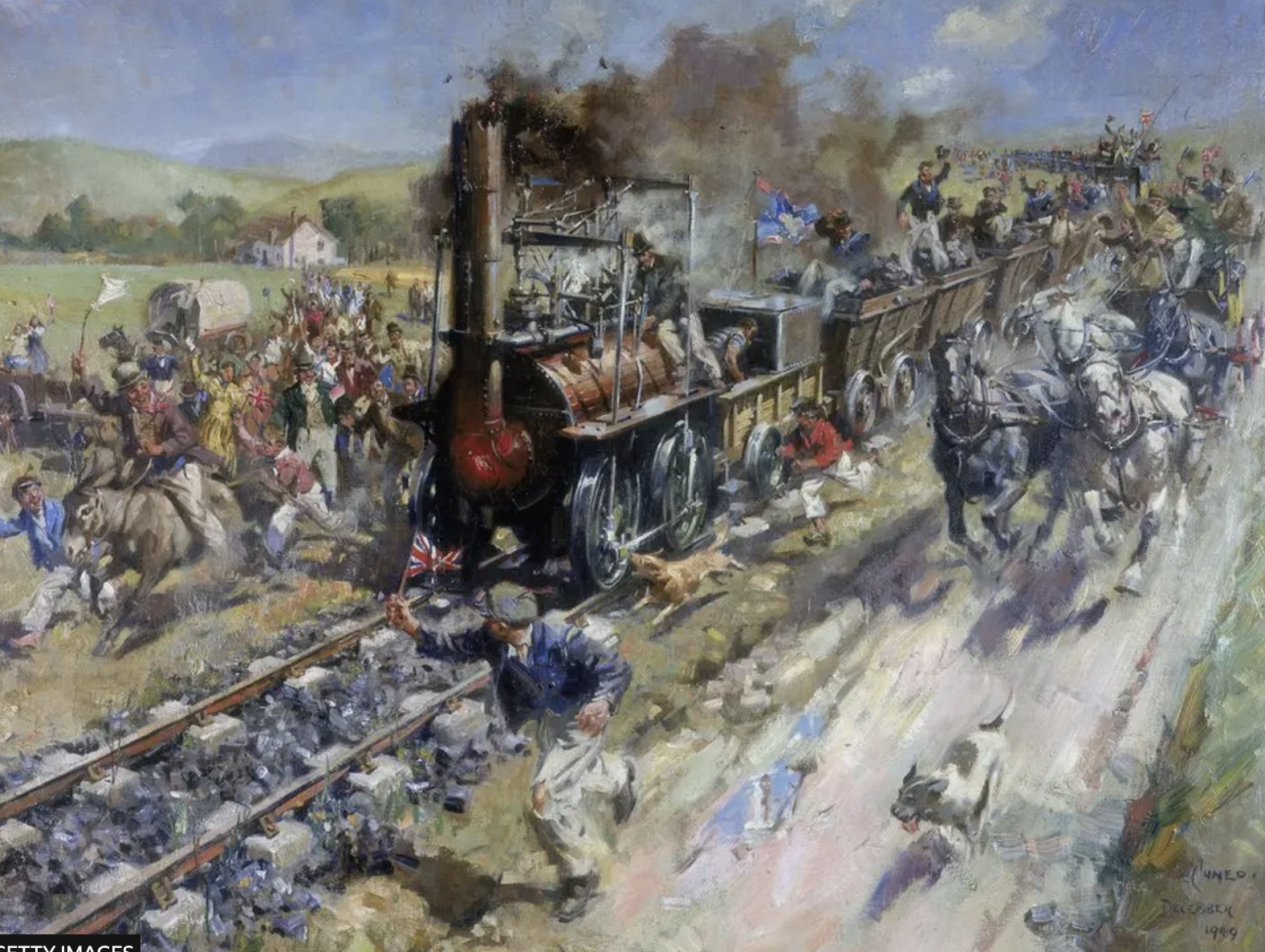
The opening of the Stockton & Darlington in 1825. Painting by Terence Cuneo; NRM/Science & Society Picture Library

The railway age properly began in September 1825 with the opening of the world’s first public railway to use steam locomotives, the Stockton & Darlington Railway in County Durham in the north of England. After the success of the first intercity railway between Liverpool and Manchester, opened in 1830, Britain enjoyed a railway boom, as pioneers planned lines linking major cities – and serving industry, the original purpose of the iron road. By the early 1840s, railway mania had taken over, in a prelude to the dot.com boom at the turn of the 21st century. In 1844, 240 private bills were presented to the British parliament to authorise 2,820 miles of railway. Had all these been built, the £100 million of capital needed represented over one and a half times Britain’s gross domestic product (GDP) for that year. Parliament still approved half these railways.

Anything goes? The heyday of the laissez-fair state

Britain in the 1840s was a firmly non-interventionist state. The dominant philosophy was laissez-faire: small government, low taxes and the free market. Most acts of parliament were private acts to authorise new railways rather than government initiatives. Anyone able to raise money could form a railway company and apply to parliament for permission to build their pet route. The sheer volume of railway business threatened to overwhelm the Westminster legislature. But an attempt to create order by setting up a railway advisory board to vet proposed plans before they reached parliament was short lived, killed by the powerful railway lobby. (And conflicts of interest: 157 out of 658 MPs had financial interests in the railways.) This was Britain’s last chance to create a strategic rail network, deploying investors’ money more efficiently. The failure led to many investors losing most if not all their money on rail schemes that had no hope of success, again pre-empting the dot.com bubble of 1999-2000.

Continue reading

The Regus car park rip off

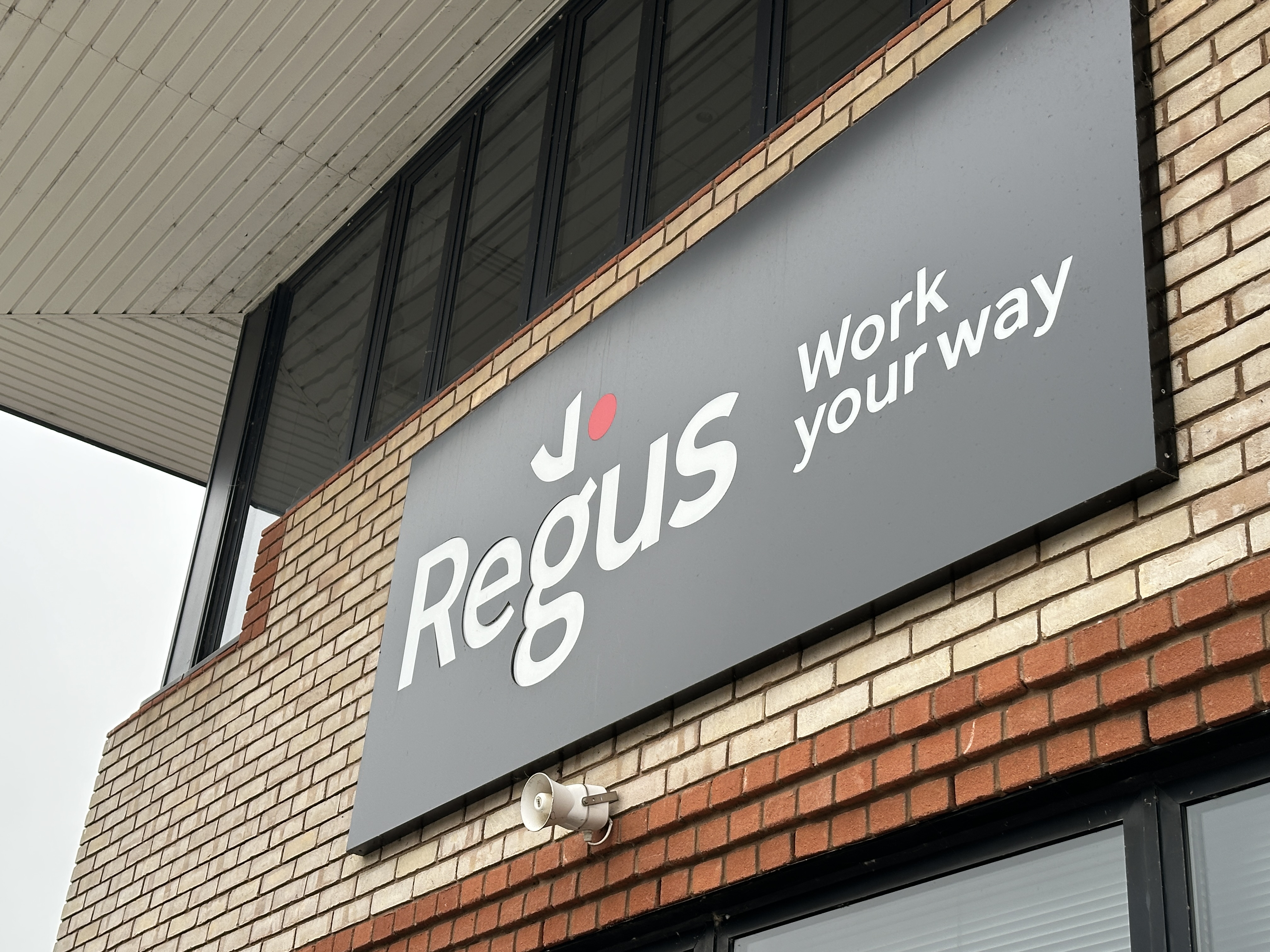
Regus High Wycombe: expensive place to park

Who’d have thought that it would cost almost as much to park at a nondescript business park in High Wycombe as it does in Cambridge’s most prestigious shopping centre, Grand Arcade? That’s the dubious distinction that the office company Regus has won for its Kingsmead business park in Loudwater, High Wycombe.

I’ve been visiting regularly as I’m receiving physio from a company based there called Ascenti. The first time I was shocked to be charged £2 for parking during my 30 minute physio session. But it got worse – I was then charged an extra 25% as a service fee. So it cost £2.50 to leave my car for the 30 minutes I was receiving treatment – just 20p less than an hour’s weekday parking in Cambridge.

Regus uses a company called Your Parking Space to collect parking charges. I downloaded the Your Parking Space app in the hope that might prove cheaper – but no.

I can understand why parking is expensive in a city like London or Cambridge, where property is expensive and good public transport is available. (I recommend the Cambridge park and ride service from Madingley Road – parking is free and you just pay for the short bus ride into town.) But the Regus rip off is utterly unjustified. No wonder the car park is largely empty.

And don’t get me started on that 25% service charge. The service is parking – and I’d already paid £2 for that. What possible justification is there for Regus and Your Parking Space to add a 25% penalty on top of that?

I should add that the daily rate of £6 is more competitive.

In praise of British Rail

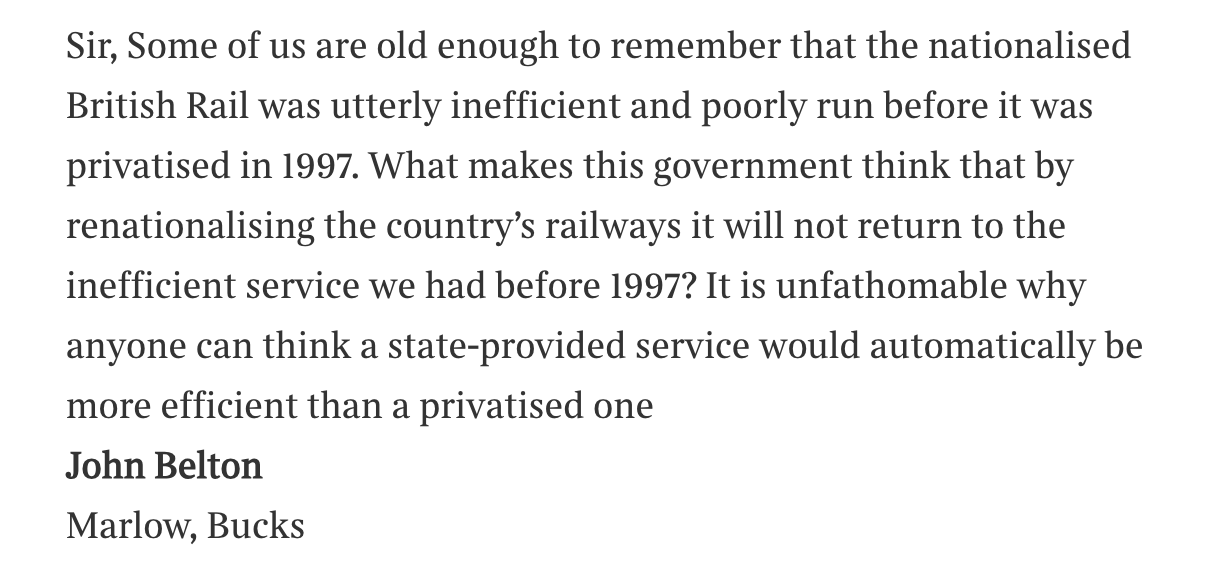
I sighed when I read this letter in The Times. Mr Belton is clearly good at a pithy rant. But his verdict against British Rail is wearily familiar and unbalanced. At least he didn’t mention the sandwiches, unlike a follow up correspondent who wrote a fair defence of the old nationalised rail network, yet fell for the sandwich myth:

Rail historian and commentator Christian Wolmar disposed of the sandwich cliche in his excellent 2022 history, British Rail. As he points out, the company pioneered shrink-wrapped sandwiches, and restauranteur Prue Leith served as a British Railways Board director. Yet long before social media flooded the world with misinformation, the myth of the curling, stale British Rail sandwich went viral, and has outlived the state owned network by three decades. The former Tory transport secretary Grant Shapps predictably promised that his (unrealised) restructuring of the rail industry wouldn’t mean ‘going back to the days of British Rail and its terrible sandwiches’.

British Rail’s track record (pun intended) was better than that of the Johnson, Truss and Sunak governments Grant Shapps served in. Especially in its last decade, when BR was rated as showing the highest level of productivity of almost all of Europe’s railways. (Oxford Companion to British Railway History, 1997.) On average, it shed 10,000 staff a year over its 50 year life, yet created a generation of outstanding leaders, such as Chris Green, John Prideaux and Robert Reid, several of whom served BR’s privatised successors.

I had first hand experience of BR as a teenager and adult, especially after moving to London in 1987. For several years, I took advantage of BR’s ‘weekend first’ offer to upgrade to first class for just £5, which made the Sunday return from Cardiff to Paddington a tranquil experience. Those journeys were in the classic InterCity 125 high speed train, one of BR’s greatest achievements, as I blogged here. (I was less impressed by the products of BR’s in-station burger chain, Casey Jones, which surpassed McDonald’s for greasy food that was an unwise choice after a few pints.) From the 1960s onwards, BR marketing was outstanding, selling the benefits of train travel and new services with wit. (Although its use of Jimmy Savile was a mistake in hindsight.) And like many families, we took advantage of BR’s Persil two for one ticket promotion in the late 1970s – the only way I was ever going to travel first as a teenager, as Dad could match his work ticket with one for me.

Yet I’m no apologist for what BR got wrong. In the early 1990s, commuting into Waterloo from Teddington was an often painful experience. I’d often wait for ages after my train was due wondering whether it would ever turn up. One morning, we got a mainline train in place of our commuter one, and I piled happily into the first class compartment, knowing that the guard couldn’t charge extra as there were no first class fares on the Teddington routes. Others showed typical British hesitation, and stood for 40 minutes in standard class.

A decade later, I was commuting on the privatised Chiltern Railways into Marylebone. It was usually very reliable, but that dependability reflected British Rail’s transformation of every aspect of the line just before privatisation: new track, signalling and trains.

Privatisation may have brought back famous railway names such as the GWR and Southern Railway, but the complexity of the privatised railway has proved an expensive and inefficient mess, as Christian Wolmar predicted at the time. Unlike in the days before 1948, the post-BR world is policed by a far bigger forest of regulation and legal agreements than the 1923-47 big four railways contended with. (Although I should note that between the wars those companies lobbied for fairer regulation to help them compete against growing road competition.)

For all my rail enthusiast nostalgia for the GWR, I am pleased that Labour is returning the railways to public ownership. Let’s hope that it will also rebalance investment away from London and the South East – and stop cheating Wales of investment as a result of the Tory decision to define HS2 as an England and Wales (not just England) project. I’m not holding my breath.

Pointless jargon: my latest letter in The Times

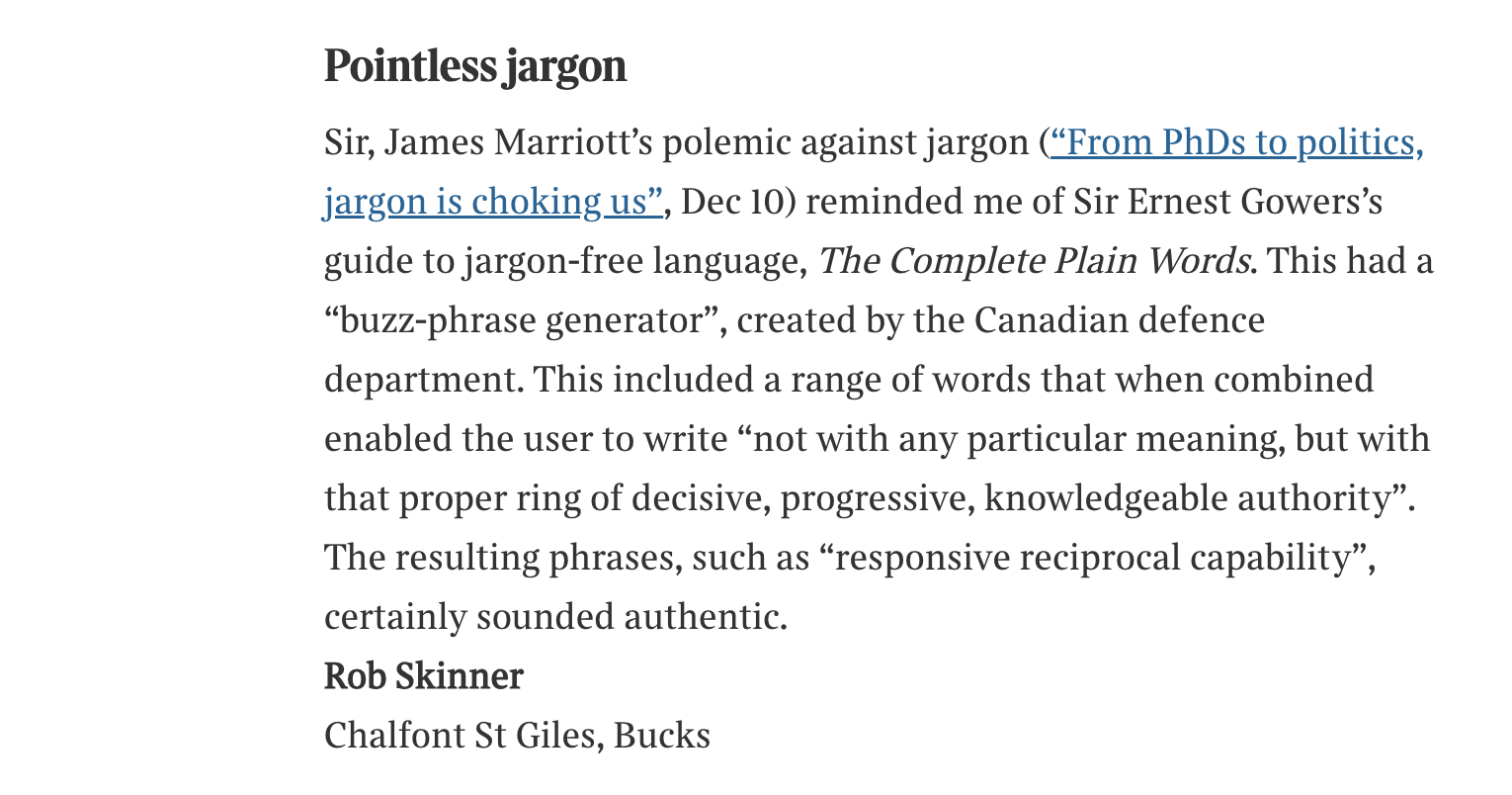
Over 40 years ago, I bought a wonderful book called The Complete Plain Words by Sir Ernest Gowers. It has guided me throughout my 37 year career in communication. Today, it featured in my latest letter in The Times – my sixth this year.

Ernest Gowers had an illustrious career in the civil service. He was Lloyd George’s principal private secretary as chancellor of the exchequer, and wrote the original Plain Words as a guide for civil servants in 1948. The edition I bought in 1984 was revised by another distinguished public servant, Sir Hugh Fraser. Both knights recognised that communication with the public should be clear and free from jargon that may baffle and annoy them. As the book says, the idea is to get an idea as exactly as possible out of one person’s mind into another’s.

James Marriott, whose article about jargon inspired my letter, was railing especially against the way jargon creates an exclusive club. Those who do not understand it are excluded. It also places a more subtle barrier, as recipients struggle to decode the meaning. As a result, jargon users are likely to spend more time dealing with an enquiry than if they’d explained themselves clearly in the first place.

I have spent almost 40 years in the financial services industry, and the past 16 years in the world of fintech – a buzz word that simply means companies that apply technology to provide financial services in a different way. (Think app-based banks rather than high street lenders.) Fintech also means combining the jargon from two industries (technology and finance) that thrive on gobbledegook.

I wrote in more detail about the fight against jargon and cliche in this 2012 blogpost.