Happy 120th birthday, Nan!

Nan 100
Above: me with Nan at her 100th birthday party, April 1991

I'm celebrating my Victorian grandmother's 120 birthday today.

Sadly, Nan won't be there to blow out the candles. But 20 years ago today she celebrated her 100th birthday, and enjoyed two further anniversaries. 

Gwendoline Annie Skinner (nee Dymond) had a remarkable life. She was born on 22 April 1891, and turned ten a few months after Queen Victoria died. The Titanic sank the week before her 21st birthday and she was married the week Alcock & Brown made the first flight across the Atlantic. She made just one flight herself: from Cardiff to Bristol in her nineties. 

She was a perfect grandmother: kindly, lovely and a source of endless stories. I was fascinated by her tales of Queen Victoria's Diamond Jubilee in 1897. And moved by her harrowing story of helping fetch her dying father's oxygen cylinders by Hansom cab in 1912.

Like many of her generation, she had a tough life in many ways. She lived through two world wars and the Great Depression. She was bombed out of one home in London's blitz. Her husband's twin brother died in the great flu epidemic at the end of the Great War. And she was widowed at 51 – exactly half way through her long life. 

Yet she had tremendous spirit. She took great pride in the success of her three children and five grandchildren. And lived to enjoy the arrival of six of her nine great grandchildren. 

Turning hundred was quite something, especially as she had been so ill during the war, fifty years earlier. (The devoted care of daughter Dorothy, whom she lived with after husband Frank's death, was a big factor in her longevity.) We all enjoyed a special party at County Hall in Cardiff. And on her 100th birthday the Lord Mayor of Cardiff visited Nan and toasted her centenary – below.

Nan 100 Lord Mayor_0001

Finally, here's a photo of Nan as a young woman. 

Gwen as young woman


Deep Horizon a year on: BP PR lessons

A year ago this week, an explosion ripped through BP's Deep Horizon oil rig in the Gulf of Mexico, killing eleven people. The three month battle to cap the well and stop the spill shattered BP's reputation. A year on from the disaster, Lansons Communications held a debate about how BP handled one of the biggest PR challenges ever faced by a British company.

BP made an early, disastrous decision: to deflect responsibility for the disaster to the operator of the rig, Transocean. That may have been technically correct (and this week BP sued Transocean for £24 billion) but meant that BP didn't express a word of sympathy for the victims for four days after the explosion. As a result, BP was on the backfoot from the start.

The other key factor in the PR battle was chief executive Tony Hayward's decision to front the company's media response. Hayward was simply the wrong man to do this. His series of disastrous PR blunders – notably a catastrophic plea that he wanted his life back, after 11 men had lost theirs – fed American anger. And his insistence on going yachting just days after Congress grilled him over BP's performance was an act of immature stupidity.

But BP's biggest problem was reality. Oil gushed into the Gulf of Mexico for almost three months. The greatest communicators in the world wouldn't have changed that stark fact. Oil spills are toxic reputationally as well as chemically: the world remembers the Torrey Canyon, Exxon Valdez and Amoco Cadiz disasters. During the crisis, a quarter of total US media coverage was about Deepwater Horizon. The intensity and duration of that media scrutiny was greater than the coverage of the 9/11 atrocities. Small wonder BP felt beleagured and unloved. 

Speaking at the Lansons event, American body language expert Joe Navarro was dismissive of Tony Hayward's media performance. "You don't ask engineers to do performance", he argued. Yet Ian King, business editor at The Times, took a different view. He applauded the very human response of another technician chief executive, Centrica boss Sam Laidlaw, who cut short a Christmas holiday to respond to a tragedy. Hayward may have done better had he concentrated on leading BP's response, leaving the media and community response to Bob Dudley, the BP executive who grew up on the Gulf coast – and who succeeded Hayward after the crisis was over.

Navarro argued that BP should have built an alliance of the organisations involved, rather than standing alone. I pointed out in the debate that this would have been impossible. Few outside the oil industry had heard of Transocean. And as events proved, the media and politicians were only interested in BP's role: big oil makes an easy target. President Obama shamelessly played fast and loose with reality – theatrically insisting on calling BP by its historic title of British Petroleum. Lansons chief executive Tony Langham said Obama demeaned his office by doing this, but recognised that 'politicians do what politicians do'. 

Ian King was very critical of BP chairman Carl-Henric Svanberg's role in the crisis. He asked why Svanberg didn't more actively support his beleagured chief executive, adding that it was a scandal that the chairman was still in office.

King was generally sympathetic to BP. he admitted that The Times initially treated the crisis as a foreign story, only later recognising its impact. He reflected on BP's dilemma over calls to suspend its dividend in a Times column in June. (At Wednesday's event, he explained how a generation of BP executives including Hayward were seared by the experience of BP's 1990s dividend cut.) And he rightly pointed out that oil companies do dirty and dangerous things so we can run our cars and enjoy our lifestyle. The oil business will never be risk free. Ian added that he never understood why British companies were always so keen to do business in America, given the litigious and protectionist instincts of the land of the free. 

Late in the debate, I pointed out that no one had mentioned social media. This was one of the biggest crises of the social media era. It led Tony Langham to praise BP's use of social media, including a reasonable apology on Facebook for Hayward's disastrous 'I want my life back' plea. Another participant said BP did an amazing internal communications job, keeping BP people informed and reassured. And BP has published a moving film called A year of change, introduced by new boss Bob Dudley, on the first anniversary of the tragedy. 

Langham pointed out the irony of criticising Hayward for insisting on taking the media flak. He asked how many times people slammed company bosses for hiding from journalists when the going got tough. (Remember how invisible bank bosses were during the early stages of the credit crunch?) Yet it takes a formidable comms chief to tell a CEO he or she's not the person to front interviews. And as Navarro said, external advisers are often better placed to do so. 

BP's experience will be studied for years to come. Last month I chaired a CIPR Corporate & Financial Group talk by Andrew Gowers, BP's head of communications during the Deepwater Horizon crisis. I said at the time that many PR people would have been partly relieved, partly disappointed, not to have been involved in this enormous story. We crave big stories – but this was a story that would have devoured almost anyone. 

I'll end with a recent comment from one of our best friends, who works for BP. She said that many BP people were frustrated that the company seemed unable to get its message across during the crisis. I'm sure the company's PR people felt the same way: BP was a company under siege. That siege only lifted when the well was capped. It's easy to look to PR people to solve problems. Sometimes we can achieve that, but reality is always our greatest resource – or weakness. 

Wednesday's event was held by Lansons Communications. It was chaired by Louise Cooper, head of Lansons Live. I was invited as head of PR of a Lansons client. 
Why RIM’s CEO shouldn’t have fled Cellan-Jones BBC interview

The chief executive of RIM, the company behind BlackBerry, has become the latest interviewee to walk out of an interview. Mike Lazardis ended his encounter with BBC's Rory Cellan-Jones after the corporation's technology reporter asked about RIM's issues in India and the Middle East, where governments have challenged BlackBerry's encryption of messages.

The interview was set up to explain the new BlackBerry Playbook tablet, RIM's answer to the Apple iPad. But RIM's PR team must have known that Cellan-Jones would take the opportunity to raise other hot topics. At first Lazardis dealt calmly with the challenge. Had he stuck to that approach, viewers would have been reassured and left to focus on the Playbook. Instead, all the talk on Twitter and elsewhere was about the CEO who walked out. 

The golden rule of media interviews is to answer the question but bridge to your key message. Cellan-Jones appears to have given Lazardis ample chance to respond and get back to talking about the Playbook. I can't help wondering how the RIM CEO would have fared against a truly aggressive interviewer, such as Jeremy Paxman or John Humphrys…

A King is (re)born: GWR King Edward II’s coronation at Didcot

IMG_0461

Great Western superpower: A King and Castle at Didcot

Today was a very special day. One of Britain's most magnificent steam locomotives was reborn almost 50 years after ending its working days in my hometown, Cardiff. The Great Western Railway's King Edward II was 'crowned' at Didcot Railway Centre, home of the Great Western Society. 

It was an emotional moment for me. As a teenager, I loved climbing over the engine at Barry scrapyard in South Wales. I made straight for 6023 on my many visits to Barry. Yet I could hardly imagine that anyone would be foolhardy enough to think that King Edward II could ever steam again. But the Great Western Society and Dennis Howells were determined to restore him to the rails. And 6023 was a lucky engine. Fate delivered it and 'father' engine King Edward I to Barry scrapyard rather than the smelters' yard. 

The Kings were the GWR's premier express engines. For most of their life they ran expresses between London and Plymouth. Several were moved to Cardiff Canton at the start of the 1960s to run expresses between the Welsh and English capitals. But the diesels were taking over, and Canton was graced by Great Western royalty for just a couple of years. King Edward II was destined to spend the next two decades in exile at Woodham's scrapyard at Barry Island – just 10 miles from Canton. 

The Barry years

King Edward II 2

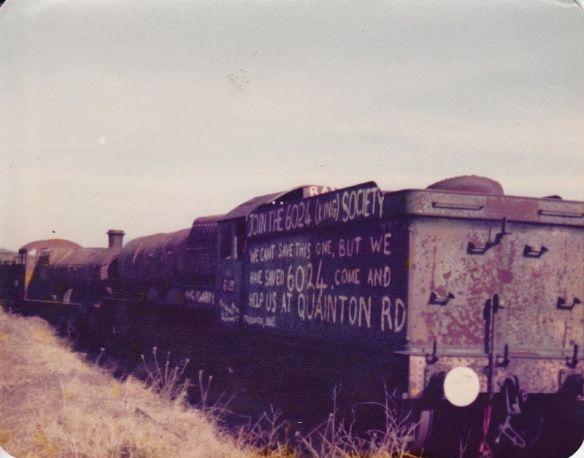
A few acres of ground beside the sea in Wales proved hallowed territory. Dai Woodham's decision not to cut up the hundreds of rusting steam engines in his scrapyard gave preservation societies the chance to save them for posterity. Two Kings were amongst their number: 6024 King Edward I and 6023 King Edward II. The photo above shows 6023 in Barry in 1979. You can see that the team restoring his 'father' engine (King Edward I) have used the tender as an advert for their own efforts. 

King Edward II

Above: March 30 1982. Here. you can see the ruined rear driving wheels, which made restoring this King such a challenging project. This was the result of a shunting accident in the 1960s at Barry. Didcot have put the old wheels on display (below, with Owen and Karen). We were told today that 6023's three pairs of driving wheels were made by three different owners: GWS; GWR and BR.  

IMG_0543

A King reborn

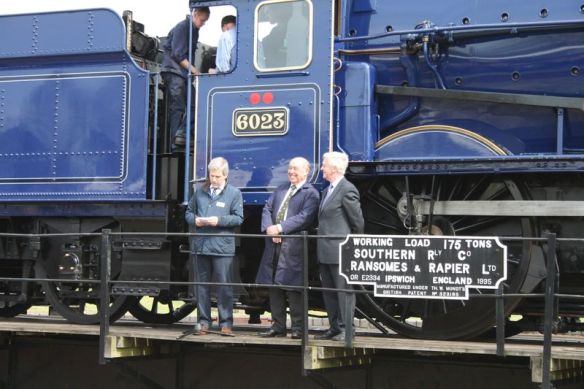
Didcot put on a magnificent show today to mark 6023's rebirth. Karen bagged us a prime spot in front of the turntable, where the coronation took place. Steve Davies, head of the National Railway Museum, paid tribute to everyone who made this emotional event possible – especially Dennis Howells, the project leader. It has taken over 20 years since the GWS took on mission impossible, but today made it all worthwhile. The photos below show the ceremony. We love the fact that GWS chose the very unusual early British Railways blue for 6023's rebirth. It suits the King and makes a change from the more common GWR and BR liveries. Didcot will host an even more royal occasion on Easter Saturday, with 'father and son' kings Edward I and Edward II in steam – the first time two Great Western Kings have worked together since the year the Beatles had their first hit, 1962.


IMG_0492 

IMG_0507

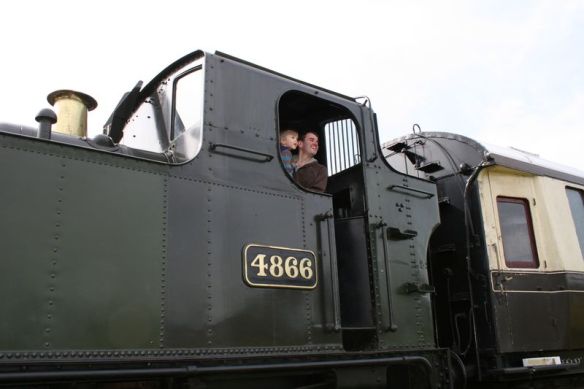
Finally, two year old Owen had a brilliant day. He loved seeing the King, Oliver (4866 0-4-2) and Duck (0-6-0PT). 

IMG_0471

IMG_0520

Above: Owen and me on the footplate of 4866, the locomotive that launched the Great Western Society 50 years ago. The GWS has done a magnificent job restoring and conserving the Great Western, Britain's longest lasting and best loved railway.

PS: Visit the new Ertblog on WordPress at robskinner.net!

(What’s the narrative) morning glory?

(With apologies to Oasis…)

Why do people feel simple words aren't good enough? This question has featured before in Ertblog. I called it word inflation in a January 2008 post asking if we need a language policy committee

My current gripe is the way the lovely word 'story' is being replaced by 'narrative'. Columnists seem the worst offenders, as regularly seen in The Guardian's comment pages:

"Privately, they know human tragedy is a raw material ready to be forged into facile tabloid narratives..Richard Peppiatt

Why do they do it? Surely journalists of all people should know better than replace simple words with overblown buzzwords? 

If you can't beat them, join them. Here are a few suggestions:

Bedtime narrative

Rags to riches narrative

Tell us a narrative

Narrative time

Same old narrative

Narrative teller

Love narrative

Never ending narrative (sorry, Limahl…)

Multi-narrative car park (oops, wrong storey…)


Twyford, Finmere and Calvert face high speed rail challenge – again

GCR

Above: the Great Central main line being built, 1890s. Photo: SWA Newton

BBC Radio 5 Live's Drive programme tonight featured protests against the proposed high speed rail line HS2 by villagers in Finmere, Calvert and Twyford in Buckinghamshire and Oxfordshire.  

The people interviewed explained how the rail link would spoil their villages and the countryside around them without bringing them any benefits – other than the chance to watch a train tearing through at high speed. 

The comments echoed those of friends and neighbours in Chalfont St Giles, which is also on the route. (See my earlier post on HS2 and Chalfont St Giles.) But I was intrigued because Finmere, Calvert and Twyford lost an earlier battle against a new main line. In the 1890s, the Great Central Railway's London extension cut through this part of the world. It was the vision of Sir Edward Watkin, who dreamt of a mainline from the north of England to the continent via a channel tunnel. Its modest London terminus at Marylebone is one of the few remaining monuments to Watkin's dream – or folly. Most of this magnificent line was closed in 1966.

Now the peaceful countryside that once echoed to Great Central expresses faces another rail invasion. Unlike the Great Central, HS2 will have no local stations or trains. But Watkin would have approved this bold project, regarding protest as a mere inconvenience. It will be interesting to see if the 21st century protesters are more successful than their Victorian predecessors. 

PS: the Great Central's construction created far more destruction in Leicester and Nottingham than in the villages on its route. In the words of LTC Rolt, it 'cut ruthlessly through the heart of the old city' of Nottingham. Photographer SWA Newton recorded the birth of the line in a series of extraordinary photos, including this graphic image of Nottingham, below. 

GCR 3