Census memories

Gwen as young woman

Above: my grandmother. She appeared in nine UK censuses, starting in 1901

We completed the 2011 UK census online last night. It felt odd but good to be taking part in this ancient ritual in such a modern way. 

I've seen a lot of criticism of the census in the media. The usual civil liberties crowd have condemned the amount of personal information required. I can't see what the fuss is about: how can government plan for future services if it doesn't know anything about us? 

The Office of National Statistics is obviously still coming to terms with online services. When we filled in the section about our two year old son, it asked for his marital status, and queried whether he looked after family members! (More sensibly, it didn't ask for employment details.)

For me, the census is a significant, even moving event. Almost 20 years ago, my grandmother appeared in her last census, the day before her 100th birthday on 22 April 1991. She was born 17 days after the 1891 edition, and first appears in the 1901 census for Cardiff, Glamorgan as Gwendoline Dymond, aged 9 years old. She would have taken part in 10 censuses had 1941's not been cancelled because of the second world war. It's very moving to be able to look her up in the 1901 census, which took place less than three months after Queen Victoria died, and two years before the first aeroplane flew. 

Surprisingly, I have vivid memories of my first census in 1971. This is purely because my mother volunteered to help. She collected the forms in Whitton, Middlesex, and made sure people had returned their forms. (She complained that one nasty man was very aggressive.) But the main reason I remember the 1971 count was that it gave me time with my first love, Helen! I may have only been seven (Helen was about 18 months older), but I stayed the night at Helen's house while Mum was on census work; in return, Mum looked after Helen while her mother was on census duty. We moved back to Wales shortly after, but I still remember the special time Helen and I spent together thanks to that long-ago census!  

Remembering South Glamorgan – the locomotive and the county

IMG_0421

Owen and I love trains. He was thrilled when I dug out my 1970s and 1980s model engines from their hiding place in the loft last month. Every weekend, I put together a short length of track so he can enjoy seeing them run. I quite like it too…

Today, on a visit to London, I spent a happy quarter hour admiring more modern model locomotives in ModelZone in Holborn. I was just browsing, but suddenly I spotted a fine Hornby OO gauge version of 56 032 Sir De Morgannwg/County of South Glamorgan. This was a powerful class 56 engine built for heavy freight work. Minutes later, I was heading for my next meeting having bought the engine, despite having nowhere to run it other than our weekend track.

It was an impulse buy, but there was a reason for it. My father Bob Skinner was public relations manager for the county of South Glamorgan from the authority's birth in 1974 until 1982, when he retired. He must have been delighted to have seen the county's name immortalised on an impressive railway engine. I can't wait to show him the model when we stay with Mum and Dad in Penarth this weekend. (Owen will be thrilled too!)

The class 56 engines played an important role in the South Wales economy, double-heading Britain's heaviest trains from Port Talbot docks to Llanwern steelworks in the 1980s. Dad's friend, Western Mail editor Duncan Gardiner, officially named one of 56 032's sister engines after Wales's national morning paper at Cardiff Central in 1981. Bizarrely, the first 30 engines in the class (but not 56 032) were built in Ceaușescu's Romania as Brush at Loughborough didn't have capacity to build them. That proved a disastrous mistake. 

Ironically, 56 032 outlived the county whose name it carried. In 1996, South Glamorgan was abolished and Cardiff became master of its own destiny again. But Owen and I will enjoy the engine – and when he's older I'll explain its link with his grandfather. Meanwhile, here a YouTube clip of the engine going through Cardiff Central in 1996. 

Supporting the ferry to Skye

Scotland sea loch still

I've never been to the Isle of Skye in Scotland. The nearest I've come is the gorgeous road along Loch Linnhe (above) on my unforgettable Land's End to John O'Groats bike ride in 2002. So my decision this week to make a donation to support the ferry from Glenelg to Skye was unexpected.

I was prompted entirely by a tweet by Christopher Main (@RestlessNative2), retweeted by Nicky Campbell, showing photos of a man driving the same car onto the ferry in 1936 and 1992. You can see the two shots on the Glenelg Skye Ferry Blog. The ferries to Skye were threatened by the opening of the bridge to the island in 1995. (The bridge was controversial as it was funded by a Private Finance Initiative that imposed outrageous tolls. Devolution meant Scotland was able to buy the bridge and abolish the tolls.) The Glenelg crossing is unique, as it's a 'turntable' ferry, run and supported by the local community. 

Ferries are special, especially when they cross small estuaries and sounds. I love cycling onto cross channel ferries (though it's over 10 years since I did this), and have long found the idea of island hopping by ferry very appealing. So I hope the Glenelg to Skye ferry lasts for many years. 


Real trains at Marylebone

IMG_2093

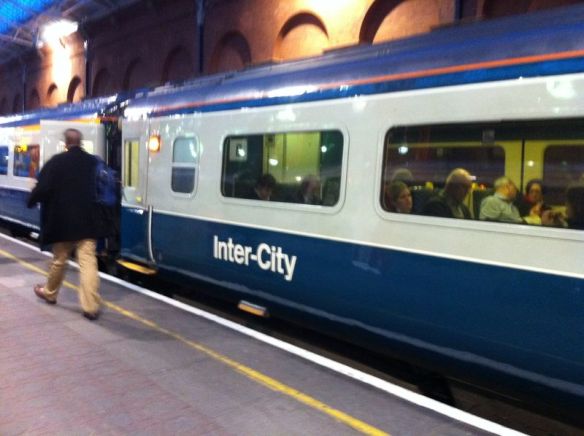
Once upon a time, Britain had real trains. Shiny locomotives hauled elegant rakes of coaches. But then our railways discovered so-called multiple-units: powered coaches. Efficient but soulless. 

So I was delighted to find a real train at Marylebone tonight: a train of British Rail blue and grey coaches from the 1970s. Sadly, the sight reflected the demise of Chiltern's sister company, Wrexham & Shropshire, whose train this was. (See my wistful post about Wrexham & Shropshire's last day.) But it was good to see a reminder of the days when a train was a train. 

PS: the 'pushing engine' carried the livery of another departed rail company, English Welsh & Scottish Railway.

IMG_2091

Coalition blues – why the Liberal Democrats need an assertiveness course

The Guardian backed the Liberal Democrats in last year's general election, along with the party's subsequent decision to enter a coalition with the Conservatives. That government has hardly proved a triumph for its parties or the people. So it was hardly surprising to see the paper in a leader today urging the Lib Dems to fight for what they believe rather than staring at their feet whenever the government does something unpopular or unjust. 

Cynics have, unsurprisingly, condemned the Guardian's assertion that the Lib Dems have no choice but to stick with the coalition. 

I too backed the Liberal Democrats at last year's election. I too saw little option but the current coalition, given Labour's rejection of an alternative partnership – and the fact a so called progressive alliance would need every other party in Commons to support it. (Oh, and Labour's crushing electoral defeat.) But Nick Clegg and his party have played their hand disastrously badly since May 2010. They've allowed the Tories to break an election pledge not to reorganise the NHS. (A stupid move not included in the coalition agreement.) They've cheered on the biggest public spending cuts since before Hitler's war. And their most respected leader, Vince Cable, is hugely diminished after falling for a crude trick and losing the chance to decide the outcome of Rupert Murdoch's bid to create an even more dominant force in British broadcasting by taking over the whole of BSkyB. 

Above all, the Lib Dem leaders seem far too comfortable in their ministerial limos and offices, and far too little concerned about the catastrophic rush to slash and burn public services. Small wonder we hate and distrust politicians when all three main UK parties rushed to reassure us during the election that services wouldn't be axed right left and centre. Now, we face the mad axemen and the usual pointless, expensive reorganisations. We see a government in disarray, acting as arms seller to Middle East dictators while trying to talk up democracy in the region; trying to flog off England's forests to the highest bidder while pretending to be green; and generally getting many other things so badly wrong. 

It's not too late for the Lib Dems. The next few years will be tough but if they start asserting themselves, they stand a chance of avoiding oblivion in 2015. And Britain would be a slightly better place to live as a result.