Light at the end of the tunnel: Tesco finally opens in Gerrards Cross

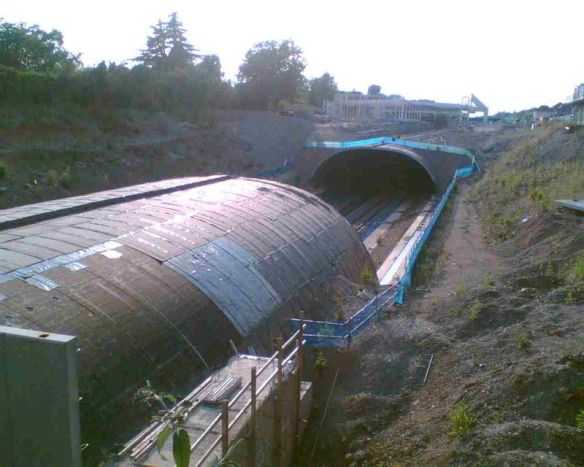
Tesco opened its latest store today, at Gerrards Cross in Buckinghamshire. The opening comes more than five years after a new railway tunnel created to provide a site for the store collapsed. The incident on 30 June 2005 came just minutes after my Chiltern Railways train passed through the tunnel.

The irony is that many in the village campaigned against Tesco, yet saw the retailer win a planning appeal. The tunnel collapse meant the village centre was bighted by constriction work for over half a decade. Work didn't resume until 2009, because of safety concerns and the replacement of the original contractors, Jackson Civil Engineering of Ipswich. 

Here's the photo I took of the ruins just days after the tunnel collapsed in 2005. And here's my blogpost about Tesco Gerrards Cross a year after the incident. 

Tesco Gerrards Cross

Beware anti-virus scam, says Get Safe Online

Britain's online safety campaign, Get Safe Online, today received blanket media coverage for its warning about an anti-virus scam that targets huge numbers of people across Britain. Criminals call people claiming their computers have a virus. They then persuade them to pay for and download software they say will remove the virus. But there's no virus – in reality, the victims are paying to infect their own computers with 'malware' that enables the conmen to steal their financial details and even their identity. 

Get Safe Online's managing director Tony Neate took to the airwaves early today to explain the scam to Radio 5 Live Breakfast's Shelagh Fogarty and BBC Radio 4 Today's John Humphrys (amongst others). And I was pleased to play my part, spreading the word on radio stations from Cumbria to Jersey, and from Cornwall to Lincolnshire. (PayPal is a long-standing sponsor of Get Safe Online.) 

Many of the interviewers I spoke to reported that they or their friends had received such calls, underlying the extent of the problem. 

Ironically, this con takes advantage of our growing awareness of the need to protect our computers against viruses. The fraudsters claim to be working with well known IT companies. Yet almost 90% of us now have anti-virus software on our PCs, making it much less likely that we'll fall victim to a virus. 

The scam isn't a new one: the Guardian's Charles Arthur was one of the first journalists to highlight the issue, along with Computer Active's Dinah Greek. Get Safe Online was concerned enough to campaign against the scam during its high profile Get Safe Online Week. Its research suggests that almost a quarter of UK internet users have had one of these calls. We hope that Britain's computer users are now on alert to defeat the conmen. 

Note: Get Safe Online is a joint initiative between the Government, law enforcement, leading businesses and the public sector. Its aim is to provide computer users and small businesses with free, independent, user-friendly advice that will allow them to use the internet confidently, safely and securely.

Britain makes joking a crime – official

Can you imagine a country in which telling a joke could give you a criminal record? Welcome to Britain, 2011. 

I've always been sceptical about warnings from civil liberties campaigners that Britain is fast becoming a police state. But I was wrong. We're fast losing our sense of humour and our love of essential freedoms. Government and the criminal justice system seem hell bent on using the terrorist threat to sweep away the freedoms and tolerance that once set us apart. 

So it should have come as no surprise that a foolish joke by a 27 year old man should have resulted in his conviction, and the failure of his subsequent appeal. Paul Chambers, frustrated by the closure of an airport near Doncaster, sent the following message on Twitter "Crap! Robin Hood airport is closed. You've got a week and a bit to get your shit together otherwise I'm blowing the airport sky high!!" He was held in custody for seven hours in a police cell, which should have been plenty of time for the authorities to realise this was a stupid joke not a terrorist threat. Yet mindless prosecutors still decided to waste public money taking him to court. Worse still, a judge called Jacqueline Davies upheld the conviction, as The Guardian reports, bizarrely claiming "Any ordinary person reading [the tweet] would … be alarmed." Any ordinary, out-of-touch, foolish judge maybe, but few other people. More sinister still, the Crown Prosecution Service deliberately prosecuted Chambers under legislation against nuisance calls rather than laws against hoax bomb threats because they required less evidence of intent. 

Any sensible person would have recognised that joking about blowing up an airport was foolish and in bad taste. I suspect Chambers quietly wishes he'd acted more wisely. But that's no reason why he should end up with a criminal record, a £1,000 fine and lose his job. Stephen Fry has offered to pay the fine. Let's hope the backlash against this stupidity makes us more vigilant in the defence of traditional British freedoms.  

Isn't it ironic that the airport at the centre of the storm is named after an outlaw? Looks like the authorities were determined to create another folk hero…

BBC strike: who’ll speak for the poor licence fee payers?

This week's BBC NUJ journalists' strike was yet another own goal by the corporation. The BBC has made a habit of destroying its own reputation – a dangerous indulgence when Rupert Murdoch and the Conservative-Lib Dem coalition appear intent on cutting the Beeb down to size.

It was hardly surprising that BBC stars Huw Edwards, Nicky Campbell and Fiona Bruce decided to look after their own rather than the people who pay their impressive salaries through the licence fee. It was horribly depressing on Friday morning to hear Radio 4's Today programme and Radio 5 Live Breakfast struck down by the self-indulgent strikers. At 7.40, Today was replaced by a discussion about Churchill and 1940 – if in doubt, talk about the war… And Newsnight's usually sensible Michael Crick said "I regard listening to or watching the BBC as strike breaking." What planet is this man on? Does he realise that we poor licence fee payers get no refund as a result of his self indulgence? I trust he won't be paid while he is on strike.

That's not to say that the BBC's management deserves any sympathy. They have lined their own pockets and utterly mishandled almost every challenge they have faced, from Jonathan Ross's enormous salary to the appalling Ross-Brand call to Andrew Sachs. I have some sympathy for the poor bloody infantry in the BBC. But the days of generous final salary pension schemes are over. The message to BBC journalists is clear. Strike if you must. But don't be surprised if you end up helping to destroy the greatest cultural institution Britain has ever created. And don't expect any sympathy if that's the result. We'll be the victims, not you.

The Times they are a-charging: thoughts on those paywall figures

Photo

Above: The future of paid for online news? The Times iPad app

Britain's media industry has been desperate to find out how many people have paid for online access to The Times and Sunday Times since News International installed its paywall in July. Ni finally issued figures this week, declaring that it had sold 105,000 'digital products' since July.

Media commentators have had a field day with the data. The Financial Times reported that experts doubted the figures, claiming they were vague or even an example of 'chicanery'. Robert Andrews at www.paidcontent.co.uk suggests that just 0.25% of Times Online readers have converted to paid subscribers (rather than pay-per-day customers). 

My view? I don't think we can read anything into these figures. We simply don't know enough to decide how well News International is doing. That 105,000 includes people on the introductory £1 for a month offer. It presumably includes people who have cancelled their subscription. Above all, it's just four months since NI launched the first paywall at a major British mainstream, mass market news website. NI will experiment with new offers, new products and new payment methods. It has enormous marketing clout. It will make this work. 

The critics suggest a host of reasons why the NI experiment won't succeed. They argue that NI is bound to fail while rival news sites such as the BBC, the Guardian and Daily Telegraph remain free. They suggest that NI is breaking a fundamental rule of the web: that charging for content is wrong. And they point out that the Times and Sunday Times have cut themselves off from online and social media communities – who's going to tweet links to stories that are locked behind a paywall? Oh, and many see Rupert Murdoch as the devil, and while they may have been happy to accept his content for free, they won't pay for it.

I don't accept the philosophical argument that all online content should be free. Why? If you value something, why wouldn't you want to pay for it? I am happy to pay for the BBC through the licence fee because I value its content and don't want that content to be scarred by advertising. I take the same view of online news. Good journalism costs money. True, I'm very happy if news organisations are happy to give it away for free. But I doubt this is sustainable as print sales fall and a generation grows up with the idea that online is the place to go for news. 

I started this post with a screenshot of the Times iPad edition. This might just show show the way to make paid for content work. (I recognise I was sceptical about this when the iPad was announced in January, but I might be wrong.) I'm not a natural Times reader, but I've thoroughly enjoyed the iPad edition this week after discovering that my online subscription includes the iPad app content. (I was sure it was separate.) The best thing is that I can download the day"s paper and then read it all offline, such as at my parents', or on a flight to San Francisco. The app isn't perfect – navigation is confusing and inconsistent – but overall I love the Times on the iPad. I'd happily pay extra on top of my Guardian print subscription to get an iPad issue. (And for the Media Talk and Tech Weekly podcasts if the Guardian decided to charge for them.) 

For me, that's the secret to paid content success. Experiment to find out what hits the spot for various customer segments. For some regular print readers, it may be adding an iPad edition for an extra £5 a month. For some online customers, it might be occasional print editions for an extra sum. News International seems to think culture is the only way to lure subscribers. I'm not a complete philistine, but it does nothing for me! Content, not culture, is king.

Disclosure: I am head of PR for PayPal UK. PayPal has pioneered payment services for digital goods, including online news. The Financial Times announced on 27 October that it was working with PayPal to further drive online subscription growth. 

Norton Fitzwarren: lightning can strike twice

Some places evoke memories of tragedy. We remember Hungerford for the 1987 massacre, and Aberfan for the 1966 disaster. 

On Britain's railways, the small village of Norton Fitzwarren near Taunton has similar associations. The Great Western Railway's mainline to the west runs through the village. The GWR had the proudest safety record in Britain, and went 50 years from 1890 to 1940 without a serious accident – an extraordinary achievement, reflecting the GWR's tireless efforts to prevent accidents. Yet the two disasters bracketing that period both happened at Norton Fitzwarren. 

The 1940 Norton Fitzwarren disaster struck 70 years ago today, during the darkest days of the war. It's hard to imagine a set of circumstances more likely to cause a disaster than those of 3 November 1940. The night was wet and windy. Train driver Percy Stacey had recently been bombed out of his home in London as the capital endured continual night bombing. Driver Stacey and fireman Seabridge took over express locomotive King George VI at 8.25pm on that wet and windy wartime night, to work the 9.50pm express from Paddington to Penzance. They were due to work it as far as Plymouth.

The train was already running over an hour late when it arrived at Taunton at 3.30am, as a result of an air raid on Bristol, which held the train in the city for more than an hour. We can barely imagine the impact this would have had on driver Stacey, who had lost his home in an air raid in London just days earlier. But he pressed on.

The stage was set for tragedy. Stacey would have expected his train to have a clear run on the main line. But because of the delays, the signalman at Taunton decided to let a newspaper train run non stop on the main line, leaving Stacey's train to continue on the relief line, which ended at Norton Fitzwarren. Stacey mistook the green lights of the main line signals for those applying to his train. As Stacey's train approached the end of the relief line, the newspaper train overtook it on the main line. Disaster was inevitable. 

At 3.48am on that dark November morning, the 89 ton King Edward VI jumped over a ditch and fell on its side. The overtaking newspaper train was showered with ballast thrown up by the crashing train. Tragically, fireman Seabridge and 26 passengers were killed. 

Driver Stacey escaped from the wreckage and struggled through the icy waters of the neighbouring flooded field to raise the alarm. Can you imagine how he must have felt? He would have been desperately tired, cold and wet. He'd have wondered whether his family was safe after another night's bombing. But more immediately, he'd have been shocked to the core by the fact his train had been wrecked, leaving him wondering what he had done. 

The irony of the disaster was that the GRW's pioneering safety measures should have prevented it. Over 30 years earlier, the company had invented 'automatic train control' (ATC), which automatically applied the brakes if a driver missed a 'distant' warning signal. The driver retained the ability to dismiss the ATC warning and the resulting brake application. At Norton Fitzwarren, driver Stacey did just that, which meant the ATC could not prevent tragedy. 

Norton Fitzwarren 1940 was a rare blot on the GWR's safety copybook in extraordinary circumstances. For 50 years, countless reports on railway disasters urged companies to follow the GWR's example and adopt ATC. It took the 1952 Harrow and Wealdstone catastrophe in which 112 people died before British Railways adopted a national ATC system, called AWS. But the GWR system survived until the early 1980s on parts of the old railway's network. The Great Western wasn't perfect, but its commitment to safety remains one of its greatest, proudest legacies. 

You can read the official Ministry of Transport inquiry report into the 1940 disaster by Lieutenant Colonel Mount here. I also recommend AR Kingdom's excellent account in The Railway Accident at Norton Fitzwarren, 1940, by ARK Publications (ISBN 1 873029 10 1).