Ending royal discrimination? A contradiction in terms

The big news on the BBC today was the story that prime minister Gordon Brown has talked to the Queen about giving royal women equal right to succeed to the throne and ending the ban on the heir to the throne marrying a Catholic.

Brown said, "I think in the 21st Century people do expect discrimination to be removed."

This discrimination is wrong. But I can't get too excited about the fact Princess Anne's claim to the throne was overtaken when her younger brothers were born. After all, over 47 million other British adults are prevented from becoming our country's head of state because we have a monarchy.

Living with Teenagers: The Guardian names the author

I was surprised to find my blog had had hundreds of extra visitors over the last couple of days. The mystery deepened when I found they had all arrived at Ertblog via a Google search about The Guardian's Living with Teenagers column, which ended in June last year.

Tonight, I solved the mystery. The Guardian's G2 section revealed the name of the author: Julie Myerson after, it seems, days of speculation. Myerson has been the subject of a barrage of criticism for using her son's drug use as the subject of a book, The Lost Child. Critics described her actions as a betrayal of motherhood. Similar criticisms were made of her Teenagers column. The Guardian has now removed the columns from its website now the author's identity is public.

My Ertblog post about that column ranked fourth in a Google search on the subject – hence all those visitors!

Is the media making it harder for Northern Ireland to overcome the dissident threat to peace?

The murders of two British soldiers and a policeman in Northern Ireland by dissident republican terrorists have cast a depressing spell over the territory.

It's a curious reflection of the calculating nature of news – and how Northern Ireland has changed dramatically – that the killings would barely have hit the front pages had they happened in Iraq of Afghanistan.

In the days after the atrocities, the British media paid huge attention to the language used by Sinn Féin politicians in their response. Radio 4's Today programme interrogated Sinn Féin leaders on the subject two days running, leading to Gerry Adams accusing John Humphrys of living in the past. The Daily Mail in a leader demanded that Gerry Adams express genuine sorrow for the soldiers' killings. It added that Adams' "callous and ambiguous response makes us all suspect that Adams hasn't really renounced violence at all".

Like many, I found Sinn Féin's words – it said the killings were "counterproductive and a strategic mistake" – chilling. But the Daily Mail's leader writers are the last people to understand or care about the sensitivity of language in Northern Ireland. It simply ignores the fact that the dissidents are at war with Adams rather than the British authorities. We may loathe Gerry Adams, but his painstaking efforts have carried the vast majority of the republican community with him on the road to peace. It's no comfort to the families of the victims, but the fact no British soldier died in Northern Ireland between 1997 and last Saturday reflects that achievement.

Northern Ireland secretary Sean Woodward chastised Today's John Humphrys this morning for imagining worst case scenarios. The people and politicians of Ulster have shown greater maturity than the media in their response to the tragic events of recent days. It's time for journalists to exercise greater responsibility in reporting what we all hope will be an aberration in Ulster's new era of peace.

PS: There's a certain incongruity at the chirpy message: "Hey there! sinnfeinireland is using Twitter"! But Gerry Adams' message via Twitter was clear: "These people [the dissident killers] are traitors to the island of Ireland".. "they don't deserve to be supported by anyone". Time for the Daily Mail to follow Sinn Féin on Twitter!

Scargill’s folly: the miners’ strike, 25 years on

It's hard to imagine a strike dominating the headlines for a year in 2009. The era of flying pickets in industrial conflict is long over, which makes the bitterly fought British miners' strike of 1984-85, which began 25 years ago this week, seem like a chapter from a far older story.

The strike divided the country. There was widespread sympathy for the miners, whose communities were threatened with catastrophe at a time of mass unemployment caused in part by the brutal economic policies of Margaret Thatcher's government.

Thatcher was determined to defeat the miners – permanently. Ten years before, the National Union of Mineworkers had humiliated the Conservatives as the Heath governments called election to decide who governed Britain: the elected government or the striking NUM? Heath lost. In 1981, the deeply unpopular Thatcher administration quietly gave in to the miners. Three years later, the new NUM leader Arthur Scargill called a national strike against pit closures. The scene was set for a monumental battle.

Famously, the NUM decided not to call a national strike ballot. Scargill today ducked the question, telling The Guardian that miners in Nottinghamshire wanted a ballot to call off the strike, as if that justified the decision to avoid one. Many who would have supported the NUM changed their mind as a result, especially when the NUM indulged in mob violence to try to intimidate working miners. The sickening low point was the killing of a taxi driver, David Wilkie, who was driving a working miner to his pit in South Wales. He died when two striking miners threw concrete through his windscreen. The thugs were later jailed for manslaughter.)

All miners deserved better than the fate they suffered in the 1980s and after. Scargill was a disastrous leader: anyone who knew anything about power knew it was folly to launch a miners' strike as spring was approaching. The Thatcher government was well prepared: I remember passing Didcot power station in April 1984 on the train and seeing an enormous stockpile of coal: the miners had no hope of forcing power cuts this time.

Scargill was a far better communicator than the chairman of the National Coal Board, Ian MacGregor, The government feared it was losing the PR battle, and after six months drafted in an NCB area director Michael Eaton as NCB spokesman. In reality, few people trusted Scargill. A quarter of a century later, he's as unapologetic as ever, despite a well-deserved reputation as a first world war general, sacrificing his men for no advantage.

Miners in my native South Wales had very mixed feelings towards the strike. Initially, they were reluctant to come out, but once the strike began they proved very solid, with the highest support at the end of any NUM area other than Kent.

The Guardian today summed up the disastrous strike as the war that no-one deserved to win. That reflects how many of us felt in 1984-85: sympathy with the miners and their communities; deep unease at the Thatcher government's indifference to their suffering; revulsion at the attempt to intimidate those who did not want to go on strike yet had been deprived of their right to vote to keep working.

Margaret Thatcher was always a deeply divisive leader. But her decision to force the unions to hold strike ballots and to outlaw secondary picketing – violent or not – was hugely popular. Within a year of the collapse of the miners' strike, Rupert Murdoch broke the power of the print unions – probably the most self serving workers in Britain – and life was never the same again.

Yet most would agree the pendulum has swung too far the other way. In 1992, Michael Heseltine's proposals to close a huge number of coal mines led to a huge protest, even in solid Conservative areas. (Though the protest ultimately proved futile as the Tories sold off Britain's remaining pits.) The current anger at the rewards failed bankers like Fred Goodwin have pocketed shows that the British people are disgusted at the way management has feathered its nest since the Conservatives vanquished the unions in the 1980s. It's a tragedy that the 1997 Labour government was unwilling to make even modest amends to the Thatcherite settlement. Its failure to do is likely to hand victory to the Tories in 2010 – surely the ultimate irony.

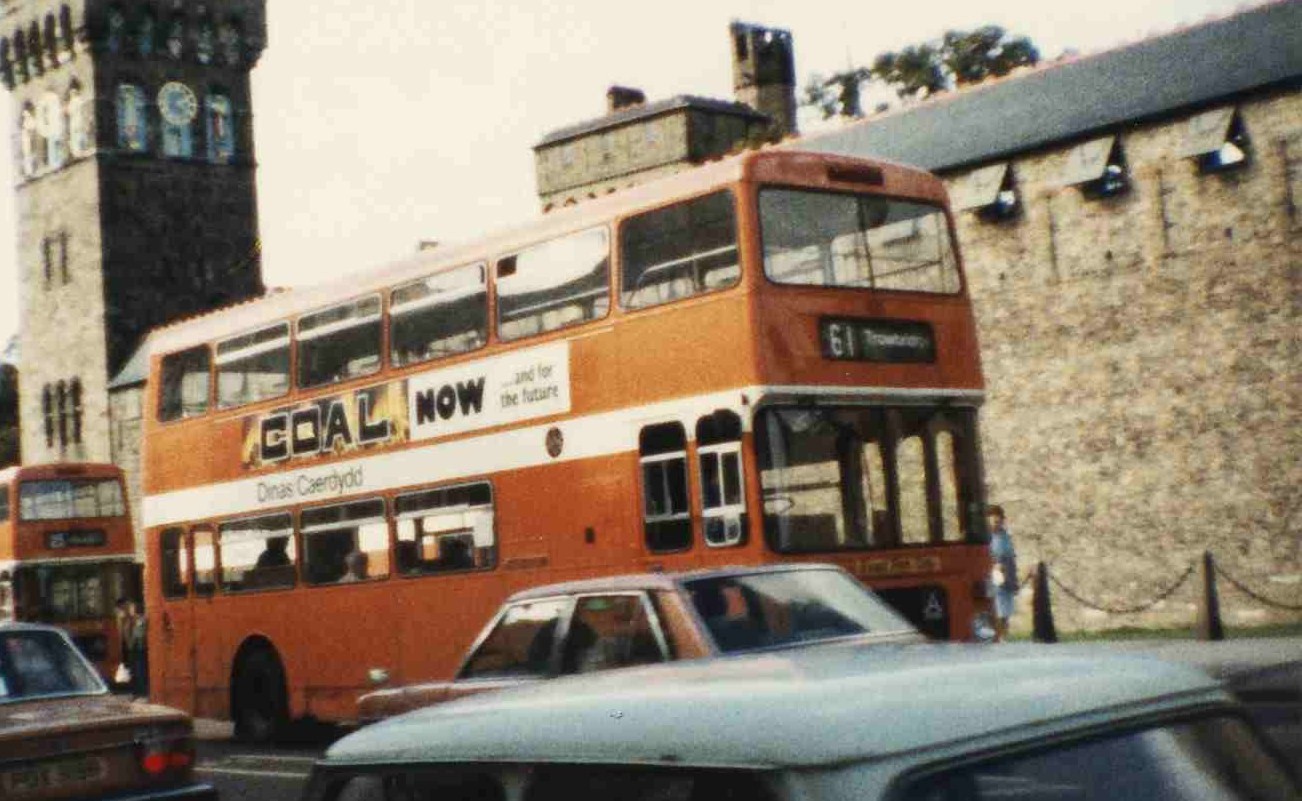
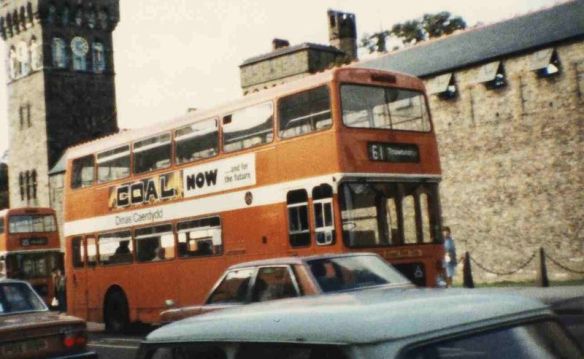
PS: six months into the miners' strike, the coal industry ran a consumer advertising campaign headlined 'Coal Now'. An extraordinarily timed move. I photographed this poster on a Cardiff bus (Dinas Caerdydd is Welsh for City of Cardiff) passing Cardiff Castle in September 1984.
IMG

Is Fred Goodwin the most famous disgraced man in Scotland since Thomas Bouch?

Few people will be sorry to see disgraced banker Sir Fred Goodwin leave Britain (Times report) after pocketing a staggering £700,000 a year pension despite presiding over the collapse of RBS, forcing a government rescue at eye-watering cost to taxpayers.

Is Goodwin Scotland's most high profile disgraced man since Thomas Bouch? Few will have heard of Bouch today, but he was the engineer responsible for the original Tay railway bridge. Bouch was knighted by Queen Victoria, who travelled over the bridge after its official opening. US President Ulysses S Grant, visiting the site, offered the accurate if prosaic comment, 'It's a very long bridge'. But Bouch was ruined when the bridge collapsed in a storm in December 1879, sending a train into the river estuary, killing 75 people.

The tragedy was a tremendous shock to the pride and confidence of Victorian Britain.

Bouch was utterly ruined. The Board of Trade delivered a damning verdict: 'For … defects both in the design, the construction and the maintenance, Sir Thomas Bouch is, in our opinion, mainly to blame. For the faults of design he is entirely responsible.' Bouch was vilified at the official inquiry, dismissed by the railway company and died less than a year after the disaster.

Was the Tay bridge disaster the result of a failure of regulation? The Board of Trade's railway inspectorate had cleared the bridge for passenger traffic, and although the inspector, Major-General Hutchinson had said he would like to see the effect of wind on the bridge, no further analysis took place. The 19th century was the high water mark of laissez faire government, and it took a series of further disasters before the British government introduced a modest degree of statutory regulation of the railways. It came too late for the 75 victims of Sir Thomas Bouch's negligence. 

But at least no one gave him an extravagant pension…  

An apology from Gordon Brown? Just Westminster chatter

The Guardian's Jonathan Freedland today joined the call for Gordon Brown to say sorry.

"It needn't be a sackcloth and ashes apology but an admission that the entire political and financial establishment erred when it believed in the infallibility of the market, and that New Labour's love affair with the City was part of that error."

He goes on to swallow the idea that Labour is simply suffering a communications problem. Tell the story, and Labour is in with a chance at next year's general election, he argues.

I expect a far more perceptive analysis from Freedland, usually one of Britain's best political commentators. The clamour for an apology is a classic Westminster village obsession. It wouldn't make the slightest impression on voters, who regard politicians' apologies as sceptically as their promises. (And it could make matters worse – just look at the reaction to the contrived apologies from disgraced bankers last month.)

Labour's problems are far more serious. It continues to disillusion voters with disastrous policy decisions, such as Peter Mandelson's part privatisation of the Royal Mail. Harriet Harman's empty promise to cut ex RBS chief executive Red Goodwin's promise showed the impotence of ministers who did nothing to stop Goodwin being rewarded for failure when they rescued RBS with billions of our money.

Dying governments often make catastrophic mistakes – wasting taxpayers' money: Margaret Thatcher's was the poll tax. I suspect the Royal Mail sell off will begin to look like Labour's equivalent of John Major's rail privatisation. We're still paying the price of that piece of prime ministerial stupidity 15 years later.