Snow falls in London

Dsc00254_2 A winter’s morning in London. Dorset Square, Marylebone. 

Dsc00252_1

Remembering Geoff Rich

Not every fifteen year old has the chance to debate politics with a newspaper editor. I was lucky: my father was head of PR for South Glamorgan (the former county that covered Cardiff) and the editors of the Western Mail and South Wales Echo were regular visitors. The most colourful of all was Geoff Rich, who died suddenly last week.

Mr Rich edited the Echo for almost 20 years. He had strong views: about Wales, Cardiff and the issues that mattered to both. I remember vividly our discussions about the early days of Margaret Thatcher’s government, largely because Geoff robustly disposed of my knee-jerk, ill-thought out assertions. That was a useful lesson for a teenager. And when Geoff wanted to emphasise a point he’d preface it with a loud ‘Mark you!’

Geoff Rich identified completely with Cardiff. He once joked that when he was posted to Reading in 1968 his homesickness led him to stand on Reading station to wave to the 5pm train to Cardiff. He added that he had three loves: family, the Echo and rugby football. He had the good fortune to become Echo editor in 1971, as the new golden era of Welsh rugby dawned. He viewed working within kicking distance of Cardiff Arms Park as akin to being a debenture holder at Mount Olympus.

I’ve met a few newspaper editors over the years but none has toppled Geoff Rich as my image of the classic editor.

Beat the Blue Monday blues

Feeling a bit down this morning? You’re not alone. According to The Samaritans today is Blue Monday: the most depressing day of the year. Festive fun is just a distant memory and spring seems an age away. No wonder it’s such a struggle keeping smiling through January.

This website gives some practical advice about how to beat the blues. Worth taking a look.

It’s an ill wind… that stops Britain in its tracks

I chose the wrong day to head home from Leeds. The worst gales for 17 years had left a trail of devastation, bringing the country to a standstill. The departure board at Leeds station told the story: trains cancelled or hours late. So when my GNER train left for Doncaster just 10 minutes late yesterday, I was pleasantly surprised. Until we came to a halt after just 10 minutes, on the outskirts of Wakefield.

The train crew were great, taking free tea, coffee and biscuits throughout the carriages. They updated us on what little news there was. Eventually, we headed back to Leeds.

Dsc00242 Leeds_departure_board_18_jan_07 Back at Leeds, the chaos was mounting  – yet the inspectors were still insisting on checking everyone’s tickets, causing yet more problems. I had by this stage decided to book a hotel room, which proved a very smart move.

This morning, trains had started running again to London. I got a train from Leeds to Doncaster and waited for a train that had room for me to get on. The first was packed and on the second there was only room in first class. Needless to say, GNER demanded I pay a supplement, despite the fact their failure to run a service yesterday had cost me over £100 in hotel and meal costs. (I can claim these back from work; many won’t have this luxury.)
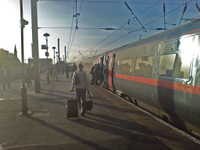
Doncaster_scrum_19_jan_07 I was impressed by the patience and good humour shown by rail staff and passengers alike. A lot of travellers said, "You must have had a nightmare!" to train and station crews. Less impressive was the lack of information available at stations and on trains. At Leeds yesterday afternoon, when I asked about London trains the information man told me there was a service to Doncaster – without adding there were no services south from there. At Wakefield, the train crew said there would be bus services to Doncaster but didn’t mention whether there would be any way of getting further south. The storm caused the railways huge problems but they should have been far better at providing information.

Happily, I got to London far earlier than I had expected, and in comfort – but then I had paid through the nose for the privilege!
State of the Union

Britain is under the spotlight. The forthcoming Scottish parliamentary elections have raised the spectre of Scottish independence, as the Scottish National Party (SNP) are expected to be the largest party.

The BBC’s Newsnight programme has a special edition tonight looking at the state of the union, 300 years after the union that created Great Britain.

My own country, Wales, still backs the union, according to the BBC poll, along with England and Scotland. I’ve been a firm supporter of devolution since the 1970s. I see it as completely consistent with our status as a United Kingdom. The greatest threat to the union is a centralist state, not a devolved Britain. But the language continues to trouble me. Recent reports have focused on the union of Scotland and England. Yet there are four people in this family: Wales and Northern Ireland as well as our two big brothers. We have rights in this debate, and must make our voices heard.

“Have something to say? I don’t care”

I love getting comments from readers of this blog. True, I’m hardly overwhelmed by feedback but as an occasional blogger I don’t expect this.

I like the way the media now seek a two way conversation with readers, viewers and listeners. For too long they regarded them as a nuisance – especially if they were complaining about a mistake. Yet I confess to a certain healthy scepticism about the way media organisations use feedback. Take the BBC. Its otherwise superb online news site peppers its news stories with apparently random comments from readers. It may seem more inclusive – but I don’t turn to BBC news to find out what Dave from Derby thinks about Britain’s foreign policy.

So I was thrilled to read a deeply heretical article in Media Guardian a week ago (sorry for being slow) in which Joel Stein from the LA Times says he doesn’t care what you or I think about his column. (Read it here – this is the original LA Times version as Media Guardian bizarrely requires you to register.)

To give a flavour:

"Where does this end? Does Philip Roth have to put his email at the end of his book? Does Tom Hanks have to hold up a sign with his email at the end of his movie? Should your hotel housekeeper leave her email on your sheets? Are you starting to see how creepy this is?"

Stein, like any good columnist, takes an argument to the limit. But he makes a good point. If he engaged with everyone who has an opinion about what he wrote, he’d never write anything. Just look at The Guardian’s Comment is Free pages – even run of the mill articles draw hundreds of comments, many incoherent, ranting outbursts that reflect badly on their authors – or would do if they revealed their identities. I prefer to read the more reflective comments on the blogs of people like Stuart Bruce, Andrew Grant-Adamson and Linda and Carol’s Passionate Blog (to name just a few). Much more the kind of community that social media should be about.

Is an actress an actor?

The Guardian’s corrections column yesterday raised a laugh with the anti-political correctness brigade.

A rigid application of the Guardian style guide caused us to say of Carlo Ponti in his obituary, page 34, January 11, that in his early career he was "already a man with a good eye for pretty actors …" This was one of those occasions when the word "actresses" might have been used.

Farewell, Gren

One of Britain’s best-loved cartoonists has died. Gren, whose work appeared in the South Wales Echo for almost 40 years, brilliantly captured the essence of South Wales. The BBC reported on his death at the age of 72 with some examples of his work. Roy Greenslade in his Guardian blog quotes former Echo editor Geoff Rich: "He didn’t … reflect the character of Wales, he didn’t report it, he was the character of Wales".

Like all great cartoonists, Gren was far more than a comedian who could draw. His insights into Welsh (and British) life, politics and sport were inspired, saying far more in a cartoon than a columnist’s 1,000 words. He was on fine form during the Falklands war in 1982, illustrating the row between the BBC and the Thatcher government over reporting the conflict. He had a vision of the Argentinian dictator on the Jimmy Young radio show: "And in the tradition of BBC’s balanced news coverage, today in the JY Prog we have jolly old Galtieri…" He gently mocked Welsh councils’ nuclear free zones with a sign at the Severn Bridge asking visitors to leave their nuclear bombs with the doorman.

Gren_pick_robert_3
My parents knew Gren well, from my father’s days running PR for Cardiff City Council and South Glamorgan. The cartoonist came to dinner with us in the mid 1970s, when his portrayals of Welsh rugby’s golden age gave him a fame beyond Cardiff and the valleys. I loved his impression of the old Cardiff Arms Park on international day on the sleeve of comedian Max Boyce’s album We’ve all had doctors’ papers. Gren added a personal touch to my copy that evening: a man in Gren’s signature style with placard calling on the selectors to "Pick Robert for Wales now, aye!" It was never going to happen – I was never any good at rugby – but it was typical of Gren’s kindness. Nearly 30 years later, he drew the cartoons for my father Bob Skinner’s book, Don’t hold the front page!

Gren, we’ll miss you and your gentle but brilliant humour.

Remember real winters?

Winnipeg_drive_snow_1 January has begun in Britain as 2006 ended – unseasonally mildly. Those new year blizzards of yesteryear seem like a dream, at least in southern Britain.

It was very different in the late seventies and early eighties. A quarter of a century ago this week, it started to snow – and didn’t stop for 44 hours. According to my 1982 diary, it started on Thursday night and didn’t stop until 5pm on the Saturday.

The photo shows our then home in Winnipeg Drive, Lakeside, Cardiff after it had stopped snowing. Schools stayed closed after the Christmas holidays – just as my A level year began. We were due to go by train from Cardiff to London for a schools history event – but had to go by coach as British Rail ground to a halt. I miss those days of white beauty, when cities were silent through road closures and getting anywhere was an adventure.

Little Chef lives to fry again

Anyone wanting an all day breakfast on the road can relax again: Little Chef has been saved. The chain of roadside restaurants was under threat after a series of ownership changes and the rise of healthy eating. I’m glad, as I used to enjoy the treat of a fry-up when driving to Cornwall or North Wales. We stopped at one near Ross on Wye en route to my graduation in 1985. I doubt that healthy eating is to blame for Little Chef’s plight. Slow service is a more likely reason in today’s rush-rush world.