Last of the Few: Battle of Britain pilot John Hemingway dies, aged 105

Group Captain John ‘Paddy’ Hemingway. Photo: RAF

The BBC today reported that the last surviving Battle of Britain pilot has died. Group Captain John ‘Paddy’ Hemingway was aged 105. He travelled from Ireland to join the RAF on the eve of war and also fought in the Battle of France, in which the RAF desperately tried to hold off the German Blitzkrieg invasion of Britain’s ally.

Winston Churchill famously called the brave RAF pilots the Few:

‘Never in the field of human conflict was so much owed by so many to so few…’

Paddy Hemingway and his fellow fliers saved Britain during the glorious, sunny summer of 1940. The Germans hoped to wipe out the RAF, and so open the way for a seaborne invasion of Great Britain. The RAF’s young pilots won the battle, making the defeat of Nazi Germany possible five long years later.

James Holland brilliantly recreated the immense stress of those Battle of Britain pilots in his 2004 novel, The Burning Blue. He also reminds us how the life of the Battle of Britain crews was so different from that of men serving in the Royal Navy or the armies in North Africa or Italy. The Few lived and died in everyday British communities, fighting in blue skies over the patchwork fields of Kent and Sussex by day, and drinking in traditional English country pubs by night.

The stress must have been overwhelming as the battle progressed, as the RAF noted for Paddy Hemingway:

‘Towards the end of the October 1940, the strain of fighting and loss of comrades was beginning to take its toll on Paddy. He was particularly troubled by the loss of his dear friend ‘Dickie’ Lee DSO, DFC in August 1940, saying in later years that his biggest regret was the loss of friends.

Continue reading

Colditz: Ben Mcintyre’s spellbinding book

The main title, BBC 1970s Colditz drama

This was the forbidding opening title scene in the BBC’s iconic 1970s television drama, Colditz, with the outline of Colditz Castle – the notorious second world war prisoner of war (PoW) camp, Offlag IV-C.

Back in the seventies, Colditz was amazingly prominent in British minds, 30 years after the war. The television series ran for two years, based in part on the bestselling books by Pat Reid, one of the first British prisoners to make a ‘home run’ to Britain. (As Nazi Germany controlled most of Europe, getting out of Colditz was just the start of a successful escape.) It was the most successful television drama the BBC had ever made, watched by a third of the viewing public. Most of the prisoners behind the walls of Colditz Castle had already escaped from other German prisoner of war camps, and so were an elite band of escapologists.

I’d barely given Colditz a thought for decades, but that all changed when I read Ben Macintyre’s 2022 book, Colditz, Prisoners of the Castle. Macintyre is a wonderful storyteller, with a knack of uncovering a multitude of spellbinding anecdotes and tales about even familiar topics. My childhood Colditz memories were replaying in my mind as I read his account of the wartime fortress prison.

Continue reading

No longer sharing my thoughts with my dad…

When I started blogging 18 years ago I chose a tagline: ‘Rob Skinner shares his thoughts with the world’. Then I reflected that seemed rather boastful – the world wouldn’t care what I thought. So I added a tongue in cheek qualification. The final line read, ‘Rob Skinner shares his thoughts with the world – or his dad’.

It proved a fair reflection of my limited audience. Dad and I often discussed my blogposts, and I was delighted when he started his own blog as the first Covid-19 lockdown began in 2020. (We later turned that into a Kindle book, as the BBC reported.) One of his own last blogposts, the month before he died, about cinema, was prompted by my reflections on childhood cinemas.

After Dad died last February, I occasionally thought the old tagline was poignant rather than apt. But I was reluctant to remove it. But now, 11 months after Dad passed away, and a year after that father and son blogging double act, seems the right time to do so.

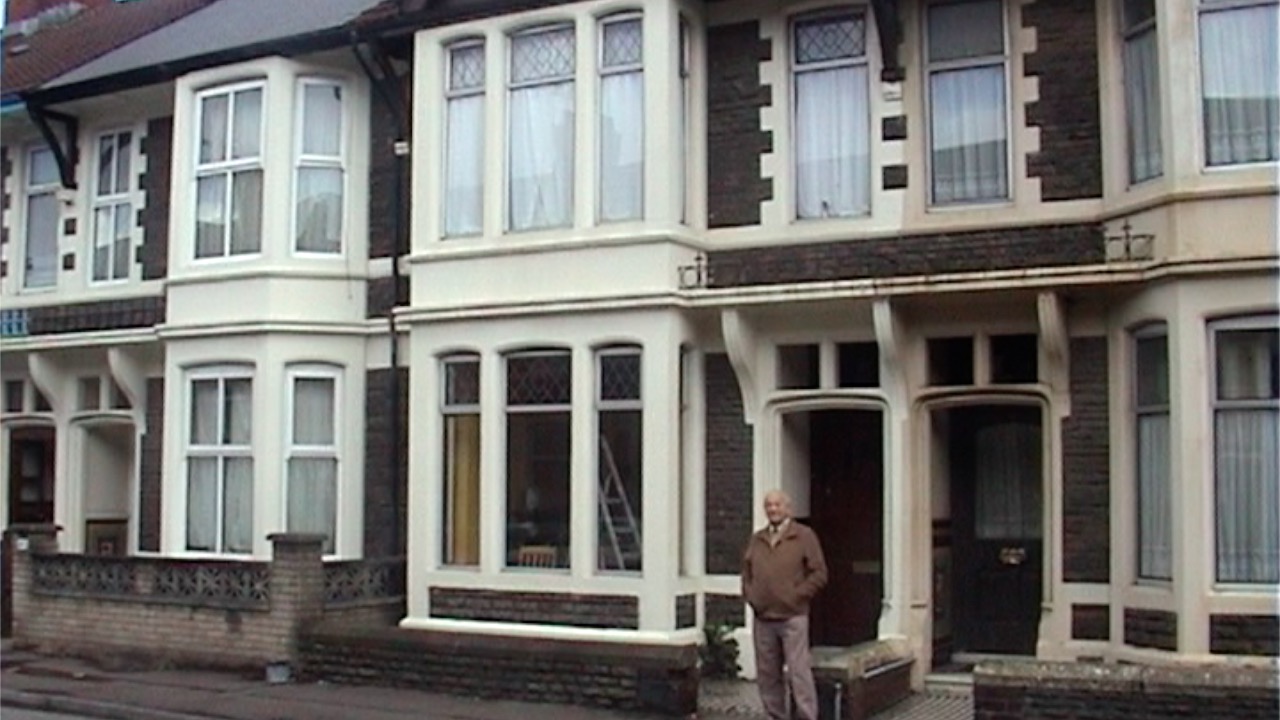
Dad (Bob Skinner) in 2005 outside the house he moved to when war broke out in 1939

Like most people who have lost a parent, I miss the chance to ask Dad a question about a hundred and one things. For example, when I blogged recently (Echoes of 1939) about his evacuation from London to stay with his aunt in Splott, Cardiff, at the outbreak of the second world war, I realised I had no idea how he got to Cardiff. Train? Coach? Alone or with his mother? Sadly, I will never know. But I have a lifetime of memories, not to mention Dad’s written memories and archives.

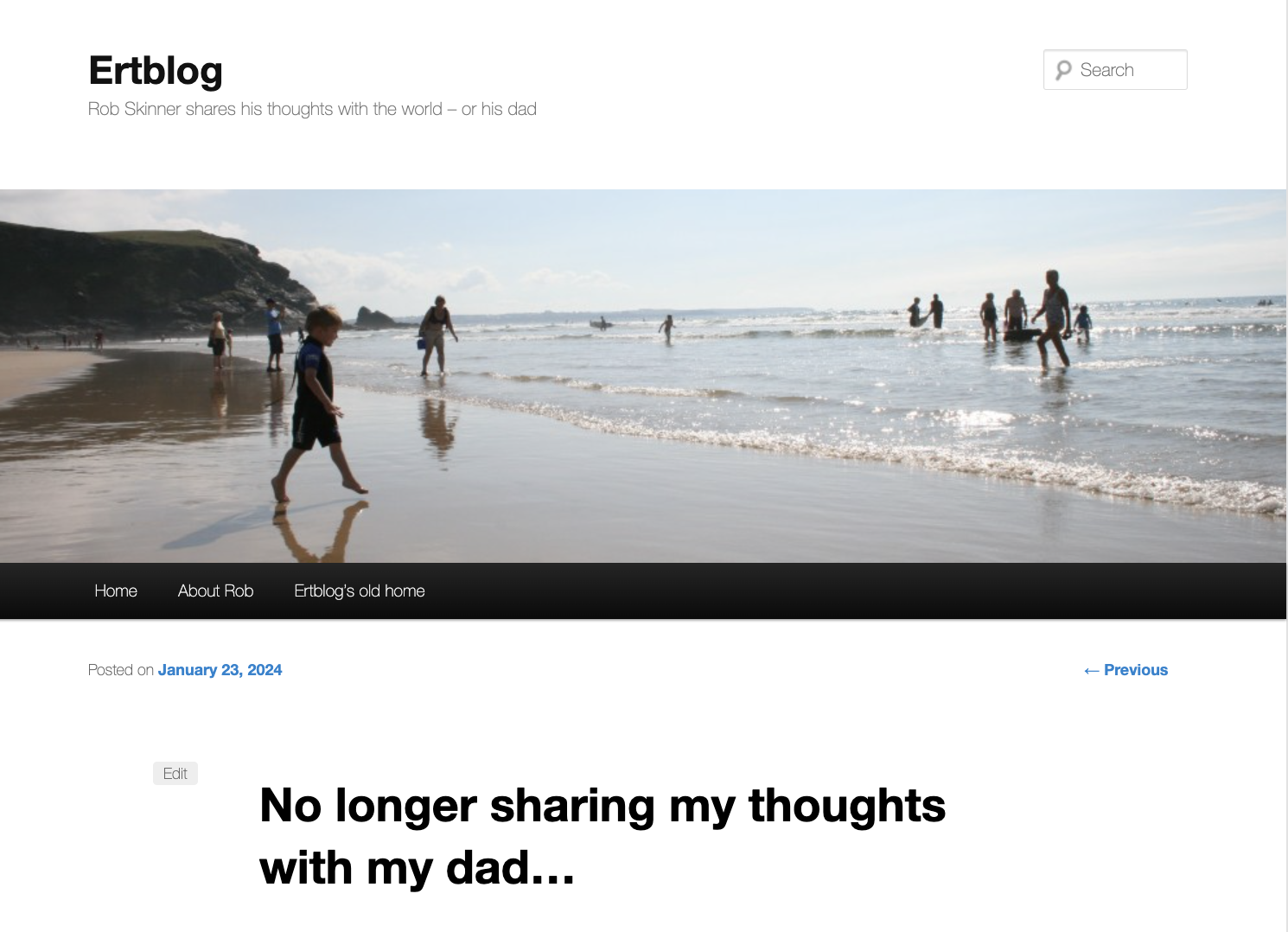
PS: for the record, a screenshot of this post with the old tagline, before I retire it.

Postscript

Ahzio’s lovely comment on this post – that I should keep the tagline mentioning my father – prompted me to change it to a dedication to both Dad and Mum, former journalists who inspired my love of writing.

My Dad and Wynford Vaughan-Thomas

My father Bob Skinner with Wynford Vaughan-Thomas, 1977

I was delighted to discover this photo of my late father with Wynford Vaughan-Thomas, one of the most illustrious Welshmen of the twentieth century.

Wynford was a wonderful broadcaster and writer. His first prominent role was as the BBC’s Welsh language commentator at the coronation of King George VI and Queen Elizabeth (later the Queen Mother) in 1937.

His most famous broadcast was from a Lancaster bomber on a raid on Berlin in 1943, an experience he told Michael Parkinson in 1981 was “the most terrifying eight hours I’ve spent in my life”. Like his BBC contemporary John Arlott, Vaughan-Thomas had an almost poetic way with words, which isn’t surprising given he was taught by Dylan Thomas’s father. He recalled that burning Berlin was “the most beautifully horrible sight I’ve ever seen, like watching someone throwing jewellery on black velvet, winking rubies, sparkling diamonds, all coming up at you.” He went on to compare the Berlin searchlights with the tentacles of an octopus.

The BBC radio programme Archive on 4 devoted an intriguing episode in 2013 to the raid with audio from the original 1943 broadcast, Vaughan-Thomas’s recollections and most movingly the memories of a survivor of the raid who was a Berlin schoolgirl in 1943. She tells how her mother risked death by going back into their collapsing home to rescue her teddy bear. Her interview brought to mind the terrible human cost of the Allied – and German – bombing raids of the second world war.

When I rediscovered the photo that opens this blogpost amongst Dad’s photo collection. I assumed that it was taken at an Institute of Public Relations dinner during the time Bob was chairman pf the IPR (now CIPR) Wales group in the 1970s. Sure enough, I found confirmation in a box file of Dad’s speeches and articles: the notes of the speech he gave that night:

“The champagne voice of Wales” – how apt!

Bob wrote a short history of the IPR in Wales in 1995, which was launched at an event in (I think) Newport. It includes this photo, which shows that my mother Rosemary also attended, and that the dinner with Wynford Vaughan-Thomas took place in November 1977, a day before Dad’s 51st birthday. Arwyn Owen, seen in the photo above, who ran PR for Welsh Brewers, kindly supported my application to join the IPR in 1990.

Wynford Vaughan-Thomas was a leading figure in Welsh broadcasting, and was one of the founders of Harlech Television (HTV, now ITV Wales). Not long before he died in 1987 he co-presented a wonderful television history of Wales, The Dragon Has Two Tongues. His sparring partner was the equally loquacious Gwyn A Williams, and over 13 episodes the two Welshmen argued passionately about the interpretation of the past. By common consent Williams won the debate, and Vaughan-Thomas was reduced at one point to dismiss his fellow presenter as “a Marxist magpie”.

Sadly this entertaining series has never been repeated in Wales for copyright reasons, although it has been broadcast in Ireland. It was accompanied by two contrasting histories, Wales: a History by Wynford, and When Was Wales? by Alf.