It’s the Sun wot fudged it

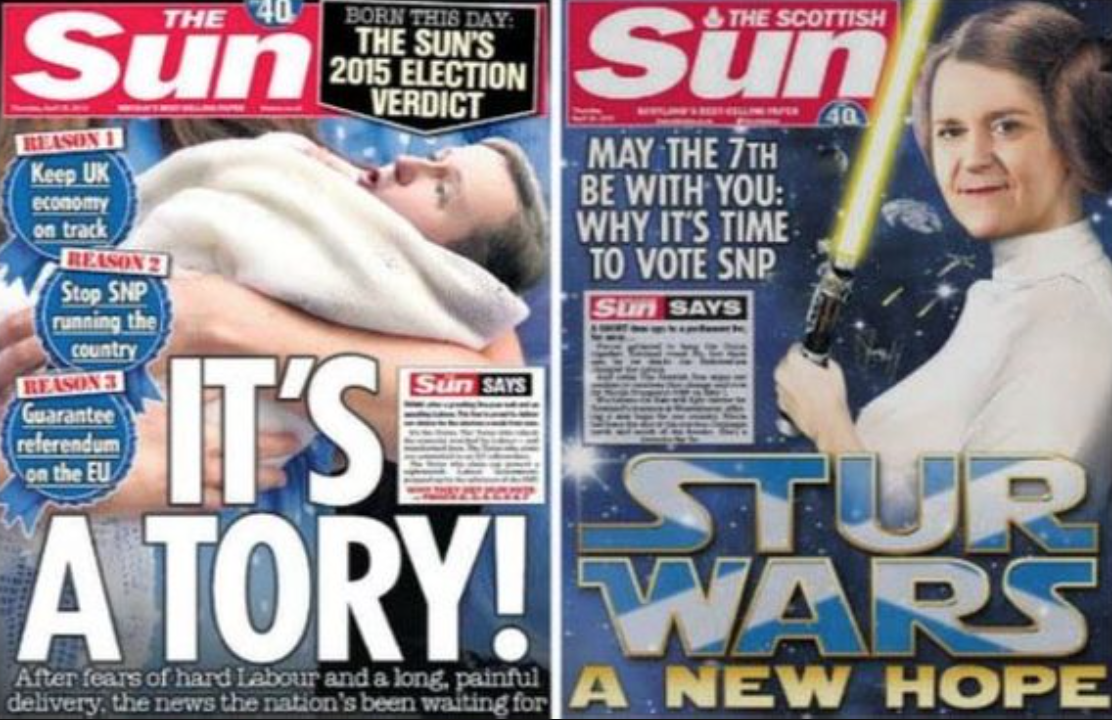
The Sun endorses Tories and SNP

Vote Tory! And SNP!

Newspapers love to think they have influence. Tony Blair grovelled to Rupert Murdoch to win The Sun’s endorsement in the 1997 election, after the paper claimed (wrongly) to have won John Major the 1992 poll. Yet this week’s decision by Murdoch to back two utterly opposing parties north and south of the border reveals the nonsense of such self important, cynical posturing.

I take exception to papers telling me how to vote. Democracy suffers through the massive bias in favour of the Tories. I also objected to the Guardian’s campaign against Boris Johnson in the 2008 London mayoral election. Yet the Sun’s laughable decision to back both the Tories and the SNP surely suggests the days when anyone paid attention to eve-of-election endorsements are coming to an end.

Hunt, Cameron and Murdoch: guilt and government by association

This week’s storm about culture, media and sports secretary Jeremy Hunt’s handling of News Corporation’s bid for complete control of BSkyB shows how Britain’s culture of government is horribly flawed.

A decade ago, Tony Blair’s sofa government style was condemned by the way Blair took Britain to war against Iraq without proper process or control. Now it seems that Hunt’s department side-stepped the rules on judicial impartiality in judging the News Corp takeover by allowing special adviser Adam Smith (oh the irony of that name…) to conduct back-channel discussions with News Corp.

The curiosity is that as ministers become professional politicians (in that they’ve never held a job in the real world), their performance as politicians becomes less ‘professional’ by the day. And that’s to put it kindly…

The Times they are a-charging: thoughts on those paywall figures

Photo

Above: The future of paid for online news? The Times iPad app

Britain's media industry has been desperate to find out how many people have paid for online access to The Times and Sunday Times since News International installed its paywall in July. Ni finally issued figures this week, declaring that it had sold 105,000 'digital products' since July.

Media commentators have had a field day with the data. The Financial Times reported that experts doubted the figures, claiming they were vague or even an example of 'chicanery'. Robert Andrews at www.paidcontent.co.uk suggests that just 0.25% of Times Online readers have converted to paid subscribers (rather than pay-per-day customers). 

My view? I don't think we can read anything into these figures. We simply don't know enough to decide how well News International is doing. That 105,000 includes people on the introductory £1 for a month offer. It presumably includes people who have cancelled their subscription. Above all, it's just four months since NI launched the first paywall at a major British mainstream, mass market news website. NI will experiment with new offers, new products and new payment methods. It has enormous marketing clout. It will make this work. 

The critics suggest a host of reasons why the NI experiment won't succeed. They argue that NI is bound to fail while rival news sites such as the BBC, the Guardian and Daily Telegraph remain free. They suggest that NI is breaking a fundamental rule of the web: that charging for content is wrong. And they point out that the Times and Sunday Times have cut themselves off from online and social media communities – who's going to tweet links to stories that are locked behind a paywall? Oh, and many see Rupert Murdoch as the devil, and while they may have been happy to accept his content for free, they won't pay for it.

I don't accept the philosophical argument that all online content should be free. Why? If you value something, why wouldn't you want to pay for it? I am happy to pay for the BBC through the licence fee because I value its content and don't want that content to be scarred by advertising. I take the same view of online news. Good journalism costs money. True, I'm very happy if news organisations are happy to give it away for free. But I doubt this is sustainable as print sales fall and a generation grows up with the idea that online is the place to go for news. 

I started this post with a screenshot of the Times iPad edition. This might just show show the way to make paid for content work. (I recognise I was sceptical about this when the iPad was announced in January, but I might be wrong.) I'm not a natural Times reader, but I've thoroughly enjoyed the iPad edition this week after discovering that my online subscription includes the iPad app content. (I was sure it was separate.) The best thing is that I can download the day"s paper and then read it all offline, such as at my parents', or on a flight to San Francisco. The app isn't perfect – navigation is confusing and inconsistent – but overall I love the Times on the iPad. I'd happily pay extra on top of my Guardian print subscription to get an iPad issue. (And for the Media Talk and Tech Weekly podcasts if the Guardian decided to charge for them.) 

For me, that's the secret to paid content success. Experiment to find out what hits the spot for various customer segments. For some regular print readers, it may be adding an iPad edition for an extra £5 a month. For some online customers, it might be occasional print editions for an extra sum. News International seems to think culture is the only way to lure subscribers. I'm not a complete philistine, but it does nothing for me! Content, not culture, is king.

Disclosure: I am head of PR for PayPal UK. PayPal has pioneered payment services for digital goods, including online news. The Financial Times announced on 27 October that it was working with PayPal to further drive online subscription growth. 

Why Britain needs a strong BBC

The BBC confirmed the worst kept secret in British broadcasting: it plans to close its 6 Music and Asian Network radio stations and halve the size of its website, www.bbc.co.uk. The BBC's strategic review is aimed at appeasing Conservative critics and commercial rivals. Rupert Murdoch's News Corporation has long waged a deeply self interested campaign to emasculate the BBC.

The BBC is always an easy target. But in tough times, the compulsory licence fee gives it a huge advantage over commercial rivals, who are struggling with the long term decline in newspaper sales as well as the collapse in advertising revenues during the recession. And the corporation has scored a series of spectacular own goals in recent years, from the mismanaged redevelopment of Broadcasting House to the Jonathan Ross/Russell Brand scandal. Not to mention all those highly paid middle and senior managers.

But the BBC remains the world's biggest, and most respected, broadcaster. It was right to expand into digital broadcasting and online news in the 1990s, displaying far greater foresight than many of its commercial rivals. And in the words of its 1980s John Cleese advert, it's still the biggest bargain in Britain: a host of national and regional television and radio stations, plus one of the world's best websites, for £142 a year. 

We can dismiss the deeply self serving Murdoch campaign against the BBC. Murdoch would love to see the corporation dismantled, to leave a rump public service broadcasting operation funded by subscription. That would leave him far greater freedom to expand Sky's market share and charge for his online content. His son James Murdoch led the call for the BBC to be cut back in last year's MacTaggart lecture, describing the BBC's expansion as chilling and mocking its 'state sponsored journalism'. Yet all the surveys show the public trust and respect the corporation, even as they rail against repeats and over-paid bosses. It's significant that Margaret Thatcher was rebuffed when she wanted to replace the licence fee with advertising – turning her attentions to ITV instead.

But it's far from clear that the proposals to reduce the BBC's costs unveiled today are the right response to criticism. Director general Mark Thompson was characteristically incoherent in explaining why axing 6 Music, the Asian Network and half the website was the right approach. 6 Music was distinctive but didn't have enough listeners, he argued. (Whose fault is that?) But if it had more listeners it would threaten commercial rivals. (Unlike the mass market Radio 1 and Radio 2?) And he made matters worse by descending into gobbledegook:

"The BBC is part of public space because the public themselves have put it there… Public space is an open … environment. There are no paywalls in public space."

How can the leader of Britain's leading broadcaster talk such nonsense? But we shouldn't be surprised. Thompson is notoriously unable to explain what he means. The author PD James famously left him tongue-tied in a Today interview last December. And a more regular interviewer, John Humphrys, ran rings round him in an interview about the BBC's controversial decision not to broadcast DEC's Gaza appeal last year. If BBC bosses must enjoy extravagant salaries, they should prove they're capable of making their case on air. 

It seems particularly perverse in an online age to promise to axe half the BBC's website. This seems a totally arbitrary sacrifice. Why half? No doubt there are sections that don't fit the BBC's allegedly more serious approach. But the 25% cut in spending online is highly questionable. 

And the plan to close 6 Music is similarly misconceived. The station costs the BBC £9m a year – just £3m more than Jonathan Ross's salary. By common consent, it's highly regarded by its (small) audience. And the Beeb has done little to promote it on other stations – despite its interminable adverts within stations. (Radio 5 Live's constant adverts are intensely annoying.) A vigorous Facebook campaign is now underway to save 6 Music. No doubt supported by Tory culture spokesman Ed Vaizey's shameless attempt to curry popular favour by claiming he's now a fan, just days after saying he'd never heard of the station. 

I suspect 6 Music will survive. Instead, Thompson should take an axe to the BBC's bloated management and its related expenses. And he should learn to make a positive case for the BBC's role in the life of the nation. We'd all suffer hugely if the BBC disappeared.

The people’s champion: Wall Street Journal’s Patience Wheatcroft tells bankers to get real

The rebellion against bankers bonuses claimed an unlikely champion today as the European editor in chief of one of the world's most iconic business newspapers said bankers just didn't get it and needed to get real. 

Patience Wheatcroft was speaking at the latest Gorkana breakfast briefing, along with WSJ Europe's new deputy editor Iain Martin, who vividly compared the RBS directors' rhetoric with 1970s union leaders, who were similarly accused of holding Britain to ransom. The two WJS journalists regarded the bankers' tactics as disastrously misjudged. Martin said he had far more sympathy for taxpayers than bankers. 

Wheatcroft supported Bank of England governor Mervyn King's view that 'casino' (investment) and high street banks should be separated, adding that it was a very strange business model to combine the two. 

Neither journalist had much sympathy for the government, arguing that it largely has itself to blame for allowing the bonus fiasco to develop. The saga simply showed that Labour never decided whether it had truly nationalised RBS and Lloyds Banking Group, or was merely the largest shareholder, allowing the banks' boards to operate at 'arm's length'. 

Google's news?

It's not every day that you get the chance to ask Rupert Murdoch's editors about their boss's battle with Google. But I got that opportunity at today's event when I asked about Google's unexpected partial retreat this week. I wasn't surprised that Patience and Iain took the Murdoch line. ("We don't like people giving away our content for nothing", as Patience put it.) But Iain was clear that newspaper management across the world had got it wrong from the start, giving content away in the hope that "something would turn up" in the shape of a revenue stream. But it simply hasn't happened – for most media owners. 

The Wall Street Journal is different. It's the only significant part of Rupert Murdoch's newspaper empire that successfully charges online readers. Its business readers value its content – even if they get their companies to pay the cost of getting past the paywall. It's not the best indication of whether other papers will successfully follow its lead. 

By a strange coincidence, today's WSJ included Google chief executive Eric Schmidt's op ed piece countering Murdoch's charge that Google is stealing content. Schmidt pointed out that Google sends online news providers a billion clicks a month from Google News. That's 100,000 opportunities a minute to win readers and generate revenue, he added. Google News only shows a headline and a couple of lines from a story. If readers want to read on, they have to go through to the media owner's website. I'm with Google on this. The search company may have blinked this weak, and made a concession to make it harder for users to bypass paywalls. But it has a greater intuitive understanding of how business and consumers thrive in an online, connected world. The media's rage against Google has echoes of luddites smashing machines in the early industrial age. The reactionaries want to return to an easier, gentler time. But none of us can turn the clock back. Not even the bankers. 

Fog in the channel…

Once upon a time, a British newspaper supposedly ran a headline, Fog in channel, Europe cut off. It was probably an apocryphal story, but summed up Britain's parochial view of the world. Iain Martin described how the British media fell into a similar trap this week by getting worked up about the threat to London's financial centre from the EU's new single market commissioner Michel Barnier. Barnier was chosen as part of the deal that made the unknown Briton Baroness Ashton the union's new foreign minister. As Martin says, the British media were so obsessed about the possibility of Tony Blair becoming Europe's so-called president they missed the idea that Barnier's role was the more significant. And, more to the point, were two weeks late in creating ludicrous headlines about a Frenchman destroying London's dominance in financial services. Still, we can probably rely on Britain's home grown bankers to achieve that. 

When news and views merge

Patience Wheatcroft made a telling point in favour of the American way of running newspapers. As Harold Evans and others have long argued, the serious US papers cherish a clear distinction between news and opinion. It's the American way, with the two parts of the paper edited separately. By contrast, too many British newspaper owners have used their papers as a mouthpiece, from Northcliffe and Beaverbrook onwards. For them, the whole paper was propaganda. The most blatant current British examples are probably the Sun, Daily Mail and Daily Mirror. But even the Independent, which for many years boasted it was as independent and reasonably minded as its title suggested, came to use its front page to shout its opinions from the news-stands. 

Patience also argued strongly in favour of 'double sourcing' the validity of stories. This was a timely reminder of the importance of being right, not first. Just this week, the world's media fell for a flawed attack on Microsoft from an obscure tech company. The Guardian's Technology section amongst others ran a story claiming a new 'black screen of death' in Windows 7. In the same edition, the paper's corrections column carried a grovelling admission that the story was groundless. This kind of reckless disregard for checking the truth is legion in today's media. 

And finally: the poacher turned gamekeeper turned poacher…

It was fascinating to hear Patience Wheatcroft talking about her 18 months as a non executive director at Barclays. A recent profile in Guardian said she had wanted to understand better an industry she had covered for so long. As she explained today, she saw 100 years' worth of banking dramas in her 18 months on Barclays' board. But she also saw the failings of her old – and future – trade. "One edition of the FT carried the headline, 'Barclays fails FSA stress test'. The next edition's headline was 'Barclays passes FSA stress test'. The next day, the paper had the cheek to boast that it had exclusively predicted that Barclays had passed the test!" 

Gorkana's breakfast briefings are well worth the early trek to London. You get the chance to talk to the top names in Britain's media industry. 

PS: if you're wondering where the name comes from, Gorkana commemorates a Gurkha soldier who saved the life of the firm's founder, Alexander Northcott when Alexander was serving with the Royal Gurkha Rifles.