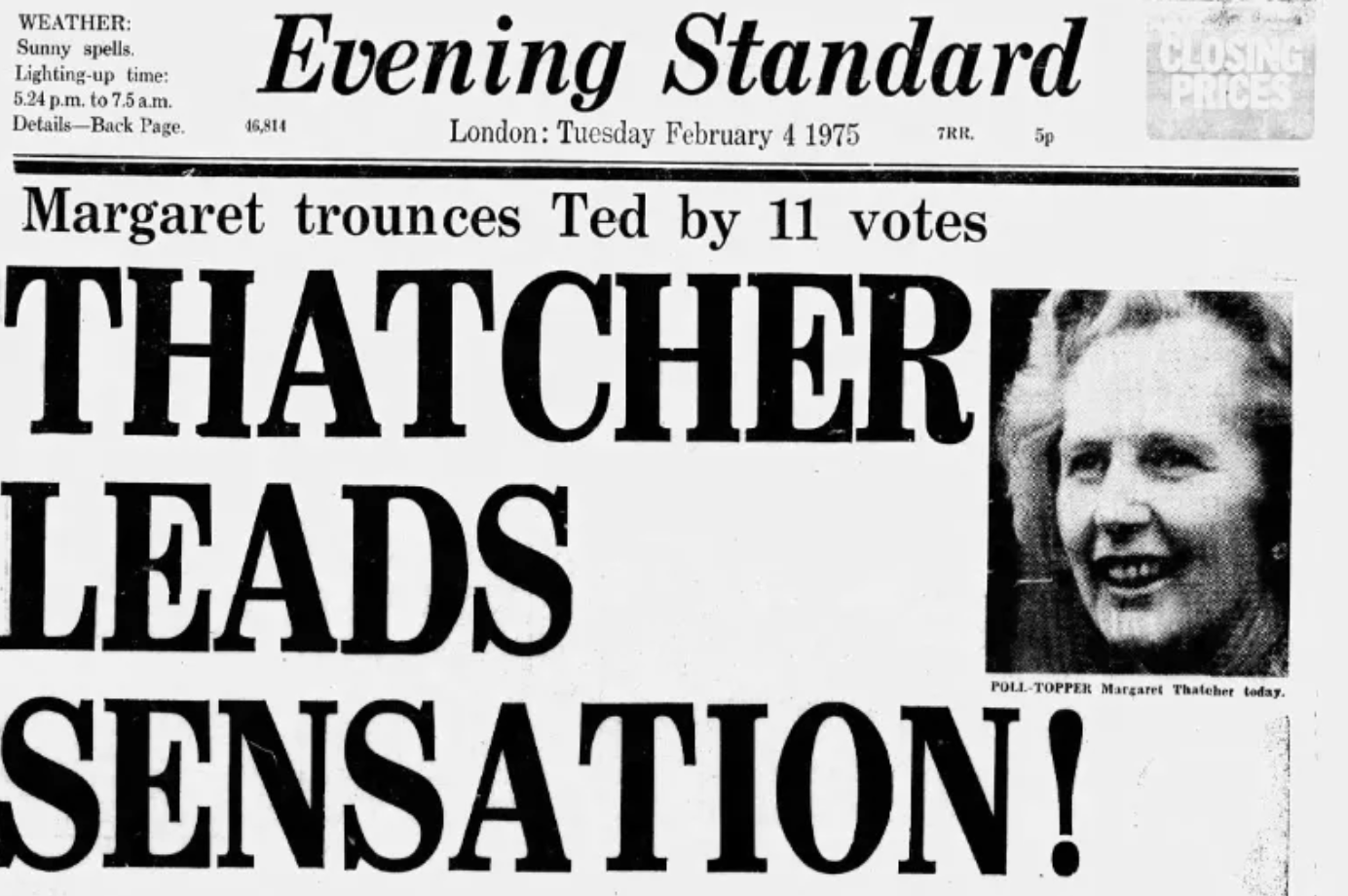
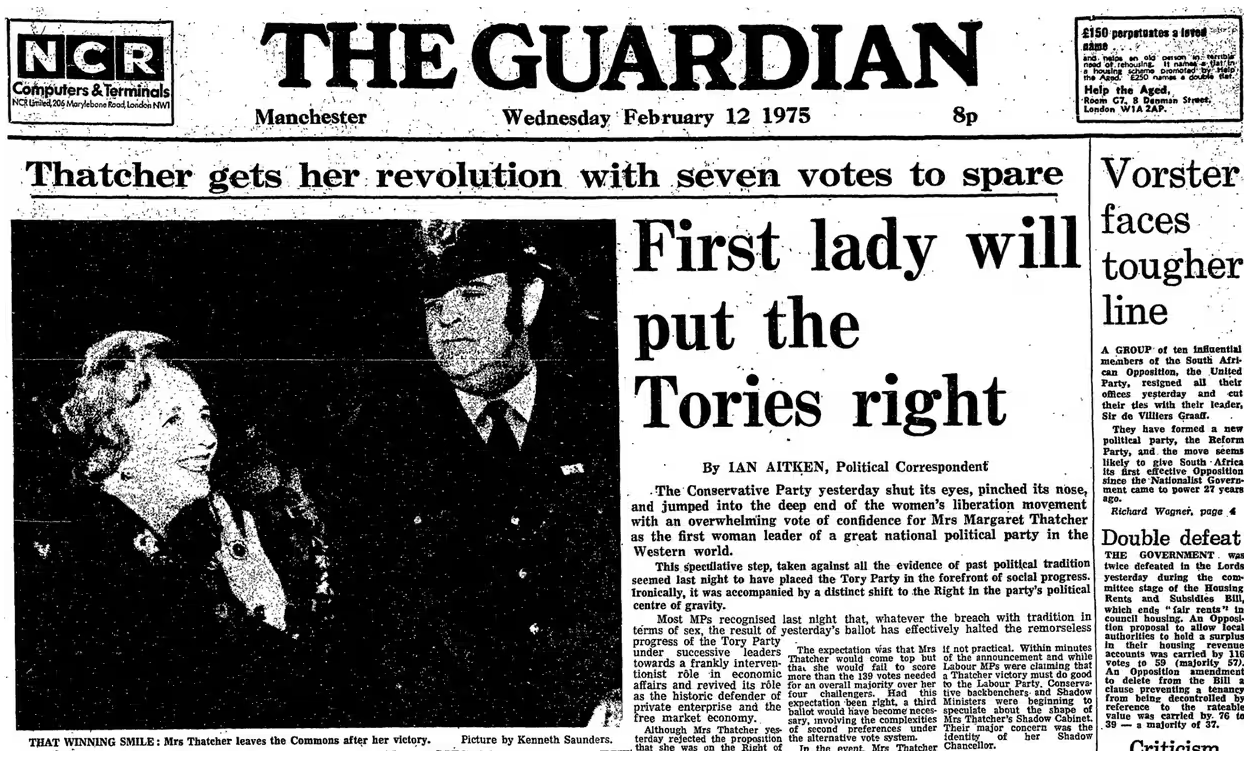
Reflections on Margaret Thatcher’s shock victory 50 years ago this week in the leadership election that eventually led her to become Britain’s first woman prime minister
I was just 11 when Margaret Thatcher amazed the political world by ousting former prime minister Edward Heath to become Conservative party leader 50 years ago this week. But as a precocious schoolboy I was fascinated.
Even in 1975, it was hard to see how Heath could cling on to the leadership. He had lost two general elections in eight months the previous year. His four years as premier had been a series of crises, and when he called the first 1974 election with the question ‘Who governs Britain?’ the voters refused to give Ted Heath’s Tories as the answer. (A hung parliament was the messy outcome.) And he was extraordinarily rude to his colleagues – people he needed to vote for him.
Thatcher had been a largely invisible middle ranking cabinet minister – apart from earning infamy as the ‘milk snatcher‘ after abolishing free milk for primary school children. But after the successive 1974 Tory election defeats she became far more prominent. Thatcher made the headlines in the second 1974 election with a plan to abolish the rates, the tax that funded local councils, and to cut the cost of home loans. As the 1975 leadership campaign unfolded, she brilliantly led the Conservative response to Labour’s finance bill, showing a mastery of detail. Thatcher also dissed the performance of the Heath government, telling the Daily Telegraph, ‘People believe too many Conservatives have become socialists already’. (An uncanny preview of right wing criticisms of the Johnson and Sunak governments almost 50 years later.) Yet few saw her as a likely party leader.
Her campaign manager, Colditz escaper Airey Neave, leaked news that Thatcher was ahead of Heath in polling for the first leadership ballot. (They were the only two candidates at that stage.) He cleverly encouraged those who wanted to oust Heath to back her in the initial vote, as that was the only way they could get their preferred candidate into the race. Heath was humiliated by coming second to Thatcher and pulled out, beginning a 30 year ‘incredible sulk’ against Thatcher that lasted until he died in 2005.
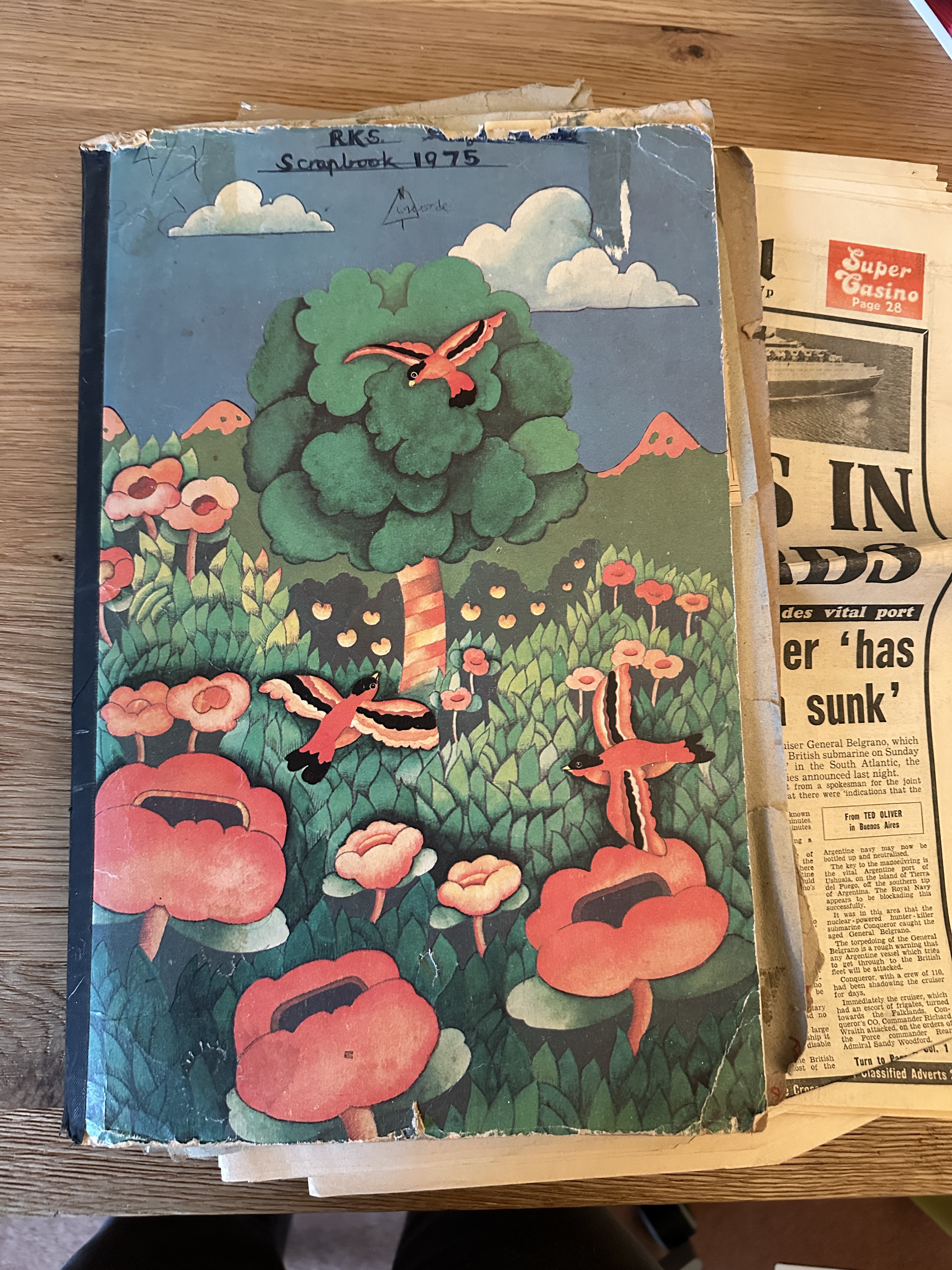
Do any children today keep a scrapbook? It seems very unlikely given almost every aspect of our lives has gone digital. So I was thrilled to rediscover my 50 year old childhood scrapbook, overflowing with yellowing newspaper cuttings. I wrote Scrapbook 1975 on the cover – I wonder whether it was a 1974 Christmas present? I seem to have written my Lakeside, Cardiff class, 4/1, there too.
I must have noticed that my scrapbook had 84 pages – one for every year of my beloved grandmother’s life at that point. (Nanny lived to within months of her 103rd birthday in 1994, as I blogged last year on the 130th anniversary of her birth.)
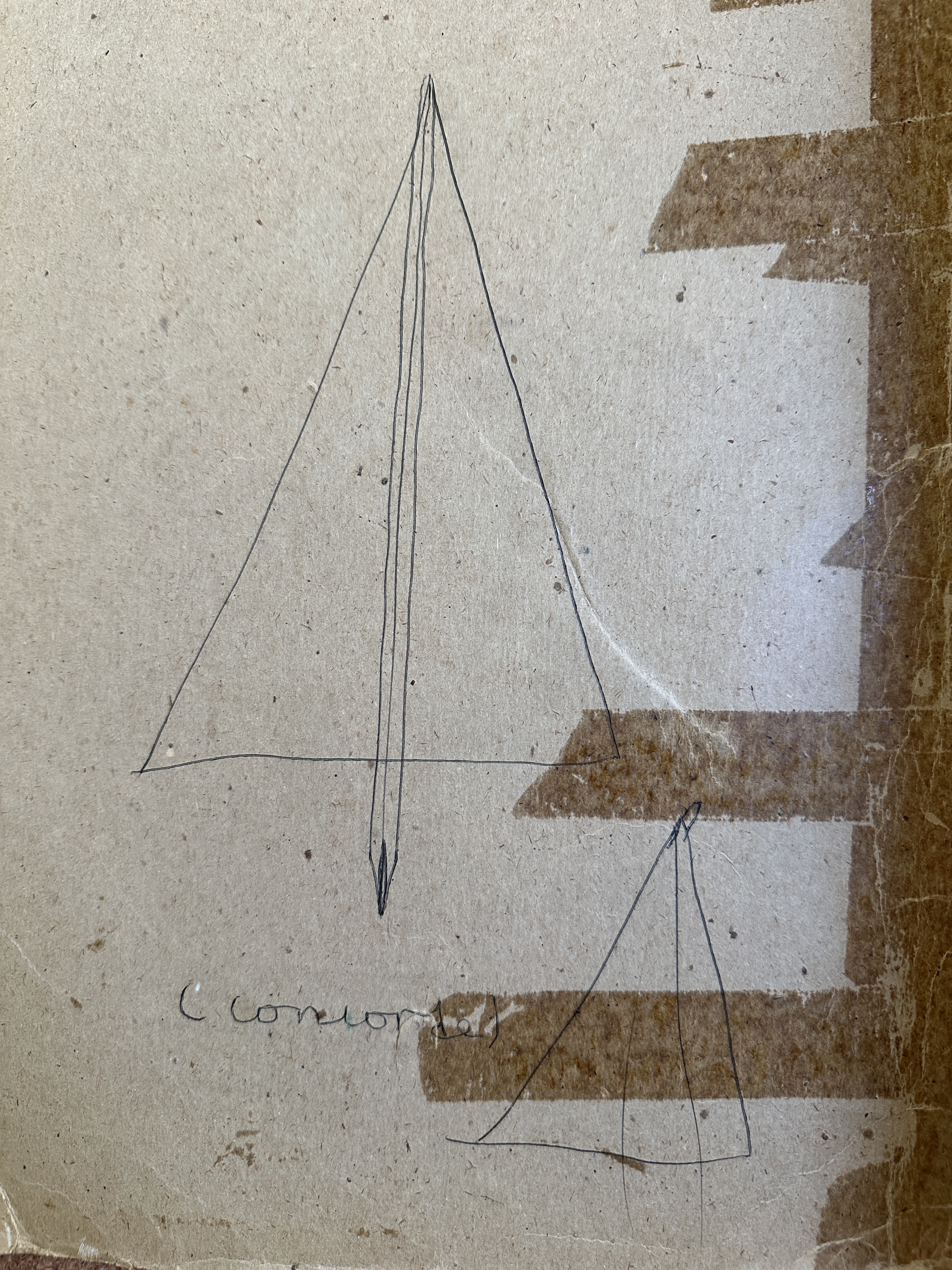
On the inside cover, I drew (badly) an impression of Concorde, the supersonic passenger plane that was to enter service the following year. These were the supersonic seventies, in the words of a 1970 Cadbury’s television advert… I never flew in Concorde, although I did walk through one in a Somerset museum in 1978. It wasn’t the same…
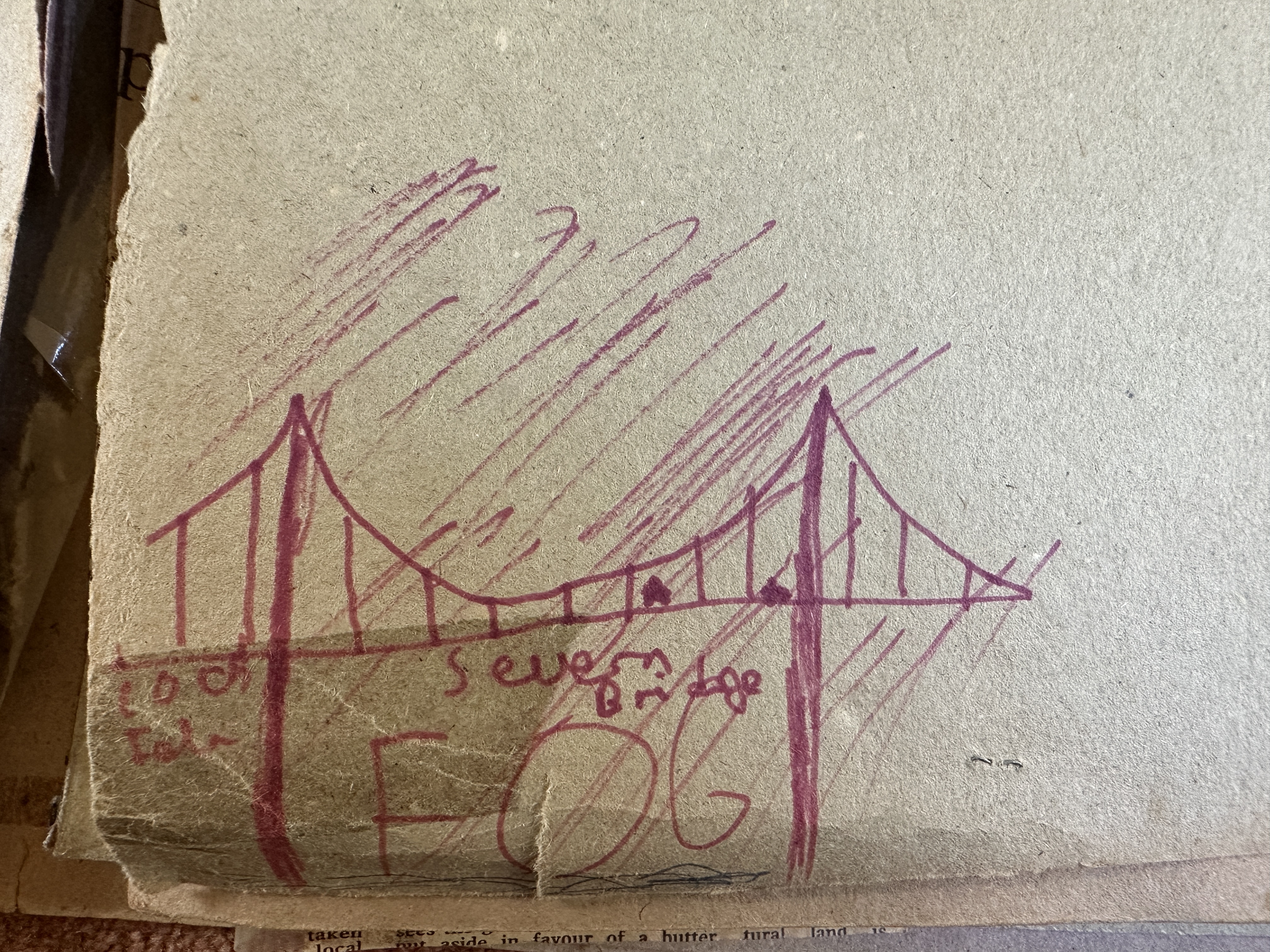
During the three day school half term, on Monday 10 February, Mum and Dad took me to Bristol for the day. If my scrapbook sketch is anything to go by, it was a foggy day. As a book lover, it was no surprise that my favourite part of the day was going to George’s bookshop, on Park Street. According to blogger Sue Purkiss, George’s dated back to 1847, so I was entering hallowed territory that foggy February day. At the time I was a big fan of Jackdaw children’s folders, a fascinating series of folders that illustrated historical topics with facsimiles of related documents. I received the Battle of Britain one Christmas, which included a wartime identity card and a 1940 Daily Mirror. I added my late grandfather’s real second world war identity card. I wouldn’t be surprised if I bought another Jackdaw at George’s. All I know for sure is that I took one of the bookshop’s bookmarks, as it’s in my scrapbook with the date on it. Sadly George’s is no more, like my old Cardiff spiritual home, Lear’s bookshop in Royal Arcade.
This is a bleak midwinter for Keir Starmer’s Labour government. Elected by a landslide just six months ago, Labour is sinking fast in the polls, and the modest enthusiasm that greeted its election has long since disappeared. Strategic messaging and policy mistakes have led to despair amongst many supporters, and jubilation from the populist insurgent party, Reform UK, now neck and neck with Labour in the polls.
True, at least some of the backlash is the traditional reaction to a Labour government from Britain’s dominant right wing press. All too often the BBC falls for the mistaken view that it has to amplify every right wing criticism of Labour. And people tend to be more fickle these days – a trend that benefitted Labour as it went from its worst election defeat for 84 years in 2019 to a landslide victory last year. But most observers accept that Labour has made an exceptionally poor start, even allowing for its dreadful inheritance.
Lessons from Thatcher’s experience
Labour’s collapse in support and morale so soon after being elected is very unusual, especially for a party winning power from opposition. The only comparable example, ironically, is an encouraging precedent for Labour. Margaret Thatcher has now passed into legend as the iron lady: indomitable, unyielding and triumphant, at least until hubris took over after her third election win in 1987. The reality is more interesting.
In the autumn of 1981, Margaret Thatcher was under siege. Just over two years into her premiership, her monetarist economic policy (trying to reduce inflation by controlling the amount of money in the economy) had proved disastrous. Having condemned Labour for presiding over rising unemployment (‘Labour isn’t working’ in the words of an infamous poster) and inflation, the Thatcher government’s policies contributed to far more job losses. In her first three years, Britain lost a quarter of its manufacturing capacity. The nightly news bulletins were dominated by reports of yet more famous brands laying off staff, or going bankrupt.
The cause in many cases was the soaring value of the pound, caused by high interest rates, which made our exports hugely expensive. (In late 1979, chancellor of the exchequer Geoffrey Howe raised interest rates to a crippling 17 percent largely because investors were not willing to lend money to the government – the so-called gilt strike, which shows that the gilts (government bonds) crisis that did for Liz Truss had an unexpected precedent in her heroine’s traumatic early years.)
Fifty years ago today, I broke the light in the loft of our Cardiff home. I only know the date this happened because a far more historic event happened the same day. Britain held a second general election in eight months – only the second time two general elections had taken place in a calendar year. (The other time was 1910, when the Liberal government was locked in a titanic battle with the unelected House of Lords to pass the People’s Budget, which introduced Britain’s first state pension.)
Harold Wilson had very narrowly won the first 1974 election in February, picking up fewer votes but a handful more seats than the Conservative government, led by Ted Heath. The Tory PM had gone to the country in the midst of a bitter battle with the striking coal miners. He framed the vote as ‘Who governs Britain?’ The electorate (at least by the rules of the UK’s first past the post voting system) answered: ‘Not you!’
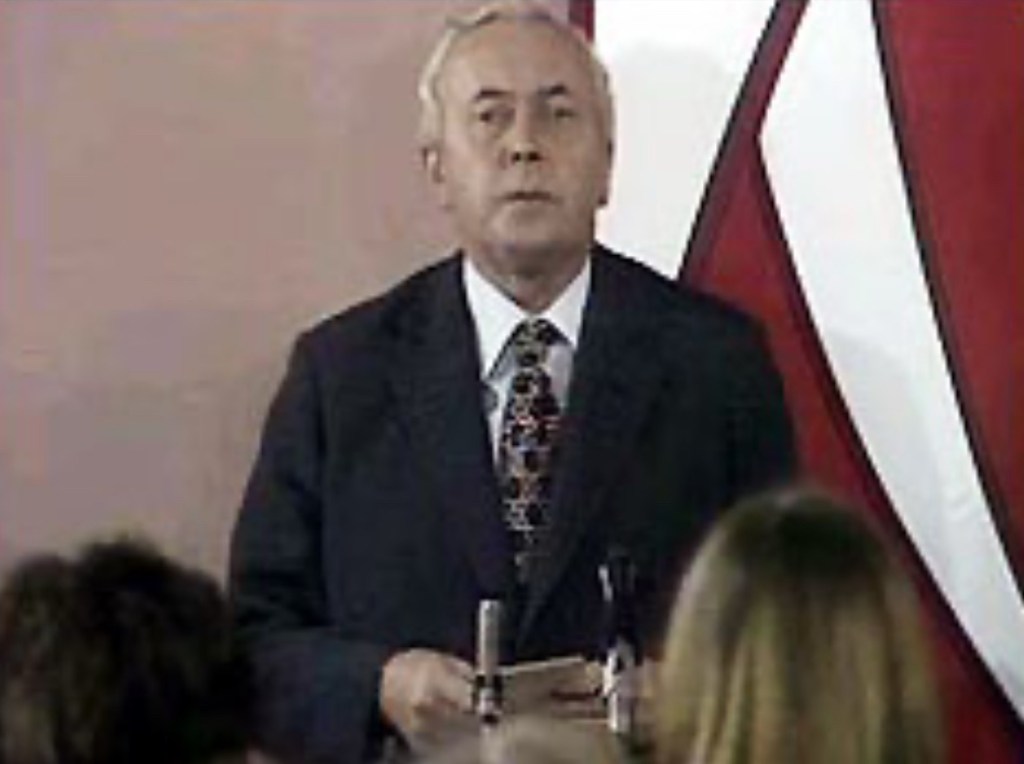
It was clear that, hampered by the first hung parliament since the war, Wilson would soon call another election to try to win a working majority. In the event, he gained a margin of a pitifully thin three seats. There followed a chaotic, exhausting yet enthralling period in British politics. Wilson himself surprised almost everyone by stepping down aged 60 in 1976, leaving Jim Callaghan to cope with the loss of that wafer-thin majority in 1977. He negotiated the Lib-Lab pact with the Liberal party and the government survived until losing a confidence vote in March 1979. The election that followed brought Margaret Thatcher to power as Britain’s first woman prime minister.
I met Callaghan six years later, when Dad and I visited him in his House of Commons office on a mission to secure a work permit for a musician from Hong Kong who was appearing in a concert in Cardiff. I’d just graduated from university, and Sunny Jim asked me what I wanted to do for a living. When I replied that I’d like to work in PR or journalism, Callaghan turned to my father and commented, ‘They all want to do that know, don’t they!” I tell the story of that meeting in more detail here.
Labour won a landslide victory in July’s general election, as the Conservative Party was swept from power after five years of law-breaking, financial incontinence and plain incompetence.
Keir Starmer’s narrative since taking office two months ago has been clear and consistent. Things are even worse than Labour feared, and the Tories are to blame.
This is a straight copy of David Cameron and George Osborne’s 2010 playbook, which pinned the blame for the 2008 financial crisis on Gordon Brown’s Labour Party. Labour was never able to shift the narrative to highlight the bold action Brown took to counter the crisis.
There are also echoes of Margaret Thatcher’s success in reminding voters of the chaos of the 1978/79 winter of discontent under Labour at every opportunity throughout the 1980s. For years, Tory party political broadcasts would show film of mountains of rubbish in the streets and picket line violence accompanied by a funereal voiceover intoning, “In 1979…” in case anyone had forgotten life under Labour.
But pinning the blame on the Tories won’t be enough for Starmer. The electorate gave a firm verdict on the Tories at the election: guilty. Labour must do more than simply emphasise what the voters have already decided. Starmer needs to become a political teacher, in commentator Steve Richards’ perceptive phrase.
Richards noted that the most successful modern British prime ministers – Thatcher, Blair and to some extent Wilson – did more than assert a political viewpoint. They realised they had to explain their vision and actions. Thatcher, for example, famously used the analogy of the household budget to explain that Britain could not spend beyond its means. (Critics disputed the parallel, but to little effect.) Blair was an even more effective communicator, combining clarity with the verve of a religious preacher. Under the New Labour, New Britain banner, he explained why the party and the country had to change. Although New Labour was accused of spin, Blair gave long media interviews and press conferences, engaging with the big issues of the day with seriousness and skill.
Starmer and team were understandably paranoid about losing the election. But they must now move beyond the doom-laden narrative of the government’s first two months to set a positive, optimistic vision for the next five years. This has to be done quickly. Starmer must avoid becoming another Theresa May: her utter inability to communicate let alone explain to the nation and her party what she was trying to achieve doomed her premiership especially after the catastrophic result (for her) of the 2017 general election. As Steve Richards put it, ‘She not only failed to tell her story, but did not even make an attempt. This was her fatal flaw – not only a failure to communicate, but an indifference to the art’. (The Prime Ministers: reflections on leadership from Wilson to Johnson, 2019)
Another judgement from Steve Richards about Theresa May strikes me as a stark warning to Keir Starmer: ‘She did at times have space on the political stage, but failed to see when she had the room to be bold and when she did not…. she acted weakly when she was politically strong…’ I fear Starmer may fall into the same fatal trap.
Even Blair’s own record in government provides a warning. On 2 May 1997, he was in complete control of the political landscape (even if he shared that control with Gordon Brown). Yet his first term was a story of paralysing caution aside from devolution to Wales and Scotland, the national minimum wage, and the historic Good Friday peace agreement in Northern Ireland. (His Tory predecessor, John Major, deserves credit for building the foundations for peace, but Blair’s masterful political artistry proved critical.) Soon after New Labour’s second landslide in 2001, the 11 September terrorist atrocities followed by the Iraq war stole what momentum Blair’s government might have achieved. I sense that if Starmer doesn’t seize the opportunity to become a political teacher now, voters will lose faith far more quickly than they did with Blair, especially as Tony enjoyed a golden economic inheritance from John Major.
Much will depend on chancellor Rachel Reeves’ budget on 30 October. Labour has already spun this as a budget of hard choices – forced on us thanks to the Tory financial black hole. And Reeves has already cancelled a host of rail and road projects, and the Edinburgh super computer intended to give Britain an advantage in the artificial intelligence race. It remains to be seen whether Labour will win the political intelligence race.
Cameron and Osborne won the argument in 2010 about Labour’s responsibility for the financial crash. But their remedy, years of austerity, has caused enormous damage to the fabric of the nation, especially public services. Funding for local government in England has been slashed by 55 percent in real terms since they took office in 2010. (Source: IFS.) All this was a factor in voter contempt for the Conservatives in July. After the Liz Truss catastrophe, Labour has to be prudent with public finances, but I fear that Labour is falling for the coalition’s slash and burn approach, much as it has stolen Cameron and Osborne’s blame playbook.
Lessons from history
Labour’s landslide win in July was bigger than the party’s famous win in 1945. (Although on a far smaller share of the vote.) Labour’s 1945 leader, Attlee, was even less charismatic than Starmer, but his government changed the country with the birth of the NHS and the welfare state, and independence for India. Yet it was out of power within six years. By 1951, voters were no longer prepared to put up with austerity and ‘jam tomorrow’ – food was still rationed years after the end of the war.
Starmer is a fan of Harold Wilson, who lost the 1970 election just four years after a landslide victory. Voters today are even less patient than 50 years ago, and Labour needs to heed these lessons from history. Lead the nation with a compelling story and show serious improvements to Britain’s shameful public services by 2028 and Labour has the chance to be the natural party of government for the 2030s.
Postscript: Jenni Russell makes almost exactly the same argument in her column in The Times three days after I published this blogpost. (Paywall.)
It was one of my strangest dreams. I was in a chip shop in the Rhondda Fach in South Wales in 1985, watching miners’ leader Arthur Scargill sadly announce it was all over. The year-long battle to stop the mass closure of Britain’s coal mines had ended in defeat.
The dream was just that. But it reflected the painful reality of that March day in 1985. The miners of Maerdy in the Rhondda Fach marched proudly back to work, but we all knew that the Thatcher government had won a bitter struggle.
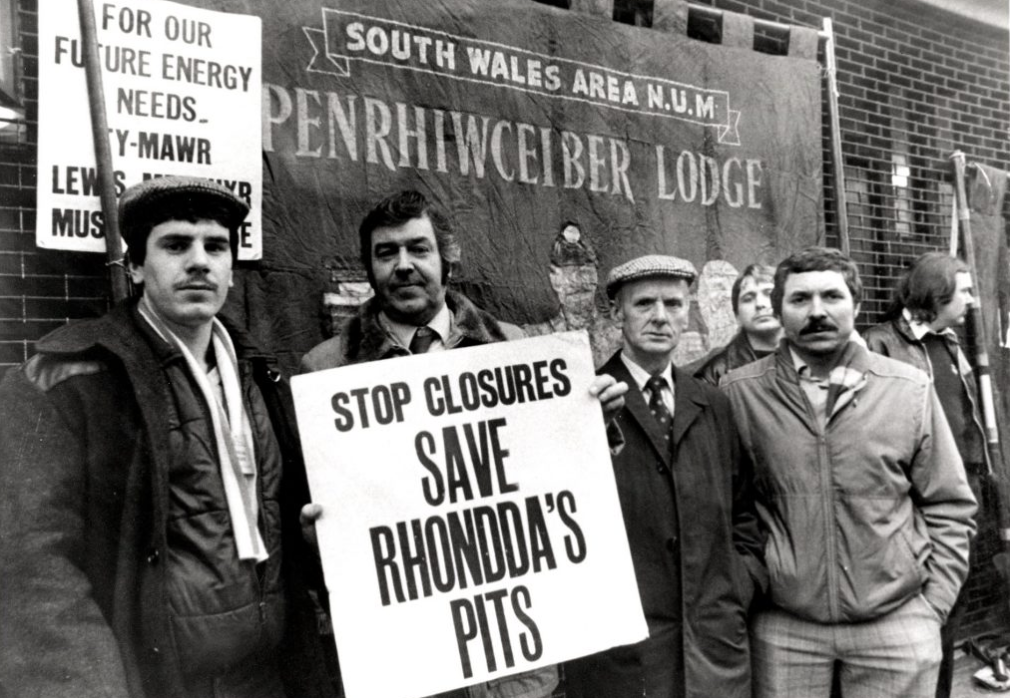
The strike began forty years ago on 6 March 1984, after the National Coal Board announced that 20 mines would close, with the loss of 20,000 jobs. Scargill said that the government would close far more mines (ultimately he was proved right in the years after the strike ended).
The battle that followed was Britain’s last great industrial confrontation, which left many of us with deeply conflicting emotions. The British people had long admired the miners, enduring one of the hardest and most dangerous ways to earn a living. (I blogged about some of the tragedies that struck South Wales in this blogpost.) They also sympathised with colliery communities such as Penrhiwceiber and Maerdy. These isolated villages existed to serve the coal trade, and faced a bleak future if Thatcher axed the coal industry. The women of those communities were magnificent in the grim months of 1984 and beyond, fighting for justice and speaking with eloquence.
I never expected Britain to be at war when I prepared to sit my A levels in 1982. Let alone at war with Argentina over a group of islands 8,000 miles away.
Yet that was the reality as I woke on the morning of Friday 2 April 1982. Barely awake at the start of the last day of the school term, I heard on Radio 4’s Today programme some armchair general talking of nuking Buenos Aires. Later that day, we learned that Argentina had invaded the Falkland islands, one of the few remaining British overseas territories. Margaret Thatcher’s British government was stunned.
Contrary to popular belief, the invasion wasn’t a complete bolt from the blue. Two days earlier. I noted in my 1982 diary: ‘Falkland island crisis worsening: Guardian front page lead’. Yet the legend holds that many people in Britain were shocked, thinking the Falklands were off the coast of Scotland. Recovering them would have been a lot easier had that been true.
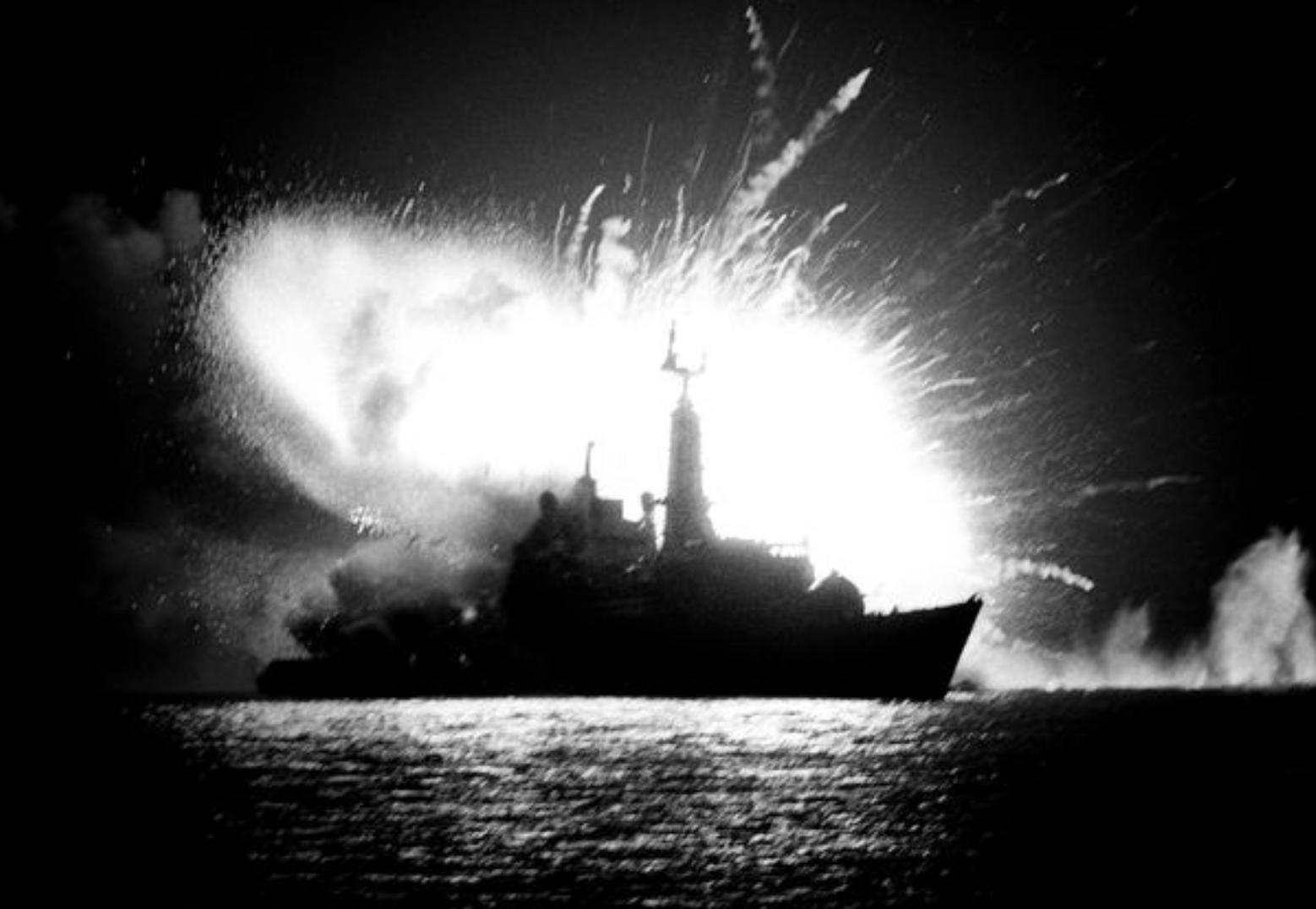
Going to war was a novel and shocking experience in 1982, almost 40 years after the end of the second world war. Yet it felt like an echo of the past. I described it in my 1982 diary as Britain’s last colonial war, a description that has stood the test of time. (Although there was no doubt that the islanders wanted to live under British rule.) Several of the warships involved in the Falklands took part in or were laid down during the second world war: the Argentinian cruiser General Belgrano, sunk by the Royal Navy, survived Pearl Harbor as USS Phoenix. In 1982, it was not so lucky. HMS Hermes, the Royal Navy’s Falklands flagship was laid down in 1944. And the RAF Vulcan bombers that flew 8,000 miles to bomb Stanley airfield relied on an updated version of the wartime H2S navigation radar system to find their target.
25 years ago today, Margaret Thatcher resigned as prime minister. She bowed to the inevitable after her cabinet finally rebelled against her autocratic rule.
I blogged at length about Britain’s first woman prime minister when she died in 2013. I titled that post ‘the woman who changed Britain’ – which she did, for both good and ill. She was a force of nature, unlike almost all of her successors. Only Tony Blair came close.
Margaret Thatcher made history. She was Britain’s first woman prime minister – a landmark that will live in history books long after the controversies of her premiership have faded. She defeated an Argentinian dictator and British union barons. She sold off most nationalised industries. And she helped end the Cold War.
When she became prime minister in May 1979, Britain was in a sorry state. The winter of discontent in 1978/79 made her victory inevitable. While many felt sympathy for low paid workers fighting for higher pay, millions decided enough was enough – ‘we can’t go on like this’ was a common feeling. People were sickened by unions that intimidated members into going on strike and used mobs to enforce their will. Two governments had been destroyed by the unions, in 1974 and 1979. Thatcher was determined it wouldn’t happen again.
Yet Thatcher was often more cautious in her early days than her legend suggests. She gave in to the miners’ demands in 1981 rather than risk defeat. The early union reforms were modest. And privatisation wasn’t even mentioned in the 1979 election manifesto.
She was lucky in her enemies. Winning the Falklands War against the Argentinian junta – a brutal dictatorship that murdered thousands of its own people – ended her vulnerable early days when the SDP/Liberal Alliance was threatening the Tories and Labour alike. Arthur Scargill stupidly bullied the miners into the 1984/85 strike when winter was ending and coal stocks were high.
In time, she became more reckless, more strident, most famously in the disastrous poll tax. John Campbell showed graphically in volume two of his biography of Margaret Thatcher, Iron Lady, how disfunctional her government became in its last years because of her behaviour. Her fall in November 1990 was no surprise.
She also began the long decline of local pride and enterprise, thanks to the emasculation of local government. For the daughter of an alderman, she was indifferent to local initiative and hostile to the idea of an alternative power base, leading to the abolition of Ken Livingstone’s Greater London Council and the English metropolitan counties. Under her rule, Britain saw the rise of private wealth and public squalor, and a sense that selfishness was acceptable.
Labour isn’t Working – Thatcher’s most cynical campaign poster, 1978
She was also callous in her indifference to the fate of communities devastated by the mass unemployment her government unleashed. The 1981 budget was one of the most brutal of the post war era, leading many to accuse her of using mass unemployment as a weapon to achieve her aims. (And in the doomed attempt to test the economic theory called monetarism.) Similarly, she deliberately shifted the tax burden from the wealthy to the less well off in the move to indirect taxation. Her choice of St Francis’s prayer – “Where there is discord, may we bring harmony” – was cynical, as was the 1978 election poster condemning Labour for high unemployment, above. Under her rule, the jobless total reached three million for the first time since the 1930s.
Finally, Margaret Thatcher suffered the fate of someone who lived only for work. She had no hinterland, as Denis Healey put it. This made her a very bad member of the former prime ministers’ club, as her successor John Major found out to his cost.
On the day Margaret Thatcher died, it’s hard to imagine a time before her time in Downing Street. But my first Thatcher memory was her appearance as education secretary 40 years on the BBC children’s programme Val Meets the VIPs. (Val was the Blue Peter presenter Valerie Singleton.) In October 1978, our family friends in Germany asked us what we thought of Mrs Thatcher. We explained we weren’t impressed by her stridency…
Tonight, Britain and the world is remembering Britain’s most remarkable postwar prime minister. Our country is the nation she created – for good and ill. None of her successors has matched her ability to explain their mission. And no man since 1979 has dared to suggest that a woman couldn’t be prime minister. That might be as great a legacy as any.
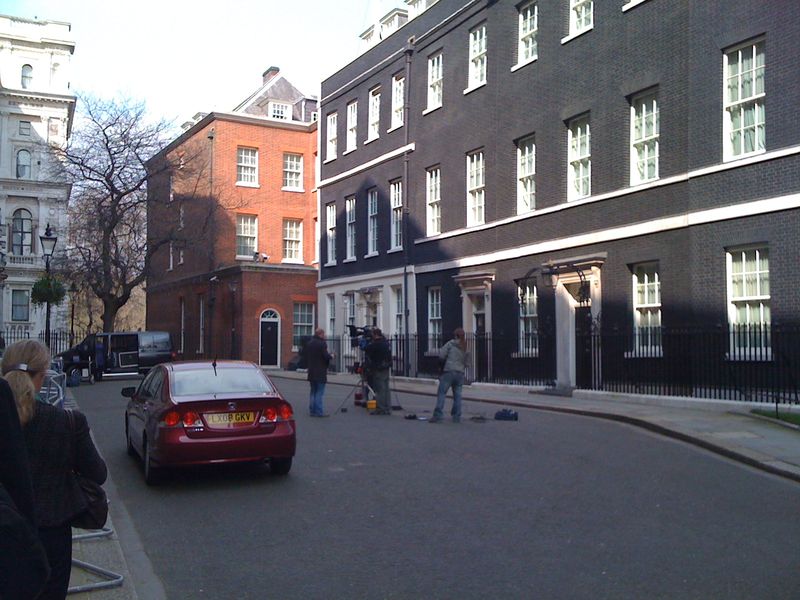
It's the most famous address in Britain. And on Thursday 6 May, it's likely to have a new occupant. So I was intrigued today to get the chance to walk through that iconic black door, courtesy of the Corporate + Financial Group of the Chartered Institute of Public Relations (CIPR).
We were on a tour of 10 Downing Street, made possible by Simon Lewis, the director of communications at Number 10, a former chairman of the group.
Number 10 is a surprisingly modest home and office for a head of government. The famous facade opens onto a small terraced house that was linked to a more impressive mansion. That iconic door is actually one of a pair that are repainted in turn every six months. And we were told that by tradition the '0' in the number on the door is slightly offset, though I can't say I noticed!
The highlight of the visit was the chance to sit at the cabinet table. Without realising, I chose the foreign secretary's chair. I found myself reflecting on the extraordinary discussions that have taken place at that table, shaping our country's survival in 1940 and during the Napoleonic wars; the creation of the NHS; and numerous financial crises including the recent banking crisis and the dramas of 1931, 1949 and 1967.
The visit reinforced my respect for Britain's tradition that the civil service is fiercely non political. Gordon Brown's political advisers at Number 10 had to resign by noon on the day he called the election, and the prime minister cannot campaign from Number 10. Simon Lewis's appointment as communications director last July restored the role of the PM's official spokesman to that of a civil servant rather than the party cheerleader it became under Alastair Campbell. That has to be a good thing, as Campbell's partisan approach proved hugely counter-productive in time – and contributed to the declining trust in the Labour government. That said, Bernard Ingham famously stretched the civil service status of the role to the limit while serving as Margaret Thatcher's press secretary in the 1980s.
The most striking change at Number 10 in recent years is that it has become home to very young children. The garden contains a large trampoline (complete with safety net) and Wendy house for Gordon Brown's sons. This new tradition is sure to continue as all three major party leaders have youngsters.
As you walk up the stairs, you notice that Winston Churchill has the singular honour of featuring twice in the gallery of former prime ministers. He appears in chronological order between Chamberlain and Attlee. But his most famous photograph has pride of place on the ground floor landing. Karsh of Ottawa took the iconic image of a scowling war leader in the Canadian capital in December 1941. It's reputed to be the most reproduced photographic portrait in history. Churchill's official biographer Martin Gilbert told the story of that photoshoot in his wonderful book In search of Churchill. Karsh was unhappy with his initial results, as Churchill looked more like a favourite uncle than a war leader. So he snatched the prime minister's cigar from his mouth during a break. The result was the famous image. Gilbert preferred the benign version, and used it on the cover of the book.
The other prime minister to enjoy special treatment is Margaret Thatcher – the only PM to have a portrait hung in Number 10 during their lifetime. It seems a fitting honour for her achievement in becoming Britain's first – and so far only – female prime minister.
Margaret Thatcher's successor, John Major, found living at Number 10 a challenge at first. Two of his closest advisers, Sarah Hogg and Jonathan Hill, described in their book Too close to call how the new PM caused a panic in his first week by going missing – and no one knew where he had gone. The crisis was averted with the discovery that Major had wandered off to McDonald's for sustenance. A cook was soon recruited to rustle up a bacon sandwich at short notice. The story serves to remind us that Britain's prime minister isn't such a dominant figure even in his (or her) own house.






 Ertblog