Blame Blair and Brown for Corbynmania

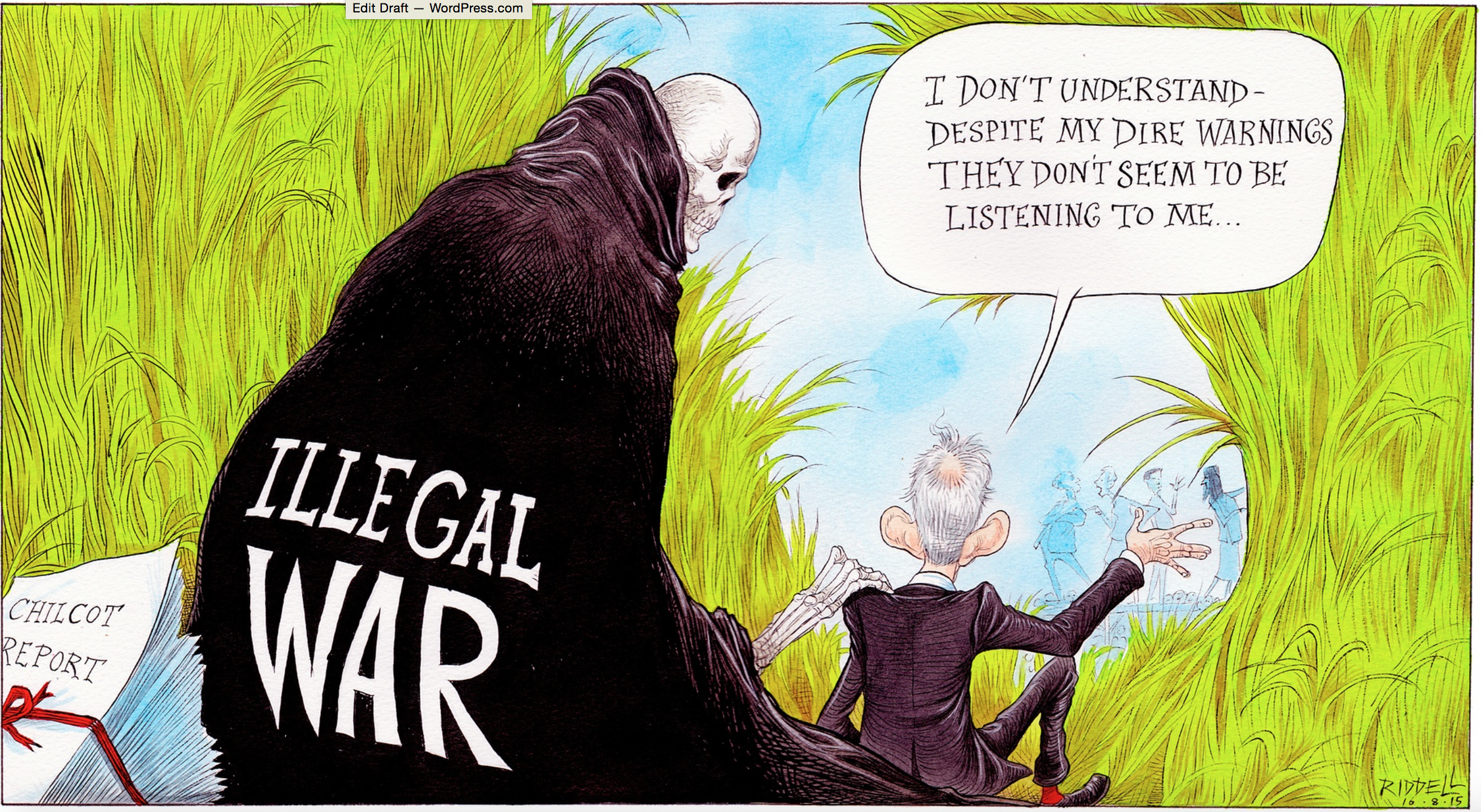
Why no-one is listening to Blair: Chris Riddell in The Observer

Why no-one is listening to Blair: Chris Riddell in The Observer

The battle for the Labour Party’s soul is raging. The man who led the party to victory in an unprecedented three general elections has issued apocalyptic warnings of the consequences of electing Jeremy Corbyn as leader. Tony Blair says that under Corbyn Labour would be routed, and possibly annihilated.

I’m no Corbyn supporter or Labour party member, but I find it breathtaking that Tony Blair or Gordon Brown have the cheek to lecture people on whom to vote for. While they created an election winning machine and made voting Labour fashionable – for which they deserve great praise – their deadly feud threw away the huge opportunity that Labour had to transform Britain after May 1997. Brown was the worst culprit, obsessed by a corrosive sense of betrayal at Blair’s election as Labour leader in 1994. He took every opportunity to undermine Blair, while Blair always shrank away from moving Brown from the Treasury, for fear of the consequences. Yet Labour and Britain paid a heavy price for this tragically dysfunctional government.

Continue reading

Osborne’s budget: so wrong, so wrong

Yet another year's budget proves the pointlessness of this annual exercise in politics over prudence.

This year's edition cut the 50% top rate of income tax. but inevitably the Chancellor had to show that he wasn't rewarding the rich. So he took back the rich people's budget dividend with the other hand. Or dd he?

I was against Labour's imposition of the 50% rate. It seemed wrong to take half of anyone's income in tax. Far better to have a universal rate of income tax, and make it the main way of raising money for public services. (By contrast, regressive VAT is little short of evil, as it steals from the poor and benefits the rich.) 

But at a time when the coalition government is making the plight of the poor worse with its aggressive spending cuts it seems criminal to reward the rich. But what would you expect from a cabinet of millionaires?

The theatre of the annual budget is hugely overplayed. Back in 2007, Gordon Brown's cut in the basic tax won the plaudits. I couldn't understand how no one had noticed that the cut had been bought by axing Brown's own 10% tax rate, punishing the poor. I pointed this out in an Ertblog post – Gordon Brown's trick or treat budget. But the political storm only battered Brown a year later. 

We'll see how George Osborne fares in the months to come. 

Tony Blair: A Journey for the showman prime minister

IMG_1436
 Tony Blair was Britain's finest showman prime minister since Macmillan, as I blogged after his last Labour conference speech in 2006. So it was little surprise that today's launch of Blair's autobiography, A Journey, was a theatrical event, dominating news bulletins. 

But Labour's longest serving prime minister's attempt to restore his tarnished reputation seems doomed. Blair now admits he thought Gordon Brown was an impossible, deeply flawed character. Yet he made no attempt to move Brown from the Treasury, and lied to the British people about his chancellor's suitability for office when Brown took over in 2007. 

Nick Robinson, the BBC's political editor, today apologised to readers of his blog for not telling the full story about the Blair-Brown feud. Yet we all knew of this poisonous schism – I read The Rivals, James Naughtie's book about the TB-GB storms, in 2003 with a growing sense of anger at this pathetic, juvenile relationship, and despairing of the lost hope of May 1997. 

Yet despite this, and my contempt for the way Blair trashed Britain's reputation by involving us in the invasion of Iraq, I still half admire this extraordinary politician. (In the same way that some still worship Margaret Thatcher.) He won three elections in a row for Labour. He played a huge role in bringing peace to Northern Ireland, building on earlier efforts by John Major, Bill Clinton, Bertie Ahern, John Hume and Gerry Adams. He delivered devolution to Wales and Scotland – despite not sharing predecessor John Smith's commitment to home rule. His government saw renewed investment in public services, even though many questioned how effectively the money had been used. Blair himself must wonder how high his reputation would stand if it hadn't been for Iraq, although we'd still be facing a ruinous deficit thanks to Labour's lax regulation of the banks' casino activities. 

Blair claims that Labour could have won a fourth term had it not abandoned new Labour. That strikes me as a crazy claim. Gordon Brown didn't lose in 2010 because he became old Labour. He lost because the British people disliked him, because he and Blair created the greatest financial crisis since the 1930s – and because of their love of spin and sleaze. Ironically, Labour's late move to create a 50% tax rate was popular, belying the idea that old Labour tactics couldn't succeed. (A law to tax 100% of disgraced banker Fred Goodwin's income would have been acclaimed.) 

I'll quote just one passage from Tony Blair's book, as it is sobering:

"On 2 May 1997, I walked into Downing Street as prime minister for the first time. I had never held office, not even as the most junor of junior ministers. it was my first and only job in government."

I've bought my copy of Blair's book from Amazon on the Kindle, to read on my iPad. It's an interesting insight into book publishing in 2010. The full price of A Journey is £25. Waterstone's is selling the hardback for £12.50, as is Amazon. Apple's iBooks store isn't selling it yet, but is likely to offer it for £12.99 if its offer for Peter Mandelson's The Third Man is a guide. Kindle is the best offer: A Journey is just £6.99. I prefer iBooks to the Kindle app on the iPad, but as I recently blogged about iBooks, it will never take off until it offers far more titles at far lower prices. 

Britain’s new government: let’s praise our politicians and civil servants

Britain's politicians aren't the most popular people on the planet, especially after the MPs' expenses scandal. But they deserve great praise for the responsible, dignified and mature way they behaved after the May 2010 general election resulted in a hung parliament.  

Gordon Brown, David Cameron and Nick Clegg rose to the occasion, with statesmanlike speeches the day after the election. Negotiations were carried out without the usual leaks and briefings. And the Conservatives and Liberal Democrats made great compromises with good grace to create what I hope will be a stable and enduring government. 

Let's not forget the huge contribution made by Britain's highly professional and non-political civil service. It must have been a great professional challenge to respond to the uncertainties of the last six days and enable the new coalition government to take office just hours after the parties finally reached agreement. 

Changing a government is the greatest glory of a democratic country. In many countries, it would be an impossible dream. Last night's dramatic events reflect well on Britain.  

Britain’s progressive coalition was a non-starter – but Labour could still win

Britain has its first Conservative prime minister for 13 years – and its first coalition since the dying days of the second world war.

The Guardian's Polly Toynbee was urging a Labour-LibDem progressive alliance again in today's paper. But it was always an impossible dream. The time had long passed for Labour to lead a centre-left alliance. Tony Blair had the chance in 1997; he wanted to seize it, as Paddy Ashdown revealed in his diaries. But Gordon Brown and John Prescott torpedoed any possibility of a deal. Brown must regret his foolishness. Prescott, the old warhorse, won't care – he is a Berlin Bunker man.

Many thought Brown's first resignation (as Labour leader) was a masterstroke. It appeared to open the way to a Lab-Lib pact. But this always seemed unlikely. How could the Lib Dems deal with a party with no leader? And Labour has shown great judgement and dignity in deciding not to pursue a coalition to stay in power. John Reid had mixed motives, but he was absolutely right to warn of the dangers in creating a partnership of losers and nationalists. In the long term, Labour may well prove to be the big winner. Despite a disastrous election, Labour is still in sight of the Tories, as the coalition contest showed. Labour will be the only true opposition party, and will surely reap the rewards in tough times to come.

As a natural supporter of Labour and the Liberal Democrats, I find a Conservative-LibDem alliance hard to swallow. But Nick Clegg was right and honourable to say the Tories had the first right to try to form a government (even though constitutionally a rainbow coalition would have been just as legitimate had it garnered a Commons majority). I hope that the Lib Dems will housetrain the Tories, making this government far more palatable (even allowing for our perilous financial position) than the dark day when the deeply divisive Margaret Thatcher entered Downing Street in 1979. And some kind of electoral reform is essential.

The tragedy for all of us who believe in progressive politics is that it could have been so different. Had Labour really believed in fair votes and a progressive alliance, it would have sealed the deal back in 1998. It would have adopted Roy Jenkins' fair voting proposals and completed Tony Blair's 'project' to include the Lib Dems in government. But Labour's tribalists said no. And the party kept faith with Gordon Brown long after it was clear that Labour would do badly with him as leader in the 2010 election. Had Gordon gone, it's likely that Labour would have been far closer to the Tory result, making a Lab-LibDem deal far more realistic.  

So much for might have beens. We have a new government. Our first coalition for 65 years. And a true breakthrough for the Liberal Democrats, with Nick Clegg as deputy prime minister. I hope the party won't suffer. I hope Labour will regenerate quickly. Most people in Britain voted again for progressive parties. Shame on Labour for failing to allow a progressive alliance before it was too late.

Needless to say, many have expressed their utter disgust with a new Tory government. They may be proved right. But I believe in democracy. The Conservatives did better than any other party in the general election across Britain as a whole. They got more votes and more seats. The Lib Dems should temper their excesses. Let's not assume failure on the new government's very first day.

PS: nothing became Gordon Brown and his family as the way they left Downing Street. I'm proud of the way Gordon and Sarah protected their young sons during their time at No 10.

The problem with The Observer’s urge for Lib Dems to embrace Labour

Today’s Observer urges the Liberal Democrats to partner Labour rather than the Conservatives, after Thursday’s general election led to a hung parliament.

As I blogged earlier, Nick Clegg’s Lib Dems face a cruel conundrum. Embracing the Tories may reflect the fact that David Cameron’s party won more seats and votes than anyone else. But the Conservatives oppose all the Lib Dems’ most cherished policies.

Yet the Labour alternative is equally appalling. It may offer a greater chance of electoral reform but the fatal block is Brown. Many voters will be appalled if the Lib Dems sustain the deeply unpopular Labour leader in power. Yet constitutionally, I’m uncertain how the Lib Dems can demand Brown goes but at the same time create a Lib-Lab pact. The Observer editorial suggests Brown should signal he will go within two years, but most people want him to go within two weeks. My father says Labour could elect a new leader in just one day, but even if that were true we’d face a huge issue about Britain getting a new prime minister who hadn’t been a party leader in the election.

The next week will be fascinating!

Clegg’s conundrum: Cameron or Brown?

Be careful what you wish for. Liberal Democrat leader Nick Clegg faces an appalling dilemma this weekend. Should his party help David Cameron form a Tory government? Or partner the election’s biggest loser, Gordon Brown, to create a Lib-Lab pact?

Clegg made it clear on Friday that the Conservatives had won the right to try, as they won the greatest number of seats and votes in Thursday’s general election. Cameron quickly offered the Lib Debs a partnership, but one that would have required Clegg’s party to give up most of its cherished policies, especially on fair votes. The parties have been in talks ever since. 

Gordon Brown is desperate for the third party to choose Labour. His death bed conversion to electoral reform means that Labour offers the Lib Dems a far greater prospect of changing Britain’s corrupt voting system. But propping up such a deeply disliked – and defeated – prime minister would be very unpopular. 

Pundits are drawing parallels with the last time a British general election resulted in a hung parliament, in February 1974. (As a precocious 10 year old, I was fascinated by that election, supporting all the three main parties over the campaign.) The defeated Tory prime minister Ted Heath had to resign after the Liberals refused a coalition. But the circumstances are very diferent. Heath’s party was just four seats behind Labour, and actually won more votes. So either main party would have had a good claim to legitimacy had it formed a government. As it was, Harold Wilson became prime minister after winning three elections out of four as Labour leader. 

The tragedy of the New Labour years

Thirteen years ago today, Britons went to the polls on a glorious spring day and gave Tony Blair's Labour Party a stunning, landslide victory. The result was a triumph for Blair, who promised a new, cleaner politics after years of 'Tory sleeze'. The country seemed thrilled at what it had done. 

Labour's huge majority was unprecedented in the modern era. Only one other post-war government had come to office with a landslide – the 1945 Attlee administration. It gave Blair huge moral authority to change Britain and create a new politics. 

At first, the Blair era lived up to those sky-high hopes. Gordon Brown passed interest rate decisions to the Bank of England. Wales and Scotland enjoyed varying degrees of home rule. Blair played a pivotal role in securing the historic Good Friday agreement, paving the way to lasting peace in Northern Ireland. And the national minimum wage was a boost for the lowest paid. In time, the party reversed years of under-investment in the NHS and schools (although many doubted how wisely that money had been spent).

But Labour soon dashed hopes that it would be whiter than white in power. It took a huge donation from the Formula 1 boss Bernie Ecclestone just before scrapping plans to ban tobacco sponsorship of the sport. It abolished hereditary membership of the House of Lords but replaced one form or patronage with another – Tony's cronies, or appointed peers. It turned the government communications service into a spin cycle, with a deeply partisan head of communications (Alastair Campbell) instructing civil servants. That led to the disgraceful hounding of an honourable man, the government scientist Dr David Kelly, who killed himself under the pressure. Trust in Labour never quite recovered after the Kelly affair, even though the party won a further general election in 2005. 

The decision to support American president George W Bush's invasion of Iraq – and to make the case for intervention with a deeply dodgy dossier of claims – was surely the defining moment of the post 1997 Labour era. A million people marched to protest against the war, but to no avail. Blair was determined to support his unlikely friend, regardless of the white lies it took to get parliament to vote for war. 

Labour's years in power were also derailed by the poisonous dispute between its two greatest powers: Blair and Brown. The feud reflects very badly on both men, but Brown has been revealed as the most flawed and destructive influence. He believed he had a god-given right to become prime minister. Eventually, Blair gave in and left Downing Street. Labour made a terrible mistake in anointing Brown as leader, and prime minister, without an election. Enough people inside and outside the party warned that Brown would be a disastrous prime minister. But Labour was too cowed by Brown's bullying tactics to hold a contest. And the credit crunch and recession destroyed Brown's greatest claim to the top job: his management of the economy for 10 years. He deserves some credit for steering Britain towards economic recovery, but as the Tories found in 1997, voters don't show gratitude to governments that clear up their own car crash. 

Brown's death bed conversion to electoral reform reveals his true colours. Labour had a golden opportunity to introduce a fairer voting system. Its 1997 landslide made reform possible but unlikely – the party should have known that the electoral cycle would run its course. Labour and the Liberal Democrats are natural allies, whatever the tribalists in both parties might think. Yet the first past the post system gave the Tories decades of power from a minority of votes. Labour's failure to act until its dying days in power may have given David Cameron the same advantage. 

All governments and political careers end in failure. But it's a tragedy that the high hopes of 1 May 1997 have been dashed in such spectacular fashion that Labour could end up in third place in the polls. Tony Blair and Gordon Brown should be ashamed. 
The leaders’ debates: a good idea, but get them right in 2015

Britain finally adopted leaders' debates in the 2010 general election – and life may never be the same again.

The three 90 minute debates transformed the fortunes of Nick Clegg and his Liberal Democrats. They confirmed Gordon Brown's weakness in an era when easy charm pays dividends. And they posed a serious challenge to David Cameron, who surely assumed he was bound to become Britain's next prime minister.

But the series of debates was far from perfect. The third debate felt like one too many, as the leaders bombarded us with soundbites and questions were repeated from the first two encounters. (All three debates included a question about immigration.) The ban on audience applause or heckling didn't have as much an impact as I suspected it would, though it probably added to the boredom of the final debate. And, above all, the debates had an air of unreality as the leaders pretended there would be no great pain to come whoever wins the election. 

So debates are here to stay. And that must mean that no political party will ever again risk a leader so unsuited to debating and engaging with voters as as Gordon Brown. 

The TV and social media election

It was billed as the social media election. Yet television – invented the year my father was born, 1926 – has electrified Britain's 2010 general election campaign.

Nick Clegg's performance in Britain's first leaders' debate a week ago catapulted the Liberal Democrats into pole position as the party for change. For seven days, Labour and the Conservatives have agonised how to respond. Should they attack Clegg or ignore him? Should they play the man or his party's policies?

Tonight's second televised debate was eagerly awaited. Would Nick maintain his lead? Would the two other party leaders perform better?

I thought all three leaders did well tonight. Interestingly, Irish journalist Christine Bohan said on Twitter that she'd kill for a leaders' debate of this calibre with Ireland's political leaders Cowen, Kenny and Gilmore. (Thanks to Orlaith Finnegan for a retweet of this.) Brown, Cameron and Clegg were impassioned and smart.

I blogged recently that talk of a social media election was overplayed, as BBC's Rory Cellan-Jones became a digital election reporter. I don't think Twitter will win the election, but it has complemented the role of the TV debates. And it's giving fresh power to the people and the political parties against the deeply biased old print media. The brilliant #nickcleggsfault viral Twitter campaign, mocking the Tory press's smears about the Liberal Democrat leader, rattled the Daily Telegraph, which was forced to defend its smear against Clegg earlier the same day.

Here's to next week's final debate.