Click & Tell: Get Safe Online Week 2012

Help your friends and family stay safe online

I’m proud to be part of Get Safe Online, Britain’s leading source of unbiased, factual and easy-to-understand information on online safety. Tomorrow marks the start of Get Safe Online Week 2012. Get Safe Online is asking everyone to pass on online safety tips to
friends, family, colleagues, neighbours or even strangers who you think may
benefit from the advice. In short: Click and Tell!

Here’s my piece of advice. Don’t click on links in Facebook or Twitter messages that say things like ‘What are you doing in this?’ or ‘Who took this photo of me in my bathroom?’. Another one to watch out for is ‘I can’t believe what they said about you in this blog’. Ignore them even (especially) if it comes from a friend, as they’ll probably have had their Facebook or Twitter account taken over by nasty people.

These messages are clever: the senders know that people will be anxious to see photos of them or to learn what others have said about them. If you get one claiming to be from a friend, don’t click – instead give your friend a call. Chances are they’ll have no idea what you’re talking about as they won’t have sent the message. (It will have been send by someone who’s taken over their account.)

You’ll find a huge amount of helpful advice about staying safe online on Get Safe Online’s website. And if you’re in Cardiff, London, Leeds, Edinburgh and Belfast, watch out for Get Safe Online’s roadshow this week.
Don’t fall for the phisher’s tale

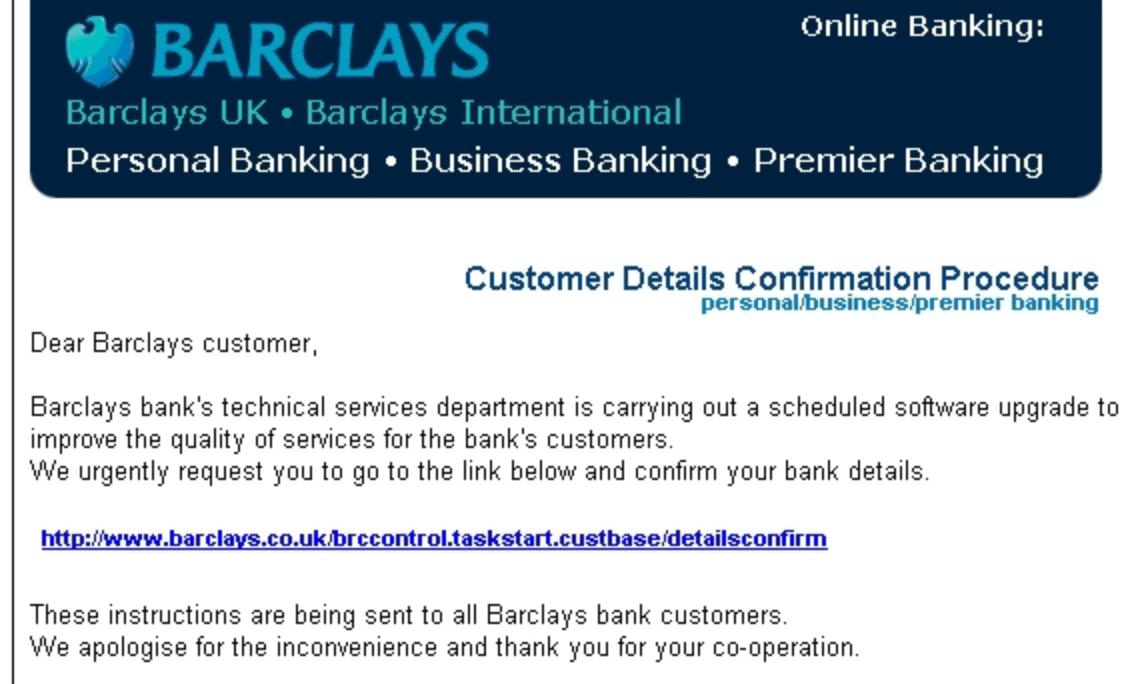
Gone phishing: not from Barclays…

Have you ever had an email from a bank you don’t have an account with telling you to update your security details? That’s a ‘phishing’ email – sent by fraudsters to trick you into revealing passwords and other sensitive information that could be used to steal your money and even your identity.

Banks and others have been warning customers about phishing scams for years. Yet they’re still out there. They usually warn of terrible consequences if you don’t take action: your account will be closed; you’ll miss out on a refund. They may even warn that you’ve been billed for child pornography. A friend this week asked me to say if a suspicious email was from the company I worked for. It wasn’t – we’d never ask for your bank details, mother’s maiden name and a host of other sensitive information.

Whatever you do, don’t fall for it. If you get an email asking you to confirm security details, be suspicious. If in any doubt, don’t open it, and don’t click on links in such emails. Instead, if it claims to be from your bank, ignore the email, go to the bank’s website and log in as normal. If the bank does need you to do anything, there will be a message waiting for you. Chances are there won’t be.

I’m lucky enough to be involved with a wonderful organisation called Get Safe Online, backed by the British government. Get Safe Online has a stack of useful information on its website aimed at keeping you safe from the phishermen and other scams. Here’s Get Safe Online’s advice about spam and scam emails.

PS: Get Safe Online Week this year (22-26 October) has the theme Click & Tell: passing on  online safety tips to family and friends. Please tell your loved ones not to fall for scam emails!

Beware anti-virus scam, says Get Safe Online

Britain's online safety campaign, Get Safe Online, today received blanket media coverage for its warning about an anti-virus scam that targets huge numbers of people across Britain. Criminals call people claiming their computers have a virus. They then persuade them to pay for and download software they say will remove the virus. But there's no virus – in reality, the victims are paying to infect their own computers with 'malware' that enables the conmen to steal their financial details and even their identity. 

Get Safe Online's managing director Tony Neate took to the airwaves early today to explain the scam to Radio 5 Live Breakfast's Shelagh Fogarty and BBC Radio 4 Today's John Humphrys (amongst others). And I was pleased to play my part, spreading the word on radio stations from Cumbria to Jersey, and from Cornwall to Lincolnshire. (PayPal is a long-standing sponsor of Get Safe Online.) 

Many of the interviewers I spoke to reported that they or their friends had received such calls, underlying the extent of the problem. 

Ironically, this con takes advantage of our growing awareness of the need to protect our computers against viruses. The fraudsters claim to be working with well known IT companies. Yet almost 90% of us now have anti-virus software on our PCs, making it much less likely that we'll fall victim to a virus. 

The scam isn't a new one: the Guardian's Charles Arthur was one of the first journalists to highlight the issue, along with Computer Active's Dinah Greek. Get Safe Online was concerned enough to campaign against the scam during its high profile Get Safe Online Week. Its research suggests that almost a quarter of UK internet users have had one of these calls. We hope that Britain's computer users are now on alert to defeat the conmen. 

Note: Get Safe Online is a joint initiative between the Government, law enforcement, leading businesses and the public sector. Its aim is to provide computer users and small businesses with free, independent, user-friendly advice that will allow them to use the internet confidently, safely and securely.