
AI regulation: a lesson from 200 years of railway history

A mighty transatlantic battle is in prospect over how to regulate artificial intelligence (AI). Donald Trump’s second administration seems sure to opt for the lightest of light touches, influenced by tech tycoon Elon Musk. (If Musk can tear himself away from his bizarre obsession with Britain.) The European Union has already legislated for a far more restrictive approach, with Britain likely to follow a middle way. The sensible aim must be to unleash the creative, social and economic benefits of AI while minimising the harm it may cause if abused or badly handled.

As debate raged about AI regulation, it struck me that many of the arguments deployed for and against AI and tech regulation also played a huge role in shaping the response to the railway revolution in the 19th century.
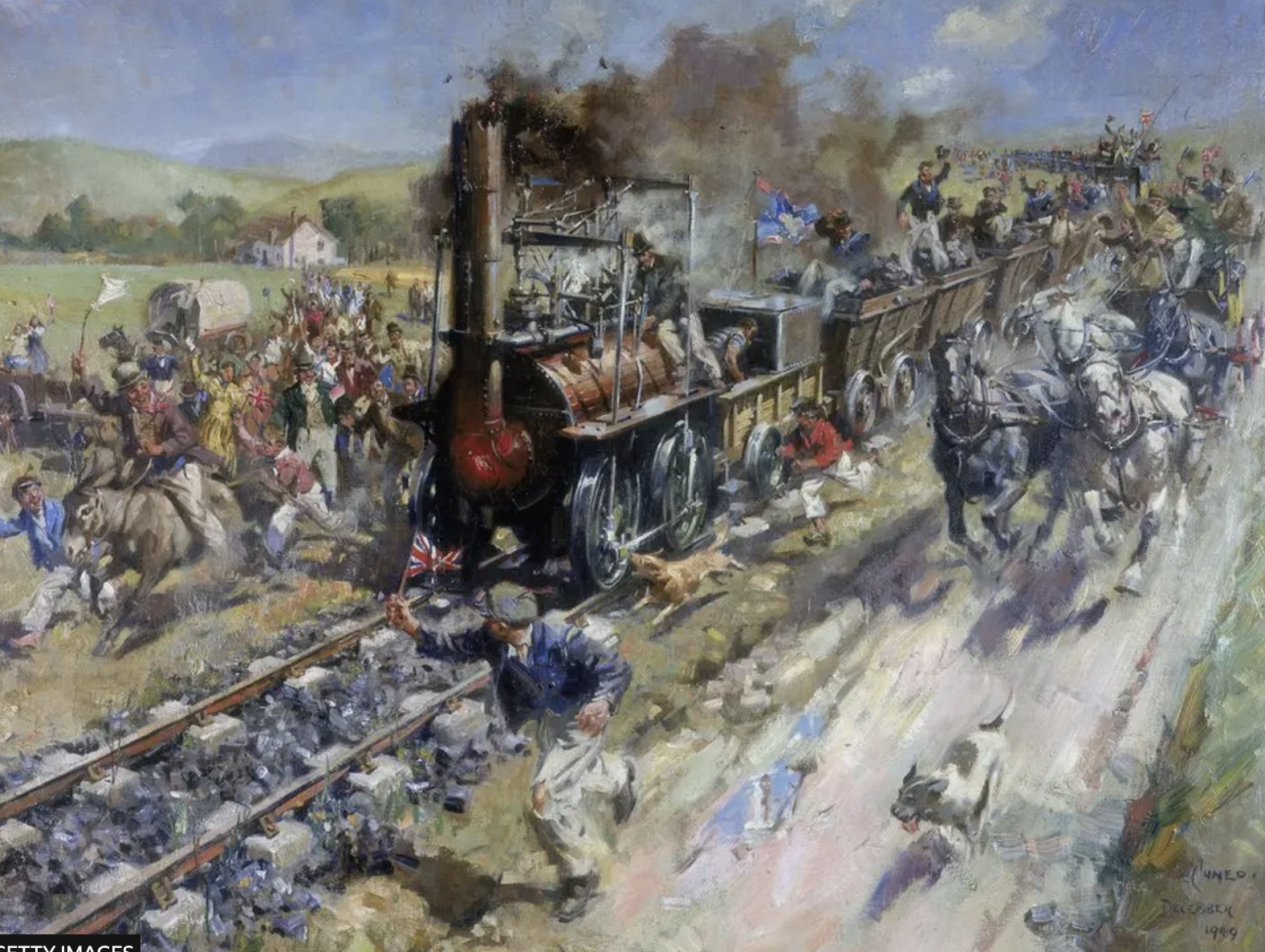
The opening of the Stockton & Darlington in 1825. Painting by Terence Cuneo; NRM/Science & Society Picture Library

The railway age properly began in September 1825 with the opening of the world’s first public railway to use steam locomotives, the Stockton & Darlington Railway in County Durham in the north of England. After the success of the first intercity railway between Liverpool and Manchester, opened in 1830, Britain enjoyed a railway boom, as pioneers planned lines linking major cities – and serving industry, the original purpose of the iron road. By the early 1840s, railway mania had taken over, in a prelude to the dot.com boom at the turn of the 21st century. In 1844, 240 private bills were presented to the British parliament to authorise 2,820 miles of railway. Had all these been built, the £100 million of capital needed represented over one and a half times Britain’s gross domestic product (GDP) for that year. Parliament still approved half these railways.

Anything goes? The heyday of the laissez-fair state

Britain in the 1840s was a firmly non-interventionist state. The dominant philosophy was laissez-faire: small government, low taxes and the free market. Most acts of parliament were private acts to authorise new railways rather than government initiatives. Anyone able to raise money could form a railway company and apply to parliament for permission to build their pet route. The sheer volume of railway business threatened to overwhelm the Westminster legislature. But an attempt to create order by setting up a railway advisory board to vet proposed plans before they reached parliament was short lived, killed by the powerful railway lobby. (And conflicts of interest: 157 out of 658 MPs had financial interests in the railways.) This was Britain’s last chance to create a strategic rail network, deploying investors’ money more efficiently. The failure led to many investors losing most if not all their money on rail schemes that had no hope of success, again pre-empting the dot.com bubble of 1999-2000.

Continue reading
Open letter to Cheryl Gillan MP on Brexit

IMG_3857

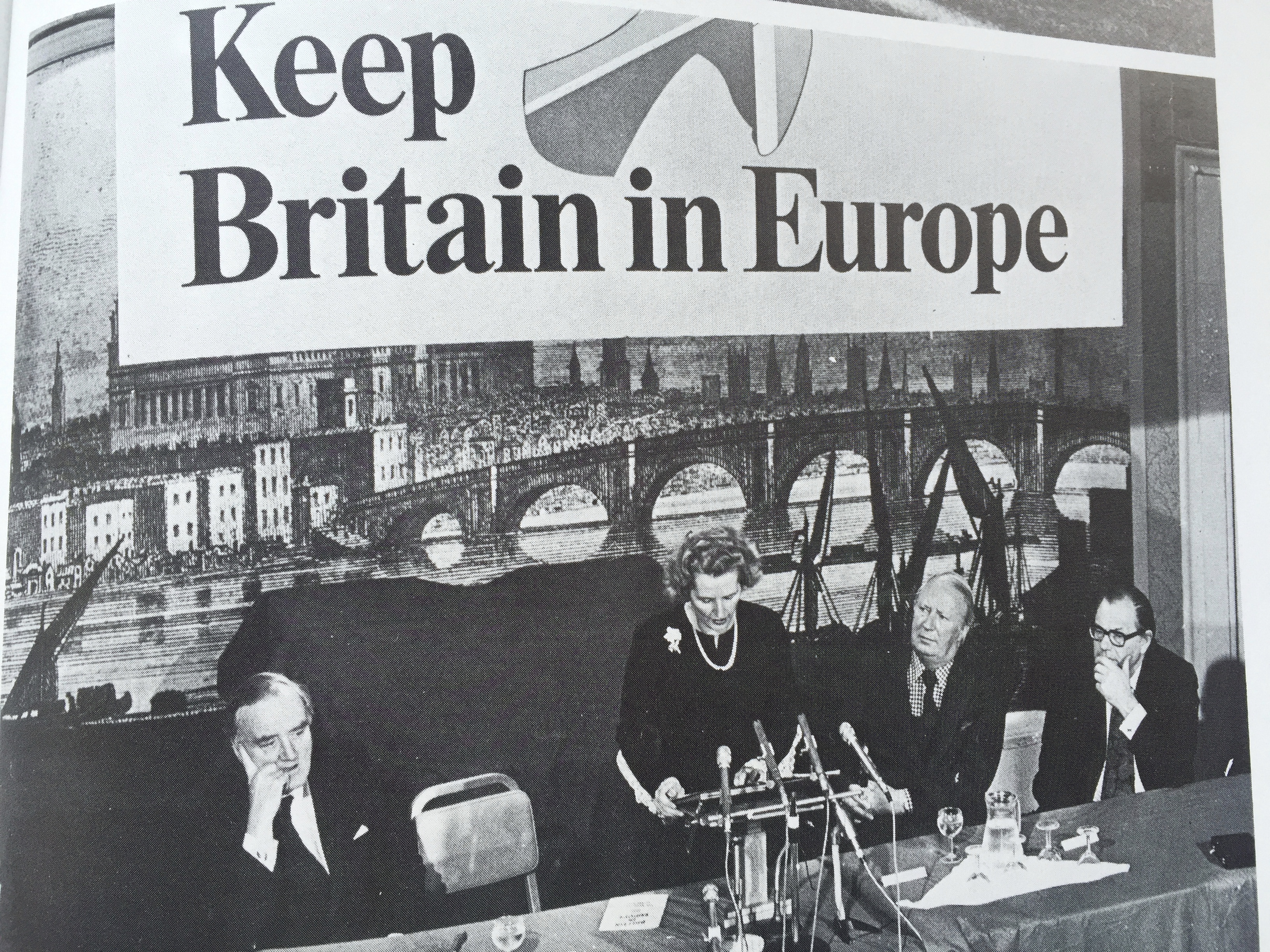
Margaret Thatcher campaigns to keep Britain in the EEC, 1975

The Rt Hon Cheryl Gillan MP

House of Commons

London SW1A 0AA

29 June 2016

Dear Mrs Gillan

Like many of your constituents, I am deeply concerned about the consequences of last week’s very narrow referendum vote to leave the EU, which you campaigned for.

We are already seeing major companies like HSBC and Visa saying they will move jobs from the UK to the continent if we lose access to the European Single Market, which Margaret Thatcher played a major role in creating. The leaders of the leave campaign such as Boris Johnson and Nigel Farage have been quick to disown the pledges they made to win votes. The Conservative and Labour parties are in chaos, and the country is rudderless at our most critical moment as a nation for generations.

You, as our MP, have a great responsibility for helping save the country from disaster. I urge you to:

Demand that Parliament has to agree to any government decision to invoke article 50 of the Lisbon treaty.

Britain is a parliamentary democracy. Recent governments have accepted that vital matters affecting the nation such as going to war must be subject to a parliamentary approval, rather than royal prerogative exercised by the prime minister. Starting the process of withdrawal from the EU is just as important – and parliament must decide.

Only vote in favour of invoking article 50 when the UK government has determined what the future relationship with the EU should be, in agreement with the devolved governments of Scotland, Wales and Northern Ireland

Like me, you were born in Cardiff, Wales. Unlike me, you have served as Secretary of State for Wales. As such, you must understand the vital need to preserve the United Kingdom. Keeping Scotland in the Union, preserving peace in Northern Ireland and maintaining the interests of Wales must be fundamental to the task of negotiating the right future for Britain in Europe. Millions will never forgive this government if it destroys Britain.

Demand that the UK maintains access to the European Single Market – including financial services

Many of your constituents work in financial services. London, the South East and the rest of the country will suffer countless job losses – and the City will be hugely disadvantaged – if UK banks lose the right to ‘passport’ their UK banking licences to the 30 countries in the EU and EEA. We have already seen HSBC and Visa say they will move jobs from the UK if this happens. This is not a game. The time for bluster and rhetoric is over – MPs have a responsibility. You will be held to account if you get this wrong.

Fight against hate speech and crimes

Millions of us are horrified at the way the referendum campaign fuelled xenophobia in Britain. We liked to think of our country as tolerant, embracing people no matter what their background. Yet leave campaigners have let a horrible genie out of the bottle. I’m appalled by the attacks on the Polish and Muslim communities, who have enriched the country. (How many of the thugs know that Polish refugee airmen helped to save us in the Battle of Britain?) It’s time to take action to end this hatred and punish those who fuel it.

Protect EU nationals working in the UK

Colleagues from other European countries working alongside me here in the UK have been in tears, taking the referendum rhetoric and the result as meaning they are not wanted here. This is appalling. They make a huge contribution to our country and economy. They are our friends as well as colleagues. I call on you now to urge ministers to guarantee that no one working here who come from other EU states will lose the right to work in the UK.

End the lies

The referendum campaign marked a new low in British political campaigns. Politicians are not famous for telling the truth, the whole truth and nothing but the truth – but never before have we seen so many of them telling outright lies and refusing to stop when exposed. The £350m claim was the most outrageous example, condemned by the independent UK Statistics Authority as plain wrong. It’s time to ban politicians from telling lies. And the thought of one of those liars becoming prime minister is totally unacceptable.

I look forward to hearing from you.

Rob Skinner

David Cameron, Harold Wilson and Euro referendums

David Cameron has opened a new chapter in Britain’s troubled membership of what we now call the European Union. He says his party will hold a referendum to decide whether we should stay in the EU, should it win the 2015 general election. He will campaign for Britain to stay, provided he is happy with whatever new settlement he negotiates with Britain’s EU partners.

Any referendum will be the first on Europe since Harold Wilson’s Labour government’s 1975 poll settled the issue for a generation. At the time, it was seen as a clever fix for Labour’s internal war about Europe. (Typical Wilson…) But within five years the party was at war again, leading to the SDP breakaway. Time will tell if Cameron’s move will be any more successful.

I was 11 when Britain voted in 1975. We had a day off school as Cardiff High was being used as a polling station. I remember telling friends we should pull out – I even stuck a copy of the No campaign’s leaflet inside the lid of my school desk. (My friends were sensibly more concerned about whether Bay City Rollers would make number 1.)

In time, I became convinced that Britain should be a positive, active member of what we now call the EU. But I have always been concerned by the madder aspects of the EU: the stupidity of the Common Agricultural Policy, the bureaucracy and lack of democracy. I hate the way the Irish have been told to rerun referendums until they get the ‘right’ result. This is not an institution that inspires love or affection in sensible folk.

I happened to listen to David Cameron’s speech live on BBC Radio 5 Live on Wednesday. It struck me as a very cleverly constructed case for change. I particularly liked the way the prime minister accepted the role the EU played in ending Europe’s eternal wars. He was right to say Europe’s single market was its biggest strength. No sensible person can argue against the idea that the EU desperately needs to change if Europe is to flourish and compete against China, India and Brazil.

Yet Cameron’s move is so blatantly a bid to secure party unity that it’s hard to see it succeeding. Europe isn’t an issue that most people care about – except in the Westminster village. Cameron is unlikely to win an overall majority in 2015, which means he won’t be the one to hold a Euro poll. Unlike Harold Wilson, that wily politician who dominated British politics for over a decade in the 1960s and 1970s.