
The Guardian: too much Apple coverage?

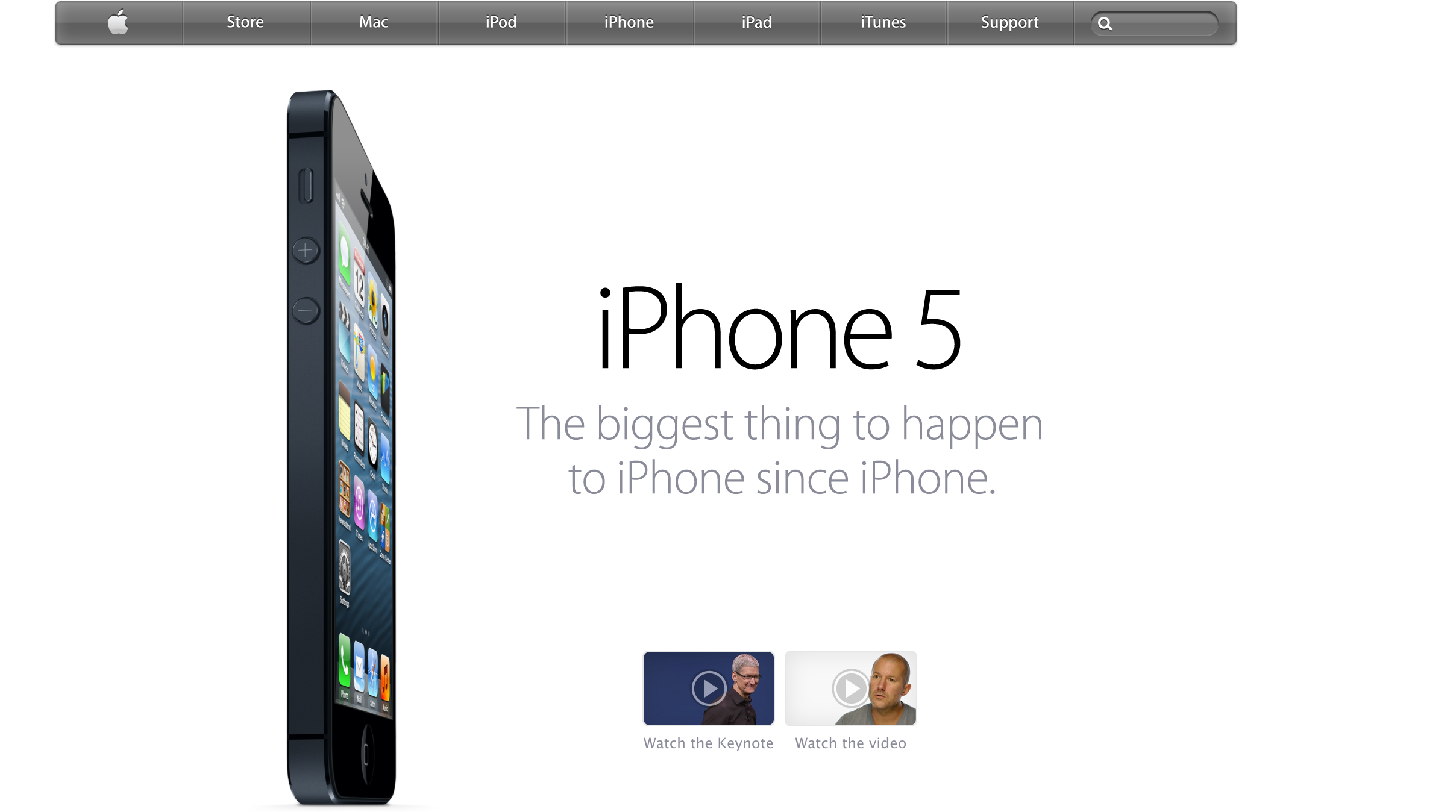
iPhone 5: does it get free and easy publicity from the media?

The Guardian’s readers’ editor Chris Elliott today devoted his Open door column to respond to reader criticism that the paper has, in Elliott’s words, been,'”brainwashed” by Apple to give the company and its products excessive amounts of favourable publicity.’

Elliott makes a comparison of the paper’s coverage of Apple phones compared with the rival Android mobile phone operating system over the past 12 months:

“There were 900 references to Apple in the paper and on the website in total; 470 of those were in print. There were 340 references to Android phones, of which 30 were in print.”

Elliott’s article was balanced without reaching a verdict on the claims of Apple bias. He quotes the paper’s technology editor Charles Arthur:

“The statistics show that people read about Apple stuff. If a story involves the company, it gets huge readership. We aim to write about it fairly. If it gets a lot of coverage, that’s because what it does can move entire markets – stock markets, other companies’ shares (eg suppliers who win/lose contracts), how we use devices (so it might not have been the first company with a touchscreen phone, but it set the standard all the others followed).”

Arthur was criticised heavily by readers last month for posting a 5 star review of the iPhone 5 that didn’t mention the flaws in the new Apple Maps app that replaced Google Maps in the iOS 6 operating system that powers the new phone. Arthur reassured readers who may be concerned about switching to the Apple app: “Don’t worry – it’s very good.” Within 24 hours, his colleague Juliette Garside reported ‘significant glitches’ in Apple Maps, including the disappearance of Stratford upon Avon, new airports and relocated towns.

Charles wasn’t the only reporter to publish a glowing review that didn’t mention the maps fiasco. The Telegraph’s Shane Richmond wrote a similarly euphoric write up the same day. The challenge tech writers like Shane and Charles face is that readers and publishers demand an instant appraisal of new tech products. They don’t always get enough time to get under the skin of the latest phones and other devices. It was much the same with the last truly new iPhone model – the rumpus about the reception problems of the iPhone 4 (the predictably named ‘antennagate’) broke a couple of weeks after the launch, long after the glowing reviews had appeared.

UPDATE: Shane has pointed out in response that he wrote a parallel story the same day as his iPhone 5 review highlighting that iOS 6 isn’t as good as it could be: “Unfortunately, in the version I tested, Apple’s Maps are missing places such as railway stations and frequently misplace cafes and restaurants, often putting them streets away from their actual locations.” Charles has highlighted his piece last week asking ‘Why do some people really hate Apple?”

The cult of Apple … and Android

It can’t be easy to be a tech writer. Anything you write about Apple or Android leads to an torrent of vitriol from fans of the rival systems that is literally beyond reason. Take one comment on Chris Elliott’s article:

“For most purposes Apple products suck. If you want to do any serious professional work using a computer you do not use Apple, but instead PCs running Microsoft Windows or a version of Linux…The only people who use Apple products are those who buy the product as a fashion accessory, or because they think it is cool and rebellious not use Windows.”

It’s hard to think of any other type of consumer product that provokes this kind of religious/cult style over-reaction. Do Ford car owners condemn Vauxhall or Mercedes owners as stupid for their choice of car? Or Canon devotees about Nikon users? It seems unlikely.

My view is that Android and Apple phones are amazing devices. They offer features that we could only dream about five years ago – and are so much more user friendly than earlier smartphones. (Just try using a BlackBerry if you want to see how awful smartphones were before the iPhone.) iPhones are brilliant for people who want a simple yet powerful user experience but aren’t bothered about customising how everything works. Android is terrific for anyone who wants more flexibility – in handsets, software and customisation. You choose.

Charles Arthur’s Digital Wars: Microsoft’s lost decade

The Guardian‘s technology editor Charles Arthur is an incisive observer of the tech business world. So it’s no surprise to discover that his book Digital Wars is a revealing account of Apple, Google and Microsoft’s battles for dominance in search, digital music and smartphones.

The clearest message from the book is that the 2000s were a lost decade for Microsoft. At the time of the millennium, it seemed invulnerable. Its dominance of the PC software market for consumers and businesses made it a hugely powerful and profitable corporation. Windows and Office were huge money spinners. The biggest cloud was the anti-trust actions taken by the United States Department of Justice and the European Commission. By contrast, rivals seemed powerless to confront the Redmond juggernaut.

Yet Arthur makes it clear that the anti-trust cases had a profound impact on Microsoft. In his words, the US case ‘reached down into the company’s soul’. Although Microsoft escaped the threat of being forced to split in two, Arthur quotes analyst Joe Wilcox’s verdict that the actions ‘hugely affected’ the way the company operated. ‘Microsoft was unequivocally less aggressive [and ] there was a lack of certainty and aggression in Microsoft’s response to Apple or other companies’.

There were other factors at work. For Microsoft’s leaders at the turn of the millennium, the internet was something they got used to in mid career, rather than in their formative years at college. They were set in their offline ways, and had to adapt. By contrast, the pioneers at Google were starting out with instinctive understanding of the net, email and networking. Their business was built online.

The other critical factor was the classic symptoms of bloated corporations: poor decisions and internal politics. Arthur explains how Microsoft blew the chance to compete with Google’s fast developing search and advertising business. It failed to buy Overture and even worse overlooked the fact it already owned a company called LinkExchange that enabled small advertisers to bid for their names to appear next to search results. (Exactly what Google was developing with AdWords.) Arthur recounts that Microsoft’s new chief executive Steve Ballmer closed the LinkExchange-based ‘Keywords’ project at just the time Google launched AdWords, because other Microsoft tribes feared it would cannibalise banner sales.

Later, Microsoft ploughed countless millions into search, but the anti-trust actions cast a long shadow: building search into the browser would invite a repeat of those courtroom years. The smart alternative, embedding search into Office was the obvious way to go. But the boss of Office wasn’t interested.

This story was repeated across the other battlefields: digital music (where Apple won the day) and smartphone systems (where Apple and Google, with its Android mobile operating system, shared the prizes).

Commentators have pointed out that Microsoft is largely a business-to-business (B2B) culture. With a few exceptions (Xbox and 1990s triumphs like Encarta spring to mind), the company does not have a consumer outlook. By contrast, Apple has set a new standard in how technology should be designed for everyday people who aren’t geeks. My painful experience with Microsoft’s Pocket PC software persuaded me not to buy a Windows-based smartphone. (My Dell PDA was lovely, but the Windows OS was appalling. How could they make hooking up to wifi such a ghastly experience?) Many will have the same view, yet by all accounts the latest Windows Phone system is a delight. Microsoft’s problem is that so many people have now fallen in love with Apple’s iPhone or Google Android-based phones. Switching will be hard.

It would be foolish to write off Microsoft. Or to assume that Google or Apple are invulnerable. (That’s where we came in – when Microsoft was all-conquering.) The one rule of the tech world is that no-one rules forever. The next chapter of this story will be just as compelling.

Beware anti-virus scam, says Get Safe Online

Britain's online safety campaign, Get Safe Online, today received blanket media coverage for its warning about an anti-virus scam that targets huge numbers of people across Britain. Criminals call people claiming their computers have a virus. They then persuade them to pay for and download software they say will remove the virus. But there's no virus – in reality, the victims are paying to infect their own computers with 'malware' that enables the conmen to steal their financial details and even their identity. 

Get Safe Online's managing director Tony Neate took to the airwaves early today to explain the scam to Radio 5 Live Breakfast's Shelagh Fogarty and BBC Radio 4 Today's John Humphrys (amongst others). And I was pleased to play my part, spreading the word on radio stations from Cumbria to Jersey, and from Cornwall to Lincolnshire. (PayPal is a long-standing sponsor of Get Safe Online.) 

Many of the interviewers I spoke to reported that they or their friends had received such calls, underlying the extent of the problem. 

Ironically, this con takes advantage of our growing awareness of the need to protect our computers against viruses. The fraudsters claim to be working with well known IT companies. Yet almost 90% of us now have anti-virus software on our PCs, making it much less likely that we'll fall victim to a virus. 

The scam isn't a new one: the Guardian's Charles Arthur was one of the first journalists to highlight the issue, along with Computer Active's Dinah Greek. Get Safe Online was concerned enough to campaign against the scam during its high profile Get Safe Online Week. Its research suggests that almost a quarter of UK internet users have had one of these calls. We hope that Britain's computer users are now on alert to defeat the conmen. 

Note: Get Safe Online is a joint initiative between the Government, law enforcement, leading businesses and the public sector. Its aim is to provide computer users and small businesses with free, independent, user-friendly advice that will allow them to use the internet confidently, safely and securely.

Guardian axes technology section

Thursdays will never be the same again. The Guardian is to axe its printed technology section after 17 December. 

Editor Charles Arthur explained the decision in this week's edition: too many IT job ads have moved online. And it's hard to disagree: the section is painfully light compared with the Guardian's hefty media, education and public sector supplements. 

But judging by the reader comments on Arthur's article above, I'm obviously not alone in mourning the printed section. I used to savour reading it on the train back from first direct in Leeds on a Thursday afternoon, or on the tube home from Canary Wharf. Now I commute by car, I save the treat for the evening. But not for much longer. 

Some have questioned the direction Technology Guardian has taken since Charles Arthur took over in 2005. The Free Our Data campaign has come under particular fire as an obsession that put many off. And I always skip past the regular section on computer games. All this, though, is a distraction. Those job ads are the lifeblood of any supplement. 

I just hope that enough of Technology Guardian survives in the main paper. (And please keep the tech podcast.) But the demise of the gadget spot in the Saturday Weekend magazine isn't a good sign. And what are the prospects of the excellent family section in Saturday's paper? The closure of the 30 year old business section in the Observer, the Guardian's sister paper, is another indication that papers are struggling to cope with the recession and the rise of online advertising. I'll enjoy my favourite sections while they're still there. But you have to ask whether newspapers are doing enough to win new readers and secure the loyalty of existing subscribers. Cost cutting may help them survive the storm. It won't secure a long term future.

UPDATE, Wednesday 25 November 2009

Charles Arthur, The Guardian's technology editor, has posted the following response.

(Note: a bug in Typepad's comment system meant Charles was unable to post a comment via Typepad. Typepad tells me they are working on a fix. Meanwhile, I am happy to post Charles's emailed comment here unedited.)

[Your quote] "Some have questioned the direction Technology Guardian has taken since Charles Arthur took over in 2005. The Free Our Data campaign has come under particular fire as an obsession that put many off."

Err… who are these "some"? They weren't very vocal. Or was I looking the wrong way somehow? And what particular fire did Free Our Data – which you'll have noticed scored a giant victory this week, with Gordon Brown and Tim Berners-Lee backing its core idea – come under? I kept meeting people who wanted it to happen; never any who said "I'm so bored of that campaign". Never.

"And I always skip past the regular section on computer games."

Unlike the gamers who read the section. We try to cover a broad waterfront.

I'd have to say: I think that the Free Our Data campaign is going to be viewed, in retrospect, as having marked a sea change in government's view of the non-personal data it collects. You may not have liked it, people you met might not have liked it – but it's going to enable lots of new businesses, and reduce costs for many more, which means more jobs and more business. (And more tax revenue for the government.)

Charles Arthur