Apple: the end of the love affair (for now)

I've been an Apple fanboy for the last couple of years. I loved my iPhone 3G from the day I got it. It prompted me to buy my first Mac and an early iPad. I've loved the intuitive, gorgeous designs and the contrast with the sheer unpleasantness of life with Microsoft products. (Windows Vista was hideous, but Pocket PC wasn't much better.) 

So I was really looking forward to upgrading my iPhone to the latest model. iPhone 4 looked a worthy successor to Apple's earlier, extraordinary smartphones. But wait: were those stories of dropped calls more than media hype? And why has my previously flawless iPhone 3G turned into a mobile version of the hideous Windows Vista since Apple pushed its iOS4 operating system upgrade? The phone now takes ages to do anything. 

I've spoken to lots of iPhone 4 owners this month. They all report huge disappointment at the phone's performance … as a phone. The dropped signal problem is a real crisis, not an invention of Apple critics. One person bitterly regretted not demanding a refund. Others I talk to are switching to rival Android phones. 

Apple has facing a real crisis. Sales may have been strong in the two months since the iPhone 4 went on sale, but if I'm typical many other likely purchasers are delaying splashing out – or, worse for Apple, are considering rival phones. Steve Jobs' complacent, arrogant response to the iPhone 4's design flaw – 'don't hold it that way' – led many to question the Cupertino company's commitment to its customers. But I was also disappointed by the feel of the latest iPhone. It doesn't caress the hand like its predecessors. That might not matter if the phone worked. But I see no reason to spend a huge amount of money on a flawed product. I haven't renounced Apple. But I feel betrayed. The folks from Cupertino need to start wooing me again after the disappointments of the summer of 2010. 
Why I chose a wifi only iPad

One of my Twitter followers, John Taylor, asked me why I chose the wifi only version of the iPad. This post – the first I've written 'on request' – answers John's question.

It wasn't an instant decision. But the more I thought about how I'd use my new toy, the more I realised the 3G version would be an unnecessary indulgence. (A description some would apply to all versions of Apple's tablet!) For me, the iPad is a sofa companion, not a road warrior. It means I can do my browsing, check emails and keep up to date with Twitter and Facebook from the living room. I don't carry it with me on my travels except on holiday – such as our current fortnight at Greenwood Grange near Dorchester in Dorset – where it's proving a wonderful way of viewing holiday photos.

If Britain had a better 3G network I'd probably have opted for the 3G version. But, as the BBC's technology reporter Rory Cellan-Jones blogged today, the mobile phone networks have failed to fulfil the dream of a fast mobile internet. If I'd spent an extra £100 on the 3G iPad, I'd have found it useless at Greenwood Grange, as there's virtually no mobile internet coverage in our cottage. (And had Greenwood Grange's wifi service, provided by @clubwifi, actually worked, 3G would have been unnecessary.)

The other reason why I didn't splash out on the top iPad model is that I'm already paying for mobile internet through my iPhone. I didn't want to pay another monthly payment for data on the go – or to pay more every time I went online. (I love the iPhone's 'as much as you can eat' pricing for the mobile internet.) So far, I've got no regrets about my iPad choice. I don't miss the 3G connection. I'm sure in time that all mobile computers will come with the latest super-fast cellular connections. But for now, wifi is a good option.

Greased lightning: why I love my iPad

IMG_0004

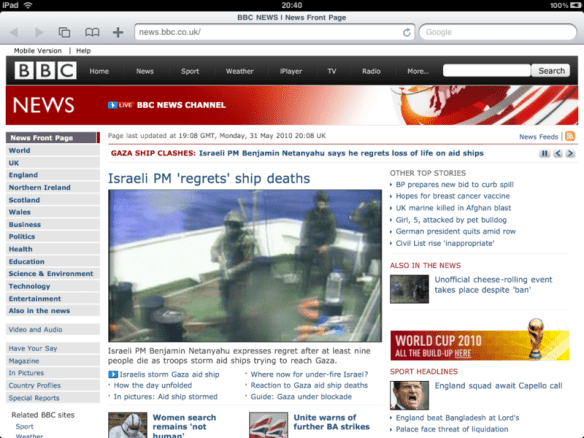
BBC News: my iPad got me here in 12 seconds…

Last Friday's launch of the iPad has prompted the inevitable chorus of critics amidst the sighs of Apple worship. 'Style over substance', 'an iPhone on steroids' and 'a solution in search of a problem' (I admit, I thought that when Steve Jobs announced the iPad last January) rank amongst the most common. 

I blogged about my iPad the day I got it, last Thursday. I've now had a few more days to get to know it. And I've discovered what must be its greatest advantage. It gets you places quicker than you imagined possible. So anyone who values their time, but can't see why they need an iPad when they've got a PC, should think again. 

To prove the point, I did an experiment tonight. I wanted to find out how much faster the iPad got me to the BBC News homepage. I was amazed at the results. 

First out of the blocks: my three year old HP Pavilion laptop, running that dog of an operating system, Windows Vista. From switching on the computer to reaching the homepage: a mind-numbing five minutes 12 seconds. To give a fair comparison, I switched off the iPad. From switch on to BBC: an excellent 35 seconds. In reality, I don't turn off the iPad, so the true result is an extraordinary 12 seconds. 

My laptop is likely to live a life of leisure now my iPad has arrived!

Falling in love with my iPad – but no thanks to Typepad

IMG_8325

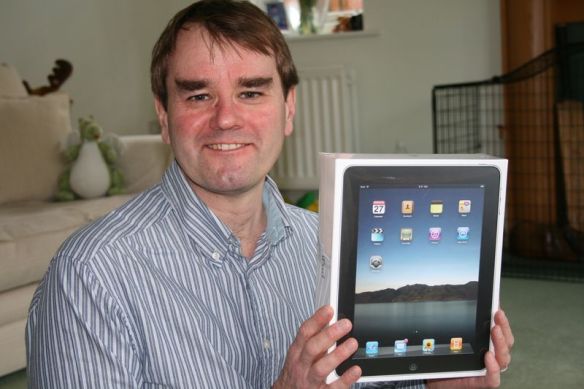
My iPad arrived today, 24 hours before Apple's tablet officially launched in Britain. This boy was very pleased with his new toy. I confess that I was sceptical about the iPad when Steve Jobs announced it in January, as I blogged on the iPad at the time. But I soon realised that a supersize iPhone would be something special. And the tablet is so much more than that. 

A tense moment

But I had a scare. I spotted what looked like a series of small scratches on the screen of my brand new iPad. I fell into a deep depression. I tweeted my horror. But @academyblog rode to my rescue, pointing out that the scratches were actually meteors on the iPad home image. But I wasn't alone in fearing damage, as the meteors didn't appear in the marketing images for the iPad. [Update: they're not meteors, but stars moving across the sky, captured by a time exposure by photographer Richard Misrach. The shot was taken at a lake in Nevada, USA.]   

So far, so very good

I've been very impressed playing with the iPad today. Typing on it is a dream – that virtual keyboard works beautifully. The device is far quicker than my iPhone 3G. It is a gorgeous canvas for photos. And my favourite newspaper's Guardian Eyewitness app is breathtaking. And free! 

You've got Mail

A constant frustration of the iPhone – at least on O2 – is its failure to send email via wifi. The iPad has no such weakness. Just as well as I chose the wifi only version! 

… and photos

I bought the iPad camera connection kit with my device. It's a bit much to have to spend £25 making up for the device's lack of a USB port. But it works well, importing photos quickly and easily. 

Some gripes

The iPad makes (some) apps less compelling, as regular browsing works far better on Apple's tablet than the iPhone. And many apps have yet to be redesigned for the iPad. Take the Typepad app I'm typing this on. It can only be used in portrait format, which means I miss the best orientation of the keyboard. Yet the web version of Typepad doesn't seem to recognise photos on the iPad. And after posting this, I found that all formatting – even something as basic as paragraph breaks – disappeared. And photos weren't inserted correctly, which meant the image at the top of this post was originally published with the iPad out of shot. Even more frustratingly, I could not then delete the image from the published post! I can't believe that a tech company could be so badly prepared for the iPad, well over a month after it went on sale in America. 

In time, I'm sure these issues will disappear. But it's a niggle for early adopters. I also hope that we'll be able to switch between portrait and landscape format when using apps – such as Tweetie, soon to be renamed Twitter for iPhone. That's one of the frustrations of the iPhone. 

But these are mere gripes. This is a gorgeous computer. It's battery life is extraordinary. It's still showing 77% battery life left after hours of play. That's outstanding. I'll post a more detailed review after I've had rather longer in its company. 


The TV and social media election

It was billed as the social media election. Yet television – invented the year my father was born, 1926 – has electrified Britain's 2010 general election campaign.

Nick Clegg's performance in Britain's first leaders' debate a week ago catapulted the Liberal Democrats into pole position as the party for change. For seven days, Labour and the Conservatives have agonised how to respond. Should they attack Clegg or ignore him? Should they play the man or his party's policies?

Tonight's second televised debate was eagerly awaited. Would Nick maintain his lead? Would the two other party leaders perform better?

I thought all three leaders did well tonight. Interestingly, Irish journalist Christine Bohan said on Twitter that she'd kill for a leaders' debate of this calibre with Ireland's political leaders Cowen, Kenny and Gilmore. (Thanks to Orlaith Finnegan for a retweet of this.) Brown, Cameron and Clegg were impassioned and smart.

I blogged recently that talk of a social media election was overplayed, as BBC's Rory Cellan-Jones became a digital election reporter. I don't think Twitter will win the election, but it has complemented the role of the TV debates. And it's giving fresh power to the people and the political parties against the deeply biased old print media. The brilliant #nickcleggsfault viral Twitter campaign, mocking the Tory press's smears about the Liberal Democrat leader, rattled the Daily Telegraph, which was forced to defend its smear against Clegg earlier the same day.

Here's to next week's final debate.

Social media comes of age: a day at Don’t Panic’s latest event

Social media is now part of the mainstream. Last week's conference about strategic social media, run by Don't Panic, confirmed how much has changed since I attended one of Don't Panic's first events on the subject, the University of Sunderland's Delivering the new PR in 2006

Don't Panic's Andy Wake has written an excellent account of the changing impact of social media on the Eventualities blog. (See also this comprehensive post by Adam Burns.) Those early events included workshops explaining what a blog was, and encouraging PR people to try their hands at blogging and social media. No such introduction is needed now, as the BBC's news bulletins regularly cover Twitter and Facebook. (Perhaps excessively, as I suggested in a blog post about the BBC's Rory Cellan-Jones last month!) Corporate communicators are now judged on how their organisations are engaging with social media as well as traditional media. 

Yet we should take care not to treat social media as a bandwagon. The best presentation at last week's Don't Panic event was by Martin Thomas, the co-author of Crowd Surfing. Martin mocked the idea that companies need a social media strategy. I totally agree – a social media strategy suggests a synthetic response to the changes that social media is prompting. (My boss recently posed the compelling question: why he should have a social media strategy but not a newspaper or email strategy.) Instead, we should apply the lessons of social media (that transparency and authenticity are crucial) to all our communications efforts. It's telling that many senior communicators regard Twitter as a way of pushing out corporate messages. That's completely wrong. In the same way, too many corporate communicators only tweet when they've got a news release to sell. That's not going to win them many friends. 

Wadds SSM

The other refreshing presentation was from Stephen Waddington from Speed Communications, who gave everyone a copy of the Beano. (Thanks to Don't Panic's Andy Wake for the photo of Stephen and his son reading the Beano in the background.) This wasn't as eccentric as you might think: Stephen's point was that great content is always a winner, whatever the medium. He contrasted the hopeless online efforts of Britain's biggest regional media groups with the SR2 blog, an extraordinarily compelling website run by Josh Halliday, a journalism student in Sunderland. 

I'll end this account with a plug for a brilliant piece of viral marketing for Blackpool, described by Sarah Lundy from Visit Lancashire. I've a particular interest here as my father was a pioneer of local government and tourism PR in Wales and London. I was thrilled with the success of Blackpool's J'aime La Tour video, which confirms Stephen Waddington's view that great content wins. 

I've included below links to my blog posts about the Don't Panic events I've attended. Social media has dominated! 

CIPR Northern Conference July 2006: PR embraces blogs 

November 2006: Delivering the new PR

June 2007: Delivering the new PR 2.0

January 2008: crisis communications

May 2008: a new era of authentic communication

May 2009: it's not about technology

Why the BBC’s Rory Cellan-Jones is wasted on digital election stories

I'm a huge fan of the BBC's technology business reporter Rory Cellan-Jones – or @ruskin147 as he's known on Twitter. I first appreciated his expertise and enthusiasm after reading his book about the dot com boom and bust, Dot Bomb

But my heart sank when I heard that Rory had been given a temporary role as the BBC's digital election correspondent. Not because I don't think social media will play a role in the imminent British general election. No, my concern is that the move appears to confirm the fears of the BBC critics who think the corporation is obsessed with Twitter and – to a lesser extent – Facebook. More significantly, it suggests a preoccupation with the medium rather than the message. 

Don't get me wrong. I love social media. I've been blogging since 2005, and have embraced Twitter and Facebook with a passion. But Rory's new (temporary) beat suggests the BBC is desperate to be seen as cool and in touch. His blogpost about the budget confirms my fear. As he says, the Facebook election page has just 1,000 fans active and 12 contributors. I sense that Rory is desperate to find a new digital angle to the election, rather than judge possible stories on their newsworthiness. That's a great shame for such a talented journalist.

The political social media enthusiasts constantly point to Barack Obama's 2008 campaign as the model for future engagement of voters through social media. But America is, as they say, another world. Obama was engaging in a great debate with Democratic party rivals, followed by the actual race for the White House. The idea of change was compelling after eight years of George W Bush. Britain is very different. British political parties seem to have transferred Punch and Judy politics to Twitter and Facebook. (The Tories' Cash Gordon stunt was pitiful.) We're hardly likely to be impressed. If they're going to succeed, they must remember that social media is about transparency and authenticity, not control and yah-boo insults. Individual MPs, such as Labour's Kerry McCarthy and Eric Joyce, often rise above this in their blogs, and provide a compelling insight into the role of the MP. (Though interestingly Kerry appears to talk more to the converted on Twitter. Does 140 characters lead politicians to be more partisan?)  

My view is that the televised leaders' debates will have more of an impact on the 2010 election than the political parties' social media efforts. The real impact of Twitter and Facebook will be from voters commenting on the debates and developments in the campaign, not the parties' own efforts on social media sites. But Kerry and Eric are great role models for other candidates.

Why BBC Trust was wrong to delay BBC iPhone apps

BBC Trust chairman Michael Lyons is back on Rupert Murdoch's Christmas card list. The corporation's governing body today told the BBC to delay launching News and Sport iPhone applications while it investigates their possible impact.

Rival news organisations, including Murdoch's News Corporation, have long criticised the BBC's activities, arguing they distort the market. They think the corporation has the unfair advantage of guaranteed income through the licence fee. 

There's some truth in this. The BBC's acquisition of Lonely Planet was a crass move into commercial territory. But all the signs are that the Trust has lost its nerve. The BBC is arguably the world's best broadcaster, but it risks becoming mired in even more bureaucracy as its governing body tries to appease its deadly rivals. As a licence fee payer, I want BBC iPhone apps. I resent people like Michael Lyons denying them to me because he's scared of Rupert Murdoch and the Daily Mail. The BBC has done far more to pioneer online services than its rivals in the last ten years, but I fear that it will give up innovating if its own regulator imposes endless delay before new initiatives see the light of day. Britain needs a strong BBC. 

Revealed: Virgin Media’s bandwidth crisis

We've had Virgin broadband for five years. We've been very happy with the service – until two weeks ago. Our broadband connection suddenly slowed to the extent the BBC iPlayer stopped working. 

Tonight, I phoned Virgin for the third time to find out what was going on. The company told me they had seriously underestimated the popularity of the BBC iPlayer and online services such as gaming through the Xbox. As a result, Virgin customers who connect through a local BT exchange are getting just 500 kilobits per second rather than the billed 8 megabits per second advertised. 

They reassured me that things would improve over the next couple of weeks. 

Shame they didn't tell me that when I called on Saturday and last night, resulting in a wasted couple of hours going through a checklist they emailed me to identify possible faults. 

DAB car radio: it’s a Mini misadventure

When I ordered my new Mini last September, I paid £300 extra for a DAB digital car radio. It was an extravagance, but after missing out on the Ashes cricket commentary last summer I decided it was worth the investment. It has proved a frustrating waste of money. 

On the way to work, the Mini’s DAB receiver loses the digital signal most mornings at the M40/M25 junction. And it rarely picks it up again by the time I get to the office in Richmond 23 miles and 45 minutes later. 

I took the car to Sytner Mini in High Wycombe last week for them to solve the problem. I was very unimpressed to be told there’s nothing wrong with the DAB set. Instead, they claimed, the problem was with the DAB signal. 

I said this was ridiculous. I was driving in the heart of south east England, not the Scottish highlands. It defied belief that day after day the BBC was failing to broadcast Radio 4 and Radio 5 Live in DAB. As it to prove the point, the day I visited Sytner, I lost the signal at Brentford and never regained it during my journey home to Buckinghamshire. 

I suspect the Mini’s DAB receiver simply isn’t powerful enough to work properly. I can’t see how this flawed receiver can possibly be regarded as fit for purpose under the Sale of Goods Act. 

It’s hard to imagine how the Government can possibly switch off analogue radio in Britain while digital car radios are so unreliable.