Supporting the ferry to Skye

Scotland sea loch still

I've never been to the Isle of Skye in Scotland. The nearest I've come is the gorgeous road along Loch Linnhe (above) on my unforgettable Land's End to John O'Groats bike ride in 2002. So my decision this week to make a donation to support the ferry from Glenelg to Skye was unexpected.

I was prompted entirely by a tweet by Christopher Main (@RestlessNative2), retweeted by Nicky Campbell, showing photos of a man driving the same car onto the ferry in 1936 and 1992. You can see the two shots on the Glenelg Skye Ferry Blog. The ferries to Skye were threatened by the opening of the bridge to the island in 1995. (The bridge was controversial as it was funded by a Private Finance Initiative that imposed outrageous tolls. Devolution meant Scotland was able to buy the bridge and abolish the tolls.) The Glenelg crossing is unique, as it's a 'turntable' ferry, run and supported by the local community. 

Ferries are special, especially when they cross small estuaries and sounds. I love cycling onto cross channel ferries (though it's over 10 years since I did this), and have long found the idea of island hopping by ferry very appealing. So I hope the Glenelg to Skye ferry lasts for many years. 


In praise of the UK Identity & Passport Service

It's become unfashionable to praise Britain's public services. So it's a pleasure to celebrate the truly outstanding service I received from the Identity & Passport Service last week.

My passport was about to expire. I needed to get a replacement in time for a business trip at the beginning of February. But I couldn't find the old passport anywhere.

I called the Identity & Passport Service. I was told they were running a trial under which I could report the loss there and then over the phone, saving the bother of filling in an extra form. When I asked for an appointment at the London passport office, I was given exactly the time I asked for. The appointment took place bang on time. And my passport arrived less than two days later – well within the seven days promised.

i'm sure that January is a quiet time for passport applications, but this was outstanding public service, and an example for any organisation, public or private. Sadly, the coalition government's savage cuts are likely to mean that things can only get worse. 

Chalfont cycle route: Narcot Lane scheme gets 6 out of 10

IMG_1164
I've long been a fan of well planned and built cycle routes. So I was pleased to see that Buckinghamshire County Council was building a cycle route from our village of Chalfont St Giles to the leisure centre and community college in the next village of Chalfont St Peter. 

I cycled the route yesterday with our 22 month old toddler Owen in his seat on the back of my Raleigh Randonneur touring bike. It was an enjoyable ride on the smooth new path – a contrast with the horribly potholed road alongside. It makes a change for a cycle path to be quicker than the main road in shadows!

But sadly the project has some flaws. Oddly, it starts some distance along Narcot Lane, which means that anyone starting at the St Giles end has to use the road, or break the law by cycling on the pavement – despite the ample width available. The route was officially opened 10 days ago, according to the Bucks Free Press, but the two road crossings are unmarked and incomplete. Just as seriously, there are no signs to explain that this is a shared footpath and cycle route. My parents-in-law, who live on the route, report that one of their neighbours was roundly abused by a cyclist for daring to set foot on the path with her dog, impeding his progress. A simple sign would have put this foul mouthed fool in his place. Finally, as the photo above shows, part of the old pavement was too narrow to convert into a cycle route. It would have been sensible for the council to narrow the road at this point to calm traffic as it enters Chalfont St Giles, which would have given room for the cycle route. Instead, cyclists are currently forced to negotiate a strip of concrete barely a foot in width, as a utility company has dug up the pavement. 

But these are niggles. The government should invest heavily in such facilities, despite the coming cuts. Encouraging cycling will pay ample dividends in future years in a healthier nation and less crowded roads. 

Owen takes the 1962 train to Harrow

“Why don’t you take Owen for a train ride?” suggested Karen. Owen loves trains, so it was a great idea for a Sunday morning outing.

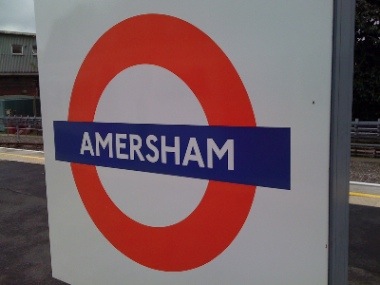
We set off from Amersham, the country end of London Underground’s Metropolitan line. The train was older than me: it dated from 1962, the year of the Cuban missile crisis, when Harold Macmillan was Britain’s prime minister and JFK America’s president. It’s some consolation to know I’m still younger than some London tube trains, even if I’m older than David Cameron, the man who’s most likely be Britain’s next prime minister in the coming days!

Not a plane in sight: five days under clear blue skies

For five days, Britain enjoyed surreally clear blue skies as the sun shone and aircraft were banished from the skies by the ash cloud from Iceland’s volcano.


Motorway signs warned: “Heathrow Airport closed”. Towns and villages for miles around Britain’s busiest airport discovered tranquility and birdsong. And a clear sky was made even more radiant by the lack of aircraft vapour trails.


But the five day respite from the skies came at a price for travellers. The flying ban left hundreds of thousands stranded around the world.


It also changed my idea of news. On Tuesday evening, ‘plane lands at Heathrow’ was the dominant story on news bulletins. Reporters thronged the terminal to talk to passengers as if they were celebrities. Meanwhile, the media demanded the Government ‘do something’ – though they weren’t sure what.


Opportunistic politicians such as the Conservatives’ Theresa May criticised the Government and the aviation authorities for closing our skies. But you can imagine what they’d have said if our airspace hadn’t been closed and an aircraft had been lost as a result.


Hounslow, Isleworth and Richmond are now getting used to having the planes back. Here’s a time delay image of jets heading for Heathrow over Richmond Green one evening in 1990.


Richmond planes 1990


Eyjafjallajökull volcano chaos reveals crazy world of UK travel insurance

Eyjafjallajökull. It's a name few newsreaders have attempted to pronounce. But there's no doubting the chaos this Icelandic volcano has caused, as its ash cloud forces a prolonged shut down of our airline network. It's also shown that travel insurance doesn't guarantee you won't be heavily out of pocket when things go wrong. 

The insurance industry sells peace of mind. But thousands of travellers have found their travel policy has instead given them a large financial headache. There's no standard British travel insurance policy. This means that some people are covered for the costs they've had to meet after being stranded by the ash cloud – but others aren't. And some insurance providers, such as HSBC, have decided to make goodwill payments, despite not covering natural disasters.

A lot of commentators have said insurance doesn't cover 'acts of God'. This is an urban myth, as the Association of British Insurance has confirmed. Insurers are agnostic about the existence of a greater being. They insure the consequences of a host of natural events that believers might call acts of God. The problem is that modern insurance policies tend to set out what is specifically covered. If your misfortune isn't on the list, you're on your own.

The other problem is that most travel policies were designed when we all took package holidays. If you're one of the millions who book your flights, hotels and car hire separately, you need to make sure your policy covers the indirect costs, such as hotel bills, if your airline can't run the flights you've booked. Many traditional policies cover delayed departures but not the consequential expenses you incur when your flight is cancelled. This is where the newer policies designed for independent travellers, such as M&S's, come into their own. They may cost more, but the extra few pounds buy that fabled peace of mind.

Disclosure: I was head of PR for M&S Money 2005 to 2008

The joy of Wessex: an unforgettable holiday in Thomas Hardy country

Hardy's cottage Lower Bockhampton

Above: Thomas Hardy's cottage, Higher Bockhampton, Dorset

When Owen arrived last year, we quickly decided we'd spend our holidays in Britain in his early years. The thought of struggling with airports and aircraft with a baby was too much. Over the past fortnight, we discovered just how rewarding holidaying at home can be.

We stayed at Greenwood Grange holiday cottages in the Dorset hamlet of Higher Bockhampton, just outside Dorchester, following an inspired recommendation by Karen's brother. The name of the village rang a bell, and I remembered that the novelist and poet Thomas Hardy was born there. It was quite a thrill to discover that Hardy's birthplace cottage (above) was just up the lane from our cottage. (Hardy was born here in 1840 and wrote several of his novels in the modest house.)

This was no literary pilgrimage, but I was fascinated to compare today's Dorchester with Hardy's Casterbridge. (I grew to love Hardy's work after studying The Mayor of Casterbridge for my A levels.) Dorchester has changed far less than most British towns since Hardy's day. A traveller entering the town from Bockhampton is in the heart of the town almost immediately – no urban sprawl here. Ironically, the biggest expansion has come to the west, where Prince Charles's new village of Poundbury is growing rapidly. Poundbury is a curious mix: in parts, it's an appealing out of the box old-style village, but the frankly bizarre new Poundbury fire station is utterly out of place. We were also rather unsettled to see almost no evidence of human life in Poundbury: the streets were deserted. It was nice to discover the headquarters of Dorset Cereals, though!
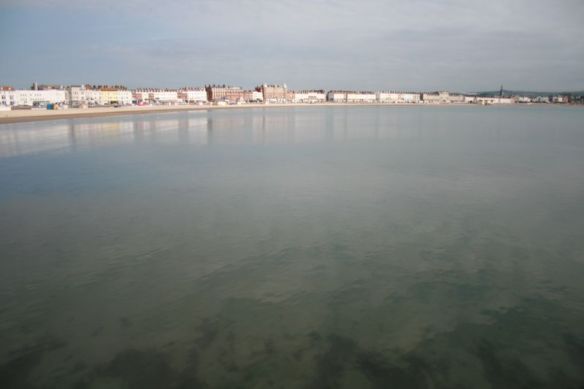
Weymouth early morning 

The great discovery of the holiday was Weymouth. We had three wonderful days on the beach there. I knew a little about Weymouth's history, as one of Britain's original seaside resorts. But we found it a great place to spend a sunny day, with shops and cafes within a pebble's throw of the sandy beach. I took the photo above just before we took a day trip from Weymouth to Guernsey.

IMG_6394
 

Finally, a glimpse of the wonderful swannery at Abbotsbury on the lagoon at Chesil Beach. It's extraordinary to think the swannery has been owned by the same family for 500 years. But we'll remember the kindness of the man who drove the tractor that pulled the trailer taking less mobile visitors from the car park to the Swannery. Knowing how much small boys love tractors, he let 11 month old Owen take the wheel of the tractor (below)!

IMG_6362

Magical mystery trips

I loved the story last week about the travel company charging holidaymakers £2,000 for a vacation at a mystery destination. Travellers would only find out where they were going when they arrived at the airport on Saturday.

I can't say I'd sign up for such a deal. But the story brought back memories of the old 'mystery trips' run by British Railways. When I was ten, we went on a mystery trip from Cardiff and had a very pleasant day in Cambridge. I remember making an Airfix kit on the way home. My parents recounted a marvellous story about neighbours in Caerphilly in the 1950s. They were on holiday on England's south coast and decided to go on a mystery trip, which took them back to … Caerphilly. They popped home for a cuppa.

Severn View motorway services: no view, no heating but usual rip off prices

We rarely stopped at motorway services before Owen was born last year. We'd drive non stop to Cardiff, avoiding the eye-watering prices. But these days our seven month old's feeds tend to come while we're on the road. So on Saturday we stopped off at the Severn View services on the M48, just before the original Severn bridge.

It brought back memories: I stopped at these services many times in the 1970s, enjoying the view over the river to the Welsh hills. But as we carried Owen into the building, I realised things had changed. This was not the original Severn View (or Aust) services, with its huge cafe overlooking the river, but a small replacement with just a Costa Coffee, Burger King and WH Smith, along with loos. The view was of the petrol station, not the Severn. And it was freezing cold (Owen's hands were very cold by the end of his feed). The chap at Costa told us the temperature was controlled remotely from head office in Bicester. "Please write to complain, they take no notice of us," he added. After spending £14 on sandwiches, crisps and drinks for the two of us, we were far from impressed. We won't return!

Eurostar: St Pancras is amazing, but wait till the tunnel is fully open again

DSC00742

Eurostar is a wonderful idea. Step onto a train in London and enjoy a fast ride to the heart of Paris or Brussels.

I travelled to both cities from Waterloo, Eurostar’s original British terminus. Waterloo was a poor departure point, squashed on the site of the old Windsor line platforms. (Closed after the severe storm of January 1990.)

Last week I experienced St Pancras International, Eurostar’s London home since November 2007. I was thrilled to see how the Midland Railway’s magnificent neo Gothic station has been given a new lease of life. I travelled into St Pancras a few times when a student in Leicester in the 1980s. Back then, it had a neglected air. Eurostar’s arrival has changed everything apart from the architectural wonders.

A statue of John Betjeman, the late poet laureate, graces the station, honouring his role in saving St Pancras from suffering from a similar fate to the Euston Arch and Great Hall in the 1960s.

Eurostar’s new terminal is classy in a way that few airports can match, thanks to the light and space created by Barlow’s magnificent Victorian roof. What an inspired idea to use the undercroft of the old station for the airy passenger areas.

DSC00748

That said, the planners have recreated the worst feature of the original Waterloo Eurostar terminal: the cramped waiting area beyond check in. This is where anyone used to airports – where facilities get better after security – will suffer. Far better to delay going through until the last minute.

The other lesson, sadly, is to avoid Eurostar until the Channel Tunnel is fully reopened after the September 2008 fire. My journey back from Paris took a deeply tedious 3 hours 17 minutes. That’s an experience I’m in no hurry to repeat, especially as the Eurostar buffet car offerings are even worse than British Rail’s Travellers Fare circa 1978. You have been warned!