Osborne’s budget: so wrong, so wrong

Yet another year's budget proves the pointlessness of this annual exercise in politics over prudence.

This year's edition cut the 50% top rate of income tax. but inevitably the Chancellor had to show that he wasn't rewarding the rich. So he took back the rich people's budget dividend with the other hand. Or dd he?

I was against Labour's imposition of the 50% rate. It seemed wrong to take half of anyone's income in tax. Far better to have a universal rate of income tax, and make it the main way of raising money for public services. (By contrast, regressive VAT is little short of evil, as it steals from the poor and benefits the rich.) 

But at a time when the coalition government is making the plight of the poor worse with its aggressive spending cuts it seems criminal to reward the rich. But what would you expect from a cabinet of millionaires?

The theatre of the annual budget is hugely overplayed. Back in 2007, Gordon Brown's cut in the basic tax won the plaudits. I couldn't understand how no one had noticed that the cut had been bought by axing Brown's own 10% tax rate, punishing the poor. I pointed this out in an Ertblog post – Gordon Brown's trick or treat budget. But the political storm only battered Brown a year later. 

We'll see how George Osborne fares in the months to come. 

Digital victim: Encyclopaedia Britannica ends print editions

The digital revolution has claimed another victim. Encyclopaedia Britannia will no longer be printed. The world's most famous (if you exclude Wikipedia) encyclopaedia will live on in digital form. 

The company behind Britannica pointed out in a news release that it had pioneered digital knowledge, creating its first digital version in 1981 and its first internet encyclopaedia in 1994. Encyclopedia (note US spelling) Britannica company president Jorge Cauze explained: “We’re digital, we’re mobile, and we’re social…We’re a very different company from 20 or 30 years ago." In other words, Britannica's print demise is not the final volume. 

Many will name Wikipedia as the cause of death of Britannica's print edition. Yet Wired's Tim Carmody names another suspect: Microsoft's Encarta encyclopaedia. He points out that millions bought the Microsoft reference work on CD and later DVD with their first computers. The tech giant delibarately priced the product cheaply to encourage families to buy home PCs in the 1990s. (I remember buying a couple of editions for £20 or less.) Expedia buyers were very unlikely to splash out £1,000 or more on Britannica.

This strikes me as a compelling argument. I'm not so convinced by Carmody's argument that Britannica was largely a vanity purchase. As a book-loving 18 year old, I was very envious when my older sister bought a Britannica set, along with a number of Britannica yearbooks. Britannica seemed like a wise and kind investment by parents keen to help their children learn about their world. 

Wrting this post has reminded me that I was once the proud owner of a set of Children's Britannica. I loved browsing those volumes – for study and for interest. Years later, I bought occasional editions of Pears' Cyclopaedia, but only really got back into the idea of an encyclopaedia when Encarta came along. 

Ironically, Encarta died three years before Britannica's print edition.  

Britannica's blog rightly said that change is OK. After all, organisations need to adapt if they're to survive. I'm not the right person to say if ditching print is the right move for Encyclopaedia Britannica. (But I'm not impressed by the blog's use of that awful cliched way of emphasising a point: "Every. Single. Day." That's not how you prove authority in a digital age.) 

I can't wait to hear whether Britannia has boosted interest in its iPad and iPhone editions since its announcement. This month's bold move must have been the biggest interest in Britannia for years. It's time to reap the rewards. 


Cymru am byth: Wales win another Grand Slam

IMG_2526


We did it! Wales won European rugby's grand slam today – our nation's third grand slam in eight seasons.

Wales beat France 16-9 in a tense decider in Cardiff's Millennium Stadium. The team were magnificent, especially Dan Lydiate, who tackled heroically throughout. 

I was nervous this morning ahead of the game, as the Guardian' sport section cover carried the banner headline, "Is this the greatest ever Wales side?". It felt like a question best asked after victory had been secured. I should have had more faith. 

We're living through a golden era in Welsh sport. The Wales rugby team is our best since the Seventies glory days – and may, as the Guardian and others suggest, be about to out-do the feats of that golden age. Swansea City are doing Wales proud as the nation's first team in neighbouring England's Premier League. And Cardiff City have narrowly lost two Wembley finals in five seasons – its first Wembley cup finals since the 1920s. 

It is, indeed, an extraordinary coincidence that the two Welsh rugby grand slams in the Gatland era coincided with Cardiff City's Wembley appearances. That was the factor that gave me hope that today would be a triumph not a searing disappointment. (Well, that and the extraordinary resilience and maturity of this young side.)

Wales's best ever national rugby team? As Warren Gatland and Shaun Edwards will be the first to point out, that title depends on success against Southern hemisphere rivals. Wales will earn their crown when they're celebrating success against South Africa, Australia and above all New Zealand. I wouldn't bet against this squad under Gatland and Edwards. 

PS: it was so poignant for Wales to win the grand slam two days after the death of 1970s Wales legend Mervyn Davies – Merv the Swerve. Davies captained Wales to grand slam glory in 1976. Months later, he retired after suffering a brain haemorrhage in a Welsh cup semi-final. Today's success followed a minute's silence to remember and honour my childhood hero.  

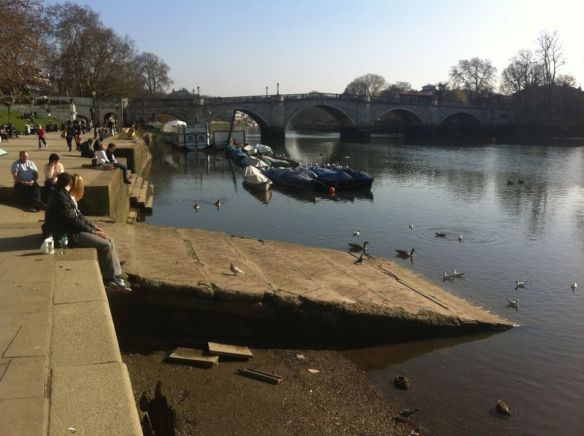
A spring day by the river, Richmond

IMG_4143

Misty morning: the Thames, Richmond, Surrey, 8.50am

I love working close to the River Thames in Richmond. Especially on a day like today, when the river alters its appearance faster than a quick change artist. 

As I approached the office, I just had to take a photo of the moody, misty vew of Richmond Bridge. I knew that the mist would soon give way to a glorious spring day. So it proved, and I went back at lunchtime to take a contrasting shot from the same place (below). 

IMG_4147a

But the river had a further surprise. As I started my drive home, Water Lane and Riverside were flooded by the high tide, so I quickly reversed – and took another couple of photos!

IMG_4155

One last image. I was struck my the fine features of this Great War soldier, carved in stone on Richmond's war memorial in front of the office. That stony sentinel has seen countless tides in the last 90 years!

IMG_4150

Remembering Norman St John-Stevas

The news that Norman St John-Stevas had died took me back to my teenage years when the Tory politician was a household name. It evoked memories of the embattled early years of Margaret Thatcher's premiership when it seemed likely she'd not win a second term.

St John-Stevas was a flamboyant character – as all today's obituaries have highlighted – but he was fatally out of tune with his humourless leader. A subtler politician would not have irritated Thatcher with St John-Stevas's mocking references to the blessed Margaret and the Leaderene. Norman became just another clever political player who never fulfilled his potential.

Yet he left a far greater and more valuable legacy than hundreds of forgotten ministers. In 1979, St John-Stevas created the modern system of departmental select committees in the House of Commons. It was a striking blow in favour of parliamentary scrutiny of the executive. And a legacy that's even more vital today, given the growth in executive – and prime ministerial – power since 1979.