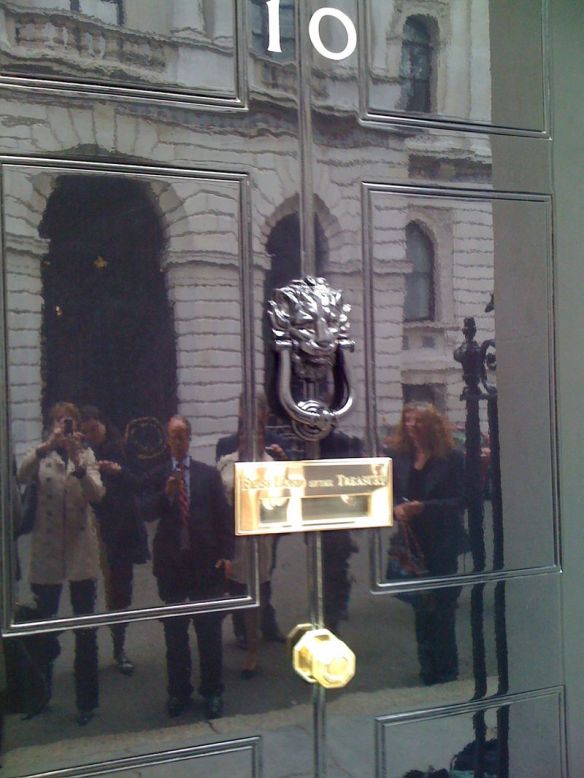
 It's the most famous address in Britain. And on Thursday 6 May, it's likely to have a new occupant. So I was intrigued today to get the chance to walk through that iconic black door, courtesy of the Corporate + Financial Group of the Chartered Institute of Public Relations (CIPR).
We were on a tour of 10 Downing Street, made possible by Simon Lewis, the director of communications at Number 10, a former chairman of the group.
Number 10 is a surprisingly modest home and office for a head of government. The famous facade opens onto a small terraced house that was linked to a more impressive mansion. That iconic door is actually one of a pair that are repainted in turn every six months. And we were told that by tradition the '0' in the number on the door is slightly offset, though I can't say I noticed!
The highlight of the visit was the chance to sit at the cabinet table. Without realising, I chose the foreign secretary's chair. I found myself reflecting on the extraordinary discussions that have taken place at that table, shaping our country's survival in 1940 and during the Napoleonic wars; the creation of the NHS; and numerous financial crises including the recent banking crisis and the dramas of 1931, 1949 and 1967.
The visit reinforced my respect for Britain's tradition that the civil service is fiercely non political. Gordon Brown's political advisers at Number 10 had to resign by noon on the day he called the election, and the prime minister cannot campaign from Number 10. Simon Lewis's appointment as communications director last July restored the role of the PM's official spokesman to that of a civil servant rather than the party cheerleader it became under Alastair Campbell. That has to be a good thing, as Campbell's partisan approach proved hugely counter-productive in time – and contributed to the declining trust in the Labour government. That said, Bernard Ingham famously stretched the civil service status of the role to the limit while serving as Margaret Thatcher's press secretary in the 1980s.
The most striking change at Number 10 in recent years is that it has become home to very young children. The garden contains a large trampoline (complete with safety net) and Wendy house for Gordon Brown's sons. This new tradition is sure to continue as all three major party leaders have youngsters.
As you walk up the stairs, you notice that Winston Churchill has the singular honour of featuring twice in the gallery of former prime ministers. He appears in chronological order between Chamberlain and Attlee. But his most famous photograph has pride of place on the ground floor landing. Karsh of Ottawa took the iconic image of a scowling war leader in the Canadian capital in December 1941. It's reputed to be the most reproduced photographic portrait in history. Churchill's official biographer Martin Gilbert told the story of that photoshoot in his wonderful book In search of Churchill. Karsh was unhappy with his initial results, as Churchill looked more like a favourite uncle than a war leader. So he snatched the prime minister's cigar from his mouth during a break. The result was the famous image. Gilbert preferred the benign version, and used it on the cover of the book.
The other prime minister to enjoy special treatment is Margaret Thatcher – the only PM to have a portrait hung in Number 10 during their lifetime. It seems a fitting honour for her achievement in becoming Britain's first – and so far only – female prime minister.
Margaret Thatcher's successor, John Major, found living at Number 10 a challenge at first. Two of his closest advisers, Sarah Hogg and Jonathan Hill, described in their book Too close to call how the new PM caused a panic in his first week by going missing – and no one knew where he had gone. The crisis was averted with the discovery that Major had wandered off to McDonald's for sustenance. A cook was soon recruited to rustle up a bacon sandwich at short notice. The story serves to remind us that Britain's prime minister isn't such a dominant figure even in his (or her) own house.

 Ertblog