The leaders’ debates: a good idea, but get them right in 2015

Britain finally adopted leaders' debates in the 2010 general election – and life may never be the same again.

The three 90 minute debates transformed the fortunes of Nick Clegg and his Liberal Democrats. They confirmed Gordon Brown's weakness in an era when easy charm pays dividends. And they posed a serious challenge to David Cameron, who surely assumed he was bound to become Britain's next prime minister.

But the series of debates was far from perfect. The third debate felt like one too many, as the leaders bombarded us with soundbites and questions were repeated from the first two encounters. (All three debates included a question about immigration.) The ban on audience applause or heckling didn't have as much an impact as I suspected it would, though it probably added to the boredom of the final debate. And, above all, the debates had an air of unreality as the leaders pretended there would be no great pain to come whoever wins the election. 

So debates are here to stay. And that must mean that no political party will ever again risk a leader so unsuited to debating and engaging with voters as as Gordon Brown. 

General election 2010: The Guardian asks readers which party it should support

The Guardian has asked readers and staff for their views on which party (if any) the paper should support in the 2010 general election. Editor Alan Rusbridger (@arusbridger on Twitter) posed the question of Friday in the wake of the second leaders' debate.

I was impressed by the paper's attempt to engage with readers. But the initiative underlines the bizarre and frankly disreputable tradition in British newspapers of telling readers who to vote for. Why should a paper tell readers who to vote for – even if they've asked their views first? 

The Guardian is far from the worst offender. The Daily Mail, Daily Express and Daily Telegraph are the media wings of the Conservative Party, and lose no opportunity to distort the news to encourage readers to vote Tory. But, as I posted in May 2008, the Guardian published a clumsy piece of propaganda urging readers to support Ken Livingstone in the London mayoral election. (Not that it helped Ken: he lost to Boris Johnson.) The Guardian even tried to influence the 2004 US presidential election with a similarly ill-judged operation to persuade voters in Ohio's Clark county to reject George W Bush.) 

It is simply grotesque that the media and politicians take any notice of The Sun's decision who to back in an election. Yet last week's decision of James Murdoch to invade The Independent's offices to protest at that paper's innocuous headline, 'Rupert Murdoch won't decide this election. You will.', shows how high the stakes are. The Murdoch clan really do think they have the right to influence an election. Their attempt to bully a newspaper that barely sells 100,000 copies a day shows concern that that this election could, just, be the one that breaks the political power of the media.

The response of the Mail and Telegraph to the rise of Cleggmania following the first leaders' debate was instructive. They both resorted to smears about the Liberal Democrat leader. As I posted last week, social media helped blunt the impact of the smear campaign with the clever #nickcleggsfault campaign. If the papers had been interested in genuine examination, why didn't they pursue the question why the Lib Dems hadn't returned donations from crooked donor Michael Brown? That would have been genuine journalism rather than political propaganda.  

Let's hope the people vote without being bamboozled by the media on 6 May. 

Memo to political canvassers: be more like us!

IMG_1082

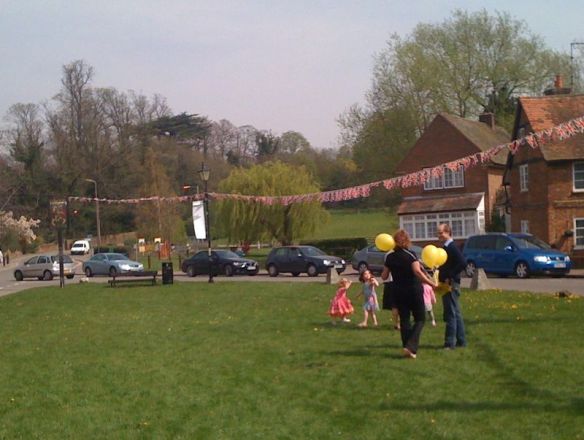
The Liberal Democrats were out in force today in Chalfont St Giles as Cleggmania swept Britain. They were giving out balloons and leaflets, and encouraging people to come to the village hustings on Friday 30 April. All the candidates for the Chesham and Amersham constituency will be taking part. 

The Lib Dem woman who talked to me was very nice but did show how political people are very different from the rest of us. I explained that we wouldn't be able to come to the hustings as it's too early for me to get home from work and put Owen to bed. She cleary didn't think this was much of an excuse. "My husband got home from London, went out leafleting and then went to a 10pm political meeting!" I suspect she was being friendly, but I did feel like I was scolded for being a wimp! 

Next time she talks to a voter she'd do well to remember that most people aren't at all political. We've got lives to live and children to look after. If people find the time of a public debate isn't convenient, it might be an idea to change the time rather than chide the voter for not being able to make it!

PS: I decided not to take a Liberal Democrat balloon for Owen. I decided that at 21 months he was too young to support a political party!


Don’t fear a hung parliament. The pound will cope

The Tories have been desperate to convince people that a hung parliament would be a disaster. They suggest our currency would be shot to pieces, claiming that our experience in the 1970s offers a grim portent of what might follow.

Veteran Tory politician Ken Clarke cited Labour's decision in 1976 to ask the IMF for a loan as an image of what happens under hung parliaments. But Ken got it seriously wrong. Britain didn't have a hung parliament in 1976. Or in the other years when sterling was on life support: 1949 and 1967 (Labour) and 1992 (Conservatives).

The story of that IMF bail out isn't as clear cut as right-wing legend would have you believe. Labour's decision to go to the IMF was prompted by Treasury forecasts that later proved unduly pessimistic. We didn't actually need the money in the end. Andy Beckett's enthralling account of the Seventies, When the lights went out, sets the record straight.

The TV and social media election

It was billed as the social media election. Yet television – invented the year my father was born, 1926 – has electrified Britain's 2010 general election campaign.

Nick Clegg's performance in Britain's first leaders' debate a week ago catapulted the Liberal Democrats into pole position as the party for change. For seven days, Labour and the Conservatives have agonised how to respond. Should they attack Clegg or ignore him? Should they play the man or his party's policies?

Tonight's second televised debate was eagerly awaited. Would Nick maintain his lead? Would the two other party leaders perform better?

I thought all three leaders did well tonight. Interestingly, Irish journalist Christine Bohan said on Twitter that she'd kill for a leaders' debate of this calibre with Ireland's political leaders Cowen, Kenny and Gilmore. (Thanks to Orlaith Finnegan for a retweet of this.) Brown, Cameron and Clegg were impassioned and smart.

I blogged recently that talk of a social media election was overplayed, as BBC's Rory Cellan-Jones became a digital election reporter. I don't think Twitter will win the election, but it has complemented the role of the TV debates. And it's giving fresh power to the people and the political parties against the deeply biased old print media. The brilliant #nickcleggsfault viral Twitter campaign, mocking the Tory press's smears about the Liberal Democrat leader, rattled the Daily Telegraph, which was forced to defend its smear against Clegg earlier the same day.

Here's to next week's final debate.

Not a plane in sight: five days under clear blue skies

For five days, Britain enjoyed surreally clear blue skies as the sun shone and aircraft were banished from the skies by the ash cloud from Iceland’s volcano.


Motorway signs warned: “Heathrow Airport closed”. Towns and villages for miles around Britain’s busiest airport discovered tranquility and birdsong. And a clear sky was made even more radiant by the lack of aircraft vapour trails.


But the five day respite from the skies came at a price for travellers. The flying ban left hundreds of thousands stranded around the world.


It also changed my idea of news. On Tuesday evening, ‘plane lands at Heathrow’ was the dominant story on news bulletins. Reporters thronged the terminal to talk to passengers as if they were celebrities. Meanwhile, the media demanded the Government ‘do something’ – though they weren’t sure what.


Opportunistic politicians such as the Conservatives’ Theresa May criticised the Government and the aviation authorities for closing our skies. But you can imagine what they’d have said if our airspace hadn’t been closed and an aircraft had been lost as a result.


Hounslow, Isleworth and Richmond are now getting used to having the planes back. Here’s a time delay image of jets heading for Heathrow over Richmond Green one evening in 1990.


Richmond planes 1990


Eyjafjallajökull volcano chaos reveals crazy world of UK travel insurance

Eyjafjallajökull. It's a name few newsreaders have attempted to pronounce. But there's no doubting the chaos this Icelandic volcano has caused, as its ash cloud forces a prolonged shut down of our airline network. It's also shown that travel insurance doesn't guarantee you won't be heavily out of pocket when things go wrong. 

The insurance industry sells peace of mind. But thousands of travellers have found their travel policy has instead given them a large financial headache. There's no standard British travel insurance policy. This means that some people are covered for the costs they've had to meet after being stranded by the ash cloud – but others aren't. And some insurance providers, such as HSBC, have decided to make goodwill payments, despite not covering natural disasters.

A lot of commentators have said insurance doesn't cover 'acts of God'. This is an urban myth, as the Association of British Insurance has confirmed. Insurers are agnostic about the existence of a greater being. They insure the consequences of a host of natural events that believers might call acts of God. The problem is that modern insurance policies tend to set out what is specifically covered. If your misfortune isn't on the list, you're on your own.

The other problem is that most travel policies were designed when we all took package holidays. If you're one of the millions who book your flights, hotels and car hire separately, you need to make sure your policy covers the indirect costs, such as hotel bills, if your airline can't run the flights you've booked. Many traditional policies cover delayed departures but not the consequential expenses you incur when your flight is cancelled. This is where the newer policies designed for independent travellers, such as M&S's, come into their own. They may cost more, but the extra few pounds buy that fabled peace of mind.

Disclosure: I was head of PR for M&S Money 2005 to 2008

Social media comes of age: a day at Don’t Panic’s latest event

Social media is now part of the mainstream. Last week's conference about strategic social media, run by Don't Panic, confirmed how much has changed since I attended one of Don't Panic's first events on the subject, the University of Sunderland's Delivering the new PR in 2006

Don't Panic's Andy Wake has written an excellent account of the changing impact of social media on the Eventualities blog. (See also this comprehensive post by Adam Burns.) Those early events included workshops explaining what a blog was, and encouraging PR people to try their hands at blogging and social media. No such introduction is needed now, as the BBC's news bulletins regularly cover Twitter and Facebook. (Perhaps excessively, as I suggested in a blog post about the BBC's Rory Cellan-Jones last month!) Corporate communicators are now judged on how their organisations are engaging with social media as well as traditional media. 

Yet we should take care not to treat social media as a bandwagon. The best presentation at last week's Don't Panic event was by Martin Thomas, the co-author of Crowd Surfing. Martin mocked the idea that companies need a social media strategy. I totally agree – a social media strategy suggests a synthetic response to the changes that social media is prompting. (My boss recently posed the compelling question: why he should have a social media strategy but not a newspaper or email strategy.) Instead, we should apply the lessons of social media (that transparency and authenticity are crucial) to all our communications efforts. It's telling that many senior communicators regard Twitter as a way of pushing out corporate messages. That's completely wrong. In the same way, too many corporate communicators only tweet when they've got a news release to sell. That's not going to win them many friends. 

Wadds SSM

The other refreshing presentation was from Stephen Waddington from Speed Communications, who gave everyone a copy of the Beano. (Thanks to Don't Panic's Andy Wake for the photo of Stephen and his son reading the Beano in the background.) This wasn't as eccentric as you might think: Stephen's point was that great content is always a winner, whatever the medium. He contrasted the hopeless online efforts of Britain's biggest regional media groups with the SR2 blog, an extraordinarily compelling website run by Josh Halliday, a journalism student in Sunderland. 

I'll end this account with a plug for a brilliant piece of viral marketing for Blackpool, described by Sarah Lundy from Visit Lancashire. I've a particular interest here as my father was a pioneer of local government and tourism PR in Wales and London. I was thrilled with the success of Blackpool's J'aime La Tour video, which confirms Stephen Waddington's view that great content wins. 

I've included below links to my blog posts about the Don't Panic events I've attended. Social media has dominated! 

CIPR Northern Conference July 2006: PR embraces blogs 

November 2006: Delivering the new PR

June 2007: Delivering the new PR 2.0

January 2008: crisis communications

May 2008: a new era of authentic communication

May 2009: it's not about technology
The election leaders’ debate: making up for our democratic deficit?

History was made tonight as Britain held its first leaders' election debate. (Or more accurately, the first debate between the three biggest UK-wide parties.)

Gordon Brown, David Cameron and Nick Clegg got off to an uncertain start, with Clegg nervous as he opened the debate. But the Liberal Democrat leader must be delighted with his performance, as ITV News and YouGov both proclaimed him the winner.

That said, the BBC's Nick Robinson made a fair point: debates have no winners. We all watch with our own prejudices and values. Labour's Alan Johnson said Brown was the victor, while William Hague said Cameron came out on top. I think they're wrong, but who am I to say? The real test will be how the leaders came across to millions of voters, especially in marginal seats.

I didn't think Cameron was as bad as some have argued. But his curse is to be seen as the successor to Tony Blair. We're suspicious of slick politicians, after discovering from Blair that that smooth-speaking politicians are the last people to trust. And the Tories have been so muddled in their thinking (slash spending? cut taxes?) that no one knows what they'd do if Cameron moved into Downing Street after 6 May. (Lesson from the past: Thatcher doubled VAT in 1979 despite not breathing a word about this bombshell during that year's election campaign.) 

The debate reinforced the view of many of us that Britain's electoral system is fundamentally unfair. Some people's election votes carry far more weight than others, which is outrageous. We must never repeat the travesty of 1983, when the Liberals and SDP won almost the same proportion of the vote as Labour but got a fraction of the parliamentary seats. I hope that the three debates help nudge the British public to share their votes more evenly, to force a fairer voting system.

The other lesson, for me, was that social media made the debate far wider than the three men in suits, watched by a studio audience told not to cheer, applaud or boo. I loved seeing what people were saying on Twitter, and sharing my thoughts and weak jokes. It made up for the ridiculous, Orwellian rules constraining the debate. (Are the politicians really so frightened of the public that they need such protection?) We've got another three hours of debate before polling day. It should be surprisingly interesting.

Is Jeremy Paxman over the hill? Clegg survives the lion’s den

Newsnight's Jeremy Paxman is Britain's most feared television interviewer. He destroyed BBC director general Mark Thompson last month in a forensic examination about the corporation's strategic review. Yet he barely landed a blow on Liberal Democrat leader Nick Clegg in tonight's election interview. 

Bizarrely, Paxman devoted the opening 10 minutes of the interview to an interrogation about the Lib Dems' immigration policy – hardly fertile ground. Yet he barely asked about Clegg's preference for partners should the Lib Dems hold the balance of power on 7 May. And he ignored Clegg's bizarre claim that a hung parliament (the party's best hope) may lead to riots. 

Gordon Brown and David Cameron must be desperate to do Newsnight after Clegg's success.