We love Enid Blyton: Five Go to Smuggler’s Top makes laureates’ list

The literati look down on Enid Blyton, accusing the late children's writer of churning out formula fiction and reinforcing outdated stereotypes. But millions of people like me owe their love of books to countless childhood hours spent reading the Famous Five and Secret Seven adventures. So I was delighted to see that Five Go to Smuggler's Top was featured in a list of the best books for children, chosen by Britain's children's laureates.

I was given an Enid Blyton book by my maternal grandmother when I was about seven. I can't remember the title now – the story involved a wooded island, which hardly narrows it down – but fell in love with Blyton's ability to tell spellbinding stories. I've long since forgotten the storylines of the books, but some of that excitement came back when I discovered the summary of Smuggler's Top on www.enidblyton.net (the first link in this post, above), and identified it as my favourite Blyton story. The vision of an island linked only by a causeway across the marshes was amazingly evocative as a child; growing up in Cardiff, in foggy weather I imagined the road up Caerphilly mountain from Thornhill as the road up Castaway Hill. I can't wait to rediscover those Blyton classics as Owen is growing up!

The Guardian stands by Erwin James, murderer turned crime commentator

I've long admired the writing of Erwin James, the Guardian's columnist and commentator on crime. He knows his subject: he served a life sentence for two murders in the early 1980s. He started writing his Guardian column A life inside in 2000, four years before his release. His writing career flourished after his release, a testimony to his ability to offer a rare insight into prison life.  

Last week, he and the Guardian were seriously embarrassed when James – real name Erwin James Monahan - admitted he had lied about his time in the French Foreigh Legion in a piece for the paper in 2006. The Guardian's reader's editor Siobhain Butterworth explained  in her Open Door column today why the paper would be giving him another chance. She says:

"It is never acceptable to lie to – or deliberately mislead – readers, but a sense or proportion about this incident is needed. Monahan is not a trained journalist who falsified news reports; he is a writer who, having pulled himself out of the most dreadful mire, went on to make the mistake of lying about his past to protect an identity he had been concealing for years. He has caused damage to the reputation of the Guardian and given some people reason to doubt his work. He will have to re-earn their trust. I wish him luck."

I think that's fair. The debate about crime and punishment in Britain rarely rises above the Daily Mail's simplistic 'lock them up and throw away the keys' approach. That's why we send more people to prison as a proportion of our population than most other western countries. I'd rather the government and the media focus on whether prison is the right punishment – and how to stop people reoffending after being released. No-one would condone the terrible crimes James committed a generation ago, but we should be pleased that he had the talent and motivation to become a writer and transform his life. Despite his serious lapse of judgement in 2006, I'm glad the Guardian is allowing him to continue to keep us all better informed about life inside.

Goodbye to Ninian Park

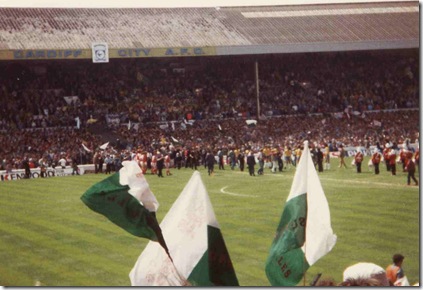
Wales Brazil 1983

Cardiff City have played their last regular league game at Ninian Park, the club's home for almost a century.

Ninian Park is hardly the most impressive ground in British football – and was looking shabby even 26 years ago (above) when I watched Wales draw 1-1 against mighty Brazil in a friendly. But many like me will have a stack of memories of the old place.

I went to my first ever football game at Ninian Park at when I was 10, on 3 November 1973. Dad took me to see Cardiff City against West Bromwich Albion, standing on the Bob Bank. It was a dreadful game, and we went to leave just before the end as a 0-0 draw looked inevitable. Suddenly, as we passed under the Grange End, we heard a roar from the away fans as West Brom scored a winner.

That game was forgettable. But as I became a regular, I learned to love Ninian Park, especially at night games under the floodlights. But the greatest night of all for me, unlikely as it will sound, was a game in the old third division. City were relegated in 1975 from the second division for the first time since the second world war. I was horrified: how could such a fate befall a club that snatched the FA Cup from England and come within a whisker of winning the league in 1924? But glory was the last thing on our minds in 1975 as we welcomed the likes of Halifax and Bury. At first, City struggled, but as 1976 arrived we were strong promotion candidates. One warm April night, Cardiff beat eventual champions Hereford United in front of a crowd of 35,000. As Max Boyce would say, I was there! My mother later got the autographs of most of the City players at a special celebratory dinner held by the county council.

I've seen just two competitive international games at City's ground, The first was Wales's narrow defeat to England in the 1976 British home internationals. (I got Lawrie McMenemie's autograph after the game: he managed Southampton team to a shock victory against Manchester United in the FA Cup Final just weeks earlier.) Soon after, I was disappointed to see Wales lose on aggregate to Yugoslavia in the second leg of the quarter finals of the European championships, in a game marred by crowd violence.

Ninian Park has featured a few times in this blog. Last year, I wrote nostalgically in Ertblog about City's wonderful FA Cup victories at the ground in 1977. I also wrote about my experiences as a Ninian Park programme seller the night Jock Stein died just minutes after his Scotland team secured a place at the 1986 World Cup finals at Wales's expense. And finally, an early  post told how Wales nearly beat Brazil in that 1983 friendly.

I could talk about City's famous victory against Real Madrid, or the European Cup Winners Cup semi final against Hamburg – or even the Pope's visit to Ninian Park in 1982. (My friend Anthony was there!) But I couldn't claim to have been there on those special days!

Back in 1977, I took schoolboy pride in being able to name every Football League club's ground. Derby County? The Baseball Ground. Sunderland? Roker Park? Those grounds, like Ninian Park, were part of the furniture of the sport for half a century or more. Over 30 years on, dozens of clubs have moved home. Cardiff City are just the latest but it does feel more personal when your own club packs its bags. 
Darling’s budget: Seventies revisited

How appropriate that Alistair Darling delivered his disastrous budget just hours after we heard about the death of the 1970s union leader Jack Jones. Since 1997, Labour has brilliantly distanced itself from its record in government during that unhappy decade. Yesterday changed all that. 

HM Treasury has a dreadful record at forecasting the future performance of the British economy. But it's rare for every commentator to dismiss a chancellor's forecasts before he's even sat down. By common consent, Darling's assertion that Britain will bounce back from recession by the end of the year is a fantasy forecast. 

The new 50p top rate of tax got most of the headlines, but it's hard to see it as anything other than gesture politics. It may make Labour activists feel better, but it's unlikely to raise serious money. We learned long ago that the rich find punitive taxes easy to avoid – that's why they employ expensive accountants. But you don't have to wealthy or Conservative to feel uncomfortable about the state taking more than half someone's marginal income.

Both Labour and Tory governments have long been dishonest about tax. Almost 30 years ago, the new Thatcher government's first budget all but doubled VAT to fund lower income tax. This switch from direct to indirect taxation has continued to this day, helping Labour (until recently) claim not to have raised taxes. Yet indirect taxes are inherently unfair as they represent a greater proportional burden on the less well off. The other con is National Insurance. Labour has increased NI rates, which are just another tax on income. Far better to merge the two, and to switch more of the burden from indirect taxation.

Darling struggled horribly in his interview with Evan Davies on Radio 4's Today programme this morning. He simply could not answer the question whether public spending will be frozen in real terms over the coming year. Davies pressed him rather cleverly whether he'd criticise his successor as chancellor for increasing taxes to plug the huge hole in public finances. Darling floundered, repeating his key messages without coming close to answering the question. Tellingly, Today chose to follow the interview with a repeat of the famous 1937 broadcast of the Spithead naval review by the drunken Tommy Woodroffe 'for light relief'! 

Knee jerk government: the flaws in Gordon Brown’s YouTube plan for MPs’ expenses

Gordon Brown really doesn't get it. He must have thought using YouTube to announce changes to the way MPs claim their expenses was a great way of showing he was in touch and in charge. The man to call time on the parliamentary expenses scandal.

The reality is very different. This was a cynical attempt to gain brownie points at the expense of his political opponents. Yet a moment's thought should have warned him of the perils. Anyone with a feel for the public's mood would have known that most voters would dismiss the plan as paying politicians extra just for turning up for work. (In other words, Gordo was acting as shop steward for greedy MPs, rather than the guardian of the public purse.) 

Just as seriously, Labour's failure to announce the proposals in the House of Commons underlines the long term decline in parliament's role as the check on executive power. YouTube may be hugely popular, but it hasn't yet established a role as part of our parliamentary system. Brown's partisan move in bypassing parliament will make it harder for him to win support for the proposals. 

That's not to say that the Government shouldn't use YouTube and other social media channels to get its message across. But using social media must be part of a thought out strategy, not a mere tactic in a political battle. For such a serious politician, the prime minister is amazingly weak at strategy. This may be a reflection of his political weakness. But it suggests he is unlikely to find a way of reviving his party's fortunes as we approach the most important general election for a generation.

PS: This month marks the 100th anniversary of Lloyd George's landmark People's Budget, which founded the welfare state and established the House of Commons' primacy over the Lords. That great reforming chancellor also introduced pay for MPs for the first time, at £400 a year. Lloyd George's view was that even the poorest in society should be able to serve as an MP, rather than just those with a private income. The issue of MPs' pay remains as contentious as it was a century ago, especially as their constituents suffer job losses and pay cuts. That's why all the party leaders should show some leadership and work together to agree a more transparent and equitable remuneration system.  

The day I gave Clement Freud a lift to the Cheltenham Gold Cup

Clement Freud, who has died at the age of 84, was a familiar face when I was growing up in the 1970s. He was a well know Liberal MP at a time when the third party had just a handful of seats. Freud was also famous as a cookery writer. But he was best known for his pet food commercials with Henry the dog.

I had an unlikely encounter with Freud in the 1990s. I was working for Eagle Star insurance in Cheltenham, and we had hired a bus to collect a group of London journalists to take them to see the Cheltenham Gold Cup horse race. Freud was loitering rather sadly by our bus, and asked if we could give him a lift to the racecourse. We happily agreed and he spent the journey talking about various restaurants in the Cotswolds, as you'd expect from a famous food writer!

Remembering Hillsborough – football’s darkest hour

For British football, the 1970s and 1980s were bitter-sweet days. English clubs dominated European football, winning the European Cup seven years out of eight from 1977. But the game was blighted by hooliganism, slum stadiums and a series of tragedies. The darkest day came 20 years ago today with the shocking Hillsborough disaster, in which 96 Liverpool FC fans were crushed to death at an FA Cup semi-final.

That Liverpool should be involved was a terrible irony. Four years before, the club's supporters had run riot at the European Cup final at the Heysel stadium in Brussels, killing dozens of Juventus fans. That shameful event led to a ban on English clubs playing in European competitions for five years. It surely also contributed to the initial assumption – swiftly disproved – that Liverpool's fans were on the rampage at Hillsborough, rather than trying to escape a horrible death.

This morning, I was moved by BBC sports reporter Alan Green's account of the tragedy on Radio 4's Today programme. Green was a junior reporter at the time, assisting the BBC's veteran commentator Peter Jones. Jones and Green had gone to Sheffield in 1989 to commentate on a football match. Instead, they provided a vivid account as the scale of the disaster unfolded. Green's experience as a news reporter in Belfast proved a grimly appropriate apprenticeship for that afternoon's work for BBC Radio 2's sports programme. (These were the days before Radio 5 Live.)

Like many others, I heard the news back in 1989 from Jones and Green's reports. I was spending the weekend in Looe in Cornwall, where my parents had rented a bungalow for the week. The Friday was a beautiful spring day, but the Saturday was wet and gloomy. Dad and I went for a drive along the coast to Seaton (Cornwall), where we had spent many happy hours back in the hot summer of 1976. That wet April Saturday, we found a bleak scene at Seaton: the pool where I had paddled had gone, and the rain swept across the beach. It seemed an appropriate backdrop to hear the appalling news from Sheffield.

Later that day, the BBC's Match of the Day became an inquest, as presenter Jimmy Hill and his guests debated how football could recover. The Taylor report recommended all seater stadiums – ending the tradition of standing on terraces such as Ninian Park's Bob Bank. The proposal wasn't universally supported, but after Hillsborough no one was in a mood to argue. The high fences – designed to keep in hooligans but lethal at Hillsborough – were torn down. Within just a few years, football had entered a new era of popularity and commercial success. Many feel uncomfortable at the enormous amount footballers now earn, and the way Sky TV has bought the soul of the game. But it's surely better than that awful era when people lost their lives in the simple act of going to watch the football in Sheffield, Brussels, Bradford and Glasgow.

Railway rivals: Virgin Trains threatens Wrexham & Shropshire’s service to London

DSC00621 

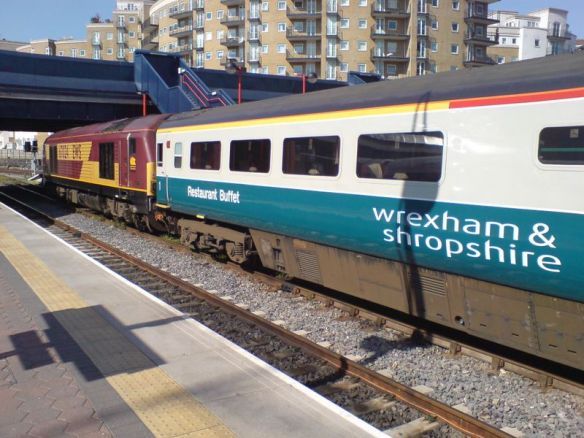
A Wrexham & Shropshire train at London Marylebone, 6 May 2008

In the Victorian and Edwardian eras, Britain saw 'railway races' as rival companies competed for the prize of the fastest trains to places like Plymouth and Aberdeen. Elsewhere, the rail system had dozens of competing routes, few of which survived Dr Beeching's axe.

Over a century later, a similar rivalry has emerged, with the unlikely destination of Wrexham in north east Wales. (See today's Guardian article: In praise of … Wrexham and Shropshire trains and this BBC story.) Wrexham & Shropshire Railway begun a train service to Wrexham and Shrewsbury from London Marylebone in 2008, prompting Virgin Trains to declare it wanted to offer a rival service. Suddenly, the media have taken an interest in the apparent David v Goliath clash. Virgin's move comes seven years after it axed direct trains to ago. (A Virgin spokesman got rather frustrated on last night's Radio 5 Live Drive programme trying to explain why it had changed its mind without descending into geekspeak.)

The Wrexham & Shropshire service has much to commend it, as John Vidal pointed out in a lyrical feature in Saturday's Guardian travel section. (Though what possessed the subs to describe this four hour, 195 mile journey as a commuter train?) It runs without a subsidy from the taxpayer, and has axed sky-high peak fares in favour of all day, every day low prices. It's also one of the few locomotive hauled services left in Britain, with spacious carriages in the old British Rail blue and grey colours. I'm always heartened to see it racing through our local station, and hope it beats off its opportunistic rival.

PS: The Guardian seems to be campaigning for Wrexham & Shropshire: Simon Hoggart praised it in his column last weekend!

It’s not about technology – a day at Don’t Panic’s guide to social media

IMG_0268[1]Stuart Bruce suggests the next big thing: mobile and location centred social media 

Don't Panic has won a reputation as a talented event company that has led the way in explaining social media to a sometime sceptical PR world.

Today saw the latest in the series, held in the cavernous Barbican Centre in the City of London. Any of the delegates wanting to try out citizen journalism couldn't have had a better venue, as just a mile away the police had their hands full handling demonstrators against this week's London G20 summit! First speaker Marshall Manson from Edelman remarked it was like Saigon with helicopters everywhere.

How times change. When I went to the University of Sunderland's Delivering the New PR event in London in 2006, managed by Don't Panic, the speakers had to explain what a blog was – and ran a 'try blogging yourself' session. Today, The Guardian's April Fool story claimed the paper was to publish exclusively via Twitter. It didn't fool anyone, but the fact it chose a microblogging site as the subject shows how far we have come.

My favourite sessions at today's conference were by people working in the public sector. Simon Wakeman explained how Medway Council in Kent has tried new ways of communicating, including podcasts and Twitter. he convinced sceptical councillors and officials about the value of using Twitter by showing how 'retweets' – others forwarding the council's Twitter messages – had widened the audience Medway was reaching with its opposition to a new airport in the Thames estuary.

Mark Payne from West Midlands Police joked he was the only policeman in the City today not in riot gear. But he had a serious message: that social media enables the police to engage with younger audiences indifferent or hostile to the police. He also told the tale of the murderer caught when the police found a video of the scene the killer had posted on YouTube. "As a seasoned detective, I thought that was a clue!" Mark admitted police bureaucracy was a barrier at times – he had to send detectives home to search for clues on Facebook and YouTube as access was blocked at work.

The speakers were passionate about the potential of social media, but sensible to tell us to think before diving in. As Wolfstar's Stuart Bruce said, "You can do a lot of damage in 140 characters!" (The maximum Twitter message.) And above all, they agreed social media isn't about the technology. The medium isn't the message. Craig Elder, the Conservative Party's head of online communities, suggested that Barack Obama may not be the social media role model some have thought – after his prolific stream of tweets on the campaign trail, 'he' has posted just four since taking office.

I'll leave the last word to Robin Wilson from McCann Erickson. When Robin began, I thought we were in for a useful if a little dry session about measuring the impact of social media work. But he then launched into a tale about female orgasms, prompted by a campaign his agency had handled for Durex's female lubricant. As Nicky Wake from Don't Panic observed, today's event was a little x-rated!