Twenty five years ago today, Britain was stunned by the news that Argentina had invaded the Falkland islands. A country that had shown total indifference to this colonial outpost suddenly decided it had to go to war to drive the invaders out. So followed two of the strangest months in recent British history.
Going to war was a novel and shocking experience in 1982, almost 40 years after World War Two. Yet it felt like an echo of the past. I described it in my 1982 diary as Britain’s last colonial war, a description that has stood the test of time, although Tony Blair’s Iraq escapade resembles an imperial adventure. And several of the warships involved in the Falklands took part in or were laid down during World War Two: the Argentine cruiser General Belgrano, controversially sunk by the Royal Navy, survived Pearl Harbor as USS Phoenix. In 1982, it was not so lucky.
To those used to instant news from more recent conflicts, the Falklands was closer to the newsreel reporting of 1939-45. Film from the south Atlantic was slow to reach Britain: my diary on May 12 proclaimed: "Increasing criticism of lack of British film out of south Atlantic." The following day I added: "At last! BBC Brian Hanrahan film from Hermes, shown at 8.50am. Go in to school slightly later." Yet that rare film had an extraordinary evocative quality. The sight of Harrier jump jets screaming into the mist captured the imagination of the British people. We weren’t foolish enough to think this was a re-run of 1940 – Britain would have survived defeat, although our pride would have suffered badly – but the Harrier briefly became a latter-day Spitfire in the nation’s heart.
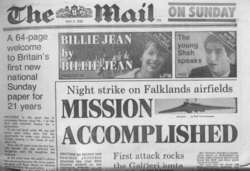 In the midst of war, a new national newspaper was launched: the Mail on Sunday. The paper was lucky that its launch coincided with an extraordinary feat of arms. The previous day, a force of ageing bombers set out on the boldest British air mission since 1945. Vulcan V bombers just months from retirement raided Port Stanley airfield, destroying Argentinian hopes of using it for fast jets. It took 15 Victor tankers and 17 separate in-flight refuellings to get one Vulcan to the target. The sheer effrontery of the operation showed that Britain was in deadly earnest. Rowland White’s book Vulcan 607 tells the dramatic story of the raids.
 Within days of the first Vulcan mission, the scale of the conflict became clear as General Belgrano and HMS Sheffield were lost. The nation heard about Sheffield’s loss from the Ministry of Defence’s spokesman Ian McDonald, who became known as the human ‘speak your weight machine’ because of his monotone delivery. Even 25 years ago such an unsophisticated approach to announcing news seemed anachronistic and amateur. Later we heard of the loss of HMS Ardent during half-time in the FA Cup Final (juxtaposed bizarrely with an advert for the very last Ford Cortina).
I was sitting my A levels as the Falklands war reached its climax. It was a strange experience revising for exams while following the war’s progress. On the night of Sunday 13 June, I took a phone call at home from the Daily Mail. The reporter said that the destroyer HMS Glamorgan had been hit by an Argentine Exocet missile, and wanted an official reaction from the county of South Glamorgan. The call was for my father, who was head of PR for the county council. Glamorgan, Sheffield and Coventry felt deeply the attacks on the ships that bore their names – as did the naval cities of Plymouth and Portsmouth.
The Duke of Wellington described the battle of Waterloo as a damn close-run thing. The Falklands was an equally close call. The British lost a handful of warships and other ships but the toll could have been far worse had scores of Argentinian bombs not failed to explode. Time was of the essence: Britain got to Port Stanley just before the South Atlantic winter arrived. It’s difficult to imagine the naval taskforce (immortalised in the background shot shown on the BBC’s news bulletins) maintaining its station through the winter. Margaret Thatcher would not have survived defeat.
Wars are about people – and represent a failure of politics and diplomacy. The Falklands conflict destroyed countless lives on both sides. Britain and Argentina have traditionally been close, despite the quarrel about the Falklands. Those close ties had unlikely consequences: the Royal Navy fought warships the UK had sold to Argentina. HMS Sheffield, the first British warship to be lost since 1945, had two sister ships in the opposing Argentinian navy in 1982. (The first time identical ships had been on opposite sides.)
Unlike most Britons, I knew exactly where the Falklands were before 2 April 1982. My brother-in-law was born in Argentina in 1953 and we talked about the islands from time to time. After the war ended, I suggested to Julio’s mother that it was hard not to feel sorry for General Galtieri, who had good reason to think that Britain simply didn’t care about these wind-swept islands. "No, I can never feel sorry for Galtieri!" Maria reminded me of the evil nature of the Argentinian junta, who killed thousands of their own people. When we think of the Falklands war, it’s worth remembering that it ended one of the most brutal regimes in the world.
I learned last week that a colleague interviewed Ian North, the captain of the Atlantic Conveyor, just before the merchant ship sailed for the south Atlantic. Ivor was tempted to sail with the ship but prudence prevailed. He was shocked to learn a few weeks later that Atlantic Conveyor had been sunk and Captain North was amongst the dead. Ivor recalled how the crew had opened the drinks cabinet for his visit. I suspect that on the 25th anniversary of the ship’s loss, May 25, Ivor will raise a silent toast to the spirit of the brave people who lost their lives in the south Atlantic.


 Ertblog