Farepak’s crash: not a national emergency

A company called Farepak, which provides Christmas hampers, has gone bust. It’s terrible news for people who have lost money as a result, which they can ill afford to lose. But it’s crazy that a man called Ian McCartney, who you may not know is our consumer affairs minister, calls it a national emergency.

A generation who lived through 1940, when Britain faced invasion and round the clock bombing, will think Mr McCartney has led a very sheltered life if he thinks this is a national emergency. 

“Welsh are the best English speakers” – ardderchog!

We Celts like to think we have the gift of the gab. Why else would we dominate the media, the arts, politics and PR? But it was still nice to read in today’s Independent that the writer Andrew Taylor has concluded that the finest English is often be spoken by the Welsh.

Ardderchog!

Delivering the new PR

LondonbuttonI spent a useful day today at the latest Delivering the new PR conference in London.

The event was headlined How blogs, podcasts and RSS can work for you. It featured a number of well known PR bloggers and commentators, including Stuart Bruce, Neville Hobson, Tom Murphy, Philip Young and Chris Rushton.
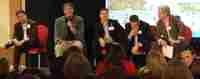
Speakers2_1 It was run by the excellent event management company, Don’t Panic, who organised the CIPR Northern Conference I spoke at last July. (Thanks to Andy and Nicky Wake for this photo of the speakers.)

There’s no doubt that blogging and social media are having a major impact on the media and corporate reputation. There are now around 60 million blogs worldwide, while consumption of mainstream media amongst teenagers and twentysomethings is plummeting. Any PR person whose sole focus is what the Daily Telegraph, Daily Mail and the Today programme say is in danger of missing a serious trick. That’s not to say the mainstream media is irrelevant: it isn’t. But it’s just part of the picture. Tom Murphy gave an example of how an American software company got huge publicity coast to coast – online and in traditional media – by just contacting seven bloggers. The Mexican wave nature of blogging did the rest.

One of the key messages of the event was that social media will end any idea that PR people can control the message. It’s always been a myth, fuelled by the short-lived success of people like Alastair Campbell, but it’s now on its last legs. The irony is that this is happening just as senior management is demanding miracles of PR teams. Issues management is a full time job, especially in sectors under the media, consumer and regulatory spotlight, but it cannot banish nasty headlines. We must not pretend that we can. Above all, we must maintain absolute integrity in the face of the pressures. I sense that people new to PR, thrust into the limelight, may be tempted to cut corners and wing it with claims that are economical with the truth. It’s a temptation that could – rightly – be career threatening.

Neville Hobson talked about how his new venture, Crayon, launched in Second Life, and explained how he and his far-flung associates get together in the diner in this virtual world. I wasn’t the only person in the audience who was sceptical about this. Yes, big name companies, including sober-minded Reuters, have bought a presence in Second Life. And yes, I was sceptical about blogging a year or so ago. So I may become an evangelist for companies getting involved in 2007. But I’m not convinced. It strikes me that Crayon is using the Second Life connection to create a buzz. That’s not in itself a reason for the rest of us to jump on the bandwagon. But we should certainly keep a close eye on how Second Life develops.
Yr hen iaith yn y Guardian

It’s good to see yr hen iaith (the old language, or Welsh, to English readers) appearing in the Guardian. The paper ran a wonderful story last week suggesting you might get a 50% discount for parking your car in Llanberis if you asked for your ticket in Welsh. A few days later the paper ran a correction:

"This is a very nice car park" should be "Dyma faes [not maes] parcio hyfryd".

You can’t expect an English paper to understand the complexities of Welsh grammar:  many of us whose Welsh is rusty would have forgotten that dyma causes a soft mutation, turning maes into faes.

Trial by television

Today’s Media Guardian carries a disturbing article by Philippa Braidwood, the head of communications at South West London and St George’s NHS Trust. The trust was the subject of a Channel 4 Despatches documentary alleging malpractice. Braidwood criticises the programme as unfair, intrusive and inaccurate, while accepting some of the failings revealed.

It is extraordinary that a national television channel can get away with filming patients without their permission. But the media increasingly expects the right to do and say whatever they want. I recently had a run in with a BBC radio producer who accused me of ‘playground tactics and spin’ when I responded to his request for a comment on a customer case with a request for him to provide me with the customer’s written authority to comment. I was simply following the fundamental principle that customers have the right to confidentiality. Until fairly recently, broadcasters rarely editorialised. Now they can’t resist. It’s a dangerous game, and, as Philippa Braidwood’s article reveals, it’s the most vulnerable who are most likely to get hurt.

The Guardian’s readers’ champion signs off

Ian Mayes has one of my heroes for the last nine years. Back in 1997, he became the first readers’ editor (ombudsman) on a British national newspaper. The appointment reflected great credit on The Guardian, which recognised that it didn’t always get things right and had a duty to set the record straight when it got it wrong.

In his column today, Mayes reflects on his experience. He will hand over to a successor, yet to be appointed, in the new year. His weekly Open Door columns are essential reading for anyone who wants to understand better how a great newspaper goes about its business. He has explained the Guardian’s policy on publishing expletives (admitting that many journalists ignore it); the coverage of the Paddington rail disaster; the reporting of mental health; and the difficulty of achieving balance when reporting the Middle East.

On a lighter note, Mayes has fought a one-man campaign to get Guardian writers to spell correctly the names of Lucian Freud and Johns Hopkins university. He’d be the first to admit that while Freud’s name appears correctly most of the time, the old Grauniad still lives on whenever the American university appears in its pages.