Just blaming the Tories isn’t enough for Starmer

Labour won a landslide victory in July’s general election, as the Conservative Party was swept from power after five years of law-breaking, financial incontinence and plain incompetence.

Keir Starmer’s narrative since taking office two months ago has been clear and consistent. Things are even worse than Labour feared, and the Tories are to blame.

This is a straight copy of David Cameron and George Osborne’s 2010 playbook, which pinned the blame for the 2008 financial crisis on Gordon Brown’s Labour Party. Labour was never able to shift the narrative to highlight the bold action Brown took to counter the crisis.

There are also echoes of Margaret Thatcher’s success in reminding voters of the chaos of the 1978/79 winter of discontent under Labour at every opportunity throughout the 1980s. For years, Tory party political broadcasts would show film of mountains of rubbish in the streets and picket line violence accompanied by a funereal voiceover intoning, “In 1979…” in case anyone had forgotten life under Labour.

But pinning the blame on the Tories won’t be enough for Starmer. The electorate gave a firm verdict on the Tories at the election: guilty. Labour must do more than simply emphasise what the voters have already decided. Starmer needs to become a political teacher, in commentator Steve Richards’ perceptive phrase.

Richards noted that the most successful modern British prime ministers – Thatcher, Blair and to some extent Wilson – did more than assert a political viewpoint. They realised they had to explain their vision and actions. Thatcher, for example, famously used the analogy of the household budget to explain that Britain could not spend beyond its means. (Critics disputed the parallel, but to little effect.) Blair was an even more effective communicator, combining clarity with the verve of a religious preacher. Under the New Labour, New Britain banner, he explained why the party and the country had to change. Although New Labour was accused of spin, Blair gave long media interviews and press conferences, engaging with the big issues of the day with seriousness and skill.

Starmer and team were understandably paranoid about losing the election. But they must now move beyond the doom-laden narrative of the government’s first two months to set a positive, optimistic vision for the next five years. This has to be done quickly. Starmer must avoid becoming another Theresa May: her utter inability to communicate let alone explain to the nation and her party what she was trying to achieve doomed her premiership especially after the catastrophic result (for her) of the 2017 general election. As Steve Richards put it, ‘She not only failed to tell her story, but did not even make an attempt. This was her fatal flaw – not only a failure to communicate, but an indifference to the art’. (The Prime Ministers: reflections on leadership from Wilson to Johnson, 2019)

Another judgement from Steve Richards about Theresa May strikes me as a stark warning to Keir Starmer: ‘She did at times have space on the political stage, but failed to see when she had the room to be bold and when she did not…. she acted weakly when she was politically strong…’ I fear Starmer may fall into the same fatal trap.

Even Blair’s own record in government provides a warning. On 2 May 1997, he was in complete control of the political landscape (even if he shared that control with Gordon Brown). Yet his first term was a story of paralysing caution aside from devolution to Wales and Scotland, the national minimum wage, and the historic Good Friday peace agreement in Northern Ireland. (His Tory predecessor, John Major, deserves credit for building the foundations for peace, but Blair’s masterful political artistry proved critical.) Soon after New Labour’s second landslide in 2001, the 11 September terrorist atrocities followed by the Iraq war stole what momentum Blair’s government might have achieved. I sense that if Starmer doesn’t seize the opportunity to become a political teacher now, voters will lose faith far more quickly than they did with Blair, especially as Tony enjoyed a golden economic inheritance from John Major.

Much will depend on chancellor Rachel Reeves’ budget on 30 October. Labour has already spun this as a budget of hard choices – forced on us thanks to the Tory financial black hole. And Reeves has already cancelled a host of rail and road projects, and the Edinburgh super computer intended to give Britain an advantage in the artificial intelligence race. It remains to be seen whether Labour will win the political intelligence race.

Cameron and Osborne won the argument in 2010 about Labour’s responsibility for the financial crash. But their remedy, years of austerity, has caused enormous damage to the fabric of the nation, especially public services. Funding for local government in England has been slashed by 55 percent in real terms since they took office in 2010. (Source: IFS.) All this was a factor in voter contempt for the Conservatives in July. After the Liz Truss catastrophe, Labour has to be prudent with public finances, but I fear that Labour is falling for the coalition’s slash and burn approach, much as it has stolen Cameron and Osborne’s blame playbook.

Lessons from history

Labour’s landslide win in July was bigger than the party’s famous win in 1945. (Although on a far smaller share of the vote.) Labour’s 1945 leader, Attlee, was even less charismatic than Starmer, but his government changed the country with the birth of the NHS and the welfare state, and independence for India. Yet it was out of power within six years. By 1951, voters were no longer prepared to put up with austerity and ‘jam tomorrow’ – food was still rationed years after the end of the war.

Starmer is a fan of Harold Wilson, who lost the 1970 election just four years after a landslide victory. Voters today are even less patient than 50 years ago, and Labour needs to heed these lessons from history. Lead the nation with a compelling story and show serious improvements to Britain’s shameful public services by 2028 and Labour has the chance to be the natural party of government for the 2030s.

Postscript: Jenni Russell makes almost exactly the same argument in her column in The Times three days after I published this blogpost. (Paywall.)
Blame Blair and Brown for Corbynmania

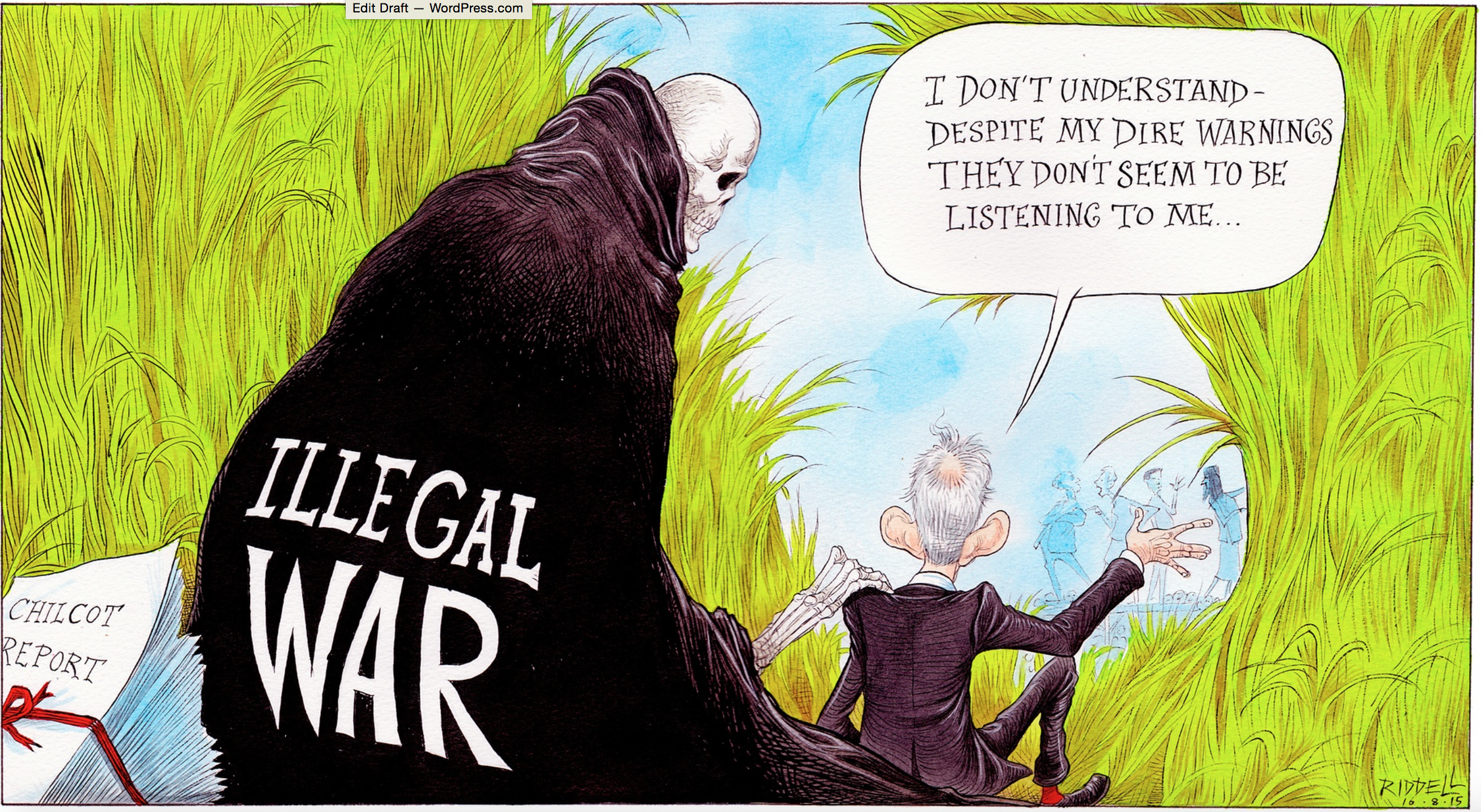
Why no-one is listening to Blair: Chris Riddell in The Observer

Why no-one is listening to Blair: Chris Riddell in The Observer

The battle for the Labour Party’s soul is raging. The man who led the party to victory in an unprecedented three general elections has issued apocalyptic warnings of the consequences of electing Jeremy Corbyn as leader. Tony Blair says that under Corbyn Labour would be routed, and possibly annihilated.

I’m no Corbyn supporter or Labour party member, but I find it breathtaking that Tony Blair or Gordon Brown have the cheek to lecture people on whom to vote for. While they created an election winning machine and made voting Labour fashionable – for which they deserve great praise – their deadly feud threw away the huge opportunity that Labour had to transform Britain after May 1997. Brown was the worst culprit, obsessed by a corrosive sense of betrayal at Blair’s election as Labour leader in 1994. He took every opportunity to undermine Blair, while Blair always shrank away from moving Brown from the Treasury, for fear of the consequences. Yet Labour and Britain paid a heavy price for this tragically dysfunctional government.

Continue reading

Tony Blair on Neville Chamberlain: a noble ambition

Tony Blair’s reputation has been shredded by his disastrous decision to back George W Bush’s invasion of Iraq. That conflict was one of many Blair plunged Britain into. So much so that John Kampfner devoted a book to Blair’s wars.

So Blair seems an unlikely person to seek to explain and sympathise with arch appeaser Neville Chamberlain, the prime minister who sacrificed Czechoslovakia to Hitler in 1938 at Munich in the vain hope that it would ensure peace.

Yet in his memoirs, A Journey, Blair speaks eloquently of Chamberlain’s mission:

“A comparison to Chamberlain is one of the worst British political insults. Yet what did he do? In a world still suffering from the trauma of the Great War, a war in which millions died, including many of his close family and friends, he had grieved; and in his grief pledged to prevent another such war. Not a bad ambition; in fact, a noble one.

“One day [at Chequers], I picked up his diaries and began to read his account of his famous meeting with Hitler prior to Munich … in Berchtesgaden… He recounts how Hitler alternated between reason … and angry ranting, almost screaming about the Czechs, the Poles, the Jews… Chamberlain came away convinced that he had met a madman, someone who has real capacity to do evil. This is what intrigued me. We are taught that Chamberlain was a dupe; a fool, taken in by Hitler’s charm. He wasn’t. He was entirely alive to his badness.

“I tried to imagine being like him, thinking like him. He knows this man is wicked, but he cannot know how far it might extend. So, instead of provoking him, contain him. Germany will come to its senses, time will move on and, with luck, so will Herr Hitler.

“Seen in this way, Munich was not the product of a leader gulled but of a leader looking to postpone… Above all, it was the leader with a paramount and overwhelming desire to avoid the blood, mourning and misery of war.”

It’s intriguing to compare Blair and Chamberlain. The man who sacrificed Czechoslovakia for a mirage of peace had a sense of destiny and certainty. Blair was similarly driven by a near-religious confidence in his judgement, especially after 9/11.

I’ll leave the last word to Winston Churchill. Just six months after succeeding Chamberlain, Churchill had the sad task of paying tribute to the man who had ignored his warnings of the mortal threat Hitler’s Germany posed to Britain. (Chamberlain died of cancer six months almost to the day of being ousted.) Winston said:

“Neville Chamberlain acted with perfect sincerity .. and strove to the utmost of his capacity and authority, which were powerful, to save the world from the awful, devastating struggle in which we are now engaged. This alone will stand him in good stead for what is called the verdict of history is concerned.”

Tony Blair, A Journey, SEO – and me

My blogpost, Tony Blair: A Journey for the showman prime minister, on Wednesday night about Blair's autobiography, A Journey, has proved a hit on Google. if you Google 'a journey tony blair ipad', my post comes first out of a staggering 211 million search results, beating huge media organisations. And it ranks highly on searches about Blair's book on iBooks and Kindle. (I'm on page two of results for a straight search for 'Tony Blair A Journey.) 

I only discovered this when I looked at what had brought a flood of visitors to the Ertblog post. 

My blog is purely for fun, so I've never set out to optimise it for search engine results. But every now and again it scores very highly on Google. My post on why I love my iPad scored third out of 47 million under the search term 'I love my iPad'. And my 25th anniversary account of the Falklands war in 2007 did very well. 

This latest, unexpected success prompted me to think seriously about the dark arts of search engine optimisation, or SEO. What prompted Google to rank my post so highly against the torrent of other articles and blogposts about Blair's book? What gave me the edge over all-powerful media groups? 

I am no expert on SEO, but I suspect the reason is that I wrote about a specific aspect of the publication of A Journey: its absence from Apple's iBooks store, which has puzzled many iPad owners. They've Googled the subject – and hit upon my blog.  (Surprisingly, I'm still as high as the second page of results for a straight search for 'Tony Blair A Journey.) The title of my post was also highly descriptive (including Tony Blair and the name of his book), while I also included a number of hyperlinks, which may have helped. 

As a PR professional, I need to know more about SEO, and this experience has prompted me to learn. In the meantime, I'd welcome any comments from SEO experts about what I did right – and wrong!

Tony Blair, A Journey, SEO – and me

My blogpost, Tony Blair: A Journey for the showman prime minister, on Wednesday night about Tony Blair's autobiography, A journey, has proved a hit on Google. if you Google 'a journey tony blair ipad', my post comes first out of a staggering 211 million search results, beating huge media organisations. And it ranks highly on searches about Blair's book on iBooks and Kindle. (I'm on page two of results for a straight search for 'Tony Blair A Journey.) 

I only discovered this when I looked at what had brought a flood of visitors to the Ertblog post. 

My blog is purely for fun, so I've never set out to optimise it for search engine results. But every now and again it scores very highly on Google. My post on why I love my iPad scored third out of 47 million under the search term 'I love my iPad'. And my 25th anniversary account of the Falklands war in 2007 did almost as well. 

This latest, unexpected success prompted me to think seriously about the dark arts of search engine optimisation, or SEO. What prompted Google to rank my post so highly against the torrent of other articles and blogposts about Blair's book? What gave me the edge over all-powerful media groups? 

I am no expert on SEO, but I suspect the reason is that I wrote about a specific aspect of the publication of A Journey: its absence from Apple's iBooks store, which has puzzled many iPad owners. They've Googled the subject – and hit upon my blog.  (Surprisingly, I'm still as high as the second page of results for a straight search for 'Tony Blair A Journey.) The title of my post was also highly descriptive (including Tony Blair and the name of his book), while I also included a number of hyperlinks, which may have helped. 

As a PR professional, I need to know more about SEO, and this experience has prompted me to learn. In the meantime, I'd welcome any comments from SEO experts about what I did right – and wrong!

Tony Blair: A Journey for the showman prime minister

IMG_1436
 Tony Blair was Britain's finest showman prime minister since Macmillan, as I blogged after his last Labour conference speech in 2006. So it was little surprise that today's launch of Blair's autobiography, A Journey, was a theatrical event, dominating news bulletins. 

But Labour's longest serving prime minister's attempt to restore his tarnished reputation seems doomed. Blair now admits he thought Gordon Brown was an impossible, deeply flawed character. Yet he made no attempt to move Brown from the Treasury, and lied to the British people about his chancellor's suitability for office when Brown took over in 2007. 

Nick Robinson, the BBC's political editor, today apologised to readers of his blog for not telling the full story about the Blair-Brown feud. Yet we all knew of this poisonous schism – I read The Rivals, James Naughtie's book about the TB-GB storms, in 2003 with a growing sense of anger at this pathetic, juvenile relationship, and despairing of the lost hope of May 1997. 

Yet despite this, and my contempt for the way Blair trashed Britain's reputation by involving us in the invasion of Iraq, I still half admire this extraordinary politician. (In the same way that some still worship Margaret Thatcher.) He won three elections in a row for Labour. He played a huge role in bringing peace to Northern Ireland, building on earlier efforts by John Major, Bill Clinton, Bertie Ahern, John Hume and Gerry Adams. He delivered devolution to Wales and Scotland – despite not sharing predecessor John Smith's commitment to home rule. His government saw renewed investment in public services, even though many questioned how effectively the money had been used. Blair himself must wonder how high his reputation would stand if it hadn't been for Iraq, although we'd still be facing a ruinous deficit thanks to Labour's lax regulation of the banks' casino activities. 

Blair claims that Labour could have won a fourth term had it not abandoned new Labour. That strikes me as a crazy claim. Gordon Brown didn't lose in 2010 because he became old Labour. He lost because the British people disliked him, because he and Blair created the greatest financial crisis since the 1930s – and because of their love of spin and sleaze. Ironically, Labour's late move to create a 50% tax rate was popular, belying the idea that old Labour tactics couldn't succeed. (A law to tax 100% of disgraced banker Fred Goodwin's income would have been acclaimed.) 

I'll quote just one passage from Tony Blair's book, as it is sobering:

"On 2 May 1997, I walked into Downing Street as prime minister for the first time. I had never held office, not even as the most junor of junior ministers. it was my first and only job in government."

I've bought my copy of Blair's book from Amazon on the Kindle, to read on my iPad. It's an interesting insight into book publishing in 2010. The full price of A Journey is £25. Waterstone's is selling the hardback for £12.50, as is Amazon. Apple's iBooks store isn't selling it yet, but is likely to offer it for £12.99 if its offer for Peter Mandelson's The Third Man is a guide. Kindle is the best offer: A Journey is just £6.99. I prefer iBooks to the Kindle app on the iPad, but as I recently blogged about iBooks, it will never take off until it offers far more titles at far lower prices. 

The tragedy of the New Labour years

Thirteen years ago today, Britons went to the polls on a glorious spring day and gave Tony Blair's Labour Party a stunning, landslide victory. The result was a triumph for Blair, who promised a new, cleaner politics after years of 'Tory sleeze'. The country seemed thrilled at what it had done. 

Labour's huge majority was unprecedented in the modern era. Only one other post-war government had come to office with a landslide – the 1945 Attlee administration. It gave Blair huge moral authority to change Britain and create a new politics. 

At first, the Blair era lived up to those sky-high hopes. Gordon Brown passed interest rate decisions to the Bank of England. Wales and Scotland enjoyed varying degrees of home rule. Blair played a pivotal role in securing the historic Good Friday agreement, paving the way to lasting peace in Northern Ireland. And the national minimum wage was a boost for the lowest paid. In time, the party reversed years of under-investment in the NHS and schools (although many doubted how wisely that money had been spent).

But Labour soon dashed hopes that it would be whiter than white in power. It took a huge donation from the Formula 1 boss Bernie Ecclestone just before scrapping plans to ban tobacco sponsorship of the sport. It abolished hereditary membership of the House of Lords but replaced one form or patronage with another – Tony's cronies, or appointed peers. It turned the government communications service into a spin cycle, with a deeply partisan head of communications (Alastair Campbell) instructing civil servants. That led to the disgraceful hounding of an honourable man, the government scientist Dr David Kelly, who killed himself under the pressure. Trust in Labour never quite recovered after the Kelly affair, even though the party won a further general election in 2005. 

The decision to support American president George W Bush's invasion of Iraq – and to make the case for intervention with a deeply dodgy dossier of claims – was surely the defining moment of the post 1997 Labour era. A million people marched to protest against the war, but to no avail. Blair was determined to support his unlikely friend, regardless of the white lies it took to get parliament to vote for war. 

Labour's years in power were also derailed by the poisonous dispute between its two greatest powers: Blair and Brown. The feud reflects very badly on both men, but Brown has been revealed as the most flawed and destructive influence. He believed he had a god-given right to become prime minister. Eventually, Blair gave in and left Downing Street. Labour made a terrible mistake in anointing Brown as leader, and prime minister, without an election. Enough people inside and outside the party warned that Brown would be a disastrous prime minister. But Labour was too cowed by Brown's bullying tactics to hold a contest. And the credit crunch and recession destroyed Brown's greatest claim to the top job: his management of the economy for 10 years. He deserves some credit for steering Britain towards economic recovery, but as the Tories found in 1997, voters don't show gratitude to governments that clear up their own car crash. 

Brown's death bed conversion to electoral reform reveals his true colours. Labour had a golden opportunity to introduce a fairer voting system. Its 1997 landslide made reform possible but unlikely – the party should have known that the electoral cycle would run its course. Labour and the Liberal Democrats are natural allies, whatever the tribalists in both parties might think. Yet the first past the post system gave the Tories decades of power from a minority of votes. Labour's failure to act until its dying days in power may have given David Cameron the same advantage. 

All governments and political careers end in failure. But it's a tragedy that the high hopes of 1 May 1997 have been dashed in such spectacular fashion that Labour could end up in third place in the polls. Tony Blair and Gordon Brown should be ashamed.