
High speed ahead for HS2

The government has given the go ahead to a new high speed rail line from London to Birmingham: HS2.

It's a hugely symbolic act. It marks a new era for the country's railways. At last, Britain won't be the poor relation to its continental cousins, who have been building high speed lines for the past 30 years. We'll have our first new domestic intercity railway since 1899, the year Great Central trains started running from the north to London Marylebone.

But HS2 has been hugely controversial, especially in the Chilterns. As I blogged when Labour announced the original HS2 plan, our own village, Chalfont St Giles, is on the route. As you'd expect, few people here are in favour of a railway that won't benefit us (there won't be any local stations) but whose construction will blight the area for many years. The anti HS2 campaign has been witty and well organised – with posters on the road to Chequers asking prime minister David Cameron if he's on the right track. Local MP Cheryl Gillan has supposedly threatened to resign as Wales Secretary if the government gave the green light. We'll see if she's still in the Cabinet at the end of the week…

I share the many of the misgivings of the protesters. I find it hard to justify the massive price when public spending is a being slashed to cut the deficit. (It seems a strange priority to splash out on an expensive rail line when youth clubs for deprived inner city teenagers are being closed.) If we're going to invest in rail, wouldn't it be better to improve existing rail lines?

But that kind of make do and mend approach isn't good enough. Britain's intercity rail network was born just before Queen Victoria came to the throne in 1837. It was the wonder of the world. Nearly two centuries later, the world wonders why Britain is so reluctant to build a new railway. HS2 opponents say we should just modernise the west coast mainline. That line was created from a series of 19th century railways. It has been 'modernised' twice in the last fifty years. It's still in essence a Victorian railway. Its London terminus, Euston, is a soulless place. I pity anyone who has any time to kill there. The same is true at Reading, Cardiff Central, Bristol Parkway and countless stations across the country.

So HS2 is the right thing to do. It will transform the experience of train travel in Britain. Our village will suffer during the long construction years, but I'll be able to show Owen the building of our first new domestic railway since his great grandmother was a child in the 1890s. (I never thought I'd have the chance to emulate SWA Newton, who photographed the birth of the Great Central in Buckinghamshire and beyond.)

PS: Other mainlines were build in Britain after the Great Central, notably the Great Western's 'cut-off' lines before the Great War, but none was a complete inter city line.

Buckinghamshire Advertiser: a failure of local journalism

Britain's regional newspapers are in crisis. Sales and advertising are falling, and titles closing. 

Perhaps inevitably, standards of journalism are falling. Nick Davies described some of the reasons for this in his book Flat Earth News. Journalists have little time to find, check and write stories. So I shouldn't be surprised by two serious errors in successive weeks on the front page of our local Buckinghamshire Advertiser

The most serious was a story in last week's paper suggesting that Beaconsfield was set to be the centre of a cake war between Gordon Ramsey's former pastry chef and and Raymond Blanc. Today's paper revealed that almost every detail in the story was wrong.

This week's howler appeared in the front page lead story about the proposed high speed rail line from London to Birmingham through the Chilterns. The story warned that … "many homes would have to be bulldozed to complete the track by 2017…"

The swiftest glance at the proposals would have shown that 2017 was the earliest work could start on the line, not the completion date. In reality, it could be even later – or never, if Labour loses the election. 

There's little point in having local papers if they're as incompetent as the Buckinghamshire Advertiser.


Why I won’t object to high speed rail line through Chalfont St Giles

Chiltern line being built 01

Above: the last mainline built through the Chilterns

The government announced plans yesterday for a new high speed rail line from London to Birmingham – via our village, Chalfont St Giles.

The news has, inevitably, led to an outcry. The Chilterns Conservation Board said it would cause irreversible damage. This highly prosperous area is sure to campaign fiercely against the new line.

I won’t be objecting. Partly because the line will pass Chalfont St Giles in a tunnel, which will minimise the impact on the village once construction is complete. But mainly because I feel strongly that it’s hypocritical to benefit from motorways, rail line and airports but object violently when someone plans one in your own area.

And I don’t accept the idea that rail lines – even high speed ones – blight the countryside. There’s something special about the sight of a train snaking its way through the countryside. The west coast main line didn’t ruin the Lune Gorge in the north of England; the later, parallel M6 did.

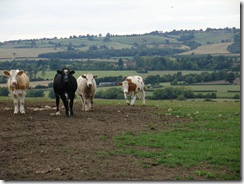
As the photo at the top of this post shows, railway lines already cross the Chilterns. This photo shows the Great Western and Great Central joint line being built at Loudwater near High Wycombe at the turn of the last century. The scars of construction are long gone; the railway is now part of the landscape. As the photo below of the same line near Ashendon shows, the railway merges into landscape.

century cows train nr Ashendon

As a boy, I loved lying in bed at night listening to coal trains making their way along the Rhymney valley line in Cardiff. It seemed the most natural thing in the world.

But will it happen?

It may not need a campaign to stop a high speed line through Chalfont St Giles. A Tory victory at the general election is likely to scupper the plans, and although the Tories say they’ll push a similar scheme, it will probably be for a different route.