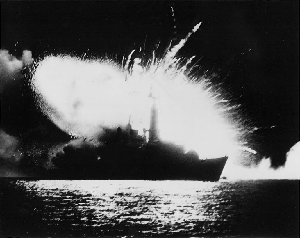
Above: HMS Antelope explodes, San Carlos Water, Falklands, 1982
Thirty years ago Britain found itself unexpectedly at war when Argentina invaded the Falkland islands. It was a profound shock – not least to millions who had no idea where the Falklands were.
According to my 1982 diary, I heard the news at 1.05pm on 2 April on Radio 4, but the British government only confirmed the news at 6pm. Yet that morning in my slumber I distinctly heard an armchair general telling Radio 4's Today programme about the possibility of attacking Buenos Aires with nuclear weapons. That was just the start of an open season for armchair generals, admirals and air vice marshals.
I wrote a lengthy post about the Falklands conflict on the 25th anniversary in 2007. I recalled how challenging the war was for the media – it took days and weeks for film to reach Britain. (I even delayed going into school one morning in May to watch the first BBC film report from the South Atlantic.)
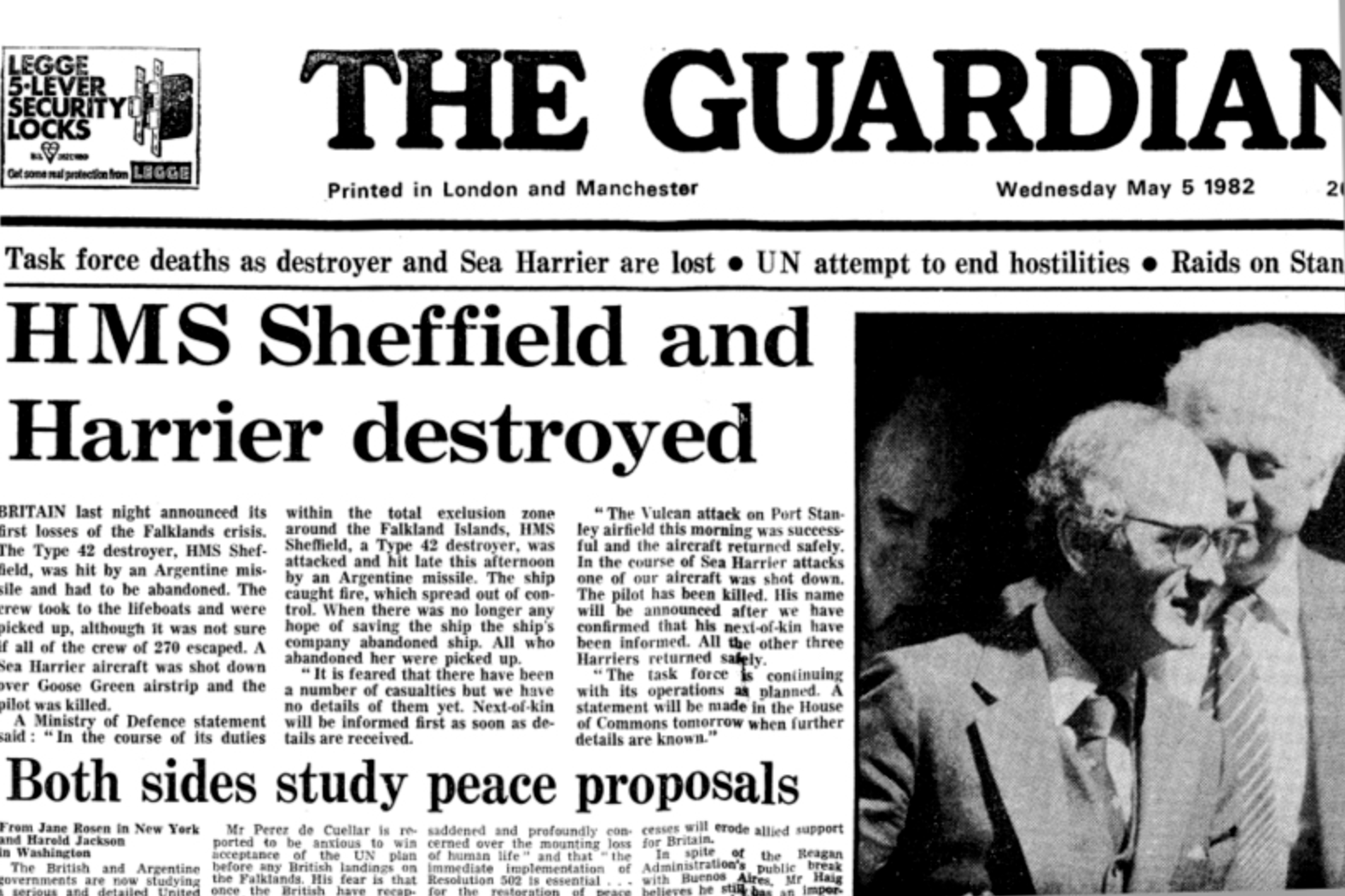
Reclaiming the Falklands was an extraordinary feat of arms by Britain. The first ships of the famous task force set sail just three days after the invasion. The Royal Navy suffered grievous blows, losing HMS Sheffield, HMS Coventry, HMS Antelope and HMS Ardent, while many of the navy's other ships were badly damaged. The army successfully 'yomped' across forbidding terrain to capture Darwin and Goose Green and later the island capital, Stanley. (It also supplied a hero from central casting in the form of Colonel H Jones, killed in the attack on Goose Green.)
But in many ways the RAF's contribution was the most remarkable, if not the most decisive. The Vulcan raids on Port Stanley's airport were the most extraordinary British air attacks since Guy Gibson led the Dambuster raid on Nazi Germany 39 years earlier. To get to the Falklands, the Avro Vulcan would need to fly 4,000 miles beyond its maximum range. That would take 15 tanker aircraft and 17 in-flight refuellings – for just one bomber.
If that wasn't enough, there was a bigger challenge: the Vulcans had not been refuelled in air since the 1960s. As Roland White recounts in his enthralling book, Vulcan 607, RAF engineers visited aviation museums around the world to grab vital refuelling probes to replace those removed from the Vulcans over 15 years earlier. As White says, the curator of the Castle air force base museum in California turned a blind eye as an RAF team removed a probe from an exhibit, covered the hole with a blanking plate and made off with an item that could help Britain reclaim the Falklands.
The cunning didn't end there. The ancient Vulcans were horribly vulnerable to modern air defences. The RAF wanted to give them a better chance with the Dash 10 system fitted to its Buccaneers. But there was nowhere to fit it on the V bombers. Or was there? Someone with a long memory remembered that the Vulcan was meant to carry the huge Skybolt missiles. Skybolt was cancelled, but perhaps the Skybolt fitting points were still there. After much prodding, the engineers found them.
One more piece of British ingenuity was still needed to fit the Dash 10. RAF Honington's engineers found a perfect way to create a pressure tight seal for the wires from the Dash 10: a home brew cork with a hole in the middle. Happily, one of Honington's crews brewed their own beer, and supplied the corks.
The Falklands war carried many echoes of the second world war. The 1938 Argentinian cruiser General Belgrano, sunk by the British in 1982, had survived Pearl Harbor as USS Phoenix. The media reporting was closer to that of 1940 than 2012. And those Vulcan bombers carried an updated version of the H2S radar sets used by Bomber Command's Lancasters in the raids on Berlin. The version of H2S used in 1982 was far better than its 1940s predecessor, but it was still an antique, over six foot across and producing an image of the target that its operators described as green porridge. But it proved its worth: the moment Mount Usborne showed up on the H2S was the confirmation that Vulcan 607 was within a mile of its plotted path after its 4,000 mile flight from Ascension to the Falklands. Minutes later, Martin Withers' crew placed two 1,000 pound bombs on Stanley's vital Argentinian-held airfield. The occupiers now knew they had a battle on their hands. And little hope of using Stanley as a base for fast jets to attack Britain's capital ships.
As I said in my 2007 post, war represents a tragic failure of politics and diplomacy. The idea of Britain and Argentina flighting was extraordinary, given the links between the two countries. (Not least the Welsh-speaking community in Patagonia.) I cherished those links, with an Argentinian brother-in-law. And Britain's most famous Falklands veteran, Simon Weston, has movingly described on Desert Island Discs how he met and embraced the Argentinian pilot who bombed him and his comrades. So many British and Argentinian lives were needlessly lost during that tragic south Atlantic autumn. Yet it had one positive outcome: a brutal fascist dictatorship was overthrown.
Thirty years on, the controversy over the Falklands remains. Democratic Argentina's president, Cristina Kirchner, has taken a tough stance on the Falklands issue. Yet she, like so many in South America, seem to have difficulty understanding a basic concept: self determination. The simple fact is that the Falkland islanders don't want to be Argentinian citizens. And they never will as long as politicians like Kirchner regard them as pawns in their political games.
Britain may have been foolish to provoke south American sensitivities by sending Prince William on a tour of duty in the Falklands. But after the events of 1982, we won't sell out the interests of the Falkland islanders. If anyone in Argentina feels upset about it, they should reflect on the fact that Britain was about to agree a settlement before its brutal junta made its fatal mistake 30 years ago.
 Ertblog