Remembering Brian Redhead

Brian Redhead

Yesterday’s Today: Brian Redhead

It’s hard to believe that it’s 20 years since the death of BBC Today presenter Brian Redhead. I still remember the shock of hearing the news on a Sunday evening BBC news bulletin, realising I’d never again hear that wonderful, impassioned northern voice on Today as I drove to work.

Brian was an extraordinary broadcaster. He’s best remembered as a combative interrogator of politicians, and for his contempt for Tory chancellor Nigel Lawson’s assumption in an interview that Redhead supported Labour. But Brian was also a fine print journalist on the Guardian – and I cherish the memory of his beautifully judged, tender 1993 interview with a school child over some long-forgotten subject. He was a journalist and broadcaster whose talent ranged far and wide.

Redhead became famous for his Today partnership with John Timpson. They seemed like chalk and cheese: mercurial and mellow; northern and southern. But the pairing worked, and helped transform Today from a lightweight show to national treasure.

Poignantly, Brian’s son Will was killed in a crash that almost took the life of Nick Robinson, Will’s friend and the BBC’s current political editor. Nick has explained how the connection inspired emotional thoughts when he briefly presented Today.

I’ve been a Today fan for almost 40 years. I remember the days when Desmond Lynam presented the programme. As a teenager, my morning routine followed the Today running order, unlike my school friends who preferred Dave Lee Travis and Mike Read on Radio 1.

Thirty years on, Brian Redhead remains a broadcasting legend.
Why I’m cancelling the Guardian after 36 years

The Guardian: from print to pixels

The Guardian: from print to pixels

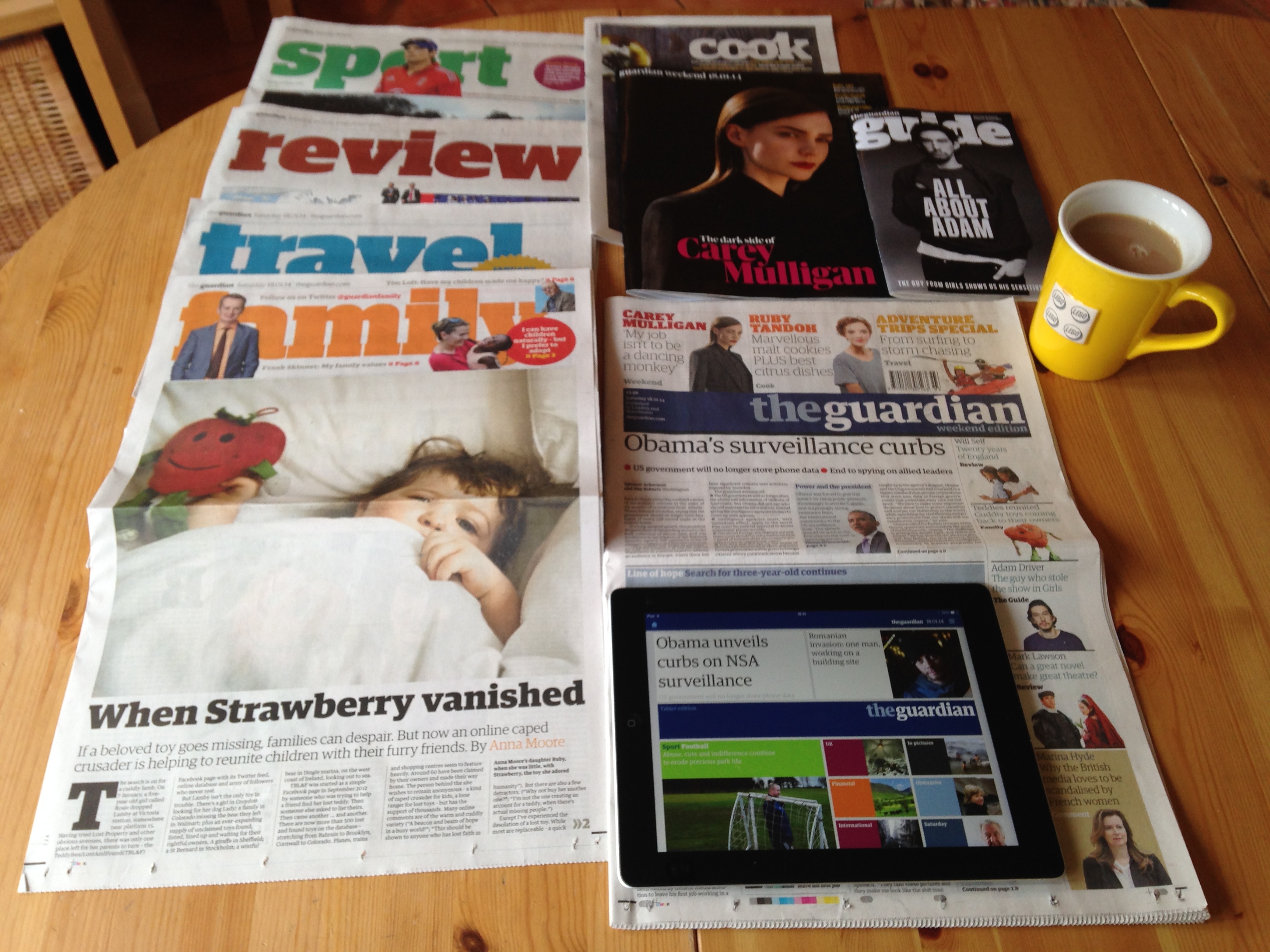
I’ve been reading The Guardian since 1978: the year the winter of discontent started and the first test tube baby was born. As a 1980s student I endured days when the paper never appeared because of strikes and days when photos were so badly printed they were impossible to discern. Today’s paper is a miracle in colour – and the writing is as glorious as ever – yet I’m cancelling my subscription.

But this is no act of infidelity. I’ve decided after two years that the Guardian’s iPad edition is perfect for me. I prefer pixels to print, at least during the working week. I can read the ‘paper’ at the breakfast table in San Francisco and Sirmione as well as at home in our Buckinghamshire village without looking for a newsagent. I don’t have to recycle yesterday’s paper. And my fingers don’t get mucky with newsprint.

I made the decision after weeks of never buying the print edition with my subscriber’s vouchers. Most days, I read the iPad edition over lunch at my desk at work, avoiding the queue at WH Smith for the printed paper.  I couldn’t see the point of spending almost £40 a month for the print subscription when I could get the digital version for around a quarter of the price.

I’ll still buy the printed Guardian on Saturdays. Weekends are different, and Karen and I enjoy sharing the weekend paper – I devour the opinions and sports sections, while she enjoys Family and Travel. (We both love the Weekend magazine.)

The Guardian is special. It stands out from the overwhelmingly authoritarian, right wing British national press. It has been a digital pioneer, although it was slow to introduce an iPad edition. Like many, I wonder how long it will maintain a print edition. Yet I’ve surprised myself. When I started reading the Guardian, Times and Telegraph on my iPad, I thought printed newspapers had a unique appeal that would endure. Now I’m not so sure.

Britain’s papers have embraced the iPad. The broadsheets have become pixel publishers, yet it’s not clear how much money they’re making from their digital editions. But there are two brutal truths: they cannot survive on print alone. And giving away content for free online threatens everything. It will be fascinating to see how this story develops over the next few years.

PS: my review of the very first Guardian iPad edition has stood the test of time. You can also read my post about The Times’ iPad edition.

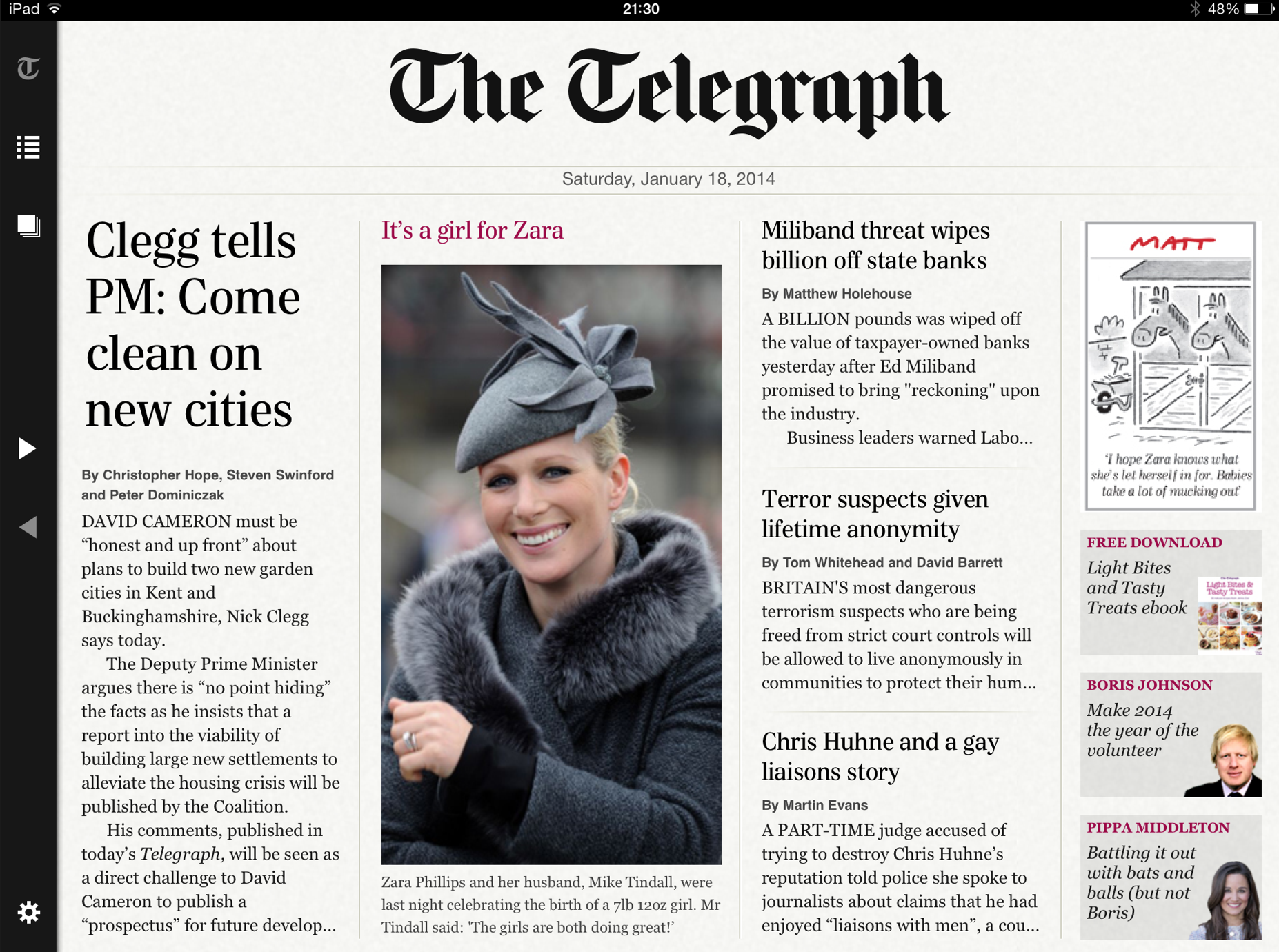
The Telegraph's iPad front page

The Telegraph’s iPad front page

The Wiltshire phone box that became a village hotspot

Purton phone boxAbove: Purton’s community phone box. Photo: Siân Wildeboer, Lde

The red phone box designed by Sir Giles Gilbert Scott is a British icon. But they’re fast disappearing as the mobile phone lets us make a call almost anywhere. Happily, one Wiltshire village, Purton, has saved its vandalised box and brought it into the 21st century as a community communications hub and wifi hotspot, thanks to the support of local company Lde Digital Services.

Local MP James Gray officially opened the box today.

As a student in the days before the mobile phone, I spent many cold and rainy evenings looking for working phone boxes in Leicester, as I blogged in 2007. It’s good to know that they still have a role in today’s world.

Thanks for the laughter, Simon Hoggart

Image

Above: The Guardian mourns its star sketch writer

Saturdays won’t be the same again. The Guardian weekend columnist and parliamentary sketch-writer Simon Hoggart has died aged 67.

Never again will we savour Hoggart’s waspish columns, mocking politicians and everyday people – especially Christmas round-robin letters.

Today, The Guardian’s obituary recounted examples of Hoggart’s wit, as well as his serious journalist, notably covering the darkest days of Northern Ireland’s Troubles.  His damning account of the British Army’s actions on Bloody Sunday in Derry in 1972 was confined by the 2010 Saville inquiry.

Hoggart was also a witty broadcaster, and he transformed Radio 4’s venerable News Quiz in the 1990s when he took over as chairman from Barry Took. He made it essential listening compared with the tired show that he inherited. (Helped by a fresh generation of brilliant comics, including Andy Hamilton, Jeremy Hardy and Linda Smith.)

A sad loss.