Bank charges: Supreme Court saves banks from further disaster

Britain's embattled banks have found a friend at last. Today's decision by Britain's new Supreme Court that the Office of Fair Trading cannot rule on the fairness of unauthorised overdraft charges is a priceless victory for the banks and Nationwide Building Society.

The Supreme Court overturned judgments of the High Court and Court of Appeal in favour of the OFT. Campaigners have long argued that the heavy charges for dipping into the red without your bank's agreement are punitive and unfair. The Supreme Court based its decision on its view that that unauthorised overdrafts were part of a package of banking services. The charges that banks levied when someone went overdrawn without authority were part of the charges for that current account, rather than a fee in exchange for an unauthorised overdraft. So they could not be regarded as a penalty for going into the red, and were excluded from the fairness test.

It's hard to avoid the conclusion that the Supreme Court reached a conclusion that would avoid further damage to Britain's beleaguered banking sector. In other words, public policy played a big part in its judgment, if not in the reasoning behind it. The world has changed dramatically since the test case was announced in July 2007. Two weeks later, the credit crunch began, and two months later Northern Rock customers were queueing to get their money out. The day before the Supreme Court's announcement, Lloyds announced Britain's biggest rights issue to avoid having to rely on the Government's Asset Protection Scheme. Campaigners like Phil Jones from consumer group Which? may be outraged by the judgment, but that's pure grandstanding. Delivering a body blow to the banks would have been popular, but ultimately consumers would have paid the price, as it would have meant the end of so-called free in-credit banking.

For almost 30 years, Britain has been one of the few countries where consumers do not pay a fee for in-credit banking. In most other countries, people pay to use a cash machine or to pay a cheque. Britain's unusual arrangement has been paid for by the people who go overdrawn without agreement. The campaigners have argued that the customers paying these unauthorised overdraft charges have been unfairly penalised, pointing to extortionate charges for relatively small overdrafts. The banks have won the day by saying that these charges are (largely) clear, and are simply part of the cost of having a current account. As Lord Walker said in his judgment, it is now up to parliament to decide whether it wants to extend the scope of the fairness test. But it's hard to see a government wanting to enter this bear pit. There are few votes in ending free banking for millions of people. And applying a general fairness test would be an impossible task. Is £115 a fair price for an iPod Nano? What about the £5.40 cost of crossing the Severn Bridge in a car?

Disclosure: I am a former bank PR manager.
Ireland were robbed by hand of Henry – but football’s the loser

The cheats have won. France will be taking part in the FIFA football word cup in South Africa next summer after Thierry Henry stole Ireland's place with a blatant hand ball to grab a late goal. 

The referee's decision may be final, but it's hard to disagree with the countless commentators who demand that FIFA introduce videos to decide such controversial decisions on the night. It works well in rugby. And in answer to those who say it slows the game, so what? Isn't the right decision better than a quick one? 

All the same, I can't get too excited about talk of football's integrity being impugned. Football has very little integrity left. It's a billionaire's game now. Managers such as Alex Ferguson routinely abuse referee's decisions regardless of whether they have a genuine grievance. Millionaire players fall to the ground to try to win penalties even when opposing defenders were feet away from making contact. Fans are charged crazy money to see their teams play. 

In short, there are far greater injustices in the world than Ireland's failure to reach the 2010 world cup finals. 

Guardian axes technology section

Thursdays will never be the same again. The Guardian is to axe its printed technology section after 17 December. 

Editor Charles Arthur explained the decision in this week's edition: too many IT job ads have moved online. And it's hard to disagree: the section is painfully light compared with the Guardian's hefty media, education and public sector supplements. 

But judging by the reader comments on Arthur's article above, I'm obviously not alone in mourning the printed section. I used to savour reading it on the train back from first direct in Leeds on a Thursday afternoon, or on the tube home from Canary Wharf. Now I commute by car, I save the treat for the evening. But not for much longer. 

Some have questioned the direction Technology Guardian has taken since Charles Arthur took over in 2005. The Free Our Data campaign has come under particular fire as an obsession that put many off. And I always skip past the regular section on computer games. All this, though, is a distraction. Those job ads are the lifeblood of any supplement. 

I just hope that enough of Technology Guardian survives in the main paper. (And please keep the tech podcast.) But the demise of the gadget spot in the Saturday Weekend magazine isn't a good sign. And what are the prospects of the excellent family section in Saturday's paper? The closure of the 30 year old business section in the Observer, the Guardian's sister paper, is another indication that papers are struggling to cope with the recession and the rise of online advertising. I'll enjoy my favourite sections while they're still there. But you have to ask whether newspapers are doing enough to win new readers and secure the loyalty of existing subscribers. Cost cutting may help them survive the storm. It won't secure a long term future.

UPDATE, Wednesday 25 November 2009

Charles Arthur, The Guardian's technology editor, has posted the following response.

(Note: a bug in Typepad's comment system meant Charles was unable to post a comment via Typepad. Typepad tells me they are working on a fix. Meanwhile, I am happy to post Charles's emailed comment here unedited.)

[Your quote] "Some have questioned the direction Technology Guardian has taken since Charles Arthur took over in 2005. The Free Our Data campaign has come under particular fire as an obsession that put many off."

Err… who are these "some"? They weren't very vocal. Or was I looking the wrong way somehow? And what particular fire did Free Our Data – which you'll have noticed scored a giant victory this week, with Gordon Brown and Tim Berners-Lee backing its core idea – come under? I kept meeting people who wanted it to happen; never any who said "I'm so bored of that campaign". Never.

"And I always skip past the regular section on computer games."

Unlike the gamers who read the section. We try to cover a broad waterfront.

I'd have to say: I think that the Free Our Data campaign is going to be viewed, in retrospect, as having marked a sea change in government's view of the non-personal data it collects. You may not have liked it, people you met might not have liked it – but it's going to enable lots of new businesses, and reduce costs for many more, which means more jobs and more business. (And more tax revenue for the government.)

Charles Arthur

Labour’s Against the Odds video is moving – but isn’t a vote winner

The Labour party has produced a moving campaigning video, called Against the Odds, to raise its spirits in the run up to the general election. 

I got some mild backwash on Twitter from Labour's 'Twitter czar' – new media spokesperson Kerry McCarthy MP – when I suggested the video was moving but was no reason to vote Labour against the bitter taste of Iraq, Afghanistan and MPs' expenses. 

Kerry retorted: was I watching the same film? In other words, how could I have responded so differently? 

Quite simple. I'm an ordinary voter, not a political activist. I'm generally left of centre, but I make my mind up on the issues and how I think the government and opposition parties are doing. I did find the film moving, but Labour's part in winning votes for women 90 years ago and creating the NHS sixty years ago is no reason – in itself – for me to vote for the party in 2010. A misty eyed video cannot make me forget the lies Tony Blair told to justify the invasion of Iraq, or the way Gordon Brown forced through the disastrous part privatisation of the London Underground. 

That's not to say Labour cannot point to achievements since 1997. But Against the Odds doesn't make the case for a fourth term. 

Nationalisation rules! Britain takes control of a railway again

Let's party like it's 1948…

But it isn't. The nationalisation of one of Britain's most important rail lines, the east coast main line, isn't as significant as many of us would like. It is a temporary measure, forced upon the government because the operator, National Express, couldn't afford to keep the franchise. I imagine the government would have chosen a more inspiring title for the new nationalised operation than Directly Operated Railways had it seriously intended to revive British Rail. 

But we can but dream: of a truly national railway, that avoided the honeypot of millions of pounds of taxpayers' subsidy being used to fund private company profits. (National Express did very well out of us until it overbid for the east coast franchise on the eve of recession.) Sadly, the party that forced through the catastrophic privatisation of British Rail is likely to regain power next year. Once again, we're left wondering what might have been had Labour done more with its 13 years in government. 

See my earlier post about the folly of rail privatisation. 

In remembrance

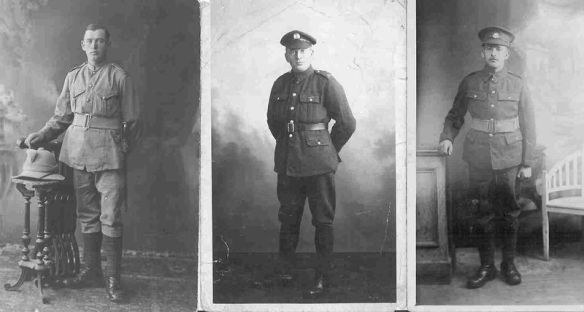
Frank and Bert Skinner 001

It's a sobering thought that tomorrow is the very first Armistice Day without a single survivor of the Great War alive in Britain. 

The last link with that brutal conflict has been lost. The collective memory of millions of lost and shattered lives has passed into history. 

Armistice Day and Remembrance Sunday were always dignified events, as a nation honoured the sacrifices of its sons and daughters in two world wars, and in the many smaller conflicts since 1945. Controversy and politics were forgotten. Almost every family in the land identified with events at the Cenotaph in London and at ceremonies throughout the land – they had all suffered loss or injury on foreign fields, or in air raids. In our case, my grandfathers and great uncles endured the hell of the Western Front. The photos above of my grandfather Frank and great uncle Bert were typical of so many taken in photographers' studios between 1914 and 1918. You can sense the pride and fear these young men experienced before being sent to the trenches in France. They both survived the trenches, but Bert tragically died in the flu epidemic of 1918. 

How bitterly ironic that as we mourn the last, modest heroes of the Great War, the very idea of remembrance should become polemicised, as the media grubbily seek to mock and condemn people for not wearing a poppy. As my father – a veteran of the Second World War – points out, how foolish is the idea that a footballer from Senegal should be expected to wear a poppy on his shirt as he takes the field. And how monstrous that newspapers should seek to stamp on our freedom to choose whether to wear the symbol of sacrifices made in the fight for freedom. 

But we shouldn't be surprised. The Sun newspaper reached a low even by its pitiful standard in its exploitation of a grieving mother of a British soldier killed in Afghanistan. I'm no fan of Gordon Brown, but I believe he showed his human side in sending a hand-written letter to Jamie Janes's mother. For the Sun – the paper that is still loathed in Liverpool for its contemptible behaviour over the Hillsborough tragedy – to use this as part of its campaign to oust Brown is beneath contempt. The decline of newspapers may be a very good thing if the press no longer has power without responsibility – in the words of inter-war prime minister Stanley Baldwin.