Don’t bin the instruction manual just yet

The BBC's Rory Cellan-Jones loves technology. It would be odd if he didn't: he's one of the Beeb's tech writers. So I wasn't surprised to see his post Read the manual? Never! on the BBC's technology blog, dot.life.

Rory's point is that products should be so simple and intuitive to use that a manual is unnecessary:

"The whole point of modern devices – from cars, to mobile phones, to wireless routers – is that they are designed for idiots like me who don't even know how to lift the bonnet, and wouldn't know how to proceed if they could. We want to take things out of the box, turn them on and see them leap into action without having to read anything."

If only! You've only got to look at the thousands of questions about tech products posted on forums and other websites to realise how unrealistic this is. I've spent much of the last week on Google finding out how to use my first Apple Mac computer – despite Apple's fame at making intuitive products and its excellent video tutorials. (Even the unexpectedly complicated task of moving emails from a PC to a Mac required far too many searches!) Modern consumer electronic products are incredibly complicated, with a plethora of menus and options. Consumers need some guidance, unlike long ago when the GPO trimphone was the last word in innovation.

The final proof that Rory is wrong is the boom in 'missing manuals' and 'dummies' guides. There wouldn't be a market for them if products were as intuitive as Rory (and I) would like.

PS: I wrote this post about the complexity of modern products and the need for manuals on Ertblog in October 2006… 

Apple’s MobileMe – don’t waste £59!

When I bought my first Mac a week ago, I decided to give Apple's MobileMe sync and storage service another go. I'd had a free trial when got my iPhone but never saw any reason to pay for it. Now, I thought, I might get something out of it. 


A few days on, MobileMe has left me tearing my hair out. It seems incapable of syncing existing calendar entries from the iPhone. It has left with with two copies of all my contacts. Oddly, the iPhone synced really well with Microsoft Outlook – I'd expect Apple's own products to talk to each other! I'm sure there are 'workarounds' – that IT industry codeword for getting the customer to sort out its problems – but I don't see why I should waste time and money finding them.

Needless to say, I won't be signing up for MobileMe at £59 a year. I'll probably drop it in the trash bin long before the trial ends!

Bekoning Bard – Great Western steam on song in 2009

Last weekend, an elderly steam locomotive thrilled thousands of people by the simple act of hauling a train from London to Stratford on Avon.


Bekoning Bard Seer Green

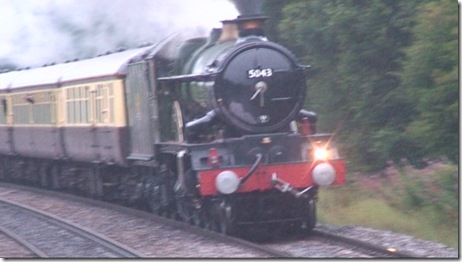
The Great Western Castle class engine Earl of Mount Edgcombe is seen above racing through Seer Green just minutes after stopping at Beaconsfield with the Bekoning Bard special. The train marked the 80th anniversary of the Bekonscot model village at Beaconsfield.

All praise to everyone involved, including Chiltern Railways.

You can see my video of the Bekoning Bard racing through Seer Green here.

How MPs can win back our respect (with help from Twitter!)

Stuart Bruce raised an interesting question recently: do we respect our MPs more when we get to know them better?

Stuart was commenting on the latest Edelman trust barometer report. His point was that we've not lost trust in our local MP by anything like the same degree we've lost faith in MPs generally trust. 

Stuart went on to say:

"A few years ago I did some research into people’s knowledge, trust and support of their local MP. What we found out is the more a person knew about their MP, the higher the levels of trust and support. Interestingly this was despite party affiliation. You could find people who were firm Labour voters who ‘admired’ their local Conservative MP because they knew what they did for them. For firm supporters this wouldn’t make a difference to how they voted, but for undecided and weak voters it could frequently make a difference."

I agree completely. My local MP is Cheryl Gillan. You may remember that she was the MP who claimed for dog food on her expenses. While I'm certainly not a natural Conservative supporter, I do regard Cheryl as a good constituency MP. This meant that the dog food incident did not affect my opinion of her. (The fact it was for a trifling amount also helped!)

I also believe that MPs who make a real effort to communicate with constituents will be better regarded. This is where blogging and Twitter might make a difference. I enjoy reading tweets and posts from Kerry McCarthy, Labour's MP for Bristol East. in the post above, she refutes the suggestion she should be working not tweeting. As she says:

"…basically what Twitter comes down to, is this: It's about communicating. It's about engaging with people. It's a conversation, a dialogue, and anyone can join in. And don't we politicians get criticised all the time for not doing that?"

Amen to that.

Twitter: spam is now following you…

When I started using Twitter for real last February, I got a buzz whenever I got new followers. But most of my recent followers have been spammers. As a result, I've been blocking them as soon as I get the emails telling me they're following me.

It's no big deal, but I wonder if Twitter could do more to stop spam. 

I do welcome genuine followers though!

The new age of the train? Britain flirts with high speed rail

At last, Britain's main political parties agree on something: we need to build high speed rail lines. Andrew Adonis, Labour's transport secretary, has unveiled plans for new railway lines, just months after the Conservatives said they would scrap plans for a third runway at Heathrow in favour of high speed rail.

I'm warming to Adonis. He's talked more sense in his first two months than all New Labour's previous transport bosses put together. Cardiff will see its first electric trains thanks to his decision to electrify the Great Western main line to South Wales. (But before we get carried away, the new electric journey times will be slower than the best achieved by the current high speed diesels over 20 years ago.)

The channel tunnel rail link has shown the benefits of high speed rail. We've seen a big switch of London to Paris and Brussels air traffic to Eurostar. Let's hope the new political consensus means we see faster progress than the 20 year project to build the 67 mile line to the channel tunnel.

PS: the photo below shows an InterCity 125 high speed train on the Great Western line near Wootton Bassett in early 1978. These trains are still in front line service 31 years later – but rather slower than in British Railways days.

HST Wootton Bassett 1978

The day I bought an Apple Mac

I've taken the plunge. Earlier today, I ordered my first Apple Mac.

I’ve wanted a Mac for years. I nearly got one when we bought our laptop two years ago. But I decided to stick to Windows, with the lure of nearly-new Vista, and a HP Pavilion dv9500. A seriously bad mistake. The HP is a nice machine, but the combination of Windows Vista, Office 2007 and Outlook 2007 is a truly horrible one: painfully slow, with a constant barrage of ‘program not responding’ messages. (Shameful, when you’d expect Microsoft’s latest programs to work together.) And, to cap it all, the frustration of weekly updates to try to stem the tide of security loopholes. (Imagine if you got a weekly visit from a car dealer telling you your car needed yet another update to stop it skidding off the road! Can you imagine ever buying another vehicle from him?)

The other prompt was my iPhone. I used to like my old Sony Ericsson phone, but living with the iPhone (see my six month review) has shown how much better life is when something is designed to be a pleasure to use. If Apple are this good at phones, I can't wait to experience my new Mac!

PS: I was intrigued to find out why they're called Apple Macintosh. Apparently, the McIntosh is a type of apple common in North America. One of Apple's founders loved the apple so much he adopted the name, but with a slightly different spelling for legal reasons.

Dark days for The Observer

A life and death drama: the stuff of every journalist's dreams. Unless, that is, the story is about your own newspaper. Reporters on the Observer, the world's oldest Sunday paper, this week had the unpleasant experience of reading about their title's possible closure in their arch rival, the Sunday Times

The chief executive of Guardian Media Group, Carolyn McCall, confirmed the possibility in a memo to staff yesterday, according to The Times.

The marriage of the Guardian and Observer in 1993 seemed like a union of soulmates: two of Britain's only left-leaning newspapers coming together to offer seven day reading for those of us who couldn't stomach the staunchly Conservative Daily Telegraph or the Murdoch-owned Times. But it never quite worked out like that. The Guardian's Saturday edition grew into a terrific weekend read, which meant many readers didn't want more of the same the next day. The Scott Trust, the proprietor of the two titles, has never had the same commitment to the Sunday paper. And while the Guardian has had just two editors since 1975, the Observer has had five since the Guardian group bought it 16 years ago - hardly a recipe for stability.  

Reports suggest that the Observer's owners are considering turning the world's oldest Sunday paper into a weekly news magazine. I don't believe this for a minute. News magazines in Britain have an almost universal record of commercial failure: millionaire James Goldsmith failed spectacularly with Now! magazine 30 years ago – long before the internet upset the print apple-cart. Only a delusional optimist could imagine a commercially unsuccessful British newspaper could flourish as a news magazine.  

I'd be very sorry to see the Observer disappear. By a strange coincidence, I first got to know the paper 30 years ago when the then owners of the Sunday Times closed the paper (and the Times) for a whole year in a futile attempt to break the strangehold of the print unions. (As a result, Margaret Thatcher's triumph in the 1979 general election went completely unrecorded by either title.) I've long admired the consumer-championing personal finance pages, edited for many years by the late Joanna Slaughter and more recently Jill Insley and Lisa Bachelor. (With an honourable mention for Margaret Dibben, who sorts out readers' problems with banks and the like.) And earlier this year the section's deputy editor, Sam Dunn asked me to write a personal viewpoint in the paper about the decline of the humble cheque. It caused quite a stir – and I concede that many readers challenged my view that the cheque was doomed!

If you want to help save the Observer, buy it this Sunday. You can also join the Twitter and Facebook campaigns to help save it – but there's no point signing up unless you're going to buy the paper every week!

PS: during the 1970s closure of Times Newspapers, the Observer ran a cartoon mocking the Times's then advertising slogan, Have you wished you were better informed? The cartoon showed a road flyover being built in two halves – with the two sections reaching each other at different heights, one labelled 'Times management', the other 'print unions'. Three decades later, it's the older title that appears in need of enlightenment.