
I like the Smart car. It’s refreshingly different.
But the company needs a spelling lesson, judging from this car at the Canary Wharf Motorexpo in London today.
I like the Smart car. It’s refreshingly different.
But the company needs a spelling lesson, judging from this car at the Canary Wharf Motorexpo in London today.
I had a shock yesterday. The number of visitors to Ertblog sky-rocketed. When I looked at where visitors were coming from, I spotted a link from the BBC’s Editors’ Blog. The BBC blog featured my post about Guardian writer Emily Bell’s comments about the BBC in its sidebar. It just shows how useful it is to get a link from a high profile site – and they don’t get much more high profile than the BBC.
I hope any new Ertblog readers enjoy the ride!
I should add that I am a fan of Emily Bell, despite my comments on her BBC piece. She is a breath of fresh air, although I do take what she says with a pinch of salt…
Tony Blair’s speech about the media today will, no doubt, prompt a stream of abuse from media organisations, opposition politicians and others. The Prime Minister acknowledged this in the way he ended his talk in a curiously half-hearted way:
“I’ve made this speech after much hesitation. I know it will be rubbished in certain quarters. But I also know this has needed to be said.”
But Blair’s comments deserve serious attention, rather than a knee-jerk dismissal because of the identity of the speaker. The PM is undoubtedly right when he points out that the modern media are blurring the line between news and comment, and that the media pack is increasingly feral when it hunts for victims. Combine the two and you can see how difficult it is to start a debate on any serious but controversial aspect of policy, such as road pricing or personal taxation.
He singled out the Independent for becoming a ‘viewspaper’ – perhaps choosing the paper with least power to wound, compared with the Daily Mail?
Blair also accepts that Labour’s addiction to spin has made matters worse:
“In the analysis I am about to make, I first acknowledge my own complicity. We paid inordinate attention in the early days of New Labour to courting, assuaging, and persuading the media. In our own defence, after 18 years of Opposition and the, at times, ferocious hostility of parts of the media, it was hard to see any alternative. But such an attitude ran the risk of fuelling the trends in communications that I am about to question.”
It’s a shame that the PM waited until his last weeks in power before admitting that the Government’s PR practices have proved counter-productive. But Tony Blair has often given the impression of a leader who asks forgiveness for his sins (and those of his courtiers), and then carries on regardless. His unwillingness or inability to rein in former Number 10 communications chief Alastair Campbell was a significant failure that caused long-term damage to him and his Government’s reputation.
The relationship between government and the media is inherently unstable and often explosive. Back in the 1930s, prime minister Stanley Baldwin railed against the press enjoying power without responsibility. Interestingly, Margaret Thatcher’s combative press secretary, Bernard Ingham made a similar complaint in a speech to the International Press Institute in 1985:
“I believe that the Watergate syndrome, combined with the broadcasters’ ‘confrontation’ approach to interviews and the determination to take the mickey out of authority … seems to require that any self-respecting reporter should knock seven bells out of symbols of authority, and especially government.”
It will be very interesting to see how Gordon Brown copes with the media when he takes over from Tony Blair later this month.
As Tony Blair prepares to leave Downing Street, it is fascinating to look back to his early days in power and his elaborate mating dance with former Liberal Democrat Leader Paddy Ashdown.
In the months immediately after Labour’s landslide victory in 1997, Blair met Ashdown regularly to talk about a possible coalition government and the introduction of proportional representation for UK general elections. The negotiations continued discussions held during Labour’s years in opposition. Ashdown’s diaries report the talks in minute detail, and are if anything more relevant now, as everyone assesses Blair’s legacy, than they were when published in 2001.
Blair clearly started the talks, in opposition, appreciating the sense of the two progressive parties making common cause. The Prime Minister has never been a tribal politician – that has been the heart of his appeal for the millions who are not wedded to any party – and saw little point in Labour remaining true only to die-hard Labour voters, especially as Neil Kinnock’s failure in 1992 showed the weakness of that approach.
Labour’s extraordinary victory in 1997 changed everything. The fact Blair pursued talk of a Lib-Lab coalition for over a year afterwards underlines his romantic streak: he wanted to create a new progressive alliance despite the fact that raw politics made it impossible. How could a party that had won a 179 seat majority be expected to share power and to change the voting system that had delivered such a huge parliamentary victory? The result would have been Labour MPs voting for their own demise. It could never have happened.
It is fascinating to witness Ashdown’s gradual disillusionment with Blair, and the way hope gives way to despair. Ashdown comes to realise that Blair wants to please everyone, despite the inherent impossibility of doing so. But Blair was obviously committed to achieving some kind of aliance of the centre-left: why else would he have spent so much time as a prime minister with a 179 majority talking to the leader of a party with 46 seats?
Blair comes across as a likeable human being in Ashdown’s diaries, someone at the junction of family life and supreme power in the British state. But Ashdown demonstrates Blair’s inability to grasp the nettle and tell him that the project was dead, a trait that has been repeated on other issues, such as cutting Gordon Brown down to size. How ironic that the PM only really showed iron determination in driving through the decision to go to war in Iraq in support of George W Bush’s presidency.
UPDATED, SATURDAY 15 JUNE 2007: Emily Bell has posted a response. See ‘comments’
The BBC’s Kevin Marsh delivers a firm rebuttal on the BBC’s Editor’s blog to a comment piece by Emily Bell in today’s Media Guardian.
Bell had a go at the BBC for not living up to its fabled duty to be impartial. She gives as an example John Humphrys’ recent interview with Channel 4’s chief executive Andy Duncan. Marsh demolishes Bell’s argument with ease.
Bell started today’s column by acknowledging the difficulties a media organisation faces reporting on itself and rivals. Yet she herself enjoys a privileged opportunity through her column and Media Guardian’s weekly podcast platform to sound off about rivals. (Especially the Daily Telegraph‘s electronic efforts.) Good clean fun, but hardly impartial.


Scenes at the first FA Cup Final to be held at the new Wembley stadium, May 2007
I’ve been blogging on Typepad for almost 18 months now. I like the site, although I wish it was better at displaying images. (Whatever happened to WYSIWYG – What you see is what you get?)
But Typepad has recently displayed a very irritable habit of losing posts as you post them. You try to go back, but your words of wisdom (or tedium) are lost in the ether.
I’ve learned to save drafts as I go along. It’s a pain, but it’s better than having to start over again.
 You know you’ve reached a certain age when you nod in agreement when someone at a conference (in this case Tom Murphy from Microsoft) asks: "Do you remember PR before the internet?"
Yes, I do. I also remember the days when an agency called PIMS posted news releases to journalists. Deciding whether the release should go first or second class or – hang the cost – by bike. Having an eight month battle in 1991 to persuade Eagle Star that I needed a PC to do my job. (They thought PCs were for secretaries only.) Happy days? No, not even with a heady dose of nostalgia.
Frightening to think my 20 year career in PR has already seen the meteoric rise and equally rapid fall of the fax machine. (Embarrassing to recall that in 1988 I asked if they had fax machines in Germany when someone asked me to fax something there.)
 So it was a pleasure today to sit in on the University of Sunderland’s latest event on the impact of social media such as blogs and podcasts, Delivering the new PR 2.0, managed by Nicky and Andy Wake from Don’t Panic Event Management.
I went to the original 2006 event in London last November, as I reported at the time. Today’s event went a stage further, beginning to explain how PR practitioners could, indeed should, engage with these trends.
Tom Murphy was excellent. It was refreshing to hear a senior Microsoft communicator telling us all not to get carried away by the hype about social media. Stuart Bruce also gave his characteristic mix of insight and common sense. (The photo above shows Stuart in full flow.)
As I wrote in my report about last year’s conference, I’m not convinced by the hype about Second Life, the online virtual ‘world’. Neville Hobson was again the resident evangelist about Second Life, describing how you can now test drive a virtual Ford car in Second Life and then place your order for the real thing there. I still think this whole SL phenomenon reeks of boys and their toys, despite the fact real companies are spending a lot of money building a SL presence. My suspicions were confirmed when Neville showed an image of his company crayon‘s virtual receptionist at their SL ‘office’ – a leggy blonde…
One of the clearest messages, from Philip Young and Stuart Rushton from the University of Sunderland, was how our personal online actions and comments can overshadow our professional reputations. Anyone taking part in online conversations should take care what they say online. In this sense, there’s no such thing as a work-life balance!

The Sunderland and Don’t Panic teams are taking Delivering the new PR 2.0 event around the country. Do go along if you get the chance.
Finally, you’ve got to hand it to Stuart Bruce. Not only was he one of the star speakers at today’s event, he’s also comms director for Alan Johnson’s campaign to become Labour’s deputy leader. This photo shows Stuart multi-tasking at today’s event! He’s also rewiring his house, as he revealed in an Ertblog comment. And preparing for the arrival of a new baby in July…
I’ve found my voice again.
The last month or so, I’ve not had the time – or, if I’m honest, the inclination – to blog. I’ve never seen much point in saying something for the sake of it, to fill time and space. But I’ve felt sorry not to have posted. It has seemed at times like a failure for someone who communicates for a living.
But it has led me to question this whole blogging business. I started off as a sceptic. (What was the point of blogging?) Then I became an enthusiast. Now I’m somewhere in the middle.
Few of us are capable of spinning out words of wisdom day in, day out. Even natural, interesting writers have a life that leaves them silent. I still can’t understand how people like Iain Dale find time to blog at length several times a day. People whose blogs I read regularly when I was starting out in the blogosphere such as Stuart Bruce seem now to be tailing off a tad now. (No doubt Stuart would say it’s because he’s running comms for Alan Johnson’s bid to become Labour’s deputy leader!)
Do you read blogs regularly? Is it something you do when you’re bored at work or pretending to your partner that you’re getting ready for a crucial meeting in the morning? Or are you really spending your time usefully?
Just a thought…
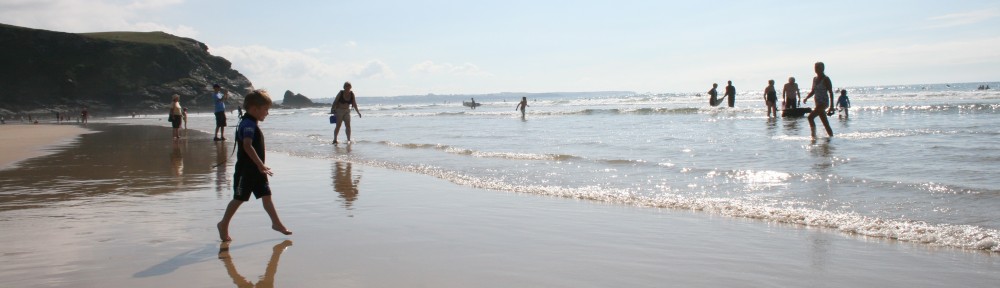
 Today’s Guardian carries a readers’ guide to the best beaches in Britain.
Why, I wondered, was Dunraven not there?
It’s our favourite Welsh beach, just east of Ogmore and Porthcawl. It has overtaken childhood memories of the seaside at Barry Island, Beer and the two Seatons, in Cornwall and Devon. Even on the hottest summer days, Dunraven can swallow the crowds.
Please don’t tell anyone!
 Ertblog