
When British mortgage rates hit 15.4 percent

John Major – the man who prompted my announcement

Mortgage rates doubling. Home owners in despair. Thousands of homes being repossessed.

Sounds familiar? This was Britain in 1990. I was running Nationwide Building Society’s press office and had the job of announcing that February that mortgage rates were going up to 15.4 percent. Just two years earlier the home loan rate was just over 8 percent.

The 1980s were a golden time for home ownership in Britain. Prime minister Margaret Thatcher championed a home-owning democracy, and the proportion of people owning their own home rose from 56 percent in 1980 to 67 percent in 1990. (Source: Statista.) But the housing boom crashed after Thatcher and her chancellor Nigel Lawson allowed the economy to overheat, and interest rates almost doubled in just over 18 months, culminating in that eye-watering 15.4 percent mortgage rate.

As spokesman for Britain’s third largest mortgage lender, I was busy explaining the impact on borrowers (and savers). Fixed rate mortgages were in their infancy in the UK, with the first launched in 1989, and I can’t remember Nationwide offering one back then. Many borrowers were on annual review mortgage schemes, which fixed the monthly payment but not the interest rate for 12 months. If interest rates soared, the borrower had to pay back the extra money owed later.

Continue reading
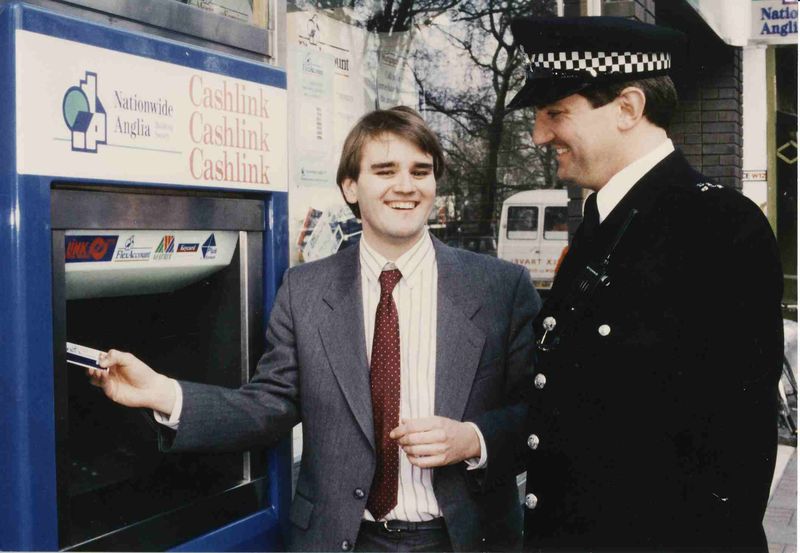
The day my bank card appeared in ITV’s The Bill

PC Stamp The Bill Nationwide 1989

The news that ITV was scrapping The Bill, its long-running police drama, brought back happy memories of my encounters with one of British television's best loved shows. 

Back in April 1989, I arranged for Thames Television to film part of an episode at Nationwide Building Society's Shepherd's Bush branch in London. The scene featured PC Stamp, played by Graham Cole, who was trying to take money out of his account. The hapless Stamp had his cash card swallowed by the ATM as he'd forgotten his PIN. The card was mine – and I arranged for Nationwide's branch staff to fish it out of the back of the ATM at the end of each 'take'. 

Rob Skinner PS Stamp The Bill

I enjoyed working with the programme, and remember Thames changing the script after I explained the planned sequence wouldn't happen in real life. The following year, The Bill filmed at another Nationwide branch, but disguised it as the storyline wasn't one I wanted the society associated with. 

The Bill became famous for featuring the working lives of the characters rather than their lives outside the station, setting it apart from other British police dramas. It had a string of memorable characters, including PC Stamp, Sergeants June Ackland and Bob Cryer and DCI Burnside. In some cases life imitated art, and millions of viewers were shocked after the actor Kevin Lloyd, who played the troubled Tosh Lines, died tragically following a drinking binge just days after being fired from the series.

In time, The Bill became a more sensationalist drama, and lost something special as a result, as former Met Police commissioner Ian Blair described in a valedictory Guardian article last week. I wasn't surprised to hear about a Facebook campaign to save the show, but can't help thinking the very idea of a preservation society for a TV drama is ludicrous. TV should be constantly refreshed – and The Bill has had its day after over a quarter of a century. As Ian Blair put it, quoting the original British TV policeman Dixon of Dock Green, "Goodnight, All!"