The Life of LTC Rolt: a fine biography of a preservation pioneer
I was thrilled to discover that Victoria Owens had written a biography of one of my heroes, LTC Rolt. Tom Rolt helped save Britain’s canal network from oblivion 75 years ago. He also pioneered the preservation of historic railways such as the Talyllyn – the world’s first railway to be run by volunteers. Rolt also wrote many books, including biographies of Brunel, Telford and George and Robert Stephenson.
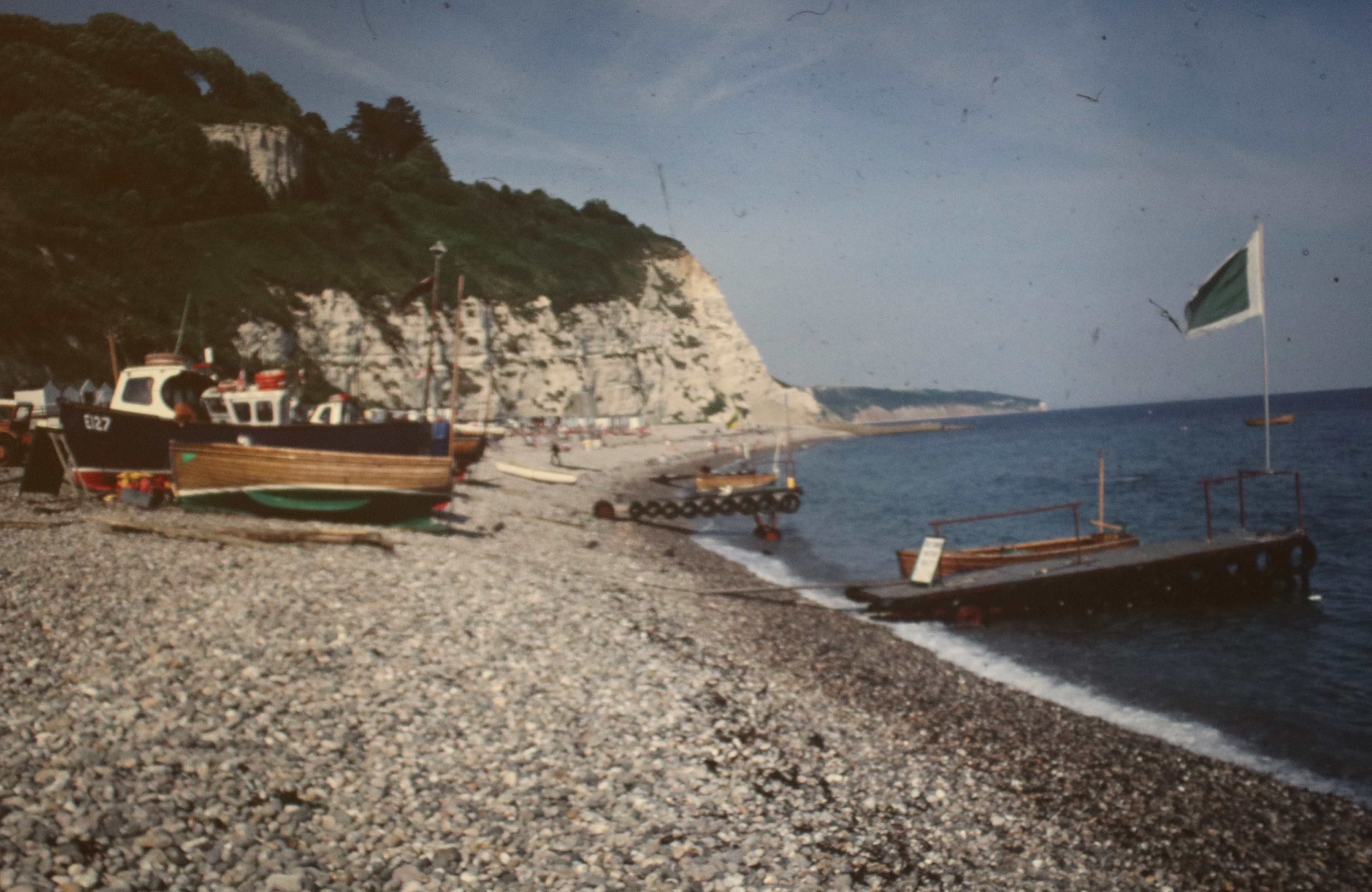
The beach at Beer
I have admired Rolt since I bought his book about railway disasters, Red for Danger, on a summer’s evening in Lyme Regis in 1979. Aged 15, I was on holiday with my parents. Like many teenagers I was baffled by the tensions that seemed to flare out of nowhere, with my father in particular, and Rolt’s book proved a soothing balm to my troubles. The next day, I lost myself in his brilliant storytelling as I relaxed in a deckchair on the pebbly beach at Beer, Devon. (I remember the lovely beach cafe, which served tea in china mugs.)
One tale from Red for Danger had me hooked. In June 1851, a train on the Brighton line was derailed when it hit a sleeper lying across the track, killing five people. Who had moved the sleeper onto the line? Suspicion fell upon a ten year old called Jimmy Boakes who lived next to the line. He was interrogated by a railway policeman, William Acton, who was unable to pin the blame on Boakes. Yet a year to the day after the accident little Jimmy was struck and killed by lightning on the very same spot. Rolt comments with relish that the locals would surely have concluded that this was divine proof and retribution.
LTC Rolt steering Cressy at Hawkesbury Stop, 1950
Over the decades that followed, I have read (and reread) most of his other books, including an intriguing three-volume autobiography: Landscape with Machines, Landscape with Canals and Landscape with Figures. Rolt’s vivid description of the turbulent background to his honeymoon with Angela provides a dramatic start to Landscape with Canals:
‘August is not the best month to choose for a honeymoon, especially as the year was 1939. Summer suddenly seemed to become overblown … The atmosphere was stagnant and oppressive; days had a sullen, brooding quality and the breathless nights, lit only by the flicker of summer lightning, brought no relief … we longed for something that would break an almost unbearable tension. Small wonder that it should be a season when … great disasters happen and wars break out.
‘We were approaching Middlewich when we heard on our radio the solemn voice of Neville Chamberlain announce that Britain had declared war on Germany … All our hopes and carefully laid plans [a design for life aboard their narrow boat Cressy] seemed to lie in ruins. A great question mark hung over our future. Angela burst into tears.’
In the pages that follow, Tom explains how he and Angela confounded those early fears, living on Cressy throughout the war. He supported the war effort with his engineering skills, briefly at Rolls Royce in Crewe, where he revealed his naive dismay that desperately needed Spitfire and Hurricane engines were mass produced rather than lovingly created by craftsmen. Tom shares glimpses of a dying world: within an hour of witnessing D-Day invasion craft being built in Shopshire, he came across a working ‘ginny-pit’ near Coalbrookdale – a horse, plodding around in a circle, was turning a wooden barrel to wind up a basket of coal. He was astonished that such 17th century scenes had survived into the jet age.
One of the mysteries of Rolt’s autobiography is the fate of his marriage after some 11 years. He admits that his relationship with Angela had been deteriorating for some time, and speculates that her parents’ ‘extraordinary, implacable hostility’ towards their marriage placed an intolerable burden on his wife. But he then pulls up the shutters, explaining that some things should be ‘nosed out’ by a biographer rather than shared by him. After they split up, he didn’t see Angela for another 20 years.
Victoria Owens fills in a few gaps in her fine biography. She points out that Tom and Angela were already often going their own ways in the year before they separated. She also questions whether Angela’s mother was quite as hostile as Rolt had made out, given that Mrs Orred helped her daughter choose curtains for Cressy just before the wedding, and the women continued to see each other afterwards. Owens wonders whether Tom and Angela’s relationship was affected by their not having children together, before conceding she could not solve the mystery. This was a desperately unhappy time in Tom Rolt’s life, as the failure of his marriage coincided with his beloved Cressy being condemned as riddled with rot, while his crusade to save the canals had ended in his being thrown out of the Inland Waterways Association after he failed to persuade members that the IWA should focus on canals that remained in commercial use.
Reading Tom’s autobiography, I assumed that Angela faded out of the Rolt family story. But, intriguingly, Owens reveals this wasn’t the case, explaining that Angela regularly wrote to Rolt’s second wife, Sonia. When Tom died in 1974, she wrote a distraught note to Sonia expressing how upset she was, adding ‘all my sympathy goes to you’. Two years later, Angela wrote to her mocking the timidity of the publishers of Landscape with Canals, who were afraid that Tom’s account of the disputes within the IWA 25 years earlier could prompt a libel claim from Robert Aickman, the chairman who ejected Rolt from membership. (Just before he died, Tom was heard saying Aickman was ‘the most evil man’ he had ever known.) Angela ‘adored’ it when Tom and Sonia’s sons Richard and Tim visited her home in France. (She told Sonia she was glad the boys were ‘in good fettle’.)
Sonia at work at Warwick on the Grand Union Canal, 1950
Tom first met Sonia at the 1945 premier of the film Painted Boats about the canals, which Rolt helped make. She was about to marry a working boatman, George Smith, who appeared as an extra in the film. Rolt, who often comes across as conservative, remembered thinking her ‘rather frightening left-wing blue stocking’ with a copy of the New Statesman under her arm. But in 1949 he accompanied Sonia to a meeting with the Transport & General Workers Union to press the T&GWU to look after boaters’ interests. Owens points out that Tom declared it an encouraging meeting at the time, but he later changed his tune, describing it in Landscape with Figures as a ‘frustrating interview’ with a union official who ‘just didn’t want to know about the [boaters’} problems’. In fairness, Tom’s later writing often has a waspish tone, perhaps reflecting his failing health and dismay at the turmoil of the 1970s. Whatever the truth, Tom and Sonia were drawing closer, and would begin their life together on a holiday together in the lovely Kerry hills on the Wales-England border two years later.
The Talyllyn Railway, 1999
Victoria Owens reveals in a footnote that Tom only married Sonia in 1969, although she changed her surname to Rolt by deed poll in 1952. The name change followed objections from members of the Talyllyn Railway Preservation Society about the couple ‘living in sin’ while working on the railway that year. (Significantly, the Talyllyn’s chapel-going former general manager Edward Thomas said the private lives of the volunteers were ‘nothing whatever to do with the railway company’.)
Wales played a significant part in Tom Rolt’s life. He is famous for helping to save the Talyllyn Railway, which he had first come across during the wartime summer of 1943. (He and Angela planned to take the train back to Abergynolwyn, but a stark ‘No Train Today’ notice resigned them to a lonely walk along the deserted track.) His great dream during the Cressy years was to cross Thomas Telford’s great aqueduct at Pontcysyllte on it, which he finally achieved in 1949, despite the terrible state of the waterways leading into that corner of Wales. He and Angela were joined by the Welsh actor Hugh Griffith and his wife Gunde.
Improbably, Griffith persuaded Tom to join Plaid Cymru, the Welsh nationalist party. Yet despite his love of Wales, Rolt retained to the end the common habit of Englishmen of his generation of talking of England when he meant Britain, for example referring to the ‘English summer’ in his account of his stay at Pont Cysyllte.
LTC Rolt wrote the last volume of his autobiography, Landscape with Figures, in the final year of his life. I remember being very moved when I first read his confession that his ‘expectation of life may be measured in months rather than years’. He wrote those poignant words in February 1974, just three months before he died. The book wasn’t published until 1992, and Sonia explained in her introduction that the family decided, ‘after an initial flutter of indecision, to let time go by’ while they settled down to this ‘most personal of testaments’.
Landscape with Figures is a sad book in other ways. In the chapter The Fight for Stanley Pontlarge he laments the loss of the traditional landscape around his village in Gloucestershire, including the decline of hedgerows, the building of new houses on old orchards and the closure of the GWR’s Cheltenham to Honeybourne mainline. (Now brought back to life as the heritage Gloucestershire Warwickshire Railway.) But the most distressing paragraphs recount his fight with a man who started a factory farm next to the Rolts’ house, with battery chickens imprisoned in cages that were floodlit 24 hours a day. Tom Rolt was ahead of his time, and would have sympathised with campaigners against pollution of the River Wye allegedly caused by industrial chicken farming. He’d have been equally appalled that Britain has lost half its hedgerows since 1950.
As an author, Victoria Owens comments wryly on Rolt’s pride at being able to support his family, privately educate his sons, assist his impoverished mother, and maintain an ancient house on his literary earnings. As she points out, it would be impossible to do so on the average writer’s income in the 21st century. He made his name with the unexpected bestselling success of Narrow Boat, published in 1944. Owens describes it as an often angry book, reflecting Tom’s mood of the time. She says that ‘In Narrow Boat, the melancholy gives way to open wrath’ as he mocks the ‘new generation of “countrymen” with unconcealed scorn’. Yet the book remains in print 82 years later, showing that Rolt was not alone in being drawn to a landscape with canals and railways.
In her preface, Owens concedes that that her book does not spring any major surprises concerning Tom’s life story. But his many fans will find it an enjoyable, largely sympathetic read, and will welcome the additional light she provides on the most important relationships in Rolt’s remarkable life. We will never see his like again.
The Life of LTC Rolt: Where Engineering Met Literature by Victoria Owens, published by Pen and Sword Books, is available in hardback and ebook editions. A paperback edition will follow on 30 October 2016
Postscript: a canal odyssey
Breakfast, River Soar, 1988
I enjoyed three summer holidays on the canals of the Midlands in 1988, 1989 and 1990. I didn’t realise at the time how those trips would have been impossible had Tom Rolt and others not launched their campaign to save the canals 40 years earlier.
I went to university in Leicester, and lived for two years close to the canalised Soar through the city. Our first trip was inspired by a dream to travel along that waterway by canal boat. I found the experience fascinating and relaxing: life takes on a new perspective at walking pace on a boat. The following year we navigated the Trent and Mersey from Shardlow to Stone, and I still remember the pleasure of finding the Wolseley Arms pub in a sylvan setting just a couple of miles after industrial Rugeley. Our last adventure was across (and under) the Pennines on the Leeds and Liverpool from Silsden to just west of Blackburn. Like Rolt, we found traversing Foulridge tunnel an eerie experience.
Richard watches a West Coast Main Line express passing the Trent and Mersey Canal, Little Haywood, 1989




Leave a Reply