Note: most of the images illustrating this post are photos of projections of the 35mm slides that I took during the tour. Their quality is variable, to put it kindly...

Time flies. It hardly seems like 30 years since I set off on my first proper cycle tour. In recent years, I’ve cycled the length of Great Britain, Ireland and Portugal, and am embarking on another end to end, across France, later this month. But it started with a 325 mile tour of the West Country in June 1990, with my university friend Richard Attewell.
Looking back, I’m struck by how different cycle touring was 30 years ago, just as the internet was poised to change our lives. (There was much talk of the ‘information superhighway’ in 1995, but I didn’t get online until the following year.) We didn’t own or carry mobile phones, and used phone boxes to arrange somewhere to stay once we decided how far we’d get. We navigated using paper Ordnance Survey maps attached to my handlebars using a brilliant map holder designed and sold by Chris Juden from the CTC (now known as Cycling UK). We weren’t complete touring novices: we’d enjoyed a weekend ride around the Isle of Wight two years earlier, and I’d cycled from Wiltshire to my parents’ house in Cardiff the year before.
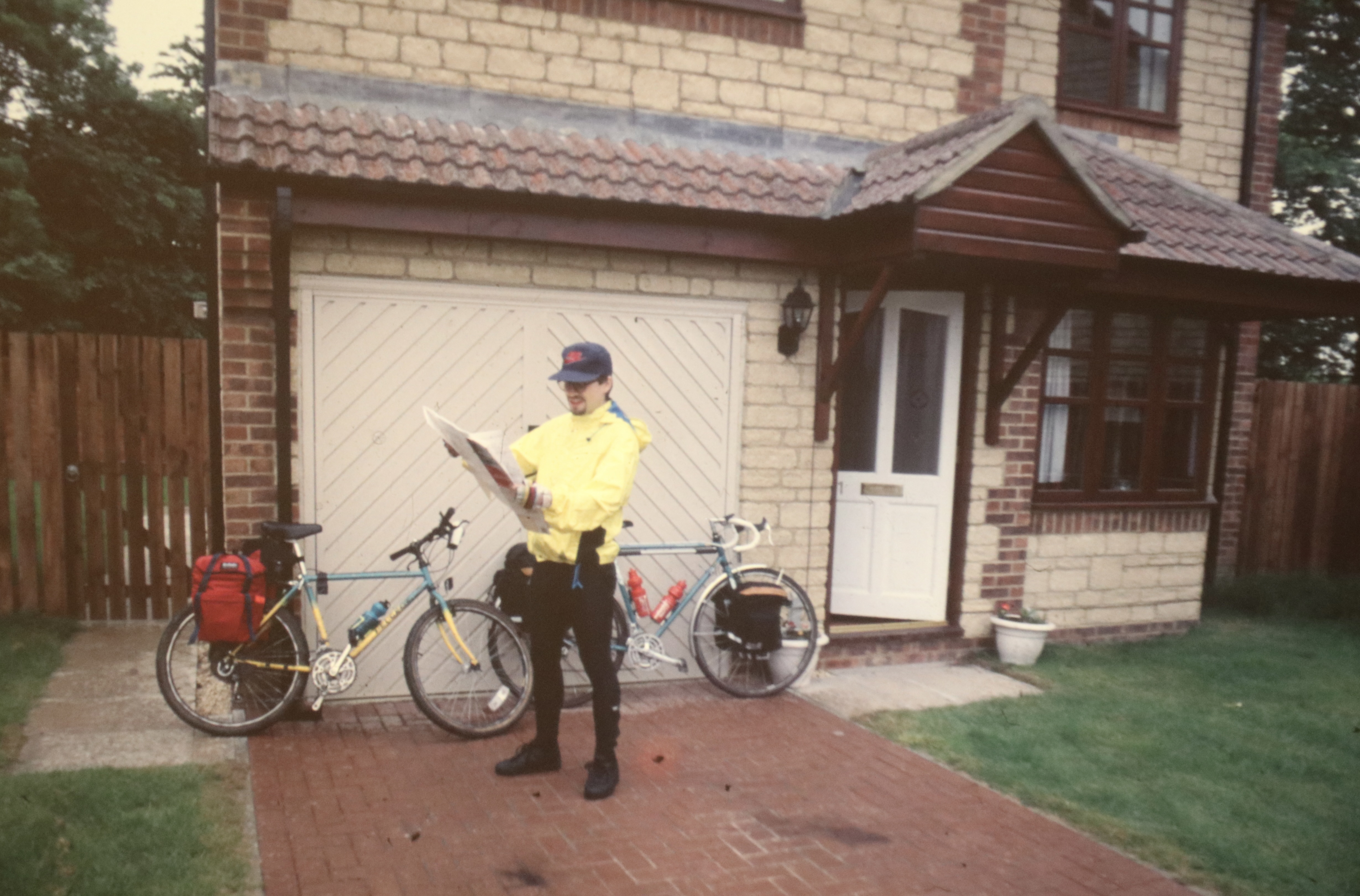

I plotted that adventure during the bleak winter evenings of January 1995, with those Ordnance Survey maps spread across the floor of my home in Ashton Keynes, Wiltshire, which was our departure point in June, as seen above.

Day 1: Ashton Keynes to Bath
Our first day on the road was a wet one, which wasn’t the best introduction to the joys of cycle touring. I remember stopping for lunch at a pub in Wiltshire, which was holding a pétanque competition in the pouring rain. We were glad to get to our destination, Bath, to dry off, before heading for dinner with a friend.
Day 2: Bath to Glastonbury
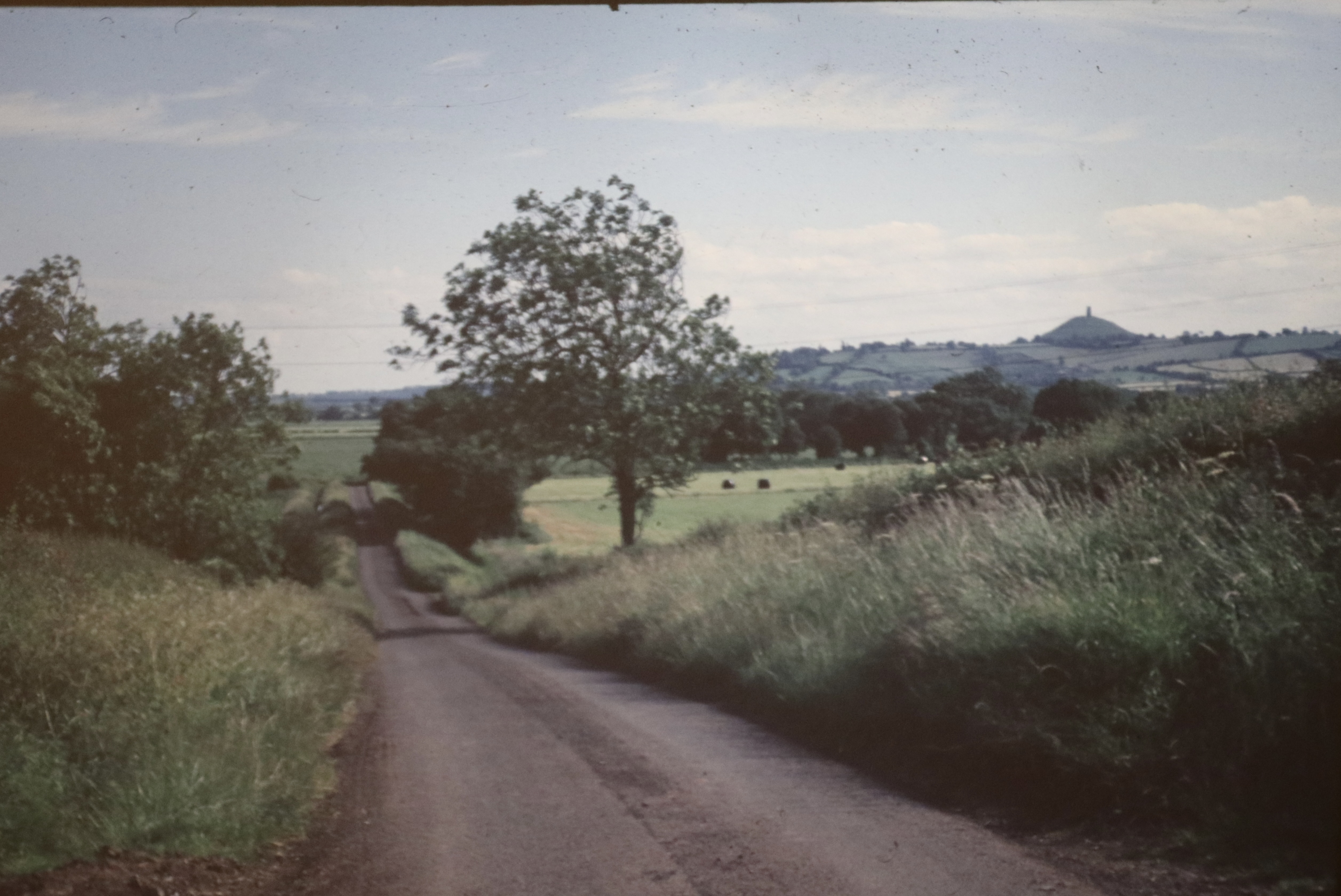
We were relieved to wake to blue skies the following day, and typically I got sunburnt. (We weren’t so trained to use sunscreen in the 20th century…) We had a stiff climb out of Bath, followed, after an enjoyable pub lunch at Paulton, by the ascent of the Mendip hills. It was a struggle at times, with my wonderful Dawes Super Galaxy bike loaded with four panniers. But we enjoyed the subsequent swoop down to Wells, and a breather to visit the tourist office to book our accommodation near Glastonbury. (You can see Glastonbury Tor in the photo above.) We relied heavily on tourist offices to arrange a bed for the night, in those pre-internet days. (The service was called BABA: book a bed ahead.)
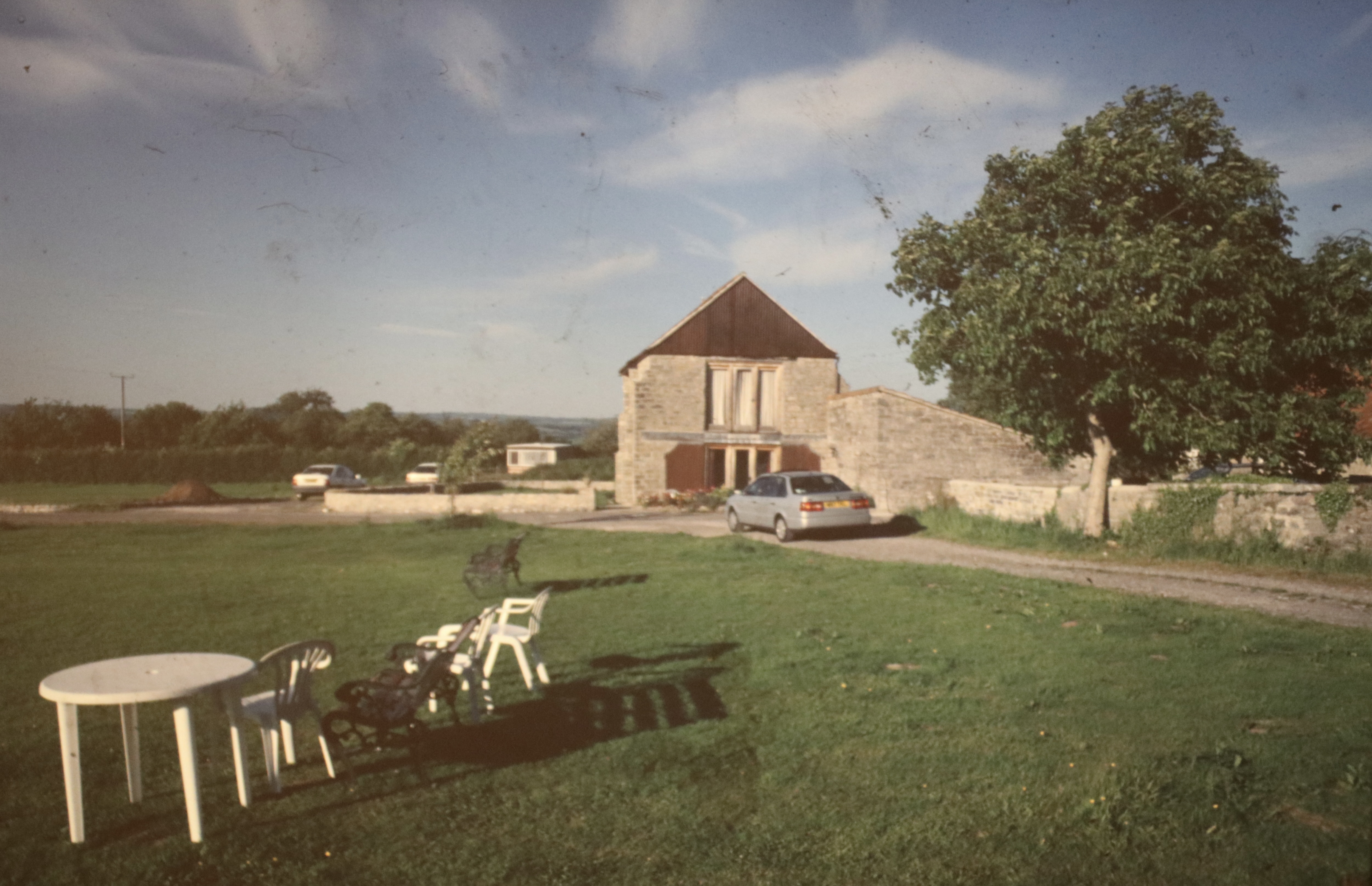
After relaxing after a tough day’s riding, we asked the owner of the campsite and B&B if there were any decent pubs for dinner nearby. His recommendation sounded like a good one, and we set off on foot for The Lion at West Pennard. He intercepted us, saying it was too far to walk, doubling his earlier estimation of the distance. Very reluctantly, we got back on our bikes for the seven mile round trip to an excellent dinner. It would have been a long walk.
Day 3: Glastonbury to Bishops Lydeard


We set off the next morning across the Somerset Levels, seen above, a magical wetland landscape covering some 650 square kilometres. The levels aren’t completely flat, but it was easier cycling than across the Mendips the day before. We reached Bridgwater at lunchtime, and found a bike shop for some emergency part for, if I remember rightly, Richard’s bike. On the final leg of the day, from Bridgwater to Bishops Lydeard, we rediscovered the hills, and were pleased to reach our destination in the village on the West Somerset steam railway. This line to Minehead was a late casualty of the Beeching axe, closing in 1971, before being revived as a heritage railway.
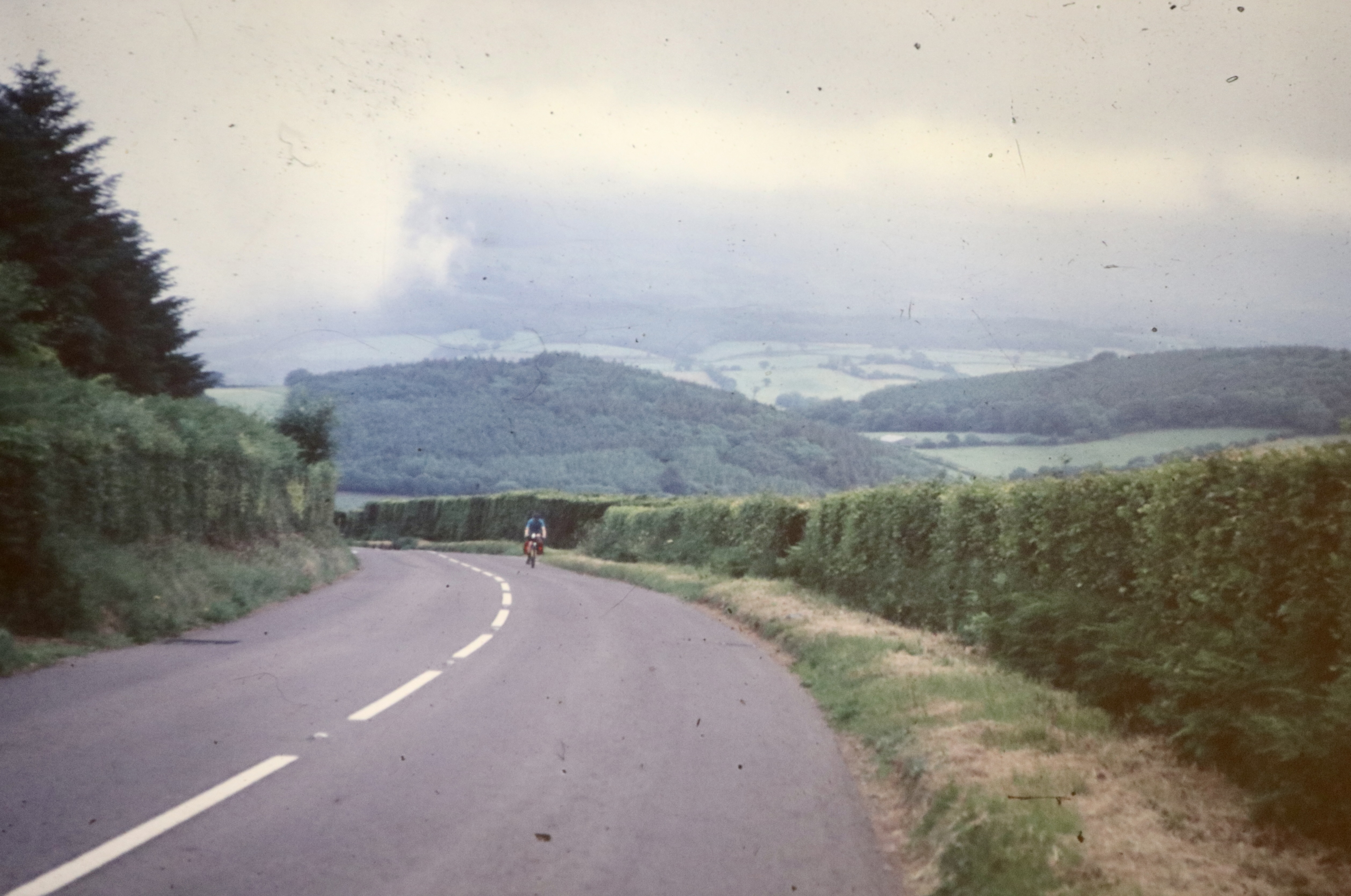
Day 4: Bishops Lydeard to Wheddon Cross
The blue skies had deserted us again as we headed across Exmoor on day four. The landscape changed as the pastoral countryside of earlier days gave way to the starker, more remote region of the Exmoor National Park. When I planned the route, I deliberately avoided the bigger climbs around Simonsbath and Exford, heading south along the Exe valley instead. It proved a good move.


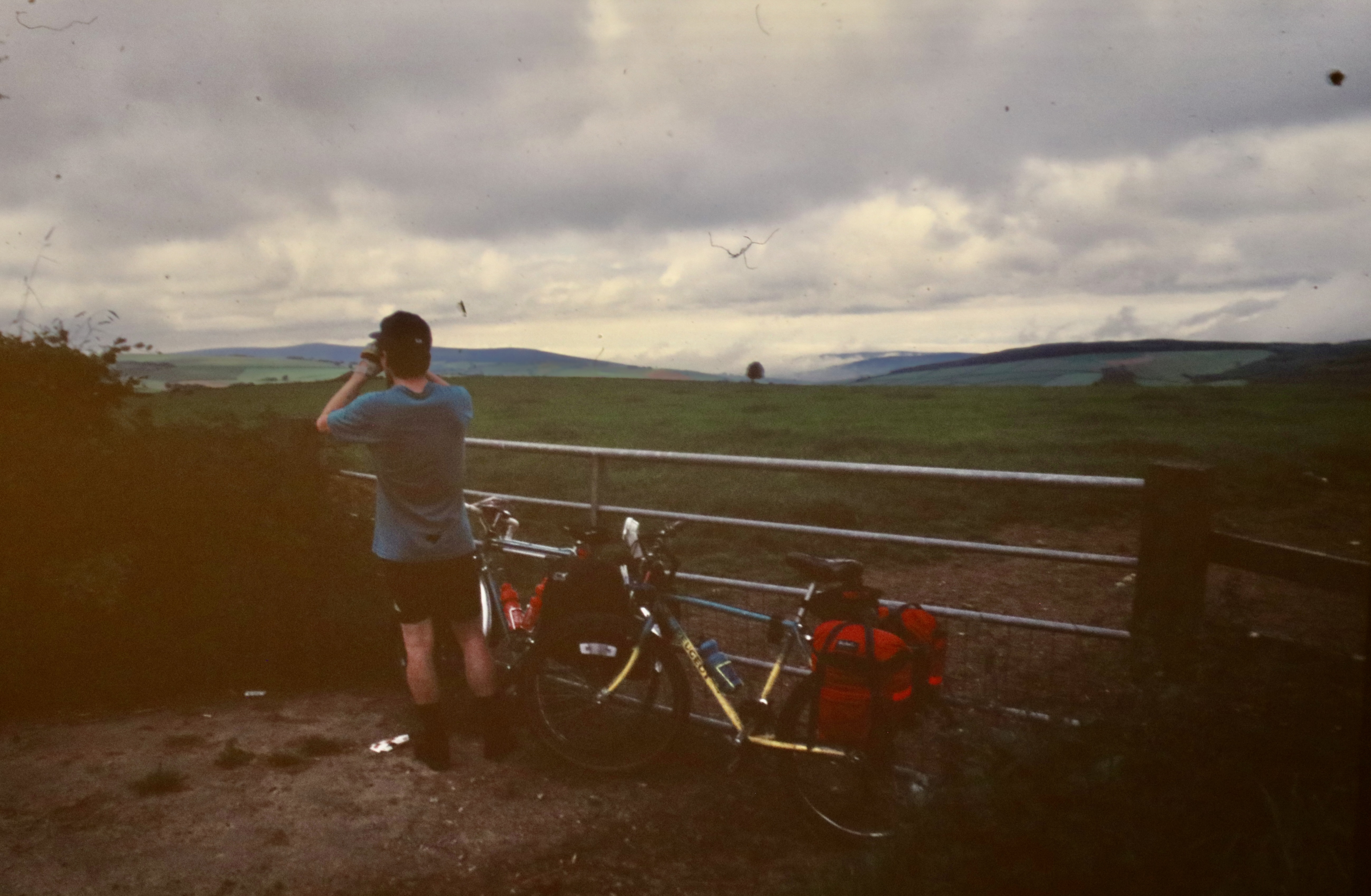
Above: 30 years on, this lone tree reminds me of the lost tree at Sycamore Gap on Hadrian’s Wall.
On this trip, we were mostly staying in modest bed and breakfasts, but for tonight we had booked to stay at the Raleigh Manor Hotel just outside Wheddon Cross. We enjoyed that touch of luxury after four days’ cycling.
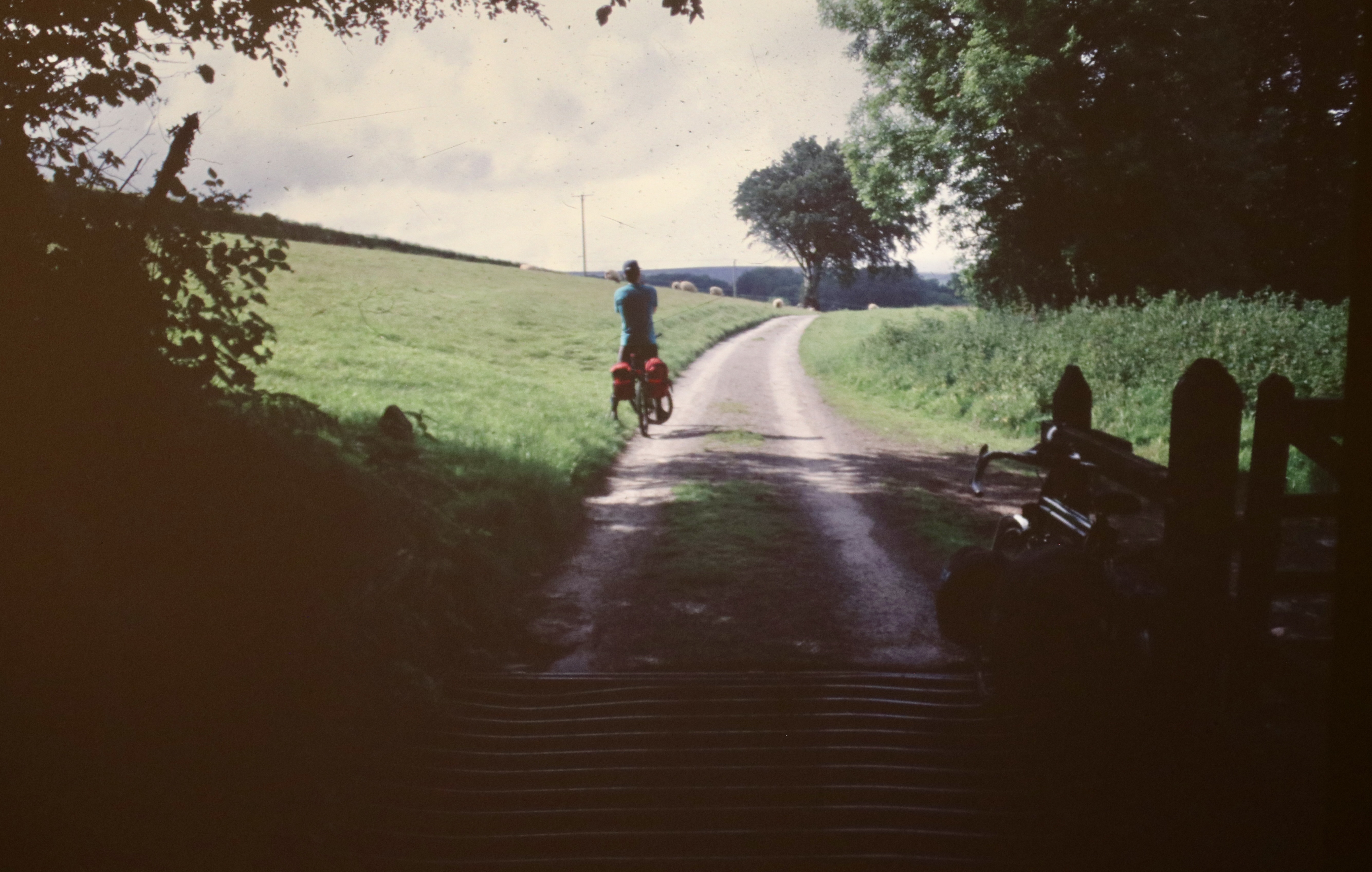
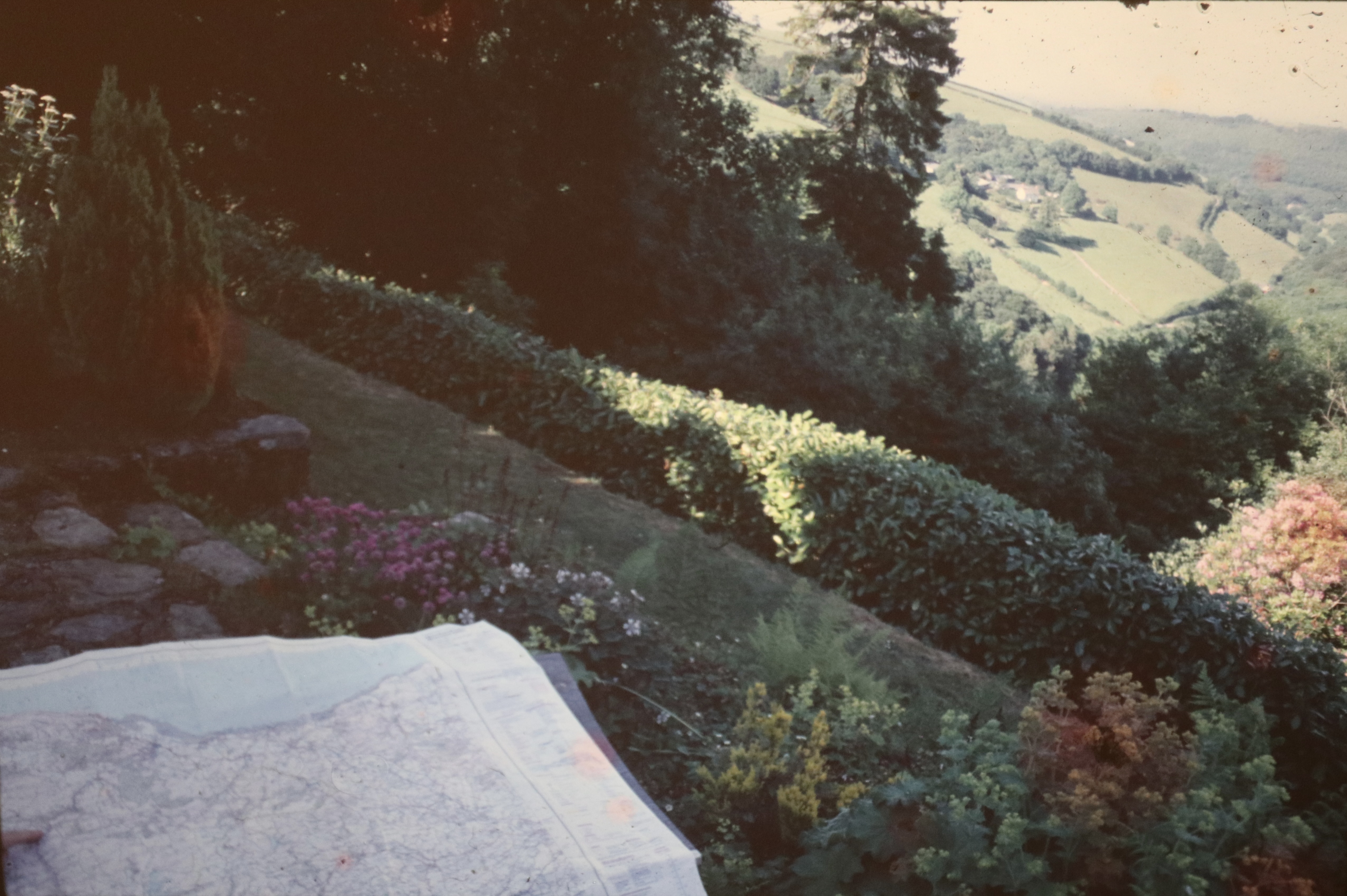
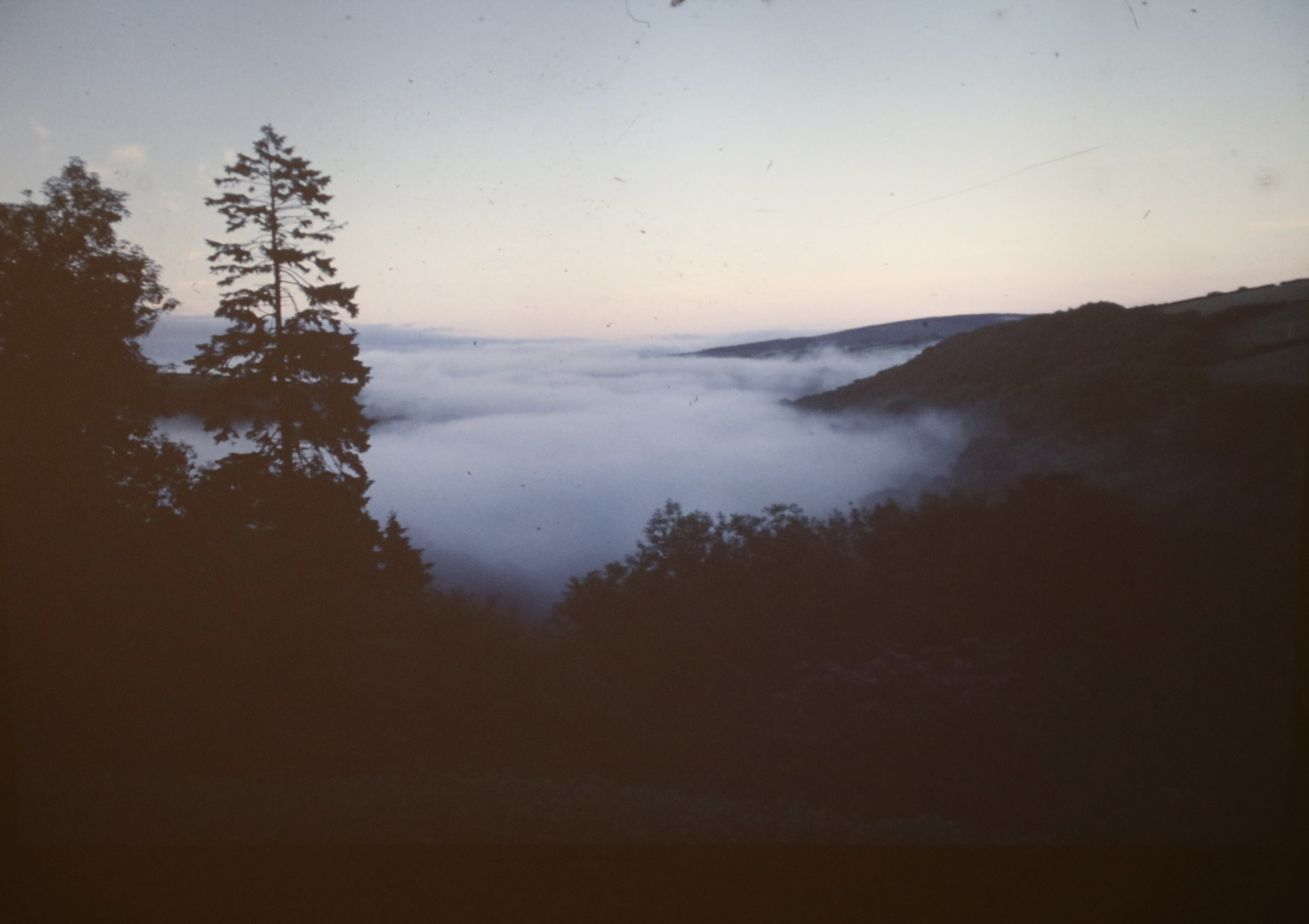
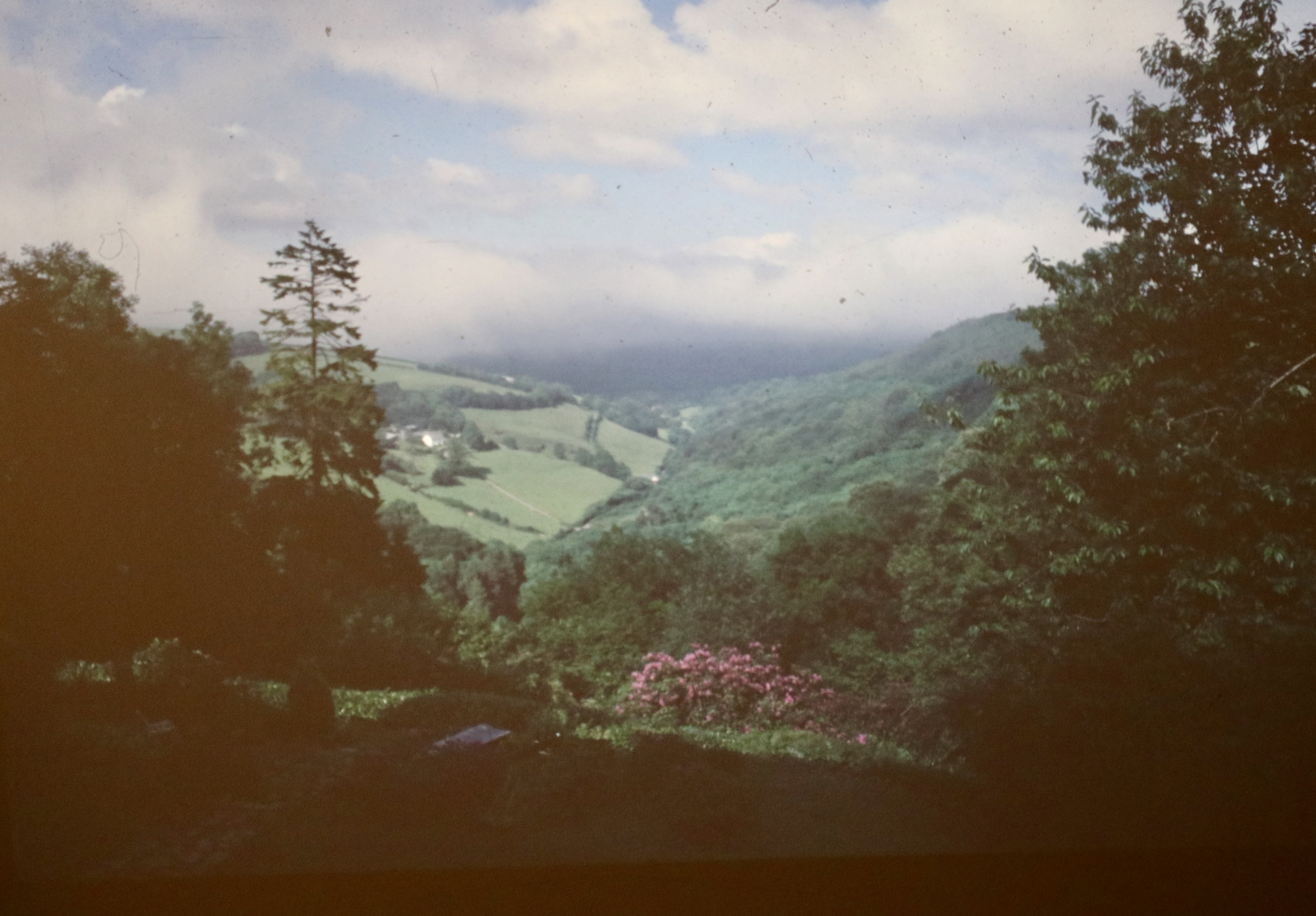
Above: on the drive leading to Raleigh Manor Hotel; the view from the hotel looking towards the Bristol Channel
You can see from the photos how the mist gave way to evening sunshine, which bathed the lovely hotel gardens in a golden glow. Sadly, it looks as if the hotel has closed down since our restorative stay in 1995.
Day 5: Wheddon Cross to Ottery St Mary


After the treat of our night at Wheddon Cross, I had a few butterflies about the next morning’s leg. After so much climbing, I assumed that the stage across the West County peninsula to the English Channel would be hilly. Instead, we had the joy of freewheeling mile after mile down the Exe valley towards Tiverton. (I really should have deduced this from the Ordnance Survey map…) At the time, this was my best ever day’s cycling. The A396 was not busy, and we stopped to take photos along the way, including the bridge at Oakfordbridge, above. It was a pleasure, also, to see the traditional fingerpost signs – perfect for cyclists, if not for nighttime car drivers.
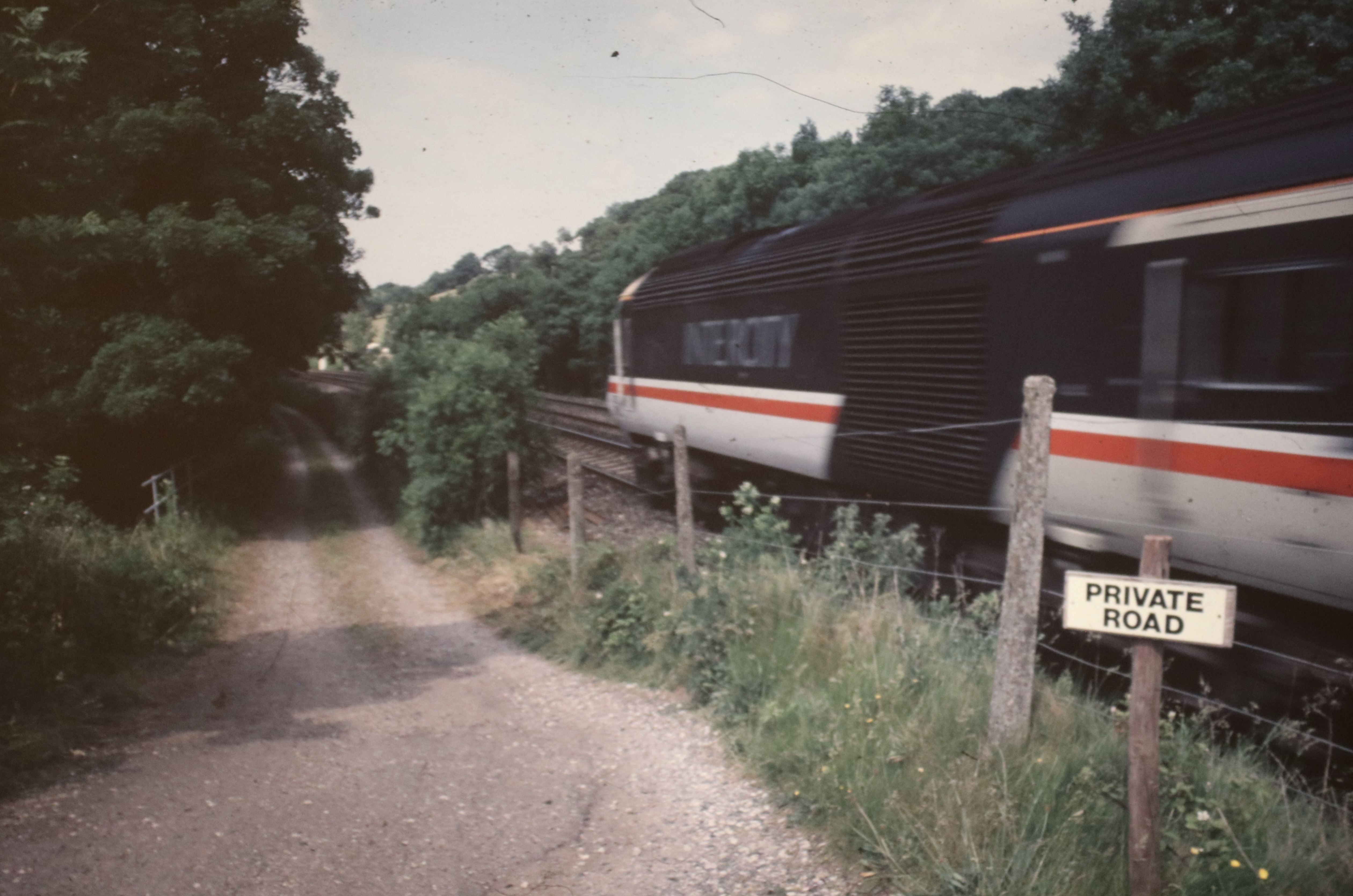
Tiverton marked the end of freewheeling heaven, but I enjoyed the section past Willand with high speed trains racing past us on their way to Exeter, Plymouth and the far west. The InterCity ‘swallow’ livery on this InterCity125 is a reminder that 1995 was the last year in the life of the nationalised railway network, British Rail. A light railway once ran from Willand (the old Tiverton Junction) up the Culm Valley to Hemyock. It had the distinction of using the very last gas lit railway carriages in Britain, withdrawn in 1962 just before the line closed to passengers in 1963. (The railway survived for another 12 years to carry milk from Hemyock.)
We were now back in delightful open countryside. For reasons that are lost in the mists of time, my mind was playing on repeat the song Many Men from The Longest Day, the epic 1962 film about D-Day. But perhaps the battle theme was appropriate: as we approached our night’s destination, Ottery St Mary, we negotiated roadworks where a section of the A30 road to the West of England was being turned into a dual carriageway. We had passed the site of the Battle of Fairmile, where the activist Swampy (Daniel Hooper) would soon become famous for a pioneering protest tunnel against the project. Today, holidaymakers drive past the scene at 70mph oblivious to this 1990s drama, before joining endless queues on the many miles of the route that haven’t been turned into a dual carriageway.
Ottery St Mary was a disappointment: a market town that had seen better days. We had dinner in a miserable pub, and stayed in a nondescript B&B.
Day 6: Ottery St Mary to Beer
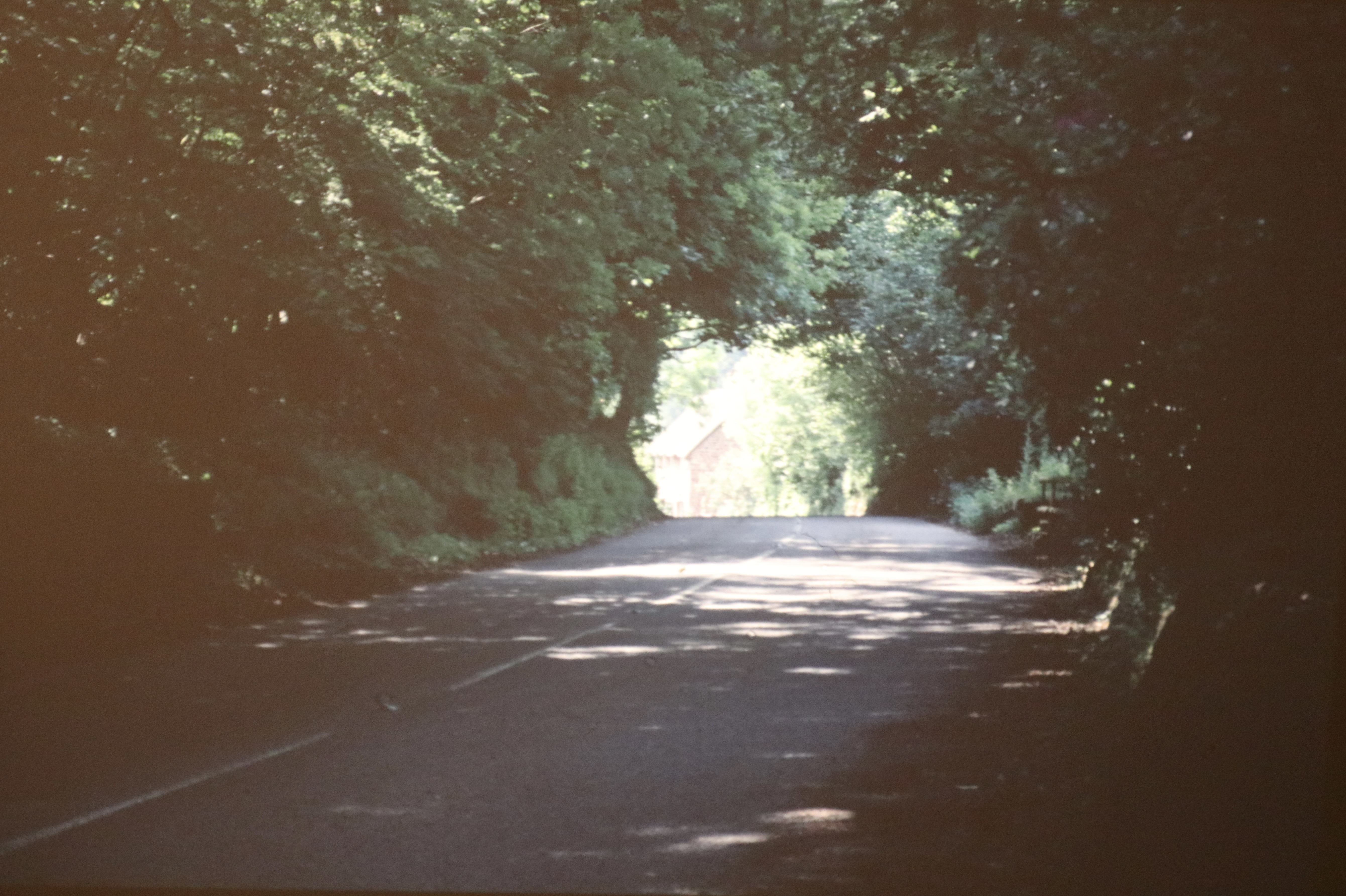

The following day was a milestone, as we reached the English Channel after our epic ride through the West Country. But we had to overcome the Devon hills first. These were the steepest climbs of the tour: I seem to remember at least one that was 1 in 4 (25 percent). I had a slight advantage over Richard with a lighter touring bike compared with his mountain bike, but we both struggled.
It was a proud moment when we wheeled our bikes onto the pebbly beach at Sidmouth. You may spot a clothes peg attached to the back of my bike, which I used to dry socks that I washed overnight at the various B&Bs. Curiously I find drying clothes on cycling tours just as challenging 30 years on, as I recounted in my blogposts about my Land’s End to John O’Groats adventure in 2019.
A political interlude
Sidmouth wasn’t our final destination for the day. We’d arranged to stay in the Dolphin Hotel in Beer, a seaside village further along the coast. (The only room we booked in advance, apart from Wheddon Cross.) This last leg was very hilly, but we reached Beer around 2pm, and enjoyed a late lunch in the hotel bar. Soon afterwards we heard the news that the prime minister, John Major, had resigned as leader of his party and challenged his rebellious Euro sceptic ministers to ‘put up or shut up’ in a leadership contest. Commentators explained that he would remain as PM for now, but would be ousted from Number 10 if he lost the resulting vote. There was much speculation that Michael Heseltine, who had brought down Margaret Thatcher almost five years earlier, might challenge Major. But Hezza remained loyal, and was rewarded by being made deputy prime minister when Major defeated John Redwood for the Tory crown.


Back to our tour… We spent a relaxing time on the beach, as I enjoyed happy memories of hours spent here on a family holiday in 1979.
Heading for home
Day 7: Beer to Charlton Adam
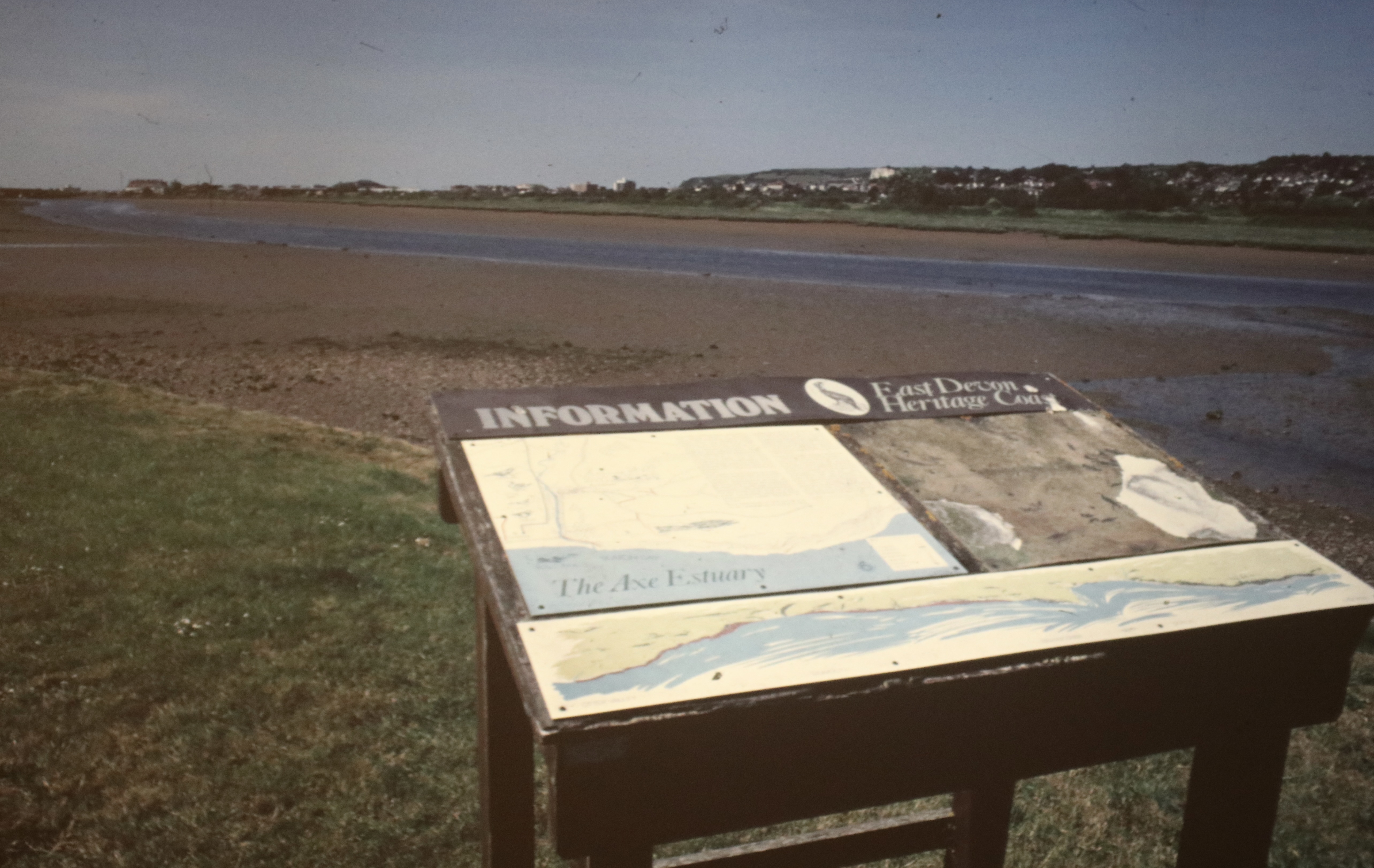
It was time to head for home. We started by cycling the short distance along the coast to Beer’s larger seaside neighbour, Seaton, passing the seafront hotel where I stayed with Mum and Dad in 1978 and 1979. I had another burst of nostalgia as we crossed the Axe and spotted the Ship Inn at Axmouth. We’d had a family walk there on a lovely evening in August 1979. The rest of the morning was not as enjoyable. After leaving Axminster we cycled for miles along a busy main road, which was very unpleasant. (I presume we decided to avoid hillier minor roads after the heavy climbs yesterday.) We did spot a sign for Crinkley Bottom, a short-lived theme park at Cricket St Thomas devoted to Mr Blobby, a character in the BBC Saturday evening show Noel’s House Party. The afternoon was more enjoyable as we rode through the flatlands to the east of the Somerset levels, past Muchelney Abbey and spotting intriguing place names such as Kingsbury Episcopi.
We phoned the local tourist office to book our room for the night in the Somerset village of Charlton Adam. The village was joined at the hip to its twin, Charlton Mackrell. That evening, we headed for the local Fox & Hounds pub, and I smiled when I heard on the jukebox a compilation album, Drive Time, which I’d bought just before the trip. I was waiting in anticipation for the last record, Jon & Vangelis’s I’ll Find My Way Home. This had been an earworm song over the past few days, along with the Longest Day theme song. But just as the preceding record faded, another song came onto the jukebox…
Day 8: Charlton Adam to (north of) Rode
A quest for a pub…

The penultimate day of our tour included a frustrating incident that would never happen in today’s online world. After making our way through Castle Cary and Bruton we were ready for lunch. I spotted the magic letters PH (for public house) on the Ordnance Survey map at Upton Noble, but when we reached that spot there was no trace of a pub, even though the map was a recent edition. We saw another PH marked on the map in the next village of Witham Friary, and raced as fast as possible with laden panniers over the three miles in the hope of getting lunch there before the pub closed for the afternoon.
We were relieved to make it on time. But it soon became clear that the Seymour Arms was not the sort of pub that served food – not even a ploughman’s lunch. Drinks were sold from a hatch in the hall rather than from a bar. Richard mournfully asked a question of a local that was purely rhetorical: ‘They don’t serve food here, do they?’ We settled for a pint and a couple of packets of crisps each, before continuing to Frome where we had a much needed, very late, lunch.
Looking back, I feel sorry that we reached such a harsh judgement about this historic pub. It was our fault that we’d relied on an OS map to choose our lunch stop. In different circumstances I’d have been fascinated to experience such a contrast to the classic English country pub. And it was an education to find that the picture postcard reputation of rural counties like Somerset masked stark deprivation. It is good to hear that the Seymour Arms is unchanged 30 years after our visit.
That night, we stayed at a rather strange place between Rode and Bradford On Avon. From memory, it was a room in a bungalow on a farm. The owner virtually interrogated us for 20 minutes when we settled in, and we decided later that he was trying to reassure himself that we wouldn’t trash the place or steal anything. We never saw him again.
Day 9: Rode to Ashton Keynes
The start of the summer’s heatwave


Our final day saw the start of the spectacular heatwave of 1995. We cycled over the canal at Bradford on Avon, and wished we’d stayed there overnight. Passing through Chippenham, we were amused to see a Downing Street – its Number 10 was much less prized than its London counterpart that John Major was fighting to retain. We enjoyed a proper pub lunch in the sunshine, making up for yesterday’s misery, and soon after, as we crossed the M4, we enjoyed the spectacular slight of the RAF’s Red Arrows racing through the sky above us. (You can see the resulting vapour trail in the photo above.)

At last, we reached my village of Ashton Keynes, and posed for photos on one of the many bridges over the infant Thames. Curiously my sister’s neighbouring village of Minety was misspelt on the fingerpost sign.
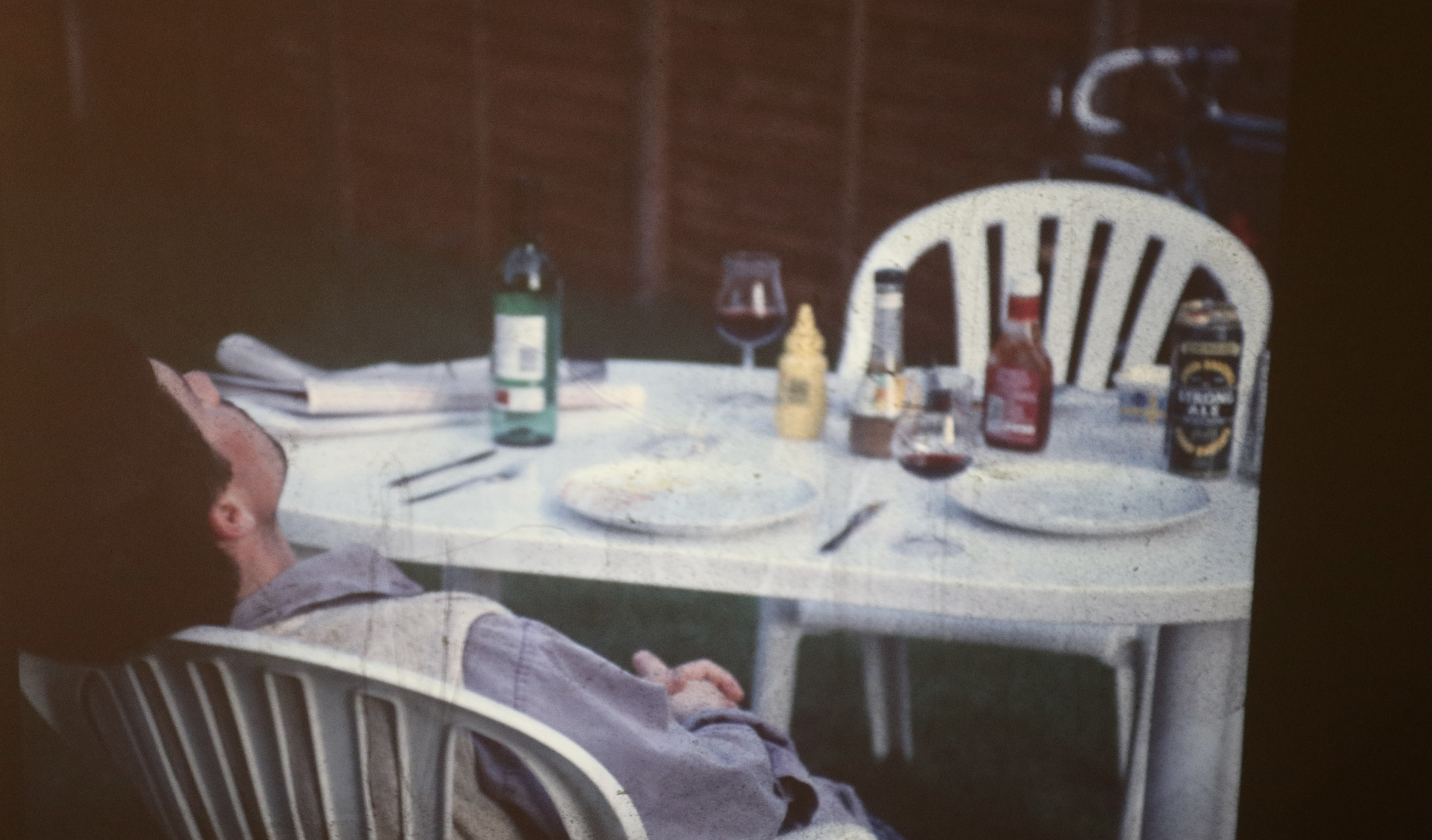
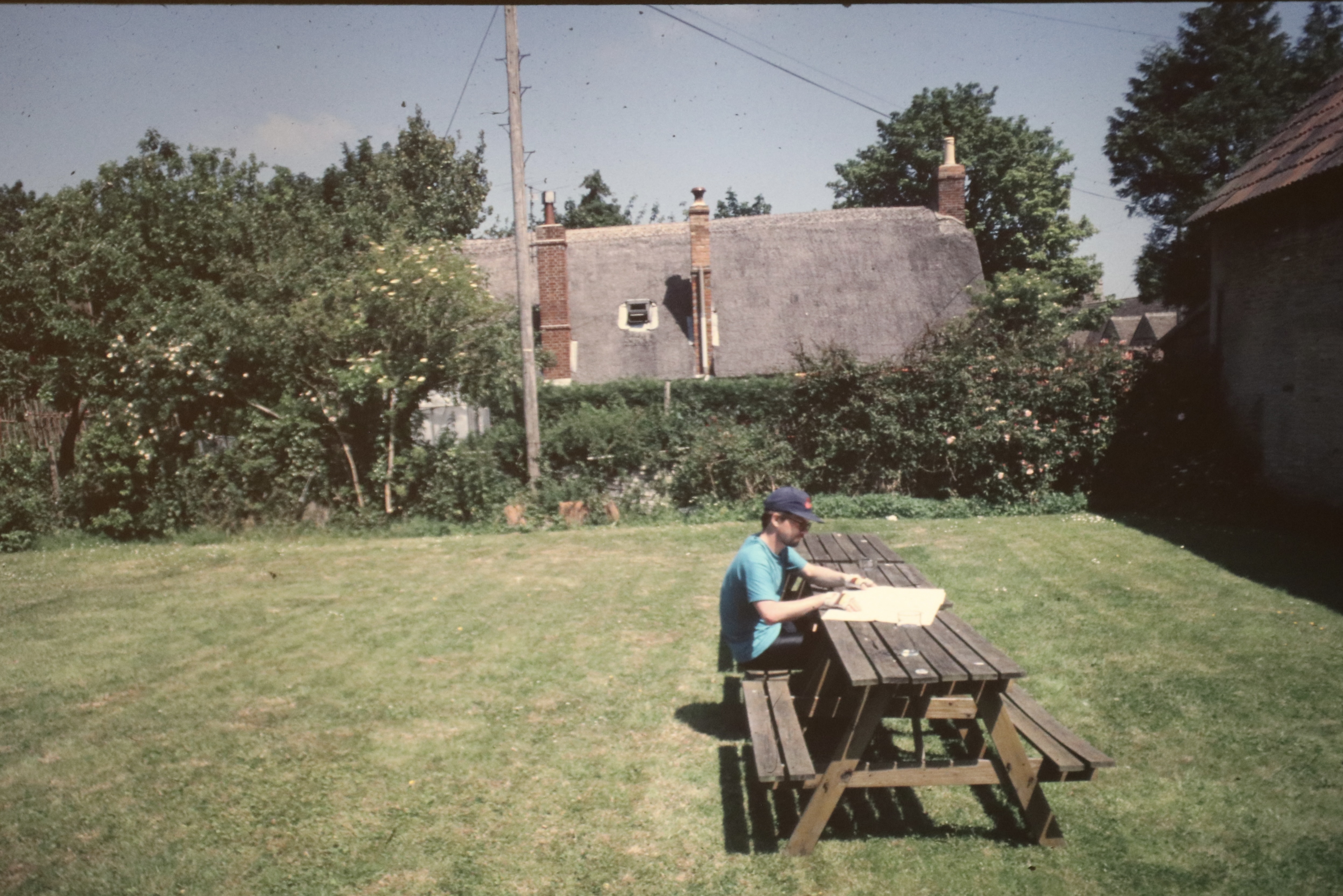
It was a pleasure to sit down for a few beers and a barbecue that evening. I was as tired as Richard, seen above, but I couldn’t find a photo of me snoozing! I finally got the chance to hear I’ll Find My Way Home, which seemed appropriate given we’d just completed a complicated 325 mile route the old-style way (no Garmin cycling satnav in 1995) with just one navigational mistake.
Reflections
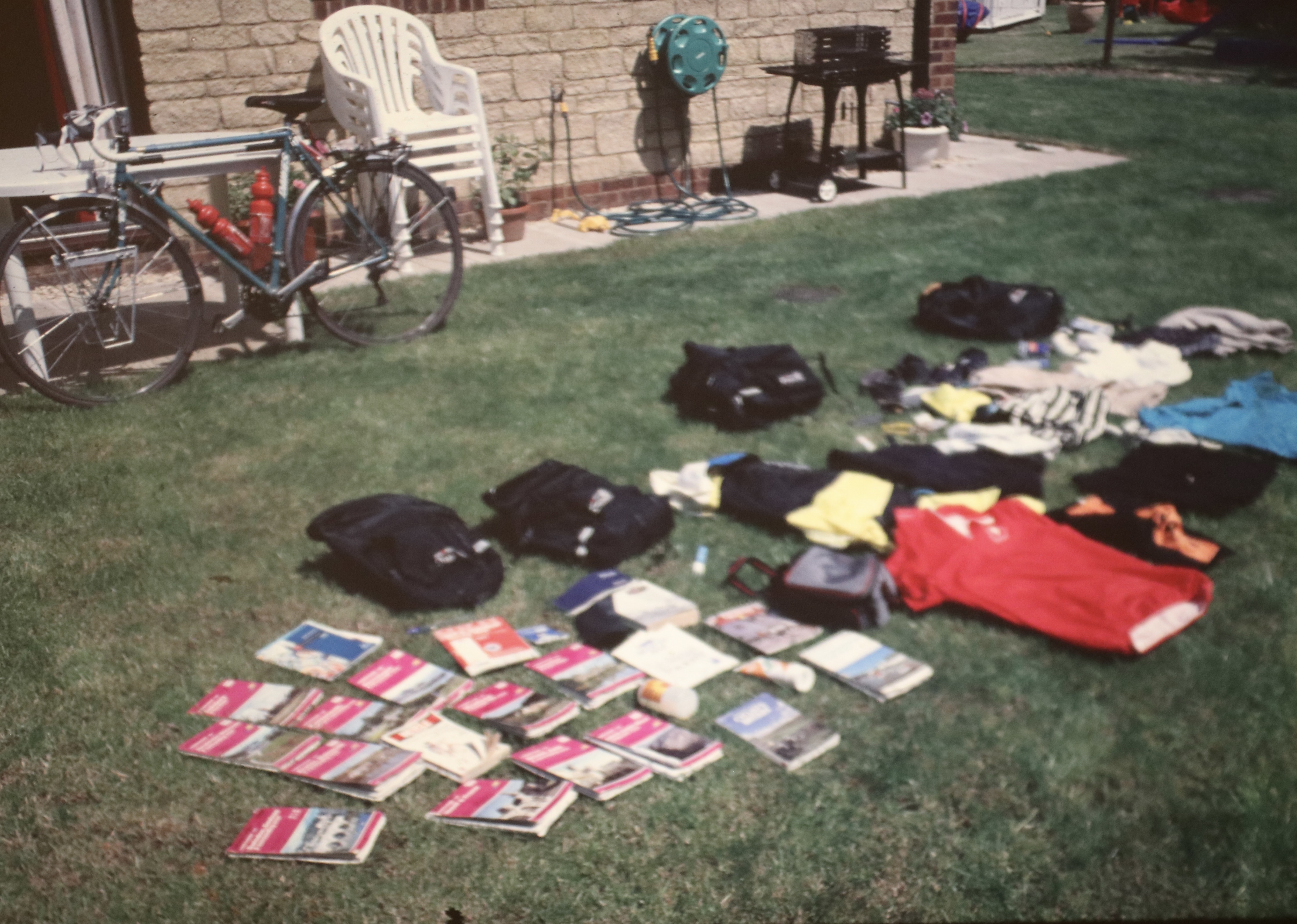
Looking at that photo of the contents of my panniers on the lawn, I’m amazed I managed to get up those West Country hills. I took all nine Ordnance Survey Landranger 1:50 000 maps for the route, and much more besides. No wonder that we struggled to go more than 40 miles a day!


Above: Richard on our West Country tour, locations unknown. That Hong Kong t-shirt anticipated the handover of Hong Kong to China two years later.
Our tour was a wonderful introduction to cycle touring. I found a sense of great satisfaction as we made our way around the West Country, and reaching the South Coast was a joyous moment. Such a journey is so much easier to plan today, as we can search online for somewhere to stay, check the best local pubs and plot the most scenic route – and check we are on the right road. Yet there was something special about those last pre-internet days, relying on a phone call to the tourist office to get them to book a room for the night. I presume we found phone boxes to make those calls as I don’t imagine I’d have taken, nor been allowed to use, my work mobile phone.
Another indication of another age is that neither of us wore cycle helmets. I did own one, which I bought when I was cycle commuting in London in 1991, but was happy to tour lidless. I always wear a helmet today, but don’t regret those carefree days with the wind in my hair.
The following year, we made a more ambitious cycle tour of Brittany. France proved a perfect venue for cyclists, although I hadn’t learnt to travel any lighter! I’m relishing the chance to cycle in France for the first time since 1998.
PS: I rode my Dawes Super Galaxy touring bike, while Richard rode his Peugeot Sandshark mountain bike.
 Ertblog