
Over 40 years ago, I bought a wonderful book called The Complete Plain Words by Sir Ernest Gowers. It has guided me throughout my 37 year career in communication. Today, it featured in my latest letter in The Times – my sixth this year.
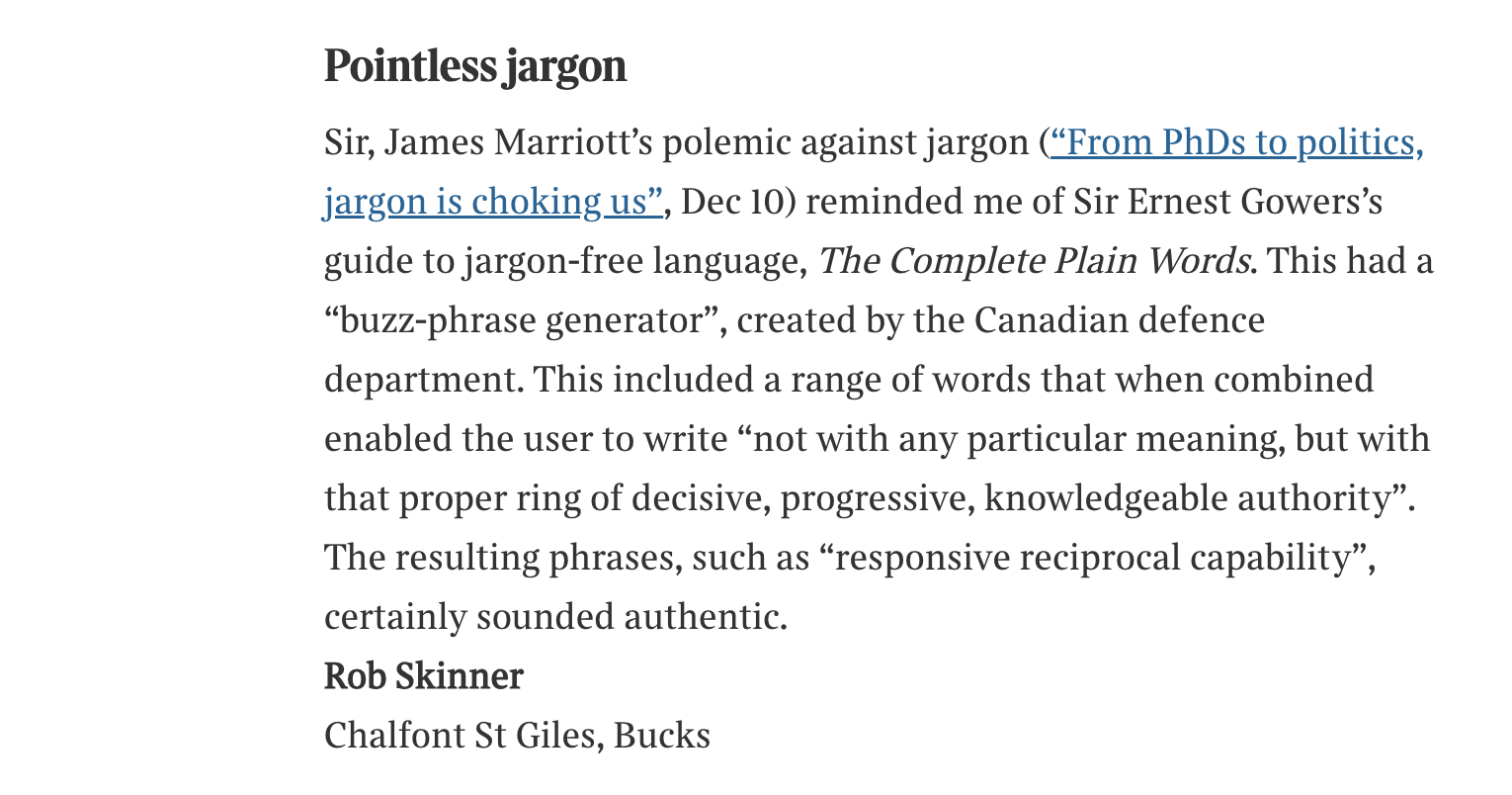
Ernest Gowers had an illustrious career in the civil service. He was Lloyd George’s principal private secretary as chancellor of the exchequer, and wrote the original Plain Words as a guide for civil servants in 1948. The edition I bought in 1984 was revised by another distinguished public servant, Sir Hugh Fraser. Both knights recognised that communication with the public should be clear and free from jargon that may baffle and annoy them. As the book says, the idea is to get an idea as exactly as possible out of one person’s mind into another’s.
James Marriott, whose article about jargon inspired my letter, was railing especially against the way jargon creates an exclusive club. Those who do not understand it are excluded. It also places a more subtle barrier, as recipients struggle to decode the meaning. As a result, jargon users are likely to spend more time dealing with an enquiry than if they’d explained themselves clearly in the first place.
I have spent almost 40 years in the financial services industry, and the past 16 years in the world of fintech – a buzz word that simply means companies that apply technology to provide financial services in a different way. (Think app-based banks rather than high street lenders.) Fintech also means combining the jargon from two industries (technology and finance) that thrive on gobbledegook.
I wrote in more detail about the fight against jargon and cliche in this 2012 blogpost.
 Ertblog