
I was sad to hear that Herman Ouseley had died. The news took me back to a year working alongside Herman in Brixton in 1992.
Herman was chief executive of Lambeth borough council at the time. The Conservative government’s environment secretary, Michael Heseltine, had the wheeze of inviting deprived areas to compete for funding for projects to transform their areas. Lambeth Council still had a terrible reputation as one of the so-called ‘loony left’ councils in the 1980s, and Heseltine told Lambeth it had no chance of winning.

That’s where I come in. I was working for Eagle Star insurance at the time, which was owned by British American Tobacco. BAT had an extensive community impact programme focused on Brixton, and in early 1992 its chairman, Sir Patrick Sheehy, agreed to second a manager to Lambeth to help it put a bid together for funding to transform Brixton. I’ve always relished a challenge – and agreed to take on ‘mission impossible’.
Three days a week, I swapped the dull corporate landscape of my City of London workplace for vibrant yet cruelly deprived Brixton. I was based in the old Bon Marche department store, which had been converted into the Brixton small business centre. It was a maze of corridors and hidden rooms, and shook when trains passed just feet away on the railway line into central London. It was just a decade after the infamous Brixton riots of 1981, and a local bar offered a cocktail called Brixton Riot in a Glass…The deprivation that helped cause the riots had certainly not gone away.
I got to know and admire Herman Ouseley during that year-long secondment. I was impressed by his immense dignity and calmness, which must have helped him cope with the stress of running such a deprived borough. I was delighted when he went on to chair the Commission for Racial Equality. He was the perfect candidate given his own background as someone who came to Britain from Guyana aged 11, and endured the endemic racism that blighted Britain for so long. He went on to found Kick it Out, a campaign to end discrimination and racism in football.
We took a community first approach to our bid, holding a presentation to government officials at a local secondary school, and arranging for young people from the school’s video unity to film the event. I wrote a briefing for ministers that referred to Brixton as an area that had produced a prime minister – John Major, who won a general election just weeks later, featuring his old Brixton home in a party political broadcast. We also held a presentation to business leaders at Lambeth Palace. This showed how much Lambeth was changing – in the days of council leader ‘Red Ted’ Knight just a few years before it would have been unthinkable for the council to partner with big business.
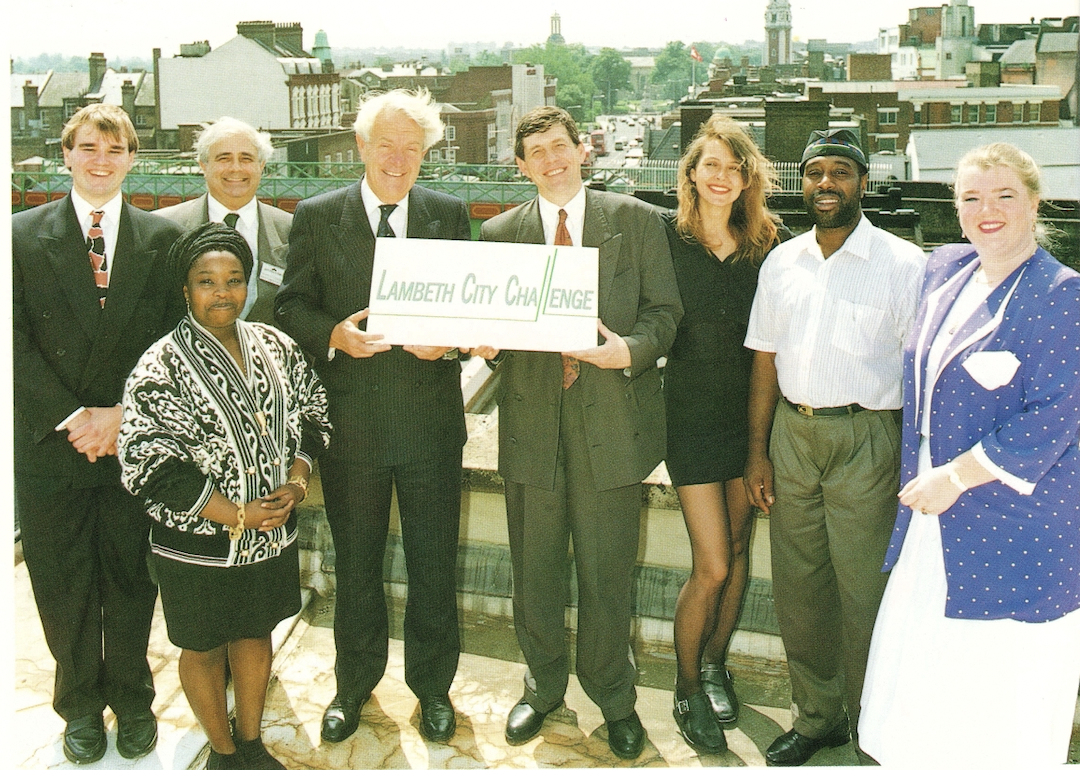
I’ll never forget the day Lambeth won. Nicholas Scott, a government minister, came to Brixton for a photocall, which we held on the roof of the small business centre. An ITV news film crew seemed less than keen to stand so close to a 200 foot drop to Brixton high street! It was a joyous day.

Three years later, I chatted to Michael Heseltine at a BAT event in London, and commented that I’d played a part in proving him wrong in dismissing Lambeth’s chances of winning. He was very gracious, but his mind may have been on other matters. All the talk at Westminster was about whether he would challenge John Major for the leadership of the Conservative party. He didn’t, but Major appointed him deputy prime minister days later after seeing off a challenge from John Redwood.
Reflections on Brixton Challenge
Even at the time I was troubled by the notion that deprived areas should compete for money. Why should the life prospects of someone living in poverty in Brixton, Toxteth, Moss Side or Handsworth depend on how good their council was at bidding? I agreed it made sense to get the private sector to invest in our inner cities, but BAT had already been doing that for some years. Indeed my boss during my secondment, BAT’s Brian Hutchinson, already worked tirelessly for Brixton.
A separate company, Brixton Challenge, was set up to oversee the implementation of the City Challenge projects. By all accounts it was not a smooth ride, and the project was criticised for not achieving what had been promised. But I look back with pride on one of the most satisfying years of my career, working with a truly diverse group of talented and enthusiastic people. Above all, I’m glad to have known Herman Ouseley.
 Ertblog